Journal of Physics: Conference Series
PAPER • OPEN ACCESS
Complex internal rearrangement processes
triggered by electron transfer to acetic acid
To cite this article: P Limão-Vieira et al 2015 J. Phys.: Conf. Ser. 635 012002
View the article online for updates and enhancements.
Related content
Preparation of hyperbranched polymer via single electron transfer living radical polymerization
X Zhang, X H Chen, J Li et al.
-The role of side chains in electron transfer induced fragmentation of amino-acids
F Ferreira da Silva, J Rafael, A Rebelo et al.
-Coupled-Channel Optical Calculations for
e+–RbCollision at Intermediate Energies
Zhang Yong-Zhi, Zhou Ya-Jun and Xu Tian-Fu
Complex internal rearrangement processes triggered by
electron transfer to acetic acid
P Limão-Vieira1,2*, G Meneses1, T Cunha1, A Gil3, M J Calhorda3, G García4,5, F Ferreira da Silva1
1
Laboratório de Colisões Atómicas e Moleculares, CEFITEC, Departamento de Física, Faculdade de Ciências e Tecnologia, Universidade Nova de Lisboa, 2829-516 Caparica, Portugal
2
Department of Physical Sciences, The Open University, Walton Hall, MK7 6AA, UK
3
Centro de Química e Bioquímica, Faculdade de Ciências, Universidade de Lisboa, 1749-016 Lisboa, Portugal
4
Instituto de Física Fundamental, Consejo Superior de Investigaciones Científicas, Serrano 113-bis, 28006 Madrid, Spain
5
Centre of Medical Radiation Physics, University of Wollongong, Wollongong, NSW 2522, Australia
E-mail: [email protected]
Abstract. We present negative ion formation from collisions of 100 eV neutral potassium
atoms with acetic acid (CH3COOH) and its deuterated analogue molecules (CH3COOD, CD3COOH). From the negative ion time-of-flight (TOF) mass spectra, OH
−
is the main fragment detected accounting on average for more than 25% of the total anion yield. The complex internal rearrangement processes triggered by electron transfer to acetic acid have been evaluated with the help of theoretical calculations at the DFT levels explaining the fragmentation channel yielding OH−.
1. Introduction
The biological effects of radiation induced reactions are known to be essentially produced by the secondary species generated along the radiation track. The vast majority of these species are secondary electrons (< 20 eV) [1, 2], which are found to be more efficient producing degradation than the primary radiation. These landmark studies [2] have shown the effectiveness of low-energy electrons (LEE) to produce single and double strand breaks in DNA, which were rationalised on the basis of single electron interactions with DNA subunits through formation of transient negative ions. Even at sub-excitation energies, LEEs are extremely efficient in damaging DNA owing to their ability to promote fragmentation through the decomposition of its building blocks [2]. It is now well-established that the degradation mechanism is described at the molecular level. As such, the relevance of negative ion chemistry of isolated biological molecules can provide valuable insights on the underlying molecular mechanisms, with the uttermost need to evaluate such processes within the physiological environment.
XXIX International Conference on Photonic, Electronic, and Atomic Collisions (ICPEAC2015) IOP Publishing Journal of Physics: Conference Series 635 (2015) 012002 doi:10.1088/1742-6596/635/1/012002
Negative ion chemistry can be explored not only in the context of free electron interactions, but from the point of view of atomic collisions, where in the latter, an electron is transferred from a donor projectile to the target molecule inducing different fragmentation pathways than those attained in free electron attachment experiments (e.g. ref. [3]). The presence of free electrons in the physiological environment is somewhat of an insufficient model on how electron-induced reactions may occur. As such, studies on electron transfer seem to be more attuned and can provide valuable insight of the underlying mechanisms that lead to molecular decomposition. Here we focus our interest in atom-molecule collisions, where a weakly bound valence electron is transferred from the projectile (neutral potassium atom) to the bio target molecule.
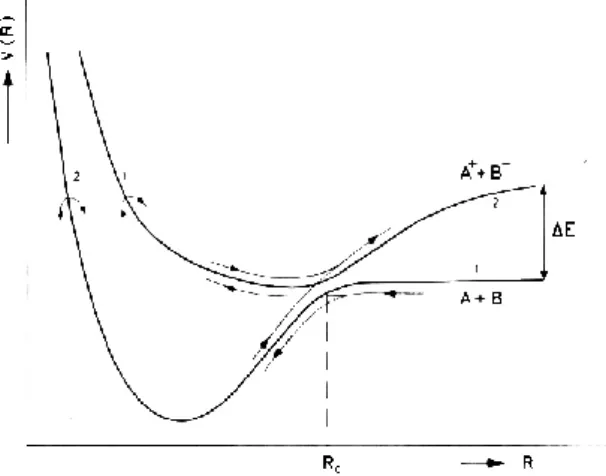
The electron transfer process happens when electrons follow adiabatically the nuclear motion in the vicinity of the crossing of the stationary non-perturbed states [4], i.e. the covalent and the ionic diabatic states (from the crossing of the covalent and the ionic diabatic potential surfaces, see Figure 1). For simplicity, let us consider a diatomic molecule, although for polyatomics hyperdimensional surfaces must be similarly considered. The ionic surface lies above the covalent surface, the endoergicity (ΔE in units of eV) at large atom-molecule distances being:
ΔE = IE(K) – EA(ABC) (1)
where K stands for the potassium atom and ABC a molecule. However, due to the Coulombic interaction there is a crossing point, Rc, for which both stationary non-adiabatic potential energy
surfaces have the same value [4]. Rc, is given by [5]:
Rc = 14.41 / ΔE [Å] (2)
During the collision process and near that crossing (Rc), there can be a perturbation of the stationary
states induced by the projectile or target nuclear motion leading to an adiabatic coupling. This leads, after the collision path, to the formation of a positive ion K+ and a molecular temporary negative ion (TNI) allowing access to parent molecular states which are not accessible in free electron attachment experiments [3, 5, 6–8].
Figure 1. Schematic potential energy curves of two adiabatic states V1-2(R) and V2-1(R) as a function
of the internuclear distance R(A-B), and trajectories with adiabatic and non-adiabatic transitions (diabatic states 1-1 (covalent) and 2-2 (ionic)); Rc stems for crossing radius and ΔE for the
endoergicity. Adapted from [9].
In effect, even if the free negative molecular ion is unstable towards autodetachment, in the collision complex it can be stabilized at distances shorter than the crossing between the two potential energy surfaces. This is due to the attractive interaction with the positive ion (K+) [8]. The negative molecular
XXIX International Conference on Photonic, Electronic, and Atomic Collisions (ICPEAC2015) IOP Publishing Journal of Physics: Conference Series 635 (2015) 012002 doi:10.1088/1742-6596/635/1/012002
ion lifetime will depend on the collision time and not only on the natural lifetime of the resonant anionic state. Indeed, when the parent negative ion has a lifetime longer than the fragmentation times, the excess energy may be distributed over the available internal degrees of freedom and so influence the type of fragmentation ions formed in the collision.
We note an extensive work on dissociative electron attachment studies [10] (and references therein), whereas those pertaining to electron transfer from atom-molecule collision experiments are somewhat scarce, with literature only available for pyrimidine-like bases [3, 11–15], their halogenated derivatives [7], sugar unit surrogates [16–18] and pyrimidine-sugar uridine molecules [19]. Relevant electron transfer studies have been also reported for short chain amino acids [20, 21].
The present work is part of a wider research programme on electron transfer in atomic collisions aimed at understanding low-energy electron damage to DNA/RNA-constituent molecules. Some previous studies on pyrimidine bases and their derivatives have shown significant differences in the fragmentation patterns against dissociative electron attachment (DEA) and electron transfer experiments [3, 8], which for the latter have been attributed to the role of the potassium cation (K+) post-collision delaying autodetachment.
Here we present a set of data on negative ion time-of-flight (TOF) mass spectra on our recent investigations regarding OH– formation from collisions of neutral potassium atoms with acetic acid molecules and its deuterated analogues. The dissociation mechanisms have been thoroughly investigated by performing comprehensive experiments on its deuterated analogues, CH3COOD and
CD3COOH together with quantum chemical calculations.
2.
Experimental setupThe experimental setup used to obtain the negative ion time-of-flight (TOF) mass spectra has been described elsewhere [3, 8]. Briefly, an effusive molecular beam crosses a primary beam of fast neutral potassium (K) atoms. K+ ions produced in a potassium ion source were accelerated to 100 eV, before passing through an oven where they resonantly charge exchange with neutral potassium to produce a beam of fast (hyperthermal) atoms. Residual ions from the primary beam are removed by electrostatic deflecting plates outside the oven. The intensity of the neutral potassium beam was monitored using a Langmuir-Taylor ionisation detector, before and after the TOF mass spectra collection. Ionic currents of the order of a few hundreds of pA were detected at 100 eV lab frame collision energy. The effusive beam of acetic acid molecules was then introduced into a 1 mm diameter source where it was crossed with the neutral hyperthermal potassium beam between two parallel plates at 1.2 cm mutual separation. The anions produced were extracted by a 220 Vcm−1 pulsed electrostatic field. The typical base pressure in the collision chamber was 1×10⁻⁵ Pa and the working pressure upon sample admission was 1×10⁻³ Pa. Mass spectra were obtained by subtracting the background signal from the sample measurements. TOF mass spectra calibration was carried out on the basis of the well-known anionic species formed after potassium collisions with the nitromethane molecule [8]. This allows for safe mass assignment, even when the width of the peaks is larger than 1 m/z.
The samples were purchased from Sigma-Aldrich with a minimum purity of ≥ 99%. They were used as delivered and degassed by a repeated freeze-pump-thaw cycles.
3.
Results and discussionAcetic acid and formic acid have been studied by DEA experiments [22–24] where the main focus was given on the dehydrogenated parent anion formation. Meanwhile, DEA theoretical calculations of Rescigno et al. [25] have shown that upon electron capture, formic acid proceeds through a π*C=O
resonance leading to OH excision. Such mechanism is only possible if the nuclear wave packet survives long enough to diabatically couple with σ*OH leading therefore to dissociation.
Notwithstanding, the calculations of Gallup et al. [26] on the DEA cross sections for formic acid, suggest that the mechanism of H loss involves electron capture into a σ*OH orbital only, where the
XXIX International Conference on Photonic, Electronic, and Atomic Collisions (ICPEAC2015) IOP Publishing Journal of Physics: Conference Series 635 (2015) 012002 doi:10.1088/1742-6596/635/1/012002
prevalent π*/σ* coupling of Rescigno et al. [25] is not the main dissociation mechanism. The recent experimental data of Allan et al. [24] on formic acid, lends support to Gallup et al.’s [26] mechanism. We note experimental evidence for the role of the π*CO orbital in electron transfer to gas phase
oriented acetic acid molecules, where intramolecular electron transfer allows accessing σ*OH orbital
leading to O–H bond cleavage [27]. The acetic acid and its deuterated analogues negative ion TOF mass spectra obtained for 100 eV potassium collision energies in the lab frame are presented in Figure 2(a)–2(c), with peak assignments in Table 1. A brief analysis of these data shows that the most abundant fragments are assigned to OH− (17 m/z), followed by CH3COO– (59 m/z) / CD3COO– (62
m/z) and O− (16 m/z). Other less intense fragment anions have been detected, where we also note that there is no evidence of parent anion formation. It is relevant that such anion formation was not reported in DEA experiments [22, 23].
Figure 2. Negative ions time-of-flight mass spectra in collisions of potassium atoms with acetic acid
and its deuterated analogues at 100 eV.
(m/z) CH3COOH CH3COOD CD3COOH Proposed anionic assignment
62 – – CD3COO–
59 CH3COO
–
CH3COO
– –
45 HCOO– HCOO– HCOO–
42 – – CDCO– 41 CHCO– CHCO– – 18 – OD– OD– / CD3– 17 OH– OH– OH– 16 O– O– O– 15 CH3 – CH3 – CDH– 1 H– H– H–
Table 1. Assignment of TOF mass spectra anionic species formed in collisions of potassium atoms
with acetic acid and its deuterated analogues at 100 eV.
XXIX International Conference on Photonic, Electronic, and Atomic Collisions (ICPEAC2015) IOP Publishing Journal of Physics: Conference Series 635 (2015) 012002 doi:10.1088/1742-6596/635/1/012002
The dissociation mechanism in potassium collisions yielding a neutral H atom and CH3COO– /
CD3COO– anions can be regarded as a pseudodiatomic behaviour. In this context, we recall Equation
(1) and for large potassium-molecule values, the van der Waals and induction forces can be neglected and consequently the covalent potential is zero and the ionic potential is purely Coulombic. If this approximation holds, Rc is given by Equation (2), where ΔE is expressed in eV. Taking CH3COOH
calculated adiabatic electron affinity as -1.302 eV [28], the value for Rc is found at ~ 2.6 Å. The
corresponding total cross sections for ion-pair formation will be of the order of πRc 2
, which is much larger than the corresponding gas kinetic cross sections. Here we are particular interested to explore the complex internal rearrangement process yielding OH– formation and so we restrict ourselves to the discussion on this fragment only. However, a thoroughly discussion on the other fragment anions formation as a function of the collision energy, which is far beyond the scope of this contribution, is due to appear soon [29].
OH– is the prevalent fragment anion in collisions of potassium atoms with acetic acid and its deuterated analogues molecules (Figure 2). A close inspection of Table 1 reveals that such anion formation in K – CH3COOD collisions does not result from a direct dissociation process but rather
through a complex mechanism, which may certainly involve internal rearrangement in the precursor TNI yielding OH– formation. In order to infer the underlying molecular mechanism yielding the hydroxyl anion formation, we have performed comprehensive DFT calculations. For further details on the theoretical methods and thoroughly discussion, see reference [30].
Neutral acetic acid shows two limiting conformations of the COOH terminal group (see a and b in Figure 3), where a is 0.2 eV more stable than b. However, upon electron capture, this order is reversed and an energy difference of 0.1 eV is found between the two anionic conformers, schematically shown in Figure 3.
Figure 3. Geometries of the two lowest energy conformers of acetic acid radical anion and the diol
(CH2COHOH•–) structure. For further details see ref. [30]
In the electron transfer process from the neutral K atom to the acetic acid molecules, the single occupied molecular orbital (SOMO) is mainly localized on the OH and the CH3 groups. Direct
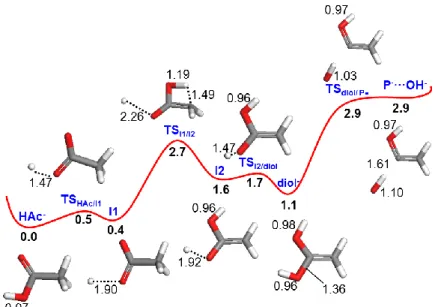
cleavage of the C-OH bond leads to OH (radical) formation. This mechanism was discarded since no OH radical experimental observed. Two different pathways might result in the hydroxyl anion formation, but calculations have shown that the lowest energy pathway involves H atom release from the COOH group, prior to subsequent intramolecular rearrangement to eliminate OH– (Figure 4). The production of a reactive H atom and the negative carboxylate anion in the first step occurs with an energy barrier of 0.5 eV. This is followed by an intramolecular H transfer from the CH3 group to CO,
resulting in an intermediate transition state (TSI1/I2) at 2.7 eV. Next, the diol structure is formed by
addition of the free hydrogen atom to the CO group (barrierless process, 0.1 eV) and finally OH– and
CH2COH are formed through fragmentation of a C-OH bond (1.36 Å). This result lends support to the
TOF mass spectra obtained in collisions of potassium atoms with acetic acid and its deuterated analogue molecules. The alternative mechanism proceeds by H transfer from CH3 to form a diol
structure followed by OH bond rupture, with a highest barrier of 2.9 eV [30]. A close comparison between the two pathways reveals that the global barriers differ by a small amount (0.2 eV), meaning
XXIX International Conference on Photonic, Electronic, and Atomic Collisions (ICPEAC2015) IOP Publishing Journal of Physics: Conference Series 635 (2015) 012002 doi:10.1088/1742-6596/635/1/012002
that there is a kinetically favoured route. In both cases, the energy barrier corresponds to an intramolecular rearrangement where H is transferred from the CH3 group to the CO group.
Figure 4. Lowest energy profile (eV) for OH– formation from CH3COOH
– (distances in Å). Adapted
from ref. [30]
Although calculations support the pathway in Figure 4 as the most favourable mechanism yielding OH– formation, experimental results (Figure 2) suggest a competition with the alternative one, in agreement with the small difference in the calculated barriers. OH– formation from CD3COOH seems
to be mostly supported by the pathway in Figure 4, with H atom abstraction from COOH and subsequent intramolecular rearrangement to eliminate the hydroxyl anion. However, OH– formation from CH3COOD is mostly described through the other pathway. In both cases, we note that the diol
structure is a transient species formed in these complex intramolecular rearrangement processes leading to fragmentation.
4.
ConclusionsThe present work provides a combined experimental and theoretical study on negative ion formation in collisions of potassium atoms with acetic acid and its deuterated analogue molecules. We note that, in the temporary negative ion (TNI), a diol transient structure is formed through a combined complex internal rearrangement mechanism, with an H atom being transferred either from the CH3 or from the
COOH groups. These will lead to a considerable internal energy conversion through the transition states, ending in OH– elimination.
5.
AcknowledgmentsFFS acknowledge the Portuguese National Funding Agency (FCT-MEC) for IF-FCT IF/00380/2014 and together with PLV the research grants PTDC/FIS-ATO/1832/2012 and UID/FIS/00068/2013. MJC and AG thank FCT-MEC for financial support (UID/MULTI/00612/2013), AG and TC for SFRH/BPD/89722/2012 and SFRH/BD/52538/2014 grants, respectively. We also acknowledge Radiation Biology and Biophysics Doctoral Trainning Programme (RaBBiT, PD-F, PD/00193/2012); UID/Multi/04378/2013 (UCIBIO). PLV acknowledges his visiting Professor position at The Open University, UK whereas GG his Professor position at the University of Wollongong, Australia. We
XXIX International Conference on Photonic, Electronic, and Atomic Collisions (ICPEAC2015) IOP Publishing Journal of Physics: Conference Series 635 (2015) 012002 doi:10.1088/1742-6596/635/1/012002
also acknowledge the Spanish Ministerio de Economía y Competitividad (Project No. FIS 2009-10245). Some of this work forms part of the EU/ESF COST Action CM1401, Our Astro-Chemical History.
XXIX International Conference on Photonic, Electronic, and Atomic Collisions (ICPEAC2015) IOP Publishing Journal of Physics: Conference Series 635 (2015) 012002 doi:10.1088/1742-6596/635/1/012002
6.
References[1] Pimblott SM and La Verne, JA 2007 Radiat. Phys. Chem. 76 1244
[2] Boudaïffa B, Cloutier P, Hunting D, Huels M A and Sanche L 2000 Science 287 1999
[3] Almeida D, Antunes R, Martins G, Eden S, Ferreira da Silva F, Nunes Y, García G and Limão-Vieira P 2011 Phys. Chem. Chem. Phys. 13 15657
[4] Kleyn A W, Los J and Gislason E A 1982 Phys. Rep. 90 1 [5] Kleyn AW and Moutinho A M C 2001 J. Phys. B 34 R1
[6] Limão-Vieira P, Moutinho A M C and Los J 2006 J. Chem. Phys. 124 054306
[7] Ferreira da Silva F, Almeida D, Antunes R, Martins G, Nunes Y, Eden S, García G and Limão-Vieira P 2011 Phys. Chem. Chem. Phys. 13 21621
[8] Antunes R, Almeida D, Martins G, Mason N J, Garcia G, Maneira M J P, Nunes Y and Limão-Vieira P 2010 Phys. Chem. Chem. Phys. 12 12513
[9] Lacmann K 1980 Advances in Chemical Physics (Potential Energy Surfaces) ed K P Lawley (John Wiley & Sons. Ltd.) Collisional Ionization pp 513-583
[10] Baccarelli I, Bald I, Gianturco F A, Illenberger E, Kopyra J 2011 Phys. Rep. 508 1
[11] Almeida D, Kinzel D, Ferreira da Silva F, Puschnigg B, Gschliesser D, Scheier P, Denifl S, García G, Gonzalez L and Limão-Vieira P 2013 Phys. Chem. Chem. Phys. 15 11431
[12] Ferreira da Silva F, Matias C, Almeida D, García G, Ingólfsson O, Flosadottir H D, Ptasínska S, Puschnigg B, Scheier P, Limão-Vieira P and Denifl S 2013 J. Am. Soc. Mass Spectrom. 24 1787 [13] Ferreira da Silva F, Almeida D, García G and Limão-Vieira P 2011 J. Phys. Conf. Series 388
012040
[14] Almeida D, Ferreira da Silva F, García G and Limão-Vieira P 2013 Phys. Rev. Lett. 110 023201
[15] Almeida D - - -Vieira P 2014
J. Phys. Chem. A 118 6547
[16] Almeida D, Ferreira da Silva F, García G and Limão-Vieira P 2014 J. Phys. Conf. Series 488 012043
[17] Almeida D, Ferreira da Silva F, Eden S, García G and Limão-Vieira P 2014 J. Phys. Chem. A
118 690
[18] Almeida D, Ferreira da Silva F, García G and Limão-Vieira P 2013 J. Chem. Phys. 139 114304 [19] Almeida D, Ferreira da Silva F, Kopyra J, García G, Limão-Vieira P 2014 Int. J. Mass
Spectrom. 365-366 243
[20] Ferreira da Silva F, Lança M, Almeida D, García G and Limão-Vieira P 2012 Eur. Phys. J. D
66 78
[21] Ferreira da Silva F, Rafael J, Cunha T, Almeida D, Limão-Vieira P 2012 Int. J. Mass Spectrom.
365-366 238
[22] Sailer W, Pelc A, Probst M, Limtrakul J, Scheier P, Illenberger E, Märk T D 2003 Chem. Phys.
Lett. 378 250
[23] Prabhudesai V S, Nandi D, Kelkar A H, Krishnakumar E 2008 J. Chem. Phys. 128 154309 [24] Janečková R, Kubala D, May O, Fedor J, Allan M 2013 Phys. Rev. Lett. 111 213201 [25] Rescigno T N, Trevisan C S, Orel A E 2006 Phys. Rev. Lett. 96 213201
[26] Gallup G, Burrow P, Fabrikant I 2009 Phys. Rev. A 79 042701 [27] Brooks P R 2009 J. Chem. Phys. 130 151102
[28] Valadbeigi Y, and Farrokhpour, H 2013 Int. J. Quantum Chem. 113 1717
[29] Meneses G, Widmann C, Cunha T, Ferreira da Silva F, Limão-Vieira P (in preparation)
[30] Meneses G, Widmann C, Cunha T, Gil A, Ferreira da Silva F, Calhorda M J, Limão-Vieira P 2015 (submitted)
XXIX International Conference on Photonic, Electronic, and Atomic Collisions (ICPEAC2015) IOP Publishing Journal of Physics: Conference Series 635 (2015) 012002 doi:10.1088/1742-6596/635/1/012002