SOWING LEGUME-RICH PASTURES MAKE
COMPATIBLE AN INCREASE IN PRODUCTION WITH
THE CONSERVATION OF PLANT DIVERSITY OF
MEDITERRANEAN DEHESAS
-Esteban A1 - 1, Moreno G1
(1) INDEHESA (Institute of Dehesa Research), University of Extremadura, 10600 Plasencia, Spain *Corresponding author: [email protected]
Abstract
Improvement in forage production and soil quality achieved by sowing legume-rich mixtures in managed grasslands is a reality; however, the compatibility of these kind of pastures with biodiversity conservation it is not so evident. The aim of this study is to evaluate the accuracy of sowing legume-rich pastures in the dehesa from an environmental point of view, by evaluating the changes on the plant community diversity in the medium-long term. Our results show that biodiversity can be sustained while increasing productivity and profitability of the farms through legume-rich pastures, thus they can be considered a suitable option in Iberian dehesas and in all probability, in other Mediterranean silvopastoral systems.
Keywords: legume-rich pastures; pasture biodiversity; species richness; scattered trees; silvopastoral systems.
Introduction
Dehesas, Mediterranean wooded pasturelands, cover around 3.5 million hectares of the south-western Iberian Peninsula, forming one of the largest agroforestry systems in Europe (Den Herder et al. 2017). Dehesas are included in the EU habitat directive as a habitat with community-wide interest and qualified as biodiversity hotspots (Myers et al. - Due to their shallow depth, and water and nutrients scarcity, fertility is low, thus, native pastures are poor in terms of productivity and quality. Attending to the well-known N limitation in the dehesa, it is essential to find a N self-sufficiency strategy, and sowing legume-rich pastures appear to be part of it. These multi-species pastures show high environmental plasticity. Each species can exploit different ecological niches, increasing the productivity, the production stability and also the pasture lifetime. However, it is still essential to improve our information about the persistence of legumes and the possible influence on biodiversity at pasture level.
Materials and methods Study area
The study area is characterized by two fundamental features: The Mediterranean character of the climate (dry summers and cold winters) and the low fertility of the soil, particularly P and Ca. The soils are mainly acid varying among Eutric and Distric Cambisols and Luvisols. The experimental design was conducted in 2016 and 2017 on seven dehesa farms in Extremadura (West of Spain) where a mixture of forage legume seeds (20 kg seed ha-1) had been sown in different years, following a chronosequence. In each farm, 3-5 different ages (years of sowing) were identified besides a control plot (parcel that has never been sown). The different plot ages were grouped for plotting and some analyses into Control plots, Young plots (0 to 5 years), Mature plots (6 to 10 years) and Old plots (11 to 15 years). In total, 33 plots were monitored,
with year of sowing ranging from 2002 to 2015. The plots were representative of the vegetation in the area in terms of botanical composition and phenology.
Regarding sowing, in November, a mixture of legumes was sown. The mixture of Rhizobium-inoculated seeds was composed of Trifolium subterraneum (61%) (different subspecies as brachycalycinum and yaninnicum) with other forage legumes: T. michelianum var balansae (7%), T. vesiculosum (3%), T. resupinatum (6%), T. incarnatum (8%), Ornithopus sativus (12%) and T. glanduliferum (3%). Superphosphate was applied as fertilizer in the sown parcels with different frequency among farms. Two microhabitats were clearly defined in each of the 33 plots: beneath oak canopy and outside tree canopy.
Sampling protocol
Botanical composition was determined with the Point Transect method (Southwood and Henderson 2000), noting the species present every 100 cm in eight random 25 m transects. Annual inventory included 264 transects (7 seven farms (
microhabitats) and a total 6864 individual plants. Statistical analysis
Statistical analyses were performed with R Software (R Foundation for Statistical Computing, Vienna 2017). Differences in age (quadratic adjustment) and habitat among values of yield, species richness and biodiversity indexes were compared by mixed effects models (LMMs) summary of the statistical considerations and results of the mixed effects models applied is shown in Table 1 and 2. Rarefaction curves were calcu
packages.
Results Plant diversity
As said before, plant diversity of dehesas is usually high, and our results in the control unsown plots confirm this statement (Shannon index value: 2.744 (beneath) and 2.528 (outside). Simpson index value: 0.889 (beneath) and 0.847 (outside)). The mean number of species recorded in each sampling plot was almost 4
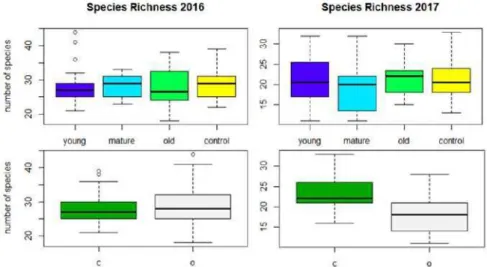
number of species recorded per habitat ( diversity) was over 150 species both beneath canopy and out of canopy, with species richness slightly higher in the latter. These differences in richness (Figure 1) are not significant with age; however, depending on the sampling year, habitat becomes significant (Table 1).
Figure 1: Species Richness in 2016 (left) and 2017 (right) in the studied plots grouped by age, and in the two microhabitats (under canopy (c) and out of tree canopy (o)).
In the initial years after sowing legume-rich pastures (young pastures in Figure 2), mean species richness per sample decreased slightly both beneath and outside the tree canopy. This level ( diversity) did not differ significantly for any of the age groups of the sown pastures with
Figure 2: Estimated species richness
by age. Solid lines and symbols represent recorded data while dashed lines represent the species richness estimated following the extrapolation (prediction) approaches proposed by Chao (2005) and Colwell et al. (2012) to make comparable values produced with different sampling efforts.
Table 1: Significance (p) effects of LMM to explain variations on in two consecutive -rich pastures (year from sowing) and their interaction (age x habitat). Farm was included as a random factor (age is nested in farm). The model included a quadratic term in age.
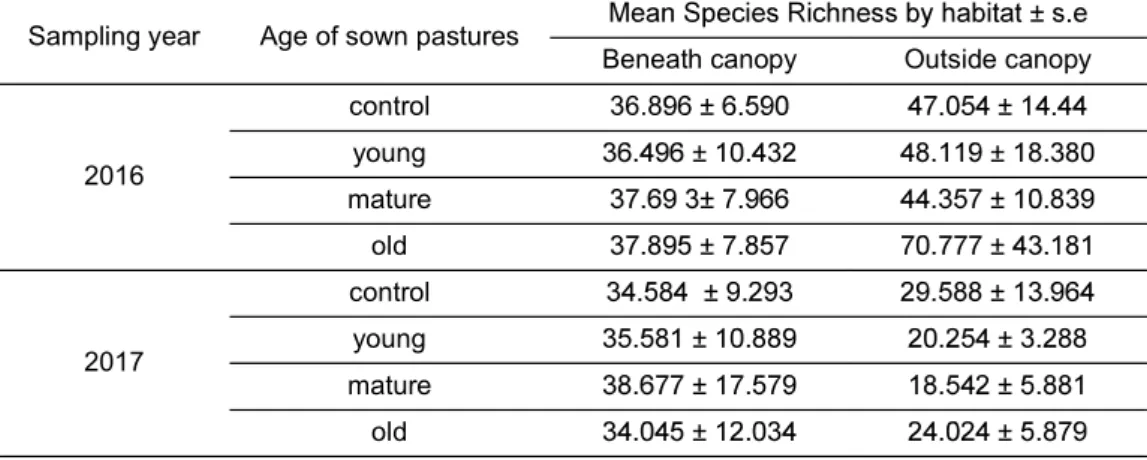
Table 2: Species richness in the considered habitats and groups of age considering the two sampling years of the study (2016 and 2017). It can be observed that Richness is higher beneath the tree canopy when weather is adverse (2017 sampling).
Sampling year Age of sown pastures
Beneath canopy Outside canopy
2016 control 36.8 young mature old 2017 control young mature old Pasture production
Yield increased significantly (p=0.018 beneath and p=0.0003 beyond tree canopy) after sowing legume-rich pastures. Mean production for control plots was 1586 kg ha-1 CI95% one year after the sowing was almost tripled 4762 kg ha-1 CI95%. Production decreased gradually in the following years, but maintaining noticeably higher levels than unsown plots.
Discussion
The desirable positive effect in productivity that motivates the sowing of legume-rich pastures was significant and stronger beyond than beneath tree canopies of legume-rich pastures was achieved, with an improvement in yield of more than 200 % over the control levels. This increase in production may be due to the interaction among N2-fixing and non-fixing-plants
Year of sampling
Biodiversity measurements
Significance (p) fixed effects
R2 Model
age habitat age*habitat
2016 Simpson 0.5472 0.9862 0.3978 0.3154 Shannon 0.7396 0.9499 0.5226 0.3508 Species Richness 0.5563 0.0388* 0.6313 0.1540 2017 Simpson 0.7375 0.0013** 0.4213 0.3444 Shannon 0.7734 4.99e-05 *** 0.2792 0.3881
al. (2015). In fact, native Trifolium such as T. striatum, T. stellatum and T. glomeratum were among the most abundant legumes on the study farms.
The response of pasture biodiversity over the years seem to be influenced by the weather, thus, with the habitat. In 2017, pastures experienced unusually high temperatures and scarce rainfall in early spring and species richness was higher beneath the canopy, whereas in 2016, with more favourable climate conditions, species richness was more abundant outside the canopy (See Table 2). We could say that beneath the tree canopy, especially in climatically adverse the increasing recurrence of heat/dry events in the spring/growing season into account, this could be a support to the implementation of sown pastures rich in legumes in silvopastoral systems as dehesa.
References
Chao A (2005) Species richness estimation. In: Balakrishnan N, Read CB, Vidakovic B (eds) Encyclopedia of statistical sciences. Wiley, New York, pp 7909 7916.
Colwell RK, Chao A, Gotelli NJ, Lin S-Y, Mao CX, Chazdon RL, Longino JT (2012) Models and estimators linking in-dividual-based and sample-based rarefaction, extrapola- tion, and comparison of assemblages. J Plant Ecol 5: 3 21.
den Herder M, Moreno G, Mosquera-Losada MR, Palma JHN, Sidiropoulou A, Santiago Freijanes JJ, Crous-Duran J, Burgess PJ (2017) Current extent and trends of agroforestry in the EU27. Agriculture Ecosyst Environ 241: 121 132.
Driscoll DA, Catford JA, Barney JN, Huleme PE, Inderjit, Martin TG, Pauchard A, Pysek P, Richardson DM, Riley S, Visser V (2014) New pasture plants intensify invasive species risk. Proc Natl Acad Sci 111:16622 16627. Fornara DA, Tilman D (2009) Ecological mechanisms associated with the positive diversity-productivity relationship in
an N-limited grassland. Ecology 90:408 418.
- , Alessandra F, Emilio B, Luigi B (2011) Hotspots of species richness, threat, and endemism for terrestrial vertebrates in SW Europe. Acta Oecol 37: 399 412
Myers N, Mittermeier RA, Mittermeier CG, da Fonseca GAB, Kent J (2000) Biodiversity hotspots for conservation priorities. Nature 403: 853 858.
Nyfeler D, Huguenin- (2009) Strong mixture effects among four species in fertilized agricultural grassland led to persistent and consistent transgressive overyielding. J Appl Ecol 46: 683 691.
Proc Natl Acad Sci U S A 112:E1695-. doi: 10.1073/pnas.1424707112.
Southwood TRE, Henderson PA (2000) Ecological Methods, Third Edition.
Temperton VM, Mwangi PN, Scherer-Lorenzen M, Schmid B, Buchmann N (2007) Positive interactions between nitrogen-fixing legumes and four different neighbouring species in a biodiversity experiment. Oecologia 151: 190 205.