The global spread of antibiotic resistance genes (ARGs) and their acquisition by clini-cally relevant microorganisms is associated with the increased hospitalization and mor-tality rates of patients that are infected with such microorganisms, which constitutes a serious problem for the health and welfare of both humans and animals1. The effect of
clinically relevant ARGs and antibiotic resistant bacteria (ARB) that are released from anthropogenic sources, together with the excessive use of antibiotics in both human and veterinary settings, is currently considered to be a serious environmental problem1–5. However, current risk
assess-ment models are inadequate to evaluate the effect of antibiotics and ARGs on resistance emergence and selection, especially in non-clinical environments.
In contrast to many chemical contami-nants — the concentration of which typically diminishes owing to degradation, dilution or sorption — bacterial contaminants (and their ARGs, which are present both within bacterial genomes and in free DNA) are capable of persisting and even spreading in the environment. The ARGs carried by these
bacterial contaminants can multiply in their hosts, be passed on to other bacterial popu-lations and be subject to further evolution. As such, ARB that occur in the environment represent potentially serious risks for human health.
The increased dissemination of ARB in the environment is probably caused by three principle mechanisms, which can occur in combination: horizontal gene transfer of ARGs; genetic mutation and recombination (which can be favoured by the existence of hypermutator bacterial strains); and the proliferation of ARB owing to selective pressures that are imposed by antimicrobial compounds or other contaminants, such as biocides or heavy metals6–10. As bacterial
communities are shaped by a complex array of evolutionary, ecological and envi-ronmental factors, it is difficult to predict the fate of ARGs and ARB that are released into the environment, or to obtain a clear understanding of the evolution and ecology of antibiotic resistance in this setting. For example, although the excessive use of anti-biotics may select for resistant populations in the environment, other biotic and abiotic
factors (such as physicochemical conditions, environmental contaminants, induction of stress responses, bacterial adaptation and phenotypic heterogeneity) have the potential to enhance the effect of selective pressures and promote bacterial evolution towards antibiotic resistance. Conversely, there is still a poor understanding of the environmental factors that may alleviate the spread of antibiotic resistance.
Antibiotic resistance hotspots are found not only in medical settings but also in envi-ronmental compartments that are subjected to anthropogenic pressure, such as munici-pal wastewater systems, pharmaceutical manufacturing effluents, aquaculture facili-ties and animal husbandry facilifacili-ties. These sites are characterized by extremely high bacterial loads coupled with subtherapeutic concentrations of antibiotics, and they con-tribute to the discharge of ARB and ARGs into the environment. At present, it is not clear to what extent environmental ARB and ARGs promote the acquisition and spread of antibiotic resistance among clinically relevant bacteria, or whether ARGs that are acquired by both clinically relevant bacteria and strictly environmental bacteria origi-nate from the same reservoirs11–13. However,
for these issues to be properly addressed, global efforts are required to characterize and quantify antibiotic resistance in the environment. In particular, it is necessary to create an adequate support for advanced biological risk assessment evaluations, which are needed to determine how contaminated environments affect the proliferation of antibiotic resistance. In parallel, the imple-mentation of technological solutions that can reduce the contamination of natural eco-systems by clinically relevant and potentially evolving ARB and ARGs is also a priority.
These topics were the focus of the European COST (Cooperation in Science and Technology) Action DARE (Detecting Evolutionary Hotspots of Antibiotic Resistance in Europe, TD 0803), which was launched in 2009 and completed in 2013. This interdisciplinary project involved 20 European countries and 123 scientists with a wide range of backgrounds (for example, engineers, microbiologists, chemists, veterinarians and physicians, working at O P I N I O N
Tackling antibiotic resistance: the
environmental framework
Thomas U. Berendonk, Célia M. Manaia, Christophe Merlin,
Despo Fatta‑Kassinos, Eddie Cytryn, Fiona Walsh, Helmut Bürgmann,
Henning Sørum, Madelaine Norström, Marie‑Noëlle Pons, Norbert Kreuzinger, Pentti Huovinen, Stefania Stefani, Thomas Schwartz, Veljo Kisand,
Fernando Baquero and José Luis Martinez
Abstract | Antibiotic resistance is a threat to human and animal health worldwide,
and key measures are required to reduce the risks posed by antibiotic resistance
genes that occur in the environment. These measures include the identification
of critical points of control, the development of reliable surveillance and risk
assessment procedures, and the implementation of technological solutions that
can prevent environmental contamination with antibiotic resistant bacteria and
genes. In this Opinion article, we discuss the main knowledge gaps, the future
research needs and the policy and management options that should be prioritized
to tackle antibiotic resistance in the environment.
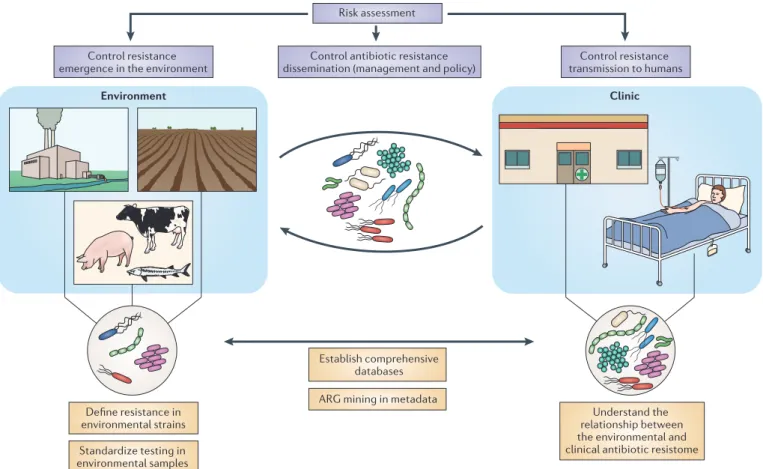
universities, research institutes, national health agencies and national veterinary agencies). In this Opinion article, we pre-sent our consensus on the main knowledge gaps, future research needs, policy options and management options that should be prioritized when tackling antibiotic resis-tance in the environment (FIG. 1). A holistic view of antibiotic resistance evolution is proposed, which considers the emergence and dynamics of ARB and ARGs in relevant environmental compartments and includes the identification of both conditions that can enhance its spread and relevant points of control.
Standardization of resistance testing
Over the past two decades, important advances have been made regarding the international implementation of standard-ized methods to monitor antibiotic resistance
in clinical isolates. These advances were essential in enabling the comparison of resistance prevalence in different geographi-cal regions to assess possible relationships between antibiotic resistance and antibiotic consumption, and to acquire a temporal perspective on resistance dynamics1. Despite
the ever-increasing evidence that the evolu-tion and spread of antibiotic resistance in the environment contributes to the occurrence of anti biotic resistance in clinical or urban settings2–9, standardized methods that are
directly applicable to environmental samples (which enable reliable comparisons with clinical data) have never been developed. Therefore, microbiologists and environmental scientists worldwide have adapted clinical criteria — usually based on pre-established breakpoints, which offer an objective classi-fication of an organism as either resistant or susceptible to a given antibiotic10 — to
define and examine antibiotic resistance in water, sludge, sediment, plant, manure and soil samples14–16. However, the conditions
and criteria for bacterial isolation, and the number of isolates that are necessary to obtain a representative set of species (or even the prevailing species), are completely different in environmental samples compared to those in clinical samples. Furthermore, most environ-mental bacteria are not recovered in culture-dependent surveys. Last, the definitions of resistance used for clinical isolates, which are mainly based on the likelihood of therapeutic failure of human or animal bacterial infections, may not apply to environmental bacteria15,16.
These shortcomings have motivated the development of methods that can give a more comprehensive overview of the prevalence of resistance in environmental samples.
One approach that has been used to evaluate the status of antibiotic resistance
Nature Reviews | Microbiology
Environment
Define resistance in environmental strains
Control resistance
emergence in the environment transmission to humansControl resistance
Understand the relationship between the environmental and clinical antibiotic resistome Standardize testing in
environmental samples
Risk assessment
Control antibiotic resistance dissemination (management and policy)
Establish comprehensive databases ARG mining in metadata
Clinic
Figure 1 | Minimizing the spread of antibiotic resistance in the environ-ment. The figure summarizes the current goals (purple boxes) in trying to
minimize the emergence and spread of antibiotic resistance genes (ARGs) and antibiotic resistant bacteria (ARB) in the environment and their transmission into the clinic. The current needs and limitations that must be resolved to achieve these goals are also shown (yellow boxes). To evaluate the spread of antibiotic resistance in the environment, and the risk of transmission to humans, it is necessary to define what constitutes resistance in environmental bacterial strains and to standardize testing in environmental samples. This
improvement in the definition and testing of resistance should contribute to the establishment of more comprehensive databases that combine data from both environmental and clinical settings. These databases would contribute to the evaluation of the relationship between the antibiotic resistomes in both settings and facilitate the mining of ARGs in metadata. These strategies would improve the assessment of the risk of dissemination of ARB and ARGs in the environment and their transmission to humans, and they would potentiate the development of control strategies (management and policy) aimed at preventing the dissemination of antibiotic resistance.
in the environment involves the calculation of resistance percentage, which is based on the ratio between the number of bacteria that are able to grow on culture media that are supplemented with antibiotics at doses close to the minimal inhibitory concentra-tion (MIC) and the number of bacteria that grow on antibiotic-free media16.
Culture-independent approaches, which are mainly based on information about ARGs that was previously acquired from the study of clinical isolates, have also been successfully developed17–21. In particular, quantitative
PCR (qPCR) can give an approximation of the prevalence of known ARGs in environ-mental samples, which can be a good estima-tion of the level of contaminaestima-tion by ARGs, although careful standardization of gene copy numbers is needed. However, as dif-ferent methodologies are regularly used, the results obtained by these approaches cannot be compared with those commonly used in surveillance reports on human medicine and veterinary medicine1,22. Therefore,
har-monized guidelines are needed regarding the number of isolates and diversity of species or strains to be tested; the cultivation conditions or the DNA extraction methods; and the tar-geted resistance phenotypes and genotypes or primer sets. Such guidelines would enable direct comparisons between different envi-ronmental compartments, thus establishing bridges with clinical data.
Standardization of resistance testing should further focus on bacterial indicators that are already in use and also on a subset of resistance determinants, preferably with both analysed concurrently. Primary bacte-rial indicators should be members of the class Gammaproteobacteria or the phylum Firmicutes, as these are the most frequent carriers of acquired ARGs (BOX 1). In partic-ular, we propose Escherichia coli and faecal enterococci — which are currently used to monitor microbiological water quality and are well characterized in terms of acquired antibiotic resistance — as indicator organ-isms16. In addition, Pseudomonas aeruginosa,
which is also used as an indicator of water quality, and Aeromonas spp., which are typi-cal water inhabitants, should be used for the examination of environmental samples in which faecal contamination is not expected.
Klebsiella spp., in particular Klebsiella pneumoniae, are also possible indicators
to consider, as members of this group are present in both the environment and the animal gut and have frequently been found to be pioneers in the emergence of antibiotic resistance23. Although other indicator
bacte-ria would be eligible, the bactebacte-ria mentioned
above have the advantage of being ubiqui-tous as well as being important carriers of antibiotic resistance and being responsible for the transfer of ARGs between different environmental compartments13,23–26.
For the selection of resistance determi-nants, criteria such as the clinical relevance, the prevalence in the environment, the association with mobile genetic elements (MGEs) and/or the potential to be acquired by any mode of horizontal gene transfer (such as conjugation, transformation or transduction) are important. Possible candi-date genes, frequently occurring in environ-mental settings that are subjected to human activities9,16,27,28, are shown in BOX 1.
These recommendations should not be regarded as attempts to narrow the focus of researchers; however, there is an urgent need for standardization of a number of core parameters to improve the comparability between studies worldwide. This is a pre-requisite for obtaining a global perspective of the environmental antibiotic resistome irrespective of the geographical region, the time frame or the environmental compartment being analysed.
The importance of global databases
The current state of knowledge is insufficient to assess the distribution and abundance of ARB and ARGs in the environment at
national, regional or global levels, which is a major limitation in determining the current risk of transmission of antibiotic resistance from the environment to human-associated bacteria. There are three main reasons for this limitation: the existing data are not comparable, as there are no guidelines for data collection; there is no formal system of data collation and curation for publication; and surveillance in environmental compart-ments or ecosystems (such as soil and water) has not been encouraged. Therefore, most of the available data come from sporadic research studies rather than long-term monitoring efforts.
Current limitations. Phenotypic resistance is often interpreted based on clinical stand-ards and recommended breakpoints, for example, from the European Committee on Antimicrobial Susceptibility Testing (EUCAST) or the Clinical and Laboratory Standards Institute (CLSI). However, the use of clinical breakpoints to assess the antibiotic susceptibility of environmental bacteria is inadequate, as clinical breakpoints are based on parameters that are only relevant for therapeutic success. A more reliable alterna-tive for the interpretation of the antibiotic resistance of environmental bacteria may be the epidemiological cut-off (ECOFF) value developed by EUCAST, which, in a given Box 1 | Bacterial groups and genetic determinants
The following bacterial groups and genetic determinants have been suggested as possible indicators to assess the antibiotic resistance status in environmental settings.
Bacterial groups • Escherichia coli • Klebsiella pneumoniae • Aeromonas spp. • Pseudomonas aeruginosa • Enterococcus faecalis • Enterococcus faecium
Genetic determinants (and the proteins they encode)
• intl1 (integrase gene of class 1 integrons, a genetic platform for ARG capture)
• sul1 and sul2 (sulfonamide-resistant dihydropteroate synthase)
• blaCTX‑M and blaTEM (β-lactamases, frequently identified in Enterobacteriaceae)
• blaNDM-1 (New Delhi metallo‑β-lactamase)
• blaVIM (carbapenemase, frequent in clinical Pseudomonas aeruginosa in certain areas)
• blaKPC (Klebsiella pneumoniae carbapenemase)
• qnrS (quinolone pentapeptide repeat family)
• aac‑(6ʹ)-Ib‑cr (aminoglycoside acetyltransferase)
• vanA (vancomycin resistance operon gene)
• mecA (penicillin binding protein)
• ermB and ermF (rRNA adenine N-6-methyltransferase, associated with macrolide resistance)
• tetM (ribosomal protection protein, associated with tetracycline resistance)
taxonomic group, separates the popula-tions with acquired resistance mechanisms (non-wild-type) from the wild-type popula-tions that have no resistance. In contrast to clinical breakpoints, the ECOFF values are epidemiologically based, do not relate to the therapeutic efficiency and do not differ among different committees (for example, EUCAST and CLSI)10. However, current
ECOFF estimations use databases in which, for a given species, the number of isolates with a clinical origin is several orders of magnitude higher than that of isolates with an environmental origin. In addition, most ECOFF studies comprise microorganisms of relevance to human health (pathogens and commensals), whereas information regard-ing non-pathogenic environmental species, which can be important carriers of ARGs, is scarce. Hence, it is questionable whether the current ECOFF values correctly reflect the distribution of resistant and wild-type bac-teria in the environment. To improve the reliability of these data, and therefore their usefulness in the classification of bacteria of different origins, it is essential to supplement ECOFF databases with additional data from environmental species and isolates.
There are several public databases and global surveillance projects, such as the Antimicrobial Resistance Global Report on Surveillance from the World Health Organization (WHO)1; the European
Centre for Disease Prevention and Control (ECDC)-based European Antimicrobial Resistance Interactive Database (EARS-Net), EUCAST, and the European Antimicrobial Susceptibility Surveillance in Animals (EASSA)29 in Europe; the Surveillance
Network Database (TSN) in the USA and Australia; and the Study for Monitoring Antimicrobial Resistance Trends (SMART) task force30 in the Asia–Pacific region. In
addition, there are two centralized databases on ARGs: the Comprehensive Antibiotic Resistance Database (CARD)31 and the
Antibiotic Resistance Genes Database (ARDB)32. However, the number of ARGs
described in human and animal opportu
-nistic pathogens in these databases is much higher than the number of ARGs described in environmental bacteria. Additionally, public databases that incorporate data from environmental bacteria or metagenomes contain genes that have been putatively annotated as ARGs based on the similarity of their nucleotide or amino acid sequences to those of previously described ARGs. However, a functional demonstration of the role of many sequences described as ‘resistance genes’ in specialized databases
is lacking, which creates a background of potentially misleading information for researchers and clinicians. The lack of a proper definition of antibiotic resistance for environmental strains of bacteria, the numerous databases with scant information on antibiotic resistance in the environment and the lack of functional demonstrations for ARGs in environmental metagenomes are considerable limitations for the charac-terization of the environmental resistome and the assessment of its clinical relevance8.
Perspectives. The consolidation of specialized databases will certainly contribute to a stan-dardized definition of ARGs and elucidate which genes contribute to the future acquisi-tion of resistance by human pathogens. In parallel, the continuous improvement of techniques for the cultivation of bacteria using multiple culture media and conditions (known as culturomics) is of vital impor-tance for the identification of ARGs and for understanding the cellular mechanisms linking ARGs and resistance phenotypes in different bacteria33. One of the greatest
chal-lenges in creating a consolidated database lies in establishing a standardized methodology and transforming it into a routine activity of environmental-quality monitoring. However, this is necessary if we are to acquire a coherent picture of environmental resistance.
Conceptually, two types of data may be integrated in public databases: data from routine monitoring (that is, from surveil-lance databases), which will give insights into the distribution, prevalence, temporal trends and geographical trends; and data gathered by research studies (that is, from emergence and evolution databases), which are seeking to understand the acquisition and molecular evolution processes. As one of the most important issues concerning envi-ronmental antibiotic resistance is its possible implications in the health of humans and animals, databases focusing on environmen-tal bacteria should also be linked to existing databases on ARB and ARGs in clinical, veterinary and food-associated products. The core entries of these integrative data-bases should comprise the ARB and ARGs described in BOX 1 and adopt the format of existing databases (for example, EARS-Net and REFS 31,32).
The information provided by surveillance databases would be substantially improved by the inclusion of other, systematically cho-sen, meta-parameters. Examples include the occurrence of heavy metals, antibiotic resi-due concentrations and, whenever possible, the composition of the microbial community,
which would be relevant for medium- to long-term evaluations of resistance evolu-tion34–36. This information could be linked to
routine monitoring assays of environmental samples, particularly wastewater and sur-face water samples37,38. Whenever possible,
links to existing databases on MGEs (for example, A Classification of Mobile Genetic Elements (ACLAME), Insertion Sequence finder (ISfinder) or INTEGRALL) and eco-toxicological information on mole cules with antibacterial effects (for example, from the European Chemicals Agency (ECHA)) should be implemented to provide a compre-hensive overview of the risk factors associ-ated with specific antibiotic resistance (for example, selection, mutation and horizontal gene transfer).
In addition to the creation of integrative databases, additional data on ARGs in the environment are also necessary. Research on uncharacterized ARGs and associated MGEs, which are not included in the routine moni-toring of environmental samples, is essential to have a thorough understanding of the environmental resistome. Whole-genome and transcriptome analyses — including those that apply next-generation sequencing (NGS) technology — and functional metagenomic studies present new possibilities for decipher-ing resistance in environmental compart-ments. Studies on the expression and function of resistance genes will be fundamental in understanding the interplay between the environmental conditions and the genomic context, and in understanding how this rela-tionship will influence the selection of specific ARGs39,40. These insights will offer the
pos-sibility of assessing the effect of external con-ditions, such as the presence of subinhibitory concentrations of antibiotics, on the presence, expression and functionality of new and clin-ically-associated ARGs in the environment. Last, these strategies may unveil unforeseen hotspots of antibiotic resistance. Continuous improvements on annotation procedures, such as those recently reported31,41–45, will not
only contribute to the annotation of ARGs in metadata, but will also provide valuable infor-mation about the enzymes that are respon-sible for each resistance mechanism, mainly concerning new genes. The association of these data to both generic (for example, the European Molecular Biology Laboratory (EMBL) or GenBank) and metagenomic databases (for example, Metagenomic Rapid Annotations using Subsystems Technology (MG-RAST)) would further provide access to related sequence data and metadata from gene fragments to metagenomes, transcriptomes and proteomes.
However, the most important associa-tions to achieve would be those between data from environmental and clinical settings, as well as the systematic combination of information obtained through research and routine monitoring practices. This bridging of information will be a step forwards in elucidating the role of environmental ARGs in the emergence and evolution of clinically-relevant antibiotic resistance.
Risk assessment
Integrated risk assessment of the evolution and emergence of antibiotic resistance in the environment addresses two main issues: first, the potential of subinhibitory con-centrations of antibiotics to promote the development of ARB in complex bacterial communities; and second, the capacity of resistance determinants to transfer from anthropogenic sources (such as treated wastewater, manure or others) to human commensal or pathogenic bacteria. Potential of subinhibitory antibiotic concentrations. The Guideline on the
envi-ronmental risk assessment of medicinal products for human use, produced by the
European Medicines Agency46, does not
recognize that the emergence and prolifera-tion of antibiotic resistance may be the most important risk associated with environmental contamination by antibiotics. Indeed, the endpoints for no-effect concentrations (NOECs; which correspond to the highest concentration at which a substance has no significant effect on the organisms exposed to it) are different from traditional environ-mental risk assessment, as the effects of antibiotics in promoting antibiotic resist-ance can go far beyond the toxicological implications. For example, even at levels that are considered safe according to the currently accepted Environmental Quality Standards47, antibiotics can still select for
ARB48–50. Furthermore, these subinhibitory
concentrations of antibiotics and antibiotic combinations may even induce the propa-gation of unforeseen multidrug-resistant opportunistic pathogens51–54. Moreover, the
effects of antibiotics may be potentiated or extended by cofactors (general stress situ-ations and micro-contaminants, such as heavy metals and biocides), which possibly enhance the spread and evolution of anti-biotic resistance34,54–59. Therefore, combined
molecular- and culture-based methods are necessary to determine the concentrations at which resistance acquisition and selec-tion is likely to occur in environmental compartments.
An addendum emphasizing the need to assess the risks posed by antimicro-bial agents of inducing ARB selection or ARG emergence should be included in the
Guideline on the environmental risk assess-ment of medicinal products for human use.
Although challenging, given the scarcity of knowledge regarding the mechanisms involved at the genetic, cellular and popu-lation levels, this addendum is urgently needed. Within this addendum the gold standard of a reliable risk assessment should determine the range of concentrations at which, under defined conditions, an anti biotic can promote selection and the acquisition of resistance.
Transmission of resistance determinants from anthropogenic sources. Another important aspect of antibiotic-resistance risk assessment refers to the spread and transmission of resistance determinants from hotspots to downstream environ-ments. Mathematical models capable of predicting the influence of potential selec-tive pressures, or the occurrence and the evolutionary success of genetic recombina-tion events, have proven to be promising tools in predicting the spread of antibiotic-resistance determinants54,60,61. As they are
specifically developed for environmental niches and environment–human interfaces, these mathematical models should rely on parameters such as population size; bacte-rial population growth rate and survival; occurrence and frequency of horizontal gene transfer and its implications on the population fitness; and the influence of other biotic and abiotic factors54,60–62. Such
models would allow predictions to be made regarding the dynamics of ARB hosting ARGs and the possible localization of ARGs on MGEs, thus supporting the assessment of their fate from anthropogenic sources to downstream environments. A quantitative risk-assessment framework should be devel-oped by coupling data and analyses, such as those outlined above, with a stochastic assessment of exposure to clinically relevant bacteria in the environment. Such a model should then be used to predict the environ-mental conditions that are associated with the evolution of antibiotic resistance and infer the probability of antibiotic resistance determinants spreading. However, owing to the scarcity of data on the occurrence of antibiotic resistance and horizontal gene transfer in the environment, it is currently difficult to develop validated models that can be applied in the framework of environmental risk-assessment guidelines.
Management and policy options
Management and policy options aimed at preventing and controlling antibiotic resist-ance in the environment comprise several different aspects, including the choice of ARB and ARGs to be listed as contaminants of emerging concern; the determination of differentiated maximum admissible levels of an antibiotic, ARB or ARG; and the identification of critical points of control at which prevention and remediation measures should be implemented.
ARB and ARGs as contaminants of emerging concern. The European Water Framework Directive establishes the requirements for determining the biological and chemical quality standards of water bodies in Europe63.
Annex I of this directive sets obligations for environmental quality standards (EQS) for priority substances and certain other pollu tants, and it even identifies priority hazardous substances. The inclusion of ARB and ARGs as priority contaminants would be justified based on the results of numerous scientific studies, which show that the occurrence of antibiotic resistance increases in bodies of water (such as inland surface waters, transitional waters, coastal waters and groundwater) when they are subjected to anthropogenic impacts, such as wastewater effluents, animal manure, agricultural runoff and wildlife living in urban areas21,34,64–67. We suggest the
inclu-sion of a supplement to the European Water Framework Directive for ARB hosting clinically relevant ARGs. In this context, it is important to establish differentiated guidance levels for the abundance of these biological contaminants in the environment. The application of these guidance levels may be especially important for the regulation of specific practices, such as reuse of wastewa-ter or soil fertilization with manure.
The inclusion of ARB and ARGs in the list of contaminants of emerging concern would require clear definitions on the nec-essary monitoring methods. Although the environmental survival of ARGs primarily depends on the host and the type of MGEs, the estimation of the levels of ARGs seems a reliable and feasible method to monitor antibiotic resistance. However, a crucial issue that needs additional investigation is the selection of target ARGs to be moni-tored as indicators of resistance and the determination of safe concentrations of these genes in water. Ideally, such indicator genes should be abundant in anthropogenic sources and rare in native aquatic and ter-restrial ecosystems to facilitate spatial and
temporal source tracking in the environ-ment. ARGs that are associated with MGEs or that present the highest environmental fitness (that is, long lasting survival and the capacity to proliferate) are good candi-dates — for example, sul1 (which encodes for sulfonamide-resistant dihydropteroate synthase); blaTEM, blaCTX-M, blaVIM and blaNDM-1
(which encode β-lactamases); tetM (which encodes for tetracycline resistance); and
vanA (which encodes for vancomycin
resist-ance) (BOX 1). However, determination of the maximum acceptable levels of these genes in the environment seems, at the current state of knowledge, a challenging objective. The establishment of a comprehensive database and the use of modelling approaches would be valuable contributions to estimate such limits. Despite these challenges, this know-ledge is an essential prerequisite, not only for establishing a strategy of direct action against antibiotic resistance in the environ-ment, but also for the application of drugs and interventions directed at preventing the emergence and evolution of ARB and ARGs (eco–evo drugs)68.
Critical control points. Environmental hotspots, where ARB are abundant or the transfer of ARGs is promoted, are critical points for resistance control. Good examples of such critical points are characterized by a high prevalence of resistance or by the occurrence of resistance determinants of emerging concern. These locations comprise habitats that are influenced by human activi-ties, such as wastewater (that is, hospital, urban and specific industrial wastewater) and waste, and wastewater from animal husbandry and intensive food-production facilities16,69,70. Moreover, sites subjected to
the frequent discharge of antibiotic residues have been shown to be potential hotspots for the selection, proliferation and spread of new resistance determinants to human com-mensal and pathogenic bacteria, and these sites should likewise be considered as critical control points71,72.
Although some of the antimicrobials administered to animals are used exclusively in veterinary applications, most belong to the same structural families that are used in human medicine. As they share the same basic chemical molecular structures and mechanisms of action, these antibiotics are assumed to put selective pressures on human commensal and pathogenic bacteria. Large quantities of antibiotics that are adminis-tered to animals in intensive production sites are discharged, often un-metabolized, with manure and slurry when applied as fertilizer
(often in a raw and unstabilized state) and thus contaminate soils as well as surface water and groundwater. At present, it is diffi-cult to ascertain whether antibiotics reaching the environment at low concentrations exert a substantial selective pressure on ARGs or ARB50,51. However, there is increasing
evi-dence showing that repeated exposure of the environment to anthropogenically gener-ated ARGs (for example, soil manure) cor-relate with the emergence and proliferation of ARGs in indigenous microbiota66,67,73,74.
However, the impact of animal production on the propagation of antibiotic resistance is demonstrated by some zoonotic species of the genera Salmonella, Campylobacter,
Listeria, Staphylococcus, Enterococcus and Escherichia, which are known to exhibit high
levels of acquired antibiotic resistance29,75–78.
Although some animal production facili-ties implement systems that decontaminate liquid and solid wastes, such treatments are not intended to remove ARB and might even promote resistance79,80. The same might be
true for biogas reactors, which use manure as a substrate, because the residues of these reactors are used as fertilizers on agricul-tural fields81. The confinement and
treat-ment of effluents and (processed) manure from intensive animal production is thus a priority.
Urban, hospital and pharmaceutical industry wastewater is among the main sources of antibiotic and ARB contamina-tion in soil and water ecosystems16,21,82. In the
environment, these contaminants can reach water resources for drinking water produc-tion, enter the food chain or reach clini-cally relevant niches9,16,17,76,82. These effects
can be potentially even more pronounced when irrigation with wastewater effluents (wastewater reuse schemes) is applied. Water reuse is already a common practice in many regions of the world owing to increased water scarcity, mainly in arid and semi-arid regions20. Most of the wastewater treatment
plants worldwide, in particular those using mechanical and biological treatments, are primarily designed to remove organic com-pounds, nutrients (for example, nitrogen and phosphorous) and suspended solids. However, the currently available wastewater treatment processes have limited capability to efficiently remove organic micropollutants, including antibiotics and other antimicro-bial agents82. Similarly, certain ARB and
ARGs can survive the wastewater treatment processes with a maintenance (or even an increase) of resistance prevalence compared to the pretreatment levels16,17,36,64. These
fea-tures require the immediate attention of the
scientific community and the development and implementation of technological solu-tions capable of mitigating ARB and ARGs in wastewater to safe levels. Although the defini-tion of a ‘safe level’ may be difficult to achieve, it is at least necessary to find an agreement on the threshold values below which the prob-ability of significant proliferation of an ARG is severely impaired.
Technologies for the removal of micro-pollutants, including antibiotics, and microorganisms from wastewater are becoming increasingly available (for exam-ple, membrane filtration, activated carbon, photo-driven technologies and ozonation)82.
However, additional research is needed to determine the effectiveness of these processes for the elimination of ARB and ARGs and to characterize the associated microbiological risks16,82. Recommendations
of effective and economically sustainable interventions at critical points within the wastewater stream are urgently needed.
Concluding remarks
Given the public health threat posed by antibiotic resistance, the development and implementation of national and interna-tional guidelines for the biological risk assessment of the emergence and propaga-tion of ARB in the environment is a strategic priority. The generation of reliable compari-sons and evaluation of temporal trends in antibiotic resistance in the environment are currently seriously limited owing to the dis-parity of surveillance strategies. To address this issue, the interdisciplinary scientific community involved in the DARE Action has proposed specific priority measures.
It is necessary to improve the com-parability between studies worldwide to provide the basis for a global perspective on the antibiotic resistome irrespective of geographical, temporal or environmental constraints. A formal system for the col-lation and curation of data for publication must be implemented, and surveillance of environmental samples must be encouraged, to comprehensively assess antibiotic resist-ance in environmental bacteria. Databases with multiple levels of information and metadata, supporting the understanding of antibiotic resistance dynamics on a global scale, must be established. An integrated risk-assessment platform must include the potential of subinhibitory concentrations of antibiotics to promote the development of ARB in complex environmental communi-ties, and mathematical models are required to devise reliable risk-assessment guidelines on the spread of antibiotic resistance from
the environment to human commensal or pathogenic bacteria. A selection of sentinel ARB and ARGs should be included in the list of contaminants of emerging concern and maximum admissible levels of these contaminants should be defined, as well as the critical points of control at which pre-vention and remediation measures can be implemented. Other pressing management options include the reduction of antibiotic usage; the confinement and treatment of problematic reservoirs, such as effluents and manure from intensive animal production or hospital effluents; and the improvement of current wastewater treatment technologies. Finally, it is important to acquire a more comprehensive understanding of the mole-cular, evolutionary and ecological mecha-nisms associated with the acquisition and spread of antibiotic resistance. In parallel, the implementation of effective management options, mainly seeking to impose barriers against the dissemination of resistance from well-established resistance reservoirs, is urgently needed to combat the evolution and spread of antibiotic resistance, while protect-ing human health and the environment.
Better control of the emergence and dissemination of ARB and ARGs does not replace the need to seek new therapeutic drugs. On the contrary, by minimising the evolution of ARB and ARGs, it also prepares the ground for new drugs to be effective for a longer period of time.
Thomas U. Berendonk is at the Institute for Hydrobiology, Technische Universität Dresden, Dresden 01062, Germany. Célia M. Manaia is at the Centro de Biotecnologia e Química Fina – Laboratório Associado, Escola Superior de Biotecnologia, Universidade Católica Portuguesa/Porto, Rua Arquiteto Lobão Vital, Apartado 2511, Porto 4202–401, Portugal. Christophe Merlin is at the Université de Lorraine and
le Centre National de la Recherche Scientifique, Laboratoire de Chimie Physique et Microbiologie pour l’Environnement, Unite Mixte de Recherche 7564, Vandoeuvre‑lès‑Nancy F‑54500, France. Despo Fatta‑Kassinos is at the Civil and Environmental
Engineering Department and Nireas, International Water Research Center, University of Cyprus, PO Box 20537, Nicosia 1678, Cyprus.
Eddie Cytryn is at the Institute of Soil, Water and Environmental Sciences, Volcani Center, Agricultural Research Organization, PO Box 6, Bet Dagan 50250, Israel. Fiona Walsh is at the Department of Biology, Biosciences and Electronic Engineering Building, National University of Ireland Maynooth, Maynooth, County Kildare, Ireland. Helmut Bürgmann is at the Eawag: Swiss Federal Institute of Aquatic Science and Technology, Department of Surface Waters – Research and Management, Kastanienbaum (LU) 6047, Switzerland.
Henning Sørum is at the Norwegian University of Life Sciences, Faculty of Veterinary Medicine and Life Sciences, Department of Food Safety and Infection Biology, PO Box 8146 Dep, Oslo N‑0033, Norway.
Madelaine Norström is at the Norwegian Veterinary Institute, Department of Epidemiology, Oslo N‑0106, Norway. Marie‑Noëlle Pons is at the Laboratoire Reactions et Génie des Procédés (UMR CNRS 7274), Université de Lorraine, Nancy 54000, France. Norbert Kreuzinger is at the Vienna University of Technology, Institute of Water Quality, Resources and Waste Management, Karlsplatz 13/226, Vienna 1040, Austria. Pentti Huovinen is at the Department of Medical Microbiology and Immunology, University of Turku, Kiinamyllynkatu 10, 20520 Turku, Finland Stefania Stefani is at the Laboratory of Molecular Microbiology and Antibiotic Resistance, Department of Biomedical Sciences, University of Catania, Via Androne 81, Catania 95124, Italy. Thomas Schwartz is at the Karlsruhe Institute of Technology Campus North, Institute of Functional Interfaces, Microbiology of Natural and Technical Interfaces Department, Hermann‑von‑Helmholtz‑Platz 1, Eggenstein‑Leopoldshafen 76344, Germany.
Veljo Kisand is at the Institute of Technology, Tartu University, Nooruse 1, Tartu 50411, Estonia. Fernando Baquero is at the Ramón y Cajal Institute for
Health Research, Ramón y Cajal University Hospital, Department of Microbiology, Madrid 28034, Spain. José Luis Martinez is at the Departamento de Biotecnologia Microbiana, Centro Nacional de Biotecnologia, Consejo Superior de Investigaciones, Darwin 3, Cantoblanco, Madrid 28049, Spain. T.U.B. and C.M.M. contributed equally to this work. Correspondence to C.M.M. e‑mail: [email protected]
doi:10.1038/nrmicro3439 Published online 30 March 2015 1. World Health Organization. Antimicrobial resistance:
global report on surveillance (WHO, 2014). 2. Cantón, R. Antibiotic resistance genes from the
environment: a perspective through newly identified antibiotic resistance mechanisms in the clinical setting. Clin. Microbiol. Infect. 15 (Suppl. 1), 20–25 (2009). 3. Allen, H. K. et al. Call of the wild: antibiotic resistance
genes in natural environments. Nature Rev. Microbiol.
8, 251–259 (2010).
4. Bush, K. et al. Tackling antibiotic resistance. Nature Rev. Microbiol. 9, 894–896 (2011).
5. D’Costa, V. M. et al. Antibiotic resistance is ancient. Nature 477, 457–461 (2011).
6. Baquero, F., Martinez, J. L. & Canton, R. Antibiotics and antibiotic resistance in water environments. Curr. Opin. Biotechnol. 19, 260–265 (2008).
7. Martinez, J. L. Environmental pollution by antibiotics and by antibiotic resistance determinants. Environ. Pollut. 157, 2893–2902 (2009).
8. Wright, G. D. Antibiotic resistance in the environment: a link to the clinic? Curr. Opin. Microbiol. 13, 589–594 (2010).
9. Vaz-Moreira, I., Nunes, O. C. & Manaia, C. M. Bacterial diversity and antibiotic resistance in water habitats: searching the links with the human microbiome. FEMS Microbiol. Rev. 38, 761–778 (2014).
10. Kahlmeter, G. Defining antibiotic resistance — towards international harmonization. Ups. J. Med. Sci. 119, 78–86 (2014).
11. De Gelder, L., Williams, J. J., Ponciano, J. M., Sota, M. & Top, E. M. Adaptive plasmid evolution results in host-range expansion of a broad-host-range plasmid. Genetics 178, 2179–2190 (2008).
12. Carattoli, A., Villa, L., Poirel, L., Bonnin, R. A. & Nordmann, P. Evolution of IncA/C blaCMY-2-carrying
plasmids by acquisition of the blaNDM-1 carbapenemase
gene. Antimicrob. Agents Chemother. 56, 783–786 (2012).
13. Walsh, T. R., Weeks, J., Livermore, D. M. & Toleman, M. A. Dissemination of NDM-1 positive bacteria in the New Delhi environment and its implications for human health: an environmental point prevalence study. Lancet Infect. Dis. 11, 355–362 (2011).
14. Dantas, G., Sommer, M. O., Oluwasegun, R. D. & Church, G. M. Bacteria subsisting on antibiotics. Science 320, 100–103 (2008).
15. Popowska, M. et al. Influence of soil use on prevalence of tetracycline, streptomycin, and erythromycin resistance and associated resistance genes. Antimicrob. Agents Chemother. 56, 1434–1443 (2012).
16. Rizzo, L. et al. Urban wastewater treatment plants as hotspots for antibiotic resistant bacteria and genes spread into the environment: a review. Sci. Total Environ. 447, 345–360 (2013).
17. Schwartz, T., Kohnen, W., Jansen, B. & Obst, U. Detection of antibiotic-resistant bacteria and their resistance genes in wastewater, surface water, and drinking water biofilms. FEMS Microbiol. Ecol. 43, 325–335 (2003).
18. Volkmann, H., Schwartz, T., Bischoff, P., Kirchen, S. & Obst, U. Detection of clinically relevant antibiotic-resistance genes in municipal wastewater using real-time PCR (TaqMan). J. Microbiol. Methods 56, 277–286 (2004).
19. Szczepanowski, R. et al. Detection of 140 clinically relevant antibiotic-resistance genes in the plasmid metagenome of wastewater treatment plant bacteria showing reduced susceptibility to selected antibiotics. Microbiology 155, 2306–2319 (2009).
20. Negreanu, Y., Pasternak, Z., Jurkevitch, E. & Cytryn, E. Impact of treated wastewater irrigation on antibiotic resistance in agricultural soils. Environ. Sci. Technol.
46, 4800–4808 (2012).
21. Czekalski, N., Gascon Diez, E. & Burgmann, H. Wastewater as a point source of antibiotic-resistance genes in the sediment of a freshwater lake. ISME J. 8, 1381–1390 (2014).
22. European Centre for Disease Prevention and Control. Antimicrobial resistance surveillance in Europe 2011 report (ECDC, 2012).
23. Tzouvelekis, L. S., Markogiannakis, A., Psichogiou, M., Tassios, P. T. & Daikos, G. L. Carbapenemases in Klebsiella pneumoniae and other Enterobacteriaceae: an evolving crisis of global dimensions. Clin. Microbiol. Rev. 25, 682–707 (2012).
24. Livermore, D. M. & Woodford, N. The β-lactamase threat in Enterobacteriaceae, Pseudomonas and Acinetobacter. Trends Microbiol. 14, 413–420 (2006).
25. Jacobs, L. & Chenia, H. Y. Characterization of integrons and tetracycline resistance determinants in Aeromonas spp. isolated from South African aquaculture systems. Int. J. Food Microbiol. 114, 295–306 (2007).
26. Cytryn, E. The soil resistome: the anthropogenic, the native, and the unknown. Soil Biol. Biochem. 63, 18–23 (2013).
27. Allen, H. K. Antibiotic resistance gene discovery in food-producing animals. Curr. Opin. Microbiol. 19, 25–29 (2014).
28. Wang, F. H. et al. High throughput profiling of antibiotic resistance genes in urban park soils with reclaimed water irrigation. Environ. Sci. Technol. 48, 9079–9085 (2014).
29. de Jong, A. et al. Pan-European resistance monitoring programmes encompassing food-borne bacteria and target pathogens of food-producing and companion animals. Int. J. Antimicrob. Agents 41, 403–409 (2013).
30. Morrissey, I. et al. A review of ten years of the study for monitoring antimicrobial resistance trends (SMART) from 2002 to 2011. Pharmaceuticals (Basel)
6, 1335–1346 (2013).
31. McArthur, A. G. et al. The comprehensive antibiotic resistance database. Antimicrob. Agents Chemother.
57, 3348–3357 (2013).
32. Liu, B. & Pop, M. ARDB — antibiotic resistance genes database. Nucleic Acids Res. 37, D443–D447 (2009).
33. Lagier, J. C. et al. Microbial culturomics: paradigm shift in the human gut microbiome study. Clin. Microbiol. Infect. 18, 1185–1193 (2012).
34. Graham, D. W. et al. Antibiotic resistance gene abundances associated with waste discharges to the Almendares River near Havana, Cuba. Environ. Sci. Technol. 45, 418–424 (2011).
35. Huerta, B. et al. Exploring the links between antibiotic occurrence, antibiotic resistance, and bacterial communities in water supply reservoirs. Sci. Total Environ. 456–457, 161–170 (2013). 36. Novo, A., Andre, S., Viana, P., Nunes, O. C. &
Manaia, C. M. Antibiotic resistance, antimicrobial residues and bacterial community composition in urban wastewater. Water Res. 47, 1875–1887 (2013). 37. American Public Health Association. Standard
Methods for the Examination of Water and Wastewater 21st edn (APHA, 2005). 38. Council of the European Union. Council Directive
98/83/EC. of 3 November 1998 on the quality of water intended for human consumption as amended by regulation 1882/2003/EC. FAOLEX [online], http://faolex.fao.org/docs/pdf/eur18700.pdf (1998). 39. Fajardo, A. & Martinez, J. L. Antibiotics as signals that
trigger specific bacterial responses. Curr. Opin. Microbiol. 11, 161–167 (2008).
40. Baquero, F., Tedim, A. P. & Coque, T. M. Antibiotic resistance shaping multi-level population biology of bacteria. Front. Microbiol. 4, 15 (2013).
41. Gibson, M. K., Forsberg, K. J. & Dantas, G. Improved annotation of antibiotic resistance determinants reveals microbial resistomes cluster by ecology. ISME J. 9, 207–216 (2014).
42. Forsberg, K. J. et al. Bacterial phylogeny structures soil resistomes across habitats. Nature 509, 612–616 (2014).
43. Port, J. A., Cullen, A. C., Wallace, J. C., Smith, M. N. & Faustman, E. M. Metagenomic frameworks for monitoring antibiotic resistance in aquatic environments. Environ. Health Perspect. 122, 222–228 (2014).
44. Donato, J. J. et al. Metagenomic analysis of apple orchard soil reveals antibiotic resistance genes encoding predicted bifunctional proteins. Appl. Environ. Microbiol. 76, 4396–4401 (2010). 45. Nesme, J. et al. Large-scale metagenomic-based study
of antibiotic resistance in the environment. Curr. Biol.
24, 1096–1100 (2014).
46. European Medicines Agency. Guideline on the environmental risk assessment of medicinal products for human use. Pre‑authorisation evaluation of medicines for human use (EMA, 2006). 47. European Commission. Common Implementation
Strategy for the EU Water Framework Directive (2000/60/EC). The guidance document No. 27: technical guidance for deriving environmental quality standards (European Communities, 2011). 48. Negri, M. C., Lipsitch, M., Blazquez, J., Levin, B. R. &
Baquero, F. Concentration-dependent selection of small phenotypic differences in TEM β-lactamase-mediated antibiotic resistance. Antimicrob. Agents Chemother. 44, 2485–2491 (2000).
49. Andersson, D. I. & Hughes, D. Evolution of antibiotic resistance at non-lethal drug concentrations. Drug Resist. Updat. 15, 162–172 (2012).
50. Gullberg, E. et al. Selection of resistant bacteria at very low antibiotic concentrations. PLoS Pathog. 7, e1002158 (2011).
51. Goh, E. B. et al. Transcriptional modulation of bacterial gene expression by subinhibitory concentrations of antibiotics. Proc. Natl Acad. Sci. USA 99, 17025–17030 (2002).
52. Davies, J., Spiegelman, G. B. & Yim, G. The world of subinhibitory antibiotic concentrations. Curr. Opin. Microbiol. 9, 445–453 (2006).
53. Bruchmann, J., Kirchen, S. & Schwartz, T. Sub-inhibitory concentrations of antibiotics and wastewater influencing biofilm formation and gene expression of multi-resistant Pseudomonas aeruginosa wastewater isolates. Environ. Sci. Pollut. Res. Int. 20, 3539–3549 (2013).
54. Tello, A., Austin, B. & Telfer, T. C. Selective pressure of antibiotic pollution on bacteria of importance to public
health. Environ. Health Perspect. 120, 1100–1106 (2012).
55. Ciusa, M. L. et al. A novel resistance mechanism to triclosan that suggests horizontal gene transfer and demonstrates a potential selective pressure for reduced biocide susceptibility in clinical strains of Staphylococcus aureus. Int. J. Antimicrob. Agents 40, 210–220 (2012).
56. Davies, J. Everything depends on everything else. Clin. Microbiol. Infect. 15 (Suppl. 1), 1–4 (2009). 57. Seiler, C. & Berendonk, T. U. Heavy metal driven
co-selection of antibiotic resistance in soil and water bodies impacted by agriculture and aquaculture. Front. Microbiol. 3, 399 (2012).
58. Baquero, F. Environmental stress and evolvability in microbial systems. Clin. Microbiol. Infect. 15 (Suppl. 1), 5–10 (2009).
59. Martinez, J. L. et al. A global view of antibiotic resistance. FEMS Microbiol. Rev. 33, 44–65 (2009). 60. Nielsen, K. M., Bohn, T. & Townsend, J. P. Detecting rare gene transfer events in bacterial populations. Front. Microbiol. 4, 415 (2014).
61. Nguyen, T. T. et al. Mathematical modeling of bacterial kinetics to predict the impact of antibiotic colonic exposure and treatment duration on the amount of resistant enterobacteria excreted. PLoS Comput. Biol.
10, e1003840 (2014).
62. Kohanski, M. A., DePristo, M. A. & Collins, J. J. Sublethal antibiotic treatment leads to multidrug resistance via radical-induced mutagenesis. Mol. Cell
37, 311–320 (2010).
63. European Parliament and the Council of the European Union. Directive 2000/60/EC of the European Parliament and of the Council of 23 October 2000 establishing a framework for community action in the field of water policy. FAOLEX [online], http://faolex.fao. org/docs/pdf/eur23005.pdf (2000).
64. Czekalski, N., Berthold, T., Caucci, S., Egli, A. & Burgmann, H. Increased levels of multiresistant bacteria and resistance genes after wastewater treatment and their dissemination into Lake Geneva, Switzerland. Front. Microbiol. 3, 106 (2012). 65. Vredenburg, J. et al. Quinolone-resistant Escherichia
coli isolated from birds of prey in Portugal are genetically distinct from those isolated from water environments and gulls in Portugal, Spain and Sweden. Environ. Microbiol. 16, 995–1004 (2014). 66. Jechalke, S. et al. Increased abundance and
transferability of resistance genes after field application of manure from sulfadiazine-treated pigs. Appl. Environ. Microbiol. 79, 1704–1711 (2013). 67. Udikovic-Kolic, N., Wichmann, F., Broderick, N. A. &
Handelsman, J. Bloom of resident antibiotic-resistant bacteria in soil following manure fertilization. Proc. Natl Acad. Sci. USA 111, 15202–15207 (2014). 68. Baquero, F., Coque, T. M. & de la Cruz, F. Ecology and
evolution as targets: the need for novel eco–evo drugs and strategies to fight antibiotic resistance. Antimicrob. Agents Chemother. 55, 3649–3660 (2011). 69. Soonthornchaikul, N. et al. Resistance to three
antimicrobial agents of Campylobacter isolated from organically- and intensively-reared chickens purchased from retail outlets. Int. J. Antimicrob. Agents 27, 125–130 (2006).
70. Silbergeld, E. K., Graham, J. & Price, L. B. Industrial food animal production, antimicrobial resistance, and human health. Annu. Rev. Publ. Health 29, 151–169 (2008).
71. Li, D. et al. Antibiotic-resistance profile in environmental bacteria isolated from penicillin production wastewater treatment plant and the receiving river. Environ. Microbiol. 11, 1506–1517 (2009).
72. Kristiansson, E. et al. Pyrosequencing of antibiotic-contaminated river sediments reveals high levels of resistance and gene transfer elements. PLoS ONE 6, e17038 (2011).
73. Jechalke, S., Heuer, H., Siemens, J., Amelung, W. & Smalla, K. Fate and effects of veterinary antibiotics in soil. Trends Microbiol. 22, 536–545 (2014).
74. Shade, A. et al. Streptomycin application has no detectable effect on bacterial community structure in apple orchard soil. Appl. Environ. Microbiol. 79, 6617–6625 (2013).
75. Kühn, I. et al. Occurrence and relatedness of vancomycin-resistant enterococci in animals, humans, and the environment in different European regions. Appl. Environ. Microbiol. 71, 5383–5390 (2005). 76. World Health Organization. Tackling antibiotic
resistance from a food safety perspective in Europe (WHO, 2011).
77. Brooks, J. P., Adeli, A. & McLaughlin, M. R. Microbial ecology, bacterial pathogens, and antibiotic resistant genes in swine manure wastewater as influenced by three swine management systems. Water Res. 57, 96–103 (2014).
78. Garcia-Migura, L., Hendriksen, R. S., Fraile, L. & Aarestrup, F. M. Antimicrobial resistance of zoonotic and commensal bacteria in Europe: the missing link between consumption and resistance in veterinary medicine. Vet. Microbiol. 170, 1–9 (2014). 79. Moura, A., Henriques, I., Ribeiro, R. & Correia, A.
Prevalence and characterization of integrons from bacteria isolated from a slaughterhouse wastewater treatment plant. J. Antimicrob. Chemother. 60, 1243–1250 (2007).
80. Pei, R., Cha, J., Carlson, K. H. & Pruden, A. Response of antibiotic resistance genes (ARG) to biological treatment in dairy lagoon water. Environ. Sci. Technol.
41, 5108–5113 (2007).
81. Resende, J. A. et al. Prevalence and persistence of potentially pathogenic and antibiotic resistant bacteria during anaerobic digestion treatment of cattle manure. Bioresour. Technol. 153, 284–291 (2014).
82. Michael, I. et al. Urban wastewater treatment plants as hotspots for the release of antibiotics in the environment: a review. Water Res. 47, 957–995 (2013).
Acknowledgements
The authors thank the EU for support provided through COST Action TD0803: DARE, and the contributions of A. Tello, A. von Haeseler, H.-P. Grossart, H. Garelick, L. Rizzo, I. Henriques, M. Caniça, M. Coci, M. Wögerbauer and T. Tenson. C.M.M., T.U.B., T.S. and D.F.K. thank the National Funding Agencies through the WATER JPI project StARE (WaterJPI/0001/2013). Acknowledged funding: T.U.B. is funded by ANTI-Resist (02WRS1272A; Bundesministerium für Bildung und Forschung (BMBF)) and the ‘support the best’ programme of the Technische Universität Dresden and Deutsch Forschung Gründung; T.S. is funded by TransRisk (BMBF); C.M. is funded by the Agence Nationale de la Recherche, Programmes ECOTECH and BIOADAPT, and the Zone Atelier Moselle (ZAM); E.C. is funded by grant #821014213 from the Israeli Ministry of Agriculture; V.K. is funded by a European Regional Development Fund through the Centre of Excellence in Chemical Biology, Estonia; and C.M.M. is funded by the Fundação para a Ciência e a Tecnologia, Portugal, projects PEst-OE/EQB/LA0016/2013.
Competing interests statement
The authors declare no competing interests. FURTHER INFORMATION DARE: http://www.cost‑dare.eu/ ECHA: http://echa.europa.eu/ DATABASES ACLAME: http://aclame.ulb.ac.be EARS-Net: http://www.ecdc.europa.eu/en/activities/ surveillance/EARS-Net/Pages/index.aspx EMBL: http://www.embl.de EUCAST: http://www.eucast.org GenBank: http://www.ncbi.nlm.nih.gov/genbank INTEGRALL: http://integrall.bio.ua.pt ISfinder: https://www.is.biotoul.fr MG-RAST: http://metagenomics.anl.gov ALL LINKS ARE ACTIVE IN THE ONLINE PDF