E‐ISSN ‐ 0
Diluted Presence in Rouge Mékong:
a proposition for the intermedial scene
Fernanda Areias Oliveira Universidade Federal do Maranhão – UFMA, São Luís/MA, Brazil Marta Isaacsson Maria Cristina Biasuz Universidade Federal do Rio Grande do Sul – UFRGS, Porto Alegre/RS, Brazil ABSTRACT ‒ Diluted Presence in Rouge Mékong: a proposition for the intermedial scene ‒ In this paper it is described the presence mediated by imaging devices. It is focused on the contemporary intermedial scene, emerging as the highlighted study Rouge Mékong, an immersive spectacle developed by Collectif
Lebovitz, a Canadian interdisciplinary collective of artists. This experience will guide us as a systematization of the presence effect concept, developed by Josette Féral, and investigated here as a constituent of the dramaturgy
of this spectacle. It is also investigated the presentation of discussions focused on the presence of the actor mediated by virtual image technology and the expectations of perception on the audience raised by Auslander (2008), Féral (2012) and Lehmann (2007) when in relation to the intermedial scene.
Keywords: Presence Effect. Intermedial Scene. Perception. Immersion and Interdisciplinarity.
RÉSUMÉ ‒ Présence Diluée dans Rouge Mékong: une proposition pour la scène intermédiale ‒ Nous avons l’intention de discuter dans cet article les dispositifs d’image et la présence médiée par eux. Notre accent est mis sur la scène contemporaine intermédiale, émergeant comme étude de premier plan le spectacle immersif Rouge Mékong développé par le collectif Canadien des artistes interdisciplinaires, Collectif Lebovitz. Cette expérience va nous guider comme une œuvre de systématisation du concept effet de présence développé par Josette Feral, étudié ici en tant que constituant de la dramaturgie de ce spectacle. On y étudie encore la présentation de discussions tournées vers la présence de l’acteur associé à la médiation par la technologie de l’image virtuelle et les attentes de perception de l’audience soulevées par Auslander (2008), Féral (2012) et Lehmann (2007) en ce qui concerne la scène intermédiale.
Mots-clés: Effet de Présence. Scène Intermédiale. Perception. Immersion et Interdisciplinarité.
RESUMO ‒ Presença Diluída em Rouge Mékong: uma proposição para a cena intermedial ‒ Descreve-se neste artigo a preDescreve-sença mediada por dispositivos de imagem. O recorte proposto situa a cena contemporânea intermedial, emergindo como estudo de destaque o espetáculo imersivo Rouge Mékong, desenvolvido pelo
coletivo canadense de artistas interdisciplinares, Collectif Lebovitz. A referida experiência nos guiará como obra sistematizadora do conceito efeito de presença, desenvolvido por Josette Féral, e aqui investigado como
E‐ISSN ‐ 0 Opening
The composition of the contemporary theatrical scene allows linkages of the most diverse regarding the possibilities of presence. In this article, we intend to focus on the presence mediated by image technology, organized for an intermedial scene committed to the complexity of relations between media and the spectator’s perception. By intermediality we understand the
relationships created from the correlations between distinct media, arising from these links various possibilities of aesthetic effects:
For my own contribution to the art and media theoretical discourses I like to use the concept intermediality with respect to those co-relations between different media that result in a redefinition of the media that are influencing each other, which in turn leads to a refreshed perception. Intermediality assumes a co-relation in the actual sense of the word, that is to say a mutual affect (Chapple; Kattenbelt, 2007, p. 25).
This place of the media, of feedbacking in the poetics of the spectacle, the constant state of affection mentioned by Chapple and Kattenbelt, interests in this debate. Thus, its materiality is incorporated into the scene because it generates coherence. The exhibition of the machine does not necessarily break the magic game of the spectacle, but the spectator is led to let himself be carried even with the technological exposition. It can be verified that this is the sense of the daily life of this spectator, since all the time it dives and emerges from the machinery of videos and images. In seconds, it dives and later resumes his relationship with the machine. We are dealing with the immersion of a poetics, which is associated with the use of the machine, but which does not guarantee its intermedial effect only by its presence.
In this article, we will give space for verticalization with the Rouge
Mékong immersive experience, developed by Collectif Lebovitz. Through
E‐ISSN ‐ 0
thought directed to the understanding of the relationship between humans and machines. We intend to align the immersivity of the artistic proposal led from an excelent mastery of digital technology to the elaboration of an interactive narrative coupled with the design of an analysis of contemporary spectatorship, based on theories of a specific philosophical thought, heir of French mecanology.
The Dilution Actualized in Rouge Mékong
Collectif Lebovitz comes from an Artistic Residence developed in the
Société des Arts Technologiques (SAT) in Montreal, Canada. This space offers
public edicts for groups or individual artists to propose research using art and technology, focusing on artistic products that stimulate the state of immersion in their spectators. SAT describes this in its call for residences:
This program is open to artists in art technology for the creation of projects and original works. Artists wishing to propose immersion work must undergo training prior to the production of video and / or audio content for
Satosphère. Demonstrations will be made during this training to assess the
artist’s ability to produce immersive projects and validate the relevance of his proposal before proceeding to the next step, the quest for creation of work in residence (SAT, online, 2016)1.
In the call to the residence we noticed a differentiated attention for the
Satosphère and the adequacy of multimedia contents in the cited space,
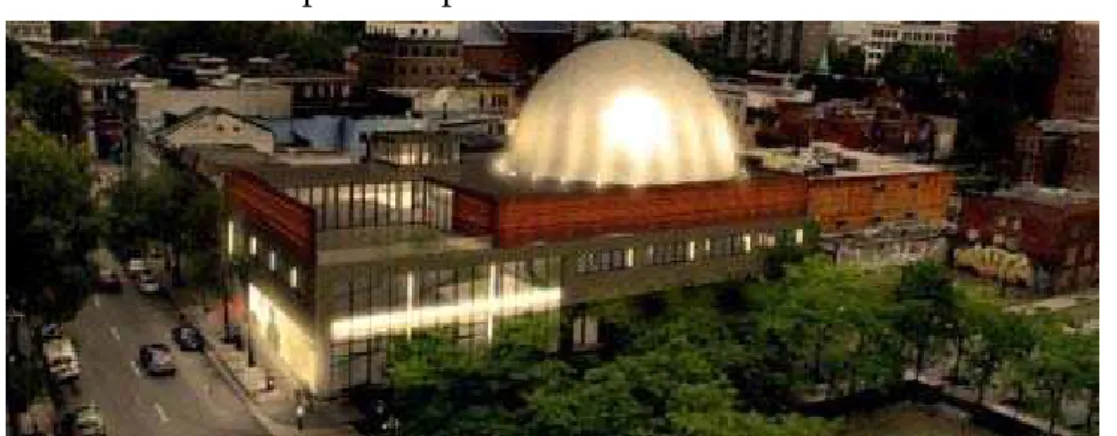
opened in 2011 and named by SAT itself as the first modular immersive theater, dedicated exclusively to activities of visualization and artistic creations. Its technical data notice a space that privileges the state of immersion of the spectator, being formed by a dome of 18 meters in diameter, 13 meters in height, covered by a spherical projection screen of 180º and eight video projectors. It can receive 350 spectators, allocated in cushions and sofas that privilege the visualization of the ceiling (Figure 1).
For the most part, the spectacles received by Satosphère are dedicated
to audiovisual projections, made by Vjs and artists dedicated to Video
Mapping. In this perspective, the Collectif Lebovitz offered a work of
E‐ISSN ‐ 0
presented in 2013 during the Festival du Nouveau Cinéma, and had all its technical structure adapted for presentation in the Dome of SAT.
Figure 1 ‒ External Image of the Société dês Arts Tecnologiques (SAT). Source: Sat’s Site2.
In Rouge Mékong the spectator is invited to, in addition to visualize,
submerge in the thought of a young woman who leaves her apartment to live a period of trips through the East. The SAT’s dome, formerly used for visual delight, proposes to unite visuality and immersion of affections. In hosting a dramaturgy that intends to approach the thought of a woman in love, the collective proposes to transform Satosphère into a space for the
visualization of images and memories of its main character. In addition to the scenography referring to the protagonist’s room, we see projected throughout the space her yearnings and memories, as described in the collective’s site:
A warm, dreamy, timeless atmosphere, inspired by the universe of Wong Kar-Wai and Sophie Calle reigns in the bedroom. Therefore, we become voyeurs, in the course of the room, we look for the scene, we discover the writings, photographs, music, the loves, the memories of Lebovitz. We travel. Then, little by little, the universe of the room, thanks to the 360 degrees video, metamorphoses with the lighting and the participants. We discover in a fragmented way the characters, stories, failures, passions, individual paths, but a common starting point, the same quest: to go deep within oneself ... (Collective Lebovitz, online, 2016, authors’ translation)3. The main character is Sarah Lebovitz, a young woman in her mid-twenties. When entering the dome, the spectator does not find her, but her presence is perceived through the objects in the room. Telephone calls answered by the answering machine, projections of her past and her possible presence in the space of representation. Féral (2012a), in her paper
E‐ISSN ‐ 0
presence, commonly associated with an ideological discourse within the performing arts and distanced from a practice really based on aesthetic postulates pertinent to performance or theater. She argues, in this sense, about the effect of presence that is constructed from an absence known and noticed by the spectator about a character. Such presence configuration, which is constructed by projections, sounds and objects, is fiercely exploited by Collectif Lebovitz from this character, which is not presented in a factual way. In an article produced for the electronic magazine Printemps
Numérique, dedicated to electronic art production in the city of Montreal,
writer Sophie Tarnowska recounts her voyeur experience about a character
she met, but who was not there:
The 40-minute show is an invitation to enter the mind of a young woman with love in her brain. Writer and photographer, Sara Lebovitz, of the Lebovitz Collective transforms the Satosphére of the Société des Arts Technologiques into her room and from there we travel with her to the
Mekong River and inside her lovelorn mind, as both explorers and voyeurs (Tarnowska, 2016).
We start with the composition of an intermedial scene, developed by a multidisciplinary team of artists, from the central idea of Françoise Lavoie-Pilote, its idealizer.
The presence, fetishized by the performing arts, has its principles relativized by the extension of an understanding about itself, in a perspective of crossing of digital media. Féral (2012a) had developed an argument about a notion of presence that gains more and more strength in the contemporary scene. This would be composed of live videoprojections, conducting voices in Video Walks, projected and previously recorded images
and other possibilities of being perceived, without actually being there. We see the representation of the actor visiting the phantasmagorias of the eighteenth century, a search that leads us to rethink the idea of presence solely linked to organicity, but delegating it to the idea of presence effect that causes the spectator.
E‐ISSN ‐ 0
their representations into play. This temporality and common space shared by the spectator and the presence being evoked (a character, an avatar, or an object) is fundamental (Féral, 2012a, p. 31).
Féral in her argument tries to distinguish between the presence, as the quality of the actor, an understanding originated in the researches of Eugênio Barba (1995), where having presence is associated with qualities of
magnification of the corporeity of the actor in scene, making clear that this perspective is about being physically present in the scene, thus presenting her
differentiation on possible readings generated from notions pertinent to other theorists. Presence, as an actor’s quality, is not at stake. The main focus is on the perception of this presence, something that does not have to be organically in the space to be perceived by the audience.
The Rouge Mékong spectacle can exemplify how the presence effect
works in the spectators’ perception. As a plot, we have the story of Sarah Lebovitz, a photographer who travels the East after a love disappointment.
Collectif Lebovitz creates an immersive atmosphere in the SAT room and
E‐ISSN ‐ 0
Figure 2 ‒ Images sequence of Rouge Mékong performance. Source:©SebastienRoy.ca
A spectator reads the letter left by the character Sarah; an spectator receives a call from Sarah; projection in bed; memory of Sarah and her ex-boyfriend; a spectator looks at a suitcase with Sarah’s personal belongings.
Associated to the presence effect that composes the staging, Collectif
E‐ISSN ‐ 0
Figure 3 ‒ Facebook profile, Sarah Lebovitz character. Source: Screen Image Elaborated by the Authors.
There is a concern in the profile organized by the spectacle’s production: to maintain the verisimilitude with the character’s narrative. In the introduction, we have the data pertinent to her personal history, while in the photo album it is possible to analyze images that supposedly were captured by Sarah herself in her current trip along the East. Staging and social network share the desire of actualizing the absence of that character.
Sarah is not presented bodily by a single performer, however, her presence is perceived by the spectators during the performance and later through her online profile. Féral (2012a, p. 32) stresses that the presence “[...] is most strongly felt when there is a rupture, a withdrawal or a failure of presence, the absence of presence, a ‘défaut de presence’”. Rectifying
absence would therefore be one of the greatest potentializers of the presence effect. In this sense, it is a matter of thinking of a presence that is intellectually perceived, even when it is not bodily there.
E‐ISSN ‐ 0
intellect see the beings and objects that surround them in unison (Féral, 2012a, p. 34).
The presence effect would work on the tension of perception; even aware of the bodily absence of a certain object or character, the spectator is affected by its effect of presence. Such affectation would be associated to our machinic sensitivity, stimulated by telepresence mechanisms such as videoconferences, or even by the familiarization of the screens. It is not uncommon to find someone who associates the idea of the TV set linked to a domestic presence, or rather a presence effect.
Féral also argues that the presence effect occurs in the field of unveiling. It is not about hiding the processes, the projection apparatus is seen and so the image would have even more autonomy. We would thus have the exposure of layers to the spectator. This one, aware of the effect that the performance seeks to achieve in itself, allows himself to get into the game. His aesthetic pleasure would be in allowing himself to be flooded, while at the same time perceiving water. Perceiving the perceptive gears that this type of spectacle proposes would not diminish in any way its immersiveness. Perceiving and flooding are senses that make up this poetics.
It is touching to observe that for a long time the intermedial effect of the virtual image in the theater had its possibilities subjugated by theoretical boundaries that saw it as impertinent to the theatrical scene. Auslander (2000), in his article Liveness, Mediatization, and Intermedial Performance,
takes up a discussion initiated by Herbert Blau (1980) in his essay entitled
Theater and Cinema: The Stopic Drive, The Detestable Screen and More of the
Same and, in opposition to its predecessor, does not nurture the belief that
living bodies and projected images would work in contradiction. He also insists on the idea that the examples mentioned by Blau, such as Eisenstein and Piscator, were interested in using films to comment on theatrical action
E‐ISSN ‐ 0
intermedial vídeo effect in the theater. Jones will associate with our heritage of modern psychology an understanding and need for representation of the unconscious. The theater, besides living a restructuring of its dramaturgy, fed by texts full of internal drama, perceives new scenic possibilities in the insertion of the projection.
There is a curious misconception today about the essential nature of moving images. We accept them only by thinking of them as objective transcripts of life, whereas in reality they are subjective images of life. This fact becomes evident at the moment we imagine, if we think of some known movie star appearing in person on stage, and then the same star appears on the screen, an echo without a body, a memory, a dream. Each self has its own reality, but one is objective and the other is subjective. Video images are our thoughts made visible and audible. They flow in a rapid succession of images, just as our thoughts do, and their speed, with their flashbacks - like sudden eruptions in the reeds of memory and their abrupt transitions from one subject to another - come very close to the speed of our thinking. They have the rhythm of thought and the same strange ability to move forward or backward in space or time without the interference of rationalizations from the conscious mind. They project pure thought, pure dream, pure inner life (Jones, 2004, p. 2).
In 1941, Jones was one of the responsibles for an extremely fruitful thought about the possibilities of the projection of images in the scene. In his discourse, more than a pessimistic approach between language tensions, there is care in understanding possibilities of scenic effects. Auslander (2000), recalling the oppositions between Blau and Jones, draws attention to the fact that even Jones’s discourse, in which there is an optimistic fit
about the theater’s shelter of cinema, or Blau’s noisy discourse, according to
E‐ISSN ‐ 0 Effects on Perception in Contemporary Spectatorship
The process of questioning about the perceptual effects of the contemporary theatrical spectator is a phenomenon relativized by some of the thinkers who are dedicated to the study of the media in theater. How is our perception altered by new spatial relationships? Can virtual and real space combine the same narrative? Are we more attracted to the lumen of the screen than to the organically present actor? Is the Theater still possible as a collective experience, in a context of fragmentation generated by proliferation in the media?
We will focus on Phillip Auslander, Josette Féral and Hans-Thies Lehmann, as we believe that, by dedicating much of their theoretical material to a search for the approximation of research focused on human perception in relation to live events, mediatized from a theoretical perspective that takes into account the theatrical tradition, they proposed a review of basic questions for the language of the scene. A common trait among the three theorists is the approximation of studies on the media in the theater, starting from a need of understanding about the contemporary scene. It is not at first a question of media scholars, however, they are researchers of the scene, of the actor, of the performativity, of the performative theater, of the post-dramatic theater, of the live performance, using here terms of the vocabulary that transits in the texts of the cited authors, who found themselves faced with the need to ask themselves: how could the processes of this mediatized scene interfere with the perception of theater spectators?
Josette Féral (2012b), in her article A body in space: perception and
projection, takes the critical position on the fragility of the theater with
E‐ISSN ‐ 0
[...] the scenographers, consciously or unconsciously, seem to integrate with naturalness the scientific discoveries of their time, so that their work of creation contributes, on one hand, to reflect (in the sense of producing
reflection) the experience that we have in everyday space and, on the other hand, to modify, through their art, the modes of perception that we have of them (Féral, 2012b, p. 130).
Within the performing arts, scenography would also include lighting. These are the closest areas to technical materiality, but, as Féral points out, this response that echoes in its scenic materiality a contemporary plasticity would not necessarily be the result of a scientific awareness about the perceptual effects that it intends to achieve in the spectators. In another article, For a poetics of performativity: performative theater (2008), the author expands the exemplification of experiences of the scene that she calls “performative”, including the demonstration of machinery as an element that aggregates this performativity:
However, in showing us the procedure, it dissipates the game of illusion while keeping the illusion in view of the spectator [...] We are here in front of a performativity of technology that cleverly dismantles the theatricality of the process to bring to the light its performativity (Féral, 2008, p. 206).
Technology comes to be inserted in the analysis about the scene as a potentializer of performativity, in the context of allowing seeing something
that is happening, abandoning its effect of the enchantment, but exhibiting its complexity in the organization and effects on that event. It would be incorporated into the unveiling, proper to the performative scene. In this sense, its conscious use of this scene nurtures the hypothesis that the processes of narrative construction would also achieve the lucid use of the media on the stage.
Féral (2012b) returns to the discussion about the spectator’s perception, problematizing the possible zones to be visualized in a spectacle through the example of the Urban Dream Capsule, which was presented in
E‐ISSN ‐ 0
would watch them, exposed 24 hours a day. The abundance of spaces existing in virtuality would also make sense in the contemporary theatrical expectation, since they would be perceptible to the spectator. The author is dedicated to the exercise of questioning the changes in the perception of spectators, with the intention of organizing which would be the conducting elements of our theatrical reception, when in spectacles full of intermediation. The central hypothesis at stake is that we would be sensorially affected by a space that is not limited to an architectural context; this space contained in the virtuality would be called space-plane. This place does not only correspond to the palpable reality of the scene, but it also includes virtual extensions, ways of visualizing the narrative beyond conventional stage space, configurations of derealization of the scene. “The visual space would take the spectator by shortcuts, while the text (and narration) would lead to a logocentrism that remains often pregnant” (Féral, 2012b, p. 148). We have in Josette an attentive investigation of a performative scene that exposes its technical materiality and proposes expanded spaces of being and perceiving this scene and that questions about the limits of the studies of the performing arts on the modes of perception and cognition.
Under the focus of mediatized culture, Auslander (2008), in his book
Liveness; Performance in a Mediatized Culture, developed a relevant
argument to the spectator’s mode of perceptions, associated with quantitative survey data such as the Survey of Public Participation in the Arts,
in 2004. He emphasizes data that indicate that 60% of North American adults go to the movies, 22% to the theater and only 4% to the ballet or opera. He also points out that we increasingly have screens in shows and spectacles, mentioning rock megaproductions of or even spectacles with great Norht American comedians. According to Auslander, in these spaces the spectators count on the presence of the live, but many choose to watch
via TV screens in the same environment.
E‐ISSN ‐ 0
This question is dificult to adress in any other than anecdotal terms; when we go to a concert or a sport event enploing a large screen, for instance, what do we look at? Do we concentrate our attention on the live bodies or our eyes drawn the screen, as Benjamin’s postulate of our desire of proximity would predict? At a party I attended recently I found the latter to be the case. There was a live band, dancing, and a video simulcast of the dancers on two screens adjacent to the dance flor. My eye was drawn to the screen, although the live dancers indeed had all the brilliance of fifity-watt bulbs (Auslander,2000, p. 9).
The author suggests that the capture of the look that belongs to the contemporary audience is directed to the search for lumens, leds, circuits and sound waves. Between organic and digital, our eyes are drawn to seek what is more familiar. Auslander, in the abovementioned quote, exemplifies, from a daily event, the accommodation of our gaze to the screens. These, omnipresent in our ephemerality, would also alter our perception in relation to the artistic work, especially with respect to the performing arts.
In Liveness, Auslander (2008) argues that theater spectators not only
seek out the media-like aesthetics to which they are affectionate, but also model their live event responses from what they would expect to see in a television program. Attention is drawn in the engagement promoted by Auslander to an absence of research that seeks to problematize the spectator’s perception of the live spectacles and their cognition modeled by the television events. The present data lead us to conclusions that little help in the understanding of the theatrical reception. After all, the fact that we have the look directed at the screens does not point to a pact that would overlay them to the effect of the actor live, but that can be associated with numerous variants, like the distance from the stage or the referral to the screens.
The engagement of the media in the scene was also problematized in Hans-Thies Lehmann’s Post-Dramatic Theater (2007). Present in most of
the studies on media in the theater, the chapter Theater and Media, under
E‐ISSN ‐ 0
enhancement devices, organizing the extension of the human vision from the nineteenth century:
In all possible types of instruments, indicators and screens, what is seen are more or less abstract signs; essential aspects of reality escape the bodily senses: ‘The realm of sensory perception is reduced to a minimal ecological niche in a vast spectrum of electromagnetic waves’ (Lehmann, 2007, p. 366).
Lehmann presents a vision that seeks to question the space that he calls
technological niche as a possible destination for an effective communication. In
this context, an ethical/aesthetic attitude would be impossible, since this space would not allow an intersubjectivity, which would only appear in the
relationship among subjects. When the human subject is surrounded by computerizable extensions, his intersubjectivity would not be full, losing himself in the tangle of information pertinent to the computer network. He brings Walter Benjamin’s ideas in order to justify what he calls the false
appearance of accessibility as an absence of aura, a presence that would work to
reinforce the idea of a contemporary phantasmagoria, in which access to the virtual would nurture the precariousness of relationships, the aura inaccessibility.
This positioning resembles a lot Dubatti’s discussions (2011, p. 21) concerning the convivial experience as the essence of the relationships among subjects in the theatrical event “[...] in the theater between, the convivial experience of artist and spectator generates a subjective field, which does not mark the domain of either the first or the second, but a similar state of mutual benefit in a third”. In Dubatti the subjective experience would also be possible only from the direct relation among subjects, without the intermediation of the machinic. The coexistence mediated by the machine would be called tech-convivence by him.
Tech-convivence is the living culture deterritorialized by technological intermediation. We distinguish two major forms of technology: interactive technology (telephone, chatting, text messages, network games, skype etc.) and monoactive techno-vision, in which a round-trip dialogue is not established between two persons, but the relationship of one or a group of persons with an object or device whose generator has been absent (Dubatti, 2011, p. 22).
E‐ISSN ‐ 0
extensions of scenic space to the realm of virtuality, or even mediatized bodies. In both Dubatti (2011) and Lehmann (2007) the machinic tends to be seen as a fragilizer of the subjective relations among humans. In these arguments there is a vestige of what Laymert Garcia (2005) will call the crisis of humanism. According to the mentioned authors, this idea appears as a weakening of the theatrical event from the impossibility of maintaining its human hegemony in the relations. However, it is important to retake the machine as a being materialized through transductive processes, arising from its pre-individual context. Thus, machine and man would not be elaborating a weakened theatrical scene of subjectivity, but together they rework and construct a subjectivity that corresponds to their pre-individual context.
Lehmann’s (2007, p. 368) approach to the technological materiality of the contemporary scene shows a concern when he questions himself about the permanence of the digital media in the theater. As he states, “[...] it may seem that the future of theater would also be in assimilation to information technologies, in the accelerated circulation of images and simulacra.” Moreover, his argument revolves around a definition of its use, in which the understanding of the border between reality and virtuality would be at stake. “It would be the case to find out if in the high-tech theater there is a
dilution of the limit between virtuality and reality or if the willingness to view all perception as a permanent doubt is created” (Lehmann, 2007, p. 368). Lehmann focuses on the use of the media with a caution pertinent to a conception of them as mechanisms of the game between reality and virtuality, or the exploration of the effects of fascination, arising from the use of something new by the theater, but which, according to him, would
also succumb to wear. There is no space in his argument for the exploration of technological materiality by the scene in an expositive way, demonstrating its course of elaboration and effect as Josette Féral called the
performativity of technology.
E‐ISSN ‐ 0
new predominant trait for theater” (Lehmann, 2007, p. 371). We would be faced with a media theater that responds to a need for interaction from the use of media and from exception to drama and illusion, seeking a present of representation that would be contained in its effects of cinematization, an
echo of realistic fetishism.
We are in the process of incorporating a digital aesthetics. This course is mediated by the appropriation of the media image by the scene, but consideration must also be given to changing the spectators’ perspective. These are daily witnesses of the incorporation of virtual pictorialities into their aesthetic perceptions.
E‐ISSN ‐ 0
Reception Actors
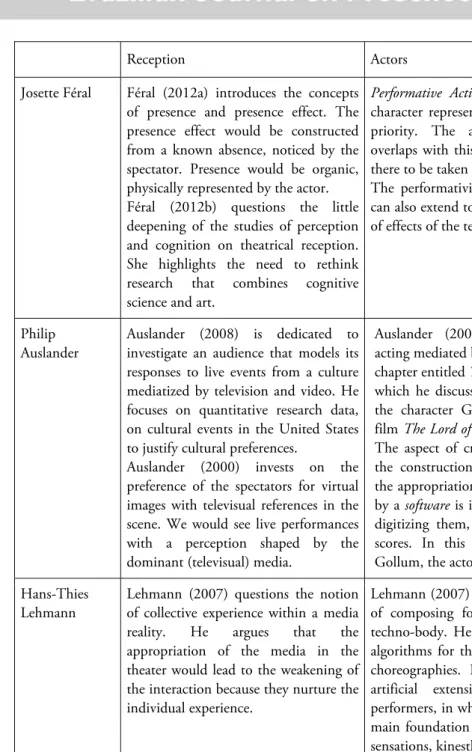
Josette Féral Féral (2012a) introduces the concepts of presence and presence effect. The presence effect would be constructed from a known absence, noticed by the spectator. Presence would be organic, physically represented by the actor. Féral (2012b) questions the little deepening of the studies of perception and cognition on theatrical reception. She highlights the need to rethink research that combines cognitive science and art.
Performative Acting (Féral, 2008). The character representation layers are not a priority. The action of the actors overlaps with this. They (characters) are there to be taken back when they matter. The performativity of this performance can also extend to the game of revelation of effects of the technical apparatuses.
Philip Auslander
Auslander (2008) is dedicated to investigate an audience that models its responses to live events from a culture mediatized by television and video. He focuses on quantitative research data, on cultural events in the United States to justify cultural preferences.
Auslander (2000) invests on the preference of the spectators for virtual images with televisual references in the scene. We would see live performances with a perception shaped by the dominant (televisual) media.
Auslander (2008) problematizes the acting mediated by electronic devices. A chapter entitled The Problem Gollum, in which he discusses the performance of the character Gollum, present in the film The Lord of the Rings, is discussed. The aspect of creation of the actor in the construction of the character and the appropriation of his corporal scores by a software is in dispute, which, after digitizing them, is able to create new scores. In this context: who created Gollum, the actor or the software?
Hans-Thies Lehmann
Lehmann (2007) questions the notion of collective experience within a media reality. He argues that the appropriation of the media in the theater would lead to the weakening of the interaction because they nurture the individual experience.
Lehmann (2007) problematizes the ways of composing for a media body or a techno-body. He emphasizes the use of algorithms for the composition of some choreographies. He also mentions the artificial extensions used by some performers, in which they would have as main foundation the search for artificial sensations, kinesthetic impulses.
Table 1 ‒ Summary of some contemporary reflections on the Intermedial Scene. Source: Elaborated by the authors.
E‐ISSN ‐ 0 Processes of Individuation and Spectatorship
In the context of the changes of the perceptive processes it is relevant to retake Stiegler (2004) to rethink the individuation processes that occur
through the artistic apparatus. When he mentions the transductive processes
that operated on the notion of musical appreciation, in what he called the “machinic turn of the sensitivity”, it helps us to think about these changes in the scale of the individual, that is, in individuation:
This individuation, for example, is omnipresent and continuous. When you are reading a book, you individuate yourself by reading this book because reading a book is being transformed by the book. If you are not being transformed by the book, you are not reading the book - you believe you are reading. You may believe that you are reading, but you are not (Stiegler; Rogoff, 2012, p. 4).
Thus, the individuation process that is organized in a subject/spectator
when in reception about the theatrical work impregnated by the digital experience must also be considered as a vestige of this machinic sensibility, acquired and still little problematized by the performing arts. Perceiving an actor through a camera imposes on the spectators completely different readings and crossings from those who propose, in most cases, the theatrical stage. The spectator’s experience of perception, as Stiegler (2004, p. 12) suggests, is organized by transductive relationships, in which the machinic and social organizations “constitute the complete aesthetic fact”.
E‐ISSN ‐ 0
Such process would take place by appropriation and would occur from a synchronous composition of the groups. To think of the digitized scene is also to recognize collective processes, with individuations moved by a common pre-individual background and which only make sense through an aesthetic fused by a machinic sensibility.
The possibility of seeing the interdisciplinary exchange embedded in these media processes nurtures a new perspective of theatrical production. It is a collaborative creation that, in turn, proposes two possibilities. The creation from the materiality shown and the adequacy of the materiality to the creation, a scenario that puts the artist in direct contact with the technician and his science, are symptoms of a world where the creative process is crossed by machines. We are sensitive to having ideas through the contact with the devices, as well as developing the thought is there any
device to solve my idea? The trick, an old friend of the theatermakers, gains
an air of professionalism by being linked to programming. Much can be programmed and solved with the help of engineering. In this place, multidisciplinary teams emerge with force, or, moreover, theater professionals dedicate more and more time to the study of digital media.
E‐ISSN ‐ 0 Notes
1 Available at: <http://sat.qc.ca/en/satosphere>. Accessed in: 10 June 2015. 2 Available at: <http://sat.qc.ca>. Accessed in: 10 June 2015.
3 In the original in French: Une atmosphère feutrée, onirique, intemporelle,
inspirée des univers de Wong Kar Wai et de Sophie Calle règne dans la chambre. Dès lors, on devient voyeur, on parcourt la chambre, fouille les lieux, découvre les écrits, les photographies, la musique, les amours, les souvenirs de Lebovitz. Nous voyageons. Puis, peu à peu, l’univers de la chambre se métamorphose, grâce à la vidéo 360 degrés, aux décors, à l’éclairage et aux arts participatifs. On découvre alors de manière morcelée des personnages, des récits, des ruptures, des passions, des chemins particuliers, mais un même point de départ, une même quête: aller au fond de soi-même...
References
AUSLANDER, Philip. Liveness, Mediatization, and Intermedial Performance. Degres: Revue de synthese a orientation semiologique, Belgium, n. 101, Spring 2000.
AUSLANDER, Philip. Liveness; Performance in a Mediatized Culture. London; New York: Routledge, 2008.
BARBA, Eugenio. A Arte Secreta do Ator – Dicionário de antropologia teatral. São Paulo: Unicamp, 1995.
BLAU, Herbert. Theater and Cinema: the scopic drive, the detestable screen, and more of the same herbert. Ciné-Tracts: a journal of film and cultural studies, Minneapolis, v. 4, p. 5-65, 1980.
CHAPPLE, Freda; KATTENBELT, Chiel. Key Issuesin Intermediality in Theatre and Performance. In: CHAPPLE, Freda; KATTENBELT, Chiel (Org.). Intermidiality in Thatre and Performance. Amsterdã; Nova Iorque: Rodopi-International Federation for Theatre Research, 2007. P. 19-29.
COLLECTIF LEBOVITZ. Rouge Mékong. Site. 2016. Available at: <http://rougemekong.com/?page_id=9>. Accessed in: 10 June 2015.
E‐ISSN ‐ 0 Lima (Org.). Da Cena Contemporânea. Porto Alegre: ABRACE – Associação Brasileira de Pesquisa e Pós-graduação em Artes Cênicas, 2011. P. 12-35.
FÉRAL, Josette. Por uma Poetica da Performatividade: o teatro performativo. Sala Preta: Revista do Programa de Pos-Graduação em Artes Cênicas, São Paulo, Universidade de São Paulo, n. 08, p. 197-210, 2008.
FÉRAL, Josette. Being: place and time. How to define presence effects: the work of Janet Cardiff. In: GIANNACHI, Gabriella; KAYE, Nick; SHANKS, Michael (Org.). Archaeologies of Presence: art, performance and the persistence of being. New York: Routledge, 2012a. P. 29-49.
FÉRAL, Josette. Um Corpo no Espaço: percepção e projeção. In: PEREIRA, Antonia; ISAACSSON, Marta; TORRES, Walter Lima (Org.). Cena Corpo e Dramaturgia: entre tradição e contemporaneidade. Rio de Janeiro: Ed. Pão e Rosa, 2012b. P. 129-148.
GARCIA, Laymert. Demasiadamente Pós-Humano. Novos Estudos CEBRAP, São Paulo, v. 72, p. 161-175, jul. 2005.
HAYATI, Daryoosh. Transmedia Storytelling: a study oft he necessity, featuresand advantages. International Journal of Information and Education Technology, Singapore,v. 2, n. 3, p. 196-200, 2012.
ISAACSSON, Marta. Cena Multimídia, poéticas tecnológicas e efeitos intermediais. In: PEREIRA, Antonia; ISAACSSON, Marta; TORRES, Walter Lima (Org.). Cena Corpo e Dramaturgia: entre tradição e contemporaneidade. Rio de Janeiro: Ed. Pão e Rosa, 2012. P. 85-99.
JONES, Robert Edmond. The Dramatic Imagination. 3. ed. Nova York: [s.n.], 2004.
LEHMANN, Hans-Thies. Teatro Pos-dramatico. Tradução de Pedro Süssekind. São Paulo: Cosac & Naify, 2007.
SOCIÉTÉ DES ARTS TECHNOLOGIQUES - SAT. Rouge Mékong. Site. 2016. Available at: <http://sat.qc.ca/en/satosphere>. Accessed in: 10 June 2015. STIEGLER, Bernard. Le Tournant Machinique de la Sensibilité Musicale. Les Cahiers de Médiologie, Paris, v. 18, p. 7-17, 2004.
E‐ISSN ‐ 0 STIEGLER, Bernard; ROGOFF, Irit. Transindividuation. e-flux jornal, New York, n. 14, p. 6, 2012.
TARNOWSKA, Sophie. Rouge Mékong. Montreal Digital Spring [Printemps numérique], Montreal, 2016. Available at: <http://printempsnumerique.info/ en/rouge-mekong/>. Accessed in: 6 August 2016.
Fernanda Areias Oliveira is a professor at the Department of Art in Universidade Federal do Maranhão. Coordinates the research group Laboratory of Dramatic Technologies (LabTecDrama), which develops research on the training of theater teachers and methodologies for intermedial scene. PhD in computer science in education at Universidade Federal University do Rio Grande do Sul.
E-mail: [email protected]
Marta Isaacsson Souza e Silva is a professor at the Department of Dramatic Art and the Graduate Program in Performing Arts at Universidade Federal do Rio Grande do Sul. PhD in Theater Studies from Université de Paris III (1991). Productivity support 1B of the National Council of Scientific Research / Ministry of Science and Technology of Brazil.
E-mail: [email protected]
Maria Cristina Biasuz is an associate professor at Universidade Federal do Rio Grande do Sul, linked to the Institute of Arts. She develops research in the area of Digital Technologies, and coordinates the N.E.S.T.A - Nucleus of Studies in Subjectivation, Technology and Art, in the Line of Research: Digital Interfaces in Education, Art, Language and Cognition.
E-mail: [email protected]
This unpublished text, translated by Michelle de Sousa Bahury and proofread by Ananyr Porto Fajardo, is also published in Portuguese in this issue.