Ulcerative Colitis in Northern Portugal and Galicia in Spain
Manuel Barreiro-de Acosta, MD, PhD,*
,†Fernando Magro, MD, PhD,
‡,§,¶Daniel Carpio, MD,*
,kPaula Lago, MD,
‡,** Ana Echarri, MD,*
,††Jos
e Cotter, MD,
‡,‡‡Santos Pereira, MD,*
,§§Raquel Gonc¸alves, MD,
‡,¶¶Aurelio Lorenzo, MD,*
,†Laura Carvalho, MD,
‡,†††Javier Castro, MD,*
,††Luisa Barros, MD,
‡,‡‡‡Jorge Amil Dias, MD, PhD,
‡,§Susana Rodrigues, MD,
‡,§Francisco Portela, MD,
‡,***Camila Dias, MD,
¶,¶¶¶and Altamiro da Costa-Pereira, MD, PhD,
¶,¶¶¶and GEDII and EIGA
Background:Clinical and therapeutic patterns of ulcerative co-litis (UC) are variable in different world regions. The purpose of this study was to examine two close independent southern Euro-pean UC populations from 2 bordering countries and observe how demographic and clinical characteristics of patients can influence the severity of UC.
Methods: A cross-sectional study was conducted during a 15-month period (September 2005 to December 2006) based on data of 2 Web registries of UC patients. Patients were stratified according to the Montreal Classification and disease severity was defined by the type of treatment taken.
Results:A total of 1549 UC patients were included, 1008 (65%) from northern Portugal and 541 (35%) from Galicia (northwest Spain). A female predominance (57%) was observed in Portu-guese patients (P< 0.001). The median age at diagnosis was 35 years and median years of disease was 7. The majority of patients (53%) were treated only with mesalamine, while 15% had taken immunosuppressant drugs, and 3% biologic treatment. Most patients in both groups were not at risk for aggressive therapy. Extensive colitis was a predictive risk factor for immunosuppres-sion in northern Portugal and Galicia (odds ratio [OR] 2.737,
95% confidence interval [CI]: 1.846–4.058; OR 5.799, 95% CI: 3.433–9.795, respectively) and biologic treatment in Galicia (OR 6.329, 95% CI: 2.641–15.166). Younger patients presented a severe course at onset with more frequent use of immunosuppres-sors in both countries.
Conclusions: In a large population of UC patients from two in-dependent southern European countries, most patients did not require aggressive therapy, but extensive colitis was a clear risk factor for more severe disease.
(Inflamm Bowel Dis 2010;16:1227–1238)
Key Words:ulcerative colitis, Portugal, Galicia, southern Europe,
predictive factors, clinical activity, Montreal Classification, biologic treatment, immunosuppression
T
he incidence and prevalence of ulcerative colitis (UC) are very variable in different countries. In Shivananda’s et al’s classic study,1a north–south gradient was detected in European countries, with a lower incidence of inflammatory bowel disease (IBD) in southern countries such as Portugal and Spain. In the last decades this difference has diminished, possibly because of notable advances of health resources in both countries, and currently both Iberian nations are consid-ered as having a mid-level prevalence of UC, with gradual propensity toward the higher level group.2,3There are insufficient data heretofore comparing differ-ent geographical populations of patidiffer-ents with UC regarding disease severity; additionally, most of these studies compared either close populations in the same country4or populations with very different geographical and genetic characteristics.5 The allocation of patients into major categories, such as the Montreal Classification,6makes this approach possible.
Northern Portugal and Galicia (northwest Spain) are two proximate areas that have been politically separated for the last six centuries. Despite this political separation, the populations have maintained a strong contact due to similar languages, cultures, and traditions.
The aim of this study was to compare two independent geographically and genetically close UC populations from two different countries and analyze how demographic and
Received for publication October 14, 2009; Accepted October 15, 2009. From the *EIGA (Inflammatory Bowel Disease Group of Galicia),
†
Gastroenterology, University Hospital of Santiago, Santiago de Compostela, Spain,‡Portuguese Group of Studies of Inflammatory Bowel Diseases,§Hospital de Sa˜o Joa˜o,¶Faculty of Medicine, Oporto University, Portugal,kComplexo Hospitalario of Pontevedra, Spain,**Hospital Geral de Santo Anto´nio, ††Arquitecto Marcide Hospital, Ferrol, Spain, ‡‡Centro Hospitalar do Alto Ave – Guimara˜es,§§Xeral Cies Hospital, Vigo, Spain,
¶¶
Hospital S Marcos-Braga,†††Hospital de Vila Real,‡‡‡Centro Hospitalar do Vale do Ave Paredes, ***Hospitais da Universidade de Coimbra,
¶¶¶
Department of Biostatistics and Medical Informatics, Faculty of Medicine, Oporto University, Portugal.
The first 2 authors contributed equally.
Reprints: Manuel Barreiro-de Acosta, Gastroenterology, University Hospital, C/Choupana s/n 15706 Santiago de Compostela, Spain (e-mail: [email protected]) or Fernando Magro, MD, PhD, Institute of Pharmacology and Therapeutics, Faculdade de Medicina, 4200 Porto, Portugal (e-mail: [email protected])
CopyrightVC2009 Crohn’s & Colitis Foundation of America, Inc.
DOI 10.1002/ibd.21170
clinical characteristics of patients may affect the severity of UC.
MATERIALS AND METHODS
Patient Inclusion
During a 15-month period (September 2005 to De-cember 2006), Portuguese doctors following patients with IBD had the opportunity to collect clinical data and send it to a central database via the Internet (http://www. gedi2005.med.up.pt/). Patient registration was carried out through a Web-based system with password and user name validated by a scientific committee. The database was approved by national authorities and was supported by the Portuguese group of studies of IBD (GEDII: http:/www. gedii.med.up.pt). From these subjects only those from northern Portugal were chosen, thereby including all patients from hospitals situated north of the Douro River (Fig. 1). Twenty-one doctors participated in the study. UC patients were included from 2 third-level hospitals (Sa˜o Joa˜o Hospital of Porto and Santo Anto´nio Hospital of Porto) (55%), from 4 second-level hospitals (Guimara˜es, Paredes, Vila Real, and Braga Hospitals) (44.5%), and patients from private physicians (0.5%). Many first- and second-level hospitals refer their patients to third-level medical centers.
Concurrently, Galician doctors following patients with IBD had the opportunity to collect clinical data and send it to a central database via the Internet (http://www.alceingenieria. net). Patient registration was processed through a Web-based system with password and user name validated by a scientific committee. The database was supported by the Galician group of studies of IBD (EIGA). Patients from Galicia (Spain) (Fig. 1) were included from 4 reference hospitals (University Hos-pital of Santiago, Complexo HosHos-pitalario of Pontevedra, Arquitecto Marcide Hospital from Ferrol, and Xeral Cı´es Hos-pital from Vigo). No patients from private practices were included. These 4 hospitals have IBD units and are all third-level centers, receiving patients from smaller centers (Comar-cal Hospitals, i.e., first- or second-level hospitals).
Spain and Portugal have very similar healthcare sys-tems. Both countries have public universal healthcare systems and all Spanish and Portuguese citizens have free access to healthcare provided by the National Health Services (NHS).7,8 The information used to complete the data was obtained from clinical charts during a routine medical ex-amination. Several reunions between members of both countries were organized to standardize and clarify the dif-ferent parameters used. The diagnostic criteria for UC were based on a suggestive clinical history associated with endo-scopic and histological signs of inflammation of the mu-cosa, after excluding infectious disease by culture and mi-croscopic stool examination.
Data Collection
For each patient several parameters were collected: date and age of diagnosis onset, disease extent, family his-tory of IBD, extraintestinal manifestations, use and response to steroids, immunosuppression, biologic treatment, and need for surgery. Only patients who underwent colectomy or proctocolectomy were considered as being submitted to ab-dominal surgery. The extent of lesions, that is, the most proximal level achieved at any time since the diagnosis, was measured and patients were classified as proctitis, left-sided, and extensive colitis.6 Age at diagnosis was divided into 3 groups (16 years, 17–40 years, and>40 years). In relation
to steroids, only oral or intravenous forms were taken into consideration and steroid resistance was presumed when patients maintained active disease despite a prednisolone dose up to 1 mg/kg/day over a 2-week period. Steroid-de-pendent disease was stipulated as the inability to taper ste-roids below the equivalent of 10 mg/day of prednisolone without recurrence of active disease, or the need for a second course of steroids in a 6-month period.
Disease Severity
Disease severity was defined by the type of treatment administered (adapted from Loftus et al9). Patients were categorized into 3 different severity grades: Group 1 repre-senting mild/moderate disease (patients with no treatment or with salicylates, or episodic pulses of steroids without steroid refraction or dependency), Group 2 for severe dis-ease with drug-dependent or drug-refractory behavior (patients treated with steroids, with steroid resistance or de-pendency, or immunomodulators/biological) and Group 3 for patients with medically refractory disease, submitted to surgery. In order to confirm and attribute a stronger value to the results, a second analysis was performed excluding all UC patients with less than 5 years of diagnosed disease.
Statistics
Categorical variables were divided in absolute fre-quencies (n) and relative frequencies (%). Means and standard deviations (SDs) for continuous variables were used if a normal distribution could be assumed, or median and interquartile range (IQR: 25th to 75th percentile) if normality could not be assumed. A Kolmogorov–Smirnov test was used to test for normality.
was used. In the multivariate logistic regression models the de-pendent variables were immunosuppression and biologic treat-ment. The model’s goodness-of-fit was assessed using the Hosmer–Lemeshow statistic. The significance level used was 0.05. Statistical analysis was performed using the software Sta-tistical Package for the Social Sciences v. 16.0 for Windows (SPSS, Chicago, IL).
RESULTS
Global Demographic Characteristics
A total of 1549 UC patients were included, 1008 (65%) from northern Portugal and 541 (35%) from Galicia (northwest Spain). Overall, 721 (47%) were male and 828 (53%) female. Median age at diagnosis was 35 years (percentile 25-26 and percentile 75-46) and median years of disease was 7 (percentile 25-3 and percentile 75-11) (Table 1). When patients were clas-sified by age at diagnosis, 72 (5%) were diagnosed at 16 years or below, 899 (59%) were diagnosed between 17 and 40 years, and 558 (36%) were diagnosed over 40 years (Table 1). An analysis of age distribution did not show a second peak at the age of 50–70 years (Fig. 2). Regarding classification of disease extent, the maximum limit and not extent at diagnosis was cho-sen because previous studies showed that the initial extent did not affect the subsequent disease activity course. Proctitis was found in 449 (29%) patients (E1 in Montreal Classification), 683 (44%) had left-sided colitis (E2 in Montreal Classification), and 415 (27%) had extensive colitis (E3 in Montreal Classifica-tion) (Table 2). When the patients were stratified in different categories of disease duration it was possible to see some changes over time. Concerning proctitis there was a decrease in
frequency after 4 years of diagnosis, achieving a steady state subsequently: 34% in those with less than 4 years of disease and thereafter 30% (5–9 years of disease), 25% (10–14 years), 25% (15–19 years), and 28% (more than 19 years). In both populations there was a rise in the frequency of left-sided coli-tis in the patients with more than 4 years of diagnosis (44%, 46%, 49%, and 45%, at 5–9, 10–14, 15–19, and more than 19 years after diagnosis, respectively) in comparison to those with a more recent diagnoses (until 4 years, 41%). In extensive coli-tis there was no change over time (25%, 25%, 28%, 24%, and 24%, at 5–9, 10–14, 15–19, and more than 19 years after diag-nosis, respectively). That is, in our population after the fourth
year of disease the variation in terms of location was not worth mentioning. A family history of IBD was detected in 140 patients (11%) and 256 patients (17%) had extraintestinal man-ifestations (Table 2). After analyzing treatment characteristics it was found that 72 (5%) patients had developed steroid-resist-ance and 195 (14%) steroid-dependency (Table 2). Regarding the use of more advanced drugs, it was observed that 227 (15%) patients had taken immunosuppressant drugs and 48 (3%) biologic treatment (Table 2).
Comparison Between Populations According to Age at Diagnosis
Important differences were shown in demographic characteristics between patients from Portugal and Galicia (Table 1). Considering gender distribution, in Portugal most patients were female (57%), while in Galicia only 48% were of this gender (P <0.001). Nevertheless, when the
popula-tion was stratified by age, gender differences were found only in patients diagnosed above 40 years, where there was a significant predominance of female patients in the Portu-guese group of patients (53%) compared to the Galician group (40%) (P ¼0.003). Concerning age at presentation, no significant differences in the percentage of patients diag-nosed before 16 years of age were observed, contrary to data found in the older population (>40 years), where the
Gali-cian population was significantly older (52%) at diagnosis when compared to the Portuguese (50%) (P¼0.028).
After applying the Montreal Classification for disease extent (Table 2), the most common type was E2 (left-sided colitis). In the Galician group there was a predominance of proctitis, while extensive colitis was more common among Portuguese patients, the latter being particularly evident in the older group (>40 years). Regarding treatment patterns,
more steroid-resistant and steroid-dependant patients were found in the Galician group of patients and subsequently more immunosuppression and biologic treatment were applied in those diagnosed in the intermediate age group (17–40 years) (Table 2).
Severity
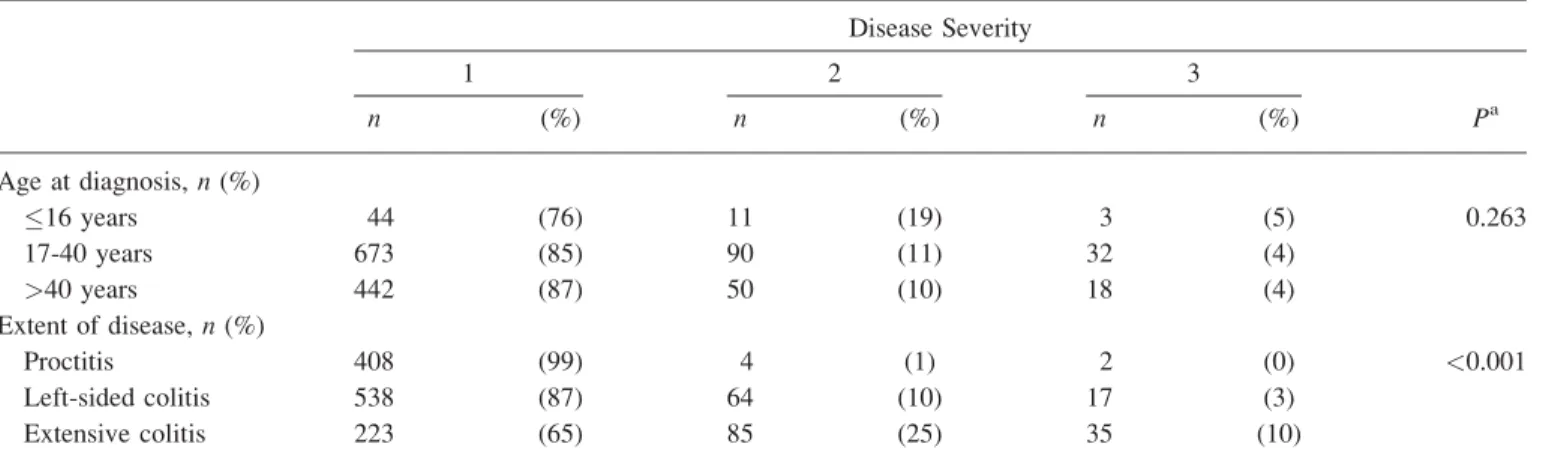
Regarding severity, notably 53% of patients did not need steroids, 16% had taken steroids without more drugs supplied, and 75% were not submitted to immunosuppres-sion, biologicals, or surgery (Table 3). Nonetheless, there was a trend toward steroid-dependency and the use of immunosuppression or biologicals in the Galician group compared to northern Portugal in all age groups (Fig. 3B). Contrariwise, in Portugal an inclination toward surgery was observed at all ages in comparison with the Galician group (Fig. 3B).
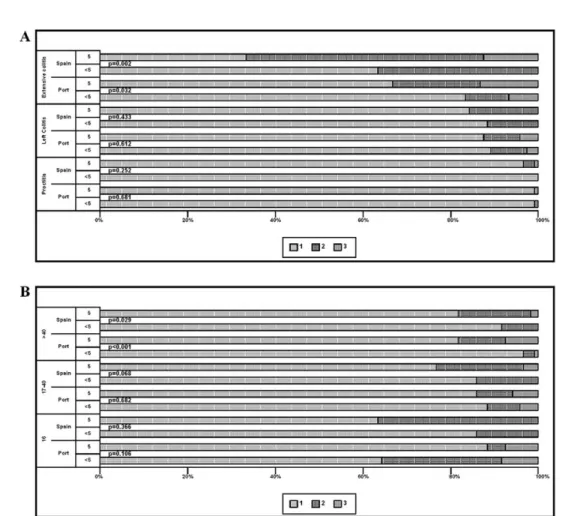
Although differences in severity in the proctitis (E1) group were not observed among the different populations, in left-sided colitis (E2) there was a trend toward
immunosuppression in Galician patients, while a propensity toward surgery was detected in Portuguese patients (Fig. 3A). This trend was more noteworthy in patients of the E3 group (Fig. 3A). Remarkably, an overwhelmingly large percentage of patients in the proctitis group did not require treatment with immunomodulators or biologicals (98%), contrary to the extensive colitis population, where 25% were solely treated with mesalamine.
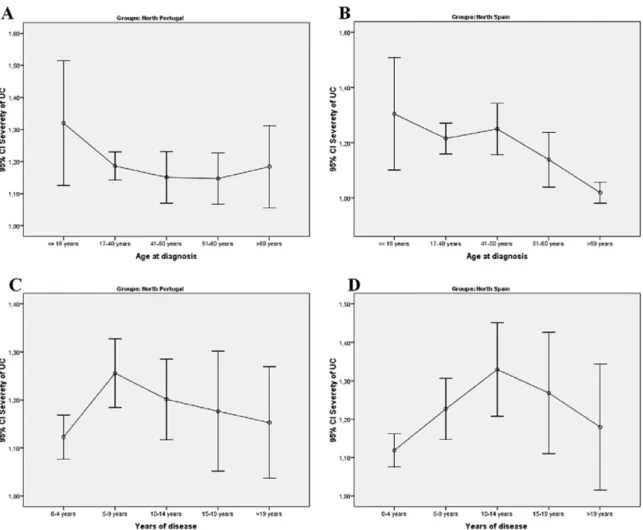
Concerning age of onset, those diagnosed before 16 years had a more aggressive initial course in Portugal and in Galicia requiring more steroids (51% and 40%, respec-tively, in northern Portugal and Galicia) and immunomodu-lators (26 and 35%, respectively in northern Portugal and Galicia). In order to highlight age onset, patients were stratified in more categories than those found in the Mon-treal Classification: 41–50 years, 51–60 years, and more than 60 years. In northern Portugal the severity curve drops until 40 years at disease onset, flattening thereafter. In Galicia the same behavior was detected until 40 years of disease onset; however, the curve continues to drop (Fig. 4A,B).
Furthermore, considering the 3 grades of disease se-verity, a tendency for increasing severity was found among patients with disease duration of 0–10 years, primarily in Galicia, followed by a slow descending gradient (Fig.
4C,D). However, emphasizing the low mean disease score found is fundamental because it suggests that the majority of the patients had mild disease.
Comparing Populations with Less Than and More Than 5 Years of Diagnosed Disease
In order to emphasize the results, as previously done in CD in the Montreal Classification, patients with 5 or less years of diagnosed UC were excluded to detect if the results observed were maintained. By excluding these patients, the cohort was reduced to 960 UC patients, 645 (67%) from northern Portugal and 315 (33%) from Galicia (Table 4). When comparing patients with less than 5 years or 5 or more years of disease no differences were found in Portugal or in Spain in relation to age distribution. Regard-ing disease location, in Portugal there was a larger percent-age of patients with proctitis in the less than 5 years group, in contrast to the extensive colitis group, which remained constant in time. Concerning disease severity, many patients in Portugal and in Spain did not require aggressive therapy, regardless of the disease duration (Fig. 5). Never-theless, there was a clear trend toward immunosuppression in extensive colitis patients in those with 5 or more years of disease (Fig. 5A). The same trend was observed in Gali-cian patients diagnosed before age 16 years (Fig. 5B). TABLE 2. Clinical Characteristics Comparing UC Patients from Northern Portugal and Galicia (Global and Adjusted by Age at Diagnosis)
Age at Diagnosis
16 years 17–40 years >40 years Total
Northern
Portugal Galicia P
Northern
Portugal Galicia P
Northern
Portugal Galicia P
Northern
Portugal Galicia
Extent of disease,n(%)
Proctitis 8 (17) 5 (19) 0.976a 173 (28) 101 (36) 0.056a 77 (24) 79 (33) <0.001a 263 (26) 186 (34) Left-sided
colitis
15 (33) 8 (31) 262 (42) 117 (42) 151 (47) 120 (51) 438 (44) 245 (45)
Extensive colitis
23 (50) 13 (50) 186 (30) 59 (21) 94 (29) 37 (16) 305 (30) 110 (20)
E.I.M.,n(%) 12 (26) 3 (12) 0.144 110 (18) 52 (19) 0.743a 39 (12) 37 (16) 0.225a 164 (16) 92 (17) Steroid
resistance,n(%)
1 (2) 1 (4) 0.745c 23 (5) 23 (8) 0.030a 8 (3) 15 (6) 0.106a 32 (4) 40 (7) Steroid
dependency,n(%)
8 (20) 6 (23) 0.727 59 (11) 52 (19) 0.002a 32 (12) 36 (15) 0.285a 100 (12) 95 (18) Immunosupression,
n(%)
12 (26) 9 (35) 0.444 81 (13) 53 (19) 0.019a 38 (12) 32 (14) 0.536a 132 (13) 95 (18) Biologic
treatment,n(%)
2 (4) 2 (8) 0.620c 15 (2) 17 (6) 0.006a 1 (0) 10 (4) 0.001b 18 (2) 30 (6)
E.I.M., extraintestinal manifestations.
aChi-square test. b
Mann-Whitney test.
Univariate and Multivariate Analysis of Factors Associated with Immunosuppression, Biological Treatment, and Abdominal Surgery
Table 5 shows the variables associated with the use of immunosuppressants and biologic therapy on uni- and multivariate analysis. Extensive colitis was clearly a pre-dictive risk factor for immunosuppression in northern Por-tugal and in Galicia (Table 5) and biologic therapy in Gali-cia (odds ratio [OR] 6.329; 95% confidence interval [CI]: 2.641–15.166). In relation to age, the older Portuguese group (>40 years) was at a significantly lower risk for
bio-logic treatment (OR 0.067; 95% CI: 0.007–0.893) when compared to younger groups, as opposed to the Galician population, where no evident differences were found con-cerning age.
DISCUSSION
Northern Portugal and Galicia (northwest Spain) are two contiguous areas with similar extents separated by the river Min˜o. Although politically separated, these areas share some characteristics besides genetics, culture, and language, such as climate, geographic distribution of the population in rural areas, and similar food habits (high fish and shellfish consumption).
A comparative cross-sectional study of two popula-tions was performed; the intention was not to perform an epidemiological study. Some previous series had compared different populations from different countries like the Euro-pean Collaborative Study on Inflammatory Bowel Disease (EC-IBD),1,10,11 and others that compared different areas from the same country4,12,13 or different ethnic groups in the same area.14 Notwithstanding, few have directly
com-pared populations from different countries and those that exist were restricted to nonbordering nation populations15 or new data with others previously published.16 To our knowledge, this is the first study comparing two genetically close populations from bordering countries.
Regarding family history rate or the presence of extraintestinal manifestations, no differences were observed between the two groups. The family history rate observed was 10%, similar to that found in similar publications,17 as well as the occurrence of extraintestinal manifestations.18,19 Concerning gender, in Portugal a female predominance was detected (57%). In the majority of UC studies no gender differences were reported,20–22 although similar results as found in the northern Portuguese group of patients have been previously mentioned.23,24 Furthermore, in the Gali-cian group diagnosed over 40 years there was a predomi-nance of males, a fact found in a previous Canadian25 and EC-IBD studies,1 where gender divergence at older ages was seen, consistent with a dramatic decline of new diag-noses in women after the third decade. In relation to age of onset of UC a second peak was not detected. This is in conformity with recent studies in which a second peak was not apparent. Whether this reflects a real change in the pat-tern or is due to recent larger and more scientifically sound studies remains uncertain.26
In the Galician group there were more patients with proctitis (34% versus 26%) and less extensive colitis (20% versus 30%), a fact logically related with a higher number of older diagnosis patients in Galicia. In concordance, a higher rate of proctitis in elderly UC has also been reported.27
In the IBSEN study28 the majority (78%) of patients did not use systemic steroids during the second 5-year TABLE 3. Classification of UC According to Severity Score
Disease Severity
1 2 3
Pa
n (%) n (%) n (%)
Age at diagnosis,n(%)
16 years 44 (76) 11 (19) 3 (5) 0.263
17-40 years 673 (85) 90 (11) 32 (4)
>40 years 442 (87) 50 (10) 18 (4)
Extent of disease,n(%)
Proctitis 408 (99) 4 (1) 2 (0) <0.001
Left-sided colitis 538 (87) 64 (10) 17 (3)
Extensive colitis 223 (65) 85 (25) 35 (10)
a
Chi-square test.
Disease severity was defined by the type of treatment administered (adapted from Loftus et al10). Patients were categorized into 4 different severity grades:
period and, according to patient perceptions, remission or mild symptoms after initial activity represented the most common course, while chronic continuous symptoms were rare. Our data support this observation because after 10 years of disease there is a progressive decline in disease se-verity and overall the mean score is low. Likewise, 53% of patients did not need steroids, and 75% were not submitted to immunosuppression, biologicals, or surgery, revealing a mild clinical behavior. This observation is crucial because an overwhelmingly large percentage of patients in the proc-titis group did not require treatment with immunomodula-tors or biologicals (90%), reinforcing the importance of sal-icylates in UC. Moreover, and in contrast to recent series from countries traditionally reported as regions of low inci-dence and milder disease,29 15% of the patients needed immunosuppressors and 3% were submitted to surgery. In the Galician population there was a higher rate of steroid-dependency and steroid-resistance. No clear explanation
was found to justify this disparity, particularly considering that both the Galician and northern Portuguese rates are lower than those described in classic studies.30 One could speculate that this could be due to the relatively low me-dian of years after diagnosis; however, after excluding patients with 5 or less years since diagnosis, the percen-tages were only slightly changed. In relation to surgical needs, the colectomy rate was lower than most previously reported,31 but comparable to figures from the European multicenter study,32 especially for the southern European centers included (3.9% at 10 years).
The most substantial difference in this study is the higher use of immunosuppressants and biological therapies among Galician patients. Once confirmed that patients from both countries resembled each other regarding health-care access (Portugal and Spain NHS have free access) and did not have substantial differences concerning medication prices,8 this difference could be attributed to the higher
rate of steroid-dependency and resistance in these patients or could plausibly be explained by the fact that the Gali-cian patients are treated in IBD units, where physiGali-cians and nurses are more experienced with the use of more aggres-sive drugs,33,34 leading to an earlier introduction in a ‘‘top-down’’35or accelerated strategy. In this context, in northern Portugal the proportion of patients taking immunosuppres-sants and biologics was lower, especially in those with extensive colitis, than that found in Galicia, but colectomy rates were higher. At the present, the dearth of prospective studies in UC does not support the tendency of early intro-duction of immunosuppressors and biologics36 as shown in the SONIC study in CD.37
In this study, stratifying for the variable age of dis-ease onset as the Montreal Classification for CD, younger patients seem to have a more aggressive initial course with a greater need for steroids and immunosuppressants. In addition, among the elderly a notably lower severity index was found, suggesting a decline in severity in this
popula-tion as interpreted from the decrease in number of exacer-bations, regression in extension of the inflammatory lesions, colectomy requirements, and risk of colorectal can-cer as previously reported.38–40 This evidence could be helpful for future classification of UC, indicating that a more meaningful age division may be set at 60 years, strat-ifying patients above this age as elderly colitis. This obser-vation was previously found in the IBSEN study,28 sug-gesting that the course of UC becomes milder with increasing age, and that the initial age should be detached from the clinical classification of patients. Moreover, in both populations extensive colitis was a risk factor for immunosuppression, in concordance with two recent se-ries.41,42In relation to biologics, there is a paucity of infor-mation in UC, although in this study extensive colitis was related to biologic treatment in Galicia. This fact is sup-ported by indirect data which associated more extensive disease with an increased risk for colectomy,32 emphasiz-ing disease extent as a biological marker.43
FIGURE 4. Disease severity (median and 25th and 75th percentiles) in different intervals of age of onset and intervals of dis-ease duration. The disdis-ease severity index was classified in 3 caterories defined by the type of treatment administered
TABLE 4. Comparison of Northern Portugal and Galicia Populations with Less Than 5 or More Than 5 Years at Diagnosis According to Gender, Age, and Disease Extent
Northern Portugal Galicia
<5 years 5 years Pa <5 years 5 years Pa Gender,n(%)
Male 175 (50) 259 (40) 0.004 118 (52) 166 (53) 0.954
Female 177 (50) 386 (60) 107 (48) 149 (47)
Age at diagnosis,n(%)
16 years 16 (5) 30 (5) 0.105 8 (4) 18 (6) 0.255
17-40 years 204 (59) 418 (65) 110 (49) 167 (53)
>40 years 128 (37) 194 (30) 106 (47) 130 (41)
Age, median (P25-P75) 36 (27–45) 33 (25–43) 0.004b 36 (27–45) 33 (25–43) 0.072b Extent of disease,n(%)
Proctitis 108 (31) 151 (23) 0.010 83 (37) 102 (32) 0.359
Left-sided colitis 132 (38) 301 (47) 102 (45) 143 (45)
Extensive colitis 111 (32) 192 (30) 40 (18) 70 (22)
aChi-square test. b
Mann-Whitney test.
depend-TABLE 5. Univariate and Multivariate Analysis of Factors Associated with Immunosuppression and Biological Treatment
Immunosuppression Biologic Therapy
Univariate Analysis Multivariate Analysis Univariate Analysis Multivariate Analysis
Northern Portugal Galicia Northern Portugal Galicia Northern Portugal Galicia Northern Portugal Galicia
OR (CI 95%) OR (CI 95%) OR (CI 95%) OR (CI 95%) OR (CI 95%) OR (CI 95%) OR (CI 95%) OR (CI 95%)
Age at diagnosis
16 years 1.000 1.000 1.000 1.000 1.000 1.000 1.000 1.000
17–40 years 0.427 (0.213–0.859)
0.447 (0.189–1.058)
0.557 (0.265–1.171)
0.878 (0.321–2.401)
0.533 (0.118–2.407)
0.785 (0.171–3.601)
0.533 (0.131–2.807)
1.415 (0.288–6.940)
>40 years 0.379 (0.181–0.795)
0.296 (0.122–0.721)
0.479 (0.218–1.052)
0.590 (0.209–1.662)
0.067 (0.006–0.759)
0.531 (0.110–2.566)
0.067 (0.007–0.893)
1.266 (0.244–6.555) Extent of disease
Left–side 1.000 1.000 1.000 1.000 1.000 1.000 1.000 1.000
Extensive 2.804 (1.900–4.138)
6.244 (3.732–10.447)
2.737 (1.846–4.058)
5.799 (3.433–9.795)
1.625 (0.620–4.259)
6.583 (2.800–15.481)
1.625 (0.559–3.922)
6.329 (2.641–15.166)
Hosmer-Lemeshow test: univariate analysis and multivariate analysis for immunosuppression in northern Portugal,P¼0.551; univariate analysis and multivariate analysis for immunosuppres-sion in Galicia,P¼0.671; univariate analysis and multivariate analysis for biologic treatment in northern Portugal,P¼0.781; univariate analysis and multivariate analysis for biologic treat-ment in Galicia,P¼0.440.
Inflamm
Bowel
Dis
Volume
16,
Number
7,
July
Acosta
et
In CD the applicability of the Montreal Classification is only considered accurate in patients with 5 or more years of disease onset, because there is a minimum time of evo-lution before classifying behavior.44 In relation to UC patients some qualms persist. In order to elucidate this issue, regarding major clinical characteristics and disease severity, the patients of each country were compared in terms of disease duration in both groups, namely, patients with less or more than 5 years. In this respect, in Portugal there were a larger percentage of patients with proctitis in patients with less than 5 years, while in the extensive coli-tis group the proportion of patients was constant over time. Longitudinal fluctuation of disease extent has been described45 and in Portugal a proximal spread from procti-tis is perceived to exist. Concerning disease severity, there was a trend toward immunosuppression and surgery in those patients with 5 or more years of disease in extensive colitis; on the other hand, in proctitis and left-sided colitis the severity was immutable over time. Regarding age of disease onset, those diagnosed before 16 years have a more severe initial course in Portugal and Galicia; however, in Portugal this tendency was lost in patients with more than 5 years of disease. A more timely immunosuppression intervention made by pediatricians in the past years in Por-tugal in light of the latest knowledge suggesting early introduction of immunosuppression in pediatric patients,46 or by disease severity lessening over time could explain this.
This study presents some limitations. First, it was a cross-sectional study. Second, two different databases were used and crossed, and consequently some differences in data collection could not have been avoided. Notwithstand-ing, one must stress that several meetings took place in order to unify criteria and explain the aims of the work. In addition, most of gastroenterologists involved were senior gastroenterologists with IBD differentiation, and in Galicia all of them worked in IBD units.
In conclusion, despite some clinical differences, in a large population of UC patients of two independent south-ern European countries most patients did not need aggres-sive therapy, and extenaggres-sive colitis was a clear risk factor for more severe disease. Furthermore, patients diagnosed before 16 years seem to have a more severe initial course, with a greater need for steroids and immunosuppressants.
ACKNOWLEDGMENTS
EIGA: Marı´a Victoria Alvarez, Manuel Barreiro-de Acosta, Pedro Carpintero, Daniel Carpio, Javier Castro, Lucı´a Dancausa, Marı´a Luisa de Castro, Ana Echarri, Alberto Ferna´ndez Villaverde, Vicent Herna´ndez, Aurelio Lorenzo, David Martı´nez Ares, Jesu´s Martı´nez Cadilla, Virginia Ollero, Santos Pereira, Jose Ignacio Rodrı´guez Prada, Eva Santos, Ramo´n Va´zquez Dourado, Pablo Vega.
GEDII: Amadeu Corte Real Nunes; Ana Isabel Valente; Ana Isabel Vieira; Anto´nia Duarte; Anto´nio Marques; Antonio Queiroz; Bernardino Ribeiro; Carolina Duesca; Celeste Fa´tima Viveiros; Cidalina Caetano; Claudia Sequeira; David Horta; Edgar Gencsi; Estela Monteiro; Fernando Magro; Filipe Gomes Silva; Francisco Portela; Glo´ria Marinho; Helder Cardoso; Helena Vasconcelos; Hel-ena Sousa; Henrique Morna; Hora´cio Lopes; Isabel Bastos; Isabel Medeiros; Isabel Seves; Isadora Rosa; Joa˜o Baranda; Joa˜o Ramos de Deus; Jorge Amil Dias; J Godinho Lopes;; Joa˜o Freitas; J. Pinto de Matos; Jorge Reis; Jorge Vieira; Jose Cotter; Jose Estevens; J M Ribeiro; Laura Carvalho; Leopoldo Matos; Luı´s Correia; Luı´s Jasmins; Luis Lebre; Luı´sa Barros; Luı´sa Gloria; Lurdes Tavares; Marı´lia Cravo; Margarida Marques; Marie Isabelle Cremers; Maria do Rosa´rio Maldonado; Manuel Correia; Maria de Lurdes Gonc¸alves; Ma´rio Cesar; Miguel Areia; Manuela Ferreira; Ma´rio Ju´lio Campos; Marta Salgado; Nuno Almeida; Paulo Andrade; Paula Lago; Paula Ministro; Paula Moura Santos; Paula Peixe; Paulo Caldeira; Paulo Freire; Pedro Martins; Raquel Gonc¸alves; Ricardo Ferreira; Ricardo Freire; Rui Loureiro; Rui Sousa; Rute Cerqueira; Salazar Sousa; Salome Costa Lima; Sara Folgado Alberto; Silvia Leite; Sofia Mendes; So´nia Barroso; Sandra Lopes; So´nia Nobre; Susana Rodrigues; Tiago Bana e Costa; Vı´tor Fernandes.
REFERENCES
1. Shivananda S, Lennard-Jones J, Logan R, et al. Incidence of inflam-matory bowel disease across Europe: is there a difference between north and south? Results of the European Collaborative Study on Inflammatory Bowel Disease (EC-IBD).Gut. 1996;39:690–697. 2. Magro F, Portela F, Lago P et al. A pharmaco-epidemiological
approach to estimate IBD prevalence and incidence in Portugal.
J Crohn’s Colitis. 2008;2:35.
3. Saro Gismera C, Riestra Menendez S, Milla Crespo A, et al. Incidence and prevalence of inflammatory bowel disease. Asturian study in 5 areas (EIICEA). Spain.An Med Interna. 2003;20:3–9.
4. Nerich V, Monnet E, Etienne A, et al. Geographical variations of inflammatory bowel disease in France: a study based on national health insurance data.Inflamm Bowel Dis. 2006;12:218–226. 5. Levenstein S, Li Z, Almer S, et al. Cross-cultural variation in
disease-related concerns among patients with inflammatory bowel disease.Am J Gastroenterol. 2001;96:1822–1830.
6. Silverberg MS, Satsangi J, Ahmad T, et al. Toward an integrated clin-ical, molecular and serological classification of inflammatory bowel disease: Report of a Working Party of the 2005 Montreal World Con-gress of Gastroenterology.Can J Gastroenterol. 2005;19:5–36. 7. Guimara˜es L, Freire JM. Health policy in the European Union: impact
on the Spanish health system.Cad Saude Publica. 2007;23(suppl 2): S143–154.
8. Eikemo TA, Bambra C, Joyce K, et al. Welfare state regimes and income-related health inequalities: a comparison of 23 European coun-tries.Eur J Public Health. 2008;18:593–599.
9. Loftus EV Jr, Schoenfeld P, Sandborn WJ. The epidemiology and nat-ural history of Crohn’s disease in population-based patient cohorts from North America: a systematic review.Aliment Pharmacol Ther. 2002;16:51–60.
Collaborative Study on Inflammatory Bowel Disease (EC-IBD).Scand J Gastroenterol. 2000;35:1272–1277.
11. Wolters FL, Russel MG, Sijbrandij J, et al. Disease outcome of inflammatory bowel disease patients: general outline of a Europe-wide population-based 10-year clinical follow-up study.Scand J Gastroen-terol Suppl. 2006;243:46–54.
12. Hilsden RJ, Verhoef MJ, Best A, et al. A national survey on the pat-terns of treatment of inflammatory bowel disease in Canada. BMC Gastroenterol. 2003;3:10.
13. Brullet E, Bonfill X, Urru´tia G, et al. Epidemiological study on the incidence of inflammatory bowel disease in 4 Spanish areas. Spanish Group on the Epidemiological Study of Inflammatory Bowel Disease.
Med Clin (Barc). 1998;110:651–656.
14. Probert CS, Jayanthi V, Pinder D, et al. Epidemiological study of ul-cerative proctocolitis in Indian migrants and the indigenous population of Leicestershire.Gut. 1992;33:687–693.
15. Linares de la Cal JA, Canton C, Pajares JM, et al. Inflammatory bowel disease in Argentina and Panama (1987–1993).Eur J Gastroen-terol Hepatol. 1997;9:1129.
16. Manousos ON, Giannadaki E, Mouzas IA, et al. Ulcerative colitis is as common in Crete as in northern Europe: a 5-year prospective study.
Eur J Gastroenterol Hepatol. 1996;8:893–898.
17. Henriksen M, Jahnsen J, Lygren I, et al. Are there any differences in phenotype or disease course between familial and sporadic cases of inflammatory bowel disease? Results of a population-based follow-up study.Am J Gastroenterol. 2007;102:1955–1963.
18. Lakatos L, Pandur T, David G, et al. Association of extraintestinal manifestations of inflammatory bowel disease in a province of western Hungary with disease phenotype: results of a 25-year follow-up study.
World J Gastroenterol. 2003;9:2300–2307.
19. Vind I, Riis L, Jess T, et al. Increasing incidences of inflammatory bowel disease and decreasing surgery rates in Copenhagen City and County, 2003–2005: a population-based study from the Danish Crohn colitis database.Am J Gastroenterol. 2006;101:1274–1282.
20. Ladas SD, Mallas E, Giorgiotis K, et al. Incidence of ulcerative colitis in Central Greece: a prospective study.World J Gastroenterol. 2005; 11:1785–1787.
21. Russel MG, Dorant E, Volovics A, et al. High incidence of inflamma-tory bowel disease in The Netherlands: results of a prospective study. The South Limburg IBD Study Group.Dis Colon Rectum. 1998;41: 33–40.
22. Kappelman MD, Rifas-Shiman SL, Kleinman K, et al. The prevalence and geographic distribution of Crohn’s disease and ulcerative colitis in the United States.Clin Gastroenterol Hepatol. 2007;5:1424–1429. 23. Timmer A, Goebell H. Incidence of ulcerative colitis, 1980–1995—a
prospective study in an urban population in Germany. Z Gastroen-terol. 1999;37:1079–1084.
24. Torres EA, De Jesu´s R, Perez CM, et al. Prevalence of inflammatory bowel disease in an insured population in Puerto Rico during 1996.
Health Sci J. 2003;22:253–258.
25. Bernstein CN, Blanchard JF, Rawsthorne P, et al. Epidemiology of Crohn’s disease and ulcerative colitis in a central Canadian province: a population-based study.Am J Epidemiol. 1999;149:916–924. 26. Johnston RD, Logan, RF. What is the peak age for onset of IBD?
Inflamm Bowel Dis. 2008;14:S2–S5.
27. Grimm IS, Friedman LS. Inflammatory bowel disease in the elderly.
Gastroenterol Clin North Am. 1990;19:361–389.
28. Solberg IC, Lygren I, Jahnsen J, et al. Clinical course during the first 10 years of ulcerative colitis: results from a population-based incep-tion cohort (IBSEN Study).Scand J Gastroenterol. 2009;44:431–440.
29. Park SH, Kim YM, Yang SK, et al. Clinical features and natural history of ulcerative colitis in Korea.Inflamm Bowel Dis. 2007;13:278–283. 30. Faubion WA Jr, Loftus EV Jr, Harmsen WS, et al. The natural history
of corticosteroid therapy for inflammatory bowel disease: a popula-tion-based study.Gastroenterology. 2001;121:255–260.
31. Langholz E, Munkholm P, Davidsen M, et al. Course of ulcerative co-litis: analysis of changes in disease activity over years. Gastroenterol-ogy. 1994;107:3–11.
32. Hoie O, Wolters FL, Riis L, et al. Low colectomy rates in ulcerative colitis in an unselected European cohort followed for 10 years. Gas-troenterology. 2007;132:507–515.
33. Cheung WY, Dove J, Lervy B, et al. Shared care in gastroenterology: GPs’ views of open access to out-patient follow-up for patients with inflammatory bowel disease.Fam Pract. 2002;19:53–56.
34. Williams JG, Cheung WY, Russell IT, et al. Open access follow up for inflammatory bowel disease: pragmatic randomised trial and cost effectiveness study.BMJ. 2000;320:544–548.
35. D’Haens G, Baert F, van Assche G, et al. Early combined immuno-suppression or conventional management in patients with newly diag-nosed Crohn’s disease: an open randomised trial.Lancet. 2008;371: 660–667.
36. Etchevers MJ, Aceituno M, Sans M. Are we giving azathioprine too late? The case for early immunomodulation in inflammatory bowel disease.World J Gastroenterol. 2008;14:5512–5518.
37. Sandborn W, Rutgeerts P, Reinisch W, et al. One year data from the Sonic Study: a randomized, double-blind trial comparing infliximab and infliximab plus azathioprine to azathioprine in patients with Crohn’s disease naive to immunomodulators and biologic therapy.
Gastroenterology. 2009;136:A–116.
38. Rodrı´guez-D’Jesus A, Casellas F, Malagelada JR. Epidemiology of inflammatory bowel disease in the elderly. Gastroenterol Hepatol. 2008;31:269–273.
39. Triantafillidis J, Emmanoudilis A, Barbatzas C, et al. Ulcerative colitis in Greece: clinicoepidemiological data, course and prognostic factors in 413 consecutive patients.J Clin Gastroenterol. 1998;27:204–210. 40. Triantafillidis JK, Emmanouilidis A, Argyros N, et al. Ulcerative
coli-tis in the elderly: clinical patterns and outcome in 51 Greek patients.
J Gastroenterol. 2001;36:354–355.
41. Lau A, Chande N, Ponich T, et al. Predictive factors associated with immunosuppressive agent use in ulcerative colitis: a case-control study.Aliment Pharmacol Ther. 2008;28:606–613.
42. Romberg-Camps MJ, Dagnelie PC, Kester AD, et al. Influence of phe-notype at diagnosis and of other potential prognostic factors on the course of inflammatory bowel disease.Am J Gastroenterol. 2009;104: 371–383.
43. Bitton A, Peppercorn MA, Antonioli DA, et al. Clinical, biological, and histologic parameters as predictors of relapse in ulcerative colitis.
Gastroenterology. 2001;120:13–20.
44. Satsangi J, Silverberg MS, Vermeire S, et al. The Montreal classifica-tion of inflammatory bowel disease: controversies, consensus, and implications.Gut. 2006;55:749–753.
45. Langholz E, Munkholm P, Davidsen M, et al. Changes in extent of ul-cerative colitis: a study on the course and prognostic factors.Scand J Gastroenterol. 1996;31:260–266.