Karin Regina LuhmI,II
Maria Regina Alves CardosoIII Eliseu Alves WaldmanIII
I Programa de Pós-Graduação em Saúde
Pública. Departamento de Epidemiologia. Faculdade de Saúde Pública. Universidade de São Paulo. São Paulo, SP, Brasil
II Departamento de Saúde Comunitária.
Setor de Ciências da Saúde - Universidade Federal do Paraná. Curitiba, PR, Brasil
III Departamento de Epidemiologia. Faculdade
de Saúde Pública. Universidade de São Paulo. São Paulo, SP, Brasil
Correspondence: Eliseu Alves Waldman Departamento de Epidemiologia Faculdade de Saúde Pública/USP Av. Dr. Arnaldo, 715
Cerqueira César
01246-904 São Paulo, SP, Brasil E-mail: [email protected] Received: 11/9/2009 Approved: 8/23/2010
Article available from: www.scielo.br/rsp
Vaccination coverage among
children under two years
of age based on electronic
immunization registry in
Southern Brazil
ABSTRACT
OBJECTIVE: To evaluate the immunization program for 12 and 24-month-old children based on electronic immunization registry.
METHODS: A descriptive study of a random sample of 2,637 children born in 2002 living in the city of Curitiba, Southern Brazil was performed. Data was collected from local electronic immunization registers and the National Live Birth Information System, as well as from a household survey for cases with incomplete records. Coverage at 12 and 24 months was estimated and analyzed according to the socioeconomic characteristics of each administrative district and the child’s enrollment status in the health care service. The coverage, completeness, and record duplication in the registry were analyzed.
RESULTS: Coverage of immunization was 95.3% at 12 months, with no disparities among administrative districts, and 90.3% at 24 months, with higher coverage in a district with lower socioeconomic conditions (p < 0.01). The proportion of vaccines, according to type, given before and after the recommended age reached 0.9% and 32.2%, respectively. In the surveyed sample, electronic immunization registry coverage was 98%, underreporting of vaccine doses was 11%, and record duplication was 20.6%. Groups with highest coverage included children with permanent records, children with three or more appointments through the National Unifi ed Health Care System, and children seen within Primary Health Care Facilities fully adopting the Family Health Strategy.
CONCLUSIONS: Vaccination coverage in Curitiba was high and homogeneous among districts, and health service enrollment status was an important factor in these results. The electronic immunization registry was a useful tool for monitoring vaccine coverage; however, it will be important to determine cost-effectiveness prior to wide-scale adoption by the National Immunization Program.
DESCRIPTORS: Immunization Programs. Immunization Coverage. Child Health Services. Electronic Immunization Registries. Equity in Health.
INTRODUCTION
is contingent on high coverage and equity of access,8 which can infl uence both individual and collective immunity.
A number of authors emphasize the importance of public policies to promote equity in health,3,23 and they argue that high vaccination coverage is a good indicator of the capacity of a health care system to overcome social disparities.12
Monitoring vaccine coverage is an essential instru-ment for evaluating immunization programs; however, estimates based on administrative data have limita-tions, especially in large urban agglomeralimita-tions, since these data may conceal intra-urban variation.2 To overcome such limitations, the Programa Nacional de
Imunizações (PNI - Brazilian National Immunization
Program) has been carrying out population-based surveys in an attempt to better estimate vaccine coverage in Brazil.16
Beginning in the 1970’s, several countries adopted electronic immunization registries (EIRs), often linked to electronic patient fi les, as a strategy to increase the effectiveness of vaccination programs. EIRs are used as a tool to schedule vaccine doses, search for and recall noncompliant patients, and monitor vaccine coverage, allowing for the identification of low-coverage areas.2,9,15
In recent years, this technology was implemented in a number of Brazilian municipalities, including Curitiba, in Southern Brazil.15 However, analyses of the applica-bility of this instrument to estimating vaccine coverage are still unavailable.
The present study aimed to evaluate the immunization program for children aged 12 to 24 months in Curitiba based on electronic immunization registry data.
METHODS
A descriptive study was carried out in 2004, which included children born in 2002 in the municipality of Curitiba. This is a city of approximately 1.65 million inhabitants, with adequate urban infrastructure and good socioeconomic indicators. In 2003, according to data from the Municipal Department of Health’s Division of Immunobiologicals, vaccine coverage among infants ranged from 93.0% to 98.0% depending on the vaccine.
The city’s public health care system is organized in Administrative Districts (ADs). Its gateway is a network of Unidade Básica de Saúde (UBS - primary health care units), some of which adopt the (ESF - Family Health
a Ministério da Saúde. Portaria GM nº 597, de 08 de abril de 2004. Institui em todo o território nacional os calendários de vacinação. Diario
Ofi cial Uniao. 12 abr 2004;Seção1: 46-7.
Strategy). In 2004, this network comprised 92 UBS distributed across the eigth ADs that compose the municipality. Forty-two of these UBS adopted ESF.
Between 1999 and 2003, an online electronic patient registry system was implemented that interlinked all units of the municipal health care network. This system is known as Quality-Health Card. In order to ensure their appropriate territorial distribution, enrollment of families and users into the system was linked to the UBS of the patient’s territory of residence.20 Enrollment of infants takes place upon receipt of the child’s from the National Live Birth Declaration register or at the child’s fi rst visit to the UBS.
The electronic registry includes a system for recording and monitoring vaccination. This system includes the patient’s vaccination registry, in which vaccine doses given at that unit can be recorded and those given at other units not connected to the municipal network can be recalled. In addition, the system schedules subsequent vaccination appointments according to the child’s age, and identifi es as a “no-show” any child who failed to receive a dose of vaccine within 30 days of the scheduled date, generating reports for monitoring compliance. This report is used by the team to organize household visits by the UBS team – especially by community health workers – functioning as a system of patient recall.
To evaluate compliance with the vaccination schedule, the following defi nitions were used, recommended by the PNI for the child vaccination calendar:a
• Complete vaccination schedule at 12 months: one dose BCG, three doses DPT-Hib, three doses anti-poliomyelitis, and three doses anti-Hepatitis B.
• Complete vaccination schedule at 24 months: in addition to the doses predicted at 12 months, this schedule includes one dose of MMR, one booster dose of DTP, and one booster dose of antipoliomyelitis.
Information on live births occurred in 2002 and sociodemographic characteristics of mothers and their children were obtained from the Sistema de
Informação de Nascidos Vivos (SINASC - Live Birth
For sample size calculation, we used as a reference our operational capacity for carrying out household visits, which resulted initially in a sample of 3,000 subjects. With such a sample, we would be able to estimate, for each administrative district, vaccination coverage with a signifi cance level of 5%, assuming mean coverage of 92% and a maximum error of 3% (amplitude of the confi dence interval). The sample was selected consid-ering that children should be at least 24 months of age at the time of selection. The point of departure was defi ned as August 1, 2002, and cases were selected from the SINASC database in increasing order of date of birth. The inclusion criterion was living in Curitiba and the exclusion criterion was death. To compensate for potential losses, children born until September 15, 2002 were included in the sample. In 2002, 26,334 children were born in Curitiba. After applying the inclusion and exclusion criteria, 3,177 children were selected.
The selected children were searched for in the electronic registry (n = 3,023) by probabilistic database linking using RecLink II software.4
The 1,111 children identifi ed in SINASC that were either not located in the electronic registry (n = 154) and/or whose immunization information was incomplete (n = 957) were visited at home between December 2004 and August 2005. Of these, 540 could not be located. A total of 2,637 children (571 located in household visits plus 2,066 whose registry information was complete) was evaluated.
Vaccination coverage was estimated for the munici-pality of Curitiba as a whole and for each individual AD at 12 and 24 months of age, and for each individual vaccine as well as for the entire vaccination schedule. Socioeconomic characterization of ADs was carried out using as an indicator the proportion of mothers with schooling below complete elementary school (1st – 8th grades). The coverage according to the child’s enroll-ment status in public health services was also evaluated, as well as to his or her enrollment status in the electronic database. Defi nitive enrollment indicates an effective link with a particular health care unit.
ESF teams were considered as complete when consisting of one physician, one nurse, and four nursing assistants for every 3,540 inhabitants.b UBS that adopted the strategy were classifi ed as full or partial, “full ESF” being defi ned as with capacity to provide care for 80% or more of the population of its respective area of coverage.
The Ministry of Health criteria were used to estimate the proportion of valid and non-valid incorrect vaccine doses, which take into account age and minimum
interval between doses. For valid incorrect doses, those that were administered more than 30 days after the scheduled date were considered as late.
EIR coverage was evaluated according to the proportion of children included in the electronic registry and that of children with at least one dose administered within the municipal network. EIR completeness and quality was evaluated by the proportion of under-reporting of vaccine doses and of duplicated registers, respectively.
The present study was approved by the Ethics Committee of the Faculdade de Saúde Pública da Universidade de São Paulo (research protocol nº. 1189).
RESULTS
The 540 losses represented 17.0% of the sample – 421 (78%) of these were due to change of address, half of which (212/421) were to other municipalities in the Curitiba Metropolitan Area.
The fi nal sample did not differ from losses in terms of proportion of birthweight ≤ 2,500 g (p = 0.94), mothers aged < 20 years ((p = 0.18), < 7 antenatal care appoint-ments (p = 0.13), maternal schooling < 7 years (p = 0.41), and mothers with more than three children born alive (p = 0.69) (Table 1). Losses were not homogeneous among the different ADs, being lower among those with worse socioeconomic conditions (p < 0.001).
From the initial sample, 95.2% of the children from the initial sample were located in the electronic registry. In the fi nal sample, this proportion increased to 98.8%. Of these, 85.6% had permanent registers and 97.7% had been given at least one dose of vaccine within one of the UBS of the municipal network.
Under-reporting in the electronic registry amounted to 11.4% (298/2,605), i.e., vaccination schedules classifi ed in the EIR as incomplete at 24 months were actually complete based on inspection of the child’s vaccination card during the home visit. On the other hand, 20.6% of children had more than one EIR register.
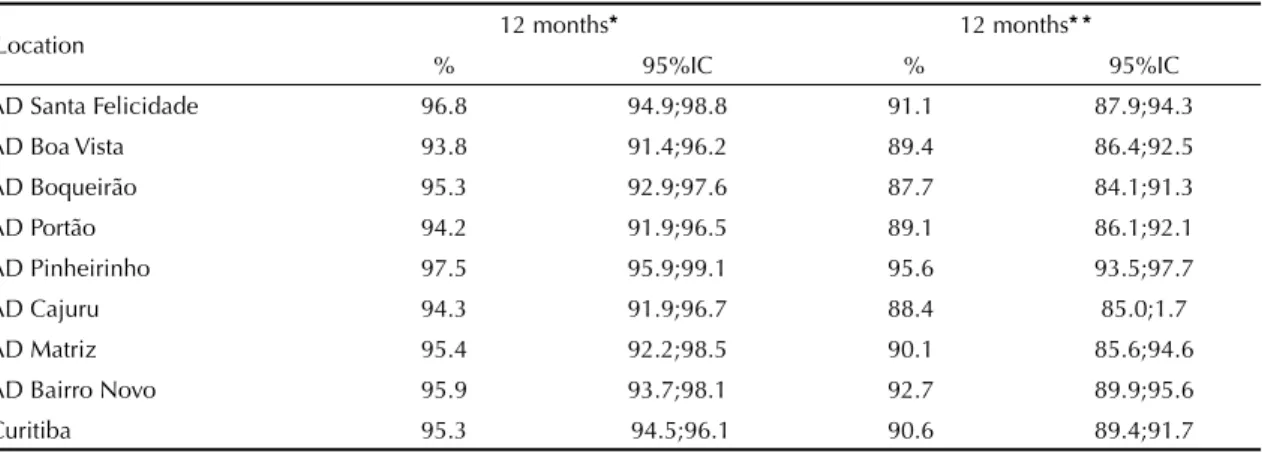
Estimated mean coverage of the complete schedule, for the entire municipality (Table 2), was 95.3% at 12 months and 90.6% at 24 months of age. A comparison of coverage rates among different ADs showed no differences at 12 months (p = 0.21), but identifi ed higher coverage at 24 months in the Pinheirinho AD (p = 0.01).
Maternal schooling was lower in the Pinheirinho and Bairro Novo districts, where the proportion of mothers with schooling below complete elementary was 44.5
b Ministério da Saúde. Secretaria de Atenção à Saúde. Programa de Saúde da Família. Brasília; 1997[cited 2004 Jul 13]. Available from:
and 45.2, respectively. These values were higher than the mean for the municipality (34.6%), and were in stark contrast to those found in the Matriz (17.7%), Boa Vista (28.2), and Santa Felicidade (30.6%) ADs (p < 0.001).
Weighting overall vaccination coverage to compensate for differential losses in different ADs slightly reduced coverage, to 95.0% (95%CI: 94.2; 95.7) at 12 months and 90.3% (95%CI: 89.3; 91.3) at 24 months.
Coverage was higher for single-dose vaccines (Table 3). The lowest coverages were detected for booster doses administered during the second year of life, especially DPT and antipoliomyelitis, as a consequence of missed or delayed vaccine doses.
The observed coverage for each type of vaccine was higher than that derived from administrative data (Table 3), which refer to vaccines administered in Curitiba regardless of district of residence. Administrative data represent the sum of vaccines administered in the munic-ipal network, and that are registered in the electronic registry (Quality-Health Card), and those administered by other immunization services not connected to the municipal network, including private ones.
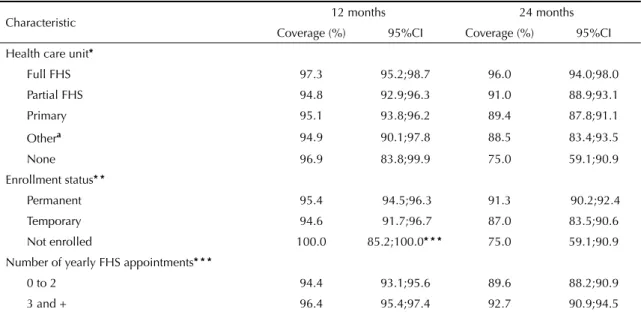
Analysis by type of health care unit in which the child is registered (Table 4) showed no difference in coverage at 12 months (p = 0.37). However, at 24 months, coverage was higher among children registered in full ESF units (p < 0.001).
Analysis by enrollment status also showed no differ-ences in coverage at 12 months (p = 0.46). However, coverage at 24 months was higher for children with permanent registers when compared to those without register or even with a temporary register (p < 0.001) (Table 4).
When considering the number of appointments a child had in the municipal network in the year the vaccine was administered, we found higher coverage among children with three or more appointments in UBS/ESF when compared to other children, both at 12 (p = 0.01) and 24 (p = 0.01) months (Table 4).
There were no differences in coverage between children with a single register and those with two or more registers at both ages (12 months: p = 0.79; 24 months: p = 0.58).
Table 1. Distribution of live births included in the sample and losses, according to birthweight and maternal and antenatal care characteristics. Curitiba, Southern Brazil, 2002.
Characteristic Losses Studied sample
n % 95%CI n % 95%CI p
Birthweight ≤ 2500 g 48 8.9 6.6;11.6 236 9.0 7.9;10.1 0.94
Mother’s age < 20 years 83 15.4 12.4;18.7 469 17.8 15.9;18.8 0.18
> 7 antenatal care appointments 118 21.9 18.4;25.6 502 19.0 17.5;20.5 0.13
Mother’s schooling ≤ 7 years 178 33.0 29.0;37.1 918 34.8 33.0;36.7 0.41
> 3 children born alive 50 9.3 6.9;12.0 259 9.8 8.7;11.0 0.69
Total live births 540 100.0 - 2637 100.0
-95%CI: 95% confi dence interval; p: p-value
Table 2. Overall vaccine coverage in the municipality and different administrative districts (AD) at ages 12 and 24 months. Curitiba, Southern Brazil, 2002.
Location 12 months* 12 months* *
% 95%IC % 95%IC
AD Santa Felicidade 96.8 94.9;98.8 91.1 87.9;94.3
AD Boa Vista 93.8 91.4;96.2 89.4 86.4;92.5
AD Boqueirão 95.3 92.9;97.6 87.7 84.1;91.3
AD Portão 94.2 91.9;96.5 89.1 86.1;92.1
AD Pinheirinho 97.5 95.9;99.1 95.6 93.5;97.7
AD Cajuru 94.3 91.9;96.7 88.4 85.0;1.7
AD Matriz 95.4 92.2;98.5 90.1 85.6;94.6
AD Bairro Novo 95.9 93.7;98.1 92.7 89.9;95.6
Curitiba 95.3 94.5;96.1 90.6 89.4;91.7
* p = 0.21 at 12 months
For all types of vaccine, there was a small proportion of non-valid incorrect doses, i.e., doses administered at a younger age or after a shorter interval than recom-mended (Table 5). On the other hand, there was a higher proportion of valid incorrect doses, administered
at a later age or after a longer interval than recom-mended. This proportion increased with age and dose sequence, reaching 32.2% for the interval between third dose and fi rst boost of DPT-Hib/DPT and 32.6% for antipoliomyelitis.
Table 3. Estimated vaccination coverage among children aged 12 and 24 months according to the survey and based on administrative data. Curitiba, Southern Brazil, 2002.
Vaccine Survey Administrative data
%a
% 95%CI 12 months
BCG 99.9 99.9;100.0 98.6
DPT-Hib (3 doses) 96.7 96.0;97.4 94.3
Antipoliomyelitis (3 doses) 96.8 96.1;97.5 93.3
Hepatitis B (3 doses) 97.3 96.7;97.9 93.1
24 months
MMR 98.6 98.0;99.1 nd
DPT-Hib (3 doses + 1 booster) 90.9 89.7;92.0 nd
Antipoliomyelitis (3 doses + 1 booster) 91.3 90.1;92.3 nd
BCGb 100.0 99.9;100.0 nd
Hepatitis B (3 doses)b 99.4 99.0;99.7 nd
BCG: Bacille Calmette Guérin; MMR: measles, mumps, rubella; DPT-Hib: Diphtheria, Tetanus, Pertussis, Haemophilus infl uenzae B; na: data not available.
a Doses of vaccine administered in 2003 divided by the number of live births in 2002 (source: Division of
Immunobiologicals of the Municipal Secretariat of Health of Curitiba).
b Considering doses administered between 12 and 24 months
95%CI: 95% confi dence interval
Table 4. Vaccine coverage among children aged 12 and 24 months according to type of health care unit, enrollment status, and number of medical appointments. Curitiba, Southern Brazil, 2002.
Characteristic 12 months 24 months
Coverage (%) 95%CI Coverage (%) 95%CI
Health care unit*
Full FHS 97.3 95.2;98.7 96.0 94.0;98.0
Partial FHS 94.8 92.9;96.3 91.0 88.9;93.1
Primary 95.1 93.8;96.2 89.4 87.8;91.1
Othera 94.9 90.1;97.8 88.5 83.4;93.5
None 96.9 83.8;99.9 75.0 59.1;90.9
Enrollment status* *
Permanent 95.4 94.5;96.3 91.3 90.2;92.4
Temporary 94.6 91.7;96.7 87.0 83.5;90.6
Not enrolled 100.0 85.2;100.0* * * 75.0 59.1;90.9
Number of yearly FHS appointments* * *
0 to 2 94.4 93.1;95.6 89.6 88.2;90.9
3 and + 96.4 95.4;97.4 92.7 90.9;94.5
FHS: family health strategy; 95%CI: 95% confi dence interval
a 24-Hour Health Unit and Elderly Care Health Unit. which do not carry out child health surveillance. The Elderly Care Health Unit is intended to provide care to older adults; however. it is traditionally considered as a reference center for vaccination at any age in the city center.
* p = 0.37 at 12 months; p <0.0001 at 24 months; one-tailed. 97.5%CI
* * p = 0.46 at 12 months; p < 0.0001 at 24 months.
DISCUSSION
The immunization program in Curitiba showed high coverage and substantial equity in the studied period, and enrollment in the health care network was a key factor in achieving these results.
The high coverage found at 12 months of age in the municipality, both for the full vaccination schedule and for each vaccine evaluated individually surpassed the goal set by the National Immunization Program and were higher than those detected in surveys carried out in other regions of the country.6,16,18 However, such comparisons should be undertaken cautiously given the different methodologies used.
The good coverage and absence of disparities between the different ADs at 12 months, and the greater coverage at 24 months in one of the sectors with lower socioeconomic status suggest that the immunization program in Curitiba is succeeding in promoting equity in health care.
In the present survey, estimated vaccine coverage was found to be higher among poorer strata of the popula-tion, as found recently in other countries.1,16 However,
classical studies in the literature have shown exactly the opposite.8 This inversion is likely to be a recent phenomenon, which should be further investigated in order to identify characteristics and attitudes of families and health care services in different settings.
Greater vaccination coverage at 24 months among children seen at PHUs that fully adopt FHS suggest that this strategy, which is now widely in use across the entire country, is effective, even though studies on the subject have shown confl icting results.11,18
Likewise, the fi nding that coverage is higher at 24 months among children with permanent records at the UBS, or with three or more medical appointments per year in the municipal network, suggests a positive infl uence of these services in ensuring the completion of the full vaccination schedule. The use of an EIR has also been found to be useful for monitoring adherence to vaccination and supporting remind/recall programs.5,9
The high proportion of delays in vaccine administration, especially among third and booster doses, indicates a need for improved recall/reminder strategies. The low proportion of vaccines administered at a younger age or shorter interval than recommended is a favorable
Table 5.Proportion of valid and non-valid incorrect doses according to type of vaccine and dose. Curitiba, Southern Brazil.
Vaccine Dose % Criterion
BCG Single dose 2.8 After 60 days of life
Hepatitis B
1st dose 0.9 After 30 days of life
2nd dose 8.0 More than 60 days after 1st dose
3rd dose 0.3 Less than 60 days after 2nd dose
15.1 More than 180 days after 2nd dose
Antipoliomyelitis
1st dose 0.9 Before 45 days of life
6.7 After 90 days of life
2nd dose 0.2 Less than 30 days after 1st dose
7.8 More than 90 days after 1st dose
3rd dose 0.3 Less than 30 days after 2nd dose
9.7 More than 90 days after 2nd dose
Booster 0.4 Less than 180 days after 3rd dose
32.6 More than 13 months after 3rd dose
DPT-Hib
1st dose 0.3 Before 45 days of life
6.3 After 90 days of life
2nd dose 0.2 Less than 30 days after 1st dose
6.9 More than 90 days after 1st dose
3rd dose 0.3 Less than 30 days after 2nd dose
10.9 More than 90 days after 2nd dose
DPT Booster 0.4 Less than 180 days after 3rd dose of Tetravalent
32.2 More than 13 months after 3rd dose of Tetravalent
MMR 1st dose 0.8 Before 1st birthday
11.1 After age 16 months
indicator of the performance of the vaccination program in the municipality. It is possible that automatic sched-uling of vaccination by EIR, which alerts health workers when the vaccine is being administered at an interval shorter than recommended, may have contributed towards this performance.22
Since the municipalization of health care services in 1991, Curitiba has been developing public policies aimed at strengthening primary health care and the connection between UBS teams and the population living in their territory of coverage by means of measures aimed at promoting equity in health care.17 Implementation of a component for registering and monitoring immunizations within the electronic patient registry is part of a strategy to promote the universaliza-tion of vaccine coverage.
The high coverage and expressive proportion of chil-dren with permanent registers allow us to consider the performance of EIR as positive.19 However, the high rate of under-reporting (11%) indicates that complete-ness is one of the major issues faced by EIR in Curitiba, a limitation that is also reported in the literature.13,14 Furthermore, the fi nding that vaccine coverage was higher in the survey when compared to that obtained from EIR-based administrative data suggests that coverage is underestimated.
Although we did not detect differences in immuniza-tion coverage according to the number of registers, register duplication is a limitation to the use of EIR,14 indicating that the method use for enrolling children and locating entries in the city’s electronic database needs to be improved.
The EIR performance indicators were not suffi ciently broad19 to allow for a proper evaluation of the contribu-tion of the EIR to the high coverage of immunizacontribu-tion. Nevertheless, EIR was found to be a useful instrument for monitoring coverage and promoting the completion of vaccination schedules.
The increasing use of electronic patient registries by municipal health care networks raises the need for a wide-ranging discussion of their use within the Brazilian National Health Care System (SUS), involving private and public facilities, in order to defi ne conceptual models and minimal standards for guiding the development of integrated health information
systems in Brazil.15 The broad computerization of health databases in the country, and the possibility of cross-referencing these databases will greatly improve access to information, and will increase the agility of planning and service evaluation.21
One aspect to be considered when interpreting the present results is that of losses, since these could lead to a nonresponder bias. However, we found that the studied sample did not differ from losses with respect to the most important characteristics investigated, including birthweight, mother’s age, presence of ante-natal care, schooling, and number of children born alive. Considering that nonresponder bias is associated with differential losses among categories of variables relevant to the study,10 we believe there is no evidence of bias substantial enough to invalidate our present results. On the other hand, losses were smaller in ADs with worse socioeconomic conditions, and this may have led to overestimation of coverage, given that in our settings adherence to vaccination seems to be greater among poorer strata of the population.16
Our results highlight the importance of monitoring health and health care service performance indicators within different micro-areas and socioeconomic strata, so as to subsidize managers in their evaluation of the impact of public health interventions.24 Moreover, based on our present results, we agree with other authors3,23 that interventions in the fi eld of public health, when administered within the realm of social inclusion poli-cies, constitute not only an instrument of promotion of health, but also of equity within this fi eld.
In conclusion, EIR was shown to be an effective tool for monitoring immunization coverage, including the
1. Ali M, Thiem VD, Park JK, Ochiai RL, Canh DG, Danovaro-Holliday C, et al. Geographic analysis of vaccine uptake in a cluster-randomized controlled trial
in Hue, Vietnam. Health Place. 2007;13(3):577–87.
DOI:10.1016/j.healthplace.2006.07.004
2. Atkinson WL, Pickering LK, Schwartz B, Weniger BG, Iskander JK, Watson JC, et al. General Recommendations on Immunization: Recommendations of the Advisory Committee on Immunization Practices (ACIP) and the American
Academy of Family Physicians (AAFP). MMWR
Recomm Rep. 2002;51(RR-2):1-35.
3. Barata RB. Iniqüidade e saúde: A determinação social
do processo saúde doença. Rev USP. 2001;51:138-45.
4. Camargo JRK, Coeli CM. RecLink: aplicativo para o relacionamento de base de dados, implementando
o método probabilistic record linkage. Cad Saude
Publica. 2000;16(2):439-47. DOI:10.1590/S0102-311X2000000200014
5. Center for Disease Control and Prevention. Notice to readers: Immunization registry standards of excellence in support of core immunization program strategies. MMWR Morb Mortal Wkly Rep. 2003;52(38):921.
6. Cesar JA, Mendonza-Sassi R, Horta BL, Ribeiro PRP, Ávila AC, Santos FM, Martins PB, Brandolt R. Indicadores básicos de saúde infantil em área urbana no extremo sul do Brasil: estimando
prevalências e avaliando diferenciais. J Pediatr (Rio J).
2006;82(6):437-44. DOI:10.2223/JPED.1550
7. Chen RT, Orenstein WA. Epidemiologic methods
in immunization programs. Epidemiol Rev.
1996;18(2):99-117.
8. Delamonica E, Minujin A, Gulaid J. Monitoring
equity in immunization coverage. Bull World Health
Organ. 2005;83(5):384-91. DOI:10.1590/S0042-96862005000500016
9. Development of community- and state-based immunization registries. CDC response to a report from the National Vaccine Advisory Committee. MMWR Morb Mortal Wkly Rep. 2001;50(RR-17):1-17.
10. Groves RM. Nonresponse rates and nonresponse bias
in household surveys. Public Opin Q.
2006;70(5):646-75. DOI:10.1093/poq/nfl 033
11. Guimarães TMR, Alves JGB, Tavares MMF. Impacto das ações de imunização pelo Programa Saúde da Família na mortalidade infantil por doenças
evitáveis em Olinda, Pernambuco, Brasil. Cad Saude
Publica. 2009;25(4):868-76. DOI:10.1590/S0102-311X2009000400018
12. Hinman AR. Immunization, Equity and Human Rights. Am J Prev Med. 2004;26(1):84-8. DOI:10.1016/j. amepre.2003.09.008
13. Hull BP, Lawrence GL, MacIntyre CR, MacIntyre PB. Immunisation coverage in Australia corrected for under-reporting to the Australian Childhood
Immunisation Register. Aust N Z J Public Health.
2003;27(5):533-8. DOI:10.1111/j.1467-842X.2003. tb00829.x
14. Kolasa MS, Chilkatowski AP, Clarke KR, Lutz JP. How complete are immunization registries? The Philadelphia
story. Ambul Pediatr. 2006;6(1):21-4. DOI:10.1016/j.
ambp.2005.08.006
15. Luhm KR, Waldman EA. Sistemas informatizados de registro de imunização: revisão com enfoque na saúde
infantil. Epidemiol Serv Saude. 2009;18(1):65-78.
16. Moraes JC, Ribeiro MCSA. Desigualdades sociais e cobertura vacinal: uso de inquéritos domiciliares. Rev Bras Epidemiol. 2008;11(Suppl 1):113-24. DOI:10.1590/S1415-790X2008000500011
17. Moysés SJ, Oliveira CAO, D’Angelis MA, Paciornik EF. A construção social do Distrito sanitário.In: Ducci L, Pedotti MA, Simão MG, Moysés SM. Curitiba: a saúde de braços abertos. Rio de Janeiro: Centro Brasileiro de Estudos da Saúde; 2001. p. 253-75.
18. Roncalli AG, Lima KC. Impacto do Programa de Saúde da Família sobre indicadores de saúde da criança em municípios de grande porte da região Nordeste
do Brasil. Cienc Saude Coletiva. 2006;11(3):713-24.
DOI:10.1590/S0102-311X2009000400018 19. Saarlas KN, Edwards K, Wild E, Richmond P.
Developing performance measures of immunization
registries. J Public Health Manag Pract.
2003;9(1):47-57.
20. Schneider AL, Margarida A, Ducci L. Informatização dos processos de trabalho em Curitiba – A história do cartão qualidade-saúde de Curitiba. In: Ducci L, Pedotti MA, Simão MG, Moysés SM. Curitiba: A saúde de braços abertos. Rio de Janeiro: Centro Brasileiro de Estudos de Sáude; 2001. p. 43-62.
21. Schout D, Novaes HMD. Do registro ao indicador: gestão da produção da informação assistencial nos
hospitais. Cienc Saude Coletiva. 2007;12(4):935-44.
DOI: 10.1590/S1413-81232007000400015
22. Sinn JS, Kronenburg MA, Morrow AL. The purpose and functions of immunization information systems within
health care organizations. Arch Pediatr Adolesc Med.
1997; 151(6):615-20.
23. Victora C, Vaughan P, Barros FC, Silva AC, Tomasi E. Explaining trends in inequities: evidence from Brazilian
child health studies. Lancet. 2000;356(9235):1093-8.
DOI:10.1016/S0140-6736(00)02741-0
24. Waldman EA. Mesa-redonda: desigualdades sociais e cobertura vacinal: uso de inquéritos domiciliares. Rev Bras Epidemiol. 2008;11(Suppl 1):129-32. DOI: 10.1590/S1415-790X2008000500013
REFERENCES
Article based on the doctoral thesis of Luhm KR, presented at the Faculdade de Saúde Pública da Universidade de São Paulo in 2008.