2010 Jul-Aug; 18(4):792-9
www.eerp.usp.br/rlae
Corresponding Author: Márcia Cristina Guerreiro dos Reis
Secretaria Municipal da Saúde de Ribeirão Preto Rua Prudente de Morais, 457
Centro
CEP: 14015.100 Ribeirão Preto, SP, Brasil E-mail: [email protected]
Prevalence of Anemia in Children Three to 12 Months Old in a Health
Service in Ribeirão Preto, SP, Brazil
Márcia Cristina Guerreiro dos Reis
1Ana Márcia Spanó Nakano
2Isília Aparecida Silva
3Flávia Azevedo Gomes
4Maria José Bistafa Pereira
5Iron deficiency anemia is the most common nutritional deficiency among children. This
cross-sectional, descriptive and quantitative study is part of a multicenter project, which verified
the prevalence of anemia in children aged three to 12 months, treated by a health service
unit in Ribeirão Preto, SP, Brazil. Interviews with mothers and determining hemoglobin
dosage were carried out with 121 children who participated in the study. Two international
criteria were adopted as parameters of anemia according to the children’s age. Descriptive
statistics, measures of central tendency and associations were used for data analysis. The
prevalence of anemia among 69 children aged three to 5 months was 20.2% and 48.0%
among 52 children aged six to 12 months. The total prevalence of anemia was 32.2%.
There was significant association between anemia and children’s age, and anemia and the
consumption of liquid cow’s milk.
Descriptors: Anemia; Prevalence; Child Health (Public Health).
1 RN, M.Sc. in Nursing, Programa de Saúde da Criança, Secretaria Municipal de Saúde de Ribeirão Preto, SP, Brazil. E-mail:
2 RN, Ph.D. in Nursing, Associate Professor, Escola de Enfermagem de Ribeirão Preto, Universidade de São Paulo, WHO Collaborating
Centre for Nursing Research Development, SP, Brazil. E-mail: [email protected].
3 RN, Ph.D. in Nursing, Full Professor, Escola de Enfermagem, Universidade de São Paulo, SP, Brazil. E-mail: [email protected]. 4 RN, Ph.D. in Nursing, Professor, Escola de Enfermagem de Ribeirão Preto, Universidade de São Paulo, Centro Colaborador da OMS
para o Desenvolvimento da Pesquisa em Enfermagem, SP, Brazil. E-mail: [email protected].
5 RN, Ph.D. in Nursing, Associate Professor, Escola de Enfermagem de Ribeirão Preto, Universidade de São Paulo, WHO Collaborating
www.eerp.usp.br/rlae
Prevalência de anemia em crianças de 3 a 12 meses de vida em um serviço de saúde de Ribeirão Preto, SP, Brasil
Das carências nutricionais entre crianças, a anemia ferropriva constitui-se no evento
mais frequente. Este é um estudo transversal, descritivo, quantitativo, recorte de um projeto multicêntrico, que veriicou a prevalência de anemia em crianças de 3 a 12 meses, em um serviço de saúde em Ribeirão Preto, SP. Foram realizadas entrevistas e
dosagem de hemoglobina de 121 crianças que participaram do estudo. Adotaram-se dois
critérios internacionais como parâmetros de anemia, de acordo com a idade da criança.
Para a análise dos dados foram utilizadas estatística descritiva, medidas de tendência
central e associações. A prevalência de anemia nas 69 crianças de 3 a 5 meses foi de
20,2% e naquelas 52, de 6 a 12 meses, foi de 48%. A prevalência total de anemia foi de 32,2%. Encontrou-se associação signiicativa entre anemia e idade da criança e anemia e uso de leite de vaca luido.
Descritores: Anemia; Prevalência; Saúde da Criança.
La prevalencia de anemia en niños de 3 a 12 meses de vida en un servicio de salud de Ribeirão Preto, SP, Brasil
Entre las carencias nutricionales de niños, la anemia ferropénica es la más frecuente.
Estudio transversal, descriptivo, cuantitativo es un extracto de un proyecto multicéntrico que veriicó la prevalencia de anemia en niños de 3 a 12 meses de edad, en un servicio de salud de Ribeirão Preto, SP, Brasil. Fueron realizadas entrevistas y dosiicación de hemoglobina en los 121 niños. Dos criterios internacionales fueron adoptados como
parámetro de anemia, de acuerdo con la edad del niño. Estadística descriptiva, medidas de tendencia central y testes de asociación fueron usados para el análisis de datos. La prevalencia de anemia en los 69 niños de 3 a 5 meses fue del 20,2%, y en los 52 niños de 6 a 12 meses fue del 48,0%. En total, la prevalencia de anemia fue del 32,2%. Encontró asociación signiicativa entre anemia y edad del niño y anemia y el consumo de leche de vaca liquido.
Descriptores: Anemia; Prevalencia; Salud del Niño.
Introduction
Anemia is deined by the World Health Organization as a condition in which the content of hemoglobin in the
blood is below normal levels for a given age, gender and physiological condition due to a deiciency of one or more essential nutrients, among them iron, folic acid,
zinc, vitamin B12 and proteins(1).
According to the United Nations Children’s Fund, 90% of all types of anemia in the world are due to deiciency of iron. Anemia in Latin and Central America is caused by a deiciency of iron, which has been characterized as a severe public health problem, affecting approximately
50% of pregnant women and children(2).
Studies addressing the prevalence of anemia in
developing countries, as in the case of Brazil, and in
low-income populations have been recommended(3). There is no national data in Brazil describing the prevalence of iron deiciency anemia, though studies carried out in several regions in the country have shown a signiicant increase of the prevalence and severity of iron deiciency anemia in risk groups in recent years(2,4). Regional data were obtained by a systematic review
addressing the prevalence of anemia in Brazil in studies
published between 1996 and 2007. More studies were
developed in the Southeast geographic region than in
other regions, though the North and Midwest, the least
anemia: more than half of the studied children presented
the disease(5). Its prevalence varies from 22.7% to 77.0% in the different regions and these discrepancies
are related to socioeconomic factors(4).
The causes of iron deiciency anemia may begin in the intra-uterine period due to a deiciency in the mother, since the physiological reserves of iron in the fetus are
formed in the last period of pregnancy. This reserve
jointly with iron acquired from maternal milk supports
the infant’s needs up to the sixth month of life.
The problem is aggravated in early childhood due
to incorrect feeding habits, especially during weaning,
when, maternal milk is frequently replaced by food that
is poor in iron. Cow’s milk is an example. Despite the fact
it presents the same level of iron as maternal milk, its
bioavailability is low(6). The quantity of iron in maternal milk is 0.1 to 1.6 mg/L with high bioavailability, which enables the infant’s system to absorb high levels of
iron, reaching about 50% to 70% of it. This process is
optimized by the presence of lactose, which participates
in the mechanisms of calcium and iron absorption, a fact
that has reinforced the evidence that maternal milk is
one of the most important sources of protection against
anemia in infants(7). Maternal nutrient deiciency during lactation may reduce the concentration of some of these
nutrients in maternal milk with consequent depletion
in the child. Coupled with this, iron absorption from
maternal milk diminishes up to 80% when other foods
begin to be consumed(8).
Therefore, we propose an investigation to address
anemia in children three to 12 months of age in a
health unit of Ribeirão Preto, SP, Brazil. This study is
part of a multicenter(9) study in which three cities in the Brazilian southeast region participated: Ribeirão
Preto-SP; São Paulo-SP and Rio de Janeiro-RJ. The results of
this study will contribute to other studies and support
the improvement of actions and protocols directed to
childcare and follow-up in health services.
The objective was to verify the prevalence of
anemia in children aged three to 12 months associated
with variables for children’s: age, gender, weight at
birth, gestational age, use of iron supplementation,
hemoglobin value (Hb) at the day of collection in a
health service in Ribeirão Preto.
Material and Method
This is a cross-sectional, observational, descriptive
and quantitative study. Three health services were
included in the overall study: BHU Vila Virginia, Ribeirão
Preto-SP; The Health Center School in Butantã, São
Paulo-SP, and the pediatric outpatient clinic in the
Institute Fernandes Figueira, Rio de Janeiro, RJ, Brazil.
The multicenter project and this study were approved
by Ethics Research Committee at the University of São
Paulo at Ribeirão Preto, College of Nursing, protocols
n° 342/2003 and 0538/2005 - CEP-EEUSP respectively,
in compliance with Resolution 196/96 of the National
Health Council.
Data were collected in the Basic Health Unit (BHU)
in Vila Virginia, in Ribeirão Preto-SP, which is located
in the south area of the city and was chosen because
it presents one of the highest rates of live birth in the city. Other factors such as the signiicant increase in exclusive breastfeeding rates in children younger than
four months of age and the systematization of actions
to promote breastfeeding were also relevant to this
choice.
Data were collected from December 1st 2005 to July 30th 2006. Study participants were mothers who agreed to participate in the study and their children aged three
to 12 months (incomplete) with appointments scheduled
in the pediatric service of the BHU Vila Virginia, Monday
through Friday in the afternoon, according to inclusion
and exclusion criteria.
Inclusion criteria included: children aged three to
12 months (incomplete), from any ethnic group and
social class with appointments scheduled in the unit
in the afternoon and who were accompanied by their
mothers.
Exclusion criteria: children with no medical ile in the unit; or with an acute infectious condition at the day
of the interview; or who were cared for in the pediatric
emergency care unit.
The age limits between three to 12 months of age
were established due to the fact that the concentration
of hemoglobin reaches the lowest value observed in
the child’s entire developmental period because of the
transformation of fetal hemoglobin to adult hemoglobin that occurs in the irst two months of life, which is referred to as “physiologic anemia of infancy”(2). The inluence of breastfeeding on anemia is better veriied in children younger than six months of age, and it is not predictive of iron deiciency after this period(10). However, we consider it important to analyze the prevalence of
anemia among children six to 12 months of age since
this is a period in which children’s diet is changed, that
is, it is a critical stage, which can frequently lead to the
disease when the child does not receive an appropriate
www.eerp.usp.br/rlae
Reis MCG, Nakano AMS, Silva IA, Gomes FA, Pereira MJB.
The following variables were considered for the
study’s descriptive analysis: maternal variables – age, schooling, number of children and occupation; and
children’s variables – age, gender, weight at birth,
gestational age, iron supplementation, hemoglobin value (Hb) at the day of collection. Two criteria were
used as indicators of anemia: Hb < 10.3 g/dl (Saarinen’s standard)(12) for children younger than six months of age and Hb< 11.0 g/dl (WHO standard)(13) for children aged six to 12 months. Other studied variables were related
to families’ life style and housing: type of housing, basic sanitation and variables related to breastfeeding and
liquid feeding. The categories proposed by PAHO/WHO(14) were used to classify breastfeeding and the categories Weaning (W) and Never Breastfed (NB) were included.
Exclusive Breastfeeding (EB): the child receives only maternal milk directly from the breast or extracted from
it and no other liquid or solid food, with the exception of medication or vitamin supplements; Predominant
Breastfeeding (PB): the child receives breast milk and also water or water-based beverages (teas, juices) and
no other liquid or solid food; Breastfeeding (B): the child receives breast milk regardless of any other liquid or
solid foods, including other types of milk; Weaning (W):
the child does not receive breast milk, but other types of milk, liquid or solid foods are offered; Never Breastfed
(NB): the child never received breast milk.
The presence or absence of anemia, categorized
by the two mentioned international standards according to age, was considered the dependent variable in the
association analysis and the independent variables were those related to the children and their diet focusing on
the types of breastfeeding, types of formulas, use of
water and tea.
Interviews with the mothers to complete the form
and blood collection from the children occurred after medical consultation. Blood samples were collected
from the children’s calcaneous to dose hemoglobin (Hb), a procedure performed with a portable photometer
(HemoCueR) for the direct and immediate reading of samples. This equipment is recommended in population
investigations to verify the prevalence of anemia. A small quantity of non-diluted blood is used; it promotes a
smaller risk of errors and presents immediate results(15). The hemoglobin value was disclosed to mothers and recorded on the children’s medical iles so measures were taken to diagnose and treat anemia if necessary.
Statistical analysis was performed using the
Statistical Package for Social Sciences (SPSS®
, version 11.5). Central tendency measures were used for
continuous quantitative variables: average, standard
deviation, median, minimum and maximum values. Chi-square and Fisher’s exact test with level of signiicance α = 0.05 were used to associate anemia and children’s variables and diet.
Results
A total of 121 mothers were interviewed. The majority
(93;76.6 %) lived with their partners; 90 (74.6%) were
housewives. The age of the mothers varied from 15 to 41 years old, with an average of 25.5 (sd=6.4) and median
of 24 years. In regard to schooling, 66 (54.5%) had
primary school (incomplete or complete); 2 (1.7%) were
illiterate and three (2.5%) had a bachelor’s degree. The average age of the children was 1.9; 56 (46.3%) were
primiparous. The majority of families, 113 (93.4%), lived
in masonry houses, while 55 (45.5%) lived in their own houses; 100% were connected to electricity; 95% had a
water connection; and 99.2% had garbage collection. The
majority of families (71;58.7%) lived with four people and one or two family members contributed to the family
income (80.2%).
In regard to the 121 children, 66 (54.5%) were male;
110 (91.0%) born at term; 69 (57.0%) were younger than six months, the average age was 189.9 days (sd=80.3)
and the median was 169 days. The lowest weight at birth
was 2,020 grams, the highest was 4,165 grams and the average was 3,188.4 grams (sd = 447.4).
In relation to breastfeeding, 78 (64.5%) where
being breastfed on the day of the interview and 43 (35.5%) were weaned, including two who were never
breastfed. Among the 78 children, seven (9.0%) were
EB; 13 (16.7%) were PB and 58 (74.3%) were B. Seven
(10.1%) out of the 69 (100.0%) children younger than six months of age were EB, 11 children (16%) were PB,
35 (50.7%) were B, while 25 of these were in mixed
breastfeeding, 15 (21.7%) were weaned and one (1.4%) was never breastfed.
Of the 52 (100.0%) children older than six months
of age, two (3.8%) were PB, 23 (44.2%) were B and 15 of these were in mixed feeding (eight children received
liquid cow’s milk and seven dried cow’s milk), eight were
B; 27 (52%) were weaned and one of them was never
breastfed.
For the total of 121 children, the average duration
of EB was 81.1 days (sd = 52.5) and the median was
90 days. For the total of 78 children who were being breastfed, the average duration of B was 170.7 days (5.7
(33.3%) out of the total of 69 children younger than
six months of age were receiving liquid and dried cow’s
milk respectively. The consumption of liquid cow’s milk
increased to 61.5% in children older than six months of
age, while the consumption of dried milk diminished to
23.1%. The consumption of water and/or tea was 82.6%
for the 69 children younger than six months.
Of the total of 121 children aged three to 12
months (incomplete) distributed according to age and
the hemoglobin value measured at the time of data
collection, average value and median of hemoglobin was 11.1g/dL; standard deviation was 1.41. The lowest value of hemoglobin found was 7.3 and the highest was 15.4 g/dL.
Tables 1 and 2 present the distribution of children
aged three to 12 months (incomplete) according to age
and anemia criteria. For the total of 69 (100%) children
aged three to 5 months (incomplete), the prevalence of
anemia was 20.2% (14) (Table 1). For children aged six to
12 months (incomplete), (n= 52) the prevalence of anemia
was 48.0%, based on the WHO criteria (Table 2).
Anemia (Saarinen’s standard)**
Age
(months)*
Yes No Total
n % n % n %
3 8 33.3 16 66.7 24 34.8
4 5 20 20 80 25 36.2
5 1 5 19 95 20 29
Total 14 20.2 55 79.8 69 100 Table 1 –Distribution of children aged three to 5 months
old*, cared for in the pediatric service of the BHU Vila
Virginia, in the afternoon, according to international
standards for anemia, from September 2005 to July
2005, Ribeirão Preto, SP, Brazil
*age in complete months + 29 days. **Saarinen’s standard, et al, 1868. Hb < 10.3 g/dl; < 6 months old.
Table 2 – Distribution of children aged six to 12 months
(incomplete), cared for in the childcare service of
the BHU Vila Virginia, in the afternoon, in relation to
international standards of anemia, from September
2005 to July 2006, Ribeirão Preto, SP, Brazil
Anemia (WHO standard)**
Age
(months)*
Yes No Total
n % n % n %
6 7 50 7 50 14 27
7 3 50 3 50 6 11.5
8 4 57 3 42.9 7 13.5
9 3 42.9 4 57.1 7 13.5
10 2 28.6 5 71.4 7 13.5
11 6 54.5 5 45.5 11 21
Total 25 48 27 52 52 100
*age in complete months + 29 days. **WHO standard, et al, 1868. Hb < 11.0 g/dl; > 6 months old.
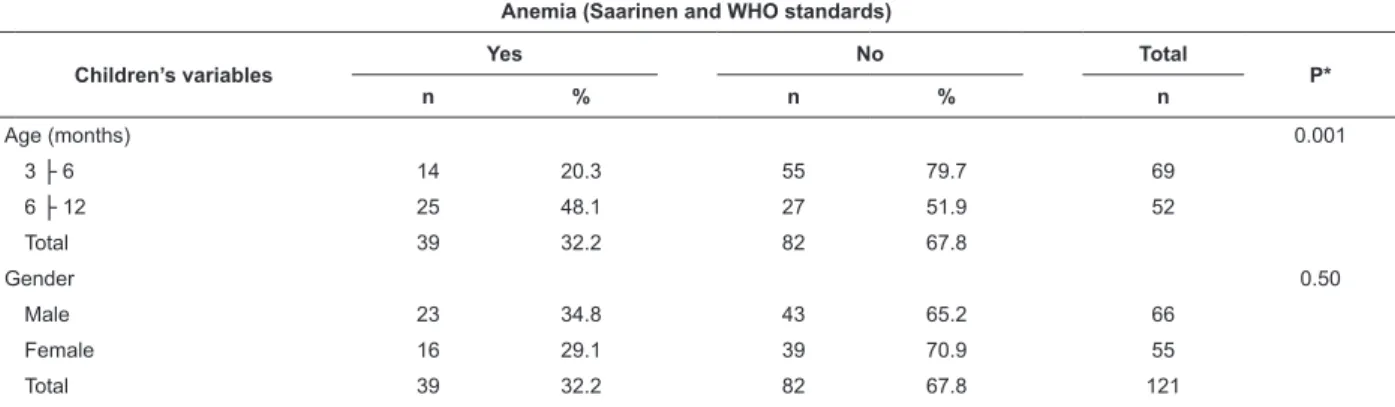
No statistical association was found between
anemia and children’s variables in the bivariate
analysis: gender, weight at birth, gestational age and
iron supplementation. However, we observed a higher
of prevalence of anemia among male children (34.8%),
among those whose weight at birth was above or equal
to 2,500 grams (32.4%), those whose gestational age
was above 37 weeks (32.7%) and among those who
did not take iron supplements (Table 3). There was
a strong association between anemia and children
older than six months of age (complete) (x2= 10.48, p<0.001).
Of the total of 121 children aged three to 12
months, the prevalence of anemia was 32.2% (29)
based on Saarinen’s standard for children younger
than six months of age (Table 1) and WHO standard for
children older than six months of age (Table 2).
Table 3 – Distribution of children’s variables (age, weight at birth, gestational age, iron supplement) associated with
anemia (Saarinen’s and WHO standards) for children aged three to 12 months (incomplete), cared for in the childcare
service of the BHU Vila Virginia, in the afternoon, from September 2005 to July 2006, , Ribeirão Preto, SP, Brazil
Anemia (Saarinen and WHO standards)
Children’s variables
Yes No Total
P*
n % n % n
Age (months) 0.001
3 ├ 6 14 20.3 55 79.7 69
6 ├ 12 25 48.1 27 51.9 52
Total 39 32.2 82 67.8
Gender 0.50
Male 23 34.8 43 65.2 66
Female 16 29.1 39 70.9 55
www.eerp.usp.br/rlae
Reis MCG, Nakano AMS, Silva IA, Gomes FA, Pereira MJB.
Table 3 – Continuation
Anemia (Saarinen and WHO standards)
Children’s variables Yes No Total P*
n % n % n
Weight at birth (grams) 1.0
< 2500 3 30 7 70 10
≥ 2500 36 32.4 75 67.6 111
Total 39 32.2 82 67.8 121
Gestational age 1.0
Pre-term 3 27.3 8 72.7 11
At term 36 32.7 74 67.3 110
Total 39 32.2 82 67.8 121
Iron supplement 0.66
Yes 5 27.8 13 72.2 18
No 34 33 69 67 103
Total 39 32.2 82 67.8 121
*Statistically signiicant at 5% level of signiicance on the hypothesis that the causal effect is due to random sampling
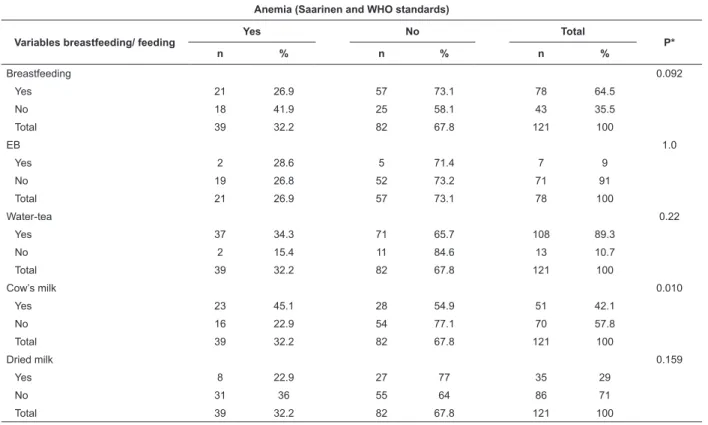
There was no statistically signiicant association between anemia and breastfeeding, regardless of
the type of breastfeeding , (x2=2.83, p=0.092) nor association between anemia and EB, or anemia and the
Anemia (Saarinen and WHO standards)
Variables breastfeeding/ feeding
Yes No Total
P*
n % n % n %
Breastfeeding 0.092
Yes 21 26.9 57 73.1 78 64.5
No 18 41.9 25 58.1 43 35.5
Total 39 32.2 82 67.8 121 100
EB 1.0
Yes 2 28.6 5 71.4 7 9
No 19 26.8 52 73.2 71 91
Total 21 26.9 57 73.1 78 100
Water-tea 0.22
Yes 37 34.3 71 65.7 108 89.3
No 2 15.4 11 84.6 13 10.7
Total 39 32.2 82 67.8 121 100
Cow’s milk 0.010
Yes 23 45.1 28 54.9 51 42.1
No 16 22.9 54 77.1 70 57.8
Total 39 32.2 82 67.8 121 100
Dried milk 0.159
Yes 8 22.9 27 77 35 29
No 31 36 55 64 86 71
Total 39 32.2 82 67.8 121 100
use of water and/or tea (Table 4). There was statistically signiicant association between the use of liquid cow’s milk and anemia (x2=6.68, p=0.010).
Table 4 – Distribution of variables breastfeeding/liquid feeding associated with anemia (Saarinen and WHO standards)
in children aged three to 12 months (incomplete), cared for in the childcare service in the BHU Vila Virginia, in the
afternoon, from September 2005 to July 2006, Ribeirão Preto, SP, Brazil
Discussion
The results refer to children cared for in a health unit from the Brazilian public network and do not relect the epidemiological situation of anemia in children
younger than one year of age in Ribeirão Preto, SP,
Brazil. However, studies addressing the prevalence of
anemia with representative samples of Brazilian cities
have reported similar or even superior values to those
found in this study(16).
In this study, the prevalence of anemia in children
aged three to 5 months (complete) was 20.2% regardless
of the type of breastfeeding. In comparing it with the
multicenter study carried out in the three studied cities,
the prevalence of anemia was 21.6% according to the
same standard for children younger than six months
of age(9). A study carried out in the state of São Paulo with children younger than six months of age, and in
Pernambuco, showed a prevalence of anemia of 59.1%
and 40% respectively(2).
There was an increase of anemia in the second
semester of life: 50.0% at six months of age and 48.0%
from six to 12 months (incomplete), which corroborates
data available in the literature and the results obtained
in the three cities from the multicenter study, which was
48.7% for children aged six to 12 months(9,17).
The prevalence of anemia in this study for the 121
children aged three to 12 months was 32.2% and when
compared with data from the multicenter study, the
value found was 35.1% (n= 443) according to the same
standards(9).
Birth conditions such as prematurity and low
birth-weight are described as risk factors relevant to anemia
since smaller reserves of iron are available at birth
and the early depletion of it lead to anemia(17). These associations were not signiicant in this study, perhaps due to the small number of children who presented such
characteristics (10 presented low weight at birth and 11
were premature).
In relation to the use of an iron supplement, its consumption was not statistically signiicant in relation to the absence of anemia. Of the total of 52 children
older than six years of age, 41 (78.8%) did not use an
iron supplement, unlike the remaining 11 (21.2%) who
did. This is a measure recommended by the Brazilian
Society of Pediatrics and by the Ministry of Health(18). Although the adoption of an appropriate diet
contributes to the maintenance of appropriate iron
nutritional levels during infancy, an additional source of iron during the irst two years of age is essential, whether
through medication supplements or fortiication of foods.
In places where the prevalence of anemia is high and the majority of foods consumed by infants are not fortiied with iron, the recommendation is that iron supplements
be a priority in the prevention of anemia(19-20).
A signiicant association between anemia and children’s age was found. Thus, children older than six
months of age were at a higher risk of acquiring anemia,
which agrees with results from other studies(9,17). In relation to breastfeeding, we veriied that the indicators found were below those recommended by
the Ministry of Health and WHO. In the comparison with
the multicenter study, in the three studied cities, the
institution in Rio de Janeiro presented the highest rate
of exclusively breastfed children (34.6%) followed by
São Paulo (15.6%). On the other hand, predominant
breastfeeding was highest among children in Ribeirão
Preto (16.7%) and lowest in Rio de Janeiro (1.5%). We
also observe in the three scenarios of the multicenter
study that the duration of EB in children younger than
four and six months diminished as they got older, as
observed in national studies in the state of São Paulo
and in Ribeirão Preto(21-22). Similar to this study, other studies did not ind signiicant association between anemia, EB and B(9,20).
The consumption of liquid cow’s milk has been identiied as one of the main determinants of anemia in the irst year of life(16). Corroborating another study(20),
we found a strong association between cow’s milk and
anemia (x2=6.68, p=0.010). Several studies agree with the indings of this study in relation to the early introduction of liquid cow’s milk and hemoglobin below
the recommended level. Casein and whey proteins from
cow’s milk, which constitute the protein fraction of the
majority of infant formulas, and industrialized baby food
negatively affect iron absorption, which is aggravated by
the increased need for iron imposed by the rapid growth
of children(23).
Feeding habits have been evidenced as determinants
closely related to anemia during infancy, among them:
brief exclusive breastfeeding; consumption of cow’s milk; late introduction and insuficient consumption of
food sources of iron, as well as foods that facilitate its
absorption.
Conclusions
The results of this study allowed determining that
the prevalence of anemia in children aged three to 12
www.eerp.usp.br/rlae
Reis MCG, Nakano AMS, Silva IA, Gomes FA, Pereira MJB.
Vila Virginia, in the afternoon, varied according to the
children’s age and standard used to detect anemia:
20.2% of the 69 children aged three to 5 months and
48% for 52 children aged six to 12 months (incomplete).
The prevalence of anemia in the 121 children aged three
to 12 months was 32.2% according to the Saarinen’s
and WHO standards.
Statistically signiicant association was found between anemia and children’s age and the consumption
of liquid cow’s milk. We draw attention to care provided
to children in this age range in the prevention, diagnosis
and treatment of this deiciency. Challenges and strengths are presented for the multi-professional team involved
with childcare. Support for mothers/women concerning
how to provide a diet appropriate for the growth and
development of their children requires a synergistic relationship between technical eficiency and the proper use of relational technology in order to welcome, listen
to and take co-responsibility with mothers/women.
Nursing practice allows the development of these
attributes, especially with women, to guide mothers/
women concerning their children’s care.
References
1. World Health Organization. Global strategy for infant and young child feeding. Geneva; 2001.
2. Coutinho GGP, Bertollo EMG, Benelli ECP. Iron deiciency anemia in
children: a challenge for public health and for society. Med J. (São Paulo). 2005; 123(2):88-92.
3. Ailinger R, Moore JB, Pawloski L, Cortés LRZ. Concepts of anemia among low income Nicaraguan women. Rev. Latino-Am. Enfermagem. março-abril
2009; 17(2):147-52.
4. Miranda AS, Franceschini SCC, Priore SE, Euclides MP, Araújo RMA, Ribeiro SMR. Anemia ferropriva e estado nutricional de crianças de 12 a 60 meses no município deViçosa, MG. Rev Nutr. 2003; (2):163-9.
5. Jordão RE, Bernardi JLD, Barros AA Filho. Prevalência de anemia
ferropriva no Brasil: uma revisão sistemática. Rev Paul Pediatria 2009; 27(1):90-8.
6. Rao R, Georgieff MK. Iron in fetal and neonatal nutrition. Semin Fetal & Neonat Med. 2007; 12:54-63.
7. Almeida JSG, Novak F. O leite humano: qualidade e controle. In: Santos Jr (org) Fisiologia e patologia da lactação. Natal: Ed Sociedade Brasileira de Mastologia; 1995.
8. Allen LH. Multiple micronutrients in pregnancy and lactation: an overview.
Am J Clin Nutr. 2005; 81 suppl:1206S-12S.
9. Reis MCG. Prevalência de anemia em crianças de 3 a 12 meses de vida em relação ao aleitamento materno, num serviço de saúde de Ribeirão Preto-SP. [dissertação]. Ribeirão Preto (SP): Escola de Enfermagem de Ribeirão Preto/USP; 2007.
10. Oliveira MAA, Osório MM. Consumo de leite de vaca e anemia ferropriva
na infância. J Pediatr. 2005; 81(5):361-7.
11. Simon VGN, Souza JMP, Souza SB. Introdução de alimentos
complementares e sua relação com variáveis demográicas e
socioeconômicas, em crianças no primeiro ano de vida, nascidas em Hospital Universitário no município de São Paulo. Rev Bras Epidemiol. 2003; 6(1):29-38.
12. Saarinen UM, Siimes MA. Developmental changes in red blood cell
counts and indices of infants after exclusion of iron deiciency by laboratory
criteria and continuous iron supplementation. J Pediatr. 1978; 92:412-6.
13. World Health Organization. Iron deiciency anaemia. Assessment, prevention, and control. A guide for program managers. Geneva: Who/ Unicef/Unu; 2001.
14. Organización Panamericana de la Salud. Indicadores para evaluar las
prácticas de lactáncia materna.Informe de una reunión. Ginebra; 1991.
15. Hudson-Thomas MA. Evaluation of the Hemocue for measuring
hemoglobin in ield studies in Jamaica. Bull WHO. 1994; 73(3):423-6.
16. Monteiro CA, Szarfarc SC, Mondini L. Tendência secular da anemia na
infância na cidade de São Paulo (1984-1996). Rev Saúde Pública. 2000; 34:62-72.
17. Osório MM. Fatores determinantes da anemia em crianças. J Pediatr
(Rio de Janeiro). 2002; 78940:269-78.
18. Ministério da Saúde (BR). Secretaria de Atenção à Saúde. Departamento de Atenção Básica. Manual operacional do Programa Nacional de Suplementação de Ferro. Brasília (DF): Ministério da Saúde; 2005.
19. Assunção MCF, Santos IS. Efeito da fortiicação de alimentos com ferro
sobre anemia em crianças: um estudo de revisão. Cad Saúde Pública. 2007; 23(2):269-81.
20. Silva DG, Priori SE, Franceschinni SC. Risk factors for anemia in infants assisted by public health services: the importance of feeding practices and iron supplementation. J Pediatr (Rio de Janeiro) 2007; 83(2):149-56. 21. Venâncio SI. Freqüência e determinantes do aleitamento materno em municípios do Estado de São Paulo. Rev Bras Epidemiol. 2002; 36(3)313-8.
22. Pereira MJB. Indicadores de aleitamento materno no município de Ribeirão Preto, SP. Rev Bras Epidemiol. 2004; 7(1):36-43.
23.Oliveira MA, Osório MM. Consumo de leite de vaca e anemia ferropriva
na infância. J Pediatr (Rio de Janeiro). 2005; 81:361-7.
Received: May. 10th 2009