ABSTRACT:Introduction: Anemia in children is a public health issue, and the current strategies include treatment
and iron supplementation, but their level of adherence or compliance is unknown. Objective: To consider the adherence to multiple micronutrient powders and the associated factors. Methods: Epidemiological study of active surveillance through sentinel facilities in 2,024 children aged 6 to 35 months treated in health facilities of the Ministry of Health of Peru, from October to December 2014. Household visits were conducted in which counting of multiple micronutrient powders was applied and determined an adherence of consumption ≥ 90% envelopes, besides a form on the associated factors (anemia knowledge, iron-rich food, side efects, dosage regimen, drugs used, and motivation) was applied. Descriptive statistics, χ² test, Odds Ratio with a 95% conidence interval (CI), and binary logistic regression or adjusted Odds Ratio (aOR) were used. Results: Of all, 79.1% participants were aged 6 to 23 months; 75.9% received multiple micronutrient powders; and the adherence was equivalent to 24.4% (95%CI 22.3 – 26.6). The factors: continue supplementation (OR = 3.5; 95%CI 1.7 – 7.5); no nausea (OR = 3.0; 95%CI 2.0 – 4.3); no use of antibiotics (OR = 2.5; 95%CI 1.7 – 3.6); and intention to continue treatment (OR = 2.3; 95%CI 1.3 – 4.1) were associated with adherence. The variables: thought of continuing treatment (aOR = 2.6; 95%CI 1.1 – 6.1); presence of side efects, but no discontinuation of the treatment (aOR = 2.5; 95%CI 1.4 – 4.3); no use of antibiotics (aOR = 2.0; 95%CI 1.1 – 3.4); and belief that not only drugs cure anemia (aOR = 1.6; 95%CI 1.0 – 2.6) were associated in the multivariate analysis. Conclusion: There was a low prevalence of adherence to a demanding cut-of point (≥ 90% of envelopes of multiple micronutrient powders), and the associated factors are associated with absence of infections, side efects, and mother’s beliefs.
Keywords: Medication adherence. Micronutrient. Child. Anemia. Peru.
Adherence to multiple micronutrient powders
and associated factors in children aged 6 to
35 months treated in sentinel health facilities,
Ministry of Health of Peru
Adherencia a multimicronutrientes y factores asociados en niños de
6 a 35 meses de sitios centinela, Ministerio de Salud, Perú
Oscar Munares-GarcíaI, Guillermo Gómez-GuizadoII
IDepartment of Research and Development, National Superintendence of Health Authority, Academic Department of Obstetrics,
San Fernando School of Medicine, National University of San Marcos – Lima, Peru.
IINational Center of Food and Nutrition, National Institute of Health, Academic Department of Basic Sciences, School of Human
Medicine, University of San Martin de Porres – Lima, Peru.
Corresponding author: Oscar Munares García. Avenida Tizón y Bueno, 276. Lima 11, Peru E-mail: [email protected]
INTRODUCTION
According to the Demographic and Health Survey of Peru1, anemia in children aged 6 to 35 months had a small decrease in the last 7 years, from 56.8 (2007) to 46.4% (2013). In the last 10 years, the equity themes that became essential for the regional and sup-ported development were developed in Latin America2. Since 2010, we have been liv-ing under a health universal assurance in Peru (under the Law 29344), and the health system has implemented strategies to decrease public health issues, among them chil-dren’s anemia.
The prevention of child’s iron deiciency begins in the prenatal care and during breast-feeding. It has been discussed in literature the maternal deiciency on the neonate’s iron condition, and the most relevant data seem to indicate that children of mothers with iron-deiciency anemia are born with decreased storages of such substance3. After 6 months of breastfeeding, iron intake is not appropriate4, therefore food should be rein-forced, because if these children do not receive proper treatment, they will have their skills reduced5, present growth delay, low body weight, and wasting6. Treatments based on the administration of ferrous sulfate against anemia have been cost-efective. A review has found that the consumption of daily supplements is more efective than weekly intakes to improve the hemoglobin levels7. However, this treatment as a public health intervention would mainly cause low adherence and side efects8,9, although studies have showed high
RESUMEN:Introducción: La anemia en el niño es un problema de salud pública, las estrategias actuales incluyen el tratamiento y suplementación con hierro, pero se desconoce su nivel de adherencia o cumplimiento. Objetivo:
Considerar la adherencia a los multimicronutrientes y los factores asociados. Métodos: Estudio epidemiológico de vigilancia activa por sitios centinela en 2.024 niños entre los 6 hasta los 35 meses atendidos en establecimientos de salud del Ministerio de Salud del Perú, entre octubre a diciembre de 2014. Se realizaron visitas domiciliarias, en las cuales se aplicaron el conteo de multimicronutrientes, que determinó la adherencia al consumo ≥ 90% de sobres, y un formulario sobre los factores asociados (conocimiento sobre anemia, alimentos ricos en hierro, efectos secundarios, esquema de dosis, medicamentos consumidos y motivación). Se emplearon estadísticas descriptivas, el test del χ², Odds Ratio con IC95% y la regresión logística binaria u OR ajustado (ORa). Resultados: 79,1% tenían entre 6 a 23 meses, 75,9% recibieron multimicronutrientes y la adherencia fue del 24,4% (IC95% 22,3 – 26,6). Los factores: seguir con la suplementación (OR = 3,5; IC95% 1,7 – 7,5); no tener náuseas (OR = 3,0; IC95% 2,0 – 4,3); no tomar antibióticos (OR = 2,5; IC95% 1,7 – 3,6) e intenciones de seguir con el tratamiento (OR = 2,3; IC95% 1,3 – 4,1) se asociaron a la adherencia. El análisis multivariado asoció pensar que debe continuar con el tratamiento (ORa = 2,6; IC95% 1,1 – 6,1); si presentó algún efecto secundario, no suprimió el tratamiento (ORa = 2,5; IC95% 1,4 – 4,3), el niño no tomó antibióticos (ORa = 2,0; IC95% 1,1 – 3,4) y creencia que anemia no solo se cura con medicamentos (ORa = 1,6; IC95% 1,0 – 2,6). Conclusión: Hubo una baja prevalencia de adherencia para un punto de corte exigente (≥ 90% sobres de multimicronutrientes consumidos) y los factores asociados están relacionados con ausencia de infecciones, efectos secundarios y creencias de la madre.
adherence (32 to 90%)10 when using multiple micronutrient powders (MMN), including lexible and daily regimens (Bangladesh) (88 to 98%)11.
The World Health Organization states that therapeutic adherence is the level in which the behavior of a person, medication use, food diet compliance, and performance of life-style alterations correspond to the recommendations agreed with the sanitation care pro-vider12, which is also applied in children. A Cochrane review has demonstrated that the MMN, also called Chispitas® or Sprinkles, reduce the rate of anemia in 31% and iron-de-iciency in 51% when compared with placebo10. MMN are an important strategy and an option to solve and prevent anemia in Asia, Africa, and in prioritized communities in developed countries13. The locations that have widely implemented the MMN, such as Mongolia, were seen with a high rate of compliance (76.6% of the parents or guardians want to continue their use)14. In Bolivia, 69% of the guardians are still supplying the MMN15.
Due to the high prevalence of anemia in children, the Peruvian government with international support implemented, between the years of 2009 to 2011, a pilot program in three regions of the country to supplement children’s diets with MMN16. Then, the program was extended to other regions through a progressive implementation, and, in 2014, the globalization of the supplementation began with an estimated population of 1,400,000 children aged 6 to 35 months17. To do this, the respective directive was oicially published together with other activities such as counseling and monitoring18, and this reg-imen was initially applied as a supplement, which will also be used for anemia treatment19. A study conducted in Apurímac (Peru, in 2010) including 664 children aged 6 to 35 months evaluated the proper consumption of MMN, which reached 4.1% in children who consumed less than 30 envelopes and 14.5% in those that consumed between 30 or less than 60 envelopes. Therefore, the authors found out that not only we need to deliver or consume the necessary amount, but also ensure the proper consumption process20. Another study conducted in Ayacucho, Andahuaylas, and Huancavelica found that 20.5% of the patients discontinued the supplementation21. In Kenya (2013), the factors associ-ated with adherence to MMN included: early age (higher prevalence of children aged 6 – 23 months than 24 – 35 months, adjusted Odds ratio (aOR = 1.5; p = 0.02), more than two quintiles of socioeconomic level (aOR = 1.7; p = 0.04), home care (aOR = 2.8; p < 0.001), and promotion of free consumption, calendars, cups, and T-shirts (aOR = 1.7; p = 0.04)9. The objective of this study was to consider the adherence to MMN and its factors associated in children aged 6 to 35 months cared in the Ministry of Health insti-tutions from 12 regions in Peru, from October to December 2014.
METHODS
TYPE OF STUDY AND OUTLINE
out to choose the facilities, considering their distribution and space-population represen-tativeness22. According to the plan to decrease anemia, 65.0% of the children aged 6 – 35 months should have received MMN in 2014.
SELECTION OF SENTINEL FACILITIES
The main information from 2013 of the institutions that reported data of children’s anemia to the National Center of Food and Nutrition (CENAN) of the National Institute of Health (NHI) was collected. A total of 4944 institutions were included: 108 hospitals, 1083 health centers, and 3753 health clinics. Micro-ield areas of information with enough sensitivity to monitor the supplementation with MMN were considered. Such facilities presented a rate of anemia similar to the region and had a similar territorial relation, that is, if the area was from the countryside and had a 45% prevalence of children’s anemia, institutions in the same place that had a similar proportion of anemia and that histori-cally sent information to CENAN were searched. Therefore, the facility with the largest population was chosen and, by following the same criterion, we achieved 34 institutions: 3 hospitals, 22 health centers, and 9 health clinics that had a space-population represen-tation based on the urban–rural and regional scope from 12 regions in Peru.
SAMPLE
Data were collected from October to December 2014. The 34 institutions registered a total amount of 4896 children in the growth and development oices (CRED). The inclu-sion criteria were children aged 6 – 35 months, cared in the last 30 days, with a located home, whose mother or guardian accepted to participate in the study; whereas children diagnosed with non-iron deiciency anemia of any other etiology were excluded, thus corresponding to a total of 2024 children chosen by convenience.
VARIABLES
Age (in months), educational level of the mother or guardian, altitude of sea level, kind of health institution (health clinics, health center, or hospital), and the scope (urban or rural) were measured. The factors associated with adherence include:
• Dosage regimen – continuing supplementation is healthier to the child, and the treatment is easy to comply with;
• Side efects – the child has had nausea; if the child presented any side efects, the treatment would be interrupted;
• Motivation – intends to continue the treatment with the child, he/she is getting better with the treatment, he/she plans to inish treatment, he/she has received a good care in the health institution;
• Beliefs – his/her family believes he/she should continue treatment, he/she believes anemia can only be cured with medications;
• Anemia knowledge – he/she has anemia due to lack of supplements or vitamins and knows the importance of iron; and
• Consumption of iron-rich foods – his/her child consumes chicken blood, and has diiculties in providing iron-rich foods to the child.
The Ministry of Health of Peru approved the MMN structure: 12.5 mg of elemental iron, 5 mg of zinc, 160 μg of folic acid, 300 μg of retinol (RE) equivalents of vitamin A, and 30 mg of vitamin C18. To establish the adherence to MMN, an evaluation of what was received and consumed in the last 30 days was carried out, using the following formula:
Adherence to MMN = x 100
Total amount of delivered MMN envelopes Amount of consumed MMN envelopes
The child was considered an adherent when such proportion was equal to or higher than 90%21.
PROCEDURES
and the associated factors. Data forms and the record sheet of adherence to MMN were used as instruments. The supervision of investigators was implemented in the ield; the CENAN staf veriied the quality of registrations; each investigator received a supervi-sion visit with the exception of three areas that received a second supervisupervi-sion. A speciic app was developed so that investigators could type all information. The forms in physical medium were sent to CENAN for information processing.
ETHICAL ASPECTS
In 2014, due to the increase of anemia in children younger than 5 years old in Peru, as a response, the Ministry of Health implemented a plan to decrease child chronic malnu-trition and prevent anemia, which was published by the ministerial resolution 258-2014/ MINSA (March 31, 2014), considering anemia a public health issue. CENAN is in charge of the sentinel surveillance of the adherence to MMN in such plan.
This study is part of the implementation of such strategy, because it did not have a surveillance system for this event. The General Administration of CENAN approved this activity. Due to this need and because we are dealing with surveys, the evaluation had minimal risk. The ethical principles were applied in the investigation to the participating mother, who were also ofered educational reports on anemia and were asked to inform the health institution after their participation ended. The principle of autonomy was fol-lowed in the entire process. The study comprised of volunteers, and all participants signed the informed consent. The information was obtained conidentially, that is, the identii-cation data were not used for the study, no blood samples were taken, and data were col-lected from CRED cards and from interviews with the mothers or guardians.
DATA ANALYSIS
RESULTS
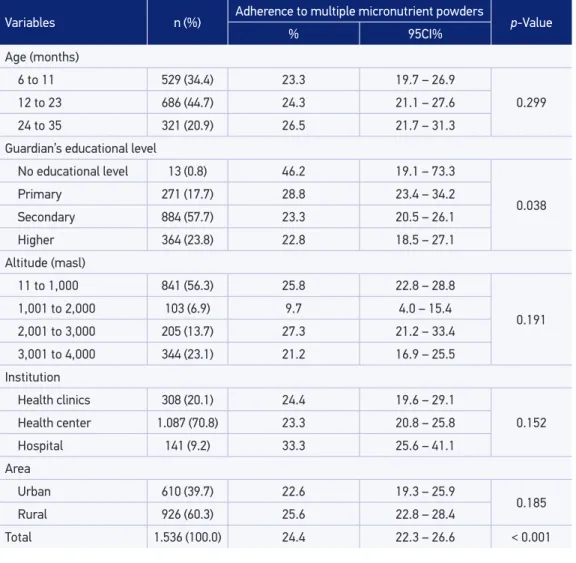
A total of 79.1% children were aged 6 – 23 months, 34.4% between 6 to 11 months, and 44.7% between 12 to 23 months. Of all, 57.7% mothers or guardians had a second-ary educational level; 56% children came from an altitude of less than 1000 meters above sea level (masl), and 23% at one between 3001 and 4000 masl. A total of 70.8% were from health centers and 60.3% were from the rural area (Table 1).
Among the 2204 children aged 6 – 35 months evaluated, 75.9% had received the MMN (n = 1536); the adherence proportion was of 24.4% in those receiving MMN (95%CI 22.3 – 26.6%), which was a signiicant value (p < 0.001). The adherence was higher in moth-ers who did not have an educational level (46.2%). There were no diferences regarding
Variables n (%) Adherence to multiple micronutrient powders p-Value
% 95CI%
Age (months)
6 to 11 529 (34.4) 23.3 19.7 – 26.9
0.299
12 to 23 686 (44.7) 24.3 21.1 – 27.6
24 to 35 321 (20.9) 26.5 21.7 – 31.3
Guardian’s educational level
No educational level 13 (0.8) 46.2 19.1 – 73.3
0.038
Primary 271 (17.7) 28.8 23.4 – 34.2
Secondary 884 (57.7) 23.3 20.5 – 26.1
Higher 364 (23.8) 22.8 18.5 – 27.1
Altitude (masl)
11 to 1,000 841 (56.3) 25.8 22.8 – 28.8
0.191
1,001 to 2,000 103 (6.9) 9.7 4.0 – 15.4
2,001 to 3,000 205 (13.7) 27.3 21.2 – 33.4
3,001 to 4,000 344 (23.1) 21.2 16.9 – 25.5
Institution
Health clinics 308 (20.1) 24.4 19.6 – 29.1
0.152
Health center 1.087 (70.8) 23.3 20.8 – 25.8
Hospital 141 (9.2) 33.3 25.6 – 41.1
Area
Urban 610 (39.7) 22.6 19.3 – 25.9
0.185
Rural 926 (60.3) 25.6 22.8 – 28.4
Total 1.536 (100.0) 24.4 22.3 – 26.6 < 0.001
children’s age (p = 0.299), sea level altitude (p = 0.191), health institution (p = 0.152), and urban and rural regions (p = 0.185) (Table 1).
The factors associated with adherence were:
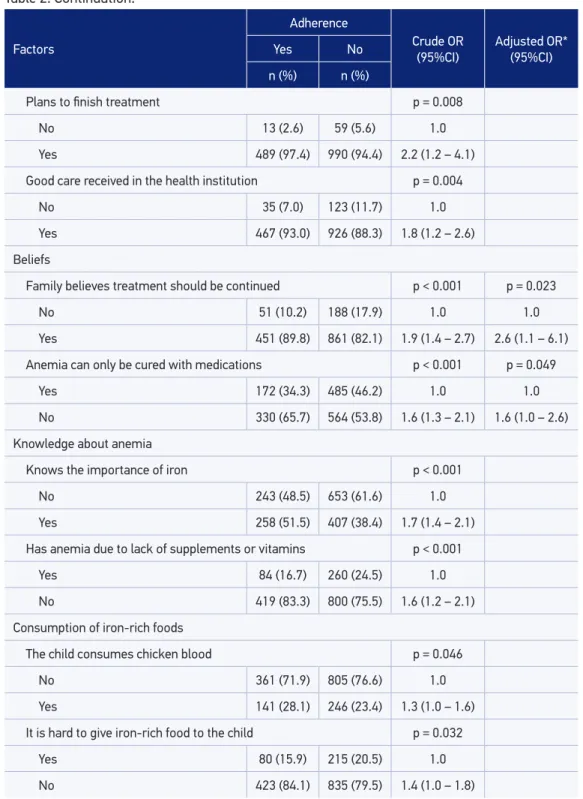
• Dosage regimen – continuing supplementation, it is healthier to the child (OR = 3.5; 95%CI 1.7 – 7.5);
• Side efects – the child has not had nausea (OR = 3.0; 95%CI 2.0 – 4.3), if the child presented a side efect, the treatment was not discontinued (OR = 2.1; 95%CI 1.6 – 2.8);
• Consumed medications – the child has not taken antibiotics (OR = 2.5; 95%CI 1.7 – 3.6), it is not hard to give him/her the iron supplement (OR = 2.3; 95%CI 1.8 – 2.9);
• Motivation: he/she intends to continue the treatment of his/her child (OR = 2.3; 95%CI 1.3 – 4.1), the child gets better with the treatment (OR = 2.3; 95%CI 1.6 – 3.2), he/she plans to inish treatment (OR = 2.2; 95%CI 1.2 – 4.1), he/she received good care in the health institution (OR = 1.8; 95%CI 1.2 – 2.6);
• Beliefs – the family believes he/she should continue treatment (OR = 1.9; 95%CI 1.4 – 2.7) and does not believe anemia cured only with drugs (OR = 1.6; 95%CI 1.3 – 2.1);
• Consumption of iron-rich foods – he/she does not have diiculties in giving the child iron-rich foods (OR = 1.4; 95%CI 1.0 – 1.8), his/her child consumes chicken blood (OR = 1.3; 95%CI 1.0 – 1.6), and it is not hard to give iron-rich foods to the child (OR = 1.4; 95%CI 1.0 – 1.8);
• Other factors such as anemia knowledge were also associated but without signiicant values (Table 2).
The logistics regression model indicated four factors associated with adherence to MMN: no use of antibiotics (aOR = 2.0; 95%CI 1.1 – 3.4); if the child had any side efects, the mother did not discontinue treatment (aOR = 2.5; 95%CI 1.4 – 4.3); if the family believed the child should continue with the supplementation (aOR = 2.6; 95%CI 1.1 – 6.1), and lack of believe that anemia is only cured with drugs (aOR = 1.6; 95%CI 1.0 – 2.6). This model was considered appropriate (Hosmer–Lemeshow test = 2.063; p = 0.914), and explained 6 – 9% of the problem variance (Table 2), even though it had a good predictive power (area under the ROC curve = 0.659), thus indicating that these factors diferentiate the adherent child from the non-adherent child well (Figure 1).
DISCUSSION
Factors
Adherence
Crude OR (95%CI)
Adjusted OR* (95%CI)
Yes No
n (%) n (%)
Dosage regimen
Continue supplementation, it is healthier to the child p < 0.001
No 8 (1.6) 57 (5.4) 1.0
Yes 494 (98.4) 992 (94.6) 3.5 (1.7 – 7.5)
It is easy to comply with the treatment p = 0.001
No 450 (89.5) 870 (82.9) 1.0
Yes 53 (10.5) 179 (17.1) 0.6 (0.4 – 0.8)
Side efects
The child has nausea p < 0.001
Yes 37 (7.4) 200 (19.1) 1.0
No 465 (92.6) 849 (80.9) 3.0 (2.0 – 4.3)
Presence of side efect, therefore the treatment was discontinued p < 0.001 p = 0.002
Yes 75 (16.5) 269 (29.0) 1.0 1.0
No 380 (83.5) 657 (71.0) 2.1 (1.6 – 2.8) 2.5 (1.4 – 4.3)
Used medications
Antibiotics p < 0.001 p = 0.016
Yes 108 (58.7) 283 (77.7) 1.0 1.0
No 76 (41.3) 81 (22.3) 2.5 (1.7 – 3.6) 2.0 (1.1 – 3.4)
It has been hard to give the iron supplement to the child p < 0.001
Yes 114 (22.7) 422 (40.2) 1.0
No 388 (77.3) 628 (59.8) 2.3 (1.8 – 2.9)
Motivation
Intends to continue the child’s treatment p = 0.004
No 14 (2.8) 65 (6.2) 1.0
Yes 488 (97.2) 983 (93.8) 2.3 (1.3 – 4.1)
The child gets better with the treatment p < 0.001
No 39 (7.8) 167 (15.9) 1.0
Si 463 (92.2) 881 (84.1) 2.3 (1.6 – 3.2)
Table 2. Factors associated with adherence to multiple micronutrient powders in children aged 6 – 35 months, Ministry of Health, 2014.
Factors
Adherence
Crude OR (95%CI)
Adjusted OR* (95%CI)
Yes No
n (%) n (%)
Plans to finish treatment p = 0.008
No 13 (2.6) 59 (5.6) 1.0
Yes 489 (97.4) 990 (94.4) 2.2 (1.2 – 4.1)
Good care received in the health institution p = 0.004
No 35 (7.0) 123 (11.7) 1.0
Yes 467 (93.0) 926 (88.3) 1.8 (1.2 – 2.6)
Beliefs
Family believes treatment should be continued p < 0.001 p = 0.023
No 51 (10.2) 188 (17.9) 1.0 1.0
Yes 451 (89.8) 861 (82.1) 1.9 (1.4 – 2.7) 2.6 (1.1 – 6.1)
Anemia can only be cured with medications p < 0.001 p = 0.049
Yes 172 (34.3) 485 (46.2) 1.0 1.0
No 330 (65.7) 564 (53.8) 1.6 (1.3 – 2.1) 1.6 (1.0 – 2.6)
Knowledge about anemia
Knows the importance of iron p < 0.001
No 243 (48.5) 653 (61.6) 1.0
Yes 258 (51.5) 407 (38.4) 1.7 (1.4 – 2.1)
Has anemia due to lack of supplements or vitamins p < 0.001
Yes 84 (16.7) 260 (24.5) 1.0
No 419 (83.3) 800 (75.5) 1.6 (1.2 – 2.1)
Consumption of iron-rich foods
The child consumes chicken blood p = 0.046
No 361 (71.9) 805 (76.6) 1.0
Yes 141 (28.1) 246 (23.4) 1.3 (1.0 – 1.6)
It is hard to give iron-rich food to the child p = 0.032
Yes 80 (15.9) 215 (20.5) 1.0
No 423 (84.1) 835 (79.5) 1.4 (1.0 – 1.8)
Table 2. Continuation.
1.0
0.8
0.6
0.4
0.2
0.0
1 – Specificity
Sensitivity
0.0 0.2 0.4 0.6 0.8 1.0
Curve area: 0.659 Lower limit: 0.598 Upper limit: 0.719
p < 0.001
Figure 1. ROC curve to predict the factors associated with adherence to multiple micronutrient powders in children aged 6 – 35 months.
Among the 2024 studied children, 75.9% received MMN, and this rate was higher than the expected for the same year (65%); but it was estimated this would get to 95%17 in 2016. Thus, it indicates that for the study months, the coverage was higher than the expected.
The rate of adherence was 24.4% (95%CI 22.3 – 26.6). According to a report from the World Health Organization, there is not a “gold standard” to measure the behavior of adherence. Therefore, to determine the adherence to MMN, the use of a new counting of the consumed envelopes can be a strategy, which is recommended both in the house-hold visit and in the clinics. However, new counting errors are common and open space characteristically to the overestimation of the behavior28, which can be complemented with other instruments, such as standardized tests. The patient should consume a 100% rate of the recommended amount, which is not very practical, but it is the main point for the ideal determination of the therapeutic adherence. This was tried to MMN cases in which the cut-of point varied from 75 to 100% of the consumption.
An evaluation carried out by the CENAN found that 25% of the children from the urban region and 32.1% from the rural region older than 1 year consumed the MMN completely (90 or more envelopes). It also indicated that in children that inished more than 75% of the dosage, there was a decrease of anemia12. A review with studies from Bangladesh, Kenya, and Nepal about programs with MMN concluded that the preva-lence of anemia was smaller in children aged 6 – 24 months that consumed more than 75% of the MMN compared to those that had an adherence < 75% (50.0 versus 61.0%)29. Another study showed a cut-of point of 80%30. Adherence is more diicult to be com-plied with when treatments are longer and happen on a daily basis, thus an investigation compared three regimens for MMN: a group consumed them for 4 months on a lexible basis, another during 3 months in the same basis, and the last one during 2 months on a daily basis. The rate of children who consumed all prescribed envelopes (100% adherence) was higher in the lexible group of 4 months (86.4%) compared to the lexible group of 3 months (58.4%) and the group of 2 months on a daily basis (13.5%)11. The results show that the process of adherence is complex and requires the efort of the mother or guard-ian and of the family, with supervision of the health team28.
The strategies to improve adherence include simpliication of the regimens, counsel-ing sessions, remindcounsel-ing systems, health team supervision and motivation, family therapy, psychological therapy, and phone monitoring. There is a tendency of combining more than one strategy to reinforce the message and increase the impact. For the speciic case with the MMN, some options are the communicational educative intervention, family and community’s participation, reinforcement of the monitoring, supervision20, and strength-ening of the surveillance systems31.
In home visits, which is a high-impact activity, we suggest the inclusion of ive questions that could facilitate the adherence: intends to continue treatment with the child; his/her plans include inishing treatment; his/her family believes treatment should be continued; he/she has received good care in the health institution; and if the child consumes chicken blood. This should be applied together with a reinforcement regimen of the main points: continuing the supplementation and the treatment are healthier to the child, among others.
The importance of iron, iron-rich foods, iron supplementation, the correct form of MMN intake and signals of children’s improvement must be incorporated into the edu-cational sessions. A person’s nutritional iron condition depends on the balance deter-mined through the interaction between the content on the diet, bioavailability, losses and requirements by growth3, which should be part of the mothers’ educational process.
A proposal of indicators of the clinic process could be the rate of children whose fami-lies believe they should continue the treatment and the rate of children with MMN without prescription of antibiotics. The rate of children who presented side efects and discontinued treatment should be veriied in home visits. In the educational sessions, the rate of mothers or guardians who believe anemia is not cured only with medications should be reviewed.
We consider this as the irst approximation to the factors that are associated with adherence to MMN, because it was a sentinel surveillance sample, and thus a sample by convenience. The rates found have diferences regarding their level of signiicance, so we recommend the conduction of analytical studies with representative samples by regions that would allow us to ind the factors based on each context. However, due to the size of the sample, we were able to ind the most characteristic factors, considering we live in a multicultural and multilingual country, which allows corresponding to the historical and cultural reality of each area.
CONCLUSIONS
There was a low prevalence of adherence to a demanding cut-of point (≥ 90% of envelopes of multiple micronutrient powders), and the associated factors are associated with absence of infections, side efects, and mother’s beliefs.
ACKNOWLEDGEMENTS
1. Instituto Nacional de Estadística e Informática. Perú – Indicadores de resultado de los programas estratégicos, 2007-2013. Resultados preliminares. Lima; 2014. 2. Almeida C. Reforma del sector y equidad en América
Latina y el Caribe: conceptos, agenda, modelos y algunos resultados de implementación. Rev Geren Polit Salud 2005; 4(9): 6-60.
3. Donato H, Cedola A, Rapetti M, Buys M, Gutierrez M, Parías R, et al. Anemia ferropénica. Guía de diagnóstico y tratamiento. Arch Argent Pediatr 2009; 107(4): 353-61.
4. Alcaraz G, Bernal C, Aristizábal M, Ruíz M, Fox J. Anemia y anemia por déicit de hierro en niños menores de cinco años y su relación con el consumo de hierro en la alimentación. Turbo, Antioquia, Colombia. Invest Ed Enferm 2006; 24(2): 16-29.
5. Reboso C, Cabrera E, Rodríguez G, Jiménez S. Anemia por deiciencia de hierro en niños de 6 a 24 meses y de 6 a 12 años de edad. Rev Salud Publica 2005; 31(4): 306-12.
6. Wang J, Wang H, Chang S, Zhao L, Yu W, Man Q, et al. The inluence of malnutrition and micronutrient status on anemic risk in children under 3 year old in poor areas in China. PLoS One 2015; 10(10): 1-13. 7. Cenbranel F, Dallazen C, González-Chica D. Efetividade
da suplementação de sulfato ferroso na prevenção da anemia em crianças: revisão sistemática da literatura e metanálise. Cad Saúde Pública 2013; 29(9): 1731-51. 8. Moráis A, Dalmau J, Comité de Nutrición de la AEP. Importancia de la ferropenia en el niño pequeño: repercusiones y prevención. An Pediatr (Barc) 2011; 74(6): 415e1-e10.
9. Suchdev P, Shah A, Jeferds M, Eleveld A, Patel M, Stein A, et al. Sustainability of market-based community distribution of Sprinkles in western Kenya. Maternal Child Nutr 2013; 9(Suppl 1): 78-88.
10. De-Regil L, Suchdev P, Vist G, Walleser S, Peña-Rosas J. Home fortiication of foods with multiple micronutrient powders for health and nutrition in children under two years of age (Review). Evid Based Child Health 2013; 8(1): 112-201.
11. Ip H, Hyder S, Haseen F, Rahman M, Zlotkin S. Improved adherence and anaemia cure rates with lexible administration of micronutrient Sprinkles: a new public health approach to anaemia control. Eur J Clin Nutr 2009; 63(2): 165-72.
12. Instituto Nacional de Salud. Estrategias para incrementar la distribución y adherencia a los multimicronutrientes en polvo en niños y niñas de 6-36 meses en el Perú. Nota técnica. Lima: EVIPNET OMS; 2011.
13. Pasricha SR, Drakesmith H, Black J, Hipgrave D, Biggs BA. Control of iron deficiency anemia in low- and middle-income countries. Blood 2013; 121(14): 2607-17. 14. Vanchinkhuu S, Norov B, Bat G. Home fortiication
in large-scale programs. Introducing a micronutrient powders program in Mongolia. In home fortiication with micronutrient powders (MNP); sight and life. MNP Suppl 2013; 27(2): 18-22.
15. MacLean A, Jalal C, Loayza M, Neufeld L. Home fortiication in large-scale programs. Chispitas in Bolivia: Experience and Case Study. In home fortiication with micronutrient powders (MNP); Sight and Life. MNP Suppl 2013; 27(2): 31-3.
16. Zamora G, Meneses D, De-Regil LM, Neufeld L, Peña-Rosas JP, Sinisterra OT. Consideraciones sobre la elaboración de las directrices de nutrición de la organización mundial de la salud y su implementación. Arch Latinoam Nutr 2015; 65(1): 1-11.
17. Ministerio de Salud del Perú. Plan Nacional para la Reducción de la Desnutrición Crónica Infantil y la prevención de la anemia, periodo 2014-2016. Resolución Ministerial 258-2014/MINSA del 31 de marzo de 2014. Perú; 2014.
18. Ministerio de Salud del Perú. Directiva 056 MINSA/ DGSP-V-01. Directiva sanitaria que establece la suplementación con multimicronutrientes y hierro para la prevención de anemia en niñas y niños menores de 36 meses. Resolución Ministerial 706-2014/MINSA del 19 de setiembre del 2014. Perú; 2014.
19. Ministerio de Salud del Perú. Guía Técnica: guía de práctica clínica para el diagnóstico y tratamiento de la anemia por deiciencia de hierro en niñas, niños y adolescentes en establecimientos de salud del primer nivel de atención. Resolución Ministerial 028-2015/ MINSA del 16 de enero de 2015. Perú; 2015. 20. Huamán-Espino L, Aparco JP, Núñez-Robles E,
Gonzáles E, Pillaca J, Mayta-Tristán P. Consumo de suplementos con multimicronutrientes chispitas® y anemia en niños de 6 a 35 meses: estudio transversal en el contexto de una intervención. Rev Peru Med Exp Salud Pública 2012; 29(3): 314-23.
21. Munayco C, Ulloa-Rea ME, Medina-Osis J, Lozano-Revollar CR, Tejada V, Castro-Salazar C, et al. Evaluación del impacto de los multimicronutrientes en polvo sobre la anemia infantil en tres regiones andinas del Perú. Rev Peru Med Exp Salud Pública 2013; 30(2): 229-34.
22. Samaja J. Muestras y representatividad en vigilancia epidemiológica mediante sitios centinelas. Cad Saúde Pública Rio Janeiro 1996; 12(3): 309-19.
23. Donis J. Tipos de diseños de los estudios clínicos y epidemiológicos. Av Biomed 2013; 2(2): 76-99. 24. García C, Aguilar P. Vigilancia epidemiológica en
salud. Arch Med Camaguey 2013; 17(6): 784-805. 25. Attanasio OP, Fernández C, Fitzsimons EO,
Grantham-McGregor SM, Meghir C, Rubio-Codina M. Using the infrastructure of a conditional cash transfer program to deliver a scalable integrated early child development program in Colombia: cluster randomized controlled trial. BMJ 2014; 349: g5785.
26. Suchdev PS, Ruth LJ, Woodruf B, Mbakaya C, Mandava U, Flores-Ayala R, et al. Selling Sprinkles micronutrient powder reduces anemia, iron deiciency, and vitamin A deiciency in young children in Western Kenya: a cluster-randomized controlled trial. Am J Clin Nutr 2012; 95(5): 1223-30.
27. Christensen L, Saguassero Y, Cuesta C. Anemia y adherencia a la suplementación oral con hierro en una muestra de niños usuarios de la red de salud pública de Rosario, Santa Fe. Arch Argent Pediatr 2013; 111(4): 288-94.
28. Organización Mundial de la Salud, Organización Panamericana de la Salud. Adherencia a los tratamientos a largo plazo: pruebas para la acción. Washington D.C.: OMS; 2004.
29. Rah JH, dePee S, Kraemer K, Steiger G, Bloem MW, Spiegel P, et al. Program experience with micronutrient powders and current evidence. J Nutr 2012; 142(1): 191S-6. 30. Rosado JL, González KE, Caamaño Mdel C, García OP, Preciado R, Odio M. Eicacy of diferent strategies to treat anemia in children: a randomized clinical trial. Nutr J 2010; 9: 40.
31. Selva L, Ochoa A. Acciones para la prevención y control de la anemia por deiciencia de hierro en niños hasta cinco años. Rev Cub Salud Pública. 2011; 37(3): 200-6. 32. Short M, Domagalski J. Iron deficiency anemia:
evaluation and management. Am Fam Physician 2013; 87(2): 98-104.
Received on: 06/29/2015