Searching for randomized controlled trials and systematic
reviews on exercise. A descriptive study
Busca de ensaios clínicos randomizados e revisões sistemáticas sobre exercício físico.
Um estudo descritivo
Antonio José Grande
I, Tammy Hofmann
II, Paul Glasziou
IIBond University, Gold Coast, Queensland, Australia
ABSTRACT
CONTEXT AND OBJECTIVE: The current paradigm of science is to accumulate as much research data as
possible, with less thought given to navigation or synthesis of the resulting mass, which hampers locating and using the research. The aim here was to describe the number of randomized controlled trials (RCTs) and systematic reviews (SRs) focusing on exercise, and their journal sources, that have been indexed in PubMed over time.
DESIGN AND SETTING: Descriptive study conducted at Bond University, Australia.
METHOD: To ind RCTs, a search was conducted in PubMed Clinical Queries, using the category “Therapy”
and the Medical Subject Headings (MeSH) term “Exercise”. To ind SRs, a search was conducted in PubMed Clinical Queries, using the category “Therapy”, the MeSH term “Exercise” and various methodological ilters.
RESULTS: Up until 2011, 9,354 RCTs about exercise were published in 1,250 journals and 1,262 SRs in 513
journals. Journals in the area of Sports Science published the greatest number of RCTs and journals cat-egorized as belonging to “Other health professions” area (for example nursing or psychology) published the greatest number of SRs. The Cochrane Database of Systematic Reviews was the principal source for SRs, with 9.8% of the total, while the Journal of Strength and Conditioning Research and Medicine & Sci-ence in Sports & Exercise published 4.4% and 5.0% of the RCTs, respectively.
CONCLUSIONS: The rapid growth and resulting scatter of RCTs and SRs on exercise presents challenges
for locating and using this research. Solutions for this issue need to be considered.
RESUMO
CONTEXTO E OBJETIVO: O paradigma atual da ciência é acumular o máximo de dados de pesquisa
possí-vel, com menos atenção dada a navegação ou a síntese do volume resultante, o que diiculta a localização e utilização das pesquisas. O objetivo foi descrever o número de ensaios clínicos randomizados (ECRs) e revisões sistemáticas (RSs) focados em exercício físico publicados em periódicos, que foram indexados no PubMed ao longo do tempo.
TIPO DE ESTUDO E LOCAL: Estudo descritivo conduzido na Bond University, Austrália.
MÉTODO: Para encontrar ECRs, foi realizada uma busca no PubMed Clinical Queries, usando a categoria
“Terapia” e o termo de Medical Subject Headings (MeSH) “Exercício”. Para encontrar RSs, foi realizada uma busca no PubMed Clinical Queries, usando a categoria “Therapy” e o termo MeSH “Exercício” e vários iltros.
RESULTADOS: Até 2011, 9.354 ECRs sobre exercício foram publicados em 1.250 periódicos e 1.262 RSs em
513 periódicos. Periódicos na área de Ciências do Esporte publicaram o maior número de ECRs e revistas classiicadas como pertencentes à area “Outras proissões de saúde” (por exemplo, enfermagem ou psico-logia) publicaram o maior número de RSs. A Cochrane Database of Systematic Reviews foi a principal fonte para RSs, com 9,8% do total, enquanto o Journal of Strength and Conditioning Research e o Medicine & Science Sports & Exercise publicaram 4,4% e 5,0% dos ECRs, respectivamente.
CONCLUSÃO: O rápido crescimento e consequente dispersão dos ECRs e RSs sobre exercício físico
apre-sentam desaios para localizar e usar pesquisas. Precisa-se de relexões sobre a resolução do assunto.
IBSc, MSc. Master’s Student in the Postgraduate
Program on Internal Medicine and Therapeutics, Federal University of São Paulo (Escola Paulista de Medicina, Universidade Federal de São Paulo, EPM-Unifesp), São Paulo, Brazil.
IIPhD. Centre for Research in
Evidence-Based Practice, Faculty of Health Sciences and Medicine, Bond University, Gold Coast, Queensland, Australia.
KEY WORDS: Motor activity.
Health information management. Health communication. Research.
Biomedical research.
PALAVRAS-CHAVE: Atividade motora.
Gestão da informação em saúde. Comunicação em saúde. Pesquisa.
INTRODUCTION
he current paradigm of science is to accumulate as much research data as possible,1 with less thought given to navigation or synthesis of the resulting mass. Research output, in the form of journal articles, is doubling about every seven years.2 his research tsunami has generated problems for users, making ind-ing, reading and applying this information in decision-making increasingly problematic. In 1994, it was estimated that a pro-fessional had to read 17 to 20 original papers every day to keep up to date,2 and this igure is estimated to have increased 8-fold since then. Over time, the research community has become more critical of the quality of the information and there have been, and continue to be, many eforts to create methods to sit, evaluate and synthesize what has been published.3
To answer questions about the effectiveness of interven-tions, the study designs that provide the highest levels of evi-dence are randomized controlled trials (RCTs), as primary research, and systematic reviews (SRs) for research synthe-sis.4,5 These two methods are important for decision-mak-ing and the number of published papers that have used these study designs is extremely high and increasing rapidly: as of May 2012, over 2.3 million RCTs and 127,000 SRs were indexed in Medline.6
Exercise, for both sports and medical conditions, has been the focus of many RCTs and SRs.7-10 Due to its broad applica-bility, exercise is used for health promotion and public health interventions, for treating disease and for preventive measures.7-9 Its importance on a daily basis is highlighted in many studies.9-11 However, it is becoming a growing challenge for professionals to be aware of this research and to be able to ind it. he “scatter” of research has been studied in a number of specialties, but not in exercise.12 he aim of our study was to describe the number of RCTs and SRs focusing on exercise, and their journal sources, which have been indexed in Medline over time.
METHODS
Selection of studies
his was a descriptive study conducted at Bond University, Australia, during the months of January and February 2013.
An initial pilot search, conducted independently by AJG and PG, tested the speciicity and sensitivity of using the term “Exercise” with the herapy/narrow ilter in PubMed Clinical Queries. his returned 75,367 results; we checked the 100 results from PubMed, in both the Trials and the Systematic Reviews columns, to assess whether the studies returned in the search matched the topic. Only approximately 40% were RCTs or SRs that had evaluated exercise. It is worth not-ing that searchnot-ing for the Medical Subject Headnot-ing (MeSH) term “Exercise” also allows synonyms such as: “(Exercises);
(Exercise, Physical); (Exercises, Physical); (Physical Exercise); (Physical Exercises); (Exercise, Isometric); (Exercises, Isometric); (Isometric Exercises); (Isometric Exercise); (Exercise, Aerobic); (Aerobic Exercises); (Exercises, Aerobic); (Aerobic Exercise)”.
A modiied search, with consensus among the authors, was conducted only by AJG in PubMed to ind all RCTs involving exercise, and consisted of the MeSH term “Exercise [MeSH]” in PubMed Clinical Queries, selecting the category “herapy” and the scope “Narrow”, and limited to “Humans”. To ind SRs, the fol-lowing strategy was used: (systematic [tiab] AND review [tiab]) OR meta-analysis [pt] OR CDSR [so] AND Exercise [MeSH], in PubMed Clinical Queries, with the category “herapy” and the scope “Narrow” selected.
he search was carried out by AJG in PubMed on January 22, 2013. We included RCTs and SRs that had been published from the beginning of indexed records until the end of 2011. We excluded those published in 2012, since indexation of these arti-cles was incomplete at the time of searching.
Data analysis
he RCTs and SRs were stratiied by year and by journal. We consid-ered the broad category of journal type that they were published in, using the following ive categories: Sport Sciences; Rehabilitation; Medicine (general and internal); Medical Specialty; and other areas (for example nutrition or nursing). he classiication of jour-nals followed the categories used by ISI Web of Knowledge.
All references were exported from PubMed to Endnote X6, and then an output style was developed and exported to Excel 2010. All records were individually classiied by AJG in a com-puter spreadsheet. Data were analyzed descriptively.
RESULTS
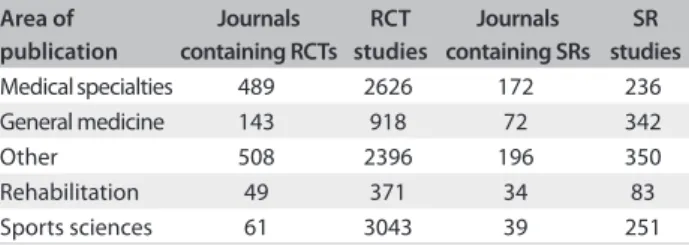
We found that 9,354 RCTs about exercise had been published in 1,250 journals up to the end of 2011, and 1,262 SRs in 513 journals. Table 1 presents the numbers of RCTs and SRs per journal category.
Figure 1 shows the numbers of RCTs and SRs published each year. he irst RCT about exercise was published in 1971 and the irst SR was published 20 years later, in 1991. Ater 1988, the number of RCTs published increased dramatically, whereas the number of SRs published per year only exceeded 100 in 2007.
Table 1. Number of randomized controlled trials (RCTs) and
systematic reviews (SRs) on exercise per journal category Area of
publication
Journals containing RCTs
RCT studies
Journals containing SRs
SR studies
Medical specialties 489 2626 172 236
General medicine 143 918 72 342
Other 508 2396 196 350
Rehabilitation 49 371 34 83
Figure 2 shows the number of RCTs published each year, across each of the areas. Two areas (Others and Medical Specialties) had similar growth trends regarding the numbers of published papers, while Sport Sciences had sharper growth. he areas of Medicine (General and Internal) and Rehabilitation showed less growth.
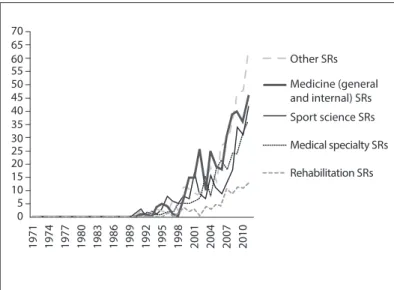
Figure 3 shows the number of SRs published each year, across each of the areas. In contrast to the growth in RCTs, the growth trend for the number of SRs published was similar in four of the ive areas, with only the Rehabilitation area showing slower growth in the number of published SRs.
Figure 4 shows the top 20 journals, which have published the highest numbers of RCTs. It also shows the corresponding num-bers of SRs that have been published by these journals. he journal that has published the highest number of systematic reviews about exercise is the Cochrane Database of Systematic Reviews (n = 124), followed by the British Journal of Sports Medicine (n = 41).
Figure 1. Number of randomized controlled trials (RCTs) and systematic reviews (SRs) on exercise published each year.
Number of RCTs Number of SRs 1200
1100
1000
900
800
700
600
500
400
300
200
100
0
1971 1972 1973 1974 1976 1977 1978 1979 1980 1981 1982 1983 1984 1985 1986 1987 1988 1989 1990 1991 1992 1993 1994 1995 1996 1997 1998 1999 2000 2001 2002 2003 2004 2005 2006 2007 2008 2009 2010 2011
Number of published papers
2 0 0 1 0 1 1 2 2 1 6 4 3 9 11 17 15 13
35 41 50 51 48 71
79 102
125
156 159
201
66
3 5 3 5 5
42
114 131 140 147 157
181
252 242 256
244
215
310
355
388
482 489 503
670
735
798
1042 1073
346
6 6
Figure 2. Number of randomized controlled trials (RCTs) on exercise
published each year, in each broad area of knowledge.
Sport science RCTs
Other RCTs
Medical specialty RCTs
Medicine (general and internal) RCTs
Rehabilitation RCTs 450
400
350
300
250
200
150
100
50
0
DISCUSSION
Exercise is a well-known intervention, which historically has been studied using an observational approach.9 One limitation with observational research is that the cause-efect relationship between variables cannot be considered strong.12 Additionally, there are many confounding variables that can lead to misinter-pretation in observational studies. RCTs and SRs provide stronger evidence for the efectiveness of exercise as an intervention.13-15 However, the exponential growth in RCTs and SRs that aim to provide higher quality of evidence about the efectiveness of interventions is occurring in many areas of knowledge,2,6,16 thus leading to risks relating to this exponential growth. hese risks need further discussion within the academic sphere.4,12
Since exercise is relevant to many disciplines and it is a grow-ing concept for health promotion and rehabilitation, it is impor-tant to relect about its types (yoga, Pilates and tai ji, among oth-ers) and where their MeSH trees are best included. One piece of
71
72
73
75 75 82
92 93 95
105 105 112
117 121
139
204
287 290
408
473
124
26 2 1 2 5 3
0 12
8 5 4 18 41
12 5 4 6 3 1 14 37 Journals Publishing SRs and RCTs
Number of articles RCTs Number of articles SRs
*Exclusively publish reviews Cochrane Database Syst Rev * Obes Rev* J Clin Endocrinol Metab Metabolism Am J Cardiol Diabetes Care BMC Public Health Eur J Appl Physiol Occup Physiol Clin Rehabil J Am Geriatr Soc J Sports Sci Prev Med J Sports Med Phys Fitness Br J Sports Med Arch Phys Med Rehabil Am J Clin Nutr Int J Sport Nutr Exerc Metab Int J Sports Med J Appl Physiol Eur J Appl Physiol J Strength Cond Res Med Sci Sports Exerc
Figure 4. The 20 journals that have published the highest numbers of randomized controlled trials (RCTs) on exercise, as well as the
number of systematic reviews (SRs) on exercise that these journals have published.
Figure 3. Number of systematic reviews (SRs) on exercise published
each year, in each broad area of knowledge.
1971 1974 1977 1980 1983 1986 1989 1992 1995 1998 2001 2004 2007 2010
Other SRs
Medicine (general and internal) SRs
Sport science SRs
Medical specialty SRs
Rehabilitation SRs 70
advice in this regard would be to recall the deinition of exer-cise and physical activity. he classical deinition of exerexer-cise is that it is “a subset of physical activity that is planned, structured and repetitive and has as a inal or an intermediate objective the improvement or maintenance of physical itness” and the deini-tion of physical activity is “any bodily movement produced by skel-etal muscles that results in energy expenditure”.17 Since many more terms are likely to emerge, their scatter becomes more of a prob-lem and inding relevant information becomes more diicult.
In our study, we found that over 1100 journals are publishing RCTs and over 440 journals are publishing SRs about exercise. hese data shows that it is almost impossible to keep up to date in the traditional “push” manner; using “just-in-case” information, where information is “pushed” to the user.12,18,19 For example, if a user subscribed to the top ten journals (or even just their table of contents) in the year 2011, that would represent being made aware of 26% of the total number of published RCTs. A recent study highlighted the enormous problem of the scatter of RCTs and SRs across numerous medical specialties and subspecialties, with the problem much more expansive in some disciplines (such as neurology) than in others.12 Our results showed that there is variation in the volume of RCTs and SRs about exercise that jour-nals in various broad knowledge areas publish.
his study has some limitations. Only one database (PubMed) was used for our search, although this is the largest database con-taining biomedical and health publications. It is possible that some of the studies that were included were not relevant to exer-cise, since we did not read the full text of each article. Conversely, it is also possible that some RCTs and SRs relevant to exercise were missed by our search.
Although RCTs and SRs provide the best study designs for evaluating intervention efectiveness, users of exercise data need skills in a) locating exercise research and b) appraising it for its quality, either by having skills in critical appraisal or by using some of the existing solutions that exist for providing il-tered, pre-appraised research (e.g. PEDro database or McMaster PLUS). We conducted a quick search on August 25, 2013, using “Exercise” in McMaster PLUS and in PEDro, and found 2,097 and 8,116 pre-appraised studies, respectively.
Exercise is relevant to so many disciplines and such broad knowledge areas that methods for providing easier access to high quality exercise research are needed. We also believe that is time to discuss not only besides methodology but also the descrip-tion of exercise programs, in order to improve their practical application.19-23
CONCLUSION
here has been rapid growth in the number of RCTs and SRs rel-evant to exercise over the last 15-20 years. Exercise RCTs and SRs
have been published in journals in the Sports Science area more than in any other area (31% of the total). We found that one par-ticular journal (Cochrane Database of Systematic Reviews) is the principal source for exercise SRs; and two journals (Journal of Strength and Conditioning Research and Medicine & Science in Sports & Exercise) published the highest number of exercise RCTs. his growth and scatter of exercise RCTs and SRs presents challenges for locating and using this research, and solutions for this issue need to be considered.
REFERENCES
1. Tolle K, Tansley S, Hey A. The fourth paradigm: data-intensive scientiic discovery. Proceedings of the IEEE. 2011;99(8):1334-7. Available from: http://ieeexplore.ieee.org/stamp/stamp.jsp?tp=&arnumber=5958175. Accessed in 2014 (Jun 11).
2. Tsay MY, Yang YH. Bibliometric analysis of the literature of randomized controlled trials. J Med Libr Assoc. 2005;93(4):450-8.
3. Mulrow CD. Rationale for systematic reviews. BMJ. 1994;309(6954):597-9. 4. Pronovost P, Wachter R. Proposed standards for quality improvement research and publication: one step forward and two steps back. Qual Saf Health Care. 2006;15(3):152-3.
5. Higgins JPT, Green S, editors. Cochrane Handbook for Systematic Reviews of Interventions. The Cochrane Collaboration; 2011. Available from: www.cochrane-handbook.org. Accessed in 2014 (May 15). 6. Silva V, Grande AJ, Martimbianco AL, Riera R, Carvalho AP. Overview of
systematic reviews - a new type of study: part I: why and for whom? Sao Paulo Med J. 2012;130(6):398-404.
7. Baker PR, Francis DP, Soares J, Weightman AL, Foster C. Community wide interventions for increasing physical activity. Cochrane Database Syst Rev. 2011;(4):CD008366.
8. Hallal PC, Bauman AE, Heath GW, et al. Physical activity: more of the same is not enough. Lancet. 2012;380(9838):190-91.
9. Heath GW, Parra DC, Sarmiento OL, et al. Evidence-based intervention in physical activity: lessons from around the world. Lancet. 2012;380(9838):272-81.
10. Seghers J, Van Hoecke AS, Schotte A, Opdenacker J, Boen F. The added value of a brief self-eicacy coaching on the efectiveness of a 12-week physical activity program. J Phys Act Health. 2014;11(1):18-29.
11. Kohl HW 3rd, Craig CL, Lambert EV, et al. The pandemic of physical inactivity: global action for public health. Lancet. 2012;380(9838):294-305. 12. Hofmann T, Erueti C, Thorning S, Glasziou P. The scatter of research:
cross sectional comparison of randomised trials and systematic reviews across specialties. BMJ. 2012;344:e3223.
13. Komarof E, DeLisa JA. Best research evidence for physical medicine and rehabilitation. J Spinal Cord Med. 2009;32(1):3-5.
15. Normand SL, Sykora K, Li P, et al. Readers guide to critical appraisal of cohort studies: 3. Analytical strategies to reduce confounding. BMJ. 2005;330(7498):1021-3.
16. Rochon PA, Gurwitz JH, Sykora K, et al. Reader’s guide to critical appraisal of cohort studies: 1. Role and design. BMJ. 2005;330(7496):895-7.
17. Bastian H, Glasziou P, Chalmers I. Seventy-ive trials and eleven systematic reviews a day: how will we ever keep up? PLoS Med. 2010;7(9):e1000326.
18. Caspersen CJ, Powell KE, Christenson GM. Physical activity, exercise, and physical itness: deinitions and distinctions for health-related research. Public Health Rep. 1985;100(2):126-31.
19. Glasziou PP, Del Mar C, Salisbury J. Evidence-based practice workbook. London: Blackwood Publishing; 2007.
20. Hofmann T, Bennett S, Del Mar C. Evidence-based practice across the health professions. Sydney: Elsevier Australia; 2013.
21. Ainsworth BE, Haskell WL, Herrmann SD, et al. 2011 Compendium of Physical Activities: a second update of codes and MET values. Med Sci Sports Exerc. 2011;43(8):1575-81.
22. Bird L, Arthur A, Cox K. “Did the trial kill the intervention?” experiences from the development, implementation and evaluation of a complex intervention. BMC Med Res Methodol. 2011;11:24.
23. Schulz KF, Altman DG, Moher D; CONSORT Group. CONSORT 2010 statement: updated guidelines for reporting parallel group randomised trials. PLoS Med. 2010;7(3):e1000251.
Sources of funding: None
Conlict of interest: None
Date of irst submission: December 4, 2013
Last received: June 3, 2014
Accepted: June 11, 2014
Address for correspondence:
Antonio Jose Grande Rua Botucatu, 740 — 3o andar
Vila Clementino — São Paulo (SP) — Brasil CEP 04023-900