Hepatocellular carcinoma may display elevated nestin
expression in endothelial cells: experimental study
O carcinoma hepatocelular pode expressar nestina fortemente
em células endoteliais: estudo experimental
Adriano Barreto Nogueira
I, Ariel Barreto Nogueira
II, Anderson Lino Costa
III, Fabiana Roberto Lima
III,
Sheila Aparecida Siqueira
IV, Manoel Jacobsen Teixeira
VHospital das Clínicas, Faculdade de Medicina da Universidade de São Paulo (HC/FMUSP), São Paulo, Brazil
ABSTRACT
CONTEXT AND OBJECTIVE: Nestin, a class VI intermediate ilament protein, is highly expressed in the portal mesenchyme and sinusoidal endothelium of the human fetal liver, but scarcely expressed in adult portal vessel endothelium. During experimental liver regeneration, an increased number of nestin-positive parenchymal cells have been observed in the zone adjacent to the Hering canals. These parenchymal cells are regarded as hepatic stem cells or hepatoblasts, which may be involved in hepatocellular carcinogene-sis. In the light of recent reports describing nestin-positive parenchymal cells in hepatocellular carcinoma, we aimed to use this tumor type as a positive control for immunohistochemical detection of nestin.
DESIGN AND SETTING: Experimental study conducted at a university hospital.
METHODS: Hepatocellular carcinoma sections from one case were analyzed for nestin expression by im-munohistochemistry using confocal microscopy.
RESULTS: Surprisingly, a conspicuous pattern resembling liver sinusoid-like cytoarchitecture was ob-served upon nestin staining of endothelial cells.
CONCLUSIONS: This pattern has not been previously described. The preliminary results shown here sug-gest that nestin-positive endothelial cells are located in niches of immature or proliferative cells. Moreover, nestin expression in endothelial cells of hepatocellular carcinoma enhances the role of angiogenesis in this tumor type, although the prevalence of this immunohistopathological pattern remains to be deter-mined. Finally, hepatocellular carcinoma is an efective positive control for nestin staining in luorescent immunohistochemistry.
RESUMO
CONTEXTO E OBJETIVO: Nestina, proteína de ilamento intermediário de classe VI, é altamente expressa no mesênquima portal e endotélio sinusoidal do fígado fetal humano, mas pouco expressa no endotélio de vasos portais no adulto. Além disso, durante a regeneração hepática experimental, um número cres-cente de células parenquimatosas nestina-positivas é observado na zona adjacres-cente aos canais de Hering. Essas células parenquimatosas são consideradas células-tronco hepáticas ou hepatoblastos, que podem estar envolvidas na origem do carcinoma hepatocelular. Em função de relatos recentes descrevendo cé-lulas parenquimatosas nestina-positivas no carcinoma hepatocelular, objetivamos usar este tipo tumoral como controle positivo para a detecção imunoistoquímica da nestina.
TIPO DE ESTUDO E LOCAL: Estudo experimental realizado em hospital universitário.
MÉTODOS: Cortes de um caso de carcinoma hepatocelular foram analisados em relação à expressão imu-noistoquímica da nestina por microscopia confocal.
RESULTADOS: Surpreendentemente, um padrão nítido com citoarquitetura semelhante a sinusoides he-páticos foi observado pela marcação por nestina em células endoteliais.
CONCLUSÕES: Este padrão não havia sido descrito previamente. Os resultados preliminares mostrados aqui sugerem que células endoteliais nestina-positivas estão localizadas em nichos de células imaturas ou em proliferação. Além disto, a expressão de nestina em células endoteliais de carcinoma hepatocelular reforça o papel da angiogênese neste tipo tumoral, embora a prevalência deste padrão imuno-histopato-lógico precise ser determinada. Finalmente, o carcinoma hepatocelular é um controle positivo efetivo para a marcação para nestina em imunoistoquímica luorescente.
IMD. Attending Physician, Division of Clinical Neurosurgery, and Researcher, Laboratory of Experimental Surgery, Hospital das Clínicas, Faculdade de Medicina da Universidade de São Paulo (HC/FMUSP), São Paulo, Brazil. IIMD. Pathologist and Radiology Resident, Institute of Radiology, Hospital das Clínicas, Faculdade de Medicina da Universidade de São Paulo (HC/FMUSP), São Paulo, Brazil. IIIMD. Attending Physician, Department of Pathology, Hospital das Clínicas, Faculdade de Medicina da Universidade de São Paulo (HC/FMUSP), São Paulo, Brazil.
IVMD, PhD. Director, Department of Pathology, Hospital das Clínicas, Faculdade de Medicina da Universidade de São Paulo (HC/FMUSP), São Paulo, Brazil.
VIMD, PhD. Professor of Neurosurgery, Department of Neurology, and Head of Department, Division of Clinical Neurosurgery, Faculdade de Medicina da Universidade de São Paulo (HC/FMUSP), São Paulo, Brazil.
KEY WORDS: Nestin. Endothelial cells.
Neovascularization, pathologic. Carcinoma, hepatocellular. Immunohistochemistry.
PALAVRAS-CHAVE: Nestina.
INTRODUCTION
he search for a speciic marker of neural stem cells during brain development has led to identiication and isolation of the gene encoding nestin,1 a class VI intermediate ilament protein. Since then, nestin staining has been described in the embryogenesis of tissues originating from all three germ layers as well as in rela-tion to regenerarela-tion, tumorigenesis and physiological condi-tions in adult mammals.2,3 herefore, nestin has been detected under diferent conditions, in a wide variety of tissues and at a broad range of intensities, which has hindered identiication of its actual function.
Nestin is expressed in the portal mesenchyme and the sinu-soidal endothelium of the liver during development, and in a few endothelial cells of the portal vessels in adult individuals.4 Moreover, hepatic stem cells, which express nestin, have been characterized in cultured adult human liver cells in vitro.5
However, controversy continues regarding the pheno-typic and histological features of human hepatic stem cells.5,6 Hepatocyte regeneration via hepatic stem cells occurs primar-ily within the topography of the Hering canals (the distal struc-ture of biliary trees), towards the central vein. According to one study, the Hering canal cells are hepatic stem cells and are responsible for the ductal reaction during human liver regen-eration and for the genesis of cholangiocytes and hepatocytes. Hepatoblasts, which line the Hering canals, are transit-amplify-ing cells and give rise to hepatocytes.6 Another study has indi-cated that hepatic stem cells are more lineage-restricted in vivo,5 similar to the hepatoblasts described above. Importantly, we are not aware of any studies showing nestin expression in tis-sue slices of human liver during regeneration. However, nestin has been shown to be present in a subset of oval cells, which are murine progenitor cells spawned during liver regeneration.7 Taken together, these data suggest that hepatic stem cells may be classiied as parenchymal cells.
Hepatic stem cells may give rise to hepatocellular carci-noma.8-10 Accordingly, clusters of nestin-positive parenchymal cells have been observed in hepatocellular carcinoma slices.10 Moreover, it has been suggested that hepatocellular carcinoma is a positive control for nestin expression, because of the staining of parenchymal cells, according to the data sheet from a commer-cially available anti-nestin primary antibody.11
OBJECTIVES
We performed nestin staining in hepatocellular carcinoma slices with the aim of identifying a reliable positive control for immunohistochemical detection of this protein,12 and report this preliminary result in order to discuss the role of nestin-expressing endothelial cells, particularly in hepatocellular car-cinoma angiogenesis.
METHODS
his study was carried out ater receiving approval from the Ethics Committee for Research Project Analysis (CAPPesq) of the Clinics Hospital, University of São Paulo Medical School (Hospital das Clínicas, Faculdade de Medicina da Universidade de São Paulo, HC/FMUSP) (research protocol no. 013/05).
he Department of Pathology of HC/FMUSP provided us with a parain block of embedded hepatocellular carcinoma con-taining three fragments from the same clinical case, and a glio-blastoma sample for a complementary experiment, to observe nestin staining on another tissue. he hepatocellular carcinoma block was cut into 5-µm slices, which were mounted on silanized slides. Hematoxylin-eosin staining was performed on a parallel slide, in accordance with standard protocols.
Immunohistochemistry was performed on the hepatocellu-lar carcinoma slices based on an immunoluorescence protocol that we had developed previously.12 In summary, the slices were deparainized in xylene and rehydrated in ethanol. To dimin-ish auto-luorescence, the slides were immersed in 1% Sudan Black B (Sigma-Aldrich, Saint Louis, MO, USA) diluted into 70% ethanol, for 30 minutes. Ater washing in phosphate-bufered saline, the slides were separated into four groups, according to the solution used for microwave antigen retrieval and the type of anti-nestin primary antibody used for detection: 1) ethylene-diaminetetraacetic acid bufer (1 mM, pH 8.0) and rabbit poly-clonal antibody (catalog no. ab93666, Abcam, Cambridge, MA, USA); 2) sodium citrate bufer (10 mM, pH 6.0) and rabbit poly-clonal antibody (as in the preceding group); 3) sodium citrate bufer and mouse monoclonal antibody (catalog no. ab22035, Abcam); and 4) sodium citrate bufer and mouse monoclonal antibody from a second manufacturer (catalog no. MAB5326, Millipore, Billerica, MA, USA). Ater heating in a microwave, the slides were kept at room temperature for 30 min, washed in phos-phate-bufered saline (PBS) containing 0.2% Triton X-100 (PBS-Triton) and then incubated in a blocking solution (1% bovine serum albumin and goat serum (1:20) diluted into PBS-Triton) for 1 h. he anti-nestin primary antibody was then applied at three diferent concentrations (1:50, 1:100 and 1:200) to all slide groups. For the negative control, we omitted the nestin anti-body on one of the slides in each group. All slides were kept in a humidiied chamber at 4 °C for 48 hours.
USA) was applied for 1 h, and the slides were washed again. 4’,6-diamidino-2-phenylindole (DAPI; 1:1,000 w/v, catalog no. 46190, hermoScientiic, Rockford, IL, USA) was used to stain the nuclei. A inal wash was carried out, an anti-fading solu-tion (Vectashield, catalog no. H1000, Vector Laboratories, Burlingame, CA, USA) was applied and coverslips were used to cover the hepatocellular carcinoma slices.
The hepatocellular carcinoma slides were analyzed using a Zeiss 510 UV META microscope (Carl Zeiss MicroImaging, Thornwood, NY, USA), and the images were saved and edited using the LSM 510 META software (Zeiss MicroImaging). To generate a panel that included a negative control and a representative result, the images were edited further using Photoshop CS5 Extended software (Adobe Systems Incorporated, San Jose, CA, USA).
To illustrate the features of nestin staining on another tis-sue, we used a glioblastoma sample and another anti-nestin pri-mary antibody (rabbit polyclonal antibody, 1:5,000, catalog no. AB5922, Millipore). In this case, a labeled streptavidin biotin kit was used, as recommended by the manufacturer (Dako LSAB+ System-HRP, catalog no. K0690, Dako Denmark, Glostrup, Denmark). Bright-ield microscopy was performed using a Nikon Optiphot-2 microscope (Nikon, Tokyo, Japan) to analyze the nestin staining pattern in the glioblastoma and the hema-toxylin-eosin staining of the hepatocellular carcinoma sample. he images were captured using a CoolSNAP Pro CF color digi-tal camera (Media Cybernetics, Inc., Bethesda, MD, USA), saved using the Image-Pro Plus sotware (Media Cybernetics) and edited using the Photoshop CS5 Extended sotware (Adobe).
RESULTS
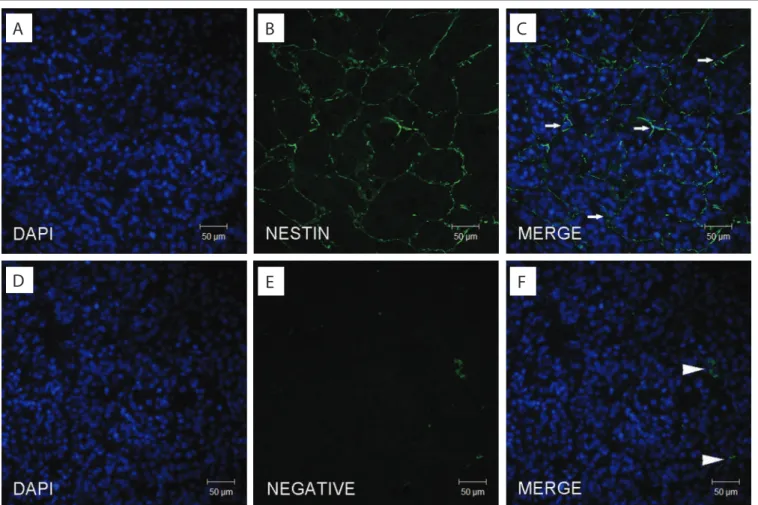
All three fragments of the hepatocellular carcinoma sample harbored nodules of various sizes, and their histological fea-tures are shown in Figure 1. hese nodules were surrounded by ibrosis, in which some blood vessels were detected. Major auto-luorescence was prevalent only in the red blood cells, yet identiication of true staining was not signiicantly hampered because the red blood cells were localized primarily to blood vessels within the ibrotic areas. In addition, the presence of a large number of endothelial cells, characterized by their thin and elongated shape and the overall appearance of a liver sinu-soid-like structure, allowed conident identiication of nestin staining. An illustrative example is depicted in Figure 2, for which the polyclonal antibody and the sodium citrate bufer were used. he best image was achieved with the 1:100 dilution of the primary antibody for all groups compared with the 1:50 or 1:200 dilutions. he type of anti-nestin primary antibody and the bufer solution for antigen retrieval did not inluence the results. Another factor contributing to efective identiication
of nestin-positive endothelial cells was the scarce markings of other cells (e.g. tumor parenchymal cells). Finally, the nestin staining did not always form a continuous net pattern; the over-all result was a spectrum, in which nodules with a range of dis-continuous igures were detected, possibly relecting diferent degrees of angiogenesis.
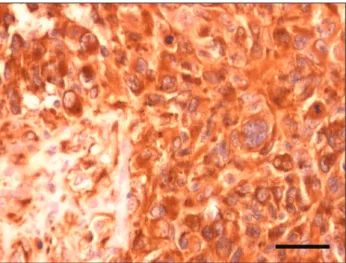
Immunohistochemistry on the glioblastoma sample revealed a difuse nestin staining pattern (Figure 3). However, when lu-orescent probes were used, the intense auto-luorescence of this type of tumor (data not shown) hindered conident identiication of cells stained for nestin. herefore, hepatocellular carcinoma is a more suitable option for a nestin-positive control than glioblas-toma, when using luorescent immunohistochemistry.
DISCUSSION
neurogenesis.17 herefore, one interesting hypothesis to be tested is whether nestin-positive endothelial cells indicate a niche with regenerative potential.
Hepatic stem cell features have been described in a subgroup of hepatocellular carcinomas that are clinically characterized by a poor outcome.8-10 In one study, high serum levels of neural cell adhesion molecule, which is also a hepatic stem cell marker, were detected in a group of hepatocellular carcinoma patients,9 and tumor specimens from a smaller proportion of these cases harbored clusters of cells that were positive for the neural cell adhesion molecule. Furthermore, some hepatocellular carci-noma cases showed a gene expression pattern comparable to that presented by rat embryo hepatoblasts, as analyzed by means of a DNA microarray.8 Finally, using the quantitative real-time polymerase chain reaction and a tissue microarray, Yang et al.10
A
D
B
E
C
F
Figure 2. Nestin-positive endothelial cells in hepatocellular carcinoma. The upper row depicts nuclear staining with DAPI (A), nestin staining in endothelial cells that form a liver sinusoid-like structure (B) and a merged image (C). The intense nestin staining in most endothelial cells (arrows), the typical morphology of these cells and the high number of tumor parenchymal cells between the endothelial cell lines contributed to the resulting net image, which was readily detected in tumor nodules via confocal microscopy. The lower row shows the negative control, as analyzed by means of ilters for DAPI (D) and Alexa Fluor 488 (E), and a merged image (F). Note that the auto-luorescence of the red blood cells could not be completely eliminated (arrowheads). The background image, shown in E, can be used for comparison with the nestin staining shown in B. Scale bar: 50 µm.
demonstrated that cases with high expression of hepatic stem cell markers were correlated with increased angiogenesis and poor prognosis; in addition, nestin expression was detected in parenchymal cells. Our inding of signiicant nestin expression in hepatocellular carcinoma endothelial cells may clarify some aspects of the role of nestin in the proliferation and angiogenesis of this tumor type.
he presence of nestin-positive endothelial cells in hepato-cellular carcinoma suggests that there is a remarkable degree of angiogenesis. However, the lineage of these endothelial cells is unknown. First, it is possible that these cells are sinusoidal endo-thelial cells that switched from a quiescent to a proliferative state (angiogenic switch).18 However, some hepatocellular carcinoma endothelial cells may arise from circulating endothelial progeni-tor cells.18 Additional studies are needed to determine whether other types of nestin-expressing cells could give rise to hepato-cellular carcinoma endothelial cells. In this manner, tumor stem cells could generate hepatocellular carcinoma endothelial cells, in the same way as has recently been demonstrated for glioblas-toma.19,20 Finally, we speculate that stellate cells (pericytes),21 which are known to modulate tumor angiogenesis,18 could also give rise to tumor endothelial cells under the inluence of vascu-lar endothelial growth factor. his growth factor is present at high levels in hepatocellular carcinoma, and pericytes show niche-dependent pluripotency in other organs.22
Regardless of the role that nestin expression plays in endo-thelial cells, the conspicuous pattern shown here makes hepato-cellular carcinoma samples a useful alternative positive control
for nestin for the following reasons. First, this pattern is particu-larly valuable for investigators engaged in analyzing luorescent images. Second, laboratory animal tissue (e.g. murine embryos) may be replaced by biopsy samples,23 which is particularly impor-tant if the researcher is using an anti-nestin primary antibody that reacts exclusively with human tissue. hird, use of hepatocel-lular carcinoma samples may avoid the need for the procurement of human fetal brain tissue.24
One caveat of our study is that we only used one hepatocel-lular carcinoma case, yet the lack of information regarding a sub-ject with such relevance and the results presented here warrant this report. For instance, although hepatocellular carcinoma is the ith most frequent tumor type, its prognosis is highly het-erogeneous.8-10 Additionally, nestin is a broadly used molecule in regenerative medicine and in oncology research,3 yet a PubMed search (as of April 2, 2014) with the keywords “hepatocellular carcinoma” and “nestin” resulted in only three articles. Finally, the nestin pattern shown here, i.e. hepatocellular carcinoma with elevated nestin expression in endothelial cells, may moti-vate additional studies to determine its prevalence and prognos-tic implication.
CONCLUSIONS
Our indings reinforce the hypothesis that nestin-positive endo-thelial cells are found in niches of immature or proliferative cells. Likewise, the results are in agreement with the role of angiogen-esis in hepatocellular carcinoma. Additional studies are required to determine the prevalence and prognostic value of the immu-nohistopathological pattern shown here. Finally, hepatocellular carcinoma samples may serve as a useful positive control for nes-tin in immunohistochemistry experiments.
REFERENCES
1. Lendahl U, Zimmerman LB, McKay RD. CNS stem cells express a new
class of intermediate ilament protein. Cell. 1990;60(4):585-95.
2. Ishiwata T, Matsuda Y, Naito Z. Nestin in gastrointestinal and
other cancers: efects on cells and tumor angiogenesis. World J
Gastroenterol. 2011;17(4):409-18.
3. Wiese C, Rolletschek A, Kania G, et al. Nestin expression--a property of
multi-lineage progenitor cells? Cell Mol Life Sci. 2004;61(19-20):2510-22.
4. Vestentoft PS, Jelnes P, Hopkinson BM, et al. Three-dimensional
reconstructions of intrahepatic bile duct tubulogenesis in human
liver. BMC Dev Biol. 2011;11:56.
5. Herrera MB, Bruno S, Buttiglieri S, et al. Isolation and characterization
of a stem cell population from adult human liver. Stem Cells.
2006;24(12):2840-50.
6. Zhang L, Theise N, Chua M, Reid LM. The stem cell niche of human
livers: symmetry between development and regeneration.
Hepatology. 2008;48(5):1598-607.
7. Koenig S, Probst I, Becker H, Krause P. Zonal hierarchy of diferentiation
markers and nestin expression during oval cell mediated rat liver
regeneration. Histochem Cell Biol. 2006;126(6):723-34.
8. Lee JS, Heo J, Libbrecht L, et al. A novel prognostic subtype of human
hepatocellular carcinoma derived from hepatic progenitor cells. Nat
Med. 2006;12(4):410-6.
9. Tsuchiya A, Kamimura H, Tamura Y, et al. Hepatocellular carcinoma
with progenitor cell features distinguishable by the hepatic stem/
progenitor cell marker NCAM. Cancer Lett. 2011;309(1):95-103.
10. Yang XR, Xu Y, Yu B, et al. High expression levels of putative hepatic
stem/progenitor cell biomarkers related to tumour angiogenesis and
poor prognosis of hepatocellular carcinoma. Gut. 2010;59(7):953-62.
11. Abcam. Product Datasheet. Anti-Nestin antibody ab93666.
Available from: http://www.abcam.com/Nestin-antibody-ab93666.
pdf. Accessed in 2014 (Aug 14).
12. Nogueira AB, Sogayar MC, Colquhoun A, et al. Existence of a
potential neurogenic system in the adult human brain. J Transl Med.
2014;12(1):75.
13. Mokrý J, Cízková D, Filip S, et al. Nestin expression by newly formed
human blood vessels. Stem Cells Dev. 2004;13(6):658-64.
14. Lardon J, Rooman I, Bouwens L. Nestin expression in pancreatic
stellate cells and angiogenic endothelial cells. Histochem Cell Biol.
2002;117(6):535-40.
15. Klein T, Ling Z, Heimberg H, et al. Nestin is expressed in vascular
endothelial cells in the adult human pancreas. J Histochem
Cytochem. 2003;51(6):697-706.
16. Palmer TD, Willhoite AR, Gage FH. Vascular niche for adult
hippocampal neurogenesis. J Comp Neurol. 2000;425(4):479-94.
17. Thored P, Wood J, Arvidsson A, et al. Long-term neuroblast migration
along blood vessels in an area with transient angiogenesis and
increased vascularization after stroke. Stroke. 2007;38(11):3032-9.
18. Semela D, Dufour JF. Angiogenesis and hepatocellular carcinoma. J
Hepatol. 2004;41(5):864-80.
19. Ricci-Vitiani L, Pallini R, Bifoni M, et al. Tumour vascularization via
endothelial diferentiation of glioblastoma stem-like cells. Nature.
2010;468(7325):824-8.
20. Wang R, Chadalavada K, Wilshire J, et al. Glioblastoma stem-like cells
give rise to tumour endothelium. Nature. 2010;468(7325):829-33.
21. Niki T, Pekny M, Hellemans K, et al. Class VI intermediate ilament
protein nestin is induced during activation of rat hepatic stellate cells.
Hepatology. 1999;29(2):520-7.
22. Dore-Dufy P, Katychev A, Wang X, Van Buren E. CNS microvascular
pericytes exhibit multipotential stem cell activity. J Cereb Blood Flow
Metab. 2006;26(5):613-24.
23. Buchwalow IB, Böcker W. Antibodies for immunohistochemistry. In:
Buchwalow IB, Böcker W, editors. Immunohistochemistry: basics and
methods. Heidelberg: Springer; 2010. p. 1-8.
24. Abbott A. Tissue-bank shortage: Brain child. Nature. 2011;
478(7370):442-3.
Sources of funding: This study received inancial support from the São Paulo Research Foundation (Fundação de Amparo à Pesquisa do Estado
de São Paulo, Fapesp; Grant no. 2010/51634-1)
Conlicts of interest: None
Date of irst submission: April 3, 2014
Last received: September 3, 2014
Accepted: September 10, 2014
Address for correspondence:
Adriano Barreto Nogueira
Instituto Central, Hospital das Clínicas
Faculdade de Medicina da Universidade de São Paulo
Divisão de Clínica Neurocirúrgica
Av. Dr. Enéas de Carvalho Aguiar, 255 — 5o Andar
Cerqueira César — São Paulo (SP) — Brasil
CEP 05403-000
Tel. (+55 11) 2661-7152