122e
Rev Bras Med Esporte _ Vol. 12, Nº 3 – Mai/Jun, 2006 * Universidade Federal do Rio de Janeiro, Laboratório de Biomecânica,Escola de Educação Física e Desportos da UFRJ, Av. Pau Brasil, 540, Cidade Universitária – Ilha do Fundão – 21941-590 – Rio de Janeiro, RJ, Brazil. Tels.: (21) 2562-6826 / 2562-6826.
Received in 13/7/05. Final version received in 10/9/05. Approved in 6/12/05. Correspondence to: Taian de Mello Martins Vieira, Rua Figueiredo Maga-lhães, 741, apto. 711, Copacabana – 22031-010 – Rio de Janeiro, RJ, Bra-zil. Tel.: (21) 3208-4683. E-mail: [email protected]
Postural balance in rowing athletes
*
Taian de Mello Martins Vieira and Líliam Fernandes de Oliveira
O
RIGINALA
RTICLEKeywords: Postural control. Stabilometry. Rowing. ENGLISH VERSION
ABSTRACT
The influence of fitness on long-term postural balance is not clear yet. This study aims to compare stabilometric parameters in long-term balance tests performed by rowing athletes and by a control group of non-athletes healthy subjects, who stood upright on a force plate for 31 minutes. At every five minutes of test, a modified Borg scale was shown to the subjects to score the dis-comfort. The parameters studied were: standard deviation, aver-age velocity and averaver-age frequency of the lateral and anterior-pos-terior centre of pressure displacements, and the elliptical area of the displacement on the level of the force plate. The athletes did not show significant differences in parameters during the entire test. The control group presented significant higher values in the elliptical area and in average velocity from the middle to the end of test. The athletes presented significant lower values in Borg’s scale, showing a greater resistance to discomfort. It is suggested that stabilometric alterations showed by the non-athletes occurred in response to peripheral physiological processes, and that physical fitness seems to be an important factor for the maintenance of a long-term static balance.
INTRODUCTION
The control of standing posture depends on motor-sensory in-formation, based on the body internal representation by the cen-tral nervous system, which guarantees the system stability through adequate strategies(1). The body axis corrections by postural
con-trol mechanisms, mentioned as consequence of the live body dy-namics itself, gives to the human body small and constant oscilla-tions whenever standing, with an important role in the pressure distribution on the feet soles and in the efficiency of the venous return(2).
The stabilometry is a technique of balance evaluation in the ortho-static posture, which consists of the quantification of the body anterior-posterior and lateral oscillations, while the individual is standing on a force plate(3-4). Once the center of pressure
displace-ment (PC) is representative of the postural oscillations, the regis-try is done by the instant calculation of its position (x, y coordi-nates), which correspond to the placement of the applied forces result on the surface in contact with the feet, which is the touch-ing ground. The signal processtouch-ing is usually applied in the time and frequency settings and since a protocol for the stabilometric test has not been established, different methodologies are applied, concerning the test time and the touching ground as well. Short time periods are usually adopted, around 30 seconds(5-8), according
to Carpenter et al.(9) and Mello et al.(10), a period of 60 seconds is
recommended to guarantee the steadiness of the stabilometric
signal. The touching ground is a variable that does not influence the signal parameters when controled(11).
Stabilometric tests for long periods are less frequent. Duarte et al.(12), used 30 minute tests in non-restrictive posture, which means
that the individuals could freely move on the plate. Their aim was to identify specific displacement patterns of the PC, as a postural control strategy to make this posture maintenance possible for an extended time. On the other hand, Imbiriba et al.(13), conducted
stabilometric tests of 31 minutes in restrictive posture, where the individuals stayed in the same standing posture on a force plate, and reported the degree of discomfort every 5 minutes through a subjective scale. Significant differences for the lateral displacement of the center of pressure were found from 15 minutes on approx-imately, when compared to another group which was submitted to short resting times during the exam. The standing posture for an extended time showed a high level of discomfort in the individ-uals, according to the authors caused by a fatigue process.
Many daily tasks demand the orthostatic posture as ordinary postural orientation, especially in situations of long standings in line and in militarism. Physiological changes caused by tasks of these nature, related to the individual´s need to stand for a long time, are derived from the gravitational forces that deeply affect the cardiac debt(14). Therefore, one may expect that the individuals
with physiological adaptations derived from a developed muscular and cardiovascular conditioning, are more apt to overcome these alterations.
It has not been found in the literature information that gives ev-idence to the effects of physical conditioning in the displacement of the center of pressure in long term stabilometric tests. Thus, the behavior of the postural oscillations that face the physiological adaptations imposed by physical training during the process, in-duced by fatigue caused by the long standing posture, is unknown. This study aims to compare the stabilometric parameters in long term tests between a group of rowing athletes and a group of non-athletes, in the standing still posture.
MATERIALS AND METHODS
The sample consisted of 19 rowing athletes (11 men and 8 wom-en) from the Clube de Regatas Vasco da Gama, with at least four years of competition, registered in the Rowing Federation of Rio de Janeiro State (FRERJ). 19 healthy sedentary students (12 men and 7 women), from the Physical Education and Sports Federal University of Rio de Janeiro, were the non-athlete group. Table 1 presents the ages and the anthropometrical characteristics of the groups. The work was submitted and approved by the Ethics Com-mittee of the Federal University of Rio de Janeiro.
TABLE 1
There is no significant difference between the groups
Age (years) Weight (kg) Height (m)
Rev Bras Med Esporte _ Vol. 12, Nº 3 – Mai/Jun, 2006
123e
The acquisition system was a AccuSway Plus force plate, with the Balance Clinic software, using a sample frequency of 50 Hz (AMTI, 2001).
The athletes and students, after written agreement, stood on the plate for 31 minutes with feet united, arms on the side of the body and facing a wall 2,0 m distant. The signal was registered during the first minute of the test and, from that time on, at every five minutes, making a total of seven scores of one minute. At every register, a modified scale of Borg was shown, where their degree of discomfort at that moment was scored, being zero for “none” and ten for “impossible to continue”.
The stabilometric parameters analyzed were: average velocity, standard deviation of the breadth and average frequency of the PC displacement of the lateral and anterior-posterior directions, be-sides the elliptical area of PC displacement in the level of the plate. The elliptical area (EA), that corresponds to the ellipsis area that best adjusts to the PC way (figure 1), was calculated through the statistics technique of Analysis of Main Components(3,15):
(
2 2)
2 4( )
2 2 /22 2 2
+ ± − +
= xx yy xx yy xy
cp
σ
σ
σ
σ
σ
σ
(1)were σxy, σxx, σyy are respectively: co-variance, variance in the x and y axes.
The Discreet Transformed of Fourier(16) was applied for spectral
estimates. The average frequency was calculated in the average of 0 to 2 Hz for each lateral and anterior-posterior displacement axis (FMX and FMY, respectively).
The average velocity was calculated for the lateral and anterior-posterior displacement VELMX, VELMY), through the ratio of the displacement in the axes related to test time. The breadth stan-dard deviation of the displacements was also calculated for each axis (DPX, DPY). The obtained values through the discomfort scale constituted a variable as well (BORG), with discreet values from 0 to 10.
The statistics analysis used the STATISTICA® 6.0 aplicative (Stat-Soft, EUA). The ANOVA test with repeated measures was applied to compare the results among the seven registration periods of the groups and the post-hoc HSD by Tukey, with significance level of p < 0.05.
RESULTS
Figure 2 shows the obtained results through the Borg scale for the two groups, exposing progressive discomfort during the test, expressed by the average values of 1,6 ± 1,6 and 3,7 ± 2,7 for the athletes and non-athletes respectively.
Table 2 presents the average values of the DPX, DPY and FMX, FMY parameters in the first and in the last minute of the test. These parameters did not show any significant differences in any time of the test, neither between the groups nor in each group separately. The average values for the first, third, fifth and seventh minute of the AE, VMX and VMY variables acquisition in the group of non-athletes, are presented in table 3. A significant increase of these parameters (p < 0,02 e p < 0,001) from the middle of the test on, was seen comparing these values, twentieth and thirtieth minute respectively, in relation to the first register.
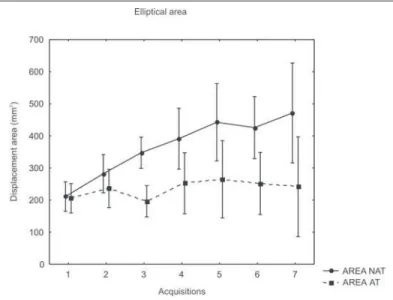
No statistic difference was found within the athletes group for any variable analyzed during the test. Figure 3 compares the aver-age values of the elliptical area of displacement between the two groups, with higher results for the non-athletes group, not statisti-cally significant, though. The average, lateral and anterior-posterior velocity was higher for the non-athletes, however, it was not sta-tistically different between the groups.
DISCUSSION
Although no statistic difference was identified, the displace-ments in the lateral and anterior-posterior directions of the non-athlete group presented an increase of approximately 51,38% and
Figure 2 – – – Level of discomfort during the test for the athletes (BORG AT) – – and non-athletes (BORG NAT)
TABLE 2
Average values for the variables: standard deviation and medium, lateral and anterior-posterior frequency (DPX, DPY, FMX and FMY respectively), for the two groups, in the first and the last minute of the test
DPX (mm) DPY (mm) FMX (Hz) FMY (Hz)
1 min 30 min 1 min 30 min 1 min 30 min 1 min 30 min
Athletes 3.92 ± 0.96 4.76 ± 1.40 4.20 ± 1.63 4.27 ± 1.60 0.28 ± 0.09 0.23 ± 0.10 0.17 ± 0.06 0.19 ± 0.08 Non-athletes 4.02 ± 0.92 5.13 ± 1.82 4.34 ± 0.98 6.57 ± 4.38 0.22 ± 0.06 0.26 ± 0.08 0.18 ± 0.05 0.18 ± 0.06
Figure 1 – – – – – Example of an ellipsis adjusted to the center of pressure way (CP) in the anterior-posterior and medium-lateral axes
Elliptical area
PC
124e
Rev Bras Med Esporte _ Vol. 12, Nº 3 – Mai/Jun, 200627,61%, respectively, until the end of the test (table 2). Such evi-dence can explain the significant increase of the displacement el-liptical area occurred for this group. The greatest discomfort re-ported by the non-athletes, caused by the task persistence, may have directly affected the analyzed variables, and the cognitive fac-tors associated to the postural control(1), such as the attention, what
can also reflect on the oscillations magnitude, increasing the AE variations.
The found changes for the non-athletes group (table 3) demon-strate that the AE, VMX and VMY analyzed parameters, are sensi-tive to the discomfort induced by the experiment, providing the athletes with higher resistance to fatigue, since they present phys-iological adaptations due to their intense training. Therefore, no significant differences were observed during the test time to the athletes group, for all analyzed variables. Papers that face the phys-ical conditioning with stabilometric parameters are scarce in the literature, especially in long term tests. Simmons(17) verified that
dancers present lower response latency to balance disturbs, show-ing a more refined control of the postural oscillations through phys-ical training, which may explain the reduced values for the AE of the athletes. The found results for area and average velocity in the conditioned group are similar to other studies that applied stabilo-metric tests, but of short time, in athletes of different sports, such as soccer, judo and gymnastics(18-20).
The research seems to agree with the time of approximately 15 to 20 minutes in relation to the discomfort signs and the PC dis-placement changes for healthy individuals but non-athletes, which corroborate with our findings. Gandra et al.(21) found a similar
be-havior of the stabilometric signal in a group of young individuals, whose tendency corresponded to the increase of the elliptical area and the displacement average velocity along the time. The evi-dence showed that the visual information deprivation emphasized such difference, started at the tenth minute of the test. Imbiriba et
al.(13) observed a relation between the lateral displacement and the
discomfort sensation, when compared results of individuals who continuously stood on the plate, with the others who rested dur-ing the test, from the fifteenth minute. Such time may be related to the physiological changes involved in the orthostatic posture maintenance, due to the influence of the gravitational influences in the cardiac debt(22-23). According to Guyton(2), about 15 to 20% of
the blood volume may be lost by the circulatory system during the 15 minutes of static, upright position, as happens when a soldier is in standing position.
The athletes presented a different behavior pattern, insensitive to discomfort, which demands a longer test time to show similar fatigue effects in the static postural control. Being rowing a sport simultaneously dynamic and a great strength application, the con-dition of being a competitor for at least four years, gives to the rowing athletes a developed muscular and cardiovascular system, as described in the literature(24-25), what may explain the steady
characteristic of the postural oscillations with the time, and the low discomfort values.
Aspects related to the extended time of the test, such as the nature of the fatigue process derived from the experiment, and the physiological variables directly involved in the peculiar behav-ior of the stabilometric parameters of the athletes, could not be identified, representing limitations to the study.
CONCLUSION
As a conclusion, , , , , one may say that long term stabilometric tests are sensitive to training, allowing to identify individuals with high level of physical conditioning. The athletes did not present chang-es in the static postural control due to the extended time of the test, since they were kept in the initial pattern of the center of pressure displacement, expressed by the steady behavior of the analyzed stabilometric parameters. However, in the control group, such parameters were passive to changes, occurred simultaneously with the increase of the discomfort level. The intense physical train-ing was the crucial factor for the differentiated characteristic be-tween groups; to the PC oscillation parameters – identified through stabilometry - and to the discomfort sensation induced by the task as well.
ACKNOWLEDGMENTS
This study had the support of CNPq and FUJB agencies.
All the authors declared there is not any potential conflict of inter-ests regarding this article.
REFERENCES
1. Shumway-Cook A, Woollacott M. Motor control: theory and practical applica-tions. 1st ed. Baltimore: Lippincott Williams & Wilkins, 1995.
2. Guyton AC. Tratado de fisiologia médica. 7ª ed. Guanabara Koogan, 1997. 3. Oliveira LF. Análise quantitativa de sinais estabilométricos na avaliação do
equi-líbrio de gestantes. Tese de Doutorado, Programa de Engenharia Biomédica CO-PPE/UFRJ: Rio de Janeiro, 1996.
TABLE 3
Average values and standard deviation for the variables area and average velocity in the two axes (VELMX and VELMY) for the non-athletes group, in the 1, 10, 20 and 30 minutes of the test
Area (mm2) VELMX (mm/s) VELMY (mm/s) 1 10 20* 30* 1 10 20* 30* 1 10 20* 30*
Average 210.94 347.42 442.57 471.30 8.48 9.30 10.73 10.96 7.54 8.82 10.06 10.79 SD 77.74 131.61 297.46 447.52 1.08 2.70 02.74 03.87 1.47 1.83 03.02 05.49
* significant difference.
Rev Bras Med Esporte _ Vol. 12, Nº 3 – Mai/Jun, 2006
125e
4. Gagey PM, Weber B. Posturologia: Regulação e distúrbios da posição ortostáti-ca. 2ª ed. Manole, 2000.
5. Harris GF, Riedel SA, Matesi DV, Smith PA. Signal stationarity in postural stabil-ity assessment of children. IEEE Eng Med Biol 1992;11:57-8.
6. Juntunen J, Ylikoski J, Ojala M. Postural body sway and exposure to high-ener-gy impulse noise. Lancet 1987;1:261-4.
7. Prieto TE, Myklebust JB, Myklebust BM. Postural steadiness and ankle compli-ance in the elderly. IEEE Eng Med Biol 1992;11:25-7.
8. Wooley SM, Rubin AM, Knatner M, Armstrong CW. Differentiation of balance deficits through examination of selected components of static stabilometry. J Otolaryngol 1993;22:899-908.
9. Carpenter M, Frank JS, Winter DA, Peysar GH. Sampling duration effects on centre of pressure summary measures. Gait Posture 2001;13:35-40. 10. Mello RGT, Gandra VD, Oliveira LF, Nadal J. Influência do tempo de aquisição
nos parâmetros do sinal estabilométrico. Anais do XVIII Congresso Brasileiro de Engenharia Biomédica. São José dos Campos, SP 2002;406-10.
11. Chiari L, Rocchi L, Cappello A. Stabilometric parameters are affected by anthro-pometry and foot placement. Clin Biomech (Bristol, Avon) 2002;17:666-77. 12. Duarte M, Harvey W, Zatsiorsky VM. Stabilographic analysis of unconstrained
standing. Ergonomics 2000;43:1824-39.
13. Imbiriba LA, Cruz CR, Mainenti MRM, Magalhães J, Garcia MAC, Oliveira LF, et al. Modification in the postural control during long-term standing. Proceedings of the IV World Congress of Biomechanics, Calgary CA, 2002.
14. Berne RM, Levy MN. Physiology. 3rd ed. Mosby: Year Book, 1993.
15. Morrison DF. Multivariate statistical methods. New York: McGraw Hill, 1976.
16. Marple SL. Digital spectral analysis with applications. Englewood Cliffs: Pren-tice Hall, 1987.
17. Simmons RW. Neuromuscular responses of trained ballet dancers to postural perturbations. Int J Neurosci 2005;115:1193-203.
18. Ferreira FR, Imbiriba LA, Garcia MAC, Olivera LF, Olivera CG. Alterações do equilíbrio postural após testes ergométricos submáximos em jogadores de fute-bol. XXII Simpósio Internacional de Ciência do Esporte, São Paulo, 1999.
19. Perrin, P, Deviterne D, Hugel, F, Perrot C. Judo, better than dance, develops sen-sorimotor adaptabilities involved in balance control. Gait Posture 2002;15:187-94.
20. Vuillerme N, Danion F, Marin L, Boyadjian A, Prieur JM, Weise I, et al. The effect of expertise in gymnastics on postural control. Neurosci Lett 2001;303:83-6.
21. Gandra VD, Oliveira LF, Nadal J. Efeito da visão no controle postural ortostático em testes estabilométricos de longa duração. Anais do X Congresso Brasileiro de Biomecânica, Ouro Preto, 2003;2:430-3.
22. Jacob G, Biaggioni I, Mosqueda-Garcia R, Robertson RM, Robertson D. Relation of blood volume and blood pressure in orthostatic intolerance. Am J Med Sci 1998;315:95-100.
23. Hermosillo AG, Marquez MF, Jauregui-Renaud K, Cardenas M. Orthostatic hy-potension, 2001. Cardiol Rev 2001;9:339-47.
24. Secher NH. Rowing. Endurance in Sport. 1st ed. Oxford: R.J. Shepard & P.-O.
Astrand, 1992;563-9.