*Correspondência:
Alameda dos Arapanés, nº 881 - cj 111 - Moema São Paulo - SP CEP: 04524-001 Telefone: (11) 9688-6312 [email protected]
Summary
Objectives. Causes may be found in most cases of acute pancreatitis, however no etiology is found by clinical, biological and imaging investigations in 30% of these cases. Our objective was to evaluate results from endoscopic ultrasonography (EUS) for diagnosis of gallbladder microlithiasis in patients with unexplained (idiopathic) acute pancreatitis.
MethOds. Thirty-six consecutive non-alcoholic patients with diagnoses of acute pancreatitis were studied
over a ive-year period. None of them showed signs of gallstones on transabdominal ultrasound or
tomography. We performed EUS within one week of diagnosing acute pancreatitis. Diagnosis of
gall-bladder microlithiasis on EUS was based upon indings of hyperechoic signals of 0.5-3.0 mm, with
or without acoustic shadowing. All patients (36 cases) underwent cholecystectomy, in accordance with indication from the attending physician or based upon EUS diagnosis.
Results. Twenty-seven patients (75%) had microlithiasis conirmed by histology and nine did not
(25%). EUS indings were positive in twenty-ive. Two patients had acute cholecystitis diagnosed at EUS that was conirmed by surgical and histological indings. In two patients, EUS showed choleste -rolosis and pathological analysis disclosed stones not detected by EUS. EUS diagnosed microlithiasis
in four cases not conirmed by surgical treatment. In our study, sensitivity, speciicity and positive and negative predictive values to identify gallbladder microlithiasis (with 95% conidence interval) were
92.6% (74.2-98.7%), 55.6% (22.7-84.7%), 86.2% (67.4-95.5%) and 71.4% (30.3-94.9%), respectively. Overall EUS accuracy was 83.2%.
cOnclusiOns. EUS is a very reliable procedure to diagnose gallbladder microlithiasis and should be used for the management of patients with unexplained acute pancreatitis. This procedure should be part of advanced endoscopic evaluation.
Keywords: Gallstones. Endosonography. Pancreatitis. Diagnosis.
MicROlithiasis
Of
the
gallbladdeR
:
ROle
Of
endOscOpic
ultRasOnOgRaphy
in
patients
with
idiOpathic
acute
pancReatitis
jOsé celsO aRdengh1*, caRlOs albeRtO MalheiROs2, faRes Rahal3, victOR peReiRa3, aRnaldO jOsé ganc4
Trabalho realizado no Setor de Endoscopia e Ecoendoscopia do Hospital 9 de Julho, São Paulo, SP
1. Livre-Docente do Departamento de Anatomia e Cirurgia da Faculdade de Medicina de Ribeirão Preto da Universidade de São Paulo – FMRP/USP; Médico do Setor de Endoscopia do Hospital 9 de Julho e Médico da Secção de Endoscopia da Disciplina de Anatomia e Cirurgia do Hospital das Clínicas da Faculdade de Medicina de Ribeirão Preto da Universidade de São Paulo- HCFMRP-USP, São Paulo, SP
2. Chefe da área V (Estômago e Duodeno) da Faculdade de Ciências Médicas da Santa Casa de São Paulo, São Paulo, SP 3. Médico da área V ( Cirurgia de Estômago e Duodeno) da Faculdade de Medicina da Santa Casa de São Paulo, São Paulo, SP 4. Livre-Docente em Gastroenterologia e Médico do Setor de Endoscopia do Hospital Israelita Albert Einstein , São Paulo, SP
i
ntROductiOnIt is usually not dificult to determine the cause of an episode
of acute pancreatitis1. Excessive alcohol consumption and
galls-tone disease are responsible in most cases, and presence of these conditions can be established by the patient’s history (alcohol abuse) and transabdominal ultrasound (gallstone disease)2.
Definition of microlithiasis is a matter of controversy. Defi-nitions that have been used include radiological invisibility3, 4,
stones less than 5 mm in diameter5 and/or stones less than
3 mm in diameter6. Because of their small size, they may be
difficult to detect and, when roentgenographically invisible,
may constitute a diagnostic challenge in patients with recur-rent acute pancreatitis5, 6. Microlithiasis of the gallbladder
is also dreaded for its tendency to migrate and cause acute
pancreatitis. Indeed, gallbladder microlithiasis and microcho -ledocolithiasis are frequently found after surgical procedures and gallstones are found in the feces of 90% of patients with acute pancreatitis4, 7, 8.
microlithiasis especially in patients with unexplained acute pancreatitis and compared EUS findings of microlithiasis with its identification through surgical procedures.
M
ethOdsPatients with acute pancreatitis
Sixty-six patients with acute pancreatitis, without etiolo-gical diagnosis were consecutively examined over a five-year period. Diagnosis of unexplained acute pancreatitis was made when the patient presented acute abdominal pain without any history of trauma, infection or use of medications (especially steroids, diuretics or antineoplastic agents), in addition to transabdominal ultrasound and computed tomo-graphy (CT) scans showing evidence of pancreatic inflamma-tion. Ultrasound and CT showed absence of gallstones in all patients. The calcium and serum triglyceride levels (< 300 mg/dl) were normal. Excessive alcohol consumption (more than 30 g/day) was ruled out for all these patients, due to their clinical histories9. We recorded the serum levels of
amylase and lipase, main clinical signs and symptoms, EUS findings as well as those of microlithiasis in the gallbladder as reported by the surgeon.
Exclusion criteria
Five patients were excluded from this study because they did not undergo cholecystectomy. Twenty-five were also excluded since they presented stones greater than 3 mm in diameter; chronic pancreatitis; neoplasia; other causes for their episodes of acute pancreatitis that were identified by EUS; suspicious sludge during the immediate postoperative period; pregnancy; stenosis or chronic obstruction of biliary ducts; prolonged parenteral nutrition; liver cirrhosis; hemolysis; prolonged fasting (> 2 weeks); obesity with rapid weight loss; and oral contraceptive use10, 11.
Study group
Of the 36 patients fulfilling the above criteria, 23 (63.9%) had had at least one episode of acute pancreatitis prior to the current attack (overall, 69 episodes in 36 patients), while thirteen (36.1%) presented acute pancreatitis for the first time. Transabdominal ultrasound and CT scans of the gallbladder did not disclose any abnormality, however CT scans showed evidence of pancreatitis in all patients (36). There were 21 women (58.4%) and 15 men (41.6%) with a mean age of 47.1 years (range 20 - 83 years).
All patients underwent EUS during the irst week following
diagnoses of acute pancreatitis. The EUS examinations were conducted by the same experienced endoscopist (JCA) using the
commercially available Olympus GIF-UM30(Olympus America Inc., Melville, NY, USA) radial scanning system at 7.5 and 12 MHz and Pentax FG-38UX (Pentax Precision Instruments, Oran
-geburg, NY, USA), coupled to the HITACHI EUB 405(Mitsubishi,
Conshockon, PA, USA) linear array scanning system at 5.0 and 7.5 MHz. During examinations, the patients were in prone position or left lateral decubitus.
Patients underwent topical anesthesia of the posterior pharynx and intravenous conscious sedation. The echoendos-cope was advanced to the second portion of the duodenum,
where the ampulla of Vater was identiied and imaging was begun. Images of the infundibulum and body of the gallbladder
were taken from the duodenum while images of the fundus were taken from the antrum.
Gallbladder microlithiasis was diagnosed using EUS when we found a hyperechoic signal (0.5 - 3.0 mm) with or without acoustic shadowing. Hyperechoic signals of more than 3.0 millimeters were excluded from this study. Thereafter, all patients underwent cholecystectomy, which was retrospectively reviewed. Findings from the surgical and/or histopathological
data were compared with the EUS indings.
Expression of the results and statistical analyses
Statistical analysis was undertaken to obtain the sensiti-vity, specificity and negative and positive predictive values with 95% confidence intervals, and accuracy of the diag-nosis of gallbladder microlithiasis by EUS. The sensitivity was defined as the ratio of patients with positive presence of microlithiasis by EUS examination in relation to patients with proven stones following surgical procedure. The speci-ficity was defined as the ratio of patients with no biliary stones in relation to negative presence of microlithiasis by EUS examination. The negative and positive predictive values of the EUS examination for diagnosis of microli-thiasis were obtained from the same group. This study was approved by the Research Ethics Boards of Hospital 9 de Julho and written informed consent was obtained from all patients
R
esults PatientsThe male-to-female ratio among the 36 patients was 1.4:1.0. Among these 36 patients with unexplained acute pancreatitis, abdominal pain was found in 100%, vomiting in 86.1%, jaun-dice in 12.1%, pleural effusion in 11.1% and ascites in 11.1%.
The mean level of serum amylase was 780.4 UI/l (range 135 - 2557 UI/l) and the mean level of serum lipase was 3428.5 UI/l (339 - 11.637 UI/l).
Endoscopic ultrasonography
We performed 40 echoendoscopic examinations (twice in four patients). Among the 36 patients who underwent echoen-doscopic examination, 3/36 (8.3%) did not present any abnor-mality in the gallbladder, while the others did (33/36; 91.7%).
The EUS identiied presence of gallbladder microlithiasis (Figure
1) in 29/36 (80.6%), acute cholecystitis (2) and cholesterolosis (2). We found four false positive cases and two false negatives in this sample of patients.
EUS and surgical indings
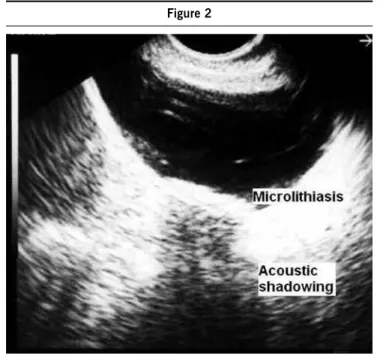
Multiple micro-gallstones were found in 27/36 (75%) of the patients (Figures 1 and 2), while they were absent in 9/36 (25%).
Statistical analysis
The sensitivity, speciicity, negative and positive predictive values, accuracy and 95% conidence intervals of the EUS for
d
iscussiOnDiagnosis of acute pancreatitis is clinically and biochemi-cally established. The main symptoms are abdominal pain and vomiting. Hyperamylasemia is considered an essential sign of acute pancreatitis, occurring in up to 80% of cases. Lipase serum levels are elevated in the great majority of these patients, and levels remain high for a longer period than the amylase levels12.
All these parameters were found in our series.
After systematic diagnostic investigation (clinical, bioche-mical and imaging methods) to identify an etiological agent for acute pancreatitis, 10% to 30% of the patients do not present
any deined cause and are labeled cases of acute pancreatitis
without apparent cause2, 13.
Among the acute pancreatitis patients without a deined
cause, 20% to 50% present microcalculi and tend to have recurrences with high morbidity-mortality rates8, 14-17. Therefore,
it is important to identify microcalculi, because of possible recur-rent relapses of acute pancreatitis and to enable early treatment
that would avoid such relapses6, 13-17. For this reason attention
has been directed to introduce sensitive noninvasive diagnostic methods and revive certain old methods (bile collection for crystal investigation) 18.
Thus, advanced endoscopic techniques such as endoscopic retrograde cholangiopancreatography (ERCP)1, 19, 20, ERCP with
bile collection for investigating microcrystals18, 21 and EUS for
the purpose of detecting microlithiasis have progressed in the propaedeutics for this disease22-25.
Patients with radiolucent migrating calculi present episodes of bile colics, recurrent acute pancreatitis and transitory jaundice, despite the radiological normal appearance of the bile ducts, as seen using ERCP and transabdominal ultrasound4. According to
some authors, microcalculi are frequently radiolucent3, 4.
We considered bile sludge (Figure 2) to represent micro-lithiasis, since this sludge and calculi with more than 4 mm
diameter can be identiied on transabdominal ultrasound because
they present an acoustic shadow26. Presence of microcalculi was
also shown in 8.3% of patients with bile sludge who underwent surgery27. It can be concluded that presence of bile sludge should
be considered abnormal, since there may be precipitates of calcium bilirubinate or cholesterol (microcalculi)28. In this series,
three cases presented with appearance of bile sludge on EUS,
and surgical indings revealed the presence of microcalculi.
Using US or radiographic methods, for calculi sizes of less than or equal to 3 mm in diameter, the diagnosis rate is around 25%6, 7. If the calculi range between 3 and 5 mm in diameter,
the rate is 40%5 and, if the radiolucency criterion is used, the
rate falls to 10%. For this reason, calculi less than or equal to 3 mm in diameter are a diagnostic challenge, particularly because of confusion with bile sludge26-28.
Patients with recurrent acute pancreatitis, whose transab-dominal ultrasound and ERCP are normal may present calculi during the operation29. Calculi size and density are the factors
Table 1. Statistical values from EuS to identify gallbladder
microlithiasis, in relation to indings from the surgical piece
specimens of the 36 patients.
% Conidence interval (%)
Sensitivity 92.6 74.2 - 98.7
Speciicity 55.6 22.7 - 84.7
Positive predictive value 86.2 67.4 - 95.5
Negative predictive value 71.4 30.3 - 94.9
Accuracy 83.2 66.5 - 93.0
responsible for the false results29. Other risk factors for acute
pancreatitis relate to the number of calculi, width of the cystic duct and width and length of the Oddi sphincter30, 31.
Transabdominal ultrasound is the examination of choice to diagnose biliary diseases6, 29, 32. Especially since transabdominal
ultrasound presents high sensitivity for diagnosis of biliary calculi33, 34. However, during episodes of acute pancreatitis,
sensitivity is lower, ranging from 58 to 67%35, 36.
In some cases of acute pancreatitis without apparent cause,
ERCP may identify potentially treatable conditions. This may occur in 30 to 50% of cases37 and those presenting calculi
between 5 and 15%29, 37. However, amylase levels may be
elevated in 30 to 75% of asymptomatic patients38.
Bile collection to investigate biliary crystals in comparison with EUS, in patients with normal transabdominal ultrasound and a diagnosis confirmed by surgery, showed sensitivity, specificity, positive predictive value and negative predictive value for EUS of 96%, 86%, 89% and 95% and for bile collection of 67%, 91%, 89% and 70%, respectively39. False
positive results occurred due to acoustic reverberation caused by movement of the bladder wall, thereby forming artifacts that were confounded with microcalculi39.
In the present study, endoscopic examination was shown
to be advantageous in relation to transabdominal ultrasound because it enabled adequate examination of the
gallbla-dder during the acute pancreatitis episodes. It is also more
advantageous than bile collection, because it does not use cholecystokinetic agents to obtain bile, which could, at least hypothetically, cause recurrence or worsening of the pancrea-titis40. It is also less invasive than ERCP41 and does not worsen
the condition of acute pancreatitis42.
Based upon sensitivity (92.6%), positive predictive (86.2%) and accuracy (83.2%) values with their respective confidence intervals (74.2-98.7%, 67.4-95.5% and 63.5-93%) that were obtained (Table 1), it can be inferred that EUS is safe and provides high-precision diagnosis. Presumably responsible factors for this high detection rate are: 1) the gallbladder is closely related to the stomach and duodenal wall; 2) the median distance between the echoendoscopic transducer and the gallbladder is small (0.5 mm); 3) the focal point is easily found, thereby making it possible to obtain images without great distortions; 4) the whole gall-bladder (infundibulum, body and fundus) and cystic duct are examined, even under severe conditions of pancreatitis; and 5) the use of frequencies of 5.0, 7.5 and 12 MHz intensifies details in the images.
Previous studies using EUS to diagnose microlithiasis found sensitivity rates of 95% to 97%39, 41, 43, with a positive
predictive value of 100%43.
In our study, the speciicity and negative predictive value (with their 95% conidence intervals) were 55.6% (22.7-84.7%) and
71.4% (30.3-94.9%), respectively. These estimates, with their
respective conidence intervals, are questionable and imprecise, considering that in other studies, the speciicity ranged from 76%
to 86%39, 41. Perhaps these results occurred because of the small
sample of individuals without the disease and the great possibility that the patients examined here would have gallbladder etiology as the cause of their episodes of acute pancreatitis.
It is emphasized that, despite being an invasive technique, EUS does not present: 1) dificulties involved in catheterizing
the papilla; 2) inconvenience of injecting contrast to make the biliary-pancreatic duct visible; 3) problems with the technique of bile collection from the bile duct and gallbladder, in which stimulation using cholecystokinetic agents is required to obtain the material; and 4) complications involved in gallbladder punc-ture to obtain bile. Thus, EUS examination seems to be harmless and have a reasonable degree of safety to identify microcalculi of the gallbladder without worsening or triggering relapses of acute
pancreatitis. It is noteworthy that the proportion of pancreatitis
cases labeled as not having any apparent cause presents an inverse relationship with the quality of diagnostic methods used.
We believe that we have clearly and precisely demonstrated that EUS represents an important advance, since it reveals
gall-bladder microlithiasis in a signiicant proportion of cases of acute
pancreatitis, initially labeled as not having any apparent cause. This examination is practical, safe, objective and easy to perform. From the sensitivity obtained with this patient sample, early and appropriate therapeutic interventions are possible, which seems to notably reduce risk of recurrences15, 44.
In the present series, EUS was fundamentally and clearly
superior to transabdominal ultrasound for identifying micro-calculi of the gallbladder that were associated with relapses of acute pancreatitis without apparent cause. Likewise, in comparison with data from investigating crystals in bile using various techniques reported in literature (ERCP), results from EUS were at least similar, without inconveniences of the ERCP method, and were safer presenting notably greater sensitivity22, 41. Nevertheless, it must be stressed that, to obtain satisfactory
conclusions regarding the two techniques, comparative studies with a rigorous methodology are required. This would make it possible to ascertain which method would be best for patients presenting acute pancreatitis without apparent cause.
c
OnclusiOnEUS is very reliable for diagnosing gallbladder microlithiasis and should be used for managing patients with unexplained acute pancreatitis. This procedure should be part of advanced endoscopic evaluation.
Conlict of interest: none
R
esuMOMicROcOlecistOlitíase: papeldaecOendOscOpiaeMpacientescOM pancReatiteagudaseMcausaapaRente
ObjetivOs. Cerca de 30% dos doentes com PA rotulada como
MétOdOs. Trinta e seis pacientes com o diagnóstico de
PA sem causa aparente foram consecutivamente estudados durante cinco anos. Dos enviados para exame ecoendoscópico, 21 mulheres e 15 homens com média de idade de 41,6 anos. Todos haviam sido submetidos antes a pelo menos um US e uma TC, que não revelaram alterações na via bílio-pancreática e 63,9% deles tinham apresentado mais de um episódio de PA. O diagnóstico da colecistomicrolitíase pela EE realizada até uma semana durante o surto de PA baseou-se no tamanho do cálculo (até 3 mm, inclusive) e hiperecogeneicidade com ou sem sombra acústica. Todos os doentes foram colecistectomizados, após o exame ecoendoscópico.
ResultadO. O exame das peças cirúrgicas mostrou que 27
(75%) doentes apresentavam MCV e nove (25%) não. A EE levou a erro no diagnóstico da microlitíase em seis (16,8%) casos, quatro casos de positivos e dois casos de falsos-negativos. Em 30 casos (83,2%) houve confirmação dos seus resultados. A sensibilidade, a especificidade, os valores predi-tivos positivo, negativo e a acurácia (com intervalo de confiança de 95%) para a EE no diagnóstico dos MCV foram: 92,6% (74,2 a 98,7%), 55,6% (22,7 a 84,7%), 86,2% (67,4% a 95,5%), 71,4% (30,3 a 94,9%) e 83,2% (66,5% a 93%) respectivamente.
COnClusãO. A EE mostra-se, portanto, de grande valor na
identificação da colecistomicrolitíase e a PA não deve ser consi-derada sem causa aparente antes da realização desse exame.
[Rev Assoc Med Bras 2010; 56(1): 27-31]
uniterMos: Cálculos Biliares.Endossonograia.Pancreatite.Diag
-nóstico.
R
efeRences1. Al-Haddad M, Wallace MB. Diagnostic approach to patients with acute idiopa-thic and recurrent pancreatitis, what should be done? World J Gastroenterol. 2008;14(7):1007-10.
2. van Brummelen SE, Venneman NG, van Erpecum KJ, VanBerge-Henegouwen GP. Acute idiopathic pancreatitis: does it really exist or is it a myth? Scand J Gastroenterol. 2003(239):117-22.
3. Pfefferman R, Luttwak EM. Gallstone pancreatitis. Exploration of the biliary system in pancreatitis of undetermined origin. Arch Surg. 1971;103(4):484-6. 4. Dayan L, Cherif-Zahar K, Lepage B, Bories-Azeau A. [Diagnostic traps and
proce-dure to follow in radio-invisible biliary calculi]. J Chir (Paris). 1976;111(4):431-42. 5. Goinard P, Pelissier G. [Biliary micro-lithiasis.]. Presse Med 1962;70:260-1. 6. Houssin D, Castaing D, Lemoine J, Bismuth H. Microlithiasis of the gallbladder.
Surg Gynecol Obstet. 1983;157(1):20-4.
7. Bertrand L, Lamarque JL. [Biliary microlithiasis. Medico-radiological observa-tions]. Nouv Presse Med .1975;4(44):3135-8.
8. Dill JE, Dill BP. Microlithiasis and pancreatitis. Gastrointest Endosc. 2002;56(5):784; author reply 784-5.
9. Acosta JM, Ledesma CL. Gallstone migration as a cause of acute pancreatitis. N Engl J Med. 1974;290(9):484-7.
10. Ohara N, Schaefer J. Clinical signiicance of biliary sludge. J Clin Gastroenterol. 1990;12(3):291-4.
11. Strasberg SM, Toth JL, Gallinger S, Harvey PR. High protein and total lipid concentration are associated with reduced metastability of bile in an early stage of cholesterol gallstone formation. Gastroenterology. 1990;98(3):739-46. 12. Frossard JL, Steer ML, Pastor CM. Acute pancreatitis. Lancet.
2008;371(9607):143-52.
13. Tarnasky PR, Hawes RH. Endoscopic diagnosis and therapy of unexplained (idio-pathic) acute pancreatitis. Gastrointest Endosc Clin North Am. 1998;8(1):13-37. 14. Lee SP, Nicholls JF. Nature and composition of biliary sludge. Gastroenterology.
1986;90(3):677-86.
15. Ros E, Navarro S, Bru C, Garcia-Puges A, Valderrama R. Occult microlithiasis in idiopathic acute pancreatitis: prevention of relapses by cholecystectomy or ursodeoxycholic acid therapy. Gastroenterology. 1991;101(6):1701-9. 16. Liu CL, Lo CM, Chan JK, Poon RT, Fan ST. EUS for detection of occult cholelithiasis
in patients with idiopathic pancreatitis. Gastrointest Endosc. 2000;51(1):28-32.
17. Levy MJ. The hunt for microlithiasis in idiopathic acute recurrent pancreatitis: should we abandon the search or intensify our efforts? Gastrointest Endosc. 2002;55(2):286-93.
18. Chebli JM, Ferrari Junior AP, Silva MR, Borges DR, Atallah AN, das Neves MM. [Biliary microcrystals in idiopathic acute pancreatitis: clue for occult underlying biliary etiology]. Arq Gastroenterol. 2000;37(2):93-101.
19. DiMagno MJ, DiMagno EP. New advances in acute pancreatitis. Curr Opin Gastroenterol. 2007;23(5):494-501.
20. Garg PK, Tandon RK, Madan K. Is biliary microlithiasis a signiicant cause of idiopathic recurrent acute pancreatitis? A long-term follow-up study. Clin Gastro-enterol Hepatol. 2007;5(1):75-9.
21. Buscail L, Escourrou J, Delvaux M, Guimbaud R, Nicolet T, Frexinos J, et al. Microscopic examination of bile directly collected during endoscopic cannula-tion of the papilla. Utility in patients with suspected microlithiasis. Dig Dis Sci. 1992;37(1):116-20.
22. Tandon M, Topazian M. Endoscopic ultrasound in idiopathic acute pancreatitis. Am J Gastroenterol. 2001;96(3):705-9.
23. Pellicano R, Repici A, Goss M, Carucci P, Rocca R, Bruno M, et al. Role of endoscopic ultrasound in biliary and unexplained pancreatitis. Minerva Med. 2007;98(4):361-5.
24. Vila JJ, Borda F, Jimenez FJ. [The role of endoscopic ultrasonography in the etiological evaluation of idiopathic acute pancreatitis]. Rev Esp Enferm Dig. 2008;100(2):90-7.
25. Petrone MC, Arcidiacono PG, Testoni PA. Endoscopic ultrasonography for evaluating patients with recurrent pancreatitis. World J Gastroenterol. 2008;14(7):1016-22. 26. Good LI, Edell SL, Soloway RD, Trotman BW, Mulhern C, Arger PA. Ultrasonic
properties of gallstones. Effect of stone size and composition. Gastroenterology. 1979;77(2):258-63.
27. Simeone JF, Mueller PR, Ferruci JT Jr, Harbin WP, Wittenberg J. Signiicance of nonshadowing focal opacities at cholecystosonography. Radiology. 1980;137(1 Pt 1):181-5.
28. Filly RA, Allen B, Minton MJ, Bernhoft R, Way LW. In vitro investigation of the origin of echoes with biliary sludge. J Clin Ultrasound. 1980;8(3):193-200. 29. Venu RP, Geenen JE, Toouli J, Stewart E, Hogan WJ. Endoscopic retrograde
cholangiopancreatography. Diagnosis of cholelithiasis in patients with normal gallbladder x-ray and ultrasound studies. JAMA. 1983;249(6):758-61. 30. Barraya L, Pujol Soler R, Yvergneaux JP. [The region of Oddis sphincter: millimetric
anatomy]. Presse Med. 1971;79(55):2527-34.
31. Armstrong CP, Taylor TV, Jeacock J, Lucas S. The biliary tract in patients with acute gallstone pancreatitis. Br J Surg. 1985;72(7):551-5.
32. Humbert P, Casals A, Boix J, Planas R, Morillas R, Barranco C, et al. [Usefulness of microscopic study of the duodenal bile in the diagnosis of pancreatitis of unknown cause]. Rev Esp Enferm Apar Dig. 1989;75(5):471-4.
33. Cotton PB, Beales JS. Endoscopic pancreatography in management of relapsing acute pancreatitis. Br Med J. 1974;1(5908):608-11.
34. Cooperberg PL, Gibney RG. Imaging of the gallbladder, 1987. Radiology. 1987;163(3):605-13.
35. Neoptolemos JP, Davidson BR, Winder AF, Vallance D. Role of duodenal bile crystal analysis in the investigation of idiopathic pancreatitis. Br J Surg. 1988;75(5):450-3.
36. Bolognese A, Muttillo IA, Scopinaro F, Banci M, Amadori LM, De Martino F, et al. [Biliary scintigraphy vs. ultrasonography in the etiological diagnosis of acute pancreatitis]. J Chir (Paris). 1996;133(2):78-81.
37. Feller ER. Endoscopic retrograde cholangiopancreatography in the diagnosis of unexplained pancreatitis. Arch Intern Med. 1984;144(9):1797-9.
38. Aliperti G. Complications related to diagnostic and therapeutic endoscopic retrograde cholangiopancreatography. Gastrointest Endosc Clin North Am. 1996;6(2):379-407.
39. Dahan P, Andant C, Levy P, Amouyal P, Amouyal G, Dumont M, et al. Prospec-tive evaluation of endoscopic ultrasonography and microscopic examination of duodenal bile in the diagnosis of cholecystolithiasis in 45 patients with normal conventional ultrasonography. Gut. 1996;38(2):277-81.
40. Reisberg IR, Mabee GW. Endoscopic biliary drainage for detection of gallbladder disease. Gastrointest Endosc. 1979;25(1):6-9.
41. Lachter J, Rubin A, Shiller M, Lavy A, Yasin K, Suissa A, et al. Linear EUS for bile duct stones. Gastrointest Endosc. 2000;51(1):51-4.
42. Blackwood WD, Vennes JA, Silvis SE. Post-endoscopy pancreatitis and hypera-mylasuria. Gastrointest Endosc. 1973;20(2):56-8.
43. Dill JE, Hill S, Callis J, Berkhouse L, Evans P, Martin D, et al. Combined endoscopic ultrasound and stimulated biliary drainage in cholecystitis and microlithiasis--diagnoses and outcomes. Endoscopy. 1995;27(6):424-7.
44. Chebli JM, Duarte Gaburri P, Meirelles de Souza AF, de Castro Ferreira LE, Andrade Chebli L, Ferrari AP Jr, et al. “Idiopathic” acute pancreatitis due to biliary sludge: prevention of relapses by endoscopic biliary sphincterotomy in high-risk patients. Am J Gastroenterol. 2000;95(10):3008-9.