*Correspondência: Cristália Prod. Quim. Farmacêuticos Ltda Av. Corifeu de Azevedo Marques, 1847 - Butantã São Paulo – SP, Brazil CEP: 05581-001
AbstrACt
Objective. This prospective, randomized, open-label study controlled by active comparator aimed at assessing analgesic eficacy and overall tolerability of a burn treatment based on topic administration
of unfractionated heparin.
MethOds. Fifty eight male or female patients were randomly selected for conventional treatment (C
group) or topical heparin treatment (TH group). Ages of patients enrolled ranged from 18 to 55 years.
They had 2nd and 3rd degree burns on 10% to 30% of the body surface (BS) caused by ire or scald,
no history of hemorrhagic diatheses, no hypersensitivity to heparin and less than 10% of the BS burned to 3rd degree. C group had frequent balneotherapy for injuries debridement and received silver
sulfadiazine dressings. TH group had the irst debridement and their burnt areas were left exposed
to receive 4200 IU of unfractionated heparin topically for each 1% of burned BS, three times daily.
Analgesic eficacy was evaluated in the 38 patients who completed the study according to the demand
of analgesic medications and response to the pain Visual Analog Scale (VAS). Tolerability was
evalu-ated from the iles of all 58 randomized patients by the comparative incidence of adverse reactions.
Results. The TH group demanded less analgesic medications (11.83 ± 9.38 per patient against 33.35
± 20.63 for the group C, p<0.01), reported less pain in the VAS, had less fever and more bleeding
than C group. There was no difference in the incidence of local infection, septicemia and safety exams.
cOnclusiOn. The TH scheme presented higher analgesic effectiveness than C scheme without important
tolerability problems.
KeywordS: Burns. Heparin. Analgesia.
cOMpaRative
study
Of
cOnventiOnal
and
tOpical
hepaRin
tReatMents
fOR
buRns
analgesia
MaRcOs guilheRMe pRaxedes baRRettO1, MaRiada gRaça nasciMentO figueiRa cOsta2, MaRia cRistinadO valle fReitas seRRa3, jORge baRROs afiune4, hugO eduaRdO
pinheiRO pRaxedes5*, eduaRdO pagani6*
Study conducted at Hospital de Restauração, PE, Hospital Cristo Redentor, RS and Hospital Municipal Souza Aguiar, Rio de Janeiro, RJ, Brazil
1. Médico, especialista em cirurgia plástica e chefe do Centro de Tratamento de Queimados do Hospital da Restauração, Recife, PE 2. Médica, especialista em cirurgia plástica e coordenadora do Serviço de Queimados do Hospital Cristo Redentor, Porto Alegre, RS 3. Médica mestre em pediatria e chefe do Centro de Tratamento de Queimados do Hospital Municipal Souza Aguiar, Rio de Janeiro, RJ 4. Médico, especialista em pneumologia e diretor médico do Cristália Produtos Químicos Farmacêuticos Ltda, São Paulo, SP
5. Médico, especialista em anestesiologia e cardiologia e gerente médico de farmacovigilância do Cristália Produtos Químicos Farmacêuticos Ltda, São Paulo, SP 6. Médico, doutor em ciências e gerente médico de pesquisa clínica do Cristália Produtos Químicos Farmacêuticos Ltda, São Paulo, SP
i
ntROductiOnCurrent treatment for 2nd and 3rd degree burns is complex,
uncomfortable for the patient and expensive for the health
systems1, 2, 3. In Brazil, the overall mortality due to burns is esti-mated in 5% to 8.4%4, 5 but can be as high as 55% for burns in more than 30% of body surface6. The burn sequels affect life quality and produce longstanding emotional and social impacts in the patients. The development of new treatment resources could modify this picture.
Heparin has been used to treat burns for decades7, but due to the lack of well controlled clinical trials this indication is little disseminated. Its action on the burn probably derives from its
anti-inlammatory and angiogenic properties that do not depend
on its´ well-known anticoagulant action8, 9. The anti-inlam
-matory action results from deactivation of pro-inlam-matory
cytokines such as TNF-alpha10, selectins secreted by leukocytes such as CD11b11,12 integrins such as ICAM-113 and attenuation of complement activation14. Angiogenic effect derives from the interaction with vascular endothelium growth factor (VEGF)15, 16
and with ibroblasts’ growth factors (FGFs)17, 18.
Animals submitted to experimental thermal burns and
treated with heparin had a faster resolution of their wounds19, 20. Various unpublished clinical studies conducted with heparin
in burns were presented in medical symposiums and congresses and are accessible only as abstracts21. Altogether, around 230 patients with 2nd and 3rd degree burns covering between 15% and 80% of body surface have been treated with heparin either topic, systemic, or both. These studies indicate that heparin offers a good treatment system for burns, in which wounds are
debridement, and dressing changes.
This study was aimed at conirming this information in the context of a clinical trial with standardized methodology and in
conformity with good clinical practices. Two treatment systems for burns were compared for their analgesic effects and tolerability: the conventional and the based on topical heparin..
c
asuisticFifty-eight male and female patients with ages from 18 to 55 years were enrolled. They were victims of 2nd degree burns
in 10%-30% of the body surface caused by ire or scald and seen in up to 48 hours after the accident. Exclusion criteria
were: 3rd degree burns in area superior to 10% of body surface, chemical or electrical burns, presence of associated lesions that enhanced morbidity, personal or family background of hemor-rhagic diatheses or heparin intolerance, active bleeding, skin
alterations prior to burn, gestation, safety exams at inclusion:
TTPA, creatinin, Na, K and SGOT values outside normality range; hemoglobin < 10 mg/dl, platelets < 150,000/ml and glycated hemoglobin > 8.5 %.
Eficacy analysis was based on data of 38 patients who concluded the study and fulilled all the procedures speciied in
the protocol (per protocol population). Tolerability analysis was based on data of all the 58 randomized patients (intend to treat population).
M
ethOdsThis study was conducted in three centers specialized in burns treatment in Brazil, in conformity with all applicable ethical regulations. The eligible patients were submitted to wound cleaning and dead tissues removal under analgesia, sedation, or anesthesia, and anti-tetanus inoculation.
After signing the Informed Consent, the patients received a number indicating their inclusion order in the Center. Each number corresponded to a randomization group previously
established by a rafle. This rafle was done in blocks of four patients, assuring that among patients’ numbers 1 to 4, two
would be located to conventional treatment and two to topical heparin treatment. The same applied to patients 5 to 8 and so on.
Patients randomized to conventional treatment (C group) received balneotherapy and silver sulfadiazine dressings changed under analgesia within a periodicity established by each center as authorized by the protocol.
Patients randomized to topical heparin (TH group) had their
wounds left exposed and received 4,200 UI of heparin for each
1% of affected body surface three times daily until the crusts appeared. The study used a spray with 10,000 UI of unfrac-tionated heparin per mL. Each spray releases 0.14 mL of the product, corresponding to 1,400 UI of heparin.
The patients of the TH group were not submitted to balneo-therapy, but received daily hygiene care in bed. After a few days, some patients in this group started taking hygienic showers with minimum assistance with no need for special analgesia.
All patients received analgesia promptly administered by demand to all patients enrolled generally made by morphine (0.05 mg/kg) associated to dipyrone (7 mg/kg) intravenously; 750 mg of paracetamol was given orally in case of fever without
pain and 5,000 UI of heparin was given subcutaneously two times daily during the hospitalization period for
thromboembo-lism prophylaxis.
Other medications, hemoderivatives and procedures were provided to all patients whenever needed. All patients were monitored for laboratory alterations more frequently associated to the use of heparin: TTPA increase, thrombocytopenia,
hepa-totoxicity, and hypercalcemia.
The primary endpoint was heparin’s analgesic eficacy evalu -ated in the per protocol population by the analgesics´ demand and response to the pain Visual Analog Scale22, 23.The analgesics´ demand corresponded to the number of solicitations made by the patient in each hospitalization day. Paracetamol used for fever only was not included in this tabulation. VAS was applied in the morning, after bed hygiene, at night and immediately before each administration of the analgesics demanded.
The secondary endpoint was heparin tolerability evaluated in all the patients randomized (intend to treat population). The
incidence of adverse events and the evolution of safety exams
were compared.
R
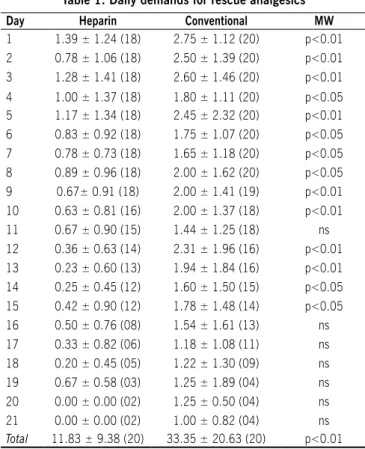
esultsThe TH group demanded fewer analgesics than C group in all
hospitalization days. This difference was statistically signiicant
in most days and in the sum of the solicitations of each patient during the hospitalization time (Table 1).
The VAS response was assessed based on the daily average of responses given by each patient (three routine measurements and occasional measurements before analgesics administration). The TH group presented lower values than C group in all
hospitali-zation days. This difference was statistically signiicant in several
treatment days (Table 2). Analysis of VAS responses given only in the morning, at night or after hygiene did not provide different information than that shown by daily average. VAS answered at the time of analgesics solicitation showed values generally
between four and six and also did not differ between the groups.
The adverse events incidence was similar in the two groups. In TH group 26 patients presented at least one adverse event (81.3% of 32 patients) against 21 patients in C Group (80.8%
of 26 patients) (Chi square p=0.7716; not signiicant).
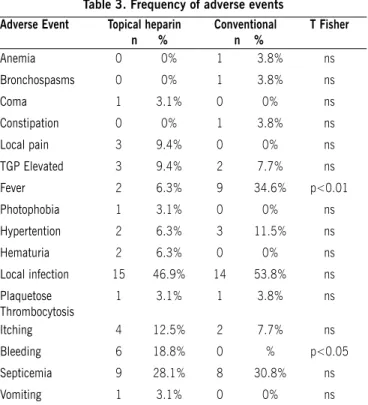
Table 3 shows that the TH group presented less fever and more bleeding than the C group. The groups did not differ in
TTPA evolution, platelets counting, SGOT and K (except for K in the sixth hospitalization day). There was also no difference in
hemoderivatives consumption between the two groups. When administered to the 2nd degree burnt areas, heparin led
to the appearance of small bleeding spots associated to exudates
of serum-hematic appearance. From the second hospitalization day on, the patients in group TH evolved with thick crusts of serum-hematic appearance on the burnt area. The crusts came out spontaneously between the seventh and tenth days. Although
this was not objectively tabulated, the authors’ subjective impres -sion is that the quality of the restored skin was not worse and may have been even better in TH group than in C group.
In two situations there was need of special medical
inter-vention for crusts’ rupture: when they presented luctuation, for
secretions drainage and when they were formed over articular
slowly, causing pain and bleeding. For this reason, four patients in the TH group discontinued their participation the study.
There was one death in the TH group caused by tentorial hernia: one 39 year-old male patient, victim of a gas bottle
explosion that evolved with intracranial hypertension due to
cranium-encephalic traumatism. Investigators unanimously concluded that topical heparin neither produced nor contributed to the casualty.
d
iscussiOnThis studied followed two groups of patients victims of burns
due to ire or scald: one treated conventionally and the other
treated with topical heparin. The differences in treatment routines prevented the performance of a double blind study, reason why the researchers chose to conduct an open label study, randomized and controlled by an active comparator.
The TH group presented lower VAS values in all
hospitaliza-tion days. This difference reached statistic signiicance in most days and is of great importance due to the dificulty for demons -trating pain reduction in the presence of the effective analgesic scheme administered to all the patients for ethical reasons. Daily analgesics solicitations average was always lower in TH group.
This difference was signiicant in most days and in the average of the each patient’s solicitations sum. The association of these
two parameters must be considered a clear evidence of the TH
scheme’s analgesic superiority, for patients in this group reported
less pain while consuming less analgesic medication.
There were no important tolerability problems in the TH group in relation to C group. Around 80% of the patients in both
groups presented adverse events, which is expected in cases of
hospitalized burnt patients.
Individualized tabulations of each event revealed that the TH
group presented more bleeding than C group. This is expected due to heparin’s anticoagulant action. This occurred only at the
site of administration. No bleedings were observed in sites where the medication was not administered.
Bleeding episodes were mild and occurred mainly when heparin was applied to burns associated to other injuries that
occurred in the context of polytraumatisms or during the disrup -tion of serum-hematic crusts formed on articular surfaces. Such bleedings were the reason for four patients to discontinuing their participation in the study. With the development of the study and
a better comprehension of the TH system’s particularities, the
crusts formed on articular surfaces were disrupted early by the investigators and bleeding was reduced.
TH group presented less cases of fever than C group, and the incidence of local septicemia infection was equal in both groups. This indicates that TH system did not result in increasing the incidence of local or systemic infections, despite lesions being left uncovered.
table 1. Daily demands for rescue analgesics
Day Heparin Conventional MW
1 1.39 ± 1.24 (18) 2.75 ± 1.12 (20) p<0.01
2 0.78 ± 1.06 (18) 2.50 ± 1.39 (20) p<0.01
3 1.28 ± 1.41 (18) 2.60 ± 1.46 (20) p<0.01
4 1.00 ± 1.37 (18) 1.80 ± 1.11 (20) p<0.05
5 1.17 ± 1.34 (18) 2.45 ± 2.32 (20) p<0.01
6 0.83 ± 0.92 (18) 1.75 ± 1.07 (20) p<0.05
7 0.78 ± 0.73 (18) 1.65 ± 1.18 (20) p<0.05
8 0.89 ± 0.96 (18) 2.00 ± 1.62 (20) p<0.05
9 0.67± 0.91 (18) 2.00 ± 1.41 (19) p<0.01
10 0.63 ± 0.81 (16) 2.00 ± 1.37 (18) p<0.01
11 0.67 ± 0.90 (15) 1.44 ± 1.25 (18) ns
12 0.36 ± 0.63 (14) 2.31 ± 1.96 (16) p<0.01
13 0.23 ± 0.60 (13) 1.94 ± 1.84 (16) p<0.01
14 0.25 ± 0.45 (12) 1.60 ± 1.50 (15) p<0.05
15 0.42 ± 0.90 (12) 1.78 ± 1.48 (14) p<0.05
16 0.50 ± 0.76 (08) 1.54 ± 1.61 (13) ns
17 0.33 ± 0.82 (06) 1.18 ± 1.08 (11) ns
18 0.20 ± 0.45 (05) 1.22 ± 1.30 (09) ns
19 0.67 ± 0.58 (03) 1.25 ± 1.89 (04) ns
20 0.00 ± 0.00 (02) 1.25 ± 0.50 (04) ns
21 0.00 ± 0.00 (02) 1.00 ± 0.82 (04) ns
Total 11.83 ± 9.38 (20) 33.35 ± 20.63 (20) p<0.01
The number of analgesics solicitations occurred each day is expressed in average ± standard
deviation (number of patients still in the study). MW: statistic signiicance in Mann-Whitney test. Total: average of the sum of each patient’s solicitations during coninement. NS: no signiicant statistic difference.
table 2 Analogic Visual scale
Day Heparin Conventional MW
1 1.15 ± 1.18 (18) 2.78 ± 1.92 (20) p<0.01
2 0.99 ± 1.12 (18) 2.05 ± 1.41 (20) p<0.05
3 1.46 ± 1.68 (18) 2.38 ± 1.36 (20) ns
4 0.96 ± 1.20 (18) 1.82 ± 1.50 (20) ns
5 1.48 ± 1.76 (18) 2.35 ± 1.45 (20) p<0.05
6 0.93 ± 0.98 (18) 1.79 ± 1.23 (20) p<0.05
7 0.74 ± 0.81 (18) 1.59 ± 1.25 (20) p<0.05
8 0.73 ± 0.72 (18) 1.83 ± 1.79 (20) ns
9 1.13 ± 1.31 (18) 1.72 ± 1.57 (19) ns
10 0.85 ± 0.96 (16) 1.98 ± 1.76 (18) p<0.05
11 0.80 ± 1.05 (15) 1.57 ± 1.61 (18) ns
12 0.57 ± 1.10 (14) 1.86 ± 1.80 (16) p<0.05
13 0.35 ± 0.55 (13) 1.89 ± 1.95 (16) p<0.01
14 0.38 ± 0.56 (12) 1.42 ± 1.54 (15) ns
15 0.28 ± 0.70 (12) 1.88 ± 1.64 (14) p<0.05
16 0.41 ± 0.84 (08) 1.29 ± 1.35 (13) ns
17 0.28 ± 0.69 (06) 1.29 ± 1.44 (10) ns
18 0.46 ± 1.03 (05) 1.36 ± 1.37 (09) ns
19 0.00 ± 0.00 (03) 1.33 ± 1.53 (03) ns
20 0.00 ± 0.00 (02) 1.50 ± 0.50 (03) ns
21 0.00 ± 0.00 (02) 1.07 ± 0.12 (03) ns
The numeric value of pain Analog Visual Scale each day is expressed in average ± standard
All patients were monitored for laboratorial alterations more frequently associated to heparin use: TTPA increase,
throm-bocytopenia, hepatotoxicity, and hypercalcemia. In all these
parameters the TH group was no worse than C group. These data allow for the conclusion that the population submitted to
TH system did not present alterations resulting from heparin’s
anticoagulant activity (TTPA), neither alterations in biochemical
parameters that could be attributed to the medication’s action (K, SGOT, and platelets). It is possible to infer that heparin’s
systemic action, applied in the conditions of this study, was not clinically relevant.
c
OnclusiOnThe system for treating burns based on the topically admi-nistrated heparin presented evidence of analgesic superiority in relation to the C system without important tolerability problems, when adequately managed.
There are elements suggesting that TH scheme may be econo-mically advantageous for the health system and more comfortable to the patient if compared to the C scheme. Studies designed
speciically for evaluating these outcomes are suggested. The authors’ subjective impression is that the quality of the
recently formed skin may have been higher in the TH group
than in C group and also suggest studies speciically designed
for evaluating this parameter.
Finally, due to characteristics of sprayed topical heparin treat-ment system (simplicity and comfort), its incorporation to burn
treatment centers’ routine may be advantageous for the patient
and very interesting, in pharmacoeconomical point of view, for the health system.
The number of analgesics solicitations occurred each day is
expressed in average ± standard deviation (number of patients
still in the study). MW: statistic signiicance in Mann-Whitney test. total: average of the sum of each patient’s solicitations
during coninement. Ns: no signiicant statistic difference. The numeric value of pain Analog Visual Scale each day is
expressed in average ± standard deviation (number of patients
still in the study). These data are calculated counting in the three daily routine responses (morning, shower and night) and the occasional responses obtained at analgesics solicitation of all the patients who were still in the study. MW: statistic signii -cance in Mann-Whitney test. total: average of the sum of each
patient’s solicitations during hospitalization. Ns: no signiicant statistic difference.
Number and percentage of patients who presented each adverse event. In the heparin group, 32 patients were included, and in the conventional group, 26. t Fischer: statistic signii
-cance in Fischer exact test. ns: no signiicant statistic difference.
Financial suport:
Cristália Produtos Químicos Farmacêuticos Ltda, São Paulo – SP
Conclict of interest: Jorge Barros Aiune, Hugo Eduardo
Pinheiro Praxedes and Eduardo Pagani are physicians and
employees of the the Laboratório Cristália, manufacturer of the heparin spray used in this study.
R
efeRences1. Piccolo NS, Correa MD, Amaral CR, Leonardi DF, Novaes FN, Prestes MA, et al. Queimaduras. Sociedade Brasileira de Cirurgia Plástica. In: Projeto Diretrizes. Associação Médica Brasileira. Conselho Federal de Medicina. [citado 2 mar 2009]. Disponível em: http://www.projetodiretrizes.org.br/ projeto_diretrizes/083.pdf.
2. Klein MB, Hollingworth W, Rivara FP, Kramer CB, Askay SW, Heimbach DM, Gibran NS.Hospital costs associated with pediatric burn injury. J Burn Care Res. 2008;29:632-7.
3. Sanchez JL, Bastida JL, Martínez MM, Moreno JM, Chamorro JJ. Socio-economic cost and health-related quality of life of burn victims in Spain. Burns. 2008;34(7):975-81.
4. Soares de Macedo JL, Santos JB. Nosocomial infections in a Brazilian Burn Unit. Burns. 2006;32:477-81.
5. De-Souza DA, Manço AR, Marchesan WG, Greene LJ. Epidemiological data of patients hospitalized with burns and other traumas in some cities in the southeast of Brazil from 1991 to 1997. Burns. 2002;28:107-14. 6. Ribeiro CA, Andrade C, Polanczyk CA, Clausell N. Association between early
detection of soluble TNF-receptors and mortality in burn patients. Intensive Care Med. 2002;28:472-8.
7. Saliba MJJ. Heparin eficacy in burns: II. Human thermal burn treat -ment with large doses of topical and parenteral heparin. Aerospace Med. 1970;41:1302-6.
8. Downing LJ, Strieter RM, Kadell AM, Wilke CA, Greenield LJ, Wakeield TW. Low-dose low-molecular-weight heparin is anti-inlammatory during venous thrombosis. J Vasc Surg. 1998;28:848-54.
9. Weber JR, Angstwurm K, Rosenkranz T, Lindauer U, Freyer D, Burger W, et al. Heparin inhibits leukocyte rolling in pial vessels and attenuates inlammatory changes in a rat model of experimental bacterial meningitis. J Cereb Blood Flow Metab. 1997;17:1221-9.
10. Fujita M, Ishihara M, Ono K, Hattori H, Kurita A, Shimizu M, Mitsumaru A, Segawa D, Hinokiyama K, Kusama Y, Kikuchi M, Maehara T. Adsorption of inlammatory cytokines using a heparin-coated extracorporeal circuit. Artif Organs. 2002;26:1020-5.
11. Salas A, Sans M, Soriano A, Reverter JC, Anderson DC, Pique JM, Panes J. Heparin attenuates TNF-alpha induced inlammatory response through a CD11b dependent mechanism. Gut. 2000;47:88-96.
table 3. Frequency of adverse events Adverse Event topical heparin
n %
Conventional n %
t Fisher
Anemia 0 0% 1 3.8% ns
Bronchospasms 0 0% 1 3.8% ns
Coma 1 3.1% 0 0% ns
Constipation 0 0% 1 3.8% ns
Local pain 3 9.4% 0 0% ns
TGP Elevated 3 9.4% 2 7.7% ns
Fever 2 6.3% 9 34.6% p<0.01
Photophobia 1 3.1% 0 0% ns
Hypertention 2 6.3% 3 11.5% ns
Hematuria 2 6.3% 0 0% ns
Local infection 15 46.9% 14 53.8% ns
Plaquetose Thrombocytosis
1 3.1% 1 3.8% ns
Itching 4 12.5% 2 7.7% ns
Bleeding 6 18.8% 0 % p<0.05
Septicemia 9 28.1% 8 30.8% ns
Vomiting 1 3.1% 0 0% ns
Number and percentage of patients who presented each adverse event. In the heparin group,
Artigo recebido: 08/05/09 Aceito para publicação: 04/10/09
12. Nelson RM, Cecconi O, Roberts WG, Aruffo A, Linhardt RJ, Bevilacqua MP. Heparin oligosaccharides bind L- and P-selectin and inhibit acute inlamma -tion. Blood.1993;82:3253-8.
13. Peter K, Schwarz M, Conradt C, Nordt T, Moser M, Klüber W, et al: Heparin inhibits ligand binding to the leukocyte integrin Mac-1 (CD11b/CD18). Circula-tion. 1999;100:1533-9.
14. Plotz FB, Van Oeveren W, Hultquist KA, Miller C, Bartlett RH, Wildevuur CR. A heparin-coated circuit reduces complement activation and the release of leukocyte inlammatory mediators during extracorporeal circulation in a rabbit. Artif Organs. 1992;16:366-70.
15. Folkman J, Shing Y. Control of angiogenesis by heparin and other sulfated polysaccharides. Adv Exp Med Biol. 1992;313:355-64.
16. Fujiyama S, Matsubara H, Nozawa Y. Angiotensin AT(1) and AT(2) receptors differ-entially regulate angiopoietin-2 and vascular endothelial growth factor expression and angiogenesis by modulating heparin binding-epidermal growth factor (EGF)-mediated EGF receptor transactivation.. Circ Res. 2001;19; 88: 22-9. 17. Rosengart TK, Budenbender KT, Duenas M, Mack CA, Zhang QX, Isom OW.
Therapeutic angiogenesis: a comparative study of the angiogenic potential of acidic ibroblast growth factor and heparin. J Vasc Surg. 1997;26:302-12. 18. Rizea Savu S, Silvestro L. Adhesion inhibition “in vitro” by heparin
deriva-tives correlates with their activity on angiogenesis in mice. J Cell Mol Med. 2003;7:187-91.
19. Saliba MJ, Griner LA. Heparin eficacy in burns: I. Signiicant early modiication of experimental third degree guinea pig thermal burnand ancilliary indings. Aerospace Med. 1970;41:179-87.
20. Cen Y, Luo P, Yan X. The effect of heparin on the deep second-degree burn in scalded rats. Zhonghua Shao Shang Za Zhi. 2001;17:174-6
21. Beneicial effects of topical heparin in burn wound healing. In: Proceedings of the First International Meeting on the Effects of Heparin the Treatment of in Burns. San Diego; 1994.
22. Jensen MP, Miller L, Fisher LD. Assessment of pain during medical procedures: a comparison of thee scales Clin J Pain. 1998;14: 343-9