*Correspondência: Hospital Geriátrico e de Convalescentes Dom Pedro II
Avenida Guapira, 2674 São Paulo – SP, Brazil CEP: 02265-002 Tel: +55 (11) 2176-1204 hdp.dirtec@santacasasp. org.br
AbstrACt
Objective. To deine the prevalence of use of drugs incompatible with the enteral route in patients living in long stay institutions for the elderly LTCFs and using feeding tubes.
MethOds. Analysis of prescriptions for LTCF inpatients who are using feeding tubes for longer than 48 hours. Active ingredients, forms of presentation, and possibility of pulverizing the drugs prescribed were compared with data in the literature regarding the feasibility of the enteral administration of drugs. Results. We found that 57 patients were using feeding tubes (11.2% of the total number of beds). Their mean age was 65.6 ± 16.0 years old, and 32 of them were women and 25 were men. Mean of drugs administered through enteral route: 5.6 ± 2.2. Items included in the prescriptions: 316 divided into 64 drugs, with 129 items (40.8% of the total) and 23 drugs (35.4%) inadequate for this route. The most often prescribed inappropriate drugs: captopril, phenytoin, ranitidine, omeprazole, and B complex. Alternative presentations were found for 15 (65.2%) of the 23 drugs that were not appropriate for enteral administration.
cOnclusiOn. Feeding tubes used as a method to administer drugs in LTCF have a signiicant risk for incompatible prescriptions.
KeyworDs: Drug utilization review. Drug administration routes. Homes for the aged.
dRugs
and
feeding
tubes
MiltOn luiz gORzOni1*, andeRsOn della tORRe2, sueli lucianO PiRes3
Study conducted at Hospital Geriátrico e de Convalescentes Dom Pedro II. Discipline: Basis of Gerontology, Department of Clinical Medicine, School of Medicine,
Santa Casa de São Paulo, São Paulo, SP, Brazil
1. Médico Doutor e Professor adjunto do Hospital Geriátrico e de Convalescentes Dom Pedro II, São Paulo, SP
2. Médico Assistente do Hospital Geriátrico e de Convalescentes Dom Pedro II, São Paulo, SP
3. Professora Instrutora e Diretora Técnica do Hospital Geriátrico e de Convalescentes Dom Pedro II, São Paulo, SP
i
ntROductiOnThe use of feeding tubes has been reported since the pre-Christian Rome, when substances were administrated with the purpose of inducing vomiting. This practice allowed the old Romans to return to their feasts and keep eating, to close deals and to reduce the risk of poisoning. In addition to the attempts to remove foreign bodies, this procedure was also used to admi-nistrate emetic and cathartic drugs with the purpose of removing toxins up to the middle of the 18th century. During that period, new and more lexible materials were created, which made it easier to use feeding tubes aimed at helping disabled patients to swallow.1
Around 250 years after the beginning of their use in the clinical practice, feeding tubes are increasingly recommended for the intake of nutrients and administration of drugs when patients are not able to receive drugs and food through the oral route. Regardless of the type of tube, it is worth mentioning that its passage is an invasive procedure that must be carried out according to speciic techniques and recommendations.2 Therefore, there is risk of mechanical complications (decubitus lesions, obstructions, misplacements, and tube discard), meta-bolic complication (electrolytic disorders, hyperglycemia and refeeding), and gastrointestinal complications (regurgitation,
vomiting, diarrhea, constipation, intestinal pneumatosis, and jejunal necrosis).3-5
The use of this route for drug administration may also be part of potential complications if the procedure is not adequately planned. Solid drugs usually cause obstructions, resulting in the need of replacing the tube, which increases the costs and the patients’ distress.2 Tablets and pills, due to the type of content (liquid, gelatinous or powder) are at risk of being incorrectly diluted or absorbed by gastrointestinal segments that are nor those intended for such administration.6 It is recommended that the drugs characterized by slow or enteric release or micro-encapsulated drugs are not pulverized, since this reduces the time of drug absorption and causes higher risk of overdose and poisoning.7-9 Even those sweetened liquid drugs may have a signiicant osmotic or laxative potential due to the presence of substances such as mannitol and sorbitol.
nutrition, bronchoscopic aspiration, demential and terminal states. Only two of these studies analyzed drugs and feeding tubes in LTCFs, but both of them considered costs and did not study the pharmacological aspects.12,13 The same keywords were searched for in the website http://www.scielo.br and we could not ind any study about this topic.
O
bjectiveTo deine the prevalence of use of drugs incompatible with the enteral route2,6,14 in patients living in LTCFs and using feeding tubes.
M
ethOdsThis is a retrospective observational study that analyzed the prescriptions of patients using feeding tubes for longer than 48 hours in LTCFs. The study was conducted at Hospital Geriátrico e de Convalescentes Dom Pedro II of Irmandade da Santa Casa de São Paulo, since this LTCF has 508 beds divided among the wards according to the level of physical or mental dependence. Based on the estimate that between 20 and 10% of the patients were using feeding tubes, the minimal sample with potential for statistical analysis was deined as comprising 55 cases (95% conidence interval).
The sample was divided according to sex and age (younger than 60 years old and 60 years old or older), and the active ingredients of the drugs prescribed were compared with the literature on the viability of drugs administered through this route.2,6,8,9,14 We also assessed the forms of presentation (pills, capsules, coated tablets of enteric or extended release
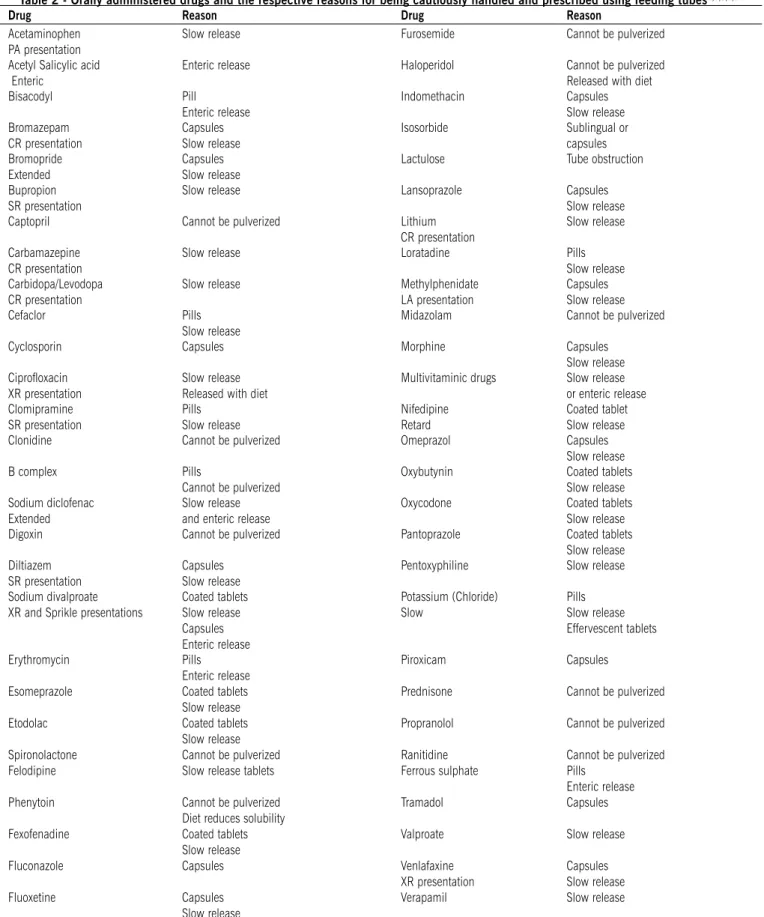
drugs) and the possibility of being pulverized. We focused mainly on the forms of presentation including acronyms related to enteric-coated drugs or extended-release drugs, since when these types of drugs are pulverized they undergo a pharmacokinetic intervention performed by the site in the digestive apparatus where the feeding tube is placed, changing its bioavailability and posing the risk of drug poisoning2,8,9 (Table 1). These data constituted the protocol shown in Table 2.2,6,8,9,14
In order to test if there were statistically signiicant differences, the Fisher’s exact test was used regarding proportions and the Student’s T test was used regarding means. Values lower than 5% were considered to be statistically signiicant.
The present study is part of the project no. 061/08 approved by the Ethics Research Committee of Irmandade da Santa Casa de Misericórdia de São Paulo.
R
esultsWe found that 57 patients were using feeding tubes (11.2% of the total number of beds). Their mean age was 65.6 ± 16.0 years old, and 32 of them were women and 25 were men. Those aged younger than 60 years were: 5 women (Group A) and 15 men (Group B) and those aged older than or 60 years were: 27 women (Group C) and 10 men (Group D) (p < 0.001).
Mean of drugs administered through enteral route was 5.6 ± 2.2; of this, 5.2 ± 2.2 were in Group A, 5.7 ± 2.3 were in Group B, 5.7 ± 2.4 were in Group C, and 5.2 ± 2.0 were in Group D (p > 0.05). Items included in the prescriptions were as follows: 316 items divided into 64 drugs, with 129 items (40.8% of the total) and 23 drugs (35.4%) inadequate for this
table 1 - Forms of presentation through oral route that should not be pulverized and that are vulnerable to pharmacokinetic intervention performed by the site of the digestive apparatus where the feeding tube is located.2,8,9
Oral presentations Usual abbreviations reasons for original formulation and contraindications for use in feeding tubes
Enteric-coated EC = Enteric-coated Planned for passing the stomach intact and beginning drug release in the intestine.
Formulation:
- Prevents drug destruction by the gastric juice
- Reduces stomach symptoms
- Delays the beginning of drug action
Administered through the feeding tube: - It is not protected against gastric juice action
- Immediate pharmacological action and at total dose
Extended-release CD = Controlled Delivery CR = Controlled Release
LA = Long Action
PA = Prolonged Action
SR = Slow Release XL = Extended Release
XR = Extended Release
Planned to slowly release the drug, allowing for lower doses a day.
Formulation:
- Layers or micrograins with progressive dissolution time - Coatings programmed for slow drug release
Administered through the feeding tube: - It is not protected against gastric juice action
table 2 - Orally administered drugs and the respective reasons for being cautiously handled and prescribed using feeding tubes2,6,8,9,14
Drug reason Drug reason
Acetaminophen PA presentation
Slow release Furosemide Cannot be pulverized
Acetyl Salicylic acid Enteric
Enteric release Haloperidol Cannot be pulverized
Released with diet
Bisacodyl Pill
Enteric release
Indomethacin Capsules
Slow release
Bromazepam CR presentation
Capsules
Slow release
Isosorbide Sublingual or
capsules Bromopride
Extended
Capsules
Slow release
Lactulose Tube obstruction
Bupropion SR presentation
Slow release Lansoprazole Capsules
Slow release
Captopril Cannot be pulverized Lithium
CR presentation
Slow release
Carbamazepine CR presentation
Slow release Loratadine Pills
Slow release Carbidopa/Levodopa
CR presentation
Slow release Methylphenidate
LA presentation
Capsules
Slow release
Cefaclor Pills
Slow release
Midazolam Cannot be pulverized
Cyclosporin Capsules Morphine Capsules
Slow release Ciproloxacin
XR presentation
Slow release Released with diet
Multivitaminic drugs Slow release
or enteric release Clomipramine
SR presentation
Pills
Slow release
Nifedipine
Retard
Coated tablet
Slow release
Clonidine Cannot be pulverized Omeprazol Capsules
Slow release
B complex Pills
Cannot be pulverized
Oxybutynin Coated tablets
Slow release Sodium diclofenac
Extended
Slow release
and enteric release
Oxycodone Coated tablets
Slow release
Digoxin Cannot be pulverized Pantoprazole Coated tablets
Slow release
Diltiazem SR presentation
Capsules
Slow release
Pentoxyphiline Slow release
Sodium divalproate
XR and Sprikle presentations
Coated tablets
Slow release
Capsules Enteric release
Potassium (Chloride)
Slow
Pills
Slow release Effervescent tablets
Erythromycin Pills
Enteric release
Piroxicam Capsules
Esomeprazole Coated tablets
Slow release
Prednisone Cannot be pulverized
Etodolac Coated tablets
Slow release
Propranolol Cannot be pulverized
Spironolactone Cannot be pulverized Ranitidine Cannot be pulverized
Felodipine Slow release tablets Ferrous sulphate Pills
Enteric release
Phenytoin Cannot be pulverized
Diet reduces solubility
Tramadol Capsules
Fexofenadine Coated tablets
Slow release
Valproate Slow release
Fluconazole Capsules Venlafaxine
XR presentation
Capsules
Slow release
Fluoxetine Capsules
Slow release
Verapamil Slow release
route (p > 0.05 between the groups).
Mean number of inappropriate drugs administered through the enteral route: 2.2 ± 1.5; of this, 1.8 ± 1.9 were in Group A, 2.2 ± 1.6 were in Group B, 2.2 ± 1.7 were in Group C, and 2.3 ± 0.7 were in Group D (p > 0.05). The most often prescribed inappropriate drugs were: lactulose, captopril, phenytoin, raniti-dine, omeprazole, complex B, folic acid, tramadol, bromopride, and nifedipine. The alternative forms of presentation were found in 15 (65.2%) of the 23 inappropriate drugs for this route. The list of the inappropriate drugs most often prescribed and their alternative presentations (when there was any) are shown in Table 3.
d
iscussiOnForms of drug presentation appropriate for patients with swallowing dificulties may become a challenge in the clinical practice. Even though it ensures a high level of absorption, the parenteral route – intravenous, intramuscular or subcutaneous – poses a potential higher risk of complications, distress, and higher cost. In addition, its use is rare in long-term treatments. Other routes – percutaneous, oral, sublingual, rectal or topic – despite being an alternative method, are limited due to the small number of drugs available for them.
The routine of the care provided to those patients living in LTCFs is usually faced with this situation, in which feeding tubes also become the main administration route of drugs. In such
cases, there is often the wrong assumption that the oral and parental routes are similar regarding the pharmacokinetic process and drug bioavailability. Before deciding to keep the same pres-cription used previously to the passage of the feeding tube, some basic rules should be taken into consideration so that the viability of the drug through this route can be established2,6,8,9,14,15:
- Type of tube - Tubes connected to the stomach usually have larger diameters and are more inexpensive than those connected to the small intestine. Its passage is simpler and the frequency of obstruction is lower than that of the intestinal tubes. Acute cases of dysphagia or digestive disorders or patients who often pull out their tubes are the usual indications for gastric feeding tubes in LTCFs. This type of tube, in addition to being of transient use, is not the preferred administration route for drugs, since it cannot receive diet for at least 30 minutes and needs to be closed after the drugs is administered so that the medication can be released. - Position of the outlet hole of the tube inside the digestive apparatus - Drugs that act in the stomach, such as antacids, are inappropriate for tubes located in the small intestine areas. Tubes located in the jejunum, on the other hand, increase the bioavailability of the drugs with extensive metabolization during their irst passage through the liver, such as beta-blockers, nitrates, tricyclic antidepressives, and opioids.
- Effects of enteral feeding on drugs - Minimum intervals from 15 to 30 minutes without diet before and after receiving medication prevent food-drug interaction, such as, for instance,
table 3 - Drugs more often prescribed for enteral route in the sample analyzed (57 cases), form of presentation, and reason for inappropriateness, alternative presentations and percentage of cases using each one of these drugs.
Drug Number of cases
Presentation reason for inappropriateness
Alternative presentation % of total (57 cases)
Lactulose 35 Syrup Tube obstruction - 61.4
Dipyrone 24 Tablet * Liquid/Ampoule 42.1
Captopril 22 Tablet
Cannot be
pulverized - 38.6
Phenytoin 18 Tablet
Cannot be
pulverized Ampoule 31.6
Acetaminophen 17 Tablet * Liquid 29.8
Ranitidine 13 Tablet
Cannot be
pulverized Ampoule/Syrup 22.8
Risperidone 12 Tablet * Solution 21.0
Omeprazole 11 Capsule Slow release Bottle-ampoule/Soluble capsules 19.3
Hydrochlorothiazide 10 Tablet * - 17.5
Sertraline 10 Tablet * - 17.5
B complex 9 Pill
Cannot be
pulverized Liquid/Syrup 15.8
Acetyl salicylic acid 8 Tablet * - 14.0
Folic acid 8 Coated tablets Slow release - 14.0
Tramadol 7 Capsule
Cannot be
pulverized Solution/Ampoule/Suppository 12.3
Bromopride 6 Capsule Slow release Solution/Liquid/Ampoule 10.5
Clonazepam 6 Tablet * Liquid 10.5
Nifedipine 6 Capsule Slow release - 10.5
Sinvastatin 6 Tablet * - 10.5
Artigo recebido: 28/07/08 Aceito para publicação: 08/09/09 lactulose, phenytoin, ciproloxacin, and haloperidol. Therefore,
the risk of precipitations, tube obstructions and reduction of serum levels is decreased due to the lower level of absorption of drugs.
- Pulverize only the necessary amount - A procedure that may interfere with the quality of the pharmacological presentation, causing alterations in the serum levels of drugs and increasing the risk of obstructing the tubes. It may also produce aerosols, offering the risk of allergic reactions and teratogenicity to those who handle these drugs. Whenever possible, it is recommended to avoid capsules, pills and forms of presentation that are charac-terized by slow or enteric release or microencapsulated drugs.
- Use “dispersion methods” whenever possible and do not mix drugs - Choosing easily dissolved drugs reduces the amount of work of those responsible for administrating the drugs. Avoiding mixing drugs decreases the risk of physical, chemical and pharmacological interactions.
- Wash the tube after each administration - Washing the tube before and after drug administration using 20 to 30 ml of distilled water helps to maintain the tube’s permeability and reduces the risk of drug adherence to the wall of the feeding tube.
These rules may seem obvious, but they can avoid ineffi-cient and burdensome prescriptions for those responsible for the care of patients using feeding tubes.
The sample of the present study only showed statis-tical significance related to the larger number of elderly women, which was expected due to the longer female longevity and the correlation between age, dependence, and LTCF.10,11 Considering that the consumption of medica-tions of people living in nursing homes ranges between 3.8 and 11.9,13,16-19 the mean of 5.6 ± 2.2 drugs adminis-tered through enteral route we found may be considered to be within the standards of prescriptions in LTCFs. An inte-resting finding is the high percentage of inappropriate drugs for enteral administration, mainly among those of frequent use, that is, in more than 10% of the sample.
A periodical review of the drugs should be part of the good clinical practice, especially regarding users of feeding tubes and those exposed to multiple drugs at the same time as it happens in LTCFs.
c
OnclusiOnFeeding tubes used as a method to administer drugs has high risk of prescription of inappropriate drugs for people living in nursing homes.
a
cknOwledgeMentsWe would like to thank the Center of Publica-tion Support of the School of Medical Sciences of Santa Casa de São Paulo (NAP-SC) for the technical and scien-tiic support regarding the publication of this manuscript.
Conlict of interest: No conlicts of interest declared concer-ning the publication of this article.
R
efeRences1. Kravetz RE. Stomach (Ewald) tube. Am J Gastroenterol. 2005;100:1444-5. 2. Beckwith MC, Feddema SS, Barton RG, Graves C. A guide to drugs therapy in
patients with enteral feeding tubes: dosages form selection and administration methods. Hosp Pharm. 2004;39:225-37.
3. Walters G, Ramesh P, Memon MI. Buried Bumper Syndrome complicated by intra-abdominal sepsis. Age Ageing 2005;34:650-1.
4. Álvarez Hernández J, Peláez Torres N, Muñoz Jiménez A. Clinical use of enteral nutrition. Nutr Hosp. 2006;21(Suppl 2):85-97.
5. Hilal RE, Hilal T, Mushawahar A. Percutaneous endoscopic jejunostomy feeding tube “knot” working: a rare complication. Clin Gastroenterol Hepatol. 2007;5:A28. 6. Catalán E, Padilla F, Hervás F, Pérez MA, Ruiz F. Fármacos orales que no deben
ser triturados. Enferm Intensiva. 2001;12:146-50.
7. Mitchell JF. Oral dosage forms that should not be crushed: 2000 update. Hosp Pharm. 2000;35:553-7.
8. Cornish P. “Avoid the crush”: hazards of medication administration in patients with dysphagia or a feeding tube. CMAJ. 2005;172:871-2.
9. van den Bemt PM, Cusell MB, Overbeeke PW, Trommelen M, van Dooren D, Ophorst WR, et al. Quality improvement of oral medication administration in patients with enteral feeding tubes. Qual Saf Health Care. 2006;15:44-7. 10. Gorzoni ML, Pires SL. Aspectos clínicos da demência senil em instituições
asilares. Rev Psiq Clín. 2006;33:18-23.
11. Gorzoni ML, Pires SL. Idosos asilados em hospitais gerais. Rev Saúde Pública 2006;40:1124-30.
12. Cooper JW. Nursing home drug and nutritional therapy cost-savings by the consultant pharmacist. Nurs Homes Sr Citiz Care. 1987;36:6-8.
13. Avery AJ, Groom LM, Brown KP, Thornhill K, Boot D. The impact of nursing home patients on prescribing costs in general practice. J Clin Pharm Ther. 1999;24:357-63.
14. Goñi Viguria R, Sánchez Sanz L, Asiain Erro M, Baztán Indave A. Administración de fármacos por sonda digestiva. Enferm Intensiva. 2001;12:66-79. 15. Thomson FC, Naysmith MR, Lindsay A. Managing drug therapy in patients
receiving enteral and parenteral nutrition. Hosp Pharm. 2000;7:155-64.
16. Bergman A, Olsson J, Carlsten A, Waern M, Fastbom J. Evaluation of the quality of drug therapy among elderly patients in nursing homes. Scand J Prim Health Care. 2007;25:9-14.
17. Mamun K, Lien CT, Goh-Tan CY, Ang WS. Polypharmacy and inappropriate
medication use in Singapore nursing homes. Ann Acad Med Singapore.
2004;33:49-52.
18. Snowdon J, Day S, Baker W. Audits of medication use in Sydney nursing homes. Age Ageing. 2006;35:403-8.
19. Stella F, Caetano D, Pacheco JL, Sé EV, Lacerda AL. Factors inluencing
psychotropic prescription by non-psychiatrist physicians in a nursing home