SUMMARY
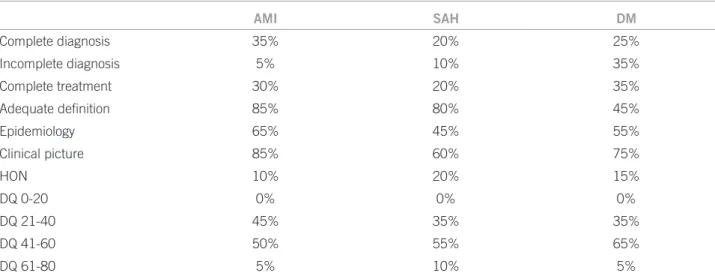
Objective: Patients and their relatives oten look for information about their diseases on the internet. Diabetes mellitus (DM), systemic arterial hypertension (SAH), and acute myocardial infarction (AMI) are the most prevalent in Brazil, thus, information on these pathologies is extremely searched for on the internet. For this reason, this study attempt-ed to evaluate the quality of information available in Portuguese on the Web regarding these disorders. Methods: he irst 20 websites in Portuguese for each disease through the Google® search algorithm were selected. he Discern Questionnaire (DQ) and Health on the Net (HON) were used as tools in order to evaluate the quality of information. To assess adequacy, international and Brazilian guidelines for diferent co-morbidities were used. Results: When evaluating the information content available, 45%, 95%, and 85% of pages had the deinition of DM, SAH, and AMI, respectively. Only 25% of the websites regarding the three co-morbidities had speciic information on diagnosis and treatment. Only 15%, 20%, and 10% of the websites had HON certiication, respectively. Using the DQ approach, scores higher than 50% were obtained in 70% of the DM websites, in 65% of SAH websites, and in 55% of the AMI websites. Conclusion: he available informa-tion in Portuguese on the internet regarding the three pathologies selected (DM, SAH, and AMI) is quite oten inadequate and insuicient.
Uniterms: Internet; quality; medical information; Portuguese.
©2012 Elsevier Editora Ltda. All rights reserved.
Study conducted at the Faculdade de Medicina do ABC,
Santo André, SP, Brazil
Submitted on: 01/11/2012 Approved on: 06/30/2012
Correspondence to:
Adriana Del Giglio Rua Mariana Correia, 369 Jd. Paulistano – São Paulo
SP, Brazil CEP: 01444-000 [email protected]
Conflict of interest: None.
Quality of internet information available to patients on websites in
Portuguese
ADRIANA DEL GIGLIO1, BEATRICE ABDALA1, CAROLINA OGAWA1, DANIEL AMADO1, DIEGO CARTER2, FERNANDA GOMIEIRO1, FERNANDA SALAMA3, MARINA SHIROMA1, AURODEL GIGLIO4
1 Medical Students, Faculdade de Medicina do ABC (FMABC), Members of Students’ Committee of ACP Brazil, Santo André, SP, Brazil 2 Medical Student, Faculdade de Medicina de Jundiaí, Jundiaí, SP, Brazil
AMI SAH DM
Complete diagnosis 35% 20% 25%
Incomplete diagnosis 5% 10% 35%
Complete treatment 30% 20% 35%
Adequate definition 85% 80% 45%
Epidemiology 65% 45% 55%
Clinical picture 85% 60% 75%
HON 10% 20% 15%
DQ 0-20 0% 0% 0%
DQ 21-40 45% 35% 35%
DQ 41-60 50% 55% 65%
DQ 61-80 5% 10% 5%
DQ, Discern Questionnaire; HON, Health on the Net Foundation; AMI, acute myocardial infarction; SAH, systemic arterial hypertension; DM, diabetes mellitus. *Results of DQ are described in accordance with the percentage of websites presenting scores from 0 to 20 (very low), from 21 to 40 (low), from 41 to 60 (intermediate) and from 61 to 80 points (high).
Table 1 – Results obtained after comparison of websites with the guidelines, and application of the DQ and the HON Code* veriication
INTRODUCTION
Since the 1980s the health scenario in Brazil has been changed. Diferently from the infectious and parasitic diseases (IPD), nowadays there is a prevalence of chronic non-communicable diseases (CNCDs)1,2. Among some
of the prevalent illnesses in population, systemic arterial hypertension (SAH), with a prevalence rate of 37%3 in the
population aged over 35 years; diabetes mellitus (DM), which is present in 9.7%4; and acute myocardial
infarc-tion (AMI), responsible for 46.11%5 of deaths caused by
cardiovascular disorders, are the most important diseases considered in this study.
In recent years, the Internet has signiicantly in-creased opportunities for obtaining information in the medical ield. It is quite diferent from traditional means of communication, since it ofers a large and varied amount of speciic information on a given topic, rather than approaching general issues6.
It is well-known that a great part of the population seeks information on their health status, along with treatments suggested by physicians on the Internet. Not-withstanding, there is still no research on the Brazilian reality concerning Internet-based seeking of health-in-formation. In the United States, a study by Cyber Dia-logue/ Internet Health Day showed that 52% of users had searched for information on diseases; one third of users had searched for information related to diet and nutri-tion, pharmaceutical products, and physical shape; and approximately 15% of users had searched for information on children’s health status.
The analysis of the quality of information is still ex-tremely controversial. The Health on the Net Founda-tion (HON)7, a Switzerland-based non-governmental
organization founded in 1995, evaluates health care websites through a code of conduct focusing on their credibility. Websites following such code are allowed to exhibit HON’s logotype8. Another form of evaluation
is the Discern Questionnaire (DQ), a project founded in 1996-1997 by The British Library and the National Health Services (NHS) Executive Research & Develop-ment Program, and published in the Journal of Epide-miology and Community Health. This approach pro-vides users with a brief and reliable way of evaluating the quality of written information on treatment options for a given health problem9. The DQ is used by many
authors, such as Collin Currie, regarding available in-formation on schizophrenia10,or Moon Young Chang,
regarding rhinitis11.
Following the tendency of searching information on the Internet, the most prevalent diseases in Brazil were used to analyze the information quality on websites in Portuguese. The present study reports the quality of information available in Portuguese concerning SAH, DM, and AMI on the Internet.
METHODS
SAH, DM, and AMI were searched using key words such as: “hypertension”, “diabetes mellitus”, and “infarction”, respectively, on Google’s search website. he irst 20 sites were selected for each pathology on October 17, 2010.
Table 2 – DQ (translated by the authors) and the results obtained for each disease analyzed*
Questions SAH AMI DM
Are the objectives clear? 5 4.2 3.9
Have the objectives been reached? 4.5 4.25 3.7
Is it relevant? 4.85 3.75 3.9
Is it clear which information sources were used for making the website? 2 4.4 2.9
Is it clear when information used for making the website was produced? 2.2 2.45 3.2
Is it balanced and with no biases? 4.3 2.5 3.1
Are there any details on additional information sources? 1.75 2.6 2.9
Is there any reference to doubtful areas? 4.8 2.05 2.2
Is it described on this website how each treatment works? 2.25 2.7 2.36
Are the benefits of each treatment described on this website? 1.55 2.2 2.36
Are the risks of each treatment described? 3 1.65 1.89
Is it described what would happen if no treatment were performed? 3.2 2.15 3.05
Is it described how each treatment selection would affect the quality of life? 1.65 1.9 2.47
Is it clear that there is more than one possible therapeutic selection? 2.55 2.25 3.2
Is there support for decision-making? 1 2 2.7
Based on the responses to all questions above, classify this website
according to its quality for selecting therapeutic alternatives. 1.55 3.4 2.6
Average 2.884375 2.778125 2.901875
DQ, Discern Questionnaire; SAH, systemic arterial hypertension; AMI, acute myocardial infarction; DM, diabetes mellitus. *Each question was evaluated on a scale from 1 to 5 points (see “Methods”).
Exclusion criteria were websites written in languag-es other than Portugulanguag-ese, duplicate, or non-specific for the diseases selected; websites for questions such as “Yahoo questions/answers”; and links to previously ana-lyzed websites, or those presenting technical problems for access.
The sites were evaluated in accordance with the fol-lowing criteria: approval by the HON Code, application of the DQ12,and comparison of the information present
on the website with specific consensus for each disease proposed by Brazilian or American subspecialty or spe-cialty societies.
The principles of the HON Code7,8 are the most
traditional, reliable, and comprehensive for evaluating healthcare and medicine information available on the internet. The aim of consultation was to validate the code certification regarding the research of sites and Brazilian professionals. The study aimed to check the HON certification on the selected Brazilian websites. DQ (Table 2) consists of 16 subjective questions, which are individually classified on a scale of five scores, where n = 1 does not meet the criterion, and n = 5 completely meets the criterion. The questionnaire focuses on the quality of the transmitted information. The grades were separately attributed by two authors and compared to the evaluation by a third party, in case of noticeable
discrepancy, and this third party was responsible for se-lecting the score. The results of the DQ are presented in series according to the scores from 0 to 20 (very low), 21 to 40 (low), 41 to 60 (intermediate), and 61 to 80 points (high).
In order to assess the technical adequacy of the text present on each website, the most recent consensus state-ments approved by Brazilian and/or International Medi-cal Society regarding the respective subspecialties cor-respondent to the illnesses researched were used. he selected consensus statements were on diabetes13,14,
hy-pertension15,and acute myocardial infarction16,17. Only
total agreement between the information present on the website and that from the respective consensus state-ments resulted in the content being considered adequate.
RESULTS
information on the complete treatment, the results were 30%, 20%, and 35% for AMI, SAH, and DM, respective-ly (Table 1).
Regarding HON certiication, it was present in less than 20% of the websites consulted (Table 1). As to the DQ (Table 1), the great majority of sites presented aver-age scores of 2.88, 2.78, and 2.9 for SAH, AMI, and DM, respectively.
On Table 2, it is possible to observe that websites regarding SAH, AMI, and DM have achieved their goal of providing readers with information (second question of the DQ). By verifying the source of content (fourth question of the DQ) presented for AMI, an average of 4.4 was obtained; the two other pathologies received an average below 3. SAH websites presented stability and no biases (sixth question of the DQ), with an average of 4.3, differently from AMI and DM-related websites, which presented averages of 2.5 and 3.2, respectively.
DISCUSSION
This study aimed to evaluate the quality of information on health care available on the Internet. Thus, three prevalent diseases in the Brazilian population were se-lected, as well as the Google® search engine, a search tool
widely used by the Brazilian community. The quality of information available was found to be unsatisfactory, reflecting a tendency previously found in the medical literature of other countries.
DQ average scores found in the study (2.85/5) are similar to those found by various foreign authors who researched the quality of information available for different diseases on the Web. Currie et al., in a study on schizophrenia10, obtained an average of 3.18/5;
Chilton and Collet18,in a study on rheumatoid
arthri-tis, 1.7/5; and Moon Young Chang et al.11, in a study on
allergic rhinitis, 1.92/5.
The HON logo was present in less than 20% of web-sites, which could reflect ignorance of this certification in the Brazilian community, and thus it is not necessar-ily a parameter for lack of quality.
All the information from the websites consulted in this study were compared to consensus statements from specialties and subspecialties societies; diagnosis and treatment related-data were found to be quite deficient, leading to a situation of misunderstanding regarding the most critical field, that is, the therapeutic approach of the disorder.
In recent years the world has experienced a dra-matic technological transformation that has radi-cally enhanced access to information, especially by means of the Internet. There is increasingly more in-formation available in the healthcare field. Access to
technical-scientific information, along with the in-creased educational level of the population gave rise to patients who actively seek information on their ill-nesses. The countless search websites facilitate these individuals proactive behavior of seeking information ever more independently.
The use of medical websites has completely changed the relationship between physicians and patients. Now-adays the patient, armed with information, questions and discusses the diagnosis and many different thera-peutic modalities much more. Therefore, the patient is a special consumer of health products and services, who has relevant information that should be, at least, taken into account19,20.
Eastin21 stresses that medical professionals are not
necessarily the authors responsible for the information available on the Web. This factor creates the possibil-ity that information has no guarantee of credibilpossibil-ity. For this reason, HON was created, and it is internationally well-known and applied.
Conversely, in Brazil there is the manual of ethical principles for medicine and healthcare websites 22, from
the Regional Council of Medicine of São Paulo (Con-selho Regional de Medicina de São Paulo — Cremesp). The manual defines ethical principles and criteria of conduct on internet websites, presenting a set of con-cepts for applications of medicine and healthcare fields similar to those of HON, including: transparency, hon-esty, quality, informed consent, privacy, medical ethics and responsibility, as well as source. These criteria are not yet standard in Brazil23, and they are not adequately
disseminated either, as the majority of physicians and patients do not know about them.
The general public needs to be informed that medi-cal information on the Web is free of rules. It is nec-essary to carefully and judiciously evaluate the degree of reliability of the information, and both medical pro-fessionals and the general public must know that the veritable and quality information should be sought on websites with a quality certification24. Physicians play
an essential role in explaining to their patients about the limits of information available on the Web, as well as indicating the most trustworthy websites regarding their disorders.
CONCLUSION
Taking into account the great importance of the diseases studied, and the role played by the Internet on patients’ information and consequently on their relatives’ infor-mation, the quality of information available concerning those diseases was questioned. Hence, it is concluded that this information is neither sufficient nor adequate for the patient’s needs.
REFERENCES
1. Malta DC, Cezário AC, Moura L, Morais Neto OL, Silva Junior JB. A construção da vigilância e prevenção das doenças crônicas não trans-missíveis no contexto do Sistema Único de Saúde. Epidemiol Serv Saúde. 2006;15(3):47-65.
2. Brasil. Ministério da Saúde. A vigilância, o controle e a prevenção das doen-ças crônicas não transmissíveis: DCNT no contexto do Sistema Único de Saúde Brasileiro. Epidemiologia e serviços de saúde. Rev Sistema Único de Saúde do Brasil. 2006;15(1):47-65.
3. DATASUS. Taxa de prevalência de diabete melito. [cited 21 Apr 2011]. Avail-able from: http://tabnet.datasus.gov.br/cgi/tabnet.exe?idb2009/g02.def. 4. DATASUS. Taxa de prevalência de hipertensão arterial. [cited 21 Apr 2011].
Available from: http://tabnet.datasus.gov.br/cgi/tabnet.exe?idb2009/g01.def. 5. Pinto CCS, Santos CFS, Pereira ER, Silva RMCRA. A importância do con-hecimento da incidência de infarto agudo do miocárdio na unidade coro-nariana e dos cuidados de enfermagem para uma gestão em saúde de quali-dade. [cited 20 Nov 2010]. Available from: http://www.uf.br/anaissegerenf/ pdf/279%20-%20a%20importancia%20do%20conhecimento%20da%20 incidencia%20de%20infarto.pdf.
6. Soares MC. Internet e saúde: possibilidades e limitações. Textos de la Ciber-Sociedad. 2004;(4).
7. HON Code. [cited 2012 apr 15]. Available from: http://www.hon.ch/HON-code/conduct.html.
8. HON Code. [cited 2012 apr 15]. Available from: http://www.hon.ch/HON-code/Pro/intro.html.
9. Discern Online. [cited 17 out 2011]. Available from: http://www.discern. org.uk/.
10. Currie C, Di Mambro P, Joice A, Glip RM, O.Neill M, Ralston EG, et al. Evaluating the quality of educational materials about schizophrenia. he Psychiatrist. 2002;26:96-98.
11. Chang MY, Han DH, Moon IJ, Kim ST, Kim DY, Lee CH, et al. Assess-ment of allergic rhinitis websites s in Korea. Clin Exp Otorhinolaryngol. 2010;3(1):32-6.
12. Charnock D, Shepperd S, Needham G, Gann R. DISCERN: an instrument for judging the quality of written consumer health information on treatment choices. J Epidemiol Community Health. 1999;53(2):105-11.
13. American Diabetes Association. Standards of medical care in diabetes – 2006. Diabetes Care. 2006;29(Suppl 1):S4-42.
14. Diretrizes da Sociedade Brasileira de Diabetes 2009. [cited 17 out 2011]. Available from: http://www.diabetes.org.br/attachments/diretrizes09_ final.pdf.
15. Diretrizes Brasileiras de Hipertensão VI. J Bras Nefrologia. 2010;32(Supl 1). 16. he Joint European Society of Cardiology/American College of Cardiol-ogy Committee. Myocardial infarction redeined: a consensus document of the Joint European Society of Cardiology/American College of Cardiol-ogy Committee for the Redeinition of Myocardial Infarction. Eur Heart J. 2000;21(18):1502-13; J Am Coll Cardiol. 2000;36(3):959-69.
17. III Diretriz Sobre tratamento do infarto agudo do miocárdio. Arq Bras Car-diol. 2004;83(Supl 4).
18. Chilton F, Collett RA. Treatment choices, preferences and decision-making by patients with rheumatoid arthritis. Musculoskelet Care. 2008;6(1):1-14. 19. Giddens A. Modernidade e identidade. Rio de Janeiro: Jorge Zahar; 2002. 20. Hardey M. Doctor in the house: the internet as a source of lay health
knowl-edge and the challenge to expertise. Sociol Health Illn. 1999;21(6):820-35. 21. Eastin MS. Credibility assessments of online health information: the efects
of source expertise and knowledge of content. J Comput Mediated Commun. 2001.;6(4):10-26. [cited 2011 May 16]. Available from: http://onlinelibrary. wiley.com/doi/10.1111/j.1083-01.2001.tb00126.x/full.
22. CREMESP. Manual de princípios éticos para sítios de medicina e saúde na Internet. [cited 20 May 2011]. Available from: http://www.saudeinforma-coes.com.br/institucional_cremesp.asp.
23. Sales ALC; Toutain LB. Aspectos que norteiam a avaliação da qualidade de informação em saúde na era da sociedade digital. In: Proceedings CIN-FORM–Encontro Nacional de Ciência da Informação. VI. Salvador; 2005. Bahia. [cited 17 Out 2011]. Available from: http://www.cinform.uba.br/ vi_anais/docs/AnaLidiaSales.pdf.