SUMMARY
Objective: To evaluate the occurrence of complications, as well as the survival rates, in elderly people having neurological diseases and undergoing enteral nutrition therapy (ENT). Methods: Patients aged over 60 years, assisted by a home medical service from a healthcare plan in the city of Belo Horizonte, MG, Brazil, were thoroughly evaluated. he mentioned evaluation occurred at their homes ater hospital discharge with enteral nutrition (EN) ater a three-month period, a six-month period, and at the end of the study. A nutritional assessment was performed along with data collection performed on the patients’ electronic medical records, and interviews performed with patients’ family members and caregivers. Results: Seventy-nine patients aged 82.9 ± 10.4 years old were evaluated; of these, 49.4% presented dementia, and 50.6% presented other neurological diagnoses. 100% of patients presented a high dependence level, assessed by the Katz index. he majority of patients (91.2%) presented some complications such as: pneu-monia, catheter loss, diarrhea, constipation, vomiting, luid leakage, periostotomy, tube obstruction, relux, and myiasis. Pneumonia was the most frequent complication, occur-ring in 55.9% of cases.he mortality rates were 15.2% at a three-month period, 22.8% at a six-month period, and 43% at the end of study. he median survival ater start-ing EN was 364 days. Diferences among the mortality rate and neurological diagnosis, EN routes of access, and complications were not observed. he survival rate was lower in patients having inadequate nutritional status and albumin levels < 3.5 mg/dL. Conclu-sion: he population followed presented a high rate of complications and death at the end of the study. Diagnosis of dementia, EN routes of access, as well as complications, did not inluence the survival rates. However, inadequate nutritional status according to the clinical assessment and albumin levels lower than 3.5 mg/dL signiicantly inluenced the survival rates.
Uniterms: Enteral nutrition; dementia; ageing; mortality; swallowing disorders; nutri-tional status.
©2012 Elsevier Editora Ltda. All rights reserved.
Study conducted at the Medical School of Universidade Federal de Minas Gerais, Belo Horizonte, MG, Brazil
Submitted on: 11/16/2011 Approved on: 07/10/2012
Correspondence to: Aline Stangherlin Martins Rua Deputado Bernardino Sena
Figueiredo, 945/804 Cidade Nova – Belo Horizonte
MG, Brazil Zip Code: 31170-210 Tel: +55 31 9604-1502
+55 31 3653-9613 [email protected]
Conlict of interest: None.
Occurrence of complications and survival rates in elderly with
neurological disorders undergoing enteral nutrition therapy
ALINE STANGHERLIN MARTINS1, NILTON ALVESDE REZENDE2, HENRIQUE OSWALDODA GAMA TORRES3
1 MSc in Adult Health at Universidade Federal de Minas Gerais (UFMG), Belo Horizonte, MG, Brazil 2 Post-doctorate in Clinical Epidemiology, UFMG, Belo Horizonte, MG, Brazil
INTRODUCTION
he elderly population has been rapidly increasing all over
the world1. In Brazil, prospective studies indicate that the
proportion of elderly people will change from 8.6% in
2000 to almost 15% in 20202. he rise in chronic disease
prevalence is associated with population-ageing, and pa-thologies such as coronary disease, systemic arterial hy-pertension, diabetes mellitus, chronic pulmonary diseases, osteoarticular illnesses, stroke, and dementia.
Dementia and stroke deserve special care, as they can cause limitations compromising the quality of life of the
elderly3.
he incidence of dementia in Brazilian elderly living in the community reaches a rate of 13.8 per 1,000
inhabit-ants/year4. It is an important cause for death in the United
States, with over 71,000 deaths per year5-7. Cerebrovascular
diseases are the third cause of death in developed countries, preceded only by other cardiovascular diseases and cancer.
Statistics show that it is the main cause of death in Brazil8.
Patients with dementia and other neurological disor-ders may present functional and cognitive impairment for a long period of time before death, and may also de-velop dysphasia, nutritional deiciency, pneumonia, and immobility, becoming partially or totally dependent in
activities of daily living5-7. Studies conducted in a
Brazil-ian public hospital revealed an incidence of 76.5% for clinically assessed dysphasia ater a stroke, rising to 91%
when assessed by videoluoroscopy9. As these problems
arise, healthcare professionals and familiars have to decide whether to use an alternative form of feeding and hydrat-ing the patient. In those cases, enteral nutrition (EN) is
frequently indicated7,10–12.
he decision-making process for starting EN in pa-tients with dementia is quite diicult for family and health
care professionals11,13. hey oten decide in favor of EN
be-lieving that it can improve nutritional status, prevent aspi-ration pneumonia, and promote the general well-being of
the patient10,12.
Many studies have recently shown the beneits of EN in patients with oropharyngeal cancer and acute
cerebro-vascular accident12,14–16. However, long-term beneits for
patients with dementia or cognitive impairment due to
neurological disorders are not still clear14.
Evidence from observational studies suggest that en-teral feeding in patients with dementia or cognitive im-pairment due to neurological disorders is not enough to reduce the risks for aspiration pneumonia; does not pre-vent or help in healing pressure ulcers; does not improve their nutritional status, quality of life, or survival rates; and is also associated with higher rates of complications and
mortality7,10,12,14,16–21.
A better understanding of the clinical evolution of patients with neurological disorders undergoing EN is
critical for improving healthcare for those patients. he purpose of this study was to evaluate the complications and survival rates of elderly patients with neurological dis-orders undergoing EN.
METHODS
his was an observational prospective study. he popula-tion studied was formed by patients undergoing EN assist-ed by the massist-edical home service of a health plan in the city of Belo Horizonte. Patients aged over 60 years and diag-nosed with neurological disorders were included; patients with neoplasias were excluded.
Information on EN initiation in patients discharged from the hospital or at home was emailed by the health plan’s nutritionists to the authors. Family members or caregivers responsible for those patients were contacted by telephone in order to receive explanation of the study and grant permission for visitation. Once the visitation had been authorized, the researcher went to the patient’s home, an informed consent was obtained, and initial data was collected, a procedure that would be repeated at three- and six-month periods. he population was divided into two groups for data analysis: patients with dementia and patients presenting other neurological disorders. Patients diagnosed with Alzheimer’s disease, Lewy-Body dementia, vascular dementia, senile dementia, Creutzfeldt-Jakob’s disease, and Parkinson’s disease with cognitive impair-ment were included in the deimpair-mentia group.
Data collection consisted of clinical and nutritional assessment. he nutritional assessment consisted of an-thropometric measurements (triceps skinfold thickness [TSF], midarm circumference [MAC], midarm muscle circumference [MAMC]. and calf circumference [CC]); determination of serum albumin levels, if available; and determination of clinical signs of malnutrition. Regard-ing this last item, patients were classiied as inadequate nutritional status when they presented signs of atrophy of the temporal muscle, of the fatty ball of Bichat; of the supraclavicular, infraclavicular, paravertebral, and sternal furcula regions, of the thighs, and of the calves; thumb clamping; navicular abdomen; and edema, evaluated by abdominal palpation. he adequate percent ratio pf TSF,
MAC, and MAMC, regarding the 50th percentile by age
and gender as recommended by NHANES III,
1988-199422 was calculated; those results were classiied
accord-ing to Blackburn and hornton’s recommendation.23 CC
was classiied according to the 30.5 cm cutof point
sug-gested by Bonnefoy et al.24.
he evaluation also included an examination of the degree of dependence, which was assessed by the Katz
index25; and the presence, development, and evolution
diarrhea, constipation, vomiting, luid leakage, periostot-omy, tube obstruction, relux, and myiasis), EN routes of access, types of enteral feeding used, hospitalization, and death were also assessed.
Information on access route, type of diet used, compli-cations, and hospitalization were obtained through clinical data and information kept at homes by the healthcare plan. Regarding the type of EN, it was classiied as a homemade
diet when composed solely of in natura food, as a modular
diet when composed of nutrient modules, and as a mixed diet when composed of a combination of the homemade and modular diets.
Information on complications and hospitalization were obtained by clinical data kept at homes by the health-care ; deaths were reported by telephone. Initial EN date was considered as the initial time of observation in order to evaluate patients’ survival rates; in many cases, EN ini-tiation occurred at the hospital, before home visitation, in situations of prolonged hospitalization.
At the end of the study, family members and caregivers were once again contacted by telephone, in order to verify the patients’ evolution regarding EN therapy maintenance, hospitalization, and death.
SAMPLE
For sample calculation, a 30% mortality rate was
consid-ered during a year26, an error margin of 10%, and a
reli-ability interval of 95% on estimates. Based on these values, the minimum required sample was 81 patients.
STATISTICALANALYSES
Data collected were submitted to univariate and bivariate analyses through the Statistical Package for Social Sci-ences (SPSS) version 15.0, and STATA 9.0. Mean, median, standard deviation, and irst and third quartiles were used. he association between categorical features was made using the chi-squared test or Fisher’s exact test. Sig-niicant diferences in the three evaluation periods were veriied by using Friedman’s non-parametric test. Other diferences between groups regarding continuous vari-ables were evaluated using Mann-Whitney’s non-para-metric test. Kaplan-Meier survival curve and log rank test were used to assess general or stratiied survival rates. Diferences were considered as statistically signiicant when the signiicance level was lower than 5%.
ETHICALASPECTS
he present study was approved by the Ethics on Hu-man Research Committee of the Universidade Federal de Minas Gerais, as per the oicial opinion ETIC No. 116/09. All family members or guardians of the participants in the study were informed of the research objectives and they agreed to their participation by an informed consent.
RESULTS
he sample consisted of 79 patients, 26.6% (n = 21) males. he mean age was 82.9 ± 10.4 years old. he mean time for diagnosing neurological disorders was 50.5 ± 52.9 months. At the beginning of the study, 100% of patients were clas-siied, according to the Katz index, as totally dependent for all activities. Of this total, 3.8% (n = 3) of patients pre-sented improvement in their dependence levels and 5.1% (n = 4) of patients became independent. Regarding the diagnoses, 49.4% (n = 39) of patients presented demen-tia; Alzheimer’s disease was the main pathology in 26.6% (n = 21), followed by vascular dementia in 2.5% (n = 2), dementia related to Parkinson’s disease in 6.3% (n = 5), Creutzfeld-Jacob disease in 1.3% (n = 1), and senile de-mentia in 11.4% (n = 9). 50.6% (n = 40) presented other neurological diagnoses as follows: Parkinson’s disease with no cognitive deicit in 3.8% (n = 3), stroke in 39.2% (n = 31), cranioencephalic trauma in 5.1% (n = 4), hypox-ic-ischemic encephalopathy ater a cardiac arrest in 1.3% (n = 1), and amyotrophic lateral sclerosis (Lou Gehrig’s disease) in 1.3% (n = 1).
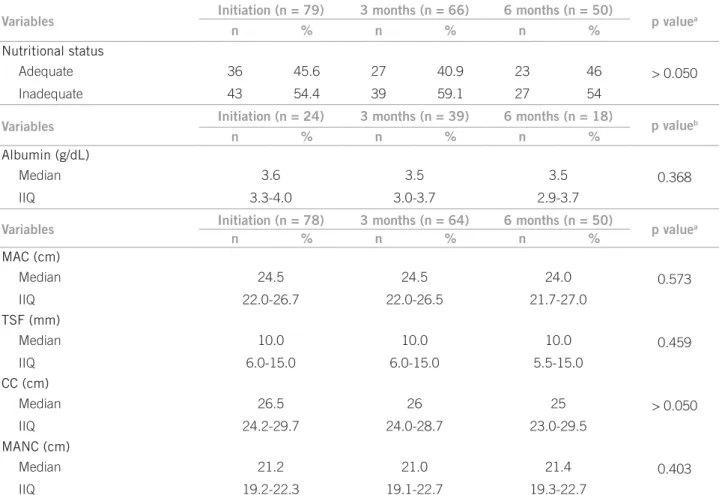
Table 1 describes the speciic parameters regarding the nutritional status of the sample during the course of the study. At the beginning of the study, except for serum albu-min levels, whose results were obtained only from patients that had an examination (n = 24), all of the other criteria (clinical signs of malnutrition and anthropometry – MAC, TSF, CC, MAMC) showed signiicant percentages of nu-tritional status involvement, in accordance with the
crite-ria deined by Blackburn and hornton23 and Bonnefoy et
al.24; no changes in such parameters were observed during
the course of the study (Table 1).
At the beginning of the study, 43% (n = 34) of the pa-tients presented pressure ulcers. 41.2% of these (n = 14) had their ulcer healed during the study. From the 45 pa-tients who did not present ulcers, 20% of these (n = 9) de-veloped ulcers during the period of study.
In 86.1% of patients (n = 68), the indication for EN was due to dysphasia, and in 13.9% of patients (n = 11), due to refusal of food. Sixty-eight patients remained with EN until the end of the study or until death. Eleven patients returned to oral nutrition during the follow-up period.
Regarding the EN pathway, 59.5% (n = 47) of the pa-tients presented a nasoenteric tube (NET) at their irst evaluation, and 40.5% (n = 32) of patients already present-ed osteotomies.
Sixty-eight patients remained with EN until the end of the study. At inal evaluation 36.8% of patients (n = 25) presented with a NET, and 63.2% of patients (n = 43) pre-sented with ostomies. he main reason for pathway altera-tion was the presence of complicaaltera-tions in 66.6% (n = 10).
a homemade diet. At the end of the study, 61.8% (n = 42) of patients were using an industrialized diet and 38.2% (n = 26), a homemade diet.
Of the 91.2% (n = 62) of patients who remained with EN until the end of the study or until death, a total num-ber of 131 complications related to nutritional therapy were observed (Table 2). Statistically signiicant associa-tions among presented complicaassocia-tions and demographic variables, gender, diagnoses, nutritional and clinical sta-tus, nutritional therapy pathways, and types of enteral diet (industrialized and homemade) were not observed.
he mortality rate at three months of observation, which was initiated when patients were discharged from the hospital or when they started EN at home, was 15.2% (n = 12, 95% CI : 8%-25%); ater six months, the mortality rate was 22.8% (n = 18, 95% CI: 14%-34%). he mortal-ity rate observed at the end of follow-up, ater an average period of 11 months, was 43% (n = 34, 95% CI: 32%-55%). he median survival rate counted from the beginning of EN was 364 days (95% CI: 243-455).
No statistically signiicant diferences between the mortality rates of the dementia group and of the other neurological diagnoses group were found (Graphic 1).
No signiicant associations among mortality rates, an-thropometric measures, and nutritional status (evaluated by the presence of clinical signs of malnutrition at the be-ginning of the study) were observed. Lower survival rates were observed in patients classiied as inadequate nutrition-al status, ater three and six months of study (p = 0.013 and
Table 1 – Nutritional status parameters in patients submitted to enteral nutrional therapy at the beginning and after three and six months of the study period
Variables Initiation (n = 79) 3 months (n = 66) 6 months (n = 50) p valuea
n % n % n %
Nutritional status
> 0.050
Adequate 36 45.6 27 40.9 23 46
Inadequate 43 54.4 39 59.1 27 54
Variables Initiation (n = 24) 3 months (n = 39) 6 months (n = 18) p valueb
n % n % n %
Albumin (g/dL)
0.368
Median 3.6 3.5 3.5
IIQ 3.3-4.0 3.0-3.7 2.9-3.7
Variables Initiation (n = 78) 3 months (n = 64) 6 months (n = 50) p valuea
n % n % n %
MAC (cm)
0.573
Median 24.5 24.5 24.0
IIQ 22.0-26.7 22.0-26.5 21.7-27.0
TSF (mm)
0.459
Median 10.0 10.0 10.0
IIQ 6.0-15.0 6.0-15.0 5.5-15.0
CC (cm)
> 0.050
Median 26.5 26 25
IIQ 24.2-29.7 24.0-28.7 23.0-29.5
MANC (cm)
0.403
Median 21.2 21.0 21.4
IIQ 19.2-22.3 19.1-22.7 19.3-22.7
aFisher’s exact test; bFriedman’s non-parametric test; IIQ, interquartile interval; MAC mid-arm circumference; TSF triceps skinfold thickness;
CC, calf circumference; MAMC mid-arm muscle circumference.
Variables n %
Complications
Pneumonia 38 55.9
Loss of tube 31 45.6
Diarrhea 20 29.4
Constipation 13 19.1
Vomit 11 16.2
Periostomial extravasation 8 11.8
Tube obstruction 6 8.8
Reflux 3 4.4
Myiasis 1 1.5
Graphic 1 –Survival rates in patients using enteral nutrition and survival rates according to the presence of dementia and other neurological diagnoses.
p = 0.027, respectively, log-rank), in patients who presented albumin level lower than 3.5 mg/dL at any moment of the study (p = 0.026, log-rank), and in patients who were hos-pitalized during the course of study (p = 0.039, log-rank).
No signiicant diferences at patients’ survival rates were observed for those who initiated the study with pres-sure ulcers, as well as for those who developed ulcers dur-ing the course of study. However, lower survival rates were observed for patients who presented ulcers at the end of six months of observation (p = 0.001, log-rank). Higher survival rates were observed in patients presenting pres-sure ulcers at any moment of the study who had evolved to healing (p = 0.007, log-rank).
No statistically signiicant associations were observed among survival rates, enteral nutrition pathway (NET and osteotomy), and types of enteral diet used (industri-alized or homemade). Similarly, no signiicant associa-tions among survival rates and complicaassocia-tions presented were observed.
DISCUSSION
he results of present study demonstrate that the major-ity of elderly patients with neurological disorders on ENT presented complications, of which pneumonia was the most frequent. he mortality rate at the end of the study was higher, and the median survival rate ater starting EN was 364 days.
he mean age of the population studied was 82.9 years old; the prevalence of female patients (73%) is similar to other medical literature observations on EN efectiveness in patients with advanced dementia. A systematic review, consisting of seven observational studies, observed ages between 63 and 107 years old (mean age of 82 years old)
and a prevalence of female patients17.
Diagnosis and causes for dementia in the present study
were similar to other studies in the medical literature17,27.
Even though the diagnoses for dementia established by physicians of the healthcare plan were accepted with no review, the higher incidence of functional impairment by Katz method tends to conirm the high incidence and the cognitive deicit severity of the population studied.
Despite the fact that there is considerable evidence to show that EN does not ofer beneits in patients with advanced dementia, it is observed that approximately 50% of patients who used EN presented dementia, a fact
also veriied by other authors19. hese data reairm the
importance of obtaining better knowledge of the evolu-tion of these patients in order to deine better therapeutic proposals.
No signiicant changes in clinical signs of malnutrition and anthropometry were observed in the periods evalu-ated. hese indings are in accordance with the medical literature, in which changes in the nutritional parameters of patients with neurological disorders using EN were not
observed10,28.
In the present study, quantitative evaluation of nutri-ent intake of patinutri-ents on EN was not performed. How-ever, patients were followed-up by a team of nutritionists from their healthcare plan, who systematically reviewed patients’ diets according to their needs. he authors opted to correlate the nutritional status (and its changes during the course of study) with the main outcomes, with no ref-erence to their adequacy, similar to studies included in
Cochrane’s systematic review17,19,21,29–31.
At the beginning of the study, 43% of the patients pre-sented pressure ulcers; 20% of the patients who did not pres-ent such pathologies developed them later. hese data are compatible with other observations in medical literature.
0 100 200 300 400 500 600 700
Time in days after the initiation of enteral nutrition
Cumulative survival rates
1.0
0.8
0.6
0.4
0.2
0.0
0 100 200 300 400 500 600 700
Time in days after the initiation of enteral nutrition
Cumulative survival rates
1.0
0.8
0.6
0.4
0.2
0.0
p = 0.965
Dementia
Other neurological diagnoses 0 - censored 1 - censored
According to Mitchell et al.32,38.7% of patients with de-mentia presented with ulcers at any moment during an 18-months follow-up period.
Regarding type of diet, the majority of patients used the industrialized diet at the beginning, as well as at the end of the study. Nevertheless, 13.8% of patients changed to homemade diet.
Fiteen hundred calories from a standard industrial-ized diet in a liquid open system may cost approximately USD 230.00 per month. Considering other expenses such as lasks, equipment, diapers, medicines and so on, the total diet cost can be expensive; this aspect could be the reason for changing to a homemade diet.
he inancial issues mentioned, along with cost-covering aspects of industrialized diet supply by the Uniied Health System (Sistema Único de Saúde – SUS) or by healthcare plans make its supply to patients using EN at home diicult; as a result, the homemade diet has become a frequent prac-tice in patients using EN at home in Brazil. As there is no diference between the two types of diet regarding mortality rates and complications, the use of such a diet can be safe and adequate.
he rate of complications related to EN was high; a total number of 131 complications occurred in 91.2% of patients. he most frequent complication was pneumonia (55.9%), loss of tube (45.6%), and diarrhea (29.4%). Pneumonia was also the most frequent complication in the studies discussed below. In a study involving 67 patients, complications were reported in 77.6% of patients, in whom pneumonia
oc-curred in 29.9%30.
Sanders, Leeds and Drew28 reported that pneumonia
was the cause of death in 27% of patients. Sanders et al.14, in
a study involving 87 patients, reported that 25% of patients presented with pneumonia ater percutaneous endoscopic gastrostomy (PEG), besides obstruction (5.7%), tube re-placement (8%), tube outlow (6.9%), rere-placement of itting (5.7%), breakup of connection (8%), cuf emptying (43.4%), local sepsis (8%), and granuloma (8%).
Patients with dysphasia and risk of aspiration usually have their oral feeding suspended and start ENT. However, it is well known that aspiration pneumonia may be caused by both types of aspiration, that is, gastric acid secretion and oropharyngeal, and due to this fact ENT, which is nor-mally indicated for preventing aspiration pneumonia, may not be efective.
he high mortality rate, 15.2% ater three months, 22.8% ater six months, and 43% ater an average period of 11 months, was equivalent to that found in other studies.
Figueiredo et al.26, in their study involving 168 patients ater
PEG, found a mortality rate of 6.5% in 30 days; 17.3% in
90 days and 33.9% in one year. Carey et al.11, in a study
in-volving 288 patients, found a mortality rate of 21% in three months and of 30% in six months.
In the present study, the median survival rate was 364 days considering the date in which ENT (in the hospital or at home) was started. he mean elderly survival rate in the
general population evaluated by Maciel and Guerra33 was
24.6 months, and 17.4 months for elderly patients present-ing with a functional limitation.
he survival curve did not show signiicant diferences among patients with dementia when compared to patients bearing other neurological disorders.
hese data are opposed to other data pointing to a lower survival rate in the dementia patient group as
com-pared to other diagnoses28. Despite the fact that advanced
dementia is related to a high mortality rate in patients us-ing ENT, there was no diference regardus-ing other neuro-logical disorders in association with mortality rates; this may be due to the severity of patients with other diagno-ses, attested by the high level of dependence in 100% of the population studied.
Patients presenting with an inadequate nutritional status attested by the presence of clinical signs of malnu-trition and albumin levels lower than 3.5 mg/dL showed signiicantly lower survival rates. Nair, Hertan and
Pit-chumoni29 have demonstrated that albumin levels higher
than 2.8 mg/dL were associated with an improvement in
survival. Varnier et al.34 have also reported higher survival
rates in patients with higher levels of albumin.
By the end of the study, patients with pressure ulcers presented signiicantly lower survival rates, whereas those who had their pressure ulcer healed during the course of the study presented signiicantly higher survival rates. It is likely that malnutrition performed a signiicant role in both healing or non-healing ulcers. However, other fac-tors such as clinical severity, immobility, and inadequate care may also have had a relevant role. In addition, patients with pressure ulcers probably present higher catabolism and higher risks of developing infection, which may con-tribute to increasing mortality rates.
No diferences in survival rates as related to routes of access, types of diet, and complications were observed.
hese data contradict the indings by Dwolatzky et al.35
who found higher survival rates in patients with PEG. Signiicantly lower survival rates were observed in pa-tients hospitalized during the course of the study, which attests to the probable clinical severity in this group.
was the nutritional status evaluation, performed by the research team. hus, neurological diagnoses review, clas-siication of ulcers, pneumonia diagnosis, and calculation of adequate caloric-protein needs were not carried out.
CONCLUSION
he elderly population with neurological disorders and us-ing followed-up enteral nutrition therapy (ENT) presented a higher rate of complications and death at the end of the study period. Presence of dementia, EN access routes, and complications did not inluence on survival rates. How-ever, the inadequate nutritional status according to clini-cal evaluation and albumin levels lower than 3.5 mg/dL signiicantly inluenced survival rates.
As this was an observational study, it was not possible to infer what evolution patients would have without ENT. Notwithstanding, the signiicant mortality rates at the end of the study, and the high incidence of complications and hospitalization, according to other observations in medi-cal literature regarding ENT in patients bearing advanced and severe neurological pictures suggest that there may be a subgroup of patients who do not beneit from this therapeutic approach. Subsequent studies should try to determine the features of this subgroup in order to avoid-ing complex and expensive therapeutic approaches for pa-tients who are not in need for them, especially at the end of their lives, as well as to guide adequately family mem-bers to prevent unrealistic expectations and unnecessary sufering.
ACKNOWLEDGEMENTS
he authors would like to thank the Postgraduate Pro-gram in Adult Health of the Universidade Federal de Minas Gerais.
REFERENCES
1. Pavarini SCI, Mendiondo MSZ, Barbam E, Varoto VAG, Filizola CLA. A arte de cuidar do idoso: gerontologia como proissão?. Texto & Contexto Enferm. 2005;14(3):398-402.
2. Instituto Brasileiro de Geograia e Estatística - IBGE. Diretoria de Pesquisa. Coordenação de População e Indicadores Sociais. Projeção da população do Brasil por sexo e idade para o período de 1980 a 2050 - revisão 2004: metodo-logia e resultados. Rio de Janeiro: IBGE; 2004. [cited 2011 jan 12]. Available from: http://ibge.gov.br/home/estatistica/populacao/projecao_da_populacao/ metodologia.pdf.
3. Pavarini SCI, Mendiondo EM, Montaño M, Almeida DMF, Mendiondo MSZ, Barham EJ, et al. Sistema de informações geográicas para a gestão de programas municipais de cuidado a idosos. Texto & Contexto Enferm. 2008;17(1):17-25.
4. Reys BN, Bezerra AB, Vilela AL, Keusen AL, Marinho V, Paula E, et al. Diag-nóstico de demência, depressão e psicose em idosos por avaliação cognitiva breve. Rev Assoc Med Bras. 2006;52(6):401-4.
5. Dharmarajan TS, Unnikrishnan D, Pitchumoni CS. Percutaneous en-doscopic gastrostomy and outcome in dementia. Am J Gastroenterol. 2001;96(9):2556-63.
6. Li, I. Feeding tubes in patients with severe dementia. Am Fam Physician. 2002;65(8):1605-10, 1515.
7. Palecek EJ, Teno JM, Casarett DJ, Hanson LC, Rhodes RL, Mitchell SL. Com-fort feeding only: a proposal to bring clarity to decision-making regarding diiculty with eating for persons with advanced dementia. J Am Geriatr Soc. 2010;58(3):580-4.
8. Sociedade Brasileira de Doenças Cerebrovasculares. Primeiro consenso brasileiro do tratamento da fase aguda do acidente vascular cerebral. Arq Neu-ropsiquiatr. 2001;59(4):972-80.
9. Schelp AO, Cola PC, Gatto AR, Silva RG, Carvalho LR. Incidência de disfagia orofaríngea após acidente vascular encefálico em hospital público de referên-cia no Estado de São Paulo - Brasil. Arq Neuropsiquiatr. 2004;62(2B):503-6. 10. Finucane TE, Christmas C, Travis K. Tube feeding in patients with advanced
dementia: a review of the evidence. JAMA. 1999;282(14):1365-70. 11. Carey TS, Hanson L, Garrett JM, Lewis C, Phifer N, Cox CE, et al.
Expecta-tions and outcomes of gastric feeding tubes. Am J Med. 2006;119(6):527.e11-6. 12. Freeman C, Ricevuto A, DeLegge MH. Enteral nutrition in patients with
de-mentia and stroke. Curr Opin Gastroenterol. 2010;26(2):156-9.
13. Sorrell JM. Use of feeding tubes in patients with advanced dementia: are we doing harm?. J Psychosoc Nurs Ment Health Serv. 2010;48(5):15-8. 14. Sanders DS, Carter MJ, D’Silva J, McAlindon ME, Willemse PJ, Bardham KD.
Percutaneous endoscopic gastrostomy: a prospective analysis of hospital sup-port required and complications following discharge to the community. Eur J Clin Nutr. 2001;55(7):610-4.
15. Rimon E, Kagansky N, Levy S. Percutaneous endoscopic gastrostomy; evidence of diferent prognosis in various patient subgroups. Age Ageing. 2005;34(4):353-7.
16. Gaines DI, Durkalski V, Patel A, DeLegge MH. Dementia and cognitive im-pairment are not associated with earlier mortality ater percutaneous endo-scopic gastrostomy. JPEN J Parenter Enteral Nutr. 2009;33(1):62-6. 17. Candy B, Sampson EL, Jones L. Enteral tube feeding in older people with
ad-vanced dementia: indings from a Cochrane systematic review. Int J Palliat Nurs. 2009;15(8):396-404.
18. Moreno Villares JM. he practice of home artiicial nutrition in Europe. Nutr Hosp. 2004;19(2):59-67.
19. Jaul E, Singer P, Calderon-Margalit R. Tube feeding in the demented elderly with severe disabilities. Isr Med Assoc J. 2006;8(12):870-4.
20. Potack JZ, Chokhavatia S. Complications of and controversies associated with percutaneous endoscopic gastrostomy: report of a case and literature review. Medscape J Med. 2008;10(6):142.
21. Meier DE, Ahronheim JC, Morris J, Baskin-Lyons S, Morrison RS. High short-term mortality in hospitalized patients with advanced dementia: lack of beneit of tube feeding. Arch Intern Med. 2001;161(4):594-9.
22. McDowell MA, Fryar CD, Ogden CL. Anthropometric reference data for children and adults: United States, 1988-1994. Vital Health Stat 11. 2009;(249):1-68.
23. Blackburn GL, hornton PA. Nutritional assessment of the hospitalized pa-tient. Med Clin North Am. 1979;63(5):11103-15.
24. Bonnefoy M, Jaufret M, Kostka T, Jusot JF. Usefulness of calf circumference measurement in assessing the nutritional state of hospitalized elderly people. Gerontology. 2002;48(3):162-9.
25. Lino VT, Pereira SR, Camacho LA, Ribeiro Filho ST, Buksman S. Adaptação transcultural da Escala de Independência em atividades da vida diária (Escala de Katz). Cad Saúde Pública. 2008;24(1):103-12.
26. Figueiredo FA, Costa MC, Pelosi AD, Martins RN, Machado L, Francioni E. Predicting outcomes and complications of percutaneous endoscopic gastros-tomy. Endoscopy. 2007;39(4):333-8.
27. Christensen MD, White HK. Dementia assessment and management. J Am Med Dir Assoc. 2007;8(3 Suppl 2):e89-98.
28. Sanders DS, Leeds JS, Drew K. he role of percutaneous endoscopic gastros-tomy in patients with dementia. Br J Nurs. 2008;17(9):588-94.
29. Nair S, Hertan H, Pitchumoni CS. Hypoalbuminemia is a poor predictor of survival ater percutaneous endoscopic gastrostomy in elderly patients with dementia. Am J Gastroenterol. 2000;95(1):133-6.
30. Alvarez-Fernández B, García-Ordoñez MA, Martínez-Manzanares C, Gómez-Huelgas R. Survival of a cohort of elderly patients with advanced de-mentia: nasogastric tube feeding as a risk factor for mortality. Int J Geriatr Psychiatry. 2005;20(4):363-70.
31. Mitchell SL, Kiely DK, Lipsitz LA. he risk factors and impact on survival of feeding tubes placement in nursing home residents with severe cognitive im-pairment. Arch Intern Med. 1997;157(3):327-32
32. Mitchell SL, Teno JM, Kiely DK, Shafer ML, Jones RN, Prigerson HG, et al. he clinical course of advanced dementia. N Engl J Med. 2009; 361(16):1529-38. 33. Maciel ACC, Guerra RO. Limitação funcional e sobrevida em idosos de
comu-nidade. Rev Assoc Med Bras. 2008;54(4):347-52.
34. Varnier A, Iona L, Dominutti MC, Deotto E, Bianchi L, Iengo A, et al. Percuta-neous endoscopic gastrostomy: complications in the short and long-term fol-low-up and eicacy on nutritional status. Eura Medicophys. 2006;42(1):23-6. 35. Dwolatzky T, Berezovski S, Friedmann R, Paz J, Clarield AM, Stessman J,