(1) Universidade Estadual de Ciências da Saúde de Alagoas (UNCISAL), Maceió, AL, Brasil.
Source of help: Support Foundation for Research in the State of Alagoas - FAPEAL, form of aid: PROBIC Scholarship
Conlict of interest: non-existent
Feeding profile and oral motor development
of low birth weight infants
Perfil alimentar e desenvolvimento motor oral dos neonatos nascidos
com baixo peso
Adriana de Medeiros Melo(1) Thamyres Grazielle dos Santos Martins(1) Tuany Lourenço dos Santos(1) Aline dos Santos Silva(1) Nayara Nerlin da Silva Santos(1)
Received on: April 09, 2015 Accepted on: September 29, 2015
Mailing address:
Thamyres Grazielle dos Santos Martins Conjunto João Sampaio 2 Quadra 2F Lote 24, nº192. Benedito Bentes Maceió – AL – Brasil CEP: 57084-639
E-mail: [email protected]
doi: 10.1590/1982-021620161814415
ABSTRACT
Purposes: to describe the feeding proile and analyze the Oral Sensory Motor System of preterm low birth
weight who participated or not the Kangaroo method.
Methods: this is a non-interventional, observational quantitative study with 60 preterm low birth weight.
A speciic form was used to describe the feeding proile. Evaluations of Oral Sensory Motor System were
made by the protocol of Castro¹.
Results: preterm and low birth weight babies evaluated formed two groups: 30 participants of the
Kangaroo Method (G1) and 30 non-participants of this method (G2). They presented Gestational Age 25-36 weeks, which were 34 female and 26 male; 8 children were fed by nasogastric tube, 46 by exclu
-sive breastfeeding, 4 fed through the cup and 1 just by the cup. In the Grupo1,9 (30%) infants showed oral relexes as expected. In the Group 2, 12 (40%) showed all relexes.
Conclusion: this study shows that babies who went through the kangaroo method do not revealed statis
-tically signiicant difference in relation to the feeding proile and oral sensory motor system, when compa
-red to babies who did not went through this method.
Keywords: Infant, Newborn; Infant, Premature; Feeding Behavior
RESUMO
Objetivos: descrever o peril alimentar e analisar o Sistema Sensório Motor Oral em neonatos prematuros
e de baixo peso que participaram ou não do Método Canguru.
Métodos: trata-se de um estudo observacional não-intervencionista, quantitativo, realizado com 60
neo-natos prematuros e de baixo peso. Foi utilizado um formulário especíico para descrição do peril alimen
-tar. Nas avaliações do sistema sensório motor oral dos neonatos utilizou-se, o protocolo de Castro¹.
Resultados: os neonatos prematuros e de baixo peso avaliados formaram dois grupos: 30 participantes
do Método Canguru (G1) e 30 não participantes deste método (G2). Apresentaram Idade Gestacional de 25 a 36 semanas, sendo 34 do sexo feminino e 26 do sexo masculino; 8 neonatos se alimentavam por sonda, 46 por aleitamento materno exclusivo, 4 recebiam aleitamento materno e copinho; e 1 apenas pelo copinho. No Grupo1, 9(30%) neonatos apresentaram todos os relexos orais dentro do esperado. Já no Grupo 2, 12 (40%) apresentou todos os relexos presentes.
Conclusão: este estudo revela que os neonatos que passaram pelo Método Canguru não obtiveram
diferença estatisticamente signiicante em relação ao peril alimentar e ao sistema sensório motor oral, quando comparados aos neonatos que não passaram por esse método.
Descritores: Recém-Nascido; Prematuro; Comportamento Alimentar
Original articles
INTRODUCTION
Faced with the expansion of technology and assis-tance resources, the chances of survival of the newborn preterm have increased. However, even with the
availability of modern equipment and qualiied profes
-sionals, food dificulties, particularly breastfeeding
this population is still cause for concern¹. Even with the stimulus to maintain lactation and breastfeeding, mothers of preterm infants (newborn preterm births)
often have more dificulty in initiating and maintaining
breastfeeding during their child’s hospital stay. Often, these are not kept in exclusive breastfeeding (EBF) after discharge, even after the guidance and encouragement to mothers².
Regarding the performance of breastfeeding, suction is needed because it will promote an adequate development of the functions and structures of the stomatognathic system. The masticatory muscles begin their maturation process and positioning, along with the movement of the muscles occurs bone development thus enhancing neuromuscular condition of oral struc-tures. Breastfeeding will provide the child a proper breathing, proper posture and provide a language and sealing lips. This unique power is also related to the development of temporomandibular joint (TMJ) in the period that has not yet occurred tooth eruption3,4. One can also highlight the importance of breastfeeding in the nutritional and immune framework of the preterm neonate, providing the iron and protect children against infections. Infants who are breastfed for some period of time show no infection by parasites and are less frequently present.
Regarding the role of mothers, breastfeeding becomes important because of the sudden separation occurred at birth, satisfying the maternal instinct5.
Breastfeeding, even with its advantages and many features designed to make it easier, is an undervalued practice in the country. In 2001, the Indicators of Primary Care Information System (SIAB) showed that the exclusive breastfeeding rate was of 62,3% in Brazil and 49.9% in the State of Alagoas6.
Early weaning may lead to the interruption of proper
oral motor development, this weaning is inluenced by
demographic variables (type of birth, maternal age, the child’s father share), socioeconomic (family income, maternal and paternal education), attached to the assis-tance prenatal care (guidance about the imporassis-tance gift breastfeeding) and the immediate post-natal care (aid health professionals)7.
The Ministry of Health in 2001 launched the National Humanization of Hospital Care Program (PNHAH), which proposed a set of actions that alter care standards to patients in the hospital setting, where the
health care requires “aggregate technical eficiency and scientiic ethics to consider and respect the uniqueness
of user and professional needs, that embraces the unknown and unpredictable, that accepts the limits of each situation”8.
The Kangaroo Mother Care is framed in the human-ization of health services shares, being characterized by the early mother-infant contact. The method is
divided into three stages: the irst stage the infant is
hospitalized, the second stage amounts to kangaroo unit and eventually the outpatient treatment9.
Through this method the newborn receives more stimulation, which simulates the intrauterine condi-tions enabling the premature baby is gestational age in an environment that promotes their brain maturation. This environment has great importance, because a
study indicated the inluence of stress level in the
active muscle tone and spontaneous movement; the improvement of muscle tone baby provides the approach of the midline members, which facilitates the acquisition of motor coordination10. In addition, to contribute to the establishment of breastfeeding on demand, controlling the physiological skills, organizes the sleep cycles and behavioral states11.
The objective of this study was to describe the
dietary proile and analyze the Sensory Oral Motor
System and in neonates and low birth weight who participated or not the Kangaroo Method.
METHODS
This research was evaluated and approved by the Research Ethics Committee and UNCISAL of origin under Nº 477.806. The study design was a prospective cross-sectional observational.
The survey was conducted from January to June 2014, the second stage of Kangaroo Mother Care (Accommodation Kangaroo) and Rooming Maternity Hospital Santa Monica, located in the city of Maceio-AL, reference institution for care to pregnant women and
neonates high risk by the Uniied Health System (SUS).
The sample included 60 preterm and low birth weight, 30 participants of the Kangaroo Mother Care (G1); and 30 non-participants (G2),
Socio-demographic characteristics, dietary and biological of the neonates; and maternal and paternal
and living conditions, obstetric history were collected by analyzing the records; and by applying a structured questionnaire with closed questions, which is answered by the heads of infants.
Initially they were selected the medical records of
neonates who its the established inclusion criteria.
The Informed Consent was read, verbally explained the progenitors, delivered and signed.
It was adopted as inclusion criteria for the RNS: infants born with gestational age (GA) less than 37
weeks, weighing ≤ 2,500g, because this group of
newborns is more likely to develop changes in the Sensory Motor Oral System (Most Holy) due to prema-turity and low birth weight.
Exclusion criteria for RNS were premature infants and low weight with diagnosis of neurological changes, genetic and/or morphological as the cases of carriers
newborns of cleft lip and palate, presenting dificulties or limitations in the performance of oral relexes and
feeding the presence of these changes.
Interviews were conducted with mothers who measure up to the following inclusion criteria: mothers preterms of underweight admitted to the 2nd stage of the Kangaroo Method or rooming. In this interview there were asked socioeconomic aspects, data on the recent pregnancy, had previous experience of breastfeeding and was successful.
Then, to evaluate the sensory oral motor system, the Castro¹ protocol was applied. The evaluation was conducted during the hospitalization period when the newborn was close to being discharged, 30 to 40 minutes before receiving the diet, so there was no discomfort or disability, because if the infant had been fed, could not be made this assessment, since oral
relexes were tested (demand bite, GAG, sucking and
swallowing), and if there cupping tongue and tongue peristalsis during non-nutritive sucking.
Handlings were performed consisting touches in the face and oral cavity, with the hands gloved exami-nation, plus the observation of nutritive sucking during feeding of the newborn. After the diet offer that was conducted the questionnaire with the mothers and analyzed the medical records of the mother and the newborn, for information on gestational age, use of respiratory support (if used), use of medications and clinical events; apart from demographic data.
The sample size calculation was based on the
scientiic paper ‘Development of the Sensory System
and Global Oral Motor Vehicles in preterm infants’’¹
because it is being used in this study the same Most Holy assessment protocol.
Data were organized in Excel spreadsheets and analyzed with the BioEstat 5.0 software for data analysis was performed using the Fisher’s exact test and Chi-square as the disposal of the collected data.
For all analyzes it will use the conidence level of 0,05%.
RESULTS
At hospital discharge, the newborns were performed using the evaluation protocol of oral sensorium system engine Castro¹, which are evaluated by the primitive
oral relexes and oral motor structures. Few differences
were observed in the Most Holy among the participants of the Kangaroo Mother Care and Housing together,
but in relation to food proile it was observed that
the AME is more prevalent in participants Kangaroo newborns. Posture of lips and tongue cupping proved
to be a relection less present in these newborns, since the swallowing relex and jaw movements showed the
best results.
Of the 30 newborns in G1, there was a slight predominance of female sex (56,6%) compared to men (43,3%). Most newborns were ages ranging from 0-30 days old (63,3%). These newborns, only 5% of them had the lowest rating for gestational age ranging
between 25-27 weeks. Thus, in view of the classii -cation for gestational age, the minority of G1 neonates showed greater risk to present deviations or delays in the development of oral sensory-motor system. While 26,6% of G1 newborns being between 34 to 36 weeks demonstrate a tendency to present the best results in
their oral relexes, as the literature states that it is from
33-34 weeks of gestational age newborns are able to coordinate the mechanisms and suction swallowing and breathing.
Of all newborns have been observed most of them (66%) were any of these complications at birth (apnea, jaundice, respiratory distress or sepsis). Also it was observed that the majority of neonates (70%) made use of some form of respiratory support: Mechanical Ventilation (MV), Mechanical Ventilation Non-Invasive (NIV), nasal CPAP or HOOD.
Regarding the food proile for the G1 at the time
At the moment of hospital discharge, all infants were exclusively breastfed, showing how there was good evolution of sensory oral motor system.
In assessing the Sensory Oral Motor System partic-ipant newborns Kangaroo Method (G1), highlight the
following aspects in relation to oral relexes: in search, only 6% of infants had this relex as not expected. The presence of this relex is fundamental to trigger the sucking relex that was present in most neonates (90%),
favoring the performance of exclusive breastfeeding. Furthermore, the present tongue and jaw in more than half of neonates (66%) of infants is related to the power
eficiency.
Of the 30 neonates of G2, there was a slight predominance of females (56,7%) compared to men (43,3%), ages ranged from 0-30 days old. These newborns, only 4% had gestational age of 24 weeks. Therefore, only a minority of G2 newborns also had a higher risk for developing deviations or delays in the sensory oral motor system, while 57% of them were in gestational age between 34 to 36 weeks, showing
a greater tendency to outdo oral relexes when related
with gestational age.
Regarding the food proile of G2, during the clinical
assessment, most newborns (N = 26) were exclusively breastfed, 2 fed by mother’s womb more complement, which was given the cup; and only 1 infants fed only through a nasogastric tube.
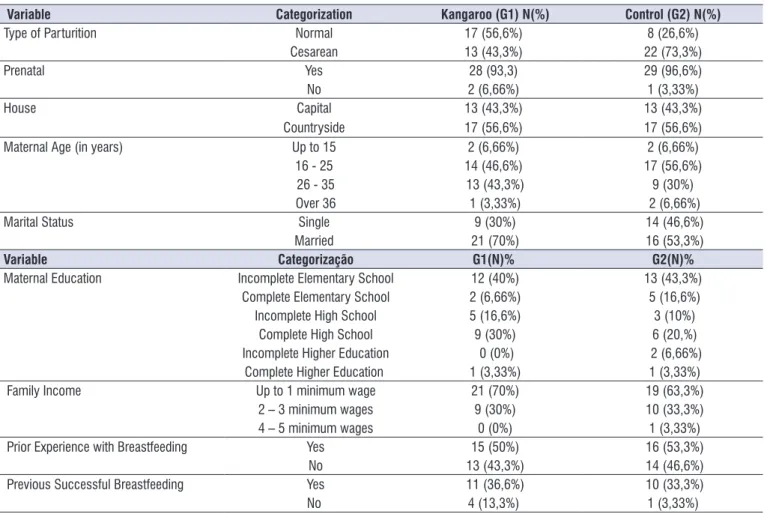
Mothers not participating in the Kangaroo Mother Care (G2) 29 did prenatal care with family income up to 3 minimum wages, with respect to maternal education 13 had incomplete primary education, 5 to complete
primary school, 21 know the beneits of breastfeeding
(Table 2).
In evaluating the system Sensory Oral Motor on non-participating newborns Kangaroo Method (G2) during the non-nutritive sucking was observed that the tongue cupping was found as not expected in 40% of neonates, ie, this group is more likely to introduce
changes in the food proile, hindering eficient power. The sucking relex changed in only 3%, can bring beneits to the oral motor development, since it favors
the performance of exclusive breastfeeding (Table 1).
Table 1 shows the prevalence of oral relexes in
newborns of both the participants of the Kangaroo Method, as non-participants, which shows good perfor-mance of the SSMO even in the face of prematurity and low birth weight.
Table 2 describes the socio-demographic data and nursing data show such signs of risk for the
development of oral motor sensorial system and AME, due to low maternal age, low education and low family income.
DISCUSSION
In this study, we observed the oral motor devel-opment of infants with low birth weight prematurity
history as well as its food proile.
Early introduction of foods in infants considered at risk at birth is worrying, given their physiological and neurological immaturity, and requires systematic monitoring12. In addition, the World Health Organisation recommends that breastfeeding is exclusively until six months of age and that breastfeeding can be maintained after six months13, adding the introduction of other foods due to higher energy demands of the infant; and because of exclusive breastfeeding no
longer is suficient to meet their nutritional needs.
The sample has few risk factors for early weaning, since the G1, 83% group of mothers were aware of the
beneits of breastfeeding, but in G2 it was found that
70% of the mothers had this knowledge, thus showing a risk slightly most with early weaning compared to G1. In addition, all newborns were discharged on exclusive breastfeeding; this data corroborated the literature, which states that because of the care provided to low-weight newborns and mother to the guidelines during the period of hospitalization favor of exclusive breastfeeding14. A study in 1997, conducted with 427 children between 3 and 6 years of age, showed that the mother who obtained knowledge about the importance of breastfeeding and breastfed their children exclusively for six months or close to this period 15.
In the present study 40% (G1) of the interviewed mothers have not completed elementary school; and G2, 43% of them on grade level in elementary education. The level of education is one of the factors
that can interfere with dificulty breastfeeding. The
literature states that this variable maternal education is correlated with early weaning, so the bigger the mother’s education time duration of breastfeeding, demonstrating that cultural aspects that start in the context of maternal and child relationship extend to family and the community16.
Of the 30 preterm and underweight participants
of the Kangaroo Method, 24% had all oral relexes as
expected, supporting the literature which says that premature neonates who underwent skin contact, or who participated in the Kangaroo Method presented better mental development and better results in motor tests, in addition to decline in the standard of time crying20.
The use of some type of respiratory support and use of orogastric or nasogastric tube was necessary in 24% of cases, due to its hazardous condition due to their anatomical and physiological immaturity. According to a study conducted in 2007, prolonged use of probe in addition to causing a long hospital stay harms the development of speech organs. Furthermore, it may lead to a delay in coordinating the suction movements and swallowing, occurring oral hypersensitivity due to little or no experience of food in the mouth during
the irst months of life and therefore power rejection
orally by interfering with oral motor development the also observed that education was related to longer
breastfeeding periods (p = 0,016 and p = 0,011 respectively)17.
In developed countries, mothers with higher levels of education tend to breastfeed longer. However, the working Giugliane et a.l18 in Porto Alegre, there was found that while inhabiting a developing country, mothers followed the model of developed countries, ie, those with higher educational level breastfed longer.
The income of the mothers of G1 (70%) was from a family income up to minimum wage, 30% 2-3 wages. While in G2, 65% of them had family income of up to one minimum wage; and 35% 2 to 3 wages. Thus, in general, the most economical level of the two groups was relatively low. Therefore, it can be said that the family income is presented as an important factor in relation to breastfeeding, as among mothers with lower income, who needed help with their work to support the family, breastfeeding may be hampered by a lack access to information on the damage of early weaning as shown in the study by Vasconcelos et al.19.
Table 1. Oral relexes of premature and low-weight newborns. Maceio, 2014
Relexes Categorization Control (G2)N(%) Kanguroo (G1)N(%) P value
Gender Male 13(43,3%) 13(43,3%)
Female 17(56,7%) 17(43,3%)
Search Relex Expected 26(86,6%) 28(93,3%)
0,3354
Not Expected 4(13,3%) 2(6,6%)
Suction Relex Expected 29(96,6%) 27(90%)
0,3060
Not Expected 1(3,3%) 3(10%)
Bite Relex Expected 25(83,3%) 29(96,6%)
0,0973
Not Expected 5(16,6%) 1(3,3%)
Relex of Gag Expected 25(83,3%) 23(76,6%)
0,7469*
Not Expected 5(16,6%) 7(23,3%)
Relex of Swallowing Expected 30(100%) 29(96,6%)
0,5000
Not Expected 0(0%) 1(3,3%)
Suction Rhythm Expected 26(86,6%) 25(83,3%)
0,5000
Not Expected 4(13,3%) 5(16,6%)
Lip Posture Expected 28(93,3%) 26(86,6%)
0,3354
Not Expected 2(6,6%) 4(13,3%)
Tongue Posture Expected 22(73,3%) 22(73,3%)
0,6145
Not Expected 8(26,6%) 8(26,6%)
Tongue Correction Expected 18(60%) 20(66,6%)
0,7888*
Not Expected 12(40%) 10(33,3%)
Tongue Peristalsis Expected 25(83,3%) 26(86,6%)
0,5000
Not Expected 5(16,6%) 4(13,3%)
Movements of Cheeks Expected 29(96,6%) 28(93,3%)
0,5000
Not Expected 1(3,3%) 2(6,6%)
Mandibular Movements Expected 30(100%) 29(96,6%)
0,5000
Not Expected 0(0%) 1(3,3%)
structures and stomatognathic functions of preterms,
conirming with the literature that states that the speech
therapy favors ownership and coordination of functions involved in the feeding process, favoring the initiation of breastfeeding in the mother’s chest and consequent discharge20.
The suction of the premature neonate with speech therapy, when the two groups were compared, it was observed that the G1 got better as to behavior, stress signs, coordination and suction rhythm; while the G2 obtained improvement over the coordination of the
swallowing relex and sucking. This result was not found in other studies, therefore, both groups beneited,
possibly with speech therapy23.
Regarding eating habits all newborns at discharge were in Exclusive Breastfeeding (AME) and 19 mothers of the G1 neonates, reported having knowledge about
the beneits of exclusive breastfeeding; however,
during the clinical assessment of the 32 neonates G1, 2 breast milk was offered by the womb more glass and 2 diet was offered by nasogastric tube. Early
initiation of breastfeeding brings beneits to newborns,
newborn; which can bring as consequences, changes in speech organs21.
These changes can occur in preterm neonates and low birth weight causing this group of infants are more vulnerable compared to the group that comes forward22, as oral relexes of this group of babies have been preset during intrauterine life. What often does not happen in the group of preterm infants23.However, it is important to note that the work of the multidisci-plinary team who attended premature low birth weight, her mother and family, housing kangaroo (G1), guiding them and providing them the necessary support to
overcome the dificulties encountered are essential to
minimize the risk of future changes. What usually does not occur in the housing assembly (G2), since even in
low eficiency in the relection and sucking rhythm, the
neonate has left hospital24.
The missing oral relexes found in both the G1 and
G2 have few indicators that show signs of risk in the evaluation index of Oral Sensory Motor System, which leads to suggest that speech therapy performed in this group of newborns promoted the adequacy of
Table 2. Socio-demographic data of the mothers of preterm newborns. Maceió, 2014.
Variable Categorization Kangaroo (G1) N(%) Control (G2) N(%)
Type of Parturition Normal 17 (56,6%) 8 (26,6%) Cesarean 13 (43,3%) 22 (73,3%)
Prenatal Yes 28 (93,3) 29 (96,6%)
No 2 (6,66%) 1 (3,33%)
House Capital 13 (43,3%) 13 (43,3%)
Countryside 17 (56,6%) 17 (56,6%) Maternal Age (in years) Up to 15 2 (6,66%) 2 (6,66%) 16 - 25 14 (46,6%) 17 (56,6%) 26 - 35 13 (43,3%) 9 (30%) Over 36 1 (3,33%) 2 (6,66%) Marital Status Single 9 (30%) 14 (46,6%)
Married 21 (70%) 16 (53,3%)
Variable Categorização G1(N)% G2(N)%
Maternal Education Incomplete Elementary School 12 (40%) 13 (43,3%) Complete Elementary School 2 (6,66%) 5 (16,6%) Incomplete High School 5 (16,6%) 3 (10%)
Complete High School 9 (30%) 6 (20,%) Incomplete Higher Education 0 (0%) 2 (6,66%)
Complete Higher Education 1 (3,33%) 1 (3,33%) Family Income Up to 1 minimum wage 21 (70%) 19 (63,3%)
2 – 3 minimum wages 9 (30%) 10 (33,3%)
4 – 5 minimum wages 0 (0%) 1 (3,33%)
motor global em lactentes pré-termo. Pró-Fono R Atual Cient. 2007;19(1):29-38.
2. Silva RV, Silva IA. A vivência de mães de recém nascidos prematuros no processo de lactação e amamentação. Esc Anna Nery Rev Enferm. 2009;13(1):108-15.
3. Neiva FCB, Catonni DM, Ramos JLA, Issler H. Desmame precoce: implicações para o desenvolvimento motor-oral. Jornal de Pediatria. 2003;79(1):07-15.
4. Bervian J, Fontana M, Caus B. Relação entre amamentação, desenvolvimento motor bucal e hábitos bucais - revisão de literatura. RFO. 2008;13(2):76-81.
5. Scochi CGS, Ferreira FY, Góes FSN. Alimentação Láctea e prevalência do aleitamento materno em prematuros durante internação em um Hospital Amigo da Criança de Ribeirão Preto-SP, Brasil. Cienc Cuid Saude. 2008;7(2):145-54.
6. Eny EM, Nascimento MJP. Causas e consequências do desmame precoce: uma abordagem histórico-cultural. Rev Enferm UNISA. 2001;2(1):52-6.
7. Carvalho AEV, Linhares MBM, Martinez FE. História de Desenvolvimento e Comportamento de Crianças Nascidas Pré-termo e Baixo Peso (<
1.500 g). Psicol Rel Crít. 2001;14(1):1-33.
8. Araújo OD, Cunha AL, Lustosa LR. Aleitamento Materno: Fatores que levam ao desmame precoce. Rev Bras Enferm. 2008;61(4):488-92.
9. Fortes PAC. Ética, direitos dos usuários e políticas de humanização da atenção à saúde. Saúde e Sociedade. 2004;13(3):30-5.
10. Freitas JO, Camargo C.L. Método Mãe-Canguru: evolução ponderal de recém-nascidos. Acta Paul Enferm. 2007;2(1):75-81.
11. Mota LA, Sá FE, Frota MA. Estudo comparativo do desenvolvimento sensório-motor de recém nascidos prematuros da unidade de terapia intensiva neonatal e do Método Canguru. RBPS. 2005;18(4):191-8.
12. Andrade ISN, Guedes ZCF. Sucção do recém-nascido prematuro: comparação do método Mãe-Canguru com os cuidados tradicionais. R Bras Saúde Matern Infant. 2005;5(1):61-9.
13. Branco EG. Aleitamento Materno X Aleitamento
Artiicial em Recém – Nascido Prematuro. A
polêmica da fonoaudiologia. 2000.No Centro
de Especialização em Fonoaudiologia Clínica. [monograia] São Paulo (SP): CEFAC 2000. 55p,
physiological, affective and improvement in their quality of life21.
In the study carried out by Sanches22, is concerned that exclusive breastfeeding of infants of low birth weight and premature babies is quite complex and
involves numerous factors that inluence their practice,
though prior knowledge of the factors associated with the interruption of this practice can facilitate the actions of the interdisciplinary team in the promotion and support of breastfeeding. As a result, it is expected
that these dificulties can be overcome by health staff
actions of the hospital, the family, society, beyond the articulation of health services25.
According to Dorothy26, preventing the changes
of oral functions is to take care of establishing proper structures, hard and soft that allow proper tone all the muscles of the stomatognathic system, correct posture of the tongue and lips in perfect lip seal, as well as breathing with nasal standard.
CONCLUSION
The study revealed that all preterm and low weight at hospital discharge were in exclusive breastfeeding, possibly due to guidance and speech therapy interven-tions that were carried out during the hospital admission period. This can be one of the factors contributing to the emergence of low early weaning rates after hospital discharge in this population.
Newborns who visited the Kangaroo method did
not achieve a statistically signiicant difference from the food proile and the oral motor sensorial system,
when compared to infants who have not gone through
this method, but the scientiic evidence on the beneits
of Kangaroo Care are numerous, improves mother-child bond and promotes exclusive breastfeeding
making knowledge about the beneits of breastfeeding
something concrete and practical, also decreasing the risk for early weaning.
ACKNOWLEDGEMENTS
We would like to thank the whole team of motherhood, as well as the mothers of infants who participated in this research and the FAPEAL (Support Foundation to Research of the State of Alagoas) for the
opportunity and incentive to scientiic initiation.
REFERENCES
26. Carvalho ED. S.O.S. Respirador Bucal - Uma Visão
Funcional e Clínica da Amamentação . 2ª Ed. São
Paulo: Ed Lovise; 2010.
Disponível em: http://www.cefac.br/library/teses/
c5c62b90b8f6efd9e683d60b83c31a3b.pdf
14. Delgado SE, Halpern R. Amamentação de prematuros com menos de 1500gramas: funcionamento motor-oral e apego. Pró-Fono R Atual Cient. 2005;17(2):141-52.
15. Ferreira, MIDT, Toledo, OA.Relação entre tempo de aleitamento materno e hábitos bucais. Rev ABO Nac. 1997;5(6):317-20.
16. Marques MCS, Melo AM. Amamentação no alojamento Conjunto. Rev CEFAC. 2008;10(2):261-71.
17. Escobar AMU, Ogawa AR, Hiratsuka M, Kawashita MY, Teruya PY, Grisi S et al. Aleitamento materno e condições socioeconômico-culturais: fatores que levam ao desmame precoce. Rev Bras Saude Mater Infant. 2002;2(3):253-61.
18. Giugliani ERJ, Issler RMS, Justo EB, Seffrin CF, Hartmann RM, Carvalho NM. Risk factors for early termination of breast feeding in Brazil. Acta Paediatr Scand. 1992;81:484-7.
19. Vasconcelos MGL, Lira PIC, Lima MC. Duração e fatores associados ao aleitamento materno em crianças menores de 24 meses de idade no estado de Pernambuco. Rev Bras Saúde Matern Infant. 2001;6(1):99-105.
20. Venancio SI, de Almeida H. Método Mãe Canguru:
aplicação no Brasil, evidências cientíicas e
impacto sobre o aleitamento materno. J Pediatr. 2004;80(1):173-80.
21. Fujinaga IC, Zamberlan NE, Rodarte MDO, Scochi
CGS Coniabilidade do instrumento de avaliação
da prontidão do prematuro para alimentação oral. Pró-Fono R Atual Cient. 2007;19(2):143-50.
22. Sanches MTC. Estudo dos fatores associados à amamentação exclusiva de recém-nascidos de baixo peso ao nascer, integrantes do Método Mãe
Canguru [Tese]. São Paulo (SP): Faculdade de
Saúde Pública, Universidade de São Paulo; 2005. 23. Linhares MBM, Carvalho AEV, Machado C.
Desenvolvimento de bebês nascidos pré-termo no primeiro ano de vida. Paidéia. 2003;13(25):59-72. 24. Nienkoetter JM, Silva CA. Caracterização do
desenvolvimento neuropsicomotor de lactentes com diferentes graus de prematuridade. RBM. 2013;49(11):427-32.