Original Article
Copyright © 2015 Revista Latino-Americana de Enfermagem This is an Open Access article distributed under the terms of the Creative Commons Attribution Non-Commercial License (CC BY-NC).
This license lets others distribute, remix, tweak, and build upon your work non-commercially, and although their new works must also acknowledge you and be non-commercial, they don’t have to license their derivative works on the same terms.
Corresponding Author:
Jênifa Cavalcante dos Santos Santiago Universidade Estadual do Ceará Av. Dr. Silas Munguba, 1700 Campus do Itaperi
CEP: 60714-903, Fortaleza, CE, Brasil E-mail: [email protected]
1 Paper extracted from master’s thesis “Analysis of obesity in adults young school: subsidy for health education by nurse”, presented to Universidade Estadual do Ceará, Fortaleza, CE, Brazil.
2 Doctoral student, Universidade Estadual do Ceará, Fortaleza, CE, Brazil. Professor, Universidade Estadual do Ceará, Fortaleza, CE, Brazil. Scholarship holder from Coordenação de Aperfeiçoamento de Pessoal de Nível Superior (CAPES), Brazil.
3 Post-doctoral fellow, Faculdade de Saúde Pública, Universidade de São Paulo, São Paulo, SP, Brazil. Professor, Universidade Estadual do Ceará, Fortaleza, CE, Brazil.
4 Master’s student, Universidade Estadual do Ceará, Fortaleza, CE, Brazil. Scholarship holder from Coordenação de Aperfeiçoamento de Pessoal de Nível Superior (CAPES), Brazil.
Association between overweight and characteristics of young adult
students: support for nursing care
1Jênifa Cavalcante dos Santos Santiago
2Thereza Maria Magalhães Moreira
3Raquel Sampaio Florêncio
4Objective: to verify associations between overweight and the characteristics of young adult
students to support nursing care. Method: case-control study conducted with young adults from
public schools. The sample was composed of 441 participants (147 cases and 294 controls, with
and without excess weight, respectively). Sociodemographic and clinical characteristics were
collected together with exposure factors and anthropometrics. Multiple logistic regression was
used. The study received Institutional Review Board approval. Results: statistically significant
association with overweight: non-Caucasian, having a partner; weight gain during adolescence,
mother’s excess weight, the use of obesogenic medication, augmented diastolic blood pressure,
of abdominal circumference and waist/hip ratio. In addition to these, schooling and weight gain
during childhood were also included in the multivariate analysis. After adjustment, the final model
included: having a partner, weight gain during adolescence, augmented diastolic blood pressure
and abdominal circumference. Conclusion: the analysis of predictor variables for excess weight
among young adult students supports nurses in planning and developing educational practices
aimed to prevent this clinical condition, which is a risk factor for other chronic comorbidities,
such as cardiovascular diseases.
Descriptors: Nursing; Overweight; Obesity; Young Adult.
Rev. Latino-Am. Enfermagem
2015 Mar.-Apr.;23(2):250-8
DOI: 10.1590/0104-1169.0174.2549
Introduction
Overweight and obesity are conditions on the rise among young adults and nurses need to work on the prevention of these conditions to improve the quality of life of this population.
One report conducted by the World Health Organization (WHO) states that obesity is the cause of death of 2.8 million people a year and 12% of the current world population is considered obese. A total of 26% of the adults on the American continent is obese; the region in which the condition is the most incident in the world. The WHO’s department of statistics reports that obesity doubled between 1980 and 2008 around the world(1).
In Brazil, excess weight is considered an important nutritional disorder. Accumulation of body fat often begins during childhood and adolescence and persists into adulthood, possibly leading to physiopathological effects in adulthood(2).
The determination of overweight and obesity results from a set of factors that constitute the lifestyle of modern populations, consuming increasingly processed, energy-dense foods rich in sugar, fat and sodium, with calories above individual needs. This imbalance stems partly from changes in dietary patterns, combined with reduced exercise in both work and leisure activities(3).
It is important to stress multiple and heterogeneous determinants (biological, historic, ecological, social, cultural and political factors) of overweight. Environmental and social causes are in the sphere in which individuals have little or no ability to interfere(4).
It is apparent, in this context, that obesity is not a problem of developed countries only; it also affects a portion of less favored populations. Therefore, government authorities as well as nurses and other health care workers need to mobilize to establish priorities and strategies to promote health and control health conditions.
It is worth noting that the emphasis concerning this public health problem in the school context has been directed to speciic groups: children and adolescents(5-7). The young adult population (20 to 24 years old) still attending school, however, has not been included in research, which justiies this study.
The question guiding this study was: Is there any association between weight excess and the characteristics of young adult students? What factors associated with overweight are susceptible to nursing interventions?
Therefore, studies analyzing intervenient factors are needed to support educational actions nurses have to develop when providing care to overweight young adult students. The objective of this study was to verify the association between overweight and characteristics of young adult students to support nursing care.
This study’s objective was to verify the association between overweight and characteristics of young adult students to support nursing care.
Method
This observational case-control study of a quantitative nature was conducted with young adult students from public schools, including both overweight and obese individuals (case group) and individuals not classiied as obese or overweight (control groups).
The study setting was the city of Maracanaú, located in the Metropolitan region of Fortaleza, Ceará, Brazil, with a population of 200,797 inhabitants(8). It is an urban region with a large number of industries and has the second highest budget revenue of Ceará.
The study’s dependent variable was overweight/ obesity. The independent variables were organized in hierarchical blocks to enable the multivariate analysis. The irst block was composed of sociodemographic variables and the second block was composed of clinical and exposure variables.
We calculated samples of case-control studies and obtained a minimum of 172 for the control group and 86 people for the case group, considering a proportion of 2:1, which ensures statistic and operational eficiency and control selection bias. Because this paper is derived from a larger funded project, we decided to include in the sample the total of cases collected (n=147 students with body mass index (BMI) > 25 kg/m²) and two controls for each case (n=294 people with BMI > 18.5Kg/m² and < 25 kg/m²), totaling 441 people.
All the participants were recruited in public schools in the city and met the inclusion criteria (being regularly enrolled, aged between 20 and 24 years old with BMI equal to or higher than 18.5 Kg/m²). Age and occupation were considered to match the case and control groups.
ingestion of fruits and greens was considered to be an unbalanced diet. Less than 150 minutes of moderate activity per week was considered sedentariness in accordance to the International Physical Activity Questionnaire (IPAQ).
The anthropometric measures were taken in a standardized manner. The abdominal circumference was measured with an inextensible tape measure putting clothing away, locating the midpoint between the iliac crest and the last rib. Measures below 88 cm for women and 102 cm for men were considered normal. The hip circumference was veriied at the level of the anterior trochanter border and its relationship with the waist was also veriied. The waist/hip ratio was considered normal among women with waist/hip=0.85 and waist/ hip=0.95 was considered normal for men(9). Weight and height were determined using an anthropometric scale for adult individuals. The participants were standing with their arms close to the body, wearing the least weight in clothing possible without shoes.
The body mass index was computed only to assign the study’s participants to either case or control group but the variable was not considered in the statistical analysis since its frequency was pre-established.
A database was created in the Statistical Package for the Social Sciences (SPSS) version 20.0, where variables were intersected and data were statistically analyzed.
Descriptive statistics (mean and standard deviation) were used and associations among risk factors were veriied through the non-parametric Chi-square test between the explanatory variables and outcome, with level of signiicance at 5%, to perform the multivariate analysis. Afterwards, we veriied the strength of the association among variables by using odds ratio and respective conidence intervals. Then, logistic regression analysis was performed to adjust for potential confounding effects considering p<0.20. The factors were hierarchically selected into blocs for the inal model, considering p<0.05.
This study followed the ethical and legal precepts concerning research conducted with human subjects and received approved from the Institutional Review Board at the State University of Ceará (UECE), No. 11516679-3.
Results
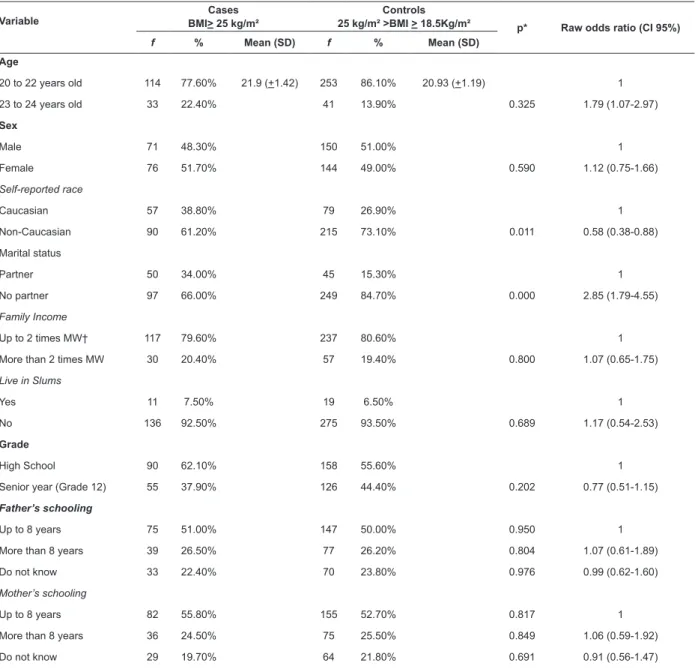
The description and analysis involved the predictor variables (sociodemographic, clinical-epidemiological,
and exposure aspects) and outcome variables (overweight or obesity), as presented in Table 1.
As shown in Table 1, most participants from both groups (case and control) were aged between 20 and 22 years, were Non-Caucasians, had no partner, had a family income of up to two times the minimum wage, did not live in slums, were attending 1st or 2nd year of high school, and parents had attended up to eight years of school. Only the sex variable showed difference between groups: women were predominant in the case group while men predominated in the control group.
Table 2 presents the clinical characteristics of the young adult students veriied by taking measures using appropriate equipment and technique.
Predominance of the following variables was veriied in both cases and controls: normal weight during childhood and adolescence, absence of weight excess among parents, normal systolic and diastolic blood pressure, and normal abdominal circumference and waist/hip ratio, no smoking, no alcohol consumption, no unbalanced diet, no sedentariness or obesogenic medications.
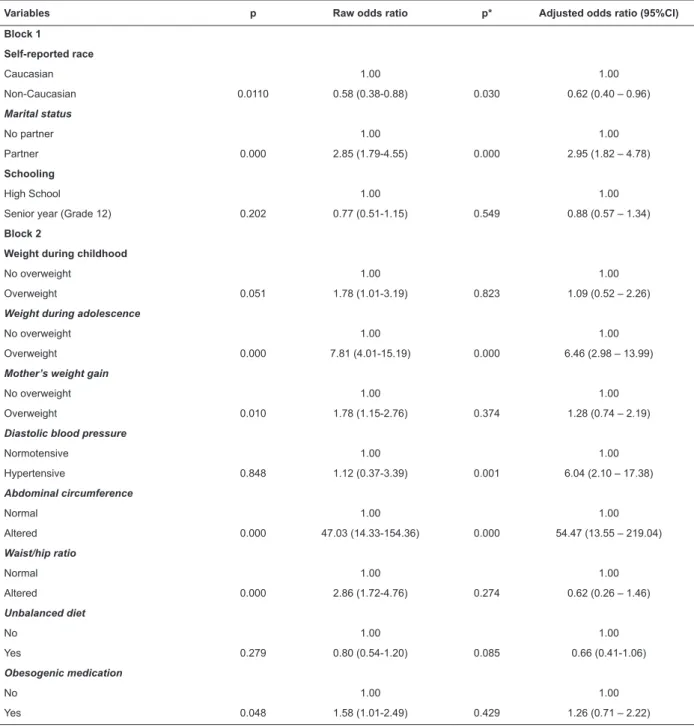
Statistically signiicant associations were found in the bivariate analysis between the following sociodemographic characteristics and overweight/ obesity (p<0.05): Being non-Caucasian and having a partner. For the following clinical and exposure characteristics, statistically signiicant associations were found for overweight and obesity (p<0.05): excess weight during adolescence; mother’s history of excess weight; altered diastolic blood pressure; augmented abdominal circumference; augmented waist/hip ratio; and the use of obesogenic medication. Variables had to present association p<0.20 to be included in the adjustment of the logistic regression model. Hence, being a senior student (grade 12) and excess weight during childhood were also selected for the multivariate analysis.
After identifying variables p<0.20 we proceeded to the multivariate analysis with the adjustment stage (Table 3).
the strong correlation with the variable abdominal circumference (coeficient r de Pearson=0.502, p<0.001). This is expected since abdominal circumference is used to calculate the waist/hip ratio.
Table 4 presents the variables that remained in the inal model. Multiple logistic regression was performed with the variables from blocks 1 and 2, which were p<0.05 in the adjustment stage. In this inal stage, race did not remain signiicant and was withdrawn from the model, remaining only the marital status “have a partner”, excess weight during adolescence, hypertension (diastolic arterial blood pressure) and augmented abdominal circumference.
Analysis of the residuals was performed to identify points in which the model had low adherence and points that improperly inluenced the model. Standardized Cook’s statistics were performed, considering DFBeta below 1 for all the variables and standardized residuals below 3, according to recommended parameters.
Table 4 shows that the inal regression model was composed of constant, marital status, weight during adolescence, diastolic blood pressure, and abdominal circumference. All presented a positive relationship with the outcome, evidenced by Exp b > 1. Hence, the variables composing the inal model are potential early indicators that lead to excess weight.
Table 1 – Bivariate analysis of sociodemographic characteristics associated with overweight/obesity in young adult students. Maracanaú, CE, Brazil, 2012
Variable
Cases BMI> 25 kg/m²
Controls
25 kg/m² >BMI > 18.5Kg/m² p* Raw odds ratio (CI 95%)
f % Mean (SD) f % Mean (SD)
Age
20 to 22 years old 114 77.60% 21.9 (+1.42) 253 86.10% 20.93 (+1.19) 1
23 to 24 years old 33 22.40% 41 13.90% 0.325 1.79 (1.07-2.97)
Sex
Male 71 48.30% 150 51.00% 1
Female 76 51.70% 144 49.00% 0.590 1.12 (0.75-1.66)
Self-reported race
Caucasian 57 38.80% 79 26.90% 1
Non-Caucasian 90 61.20% 215 73.10% 0.011 0.58 (0.38-0.88)
Marital status
Partner 50 34.00% 45 15.30% 1
No partner 97 66.00% 249 84.70% 0.000 2.85 (1.79-4.55)
Family Income
Up to 2 times MW† 117 79.60% 237 80.60% 1
More than 2 times MW 30 20.40% 57 19.40% 0.800 1.07 (0.65-1.75)
Live in Slums
Yes 11 7.50% 19 6.50% 1
No 136 92.50% 275 93.50% 0.689 1.17 (0.54-2.53)
Grade
High School 90 62.10% 158 55.60% 1
Senior year (Grade 12) 55 37.90% 126 44.40% 0.202 0.77 (0.51-1.15)
Father’s schooling
Up to 8 years 75 51.00% 147 50.00% 0.950 1
More than 8 years 39 26.50% 77 26.20% 0.804 1.07 (0.61-1.89)
Do not know 33 22.40% 70 23.80% 0.976 0.99 (0.62-1.60)
Mother’s schooling
Up to 8 years 82 55.80% 155 52.70% 0.817 1
More than 8 years 36 24.50% 75 25.50% 0.849 1.06 (0.59-1.92)
Do not know 29 19.70% 64 21.80% 0.691 0.91 (0.56-1.47)
Table 2 – Bivariate analysis of clinical and exposure characteristics associated with overweight/obesity in young adult students. Maracanaú, CE, Brazil, 2012
Variable
Cases BMI > 25 kg/m²
Controls
25 kg/m² >BMI >18.5Kg/m² p*
Raw Odds Ratio (CI 95%)
f % Mean (SD) f % Mean (SD)
Weight during childhood
No overweight 123 83.70% 265 90.10% 0.051 1
Overweight 24 16.30% 29 9.90% 1.78 (1.01-3.19)
Weight during childhood
No overweight 108 73.50% 281 95.60% 0.000 1
Overweight 39 26.50% 13 4.40% 7.81 (4.01-15.19)
Father’s weight gain
No overweight 120 81.60% 240 81.60% 1.000 1
Overweight 27 18.40% 54 18.40% 1.00 (0.60-1.67)
Father’s weight gain
No overweight 97 66.00% 228 77.60% 0.010 1
Overweight 50 34.00% 66 22.40% 1.78 (1.15-2.76)
Systolic blood pressure
Normotensive 142 96.60% 117.01 (+13.46) 285 96.90% 112.05 (+11.99) 0.848 1
Hypertension 5 3.40% 9 3.10% 1.12 (0.37-3.39)
Diastolic blood pressure
Normotensive 127 86.40% 75.67 (+14.43) 288 98.00% 68.76 (+10.37) 0.000 1
Hypertensive 20 13.60% 6 2.00% 7.56 (2.97-19.27)
Abdominal circumference
Normal 99 67.30% M:91.85 (+9.86) F:90.27 (+10.11)
291 99.00% M:76.51 (+5.50) F:74.74 (+6.66)
0.000 1
Altered † 48 32.70% 3 1.00% 47.03 (14.33-154.36)
Waist/hip ratio
Normal 107 72.80% M:0.86 (+0.62) F:0.85 (+0.74)
260 88.40% M:0.82 (+0.08) F:0.80 (+0.09)
0.000 1
Altered ‡ 40 27.20% 34 11.60% 2.86 (1.72-4.76)
Smoking
No 129 87.80% 250 85.00% 0.439 1
Yes 18 12.20% 44 15.00% 0.79 (0.44-1.43)
Alcohol
No 41 29.90% 85 32.10% 0.660 1
Yes 96 70.10% 180 67.90% 1.11 (0.71-1.73)
Unbalanced diet
No 71 48.30% 126 42.90% 0.279 1
Yes 76 51.70% 168 57.10% 0.80 (0.54-1.20)
Sedentariness
No 28 19.00% 53 18.00% 0.794 1
Yes 119 81.00% 241 82.00% 0.93 (0.56-1.55)
Obesogenic medication
No 104 70.70% 233 79.30% 0.048 1
Yes 43 29.30% 61 20.70% 1.58 (1.01-2.49)
Table 4 – Final model of the logistic regression. Maracanaú, CE, Brazil, 2012
B (standard error)
Confidence interval of 95% for Exp b
Inferior Exp b Superior
Included
Constant -6.59 (0.92) *
Marital status 0.89 (0.29) † 1.40 2.44 4.27
Weight during adolescence 1.84 (0.38) * 2.98 6.30 13.31
Diastolic blood pressure 1.96 (0.54) * 2.49 7.11 20.28
Abdominal circumference 3.48 (0.62) * 9.59 32.42 109.54
Note: R²=0.20 (Hosmer and Lemeshow), 0.28 (Cox & Snell), 0.39 (Nagelkerke). X² model= 143.64, p<0.001. *p<0.001, †p<0.01.
Table 3 – Multivariate analysis of sociodemographic characteristics (block 1), clinical characteristics and other exposure factors (block 2), associated with overweight/obesity in young adult students. Maracanaú, CE, Brazil. 2012
Variables p Raw odds ratio p* Adjusted odds ratio (95%CI)
Block 1
Self-reported race
Caucasian 1.00 1.00
Non-Caucasian 0.0110 0.58 (0.38-0.88) 0.030 0.62 (0.40 – 0.96)
Marital status
No partner 1.00 1.00
Partner 0.000 2.85 (1.79-4.55) 0.000 2.95 (1.82 – 4.78)
Schooling
High School 1.00 1.00
Senior year (Grade 12) 0.202 0.77 (0.51-1.15) 0.549 0.88 (0.57 – 1.34)
Block 2
Weight during childhood
No overweight 1.00 1.00
Overweight 0.051 1.78 (1.01-3.19) 0.823 1.09 (0.52 – 2.26)
Weight during adolescence
No overweight 1.00 1.00
Overweight 0.000 7.81 (4.01-15.19) 0.000 6.46 (2.98 – 13.99)
Mother’s weight gain
No overweight 1.00 1.00
Overweight 0.010 1.78 (1.15-2.76) 0.374 1.28 (0.74 – 2.19)
Diastolic blood pressure
Normotensive 1.00 1.00
Hypertensive 0.848 1.12 (0.37-3.39) 0.001 6.04 (2.10 – 17.38)
Abdominal circumference
Normal 1.00 1.00
Altered 0.000 47.03 (14.33-154.36) 0.000 54.47 (13.55 – 219.04)
Waist/hip ratio
Normal 1.00 1.00
Altered 0.000 2.86 (1.72-4.76) 0.274 0.62 (0.26 – 1.46)
Unbalanced diet
No 1.00 1.00
Yes 0.279 0.80 (0.54-1.20) 0.085 0.66 (0.41-1.06)
Obesogenic medication
No 1.00 1.00
Yes 0.048 1.58 (1.01-2.49) 0.429 1.26 (0.71 – 2.22)
Discussion
Having a partner, considered in this study as being in a stable union or married, was statistically associated with overweight/obesity in both the bivariate and multivariate analysis, and remained in the inal model. One study(10) conducted with the employees
of a federal university veriied that marital status was strongly associated with overweight and obesity, and prevalence was lower among single individuals, 41.8 and 1.8%, respectively. Another study(11) found
signiicant risk estimates (p<0.001) among men with a partner (PR=1.88). Another study(12) conducted with
adults in Maranhão veriied that not having a partner was associated with lower prevalence of abdominal obesity (PR=0.28).
We suggest that marriage may inluence weight gain due to changes in social behavior, which lead to increased caloric ingestion, due to foods rich in fat and sugar and decreased energetic expenditure, as a consequence of neglecting more rigorous physical activities and increased visits to restaurants and coffee shops as leisure. Additionally, couples tend to concern less with their self-image.
Current literature indicates that young adults are at risk of becoming obese or gaining excess weight when transitioning from childhood into adolescence or from adolescence into adulthood. The most critical periods of life for the development of obesity are early childhood, during the strong luctuation in the trajectory of body fat that occurs between ive and seven years old, and adolescence. From six years of age onwards, approximately one in every two obese children become an obese adult while only one in ten non-obese children become obese in adulthood(13-14).
With regard to weight gain during adolescence, it was statistically signiicant in the bivariate analysis and remained in the inal model when tested in the multivariate analysis, showing that young adults with a history of excess weight during adolescence are 6.3 times more likely to develop overweight/obesity in adulthood.
Some studies report that obesity during childhood and adolescence is a concern because, if not controlled, the prognosis is increased morbidity and reduced life expectancy(15-16), as it is associated with dyslipidemia, hypertension, glucose intolerance, psychosocial dificulties and increased risk of persistent obesity during adulthood(6).
The literature usually addresses hypertension as a consequence of weight gain(7,17). In this study, an
association between hypertension as predictor variable and overweight/obesity as outcome could be identiied. Both systolic and diastolic blood pressures were veriied to check for hypertension and only the latter showed statistic signiicance as outcome, both in the bivariate and multivariate analysis, so that diastolic blood pressure remained in the inal model. Hence, this study shows that hypertensive individuals are seven times more likely to develop overweight/obesity.
One cross-sectional study(18) applied multiple logistic regression to verify the variables associated with overweight and obesity and the adjusted analysis showed that hypertension was one of the variables that were statistically associated (p<0.05) with overweight. Hypertensive individuals were 3.3 times more likely to develop overweight than normotensive ones. The analysis of obesity showed that hypertensive individuals were ive times more likely to develop abdominal obesity that normotensive individuals.
One study(11) veriied in the bivariate analysis that men who self-reported hypertension presented a prevalence ratio 1.44 times higher of overweight and obesity; for women this ratio was 1.72. After applying Poisson regression, self-reported hypertension remained signiicant for both sexes.
Abdominal circumference is used to classify different degrees of abdominal obesity, as well as cardiovascular risk, and is another indicator used in epidemiological studies, in addition to BMI. This accumulation of fat in the abdominal region is considered a risk factor for other diseases, such as endocrine, metabolic and cardiovascular diseases, even when BMI is within normal parameters(12). Based on this fact, we investigated the association between this variable and the outcome, which was detected in the bivariate and multivariate analyses. The inal model showed that abdominal circumference above normal parameters, which characterizes central obesity, increases 32 times the likelihood of a young adult to develop overweight or obesity.
It is important to note that all the variables addressed in this study have some relationship with overweight/obesity. How strong this relationship is, however, depends on speciic populations. The purpose of nurses is to identify which predisposing factors are interfering in the outcome through statistical analysis and then use their clinical and critical rationale to direct practices, be these practices to promote health or to prevent diseases or associate morbidities.
delivering care to overweight or non-overweight young adult students, directing the practice of health education.
These points include considering that obesity involves biological, historical, ecological, economic, cultural, social and political factors, the causes of which are not only individual, but also environmental and social. Nurses should work to reach young adult students who do not usually seek the conventional health service network, and visit social spaces such as schools to promote the establishment of bonds between the health unit and the school, enabling the implementation of a quality multidisciplinary service to prevent diseases and promote health.
It is worth noting that nurses are supposed to provide nursing consultations, monitor anthropometric data and ask for complementary exams to assess those at risk and refer these individuals to specialized professionals when necessary; identify together with the young adult what factors contributed, contribute or will contribute to overweight, from the perspective of diet, social and sportive behavior, and together seek strategies to overcome these factors; to overcome environmental and social factors, nurses and young adults should use the strategies proposed by public health policies and health care insurance/plans concerning the clinical condition; when overweight has already settled in, methods that minimize the risk of associated morbidities should also be used.
It is important to consider that nurses should have the support of other health care workers providing integral and interdisciplinary care to overweight or non-overweight young adults; all intervenient factors should be addressed by the nurse, considering the strategy to promote the health of young adult students who have not yet become overweight by using educational practices; and inally, nurses should always update their knowledge concerning research addressing the clinical care they provide, in addition to conduct studies to contribute to the implementation of such care.
Conclusion
After bivariate analysis and adjustment of the multivariate analysis, the following variables remained in the inal model: having a partner, overweight during adolescence, diastolic blood pressure indicating hypertension and augmented abdominal circumference.
All the variables tested in this study were subject to be statistically associated with overweight/obesity
because they were based on various studies developed on this topic. One has to consider, however, the age interval of this young population addressed in this study. Many of the predictor variables would require longer periods to fully manifest. Other factors may have contributed to a lack of association: e.g. the accuracy of the answers provided by the participants was not take into account.
The conclusion, therefore, is that the analysis of the predictor variables for excess weight in young adult students support nurses in the planning and development of educational practices aimed to prevent this clinical condition, a risk factor for other chronic comorbidities, such as cardiovascular diseases.
References
1. World Health Organization. World Health Statistics 2012. 2012 [acesso em: 6 out 2014]. Disponível em: http://www.who.int/gho/publications/world_health_ statistics/WHS2012_IndicatorCompendium.pdf?ua=1 2. Rodrigues EM, Boog MCF. Problematização como estratégia de educação nutricional com adolescentes obesos. Cad Saúde Pública. 2009;22(5):923-31.
3. Oliveira AFC, Nogueira MS. Obesidade como fator de risco para a hipertensão entre profissionais de enfermagem de uma instituição filantrópica. Rev Esc Enferm USP. 2010;44(2):388-94.
4. Câmara Interministerial de Segurança Alimentar e Nutricional (CAISAN). Plano Intersetorial de Prevenção e Controle da Obesidade: promovendo modos de vida e alimentação adequada e saudável para a população brasileira. 2011. [acesso em: 10 nov 2012]. Disponível em: http://189.28.128.100/nutricao/docs/geral/ apresentacao_plano_obesidade2.pdf
5. Mariz LS, Medeiros CCM, Vieira CENK, Enders BC, Coura AS. Changes in the frequency of food intake among
children and teenagers: monitoring in a reference service.
Rev. Latino-Am. Enfermagem. 2013;21(4):973-81. 6. Medeiros CCM, Xavier IS, Santos VEFA, Souza MAO, Vasconcelos AS, Alves ERP. Obesidade infantil como fator de risco para a hipertensão arterial: uma revisão integrativa. REME. 2012;16(1):111-9.
7. Souza MCC, Tibúrcio JD, Bicalho MF, Rennó MS, Dutra JS, Campos LG et al. Fatores associados à obesidade e sobrepeso em escolares. Texto Contexto Enferm. 2014;23(3): 712-9.
em: 18 julho 2010]. Disponível em: http://www. senadorsaonline.com.br/2010/12/censo-2010-confira-os-dados-do-estado.html
9. VI Diretrizes Brasileiras de Hipertensão. Arq Bras Cardiol [internet] 2010. [acesso em: 2 novembro 2014];95(supl1):I-III. Disponível em: http://www. scielo.br/scielo.php?script=sci_arttext&pid=S0066-782X2010001700001&lng=en
10. Costa MAP, Vasconcelos AGG, Fonseca MJM. Prevalência de obesidade, excesso de peso e obesidade abdominal e associação com prática de atividade física em uma universidade federal. Rev Bras Epidemiol. 2014;17(2):421-36.
11. Lino MZR, Muniz PT, Siqueira KS. Prevalência e fatores associados ao excesso de peso em adultos: inquérito populacional em Rio Branco, Acre, Brasil, 2007-2008. Cad Saúde Pública. 2011;27(4):797-810. 12. Veloso HJF, Silva AAM. Prevalência e fatores associados à obesidade abdominal e ao excesso de peso em adultos maranhenses. Rev Bras Epidemiol. 2010;13(3):400-12.
13. Gordon-Larsen P, The NS, Adair LS. Longitudinal trends in obesity in the United States from adolescence to the third decade of life. Obesity (Silver Spring). 2010; 18:1801-1804.
14. Yannakoulia M, Panagiotakos D, Pitsavos C, Lentzas Y, Chrysohoou C, Skoumas I et al. Five-year incidence of obesity and its determinants: the ATTICA Study. Public Health Nutrition. 2009;12(1):36-43.
15. Alves JGB, Siqueira PP, Figueiroa JN. Excesso de peso e inatividade física em crianças moradoras de favelas na região metropolitana do Recife, PE. J Pediatr. 2009;85(1):67-71.
16. Gopinath B, Baur AL, Burlutsky G, Mitchell P. Socio-economic, familial and perinatal factors associated with obesity in Sydney schoolchildren. J Pediatrics Child Health. 2012;48(1):44-51.
17. Ramos-Arellano LE, Benito-Damián F, Salgado-Goytia L, Muñoz-Valle JF, Guzmán-Guzmán IP, Vences-Velázquez A, et al. Body fat distribution and its association with hypertension in a sample of Mexican children. J Investig Med. 2011;59(7):1116-20.
18. Cristóvão MF, Sato APS, Fujimori E. Excesso de peso e obesidade abdominal em mulheres atendidas em Unidade da Estratégia Saúde da Família. Rev Esc Enferm USP 2011;45(esp2):1667-72.
Received: May 13th 2014