THE ORIGIN AND SPREAD OF THE WAR CHARIOT
Elias Manuel Morgado Pinheiro
___________________________________________________
Dissertação
de Mestrado em Civilizações do Médio Oriente e Ásia Antiga
i
Dissertação apresentada para cumprimento dos requisitos necessários à obtenção do grau de Mestre em História - Civilizações do Médio Oriente e Ásia Antiga,
ii
AGRADECIMENTOS
A todos os que de alguma forma contribuíram para a realização do presente trabalho, mas especialmente a:
Professor Doutor João Paulo Oliveira e Costa, pelas revisões, sugestões e correcções ao presente texto; pelas suas extraordinárias aulas, às quais devo um novo entendimento da história da Ásia; e pela confiança necessária para prosseguir numa área de estudo inédita em Portugal.
Professor Doutor Francisco Caramelo, pelos seus esclarecimentos, assim como pelas suas extraordinárias aulas ao longo dos anos, sem as quais o presente trabalho não poderia ser feito.
Professora Doutora Jessica Hallett, cuja opinião foi essencial à decisão de realizar o presente estudo
Dr. Kenneth Parr, pela sua cuidada revisão do presente texto.
iii
RESUMO
Origem e Difusão do Carro de Guerra
Uma das mais bem sucedidas tecnologias da Idade do Bronze foi o carro de guerra. O seu sucesso levou a uma dispersão inaudita através da Ásia. A problemática das suas origens é tradicionalmente abordada numa base regional. O presente estudo pretende abordar o assunto de um ponto de vista trans-regional, focando as ligações existentes entre diferentes regiões, de forma a gerar uma visão mais abrangente do problema. Para além disso, procura evidenciar as ligações existentes entre as regiões mais periféricas, a Índia e a China, e o tradicional núcleo de desenvolvimento do carro de guerra, a Ásia Ocidental e as estepes Eurasiáticas.
Considerando as ligações entre as estepes a sul do Urais e a Ásia Ocidental, é possível concluir que os primeiros passos no desenvolvimento do carro de guerra ocorreram nas estepes da região de Sintashta, c. 2000 BC. Contudo, na Ásia Ocidental, essa tecnologia foi mais tarde adaptada a modelos autóctones, de forma a criar um veículo melhor equipado para lidar com as necessidades locais. Apesar da existência de pequenas adaptações locais, as semelhanças entre os vários modelos de carros de guerra permitem rejeitar a possibilidade de um desenvolvimento independente em diferentes regiões. De facto, é possível identificar uma só tradição referente ao carro de guerra ao longo do continente asiático, da Ásia Ocidental à China, e das estepes Eurasiáticas à Índia.
PALAVRAS-CHAVE: carro de guerra, estepe, Ásia, Índia, China, origem do carro de guerra, difusão do carro de guerra, ligações trans-regionais.
Abstract
The Origin and Spread of the War Chariot
One of the most successful Bronze Age technologies was the light war chariot. Its success meant an unprecedented spread throughout all of Asia. The subject of its origins is traditionally approached on regional basis. The present work seeks to address the issue from a trans-regional standpoint, focusing in the connections between different regions, and thus creating a broader understanding of the problem. Furthermore, it seeks to highlight the connections between the more peripheral regions, India and China, and the traditional cluster of development of the war chariot, West Asia and the Eurasian steppes.
Considering the connections between the steppes south of the Urals and West Asia, it is possible to conclude that the first developments towards the light chariot took place in the Sintashta region, c. 2000 BC. However, in West Asia, that particular technology was adapted to native chariot designs, in order to produce a vehicle better suited to specific regional needs. Despite minor local adaptations, the similarities
between all chariots‟ designs discard the possibility of independent development in
different regions. In fact, a single and continuous chariot tradition can be seen throughout the continent, from West Asia to China, from the Eurasian steppes to India.
iv
Table of Contents
Introduction ... 1
Chapter I: Origins of the War Chariot ... 5
I. 1. The Wheel ... 10
I. 2. Sintashta ... 26
I. 3. The Horse ... 38
Chapter II: India ... 56
Chapter III: China ... 68
Conclusion ... 77
v
ABBREVIATIONS
ARM Archives Royales de Mari
CTH Catalogue de Textes Hittites
EIEC Encyclopedia of Indo-European Culture
KBo Keilschrifttexte aus Boğazköy
RHA Revue Hittite et Asiatique
RV Rig Veda
ŚBM Vājasaneyi Madhyandina Sākhā
TS Taittirīya Saṃhita
1
Introduction
When one considers the late Bronze Age major battlefields, there is one common element among them, from Europe to China, the war chariot. While vehicles had been used in the battlefield before, they were slow and cumbersome, relegated to support functions. The introduction of the war chariot in military formations marked a clear departure from these early traditions. Built for speed rather than strength, the war chariot allowed for the use of vehicles in the heart of battle. This was nothing short than a revolution.
In the same way that a disciplined infantry formation multiplies the combat efficiency of individual fighters, becoming an entity greater than the sum of its parts, the war chariot allowed man and horse to function as one, thus increasing the martial potential of both parties. Whether used as a close quarter fighting vehicle or as a fast moving firing platform, the chariot provided an unprecedented increase in the effectiveness of the warrior/archer. Therefore, these men became the elite warriors of the world greatest armies.
What is truly remarkable, however, is how fast this new technology spread throughout all of Asia, from the Eurasian steppes to China proper. The oldest chariots known today, dating c.2000 BC, were found in the Eurasian steppes. However, its use in large scale battle was first attested in the battle of Megiddo, c. 1457 BC, between Egypt and a coalition of Canaanite forces, in West Asia. It is possible that chariots had been used before, but no record remains. Simultaneously, literary evidence place chariots in the north-western part of the Indian subcontinent in c. 1500 BC, in connection to the migration of Indic speaking peoples into the region. In addition, chariot remains were found at the Shang capital of Anyang, dated c. 1200 B.C.
Since all these chariots shared the same basic design, it is highly improbable that such complex technology could emerge simultaneously and in a similar fashion in such distant locations. Therefore, a common origin must be found.
2 ways in different locations, and naturally, the way they were used and their design would condition each other. Therefore, it is reasonable to expect that warfare conditions in specific locations would change the design of the war chariot. These were not drastic modifications, but enough to force us to consider them when discussing the subject of origins. The war chariot, in its final form, might have arisen from a combination of small improvements made in different regions. In this case, in order to identify a possible origin, one must not focus in a specific location, but rather in trans-regional connections between different regions; namely, the Eurasian steppes and West Asia.
It is the objective of this work to review the antagonistic theories regarding the origin of the war chariot, addressing each component individually, in order to build a composite view of the vehicle, and thus presenting a new understanding of its origins, based on both West Asian and steppe evidence. Furthermore, the cases of India and China will be addressed, with the objective of highlighting the connection between these regions and the potential origin of the war chariot, while at the same time demonstrating the existence of a single and continuous chariotry tradition across Asia.
Considering the complete lack of investigation in this particular field in Portugal, much of the present work seeks to establish a starting point to new forays into the subject. Rather than a final word, it should be understood as the first step of a future investigation. While the basic connecting lines between Eurasia, West Asia, India, and China, regarding the war chariot are presented here, a closer in-depth approach to each one is necessary. However, such thorough task is far beyond the scope of a master thesis. It should be noted that an encompassing study of the subject must also include Europe. However, the current work is focused exclusively in Asia, a limitation imposed by the geographic specificity of the relevant master‟s course.
Furthermore, considering the lack of specialized collections and the virtual inexistence of volumes pertaining to chariot warfare and steppe archaeology in Portuguese generalist libraries, the current thesis aims to be a readily available source of useful and quality information regarding the subject.
3 established. While this is true to any field of research, it is especially important in these traditionally more marginal subjects in Portuguese historiography.
The present work is divided in two sections. The first pertains to the origins of the war chariot, consisting of the first chapter. In it, the current trends regarding the subject will be summarized, while at the same time reviewing the main evidence supporting them. This chapter is divided in three distinct parts: the spoked wheel, the Arkaim-Sintashta culture, and the horse domestication. The first part discusses the earliest evidence for the development of the war chariot, with exceptional focus on the spoked wheel. While the box of the war chariot varied from region to region, the spoked wheel is one of the common elements found in every design, therefore being used as indicator for its presence. A second element can be used for this purpose, namely the brittle and harness. However, it is not possible to make a direct connection between one particular type of harness and this specific type of vehicle. The second part, Sintashta, addresses the economic, social and military context of Sintashta-Arkaim type settlements in relation to the eventual development of the light chariot. It seeks to ascertain whether or not there was a necessity for such technology, and if the conditions required for its development were gathered at the Bronze Age southern steppes. The final part deals with the horse domestication. It seeks to identify the first known instance of large scale domestication, and through it, locate the broader geographical region where the process took place. Furthermore, it seeks to set a chronological limit for the introduction of the horse in the Near and Middle East. Because the light chariot was developed as means to harness the new animal‟s full potential, by ascertaining an approximate date for the introduction of the domestic horse in the Near and Middle East, one can establish the earliest possible date for the beginning of a putative autonomous development of lighter vehicles in the region.
The second section, comprising chapter two and three, deals with the introduction of the war chariot in India and China, respectively. It seeks to highlight the differences and similarities between the chariots used in both regions and those found at Eurasia and West Asia, while at the same time trying to identify the origin of their chariotry tradition and its diffusion channels. Considering India, the Rig Veda is used as
5
I. Origins of the war chariot
The chariot is often compared with a modern tank. Such comparison can be understood if one considers the key contribution made by the armoured divisions in the great wars of the last century, or even the military revolution set in motion by the tank‟s
first deployment, against the impact of the war chariot in ancient times. Nevertheless, if one considers the actual role of both the tank and the chariot in the battlefield, such comparison is, at the very least, flawed.
The tank is a slow moving machine, relying on its heavy armour and firepower to overcome the opponent, shattering its lines. In that sense, it‟s more akin to a hoplite
phalanx, or a roman cohort, rather than a light war chariot.
In fact, the strength of the chariot relied on its speed, manoeuvrability, and versatility, rather than in sheer force. The notion that it was used to charge enemy infantry lines is well spread, but highly inaccurate, at least for the relevant time period. Such tactics were indeed used, but much later, with sturdier chariots, and bigger, stronger, and partially blinded horses.
A more fortunate comparison could be made between the war chariot and the helicopter. The war chariot was a fast moving fire platform, capable of support fire to the infantry, with the ability to quickly insert and extract key elements in critical areas of the battlefield, patrol enemy routes, obtain information and enforce sieges. Its effectiveness is the result of the combination of three essential factors: the spoked wheel, for lightness; the horse, for speed and manoeuvrability; and the weapons carried by its crew. This realization is of extreme importance when dealing with the subject of the geographical origin of the war chariot, since it is the combination of these three elements that make the light chariot a war machine.
6 better part, that notion prevails today. However, identifying this origin proved to be a much more daunting task, one that has produced a heated debate that rages on today.
Throughout most of the 20th century, the homogeny found in chariots from the Southern Ukrainian steppe, West Asia and Egypt, lead scholars to the assumption of a common origin. That concept was further expanded into the notion that a single people was responsible for the development and spread of the war chariot. Therefore, it stands to reason, that in order to identify the origin of the technology, one simply had to find a foreign element associated with it, within pre-existing societies. Thus, in the Near East, two different groups of people, both to an extent foreigners, became the focus of the discussion: the Hurrian and Kassite speakers1. Of the two, the former was of particular interest, in great measure due to the Mitanni political system, where an Indo-European superstrate existed over a Hurrian substrate2.
Mittani, in general, and the Indo-European element, in particular, were closely associated with chariotry and horse-breeding. A particular text (CTH 284), authored by Kikkuli of Mittani, dealing with horse breeding and training, attests this association. Despite being written in Hittite language, the author introduces himself has “Kikkuli, master horse trainer of the land of Mitanni”3. Additionally, the Kikkuli text is notorious
for the presence of a significant number of Indo-European loanwords, which further emphasizes the connection.
So, in light of this evidence, the theory that the light horse-drawn chariot had been introduced in the Near East, in its final form, by groups of Indo-European speakers from beyond the Caucasus arose. This view was crystallized in the early 1960‟s by
Albrecht Goetze. In 1963 he wrote:
“What is important [...] is the role played […] by the Hurrians and by the thin layer of Indians which revitalized them from about 1650 on. For to them can be traced a fundamental change in the technique of warfare which is recognizable everywhere in the Near East at that time and characterizes the period as nothing else. It is the introduction of the light horse-drawn chariot. […]The result was that henceforth warfare
was essentially different from what it had been before.4”
He further added:
7
“Nothing much further need be said about the Hurro-Indic origin of the innovation. To the philologists it is proved by words used in connection with horse and
chariot.”5
From the above statements, it is possible to extract the fundamental notions of the theory. First, the war-chariot is seen as a whole, and thus, the source of one innovation must be the source of them all. Second, it was introduced in West Asia as a finished product, having had an immediate and drastic impact on the region. Lastly, it was introduced by Indo-European speakers, which is unequivocally proven by the great number of Indo-Aryan loanwords addressing chariotry and horse-breeding, present in otherwise unrelated languages. These were virtually undisputed points in the first half of the 20th century.
However, in the late 1970‟s, two new hypotheses arose, that replaced, although at variable levels, this established view. These two hypotheses, albeit corrected, reformulated, and sometimes rewritten over the years, are at the root of today‟s schools
of thought regarding the subject.
The first of these theories to emerge was first drafted6 by Piggott in 1978, and then expanded in two other publications7, although without significant change. In its essence, it is very similar to the previously accepted view, although reflecting a new understanding on the nature of linguistic groups. Unlike its predecessors, Piggott avoided attributing the origin of the chariot to a specific ethnic or linguistic group, opting to identify a geographical origin. However, he maintained several of the previous
hypothesis‟s fundamentals:
“[…] the horse-drawn light cart or chariot was as a whole a new invention, and that the new factor involved was speed provided by a new motive force”8
And:
“In the […] civilizations of the ancient Near East, the adoption and development of the chariot in the earlier second millennium B.C. […] was not an
5 Goetze, 1963, p.124 6 Piggott, 1978
8
internal evolution, […] based on improved carpentry techniques and the substitution of a new draught equid Equus caballus, for the previous Equus hemionus. It was rather the result of a ready social acceptance of the light, spoked-wheel, horse-drawn vehicle from
[…] prehistoric peoples within the natural territory of the wild horse, who included some within the Indo- European language family, whose vocabulary contributed to the
jargon of chariotry.”9
Here lies the fundamental difference between Piggott‟s approach and that of most of its predecessors. Piggott deliberately avoids associating a technology with a linguistic group. He simply states that the war chariot was developed in a geographical area which included populations who spoke an Indo-European language, and later contributed to the lexicon of technical terms related to chariotry. Although not stated, this leaves open the possibility that these indo-european groups weren‟t the developers
of the chariot, although having contributed to its later spread.
This hypothesis, albeit updated to accommodate recent evidence, has been given new life in the last decade of the 20th century, with the discovery of several chariot graves with spoked wheels, horses, and bits, in the Ural-Tobol steppes, in southwest Russia and northern Kazakhstan10. The calibrated radio-carbon dates advanced for the earliest of these vehicles is c. 2000-1800 B.C11., which makes them the oldest evidence available of a potential full working light war-chariot.
The second theory was first published in its finished form in 1979, by Littauer and Crouwel12. This new hypothesis represented a radical departure from the conventional wisdom of the day; a departure fully acknowledged by the authors:
“The material considered […] strongly suggests the possibility of a local
evolution of the light, spoked-wheeled, horse-drawn chariot in the Near East itself, in contrast to the long held theory that this was introduced from outside in an already evolved form by Indo-European-speaking steppe tribes.”13
9 Piggott, 1978, p.42
9 Unlike its predecessors, Littauer and Crouwel, through an extensive analysis of evidence relating to wheeled vehicles and animal breeding in the Near East before
c.1500 BC, have concluded the existence of chariot prototypes of local origin.
It approaches the subject on very different grounds than ever before: the chariot is not seen as a whole, but rather as the sum of a series of innovations; these innovations can be seen in earlier vehicles, and therefore, the chariot is not a foreign element in the Near East; considering the long history of wheeled vehicles originated in the Near East, the later Indo-European loanwords are far too late to be of any relevance to the matter of origin.
10
I.1. The Wheel
Considering the wheel alone, it‟s impossible to determine an exact date for its
first use. The best one can hope for is to establish a time period when its use became widespread, and then proceed from there to create a timeline.
That which might be the first archaeological evidence of the use of a wheeled vehicle are track marks found beneath a gravestone, found in Flintbeck, north Germany, and dated c. 3600 BC. Still, there is no conclusive way to determine exactly how they were produced, and for this reason, should be treated with extreme precaution. On the other hand, considering this is an isolated finding, even assuming they are indeed track marks produced by wheels, it is in no way evidence of general use, which is the relevant question.
That which is potentially the oldest evidence of a wheeled vehicle comes from a clay mug found at a waste pit from Bronocice, south Poland. In the same pit were found animal bones dating from c. 3500 BC to 3350 BC. The said mug shows an incision on its surface depicting a four wheeled wagon with harness pole. Although not shown, one can assume these wagons were pulled by oxen, considering the several sacrifices found on late Baden Culture graves, c.3500 – 3000 BC, in Budakalász,
Hungary, and on Globular Amphorae culture graves, c.3200 – 2700 BC, in southern
Poland14. Still, if one considers the traditional decorative motives of the Trichterbecker
culture, from which the clay mug originates, it becomes apparent that the wagon depiction is an anomaly, one of a kind. This suggests that the wagon was a rare object, worthy of being depicted, and thus not of common usage.
In Mesopotamia, clay tablets found on the ruins of Temple C in Eanna precinct, Uruk IVa, show pictograms depicting four-wheeled vehicles, with an upper structure. These tablets where preserved due to a fire, which was also responsible for the destruction of the temple. The presence of charcoal allows dating the wood used in the construction of the temple through radiocarbon, yielding the approximate dates of 3500
– 3370 BC for the roof timbers. Nevertheless, these dates need to be taken with caution. In a tree, only the bark and the wood immediately beneath it consist of living tissue, the core being dead. Because of this, the date advanced by radiocarbon concerns not when the temple burned, but rather when it was built. So, the tablets must date after
11 3370 BC, probably c.3300-3100 BC15. Another relevant fact relates to the amount of occurrences of the said pictogram. In over three thousand nine hundred texts, the pictogram for “wagon” is illustrated three times, against the pictogram for “sledge”, which occurs thirty-eight times16, thus showing that it remained the main means of transportation, at least for heavy loads.
Considering the previously mentioned findings, it is possible to state that the wheel technology became widespread in the second half of the 3rd millennium BC.
The oldest evidence of the use of the spoked wheel known today is dated c. 2000-1850 B.C., consisting of the imprint of the lower half of a wheel; left in the earth, as the wood rots away, found in graves in southern Urals and northern Kazakhstan.
Fig. 1 Sintashta SM gr.30 after David W. Anthony, Dorcas R. Brown, The Secondary Products Revolution, Horse-Riding, and Mounted Warfare
http://users.hartwick.edu/anthonyd/harnessing%20horsepower.html (November 2009)
The most conservative estimation of the number of chariot graves places it at sixteen, all of them centred in a small geographical area, enclosing both the Sintashta
12 culture in the Ural-Tobol steppes, and the Petrovka culture in northern Kazakhstan. These imprints show half a wheel, average 1-1.2m in diameter, with between 10 and 12 spokes17.
These chariots were buried with human remains, probably its owners and/or charioteers, with their respective weapons. At least on one occasion (Sintashta SM gr.28), a chariot was buried with two male adults, suggesting that it might be its crew, considering its wheel span of approximately 1.5m. In addition to human remains, horse remains were also found in many of these graves, and often in pairs, suggesting that the tractor team was sacrificed and buried with their owner. A few of these chariot graves produced disk cheek-pieces, thus proving the use of bitted horses.
Due to the fragmentary nature of the steppe archaeological record, we do not possess evidence regarding the development of the wheel on the steppe, but, like any new technology, the spoked wheel took some time to become widespread. Assuming that the steppe is indeed the origin of the spoked wheel, it is reasonable to expect that, just like the finished product, its prototypes spread to other areas. By analyzing such wheel types, although used in other places, and often, in later times, it is possible to deduce the evolution of the technology in the steppe, as long as a clear and undisputed relationship between the two areas can be proved.
Considering Western Asia and the Middle East, the archaeological record is far less fragmentary, being possible to assemble a continuous evolutionary timeline for the wheel technology, from the earlier 3rd millennium B.C., to c. 1500 B.C., when the war chariot became widespread in the Near East18.
The first military vehicle used in west Asia consisted of slow-moving, four wheeled wagons, as shown on the famous Standard of Ur. The earliest of these vehicles
date to the earlier third millennium B.C. (ED period), and remained in active use until c. 2300 B.C. after which were relegated to a ceremonial function19. These vehicles suffered from severe limitations, derived from their design. The narrowness of the floor (avg. 0.5m) made it an awkward fire platform, considering that the javelin thrower would travel behind the driver. The axles, much larger than the platform (avg. 0.7 -1.0m), and fixed to the cart with the wheels revolving on them, show no evidence of
17 Anthony, 2007; p.397; Epimakhov, 2002
13 horizontal articulation, which would have a considerable detrimental effect on the manoeuvrability of the vehicle.
Block wheels used in these vehicles, whose diameter varied between 0.5m and 1.05m, were made of three wooden pieces, joined together by slats, with the centre one functioning as the nave.
These carts were pulled by teams of equids, either the wild ass (Equus asinus)
or the onager (Eqqus hemionnus), or more probably, a hybrid between the two. There is
a possibility that such carts were pulled by horses, but considering how rare they were in the Near and Middle East at the considered time, it is highly unlikely. Despite being shown four equids, only two were actually yoked, with the remaining ones being used
as reserves. These weren‟t bitted equids, being controlled through the use of nose rings, which was detrimental to the cart‟s already poor manoeuvrability, since such a method would only allow for breaking and advancing, not turning.
These limitations severally impacted the usefulness of these wagons in combat, making them more suitable for escorting convoys or protecting supply lines. Nevertheless, these vehicles are often depicted overrunning fallen enemies, showing that it had symbolic value, probably as a transport means for high ranking individuals.
In this same time period there was another wheeled vehicle that might have had military applications: a two wheeled car commonly referred to as “straddle car”. It consisted of a main log, to which the wheels were attached, where the driver (single occupant) would sit astraddle, thus justifying the name. The wheels were the same type as the ones used on regular four wheel wagons. These vehicles, despite being armed with javelin sheaths, were never depicted in a strictly military context, and thus might have been used only for hunting20.
The former type of vehicles became progressively obsolete in the final quarter of the third millennium B.C., with the advent of a new wheel type. This new wheel, the cross-bar wheel, is first seen in a seal found in Tepe Hissar, in modern day northern Iran, and dated c. 2100 BC (Tepe Hissar III b). This wheel type is distinct from others due to its asymmetrical nature. A large diametrical bar is placed inside the felloe, in order to accommodate the hub of the wheel, while two or more cross-bars are placed perpendicular to it, in order to reinforce the entire structure. In relation to the central-bar, the smaller cross-bars might either traverse it, with both ends imbued into the inside
14 of the felloe, or being mortised into the sides of the larger bar, effectively increasing the number of cross-bars to four21. Either way, it is the first evidence of a new trend towards lighter vehicles in the Near East.
This new trend becomes clearly dominant after 2000 B.C., where numerous examples of experimentation with new designs of lighter wheels can be found. While the traditional four wheeled wagons are relegated to ceremonial use, a new type of four wheeled vehicle emerges, shown in seals originated in Karum Kanesh II, in Anatolia, and dated c. 2000 -1875 B.C. Although some of these vehicles (fig.2) continue to use the cross-bar wheel, others show a new design: the spoked wheel, similar to the ones found in northern Kazakhstan, but of simpler design (fig.3). The relation between the two, as well as the relation between these and the cross-bar wheel will be addressed later.
Fig. 2 Enlarged detail from a cylinder seal of Karum Kanesh II showing cross-bar wheels (c. 2000-1850 B.C.) after Littauer and Crouwel, 1979, fig. 24
The spoked wheel consists in an outer rim united to an independent inner hub, through a variable number of spokes, four in the considered case. These are the earliest examples of the use of spoked wheels in the Near East. Besides these four wheeled carts, the seals of Karum Kanesh II also show another type of vehicle: a lighter, two
15 wheeled version of the first. However, despite the fact that these are the earliest known two wheeled vehicles with a spoked wheel, they are not yet war chariots. As it can be seen from the image (fig.4), not only are the animals controlled by nose rings, not bits, they are even-toed ungulates, and therefore, neither are they horses nor any other species of equids, which are odd-toad ungulates.
Fig. 3 Enlarged detail from a cylinder seal of Karum Kanesh II showing spoked wheels (c. 2000-1850 B.C.) after Littauer and Crouwel, 1979, fig. 25
Fig. 4 Enlarged detail from a seal impression from Karum Kanesh II (c. 2000-1850 B.C.) after Littauer and Crouwel,
16 After c. 1600 B.C. the chariot became widespread in the Near East, from Egypt to Anatolia. Between c.1800 and c.1600 B.C. new innovations took place. These can be seen in the Egyptian chariots, the main source of evidence for this period. Perhaps the most relevant innovation is the shift in position of the axle, being attached to the chariot at the very rear of the cab, instead of right underneath it. This new design, despite putting extra pressure on the horses‟ necks, does increase the overall stability of the vehicle. This increase of stability was paramount to the use of the chariot as a firing platform, a practice now fully widespread both in Egypt and in the Levant. The box is made of bent wood and rawhide, being an average of 1.0m wide and 0.5m deep22. Since the focus was on speed rather than protection, the crew was shielded only by a stretched ox hide, in the front of the cab, while the sides remained vulnerable. The six spoked wheels averaged 90cm in diameter and were made with light but sturdy materials, mainly elm, ash, and almond. The wheels were of an extremely complex design: each spoke was made by gluing together two halves of bent-wood V-shaped pieces. This structure would then be attached to the nave of the wheel through the use of fresh cattle intestines that would later harden and shrink as it dried, keeping the entire structure together. The rim was made by binding four felloes to four felly-bands, united by strips of rawhide and reinforced with bronze wire, while an outer tyre, also made of rawhide, would compress the entire structure. The wheels were secured to the axle by a lynch-pin. The axle was much larger than the superstructure, averaging 1.45m in length. This allowed for sharp turns, and contributed to the stability of the vehicle, by providing significant shock absorption. 23
Each chariot was manned by a crew of two: the charioteer, often carrying a
shield, and a “chariot warrior”, armed with bow and arrows, as well as maces, axes and
khopesh, presumably for dismounted combat. However, the main weapon was the
composite bow, and the chariots were fitted with quivers of arrows for extra ammunition.
For protection, these warriors wore either textile armour (linen layers mixed with resin) or scale armour (made of bronze or hardened leather). In addition to these two crew members, the chariots were deployed in conjunction with light-armoured
17 infantrymen, armed with a light leather shield and a short spear, and whose purpose was to assist the crew.
Pictorial evidence demonstrates that Levantine chariots were similar to the Egyptian ones, and were probably used the same way. (fig.6)
Fig. 5 Ramesses II's victory over the Cheta people and the Siege of Dapur. Ramesses II's temple in Tebes, after Nordisk familjebok (1907), vol.6, Till art. Egypten. VI
18
A second type of chariot was used at the time, named the “Hittite Chariot” or “Anatolian Type Chariot” 24. Unlike the Egyptians, the Hittites did not use the chariot
exclusively as a firing platform, also using it to fight at close quarters. Therefore, their chariots were of heavier build, having a fully filled riding, probably with leather or wood, in order to protect the crew. Since the “hittite chariot” wasn‟t used to fire
projectiles at the enemy, it did not require the added stability, and therefore maintained the axle centred beneath the box. On the other hand, chariots with their axles placed at the rear of the box significantly increased the pressure on the horses‟ necks; while this
increased pressure might have been tolerable on light-rail chariots, it might not be the case on these heavier types. Nevertheless, there are depictions of the Hittite chariot being used as a fire platform. The shift to close-quarter battle is a later development, as early chariots from the heart of the empire were depicted with a driver and a bowman.
The heavy Hittite chariots‟ cab had approximately 1.25m width by 1m deep, in order to accommodate the third crewman. The riding of the cab was built out of wood slats, covering all sides but the rear. The standard wheels show six spokes, being c. 90cm in diameter. The draught pole runs under the cab, all the way to the rear, for added strength.
Besides the driver, the Hittite chariot carried a spearman, whose mission was to thrust a spear, not hurl it, into the enemy, as well as a shield-bearer, protecting the other two (fig. 7). The latter is sometimes depicted carrying throwing spears. However, early examples of Hittite chariots are seen carrying a driver and an archer, armed with a composite bow, in similar fashion to the Egyptian ones. The Hittite chariot warriors wore heavy scale armour, covering most of their bodies, and bronze helmets, while the driver and the shield-bearer wore light textile armour.25 It has been suggested by Littauer and Crouwel26 that both designs are resultant of the evolution of previous cars found either in Anatolia or in the Near East, hence being a local development.
According to them, the light chariot had its origins “either as a flat car with open railing
(Anatolia), as a shallow open-railed vehicle with curving pole (Mesopotamia), or
(Syria) as a gradual modification of the old platform car”.27
24It should be noted that “Hittite Chariot”or “Anatolian Type Chariot” are a specific type of chariot and
do not represent the entirety of the chariots used by Hittites. They deployed many different types of chariots, reflecting the many nations under their control.
19
Fig. 7 Hittie Chariot, after Paul Volz: Die biblischen Altertümer (1914), p. 514
This certainly seems to be the case with the Egyptian-type chariot. Its design and bent wood technology can be seen as the culmination of an evolutionary process, inherent to the Near East, with the goal of making lighter vehicles, and whose genesis can be seen in the early depictions of two wheeled cars found at Tepe Hissar, fitted with cross-bar wheels. However, this posed a significant problem. By the authors‟ own admission, the idea of a local Near Eastern development of the spoked wheel is only viable under the assumption of an early spoked wheel made by mortising the spokes into a round inner nave28, mainly because that is the only design that might result from the evolution of the cross-bar wheel. However, that is not the case of Egypt. The earliest known evidence of spoked wheels outside the steppe are found in Anatolia. The lack of detail inherent to seal impressions does not allow any conclusion regarding how the wheels were made, and therefore, it is impossible to know if these wheels were made in a similar fashion as those found in Egypt. However, it opens the possibility that the spoked wheel is not derived from the development of the earlier cross-bar wheel29. In fact, considering the close dates between Hissar II seals and the Karum Kanesh seals, allied with their respective geographical location (Northern Iran and Anatolia
28 Littauer and Crouwel, 1977, pp.102-103
29 This view was later considered by Littauer and Crowel.
20 respectively), it is most likely that both wheel types are unrelated to each other, and that their apparent similarity is nothing but convergent design.
This hypothesis seems to be confirmed by wheels found in Acemhöyük, south of Ankara. These are the earliest evidence of actual spoked wheels found in Anatolia, dating from the late 18th century B.C. The angles of the spoke with the naves suggest that the wheel was made in a similar fashion as in Egypt. On the other hand, Sintashta wheels, having ten spokes, have a much steeper angle between the spokes and the nave, and although it does not automatically discard the Egyptian method, it strongly suggests a different one, with the spokes mortised into the nave. However, ceramic models found in modern-day Slovakia, slightly later than the Sintashta-Arkaim imprints, show a construction method similar to the one used in Acemhöyük, and therefore, similar to the one used by Egyptian chariot makers two centuries later.30 Considering that a construction method for spoked wheels can be found from Slovakia to Anatolia, in a 200 years span, it certainly suggests a common origin, from which the innovation stemmed. In light of current evidence, the most plausible origin is the steppe.
In regards to the design of the Egyptian chariot, it has been shown that the spoked wheel is, with all likelihood, an external innovation. The superstructure, however, is a local near eastern development from former types. The particular bent-wood railing found in Egyptian chariots is seldom found outside Near East (with the exception being the 13th century B.C. Mycenaean rail chariot), and so is its use on the battlefield. The lack of arrowheads in steppe chariot graves suggests that the bow wasn‟t
used in that particular context, and therefore, regardless of the origin of the weapon itself, the union between chariots and bows must be a Near or Middle Eastern innovation.
The differences between the Anatolian type chariot and the light-rail chariot used in the Near East are clear, both in construction and deployment. However, this
doesn‟t mean that they do not share a common origin. Still, assuming that is the case31
and considering that the Anatolian design is used nowhere else in West Asia but in the heartland of the Hittite empire, it is safe to assume that its development took place in Anatolia, regardless of the origin of its former model32.
30 Littauer and Crouwel, 1986, pp. 395- 398 31 Littauer and Crouwel ,1980, §3
21 However, in light of the similarities between the Hittite chariot and yet another type of vehicle, the Mycenaean box chariot, I would like to suggest another hypothesis.
The Mycenaean box chariot (fig. 8a) was used in the Mycenaean world from c-1550 B.C. to c.1300 B.C. (LH I – IIIA), when it was replaced by a light-rail type chariot, similar to those used in the Near East. Unlike those, the box chariot was built for strength rather than for speed and manoeuvrability. The four-spoked wheels were made more robust, while the entire structure, although made with bent-wood, was thoroughly reinforced. An additional horizontal shaft placed above the draught pole united the yoke to the front of the car, and it probably bent downwards to join with the floor. The draught pole runs all the way to the rear of the cab for added strength, while the axle was placed centred beneath it. The railings were filled with ox hide or wickerwork, and the floor was made by interwoven rawhide stripes, for shock absorption, in similar fashion to the Near East.33
The crew consisted of two men, one driver and one warrior. The driver wore a quilted linen tunic, with greaves and a boar tusk helmet. The warrior wore a similar tunic, and above it he wore knee-length bronze plate armour. In addition, he wore a boar tusk helmet with cheek-pieces made of either bronze or horn (fig.8b). He was armed with a long sword and a spear. Spearheads found at Grave Circle A in Mycenae are exceptionally long, some with 65cm, which prove that such weapons were thrusting spears rather than throwing ones, as they were extremely unbalanced for a ranged weapon.34
The robustness of the chariot, in addition to the weapons and armour used by its crew show that, like the Hittite chariot, the Mycenaean box chariot was used for close-quarter battle. The exceptionally long spearheads make for a very unbalanced weapon, and therefore it had to be handled with both hands by the chariot warrior, which in turn made it impossible for him to carry a shield. This disadvantage was circumvented by the use of heavy armour (fig. 8b).
22
Fig. 8 a)"Mycenaean chariot krater [Mycenaean] (74.51.966)". In Heilbrunn Timeline of Art History. New York: The Metropolitan Museum of Art, 2000
http://www.metmuseum.org/toah/works-of-art/74.51.966 (October 2006)
b) Dendra Panoply, Bronze panoply of armor found in Mycenaean warrior’s grave at Dendra, near Mycenae, c. 1200 BC
http://web.ics.purdue.edu/~rauhn/bronze_age_aegean.htm (July 2010)
The similarities between both vehicles, and more importantly, the way they were used in battle, distinguishes them from their Near Eastern and Egyptian counterparts. Despite sharing the same fundamental technology, each design represents two different and opposite philosophies regarding its application. Therefore, it is reasonable to assume they might have different origins.
Much has been said regarding the effectiveness of steppe chariots as a war machine. The short distance between the wheels of some of the Sintashta/Krivoe Ozero chariots has been interpreted as proof of its ineffectiveness in battle35, on the grounds of its poor manoeuvrability. However, this interpretation is made under the assumption that the chariot was used exclusively as a firing platform36.
In fact, if one considers the smallest examples of chariots found in Sintashta and on Krivoe Ozero (SM gr.5, 12, 19, 30; k.9 gr.1)37, it‟s gauges average 1.2 – 1.3m, and therefore, far too short to be used as a fire platform in a similar fashion as in the
Near East, for the simple fact that the cab wasn‟t big enough to accommodate two
35 Littauer and Crouwel, 1996
23 crewmembers. Although Egyptian tomb paintings sometimes show the pharaoh driving and firing his bow singlehanded with the reins around his hips, and such practice is
known from later times during chariot races, that doesn‟t seem to be the case, when
considering steppe chariots. For a modicum of stability, the nave of the wheel must project itself along the axle (20cm each side on small 1.54m width Egyptian chariots). Therefore, 1.2m width chariots like the ones found in Sintashta and Krivoe Ozero aren‟t
large enough to accommodate large naves, thus, lacking in stability. On the other hand, short axles have a detrimental impact on manoeuvrability, making sharp turns impossible, which would increase the ineffectiveness of the steppe chariot as a mobile firing platform for an archer.
However, if such chariots were used for some form of close combat, such limitation would either disappear or be greatly decreased, since it would not require added stability nor increased manoeuvrability. Findings at the graves seem to support this view. The general absence of arrowheads found in chariot graves suggest that bows
weren‟t, as a rule, used in this context. On the other hand, many graves (SM gr. 4, 5, 30) showed long-stemmed points, rather than the triangular ones traditionally used in arrows (fig. 9).
Fig. 9 Flint projectile points of the Sintashta culture. Top Row: new type, possibly related to the introduction of the javelin. Bottom Row: old type, possibly used for arrows. after Gening et al. 1992
24 This does not prove that the chariot was used in close quarter battle. However, in SM gr.30 (fig. 1), in addition to one of the smallest war chariots, was found an arsenical bronze spearhead, which, by its length and mass, could not be used in as a throwing weapon, thus suggesting its use in close battle. If that is indeed the case, then one can assume that, as in the Hittite and Mycenaean vehicles, the steppe chariot was built for strength rather than for speed and manoeuvrability, and therefore be an effective weapon, regardless of its small gauge between wheels.
This opens the possibility that both the Mycenaean and the Hittite chariot have their origins in the steppe. Despite some discrepancy on the date and extent, connections between Anatolia and the Trans-Caucasian steppes are generally accepted. So, there is no reason to assume that technological exchanges between the two regions were not possible. That seems to have been the case with the spoked wheel, and it is as likely to be with the chariot itself.
We can identify two different types of war chariot in West Asia in the Bronze Age. One, native to the Near East, is a light-rail chariot, whose focus is on speed and manoeuvrability. It was used as a mobile firing platform, and thus displayed particular adaptations for increased stability, notably the axle at the rear of the cab. The origins of this type of chariot lie in either a shallow open-railed car originating in Mesopotamia, or
in a “platform car” type vehicle originating in Syria. When considering the development of these former vehicle types into the light-rail chariot, one trend emerges, one which aims at lighter vehicles. The first known evidence of this trend can be found in Tepe Hissar, northern Iran, where two-wheeled carts were fitted with cross-bar wheels, a first attempt to produce lighter wheels than the traditional block ones. However, this wheel type was abandoned for a new type, the spoked wheel, introduced around two centuries later in Anatolia, probably from the steppe. Therefore, the light-rail war chariot results from the application of foreign technology, the spoked wheel, to a Near Eastern bent-wood design.
25 its probable use on the battlefield, and by comparing it with the one used by the Hittites, a parallel can be drawn, raising the possibility that the origin of the Anatolian type chariots lies in the trans-caucasian steppe. However, the lack of evidence regarding the
steppe chariots‟ superstructure does not allow for definitive conclusions. On the other
26
I.2. Sintashta
When considering the steppe origin hypothesis for the war chariot, Littauer and Crouwel raise a series of points which question its validity. Not only do the authors consider the previously-mentioned design limitations, to which a possible explanation was advanced, but they also analyse the economic and technological context in which the steppe chariot would have appeared, deeming it improbable. They instead suggest that the steppe chariot is nothing but a crude imitation of Near Eastern chariots, and whose sole purpose is status display. The reasoning behind this claim lies in the apparent superfluous nature of the chariot on the steppe.
According to the authors, when compared with the Near East, the chariot is fairly useless on the steppe, especially considering the availability of a more effective alternate method of transportation, the mount itself.
It is an undisputed fact that the chariot suffers from severe limitations on the steppe and its immediate surroundings. The terrain is far from optimum: snow, high grass, deep mud, and hard ground found on the steppe itself had a considerable impact on the speed and manoeuvrability of the chariot. On its fringes, the closed woods, steep terrain, soft sand and swamp terrain would have the same effect.
Secondly, considering the socio-economical context of the steppe, there was no use for such a vehicle. Besides its already-mentioned limitations in battle, its inability to match the speed and agility of herded horses and wild animals meant that the mount would be a better alternative for both herders and hunters. The chariot would be of minor importance for migrating nomadic groups due to its inability to carry heavy loads, its lack of comfort over great distances, and its complexity, which would make it impossible to repair en route. Heavy carts or pack animals would be a much better
alternative.
These limitations, in conjunction with the existence of better alternatives, and the lack of prototypes, made, according to the authors, the steppe chariot a needless and superfluous object.
27 millennium BC, which “consisted of a number of city-states, with a common language, religion and shrines. Industry and commerce were highly developed, as were the arts and crafts; architecture was ambitious. Literacy fostered written laws and litigations and facilitated trade. Although transport of all types could come downstream by river, it had
to go upstream by land, and land travel was encouraged by the level terrain”38. The
chariot was developed to allow better communication between different communities, who shared similar institutions and a striving industry and commerce, but that were geographically apart.
Therefore, in the Near East, the chariot was a much-needed conveyance, a product of a developed and complex society, in order to suppress the combined limitations of its social, economic, and political organization and geography. This necessity was what motivated the improvement of already existing methods of transportation that led to the development of the light chariot.
According to the authors, “The scenarios are one of improvement and development out of an established and very useful artefact versus one of the new creation of a superfluous artefact”39. Unlike its near eastern counterparts, for the
development of the steppe war chariot, another motivation rather than necessity must be found.40
However, this is a very simplistic approach to the problem. It fails to take into account the particular circumstances gathered at the southern Uralian steppes during the Sintashta period that might have contributed to the development of the war chariot.
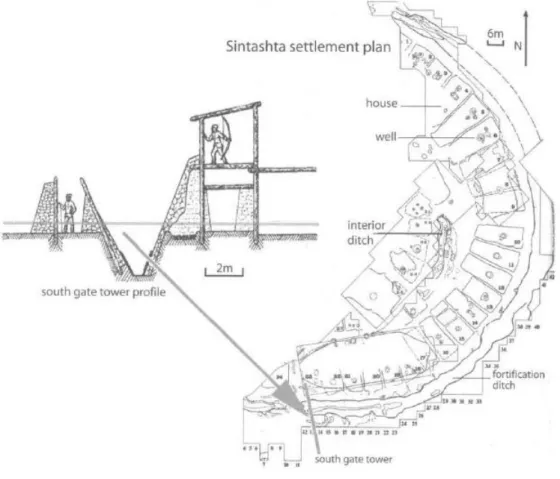
Located in the steppes southeast of the Urals, near the margins of the Sintashta River, from which it takes its name, Sintashta is a large circular town, with approximately 140m in diameter. Originally encompassing between fifty and sixty buildings41, Sintashta was surrounded by a timber reinforced earthen wall, followed by a man-tall ditch. Although small fortified settlements have been found in prior cultures (mainly Yamnaya period), Sintashta represents a new type of settlement in the steppe, mainly because of its dimensions, the extent of its fortifications, and its particular
38 Littauer and Crouwel, 1996, p.936 39 Littauer and Crouwel, 1996, p.938 40 Littauer and Crouwel, 1996, p.935
41 The ruins of 36 structures have been unearthed at Sintashta. Approximately half the settlement was
28 purpose. Fortified settlements are a clear break from traditional steppe organization (fig. 10).
Fig. 10 Sintashta settlement: layout and fortifications, after Gening et al. 1992, fig. 7 &12
The presence of fortifications denounces the intention of permanently protecting a specific location, which is a very uncommon practice amongst groups of nomads. Something pushed these groups to settle in a particular location, which was potentially desired by hostile populations, hence the need for defences.
It has been shown that groups of nomadic peoples tend to orbit towards critical locations in times of need42. When faced with low production and/or increased competition, populations tend to settle near critical resources, in order to protect them for themselves. This seemed to be the case with the Sintashta type settlements.
From c.2500 B.C onward, the climate in the Eurasian steppes became colder and more arid43. This change was felt particularly hard in the steppes east of the Urals, naturally drier and colder than the Volga steppes to the west. The increased aridity meant a significant decrease in marsh-like areas, favoured by pastoralists as winter
29 refuge, due to abundant forage. In turn, this led to a significant increase in competition for locations, prompting some groups to settle near them.
Groups of Poltavka and Abashevo pastoralists began to settle in key locations near marshlands. It is relevant that most of the Sintashta settlements, despite their obvious need for protection, were located on the fringes of the floodplains of small and medium rivers, sacrificing the added protection offered by higher ground. This shows that the primary concern of these populations was not the protection of the settlement itself, but rather the protection of the access to marshland.
Map. 1 Culture groups in the Middle Bronze Age (2800 - 2200 BC), after Anthony 2007 fig. 15.5
Even the smallest of these settlements were heavily fortified (Chernorech‟ye
III, aprox. six structures). This suggests a state of endemic warfare. It is not possible to identify one single reason for this conflict. The simplest explanation would be competition between hostile tribal groups for the same resources. However, this might not be the only reason.
30 slag from copper ore (fig.11). The great majority of bronze objects were made with arsenical bronze, avg. 1-1.25% arsenic, with only 2% of objects excavated made of tin bronze. From a mining site of Vorovskaya Yama, east of the Ural River, an estimated six thousand tons of quartezitic rock was extracted for the ground44. This intense production meant a great demand for metal. These levels of production suggest foreign trade, rather than an exclusive domestic use. That seemed to be the case.
The shift in production visible in Late Bronze Age steppe settlements can be understood as part of a much broader process, which also includes South Central Asia urban complexes
Of all the bronze objects unearthed at Sintashta sites, only 2% were made of tin bronze. The reason for this is the extreme scarceness of tin throughout the old world. However, tin was one of the most important commodities in Near East and Mesopotamia.
Fig. 11 The furnaces of Sintashta settlements 1,3,4 - Arkaim, 2 – Sintashta from S.A.Grigoryev, The
Investigation of Bronze Age Metallurgical Slags of the Sintashta Culture in the Southern Ural, Southern Ural Branch of History and Archaeology Institute UB of the Russian Academy of Sciences, Chelyabinsk, Russia
The origin of the tin imported to the Near East and Mesopotamia is still under debate. J. E. Dayton45 lists several possible locations for the sources of tin traded in the
31 Near East, and concludes that it lies in Europe. That might have been the case, considering Europe had vast deposits of tin or copper ore with high percentages of tin. However, this poses a problem. By the author‟s own admission, most of the European sites were not explored by the end of the 3rd millennium46. On the other hand, evidence suggests that significant quantities of tin were imported to Anatolia and the Near East from the east, not the west. This does not mean that there was no tin being imported
from Europe, but that there was another source available.
After 2000 B.C., tin was exported to Anatolia from northern Syria, while Mari imported its tin from Anshan and Susa, in Elam47. Although the source of the northern Syrian tin is not known, it is possible that it might be the same as in Mari. An alternative source for tin is the Indus valley cities of Mohenjo-Daro and Harappa. About 30% of tested bronze object found in Mohenjo-Daro and Harappa were made of tin bronze; despite in low percentages (70% had a 1% tin to a 99% copper ratio). Tin bronzes were found in sites in Oman, in the Arabian Peninsula, in conjunction with other imports from the Indus48. This opens the possibility that some of the tin used in Mesopotamia and Near East had its origin in the Indus Valley.
However, this also raises a problem: neither Elam nor the Indus valley cities had significant tin deposits available. Therefore, one must conclude that they also imported tin from elsewhere. The most probable origin for the tin imported by Elam and Mohenjo-Daro and Harappa is the Zeravshan River valley, where the oldest known tin mines were found. Evidence shows the existence of links between this region and Sintashta type steppe cultures, at least since c.2100 B.C. In upper Zeravshan, cheek-pieces, found in a burial site at Zardcha-Khalifa, are direct copies of the ones found in Sintashta. Furthermore, a closer link can be found between the two regions. Ceramic found at the settlement of Tugaj is very similar to the one seen in Petrovka culture sites, a variant of Sintashta culture in Northern Kazakhstan49. However, that which might be the best evidence regarding the exchanges between both cultures are the appearance of horses and horse motifs in the southern urban societies after c. 2000 B.C. This matter will be discussed later in this chapter.
Considering that many settlements seem to have been abandoned around 2000 BC, most notably the sites of Sarazm and Zaman Baba, some authors have suggested an
32 actual migration of steppe peoples to this region at the time50. That might have been the case. Prior to c.2000 B.C., bronze objects found at Bactria-Margiana Archaeological Complex (BMAC) tended to made with arsenical bronze, while other metal objects were made of either unalloyed copper or a 8-10% lead copper alloy. However, after 2000 B.C. tin bronze became much more common in BMAC sites, reaching over 50% of the objects in some cases. However, this is true only in Bactrian sites. In Margiana sites, tin bronze remained a rare commodity51. This might be explained by the proximity between Bactrian sites and the Zeravshan river valley. This allows for two different conclusions. First, considering that no tin was found in Zeravshan sites before the 2nd millennium B.C., it is possible to conclude that the mines began to operate c. 2000 B.C., closely after the establishment of Sintashta steppe cultures in northern Kazakhstan and shortly before the appearance of Petrovka culture pottery in the region. Secondly, there was direct trade between Bactrian BMAC towns and Zeravshan settlements.
Considering that the BMAC towns had extensive contacts with both the Iranian Plateau and with the Indus Valley, a possible tin trade route emerges. Tin gathered at Zeravshan river valley, either by Petrovka miners, or at the very least, by populations with close contact with Sintashta-type cultures, was transported to the south, through BMAC towns, until it reached either Elam or Mohenjo-Daro and Harappa. This places the steppe cultures of southeast Urals at the beginning of an important trade route. This explains the major shift in production, as well as the extreme specialization, observed in Sintashta-type settlements in the early 2nd millennium B.C. By c. 2100 B.C., Sintashta sites were no longer herding settlements, but heavily fortified, highly specialized, metallurgical military complexes.
As mentioned earlier, the initial stimulus for permanent settlement came from the need to secure critical resources in a time of scarceness, brought by climatic change. Between 2100 and 1800 B.C. more than 20 fortified settlements were created between the Ural and Topol rivers52. The high proliferation of settlements indicates fierce competition for the available resources, while the presence of fortifications suggests that numbers alone were not enough to protect a certain location. These circumstances indicate a change in warfare. Traditionally, steppe warfare between nomadic groups was
33 limited to cattle raiding and tribal skirmishes. However, if that was the case in the Sintashta period, the concentration of several groups in one settlement would be sufficient to deter any further hostilities, and thus, render the fortifications unnecessary. However, that was not the case. Not only were the settlements heavily fortified, there is evidence that there is fierce competition between hostile groups, not for the control of the settlement itself, but for its location. G. B. Zdanovich and I. M. Batanina53 have demonstrated that newly-arrived populations preferred to raze previous settlements and then proceed to build on the same location, rather than build a new settlement in a new location: “It is interesting to note that it would have seemed preferable for the newly arrived population to build a new fortified center in a new site, even if it is near the old one. However, this did not happen. The bearers of the new geometrical symbols ruined the old structures with their own buildings and intentionally crossed them to create their
own original settlement landscape”54. This shows that, despite its impressive
fortifications, there were warring groups strong enough to take and destroy an entire settlement. This was an age of fully-fledged conflict: “«Squares» demonstrate an especially «hostile» attitude towards «ovals» and «circles». The destroyed circumferences are at the bottom of the cultural layers of the square settlements Rodniki, Stepnoe, Ustye, probably Kamysty, and Chekatai. Aerial photographs show the imposition of different defence systems and help to suggest the succession of changes in the settlements planning schemes”55
The necessity to control key locations in order to secure access to critical resources, combined with a constant flow of wealth originating from long-distance metal trade, made possible the formation of alliances and the gathering of large groups of warriors, thus creating a vicious circle of escalation in conflict, which in turn led to an exponential increase in the intensity of warfare.
The state of intense warfare, fuelled by a constant flow of wealth, became the breeding grounds for new customs, new tactics, and new weapons. This increase in conflict can be seen in the Sintashta culture graves. For the first time in the region, large deposits of weapons are found buried next to human remains. Earlier burials seldom displayed weapons, and in the rare cases when that happened, mainly in Abashevo
53Zdanovich and Batanina, 2002 54 Zdanovich and Batanina, 2002, p. 124 55 Zdanovich and Batanina, 2002, p. 124
34 graves, it was limited to a single axe or projectile weapon. In contrast, in Sintashta culture graves, a great number of different weapons can be found, as well as numerous projectile points. At the same time, the frequency of weapons burials increased drastically. David Anthony suggests an increase from less than 10% of all graves containing weapons in earlier Bronze Age cultures, to a maximum of 54% of adult graves in Sintashta culture graves56.
Another clear indicator of increased conflict is the emergence of new weapons. This development in armaments can best be seen in projectile points. Older lanceolate arrowheads with flat bases became longer. A new type of projectile-stemmed point appeared, consisting of a long (avg.4-10cm long) blade with a thick medial ridge. Being stemmed, it was probably used in javelins rather than in arrows, as mentioned before. Besides these projectile points, a new type of socketed spear head, made of bronze or copper and heavier than its predecessors was also found57. Because of its mass and weight, this spearhead might have been used in close combat rather than as a throwing weapon.
In this period of martial technological development, the war chariot might have arisen.
According to Littauer and Crouwel, the war chariot is a superfluous artefact in the steppe, mainly because of the existence of a more suitable alternative, the horse. That might have been the case in conventional tribal warfare, consisting on occasional skirmishes and cattle raids. This type of conflict is characterized by small and quick engagements. Rather than being used as a weapons platform, the horse was probably used to create a surprise element, and later a swift retreat. In comparison with modern-day horses, Bronze Age horses were little more than sturdy ponies. While some could carry a man, they certainly could not endure the hardships of battle. They could not carry a fully armoured warrior for long periods of time, and being an animal with a fight or flight response heavily geared towards flight, in the case of mares and geldings, or of extreme aggression, in the case of stallions; it would be extremely difficult to manage in any sort of formation or tactical use. While this was no serious drawback in earlier tribal warfare, when the horse served as transportation to light-armoured warriors, during the Sintashta period, where large-scale battles were fought between large groups of
35 organized, and judging by their graves, heavily-armed troops, the horse simply could not be used effectively in the battlefield. It was possible to use it as a mount, but it
wasn‟t possible to use it as cavalry.
It is reasonable to expect that Sintashta warriors were aware of the horses‟
potential as a weapon. However, a way to circumvent its natural limitations had to be found before horses could be used to full effect on the battlefield. The chariot is the solution to this problem.
Therefore, the war chariot, rather than a superfluous object in the steppe, is a much-needed war machine that allowed horses to be deployed on the battlefield, during a time where large-scale conflict was endemic. At the time, the necessity was far greater on the steppe than in the Near East, thus providing a stimulus for its local development.
That seems to have been the case. The discrepancy (fig.12) in size of known steppe war chariots has been interpreted by Littauer and Crouwel as a sign of its inadequacy as a war machine, discarding them as imitations of Near Eastern ones. However, these discrepancies, if anything, suggest experimentation with a new technology, rather than imitation of an already-established one.
Fig. 12 Gauge discrepancies in different steppe chariots after David W. Anthony, Dorcas R. Brown, The
Secondary Products Revolution, Horse-Riding, and Mounted Warfare


![Fig. 8 a)"Mycenaean chariot krater [Mycenaean] (74.51.966)". In Heilbrunn Timeline of Art History](https://thumb-eu.123doks.com/thumbv2/123dok_br/15863321.663286/28.892.140.740.108.459/fig-mycenaean-chariot-krater-mycenaean-heilbrunn-timeline-history.webp)