Submitted on: 29.09.2017
1
Public libraries' contribution to Sustainable Development Goals: gathering
evidences and evaluating practices
Leonor Gaspar Pinto
CHAM, FCSH, Universidade NOVA de Lisboa, Universidade dos Açores and Commission for Citizenship and Gender Equality, Portugal
Paula Ochôa
CHAM, FCSH, Universidade NOVA de Lisboa, Universidade dos Açores, Portugal
Copyright © 2017 by Leonor Gaspar Pinto and Paula Ochôa. This work is made available under the terms of the Creative Commons Attribution 4.0 International License:
http://creativecommons.org/licenses/by/4.0
Abstract:
Initiated in November 2016, the project Public Libraries and Sustainability: Gathering Evidences of Contribution to SDGs (Project PLS) aims to develop a framework for evaluating public libraries’ contribution to Sustainable Development Goals (SDGs) and tailor it to Portuguese public libraries. This paper discusses the role of impact evaluation practices and competencies in evidence gathering and advocacy processes of libraries’ contribution to the UN 2030 Agenda, focusing on the Project first stages.
After presenting the research background and general methodological frame, the relevant approaches, methods and tools for assessing libraries’ contribution to SD are examined, particularly the impact evaluation perspective. The resulting Model for Evaluating Public Libraries Contribution to SDGs is discussed, as well as the alignment process with SD goals and national priorities through the SDG# Mapping Tool.
Finally, some key aspects of the ongoing research are presented.
Keywords: Public libraries; Sustainable Development Goals; Impact evaluation; Methods; Portugal.
Introduction
Despite being an old concept shaped by evolving contexts (Kidd, 1992; Giovannoni &
Fabietti, 2013), sustainability (or sustainable development1) has become a buzzword over the
last two decades nurtured by the discussion about man-made global warming and resource protection.
1 Although some researchers argue that there is a conceptual difference between sustainable development
and sustainability, in line with Gray (2010) and Giovannoni & Fabietti (2013), we use these concepts
The most commonly quoted definition of sustainable development2 stresses the meeting of
needs and puts a clear focus on intergenerational equity along with responsibility in a broad sense. In September 2015, the adoption by United Nations Member States of the 2030 Agenda for Sustainable Development (UN, 2015) set the global, national and local framework for putting that responsibility into action. Achieving the 17 Sustainable
Development Goals (SDGs) and the 169 targets will mean that “No one was left behind”, but
it will also reflect the progressive and cumulative engagement of countries, communities, sectors, public and private organizations and citizens in this process. Within this quest for global sustainable development, the Library and Information Services (LIS) sector should be a key-partner and active contributor. To be recognized as such by stakeholders, the LIS sector
needs to promote libraries’ role as development agents, namely by gathering evidences and
evaluating their contribution to SDGs implementation.
In this context, in November 2016, a team of researchers of the Faculty of Social Sciences and Humanities of Universidade Nova de Lisboa (Portugal), willing to “think globally, but
act locally” and looking for an answer to the question How can public libraries gather evidences and evaluate their contribution to Sustainable Development Goals?, initiated a research project entitled Public Libraries and Sustainability: Gathering Evidences of Contribution to SDGs (Project PLS). The Project PLS aims to develop a Framework for Evaluating Public Libraries Contribution to SDGs and tailor it to Portuguese public libraries. As recommended by the report Worth their weight: an assessment of the evolving field of library valuation (Imholz & Arns, 2007), the project strategy intends to strengthen library advocacy efforts through evidence-based results and a comprehensive research agenda that
promotes systematic valuation of libraries’ contributions, conceptual models and analytical tools to make a unified and full case for public libraries (Koufogiannakis & Brettle, 2016).
This paper aims to respond to these needs and, where possible, translate them into productive suggestions for future research and to ongoing strategies of evaluation alignment processes.
1. Background and general methodological frame
Since 2012, at the Faculty of Social Sciences and Humanities (UNL), researchers have been pursuing a line of research that intersects LIS performance evaluation with sustainability
transitions management3 and competences development. During 2013 and 2014, this
intersection was put into practice in co-creation workshops on Building a sustainability
assessment framework, targeted at students of LIS courses. These interdisciplinary
experiences led to the (co)definition of a draft conceptual framework for assessing the sustainability and impacts of LIS, which was further consolidated (Ochôa & Pinto, 2014) and expanded by introducing ISO 16439 (2014) and media and information literacy evaluation perspectives (Ochôa & Pinto, 2015).
2Published in 1987, the Brundtland Report states that “Sustainable development is development that
meets the needs of present without compromising the ability of future generations to meet their own needs”
(World Commission on Environment and Development, 1987, p. 43).
3 Transitions are complex and long-term processes comprising multiple actors and changes, also
comprising the study of unsustainable systems (Grin et al., 2010). The inclusion of the information sector
should be viewed as a tool to help foster sustainability transitions. Nolin (2010) considered three constitutive
parts of information for sustainable development: development of sustainable information technology;
development of sustainable information conservation; and development of sustainable information sharing.
3
The intensification of IFLA’s advocacy initiatives towards global sustainability after 2013 (e.g.: IFLA statement on libraries and development, 2013; Lyon Declaration, 2014), the international adoption of the post-2015 Development Agenda in September 2015 and the
release in June 2016 of the Final list of proposed Sustainable Development Goal indicators
(UN, 2016) made clearer the need to provide LIS community with methods and tools for measuring and evaluating its contribution to sustainability. These initiatives are being reproduced since 2016 at national level by the participation of BAD - the Portuguese Association of Librarians, Archivists and Documentalists in IAP (International Advocacy Programme), addressing sustainability issues in several partnerships (namely FEBAB), events (seminars and regional meetings) and specialised webinars.
Evaluation Research and Evidence Based Theoryprovided the general frame for Project PLS.
The research question was addressed through a methodology eminently qualitative supported by the combination of two principal methods - literature review and construction / application of conceptual models and tools for analysis.
The Project PLS is structured along five principal stages: (1) Identification of relevant approaches, methods and tools for measuring and evaluating LIS contribution to sustainable development; (2) Alignment with SD goals, targets and indicators (3); Framework for Evaluating Public Libraries Contribution to SDGs; (4) Pilot test (group of Portuguese public libraries); (5) Final report. During the first stage, the literature review process was complemented with a questionnaire that made the diagnostic of Portuguese public libraries involvement in SDGs international, national and local initiatives.
2. Libraries and sustainability: approaches and methods of evaluation
Within the broad corpus of sustainable development and sustainability evaluation, the literature review on the LIS / Sustainability topic and further application of an analytical tool led to the identification of three main approaches: one, aimed at greening libraries and reducing their environmental impact; other, anchored on culture as the fourth pillar of sustainability, largely driven by UNESCO; and another centred in libraries’ contribution to global (sustainable) development goals, fostered by IFLA. Although these strains of thought and practice are frequently interrelated, for analytical purposes they were separated.
In what specifically concerns the intersection of LIS with evaluation and sustainability, the corpus analysis showed that adopting an impact assessment perspective would provide us with adequate model, methods and procedures for gathering evidences on LIS contribution to
SDGs. Within this broad corpus, two approaches stood out:
• D. Streatfield & S. Markless’ model of library impact evaluation (Markless & Streatfield,
2006) and, particularly, the Impact Planning and Assessment (IPA) Road Map developed
for the Bill e Melinda Gates’ Global Libraries initiative (GL) (Streatfield & Markless,
2009; Global libraries…). In 2013, the GL approach produced a Common Impact
Measurement System (CIMS) based on data collected by grantees public libraries
(Streatfield, Markless & Cottrill, 2015) and latter a public library impact data hub – Data Atlas (Schrag et al., 2015).
• ISO 16439 (2014) –Methods and procedures for assessing the impact of libraries, which
Avoiding the discussion about the conceptual distinction between evaluation and
assessment4, we considered both as synonymous, referring to the process of determining the
merit or value of something or the result of that process. In line with ISO 16439, impact is here defined as “the difference or change in an individual or group resulting from the contact
with library services” (2014, p. 4). So, LIS impact evaluation is the process of gathering impact evidence of benefits that have stemmed or changes on individuals, institutions and/or society, resulting from library services or products.
As Streatfield & Markless (2009) emphasise, change is the essential element of impact:
changes in individuals’ knowledge and skills, attitudes and perceptions or behaviour or
broader social or economic change. GL IPA Road Map suggests six principal areas (dimensions) where public access to information in libraries can make a difference: Culture and leisure, Education, Communication, Economic development, Health and Government and Governance (e-Government). Later, CISM added one more area: Digital inclusion (Schrag et al., 2015). In the IPA process, data is collected using two related measurement systems: Performance Metrics (PMs) – 21 required and 2 optional indicators, that measure technology and services provided; and CIMS – 41 required and 53 optional indicators, that intend to measure impact on the lives of people. Within this assessment process, evidence
“…can be any type of information piece of data that people use to help them answer a question (…) It becomes evidence when you use it to build a case about the impact of public
libraries” and an indicator “…is a specific statement against which achievement or progress
can be quantitatively measured” (Global libraries…, p. 8-9)
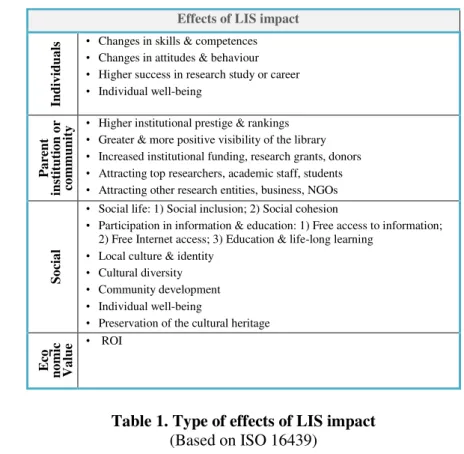
ISO 16439 presents a set of methods and procedures for assessing the impact of LIS considered to be the most heavily used and that have proved to be most effective for that purpose. The type of effects of LIS impact is synthetized in Table 1.
Table 1. Type of effects of LIS impact
(Based on ISO 16439)
4 See, for instance, Streatfield & Markless (2009, p. 135).
Effects of LIS impact
Ind
iv
id
u
a
ls • Changes in skills & competences • Changes in attitudes & behaviour
• Higher success in research study or career
• Individual well-being
Pa
re
n
t
in
stitu
tio
n
o
r
co
m
m
u
n
ity
• Higher institutional prestige & rankings
• Greater & more positive visibility of the library
• Increased institutional funding, research grants, donors
• Attracting top researchers, academic staff, students
• Attracting other research entities, business, NGOs
S
o
cia
l
• Social life: 1) Social inclusion; 2) Social cohesion
• Participation in information & education: 1) Free access to information; 2) Free Internet access; 3) Education & life-long learning
• Local culture & identity
• Cultural diversity
• Community development
• Individual well-being
• Preservation of the cultural heritage
Ec
o
n
o
m
ic
Va
lu
5
In most of the cases, LIS impact cannot be captured directly, so it can be collected in the following ways:
“- inferred through
- output data (e.g. attendance at events; levels of service use; results of examinations);
- library performance indicators;
- user satisfaction levels;
-solicited (through questionnaires, interviews, focus groups, or other methods for
requesting information or opinion);
- observed (through structured observation; informal observation; self-recording; tests).” (ISO 16439, p. 21)
Frequently, the combination of different methods provides a richer set of findings, leading to a better understanding of LIS impacts.
3. Model and tools for evaluating public libraries’ contribution to SDGs
By incorporating this impact assessment perspective into the PLS project, we considered that
evidences of public libraries’ contribution to SDGs should be collected through impact assessment methods that could be aligned with sustainable development goals and targets. In this context, the contribution concept plays a leading role: on one hand, it emphasises the focus on goals (SGDs) and on the other, it embodies the assumption that public libraries in general, like the grantees using GL IPA Road Map, have “…contributed to the changes
identified and (…) [have] ‘added value’ but there may be other influences involved so we do not seek to prove causal relationship.” (p. 136)
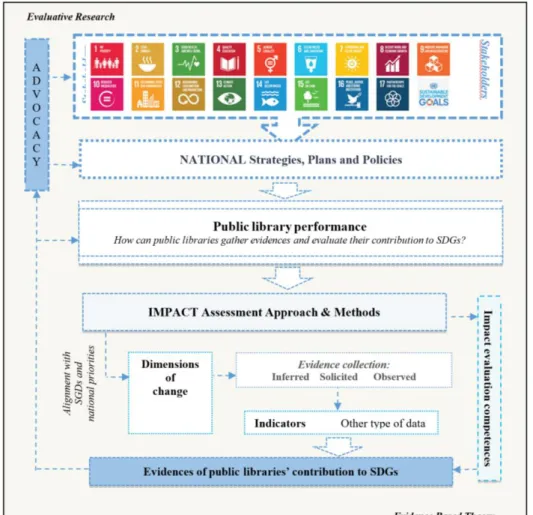
The impact assessment perspective was the cornerstone of the Model for Evaluating Public Libraries Contribution to SDGs represented in Figure 2. Being driven by an evidence based approach, this Model also emphasises an aspect that is crucial for the assessment process: the existence of adequate evaluation skills. Build on previous research on impact evaluation competences for cultural organizations (Ochôa & Pinto, 2016), the essential competences for implementing the PLS assessment framework were identified and grouped around six domains: Reflexive practice, Technical practice, Situational analysis, Management, Interorganizational and Interpersonal.
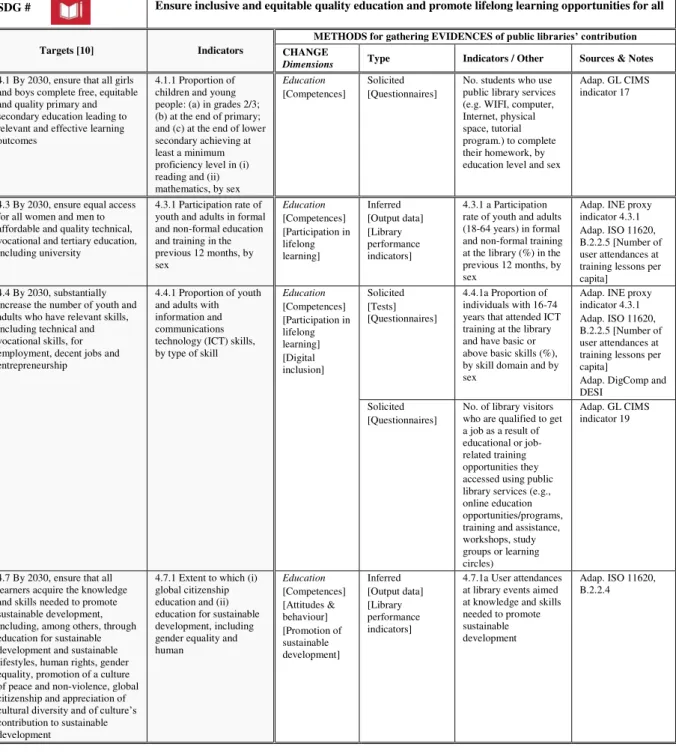
For the alignment with SD goals and national priorities, we created a SDG# mapping tool with six columns, organized in two groups: SDG # - Targets and Indicators; Evidences of Public Libraries’ contribution – Change Dimensions; Type [of method]; Indicators / Other [methods], Sources/Observations. When planning the mapping process, we prioritized the analysis of those SDGs and targets that were aligned with present Portuguese strategic priorities towards the 2030 Agenda, namely SDGs 4, 5, 9, 10, 13 and 14 (Portugal, 2017).
Figure 3 exemplifies this process by presenting the results of SGD 4 mapping. It should be noted that all targets were thoroughly analysed even though this figure only shows those that will be integrated into the framework for evaluating public libraries’ contribution to SDGs.
In what specifically concerns the methods for gathering evidences about public libraries’
contribution to education / digital inclusion, we found the SDG indicator associated with target 4.4 too narrow: by focusing on ICT skills, it leaves out other “relevant skills, including
technical and vocational skills, for employment, decent jobs and entrepreneurship”.
Considering the EU context and the growing influence of DigComp – the Digital
years that can perform ICT related tasks (%), by type of task (annual)”5– was adapted to
comply with the SD target and DigComp’s five domains (Information and data literacy, Communication and collaboration, Digital content creation, Safety and Problem solving) (Vuorikari, R. et al., 2016).
Fig. 1. Model for Evaluating Public Libraries Contribution to SDGs
5This indicator refers to the 2014 survey on ICT usage by households and individuals (INE. Objetivos de
Desenvolvimento Sustentável. Available at: -
7
SDG # Ensure inclusive and equitable quality education and promote lifelong learning opportunities for all
Targets [10] Indicators
METHODS for gathering EVIDENCES of public libraries’ contribution CHANGE
Dimensions Type Indicators / Other Sources & Notes
4.1 By 2030, ensure that all girls and boys complete free, equitable and quality primary and secondary education leading to relevant and effective learning outcomes
4.1.1 Proportion of children and young people: (a) in grades 2/3; (b) at the end of primary; and (c) at the end of lower secondary achieving at least a minimum proficiency level in (i) reading and (ii) mathematics, by sex
Education [Competences]
Solicited [Questionnaires]
No. students who use public library services (e.g. WIFI, computer, Internet, physical space, tutorial program.) to complete their homework, by education level and sex
Adap. GL CIMS indicator 17
4.3 By 2030, ensure equal access for all women and men to affordable and quality technical, vocational and tertiary education, including university
4.3.1 Participation rate of youth and adults in formal and non-formal education and training in the previous 12 months, by sex Education [Competences] [Participation in lifelong learning] Inferred [Output data] [Library performance indicators]
4.3.1 a Participation rate of youth and adults (18-64 years) in formal and non-formal training at the library (%) in the previous 12 months, by sex
Adap. INE proxy indicator 4.3.1 Adap. ISO 11620, B.2.2.5 [Number of user attendances at training lessons per capita]
4.4 By 2030, substantially increase the number of youth and adults who have relevant skills, including technical and vocational skills, for employment, decent jobs and entrepreneurship
4.4.1 Proportion of youth and adults with information and communications technology (ICT) skills, by type of skill
Education [Competences] [Participation in lifelong learning] [Digital inclusion] Solicited [Tests] [Questionnaires]
4.4.1a Proportion of individuals with 16-74 years that attended ICT training at the library and have basic or above basic skills (%), by skill domain and by sex
Adap. INE proxy indicator 4.3.1 Adap. ISO 11620, B.2.2.5 [Number of user attendances at training lessons per capita]
Adap. DigComp and DESI
Solicited [Questionnaires]
No. of library visitors who are qualified to get a job as a result of educational or job-related training opportunities they accessed using public library services (e.g., online education opportunities/programs, training and assistance, workshops, study groups or learning circles)
Adap. GL CIMS indicator 19
4.7 By 2030, ensure that all learners acquire the knowledge and skills needed to promote sustainable development, including, among others, through education for sustainable development and sustainable lifestyles, human rights, gender equality, promotion of a culture of peace and non-violence, global citizenship and appreciation of
cultural diversity and of culture’s
contribution to sustainable development
4.7.1 Extent to which (i) global citizenship education and (ii) education for sustainable development, including gender equality and human Education [Competences] [Attitudes & behaviour] [Promotion of sustainable development] Inferred [Output data] [Library performance indicators]
4.7.1a User attendances at library events aimed at knowledge and skills needed to promote sustainable development
Adap. ISO 11620, B.2.2.4
Fig. 3. SDG# mapping tool
4. Final remarks: relevant aspects that might become learned lessons
Some aspects that might become learned lessons are worth mentioning:
• If there is already a national alignment and monitoring system of indicators, whenever possible, for the stated goals and targets we should use the national indicators, wrapping it in a public library focus and integrating it in the library performance evaluation system. We should also add other specific indicators that can provide stakeholders with evidences of public libraries contribution to the Agenda 2030. In this context, we recommend:
-Better leverage of existing data among the statistical agencies to allow for the consistent estimation of the contributions;
-Increase access to data, in order to facilitate more robust libraries evaluation research; -Identification of gaps in impacts data and how they might be filled;
-Convene international workshops/forums to discuss evaluation drivers, impediments
and enablers.
• Since many of the SDG indicators are targeted at specific age groups and/or sex, breaking down data by group age and sex is a useful guiding principle.
• Being in UE Member-State, Portuguese public libraries should pay attention to the final
list of EU SDG (European System of Sustainable Development Indicators – EU SDI set),
which will be annually monitored from 2018 onwards.
• In specifically in what concerns the education and digital inclusion areas, using
DigComp as reference for assessing public libraries’ contribution to digital competences
development will be imperative. Since 2015, DigComp is used in the EU for self-assessment and curriculum development (Europass) and in the construction of the Digital Skills Indicator, which is part of the Digital Economy and Society Index (DESI).
Finally, it is important to mention that to raise awareness of the role they can play in the next years, public libraries need to show proof of their contribution to UN 2030 Agenda and the SDGs by measuring and gathering evidences of their performance, namely in what concerns access to information and knowledge, access to ICT infrastructures and media and literacy
competences development. At the same time, library workers’ participation and engagement in the ongoing advocacy process must be boosted by providing them with adequate sustainability evaluation competences.
References
Antonelli, M. (2008). The Green Library Movement: an overview and beyond.
Electronic Green Journal, 1(27). [Accessed 11 may 2017]. Available at:
http://escholarship.org/uc/item/39d3v236.
Giovannoni, E.; & Fabietti, G. (2013). What is sustainability? A review of the concept and its applications. In Busco, C. et al. (eds.) - Integrated reporting: concepts and cases that redefine corporate accountability. Springer International Publishing.
Global libraries impact planning and assessment guide. [S. d.]: Bill & Melinda Gates
Foundation. Available at:
http://www.publiclibraryadvocacy.org/wp-content/uploads/2015/06/IPA-Guide-2015.pdf.
Gray, R. (2010). Is accounting for sustainability actually accounting for sustainability... and how would we know? An exploration of narratives of organisations and the planet. Account Org Soc, 35(1), p. 47–62.
Grin, J., et al. (Eds.) (2010). Transitions to sustainable development: new directions in
9
Hauke, P.; Latime, K.; & Werner, K. U. (2013). The green library – die grüne
Bibliothek: the challenge of environmental sustainability. Berlin/Munich: De Gruyter Saur,
2013.
IFLA (2013). IFLA statement on libraries and development (August 2013). [Accessed 5
May 2017]. Available at:
https://www.ifla.org/files/assets/alp/statement_on_libraries_and_development.pdf.
IFLA (2015). Libraries and implementation of the UN 2030 Agenda. [The Hague]:
IFLA. [Accessed 12 May 2017]. Available at:
https://www.ifla.org/files/assets/hq/topics/libraries-development/documents/libraries-un-2030-agenda-toolkit.pdf.
Imholz, S.; & Arns, J. W. (2007). Worth their weight an assessment of the evolving field of library valuation. New York: ALA. [Accessed 30 May 2017]. Available at:
http://www.ala.org/research/sites/ala.org.research/files/content/librarystats/worththeirweight. pdf.
ISO 16439 (2014). Methods and procedures for assessing the impact of libraries.
Kidd, C. V. (1992). The evolution of sustainability. Journal of Agricultural and Environmental Ethics. 5(1), p. 1-26.
Koufogiannakis, D.; & Brettle, A. (Ed.) (2016). Being evidence based in library and information practice. London: Facet.
Markless, S.; & Streatfield, D. (2006) - Evaluating the impact of your library. London: Facet Publishing.
Nolin, J. (2010). Sustainable information and Information Science. Information
Research, 15(2) paper 431. [Accessed 30 May 2017]. Available at:
http://InformationR.net/ir/15-2/paper431.html.
Ochôa, P.; & Pinto, L. G. (2014). Sustainability metrics in library and information
services: a quality management framework. Proceedings of the IATUL conferences. Paper 5.
[Accessed 30 May 2017]. Available at:http://docs.lib.purdue.edu/iatul/2014/plenaries/5. Ochôa, P.; & Pinto, L. G. (2015). Sustentabilidade e medição de impactos em
organizações: o papel dos indicadores de literacia mediática, comunicação e cidadania. In S. Pereira & M. Toscano (Eds.) (2015). Literacia, Media e Cidadania - Livro de atasdo 3.º
Congresso. Braga: CECS,p. 408-420. [Accessed 30 May 2017]. Available at:
http://www.lasics.uminho.pt/ojs/index.php/cecs_ebooks/article/viewFile/2252/2169.
Ochôa, P.; & Pinto, L. G. (2016). Cocriação de valor e aprendizagem colaborativa em organizações culturais: os desafíos, as práticas e as competências necessárias para a
avaliação de impactos. Paper presented at Congresso Internacional Redes de cooperação
cultural transnacionais: um olhar sobre a realidade lusófona [Proceedings] (Braga, 15-16 November).
Schrag, T. et al. (2015). Building a public library impact data hub: a Global Libraries
“Data Atlas” for storytelling, strategy development, and collaboration. In IFLA General
Conference and Assembly, Cape Town, 2015 - Dynamic libraries: access, development and
transformation. [Accessed 21 May 2017]. Available at: http://library.ifla.org/1272/. Streatfield, D.; Markless, S. (2009) –What is impact assessment and why is it
important? Performance measurement and metrics.10(2), p.134-141.
Streatfield, D.; Markless, S.; Cottrill, J. (2015). Gathering and using systematic evidence of public library service outcomes and of public perceptions of libraries to secure sustainability: the Global Libraries experience In IFLA General Conference and Assembly,
Cape Town, 2015 - Dynamic libraries: access, development and transformation. [Accessed
UN (2015). Transforming our world: the 2030 Agenda for Sustainable Development. Resolution adopted by the General Assembly on 25 September 2015. [Accessed 13 May 2017]. Available at:
http://www.un.org/ga/search/view_doc.asp?symbol=A/RES/70/1&Lang=E.
UN (2016). Final list of proposed Sustainable Development Goal indicators. Annex 4
of the Report of the Inter-Agency and Expert Group on Sustainable Development Goal Indicators (E/CN.3/2016/2/Rev.1). [Accessed 5 May 2017]. Available at:
https://sustainabledevelopment.un.org/content/documents/11803Official-List-of-Proposed-SDG-Indicators.pdf.
Vuorikari, R. et al. (2016). DigComp 2.0: the Digital Competence Framework for
Citizens. update Phase 1: the conceptual reference model. Publications Office of the
European Union. [Accessed 25 May 2017]. Available at:
http://publications.jrc.ec.europa.eu/repository/bitstream/JRC101254/jrc101254_digcomp%20 2.0%20the%20digital%20competence%20framework%20for%20citizens.%20update%20pha se%201.pdf.
World Commission on Environment and Development (1987). Our common future.
Oxford: University Press.
Portugal (2017). National report on the implementation of the 2030 Agenda for
Sustainable Development: Portugal. Voluntary National Review presented at the United
Nations High-level Political Forum on Sustainable Development: July 2017 – New York.
Available at: