FRETTED AND NON-FRETTED STRING INSTRUMENTS
V. Debut(1,2), J. Antunes(1,2), P. Vaz de Carvalho(3)
(1) Instituto de Etnomusicologia, M´usica e Danc¸a, Faculdade de Ciˆencias Sociais e Humanas, Universidade Nova de Lisboa, 1069-061 Lisboa, Portugal
(2) Centro de Ciˆencias e Tecnologias Nucleares, Instituto Superior T´ecnico, Universidade de Lisboa, Estrada Nacional 10, Km 139.7, 2695-066 Bobadela LRS, Portugal
(3) Instituto de Etnomusicologia - Centro de Estudo de M´usica e Danc¸a, Universidade de Aveiro, 3810-193, Aveiro, Portugal
PACS 43.75
Abstract
Vibrato is part of the subtle musical expressions frequently used by musicians to convey emotions during musical performance. Physically, it is a low-frequency modulation superimposed to the pitch of a musical tone, which has a strong perceptual role as it also affects the overall frequency spectrum. Obviously, the playing technique differs according to the instruments. For bowed string instruments, it is performed by changing periodically the string singing length through a rocking motion of a finger on a string. However, for fretted instruments such as guitars, vibrato is different because the frets impose the acoustic length of the string. Classical guitarists therefore push and pull the string periodically to modify the string tension, thereby altering the pitch. In this paper, we extent our modal-based sound synthesis techniques developed for string instruments to provide a physical model of fretted and non-fretted instruments with vibrato playing. Vibrato is introduced on a physical basis, by including cyclic variations of either the string tension or the position of artifical fingers constraining the string locally, and no numerical artefact is included. The modeling work exploits the benefits of the modal approach, which especially appears adequate to handle the variations in string tension as an external pseudo-excitation. We briefly present our time-domain numerical model for the plucked string problem, and then address the implementation issues. The cases of a both vibrato techniques are considered, and extension of the model to include nonlinear geometrical effects is presented based on the Kirchoff-Carrier equations, since it considers the nonlinearity coming as change of the string tension. Finally, an attempt is made to compute the sound radiation by convolution, combining the computed force exerted by the string at the bridge with a measured vibro-acoustic impulse response. Results stemming from numerical time-domain simulations are presented to illustrate the rationale and efficiency of the approach.
1
Introduction
waveguide representation [2] are certainly very efficient for simulating the sound of musical instruments, but when the parameters of the system are varied continuously as for reproducing a glissando or a vibrato, several aspects of the real physics can be blurred to overcome numerical difficulties. For instance, the manner of altering the pitch of a note by changing the length of the resonator is certainly accurate in the sense of matching in the actual tuning of a note, but physically, it remains different from what musicians do by constraining the string by a finger or by closing a tonehole. Simulating a vibrato in waveguide modeling is also known to be prone to numerical artefacts such as disturbing clicks and aliasing, and signal processing techniques are usualy required to lessen such undesirable effects [3].
Among the range of methods developed to address physically-based synthesis of musical instruments, modal techniques are well-known to be capable of closely reproducing the observed physics. There is no difficulty in including various physical processes which occur during wave propagation, namely dissipation and dispersion, and it is straightforward to incorporate any physical force into the modeling in terms of an external pseudo-excitation. At the computational level, the numerical implementation to obtain the actual solutions is also very efficient. By describing the spatial dependence of the solutions in terms of well-defined modes, the modal discretisation of the PDEs leads to a set of ODEs from which the time-varying amplitude of each mode is solved by time-integration methods. Of course, one difficulty deals with the modal truncation which is problem dependent, but in practice the size of the modal basis can be asserted by physical reasoning for ensuring convergence of the results.
Following our extensive work on guitar string modeling [4], this paper is centered on the implementation of vibrato playing into a simple modal synthesis model of pluck tone, with the final objective of improving the realism of the sounds stemming from our time-domain simulations. To be coherent with the physics-based approach, vibrato is accounting by dynamic variations of the model parameters, and without intoducing any numerical artefact. Since vibrato is a periodic variation of the pitch of the tone, there are in practice two different ways of achieving vibrato on a string instrument, either by a change of the length of the string or a change of its axial tensioning [5]. In this paper, both cases are considered, thus encompassing the reality of fretted and non-fretted string instruments. The former case assumes an artificial finger constraining the string at a given location along the fingerboard, and uses a penalty formulation for the string/finger interaction similar to the model described in [4, 6]. Vibrato is then achieved by periodic variations of the finger position around its original location, so that the model mimics the interaction of the musician with the string. The case of vibrato for fretted instruments is addressed on a different basis, for which we consider cycling changes of the string tension, thereby reproducing the influence of the musician on the string.
The paper briefly describes the string formulation used for the implementation, which considers the pluck response of an isolated string using a modal representation of its dynamics, and then presents the computational issues for simulating the two vibrato techniques. Benefiting from the formulation obtained for the time-varying change of the string tension, we also extend the model to account for the geometrical nonlinearity of the string which is usually quite apparent in musical string. To that end, we use a simplified description of the complex 3D nonlinear behaviour of vibrating string, based on the Kirchoff-Carrier equations, which has been extensively used for sound synthesis purpose of string instruments [7, 8]. Several string responses stemming from numerical time-domain simulations are then presented to illustrate the rationale and efficiency of the approach. Finally, since the string interacts with the instrument body at a single point, an attempt is made to compute the sound radiation, by convoluting the force at the bridge computed from the modal amplitudes, with a given vibro-acoustic impulse response measured on a real-life classical guitar. This adds to the force signals the amplitude and spectral shapings provided by the radiating properties of the instrument body, and gives naturalness to the synthesised sounds.
2
Modal description of the string dynamics
Consider an ideal string of lengthL0, cross-sectional areaSand densityρ, fixed at both ends and stretched to an
axial tensionT0. The dynamics of a conservative string involving one transverse motionZ(x, t)and subjected to an
externally applied excitationf(x, t)are described by the classic set of (undamped) wave equations:
ρS∂
2Z
∂t2 −T
∂2Z
Within the modal framework, the transverse motion of the string in physical coordinates are written as:
Z(x, t) =
N X
n=1
qn(t)ϕn(x), (2)
whereqn(t)andϕn(x) = sin(nπx/L0)are the modal amplitudes and modeshapes of moden. Assuming proportional
damping and substituing (2) in (1), the forced response of the string is formulated as a set ofNsecondary-order ODEs, written in the matrix form as:
M¨q(t) +C ˙q(t) +Kq(t) =f(t) (3) where q(t) is the vector of the modal amplitudes, and M, C and K are diagonal matrices of the string modal parameters, given by:
mn=ρSL0/2, cn= 2mnωnζn, and kn=mnωn2 (4) withωnandζnthe circular eigenfrequencies and damping values of moden. Classically, the vector of the modal forces
f(t)is obtained by projection of the forcing termsf(x, t)on the string modes, according to:
fn(t) = Z L0
0
f(x, t)ϕn(x)dx (5)
Remarkably, there is no assumption regarding the nature of the external force field, which can be either linear or nonlinear. This can be particularly convenient to incorporate any string/finger interaction, either for the excitation or for altering the playing frequency [4, 9, 10], or to account for body effects for addressing the string/body dynamics [4, 10].
Finally, the mechanical coupling of string to body is given by the force exerted by the string on the bridge. It can be estimated from the modal time responsesqn(t)by modal summation as:
R(t) =−T(t)
N X
n=1
qn(t) "
∂ϕn(x)
∂x
#
x=0
=−T(t)
N X
n=1
qn(t)
nπ L0
(6)
whereT(t)is the total tension of the string.
As seen, only a single polarisation of the string is accounted in our simulations, but notice that the inclusion of the second transverse polarisation is straightforward since both motions are orthogonal on a monochord. This has been assumed in order to highlight the modulation effect of vibrato on the string response, especially when computing the sound radiation. In practice, both polarisations drive the instrument body, and the radiated sound might present an amplitude modulation due to the non-degeneracy of the string modal families caused by the bridge.
3
Modeling of time-varying and nonlinear phenomena
We now extend the basic string model presented in the previous section by including two refinements of strong perceptual relevance: (a) the possibility of performing vibrato, either by a change in tension or a change in string length, and (b) the geometrical nonlinearity of the string, which is responsible for spectral effects in the string response for large excitation amplitude.
3.1
Time-varying string tension: classical guitar-like vibrato
Since the frets impose the acoustic length of the vibrating string, classical guitarists usually push and pull the string periodically to perform vibrato [5]. That way, they slightly modify the string tension, thus altering the pitch of the note. Considering small dynamical perturbations of the string tensionTe(t)superimposed to an initial tensioningT0, the
actual string tension can read as
so that the dynamics of the string is given by the standard wave equation
ρS∂
2Z
∂t2 −T0
∂2Z
∂x2 =Te(t)
∂2Z
∂x2 +f(x, t) (8)
Clearly, in addition to the external forcing f(x, t), string motions are forced by the small-amplitude variations of tensionTe(t). The corresponding modal forcesfT
n are given by:
fT n(t) =
Z L0
0 e
T(t)∂
2Z(x, t)
∂x2 ϕn(x)dx , (9)
and by substituting the modal expansion of the string motion (2) into Eq. (9), this results in:
fT
n(t) =−Te(t) Z L0
0
N X
p=1
qp(t)
pπ L0
2
ϕp(x)ϕn(x)dx , (10)
Finally, by accouting for the orthogonality relationships between the real modesϕn, the modal forces associated with the tension variations read as:
fT
n(t) =−
n2π2
2L0
qn(t)Te(t) (11)
From Eq. (11), it can be seen that the variations in string tension affect all the string modes but do not imply inter-modal coupling. Restating Eq.(11) by including the modal force as stiffness variation in the left-hand side, it can be shown that the modal frequencies change according to the same amount given by
q
1 +Te(t)/T0). Interestingly, by assuming
time-varying variations of the string tension, the combination of the modal formulation (8) with the modal forces (11) results in a set of Mathieu-Hill equations, where the pseudo-external excitation appears as a time modification of the stiffness of each system mode. Although one expects stable oscillating regime for a plucked string, solutions of this kind of equation can become unstable for specific set of control parameters, in particular when the excitation frequency is related through an integer or fractional multiple of the string natural frequencies, resulting in parametric resonance phenomena [11]. However, knowing that typical frequency for vibrato is about 5 Hz [12], such a problem of instability disappears for the treated application, the fundamental frequency of the lowest string mode of a guitar being of 82 Hz. In practice, we did not encounter any stability problem in our computations.
3.2
Time-varying string length: violin-like vibrato
For violin-like instrument, vibrato is produced by periodically changing the length of the string through the rocking action of the finger on the fingerboard. Similarly to what is proposed in [6, 10], this can be reasonably modeled by constraining the string locally, using an artificial finger which moves around a given location on the fingerboard. That way, the model closely reproduces the actual action of the musician with his instrument and no numerical artefact is introduced since the string length used to define the modal basis remains that of the original unconstrained system.
The finger/string interaction force, occuring at locationxf, can be expressed using a penalty formulation, imposing a null and near-zero displacement of the finger and the string respectively, and introducing two suitable coupling constantsKf andCfas:
fF(x
f, t) =−KfZ(xf, t)−CfZ˙(xf, t) (12) or, in a modal framework:
fF(x
f, t) =−Kf N X
n=1
qn(t)ϕn(xf)−Cf N X
n=1
˙
Projecting the force interaction on the string modes, the corresponding modal forcesfF
n can be written as:
fF n(t) =
Z L0
0
fF(x
f, t)ϕn(x)dx=fF(xf, t)ϕn(xf) (14)
then resulting in,
fF n(t) =
"
−Kf N X
p=1
qp(t)ϕp(xf)−Cf N X
p=1
˙
qp(t)ϕp(xf) #
ϕn(xf) (15)
and where inter-modal coupling between the string modes is evidenced by the cross-product of the string modesϕpϕn. It is then straightforward to achieve vibrato from Eq.(15) by changing the finger position with respect to a given modulation. A more realistic finger/string interaction model can account for the finite width of the finger, by assuming a constraint of the form of (15) applied at a number of points. In the present case, we used 3 points at locations
xf1 = xf, xf2 = xf +W/2, andxf3 = xf +W, withW the finger width, which simultaneously move on the
fingerboard during vibrato.
3.3
String geometrical nonlinearities
From the point of view taken to derive the equations for guitar-like vibrato, it is felt that the modal approach can also handle the simplified model for nonlinear vibrating strings derived by Kirchhoff and Carrier [13]. The model relies on the assumption that the nonlinearity comes from quasi-static variations of tension associated with the net increase in string length related to transverse motions, so that a similar framework as presented in Secion 3.1 can be used to include geometrical nonlinear effects.
According to the Kirchhoff-Carrier model, the effect of the nonlinearity is included as a dynamical tensionTdyn(t) superimposed to the original tensioning of the stringT0, computed by a spatial average of the square of the string slope
as:
Tdyn(t) =
ES
2L0 Z L0
0
∂Z(x, t)
∂x
2
dx (16)
and which can be restated with the use of the modal expansion (2) to yield:
Tdyn(t) =
ESπ2
4L2 0
N X
n=1
n2q
n(t) 2
!
(17)
Substituting Eq. (17) into (11), the non-linear mode-coupling geometric forces are finally expressed as:
fNL
n (t) =−
ESπ4
8L3 0
n2
N X
m=1
m2qm(t) 2
!
qn(t) (18)
where one can note the presence of cubic terms of the string transverse amplitudes, which couple the string modes nonlinearly. If the derivation of (18) is very similar to (11), it must be noticed that there is a net difference between the two cases. While the modal force drives the string modes at a slow frequency during tension-change vibrato (typically 5 Hz), note that string motions are now forced at the frequency rate of the string modal responses, thus resulting in a very different kind of modulation between the two cases. Other distinguished feature comes from the linear and nonlinear dependences of the tension variations which also lead to different inter-modal energy transfers.
4
Numerical time-domain simulations
4.1
Computational parameters
The string considered is a standard guitar E-string, tuned to the fundamental frequency 82.2 Hz, with a tension of
densityρS= 5.25×10⁻³kg.m−1. A number of 60 modes is considered for the modal basis, covering the frequency
range up to 5000 Hz, and for simplicity, modes are assumed harmonic, with a modal damping value of 0.1%.
Regarding the excitation, the string is assumed to be plucked by a finger or a plectrum, at locationxe= 10 cm from the bridge. The string/finger interaction is expressed using a penalty formulation similarly to Eq. (12), given by:
fe(t) =
−Ke h
Z(xe, t)−Ze(t)
i
−Ce h
˙
Z(xe, t)−Z˙e(t)
i
(19)
whereZ(xe, t)is the string displacement at the string/finger contact point,Z˙(xe, t)the corresponding velocity,Ze(t) andZ˙e(t)are the finger displacement and velocity at the excitation location. The coupling parametersK
e andCe depend on either excitation is provided by a finger (lowKeand highCe) or by a plectrum (highKeand lowCe). A plectrum will be assumed in the present computations, usingKe= 106N/m, andCe= 1 Ns/m. Since the string/finger interaction is local, the corresponding modal force to be included in Eq. (5) are simply given by:
fe n(t) =f
e(t)ϕ
n(xe) (20)
whereϕn(xe)is the mode shape amplitude at the excitation location. The string is assumed to be pulled during 10 ms until reaching the position (ze
s0) and is then released to vibrate freely by assuming a null excitation force for later times.
A very simple model for the dynamic variations of the string tension or finger position is considered. It is assumed to vary according to a sinus function, using two parameters such as
e
V(t) =avsin(2πfvt) (Vstands for Teor xf) (21)
whereavandfvare the amplitude and frequency of the vibrato respectively. In the simulations, both parameters are kept constant but any kind of tension modulation can be handled to closely reproduce any kind of vibrato used by players. The duration of the entire simulation is 10 s, and dynamic variations are assumed to start at timet= 250 ms and end att= 8.85 s. Following Erkut et al. [12], the vibrato rate is assumed in the range [1-5] Hz, with variations in pitch up to 3 Hz. Vibrato for violin-like instrument is achieved similarly, and variations of the finger position are calculated in order to achieve the same effect on the frequency as obtained by changes in tension.
The sounding frequency of the simulated tone is 99 Hz, therefore imposing the stopping fret (or first finger) location at 0.54 m from the bridge. As already mentioned, a total of three artificial fingers is used in the computations, assuming coupling constants ofKf = 106N/m andCf= 1 Ns/m for the fret (or first finger), while values of 105N/m andCf= 10 Ns/m are considered for the two more distant fingers. For the time-step integration of the modal ODEs, a discrete version of the direct integration method has been implemented as presented in [4], using a convenient time-step of 10−6s. For initial conditions, all string modal displacements and velocities are null at timet= 0.
4.2
Simulations of guitar-like and violin-like vibrato techniques
The first computations presented in Figures 1 and 2 pertain to a plucked string computed for two configurations, with and without vibrato. In these computations, the string is plucked with amplitude ofze
s0 = 2mm, and vibrato is
assumed to be performed through dynamical changes of the string tension. Tension variations are calculated to produce frequency excursions of 3% of the played note frequency, with a vibrato rate offv= 5 Hz, thereby representing a rather deep and fast vibrato for guitar players.
0 2 4 6 8 10 −1
0 1 2x 10
−3STRING TRANSVERSE MOTION AT EXCITATION POINT
Z (x
e
,t) [ m ]
0.2 0.25 0.3 0.35 0.4 0.45 0.5 0.55 0.6
−1 0 1 2x 10
−3
Time [ s ]
Z (x
e
,t) [ m ]
Without vibrato with vibrato
Figure 1: String motion. Vibrato is performed by variations of string tension.fv= 5 Hz,av= 3 Hz.
0 200 400 600 800 1000
10−4
10−2
100
102
EXCITATION LOCATION
Frequency [ Hz ]
| Y (f) |
With vibrato without vibrato
Figure 2: Spectra of string motion. Vibrato is performed by variations of string tension.fv= 5 Hz,av= 3 Hz.
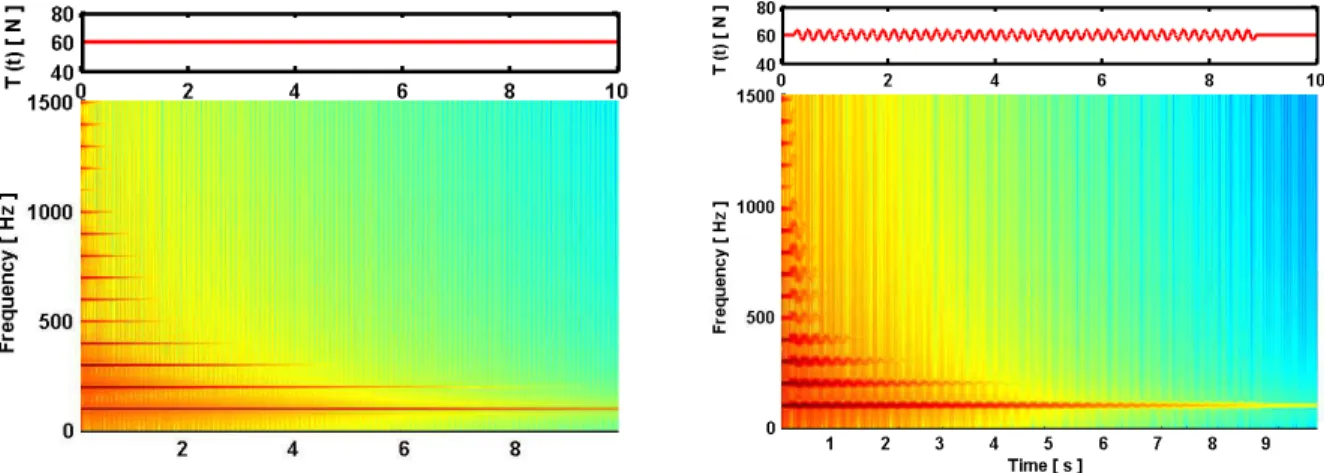
Figure 3: Spectrograms of the force exerted by the string at the bridge. Left: no vibrato; right: guitar-like vibrato.
variations increases with the frequency of the modes, with the same proportional amount, so that the internal harmonic relationships between the string modes and the periodicity of the time signal are maintained.
In Figure 4, we compare the effect of the two studied vibrato techniques on the string reponse. It shows the dynamic variations for the tension and fingers positions assumed in the computations, together with the corresponding time-varying playing frequency of the string motion, computed using a zero-cross counting technique within a moving window 0.1 s wide. It can be seen that both playing techniques result in identical frequency variations for the base frequency. The same is true for the frequencies of the higher-order string modes, so that the two vibrato techniques result in very similar excitation force at the bridge, which is responsible for the sound radiation.
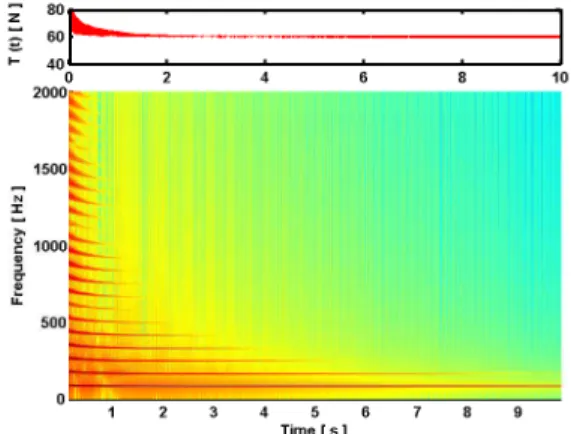
Finally, Figure 5 pertains to the tension modulation given by the Kirchhoff-Carrier string model, which describes the nonlinear behaviour of strings for large amplitude motions. Similarly to Figure 3, it shows the temporal variations of the string tension computed through Eq. (17), and the corresponding spectrogram of the support reaction at the bridge when considering a pluck with amplitudeze
s0= 0.005 m on the open stringE2. As seen, there is a net shift of
1 2 3 4 5 6 7 8 9 55
60 65
T(t) [ N ]
1 2 3 4 5 6 7 8 9 0.52
0.54 0.56
Time [ s ]
Position [ m ]
1 2 3 4 5 6 7 8 9 95
100 105
Time [ s ]
fi
[ Hz ]
Figure 4: Dynamic variations of the string tension (up) and fingers positions (middle), and corresponding instantaneous frequency of the string motion (bottom).
Figure 5: Kirchhoff-Carrier nonlinear string model. Time-history of the string tension and corresponding spectrogram of the bridge force. Pluck amplitudeze
s0= 0.005 m
the model also reproduces the spectral enrichment of the vibratory responses with the excitation amplitude, leading to a much brighter sound for large plucking excitation amplitude.
5
Simulated acoustic radiation
Generating realistic sounds of guitar plucks from the knowledge of the string behaviour imposes to incorporate the linear vibration response and sound radiation characteristics of the instrument body. To address the mechanical coupling of the string to the body, a rigorous simulation must account for the bidirectional interaction between the two subsystems, which continuously exchange energy back and forth, thereby altering the string modal parameters. This approach has recently been successfully implemented by the authors in a thorough modeling work of the 12-string Portuguese guitar [4]. However, in this work, we decided to adopt a simpler approach since our interest is focused on the computation of the sound radiated using the convolution algorithm. We then assume that the influence of the body vibration is somewhat included into the values of the string modal damping.
The vibro-acoustic impulse response of a real-life guitar was measured by impact testing. Measurements were performed on a Giannini classical guitar, with a hand-held hammer and a condenser microphone to record the sound radiation (see Figure 6). Excitation was applied in the perpendicular direction of the soundboard, on a miniature force sensor (Kistler type 9211) glued on the bridge, close to the string/bridge interaction point. The acoustic pressure was measured at one point, at a distance of 40 cm from the central axis of the guitar. Measurements were performed in a quiet room, and all strings were damped in order to isolate the body behaviour. Signals were recorded at sampling rate of 51200 Hz, during 3s. Impulse responses were computed by inverse Fourier Transform of the complex transfer functions, built from the vibratory excitation and acoustic response signals described in the frequency domain. A typical impulse response obtained during measurements is plotted in Figure 7, with the corresponding transfer function. In the time-domain, the sound radiated can be computed by convolution, according to:
p(xm, t) =hZ(xb, xm, t)∗RZ(xb, t) (22)
where hZ(xb, xm, t) is the vibro-acoustic impulse response of the instrument body, measured at the microphone location xm, considering an excitation perpendicular to the soundboard and close to the bridge location xb, and
RZ(xb, t)is the force exerted by the string on the bridge.
Figure 6: Measurement of the vibro-acoustic response of the tested guitar. Global view (left), impact testing measurement (right).
0 0.05 0.1 0.15 0.2 0.25
−2000 0 2000
Time [ s ]
h(t) [ 1/N ]
0 1000 2000 3000 4000 5000
10−2 100
Frequency [ Hz ]
| H (
ω
) | [ 1/N ]
Figure 7: Vibro-acoustic impulse response (up) and corresponding transfer function (bottom).
0 2 4 6 8 10
−1 −0.5 0 0.5 1
RADIATED PRESSURE
Time [ s ]
p(t) [ Arbitrary Unit ]
0 1000 2000 3000 4000 5000
10−5 100 105
Frequency [ Hz ]
| P(f) |
0 2 4 6 8 10
−1 −0.5 0 0.5 1
RADIATED PRESSURE
Time [ s ]
p(t) [ Arbitrary Unit ]
0 1000 2000 3000 4000 5000
10−5 100 105
Frequency [ Hz ]
| P(f) |
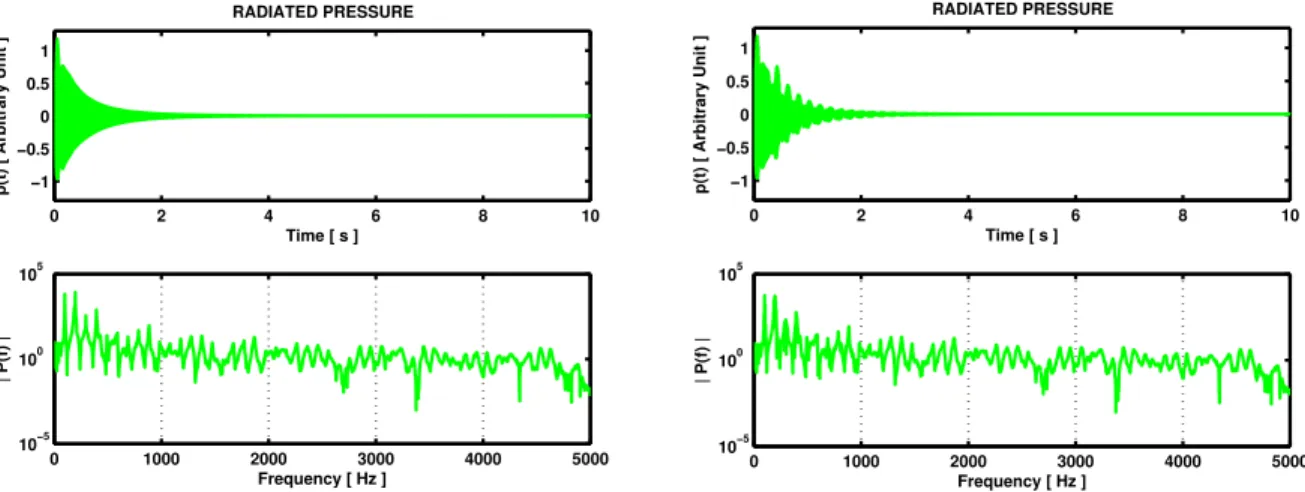
Figure 8: Computed pressure field at the microphone location. Without (left) and with (right) vibrato.
the pressure acquires a net amplitude modulation during vibrato, illustrating the influence of the radiation properties of the instrument body, which responds differently to the time-varying frequency contents of the driving force.
6
Conclusions
computational techniques [14]. Future extension of the model will include the mechanical string/body interaction in order to reproduce the frequecy-dependent decay rates of the different overtone components of the sound which has not been included in this work. This can be done following the approach presented by the authors in [4, 10] once the modal properties of the vibratory response of the instrument body are known, either experimentally or numerically.
Acknowledgments
The authors thank Lu´ıs Porfirio fromLa Casa Nostra - Audovisuaisfor his contribution to the experimental work, and Fabrice Galzin for lending the classical guitar. Vincent Debut also aknowledges support from the Fundac¸˜ao para a Ciˆencia e Tecnologia (FCT) under grant research FCSH/INET-md/UID/EAT/00472/2013.