Some Like It Hot: Camera Traps Unravel the
Effects of Weather Conditions and Predator
Presence on the Activity Levels of Two Lizards
Chris Broeckhoven*☯, Pieter le Fras Nortier Mouton☯
Department of Botany and Zoology, Stellenbosch University, Stellenbosch, South Africa
☯These authors contributed equally to this work. *[email protected]
Abstract
It is generally assumed that favourable weather conditions determine the activity levels of lizards, because of their temperature-dependent behavioural performance. Inactivity, how-ever, might have a selective advantage over activity, as it could increase survival by reduc-ing exposure to predators. Consequently, the effects of weather conditions on the activity patterns of lizards should be strongly influenced by the presence of predators. Using remote camera traps, we test the hypothesis that predator presence and weather conditions inter-act to modulate daily inter-activity levels in two sedentary cordylid lizards,Karusasaurus polyzo-nusandOuroborus cataphractus. While both species are closely related and have a fully overlapping distribution, the former is a fast-moving lightly armoured lizard, whereas the lat-ter is a slow-moving heavily armoured lizard. The significant inlat-terspecific difference in anti-predator morphology and consequently differential vulnerability to aerial and terrestrial predators, allowed us to unravel the effects of predation risk and weather conditions on activity levels. Our results demonstrate thatK.polyzonusis predominantly active during summer, when ambient temperatures are favourable enough to permit activity. In contrast, a peak in activity during spring was observed inO.cataphractus, with individuals being inac-tive during most of summer. While favourable weather conditions had a strong effect on the activity levels ofK.polyzonus, no such relationship was present inO.cataphractus. Con-trary to our hypothesis, the presence of terrestrial predators does not seem to affect daily activity levels or alter the influence of weather conditions on activity levels. We conclude that inactivity inO.cataphractusappears to be related to seasonal differences in vulnerabil-ity to predators, rather than the presence of predators, and highlight the importance of addi-tional selective pressures, such as food abundance, in determining the species’activity levels.
OPEN ACCESS
Citation:Broeckhoven C, Mouton PlFN (2015) Some Like It Hot: Camera Traps Unravel the Effects of Weather Conditions and Predator Presence on the Activity Levels of Two Lizards. PLoS ONE 10(9): e0137428. doi:10.1371/journal.pone.0137428
Editor:Daniel E. Naya, Universidad de la Republica, URUGUAY
Received:March 16, 2015
Accepted:August 17, 2015
Published:September 23, 2015
Copyright:© 2015 Broeckhoven, Mouton. This is an open access article distributed under the terms of the
Creative Commons Attribution License, which permits unrestricted use, distribution, and reproduction in any medium, provided the original author and source are credited.
Data Availability Statement:All relevant data are within the paper and its Supporting Information files.
Funding:This research was supported by incentive funding from the National Research Foundation (NRF) to PFNM and a National Geographic Young Explorers Grant (#9090-12) to CB. The funders had no role in study design, data collection and analysis, decision to publish, or preparation of the manuscript.
Introduction
Activity provides individuals with the opportunity to feed, mate and defend territories and plays a vital role in determining survival and reproductive success [1–3]. In lizards, it has been hypothesised that the time of activity is synchronised with changes in weather conditions, espe-cially ambient temperature [4–6], because the majority of physiological processes operate opti-mally near the preferred body temperature [7–9]. Field observations, however, suggest that additional selective pressures might influence daily activity levels [5,10,11]. Predation is pre-sumably the strongest selective pressure to act against continuous activity, because it entails immediate fitness loss [12]. Hence, individuals often decrease activity when predators are active or when predation pressure is high [13,14]. As a result, the influence of weather variables on activity levels should be strictly regulated by predatory pressures and activity patterns should reflect the selective advantage of the positive and negative components of activity [5,14–16]. Few studies, however, have attempted to determine whether weather conditions and predator presence interact to produce variation in foraging behaviour and/or activity. For example, Lopez-Dariaz et al. [17] showed thatAnolis sagreidid not forage near ground-level if the predatory lizardLeiocephalus carinatuswas active, despite favourable weather conditions. Nevertheless, associations between long-term daily activity levels and weather conditions, and the interactive effect of predation risk, are seldom investigated.
The lack of studies on the activity patterns of lizards can be partially attributed to the diffi-culties associated with estimating activity levels. Traditionally, activity patterns have been inferred from direct observations of activity levels recorded for a short period of time [5,11,18]. In addition to the obvious limitations, the presence of an observer could alter the behaviour of organisms or predators thereof [19,20]. Recently, camera trapping technology has been used to calculate the activity budgets of mammals (reviewed in [21,22]) and has proven to reliably estimate activity levels [23]. Camera trapping is a non-invasive and less labour-intensive method to obtain activity data than focal observations. Consequently, activ-ity patterns can be inferred from data collected from an extended continuous period of time, giving it a clear advantage over traditional observation methods. The use of camera traps in lizard studies, however, has been limited to monitor lizards (genusVaranus)[24,25] and their purpose restricted to obtaining estimates of site occupancy [24,25]. The restricted use of camera traps in lizard studies results from the fact that most lizards are relative small and therefore fail to trigger camera traps, leading to limited trapping success [26]. Moreover, liz-ards do not exhibit strong site fidelity, rendering continuous observation of individuals diffi-cult to accomplish.
ineffective against the beaks and talons of aerial predators [34,36]. Instead, light armour which allows a fast retreat to the shelter is the preferred strategy against aerial predation [34,36]. Hence, the difference in anti-predator strategy and consequently vulnerability to the two types of predators may influence the activity levels ofO.cataphractusandK.polyzonus.
In concordance with Lopez-Dariaz et al. [17], we hypothesise that predator presence and weather conditions should interact to modulate activity. We predict that the effect of weather conditions on lizard activity is different in the presence of predators than in the absence of predators. More specifically, we predict that, regardless of weather conditions, the presence of terrestrial predators will have a more negative effect on the activity levels ofK.polyzonus, com-pared toO.cataphractus, while the presence of aerial predators will have a more negative effect on the activity levels ofO.cataphractus, compared toK.polyzonus.
Materials and Methods
Study site
The study site, located 20 km north of Lambert’s Bay, Western Cape, South Africa was restricted to an isolated area of c. 0.02 km2consisting of scattered sandstone outcrops. Lei-poldtville Sand Fynbos vegetation, consisting of perennial grass (Cladoraphis cyperoides) and dwarf shrubs (e.g.Galenia africana,Zygophyllum morgsana) is present on the coastal plains [37]. This arid region falls within the winter rainfall zone of South Africa and is char-acterised by extensive vegetative ground cover (mainly annual Asteraceae) and a peak in arthropod abundance during spring (August to October), followed by a period of low arthropod availability and high ambient temperatures during summer (December to April) [38–39]. Annual rainfall is low (less than 200 mm), but the close proximity of the study site to the Atlantic Ocean (<10 km) reduces the aridity greatly. The study site was privately
owned and verbal permission was obtained from the landowners prior to the initiation of data collection.
Estimation of lizard activity and predator presence
Fig 1. Example of a camera trap photograph used to calculate activity levels.Images illustrate active individuals of the heavily armouredOuroborus cataphractus(top) and the lightly armouredKarusasaurus polyzonus(bottom).
Calculation of lizard activity levels
Each day was divided into 24 consecutive half-an-hour intervals, with each interval being rep-resented by six images. For each interval, we recorded the highest number of‘active’lizards. A lizard sitting with its body exposed outside the crevice, either mobile or immobile, was counted as‘active’. In this sense, activity included a range of behaviours, including thermoregulation, feeding, mating and territory defence. The numbers of active individuals were summed up and divided by the total number of intervals (i.e. 24) to obtain a daily index of activity. InO. cata-phractus, the total number of intervals was multiplied with the total group size in order to take the degree of sociality into account. This method allowed us to obtain an index of activity score ranging from 0 to 1, with 0 being no lizards active during the day and 1 being all lizards active during the entire day. Note that no discrimination was made between individuals within groups ofO.cataphractusas we were interested in interspecific variation in activity patterns, rather than individual variation in activity.
Meteorological data
Weather data were obtained from the Nortier weather station, 10 km south of the study site (S1 File). Weather variables included mean daily temperature, mean daily humidity, total daily rainfall, mean daily wind speed, mean daily barometric pressure and daily photoperiod.
Data analyses
Time-series analyses were performed using Eviews version 8.1 (Quantitative Micro Software, Irvine, CA, USA) to determine the effect of weather variables, predator activity and their inter-action effect on lizard activity. Prior to statistical analyses, we tested for stationarity of the data by examining each variable separately for the presence or absence of a unit root (i.e. indication of non-stationarity) using the Augmented Dickey-Fuller test. Non-stationary time-series indi-cate that the values increase or decrease over time. As such, they violated the assumptions of the statistical estimation theory and are unsuitable for regression analysis [41,42]. All variables, however, were stationary (S1 Table) and could therefore directly be used as input for time-series analysis.
Results
General lizard activity patterns
Despite the occurrence of missing data due to battery failure or damage to camera traps caused by livestock, lizard activity levels were recorded during 280 days (Table 1) on average per rock (S2 File). The camera trapping yielded a total of 223 860 photographs that served as input for the analyses of activity patterns. Due to the size of the rock, we were not able to reliably esti-mate the daily activity levels of the thirdK.polyzonusindividual and this individual was excluded from subsequent analyses.
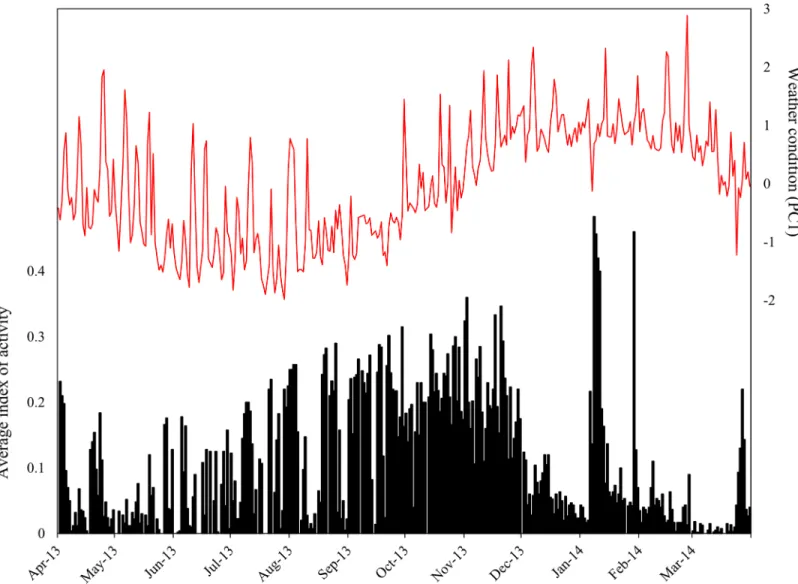
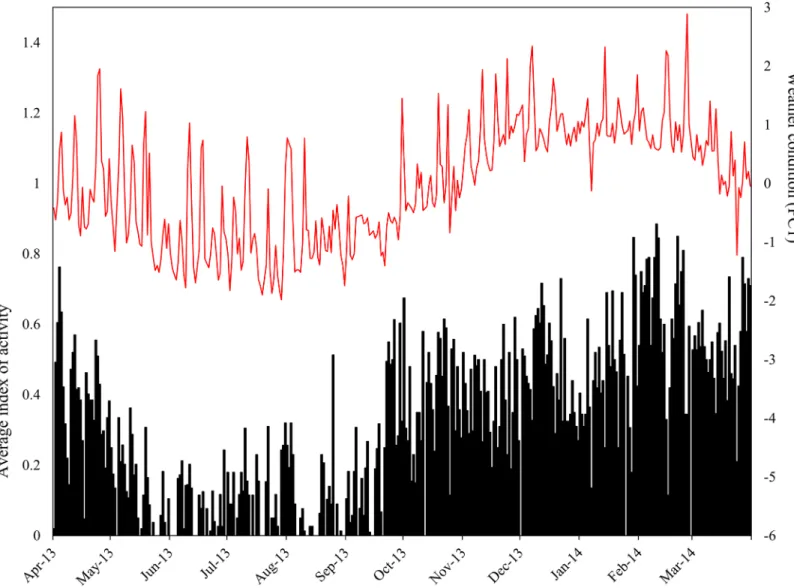
Individuals ofO.cataphractuswere predominantly active from late-August till the begin-ning of November, coinciding with spring season (Fig 2). During winter, days of inactivity and activity alternate each other, while during summer, lizards remained inactive most of the time. However, during January and March, several peaks of high activity were detected (Fig 2), coin-ciding with occasional summer rainfall. InK.polyzonus, an opposite pattern was present: activ-ity was low to absent from late autumn until spring, but increased during late spring and peaked during summer months (Fig 3).
Predator activity
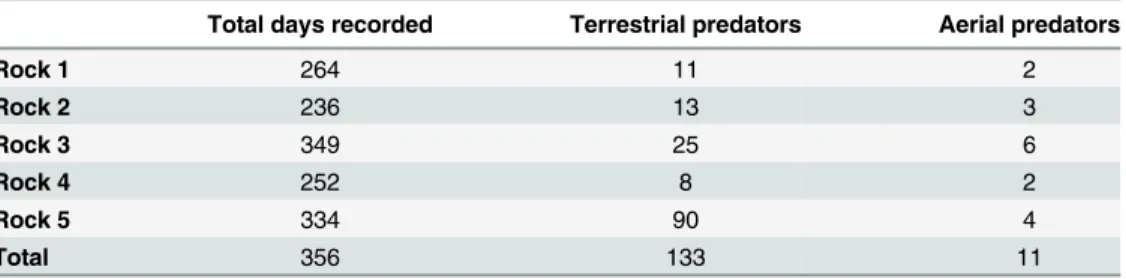
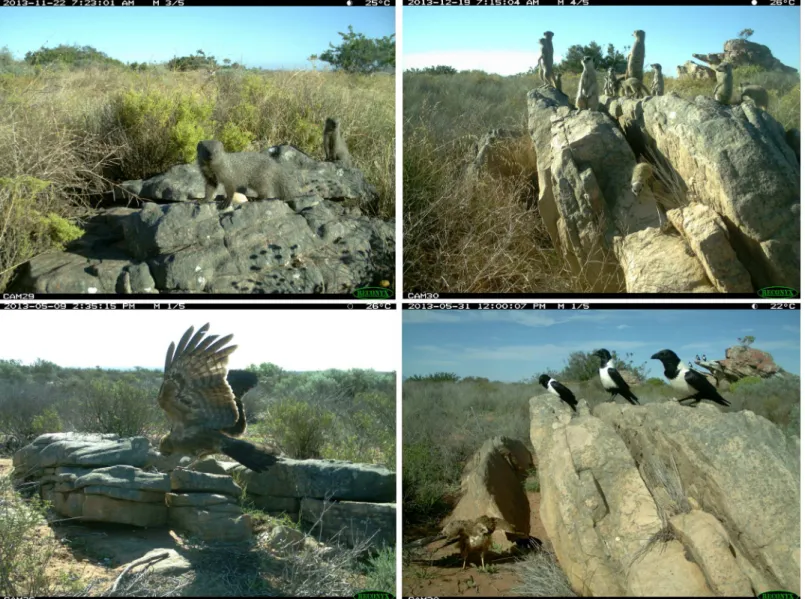
Remote camera trapping showed the presence of several terrestrial and aerial predators that can be classified as potential predators of the two species (Fig 4). Terrestrial predators were observed foraging close to lizard crevices on 122 days (Table 1), while aerial predators were detected by the camera traps on 11 days (Table 1). Small grey mongoose (Galerella pulveru-lenta) and meerkat (Suricata suricatta) were the most frequently observed terrestrial predators, while the African harrier-hawk (Polyboroides typus) and pied crow (Corvus albus) were the aerial predators that visited the lizard rocks.
Effects of weather conditions and predator presence on activity levels
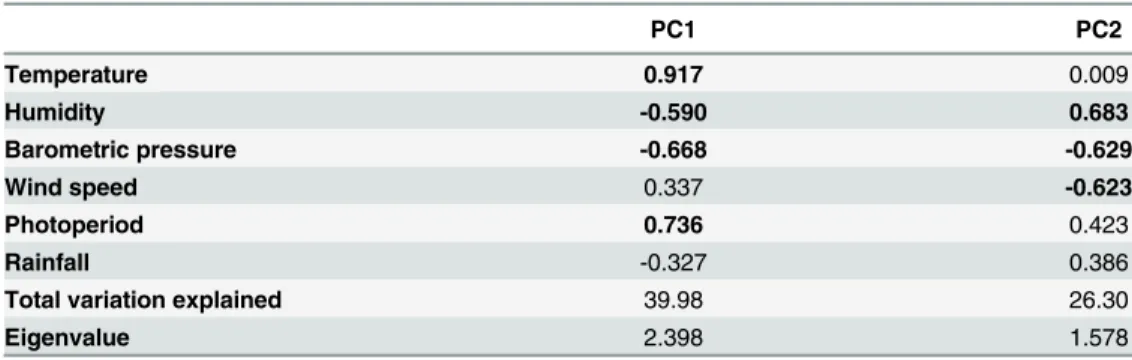
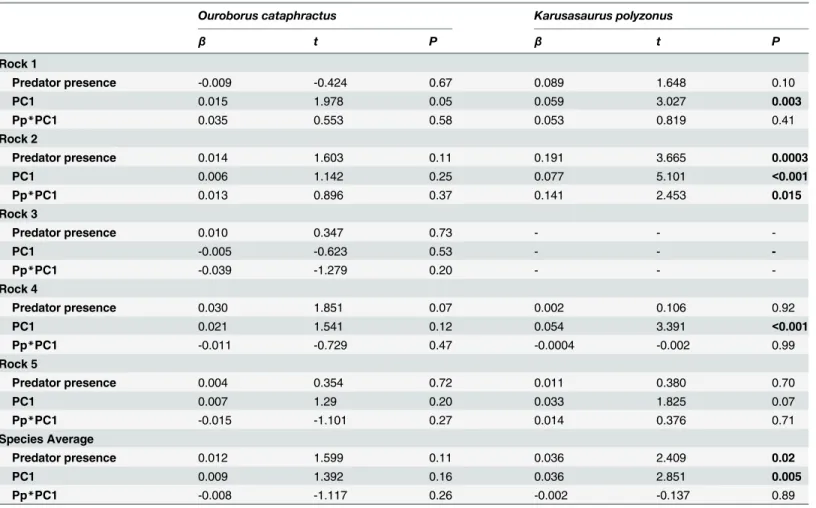
Due to the low frequency of aerial predator occurrence (Table 1), all time-series analyses were limited to terrestrial predators. The ordinary least squares analysis showed that favourable weather conditions (represented by PC1;Table 2,S2 Table) had a strong positive effect on the activity levels ofK.polyzonus, but not on the on the activity levels ofO.cataphractus(Table 3, S2 Table). The presence or absence of terrestrial predators did not affect the influence of weather conditions on activity (all interaction effects:P>0.05;Table 3,S2 Table). A significanteffect of predator presence and interaction effect was present inK.polyzonusindividual 2 (Table 3,S2 Table), but this is most likely due to the low number of camera trapping days (Table 1).
Table 1. Frequency of visits by terrestrial and aerial predators to lizard rocks.
Total days recorded Terrestrial predators Aerial predators
Rock 1 264 11 2
Rock 2 236 13 3
Rock 3 349 25 6
Rock 4 252 8 2
Rock 5 334 90 4
Total 356 133 11
The number of days on which terrestrial and aerial predators were detected, is indicated.
Discussion
It is widely assumed that the activity levels of lizards are regulated by favourable weather condi-tions, especially ambient temperature. [4–6]. Recent evidence, however, suggests that predation might act against continuous activity [10,11] and alter the effects that favourable weather con-ditions have on activity levels [12,17]. Using remote camera trapping, we were able to acquire long-term data on the daily activity levels of the two cordylid lizardsOuroborus cataphractus andKarusasaurus polyzonusand test how weather variables affect activity patterns in the pres-ence and abspres-ence of predators. In contrast to our hypothesis, the prespres-ence of predators does not seem to influence the daily activity levels of the two lizard species tested in this study. Moreover, while favourable weather conditions strongly affect the activity levels ofK. polyzo-nus, this association is absent inO.cataphractus.
Fig 2. Activity pattern ofOuroborus cataphractus.A graph of the average index of activity plotted against weather condition (represented by PC1)
illustrates that the activity levels ofO.cataphractusare not determined by favourable weather conditions.
Influence of predation on activity levels
Several selective pressures, including predation [5], have been proposed to induce inactivity in lizards. Although prey respond to the presence of a predator by fleeing into the nearest refuge [44], our results show that neither the daily activity levels, nor the influence of weather condi-tions on activity appear to be affected by the presence of predators. Yet, despite the high occur-rence of terrestrial predators in the area, it must be noted that our camera trapping
methodology might not have provided us with a representative idea of the presence of aerial predators. Hence, our results do not allow us to exclude a possible effect of aerial predation on activity levels. For example, during summer, a lack of vegetative cover might increase visibility to aerial predators and consequently the aerial predation risk perceived by individuals [45]. Assuming that speed is the best antipredator strategy against predatory birds [34,36], the heavily armouredO.cataphractusmight experience a higher aerial predation risk during the dry season compared to the lightly armouredK.polyzonus. Indeed, the number of attacks on stationary models ofO.cataphractusby aerial predators was significantly higher during the dry
Fig 3. Activity pattern ofKarusasaurus polyzonus.A graph of the average index of activity plotted against weather condition (represented by PC1)
illustrates that high activity levels ofK.polyzonuscoincide with favourable weather conditions (high PC1 scores).
season than during spring (seeS3 File). Consequently, the cost of activity outside the safety of the retreat site might be high inO.cataphractusduring summer, due to its vulnerability to aerial predators, and it would be advantageous for individuals to remain inactive.
The prolonged period of inactivity during summer, however, seems to be compensated for by a peak in activity during late-winter and spring. The extensive vegetation cover provided by annual plants during spring [39], might reduce visibility to aerial predators and decrease the aerial predation risk ([45],S3 File). Moreover, the protective effect of heavy armour would diminish the terrestrial predation risk [33], thereby allowing individuals to exploit the abun-dance of arthropods away from the crevice during spring and build up energy reserves for sum-mer [46]. In addition, the temporal overlap of mating [46] and intense foraging from mid-winter to spring appears to be vital for the survival ofO.cataphractus, as it would restrict over-all exposure to aerial predation to an absolute minimum [34,35]. On the contrary, high ambi-ent temperatures during summer would allow for maximal running capacity in the lightly
Fig 4. Camera trap photographs illustrating examples of terrestrial and aerial predators present in the habitat.Top: small grey mongoose (Galerella
pulverulenta) and meerkat (Suricata suricatta), bottom: African harrier-hawk (Polyboroides typus) and pied crow (Corvus albus).
armouredK.polyzonus[7,9]. Fast running, in turn, would permit prey capture outside the safety of the retreat site during summer without a significant increase in aerial predation risk. The relatively low ambient temperatures during winter/spring and high preferred body tem-perature [47] might impair running capacity and renderK.polyzonusvulnerable to terrestrial predation during this time of the year. Nevertheless, more data on foraging behaviour outside the retreat site, as well as the actual predation risk experienced by both lizard species are required to test the hypothesis that the interspecific variation in activity is related to differential vulnerability to predators.
Additional selective pressures promoting inactivity
An alternative explanation for inactivity is the fluctuating food abundance in highly seasonal environments. Inactivity conserves energy, which might be beneficial when food abundance is low [5]. For instance, Ballinger & Ballinger [48] report that periods of severe food shortage underlie inactivity inSauromalus obesusandScleroporus jarrovi. Likewise, low food abundance during the dry season might explain the low levels of activity inO.cataphractus. Heavily armoured cordylid lizards appear to compensate for their reduction in running speed by remaining close to the rock shelter during general maintenance behaviour [32]. In addition, group-living behaviour evolved inO.cataphractus, presumably to provide individuals with an enhanced vigilance benefit and lower the impact of aerial predation at the retreat site [49]. Given that the species displays a sit-and-wait foraging strategy [28], intraspecific competition for similar food resources becomes a major cost for the group-livingO.cataphractus, compared to a solitaryK.polyzonus[34]. High intraspecific competition for food at the rock-crevice resulting from group-living behaviour and low food abundance during summer might thus be the main selective pressure driving inactivity inO.cataphractus[34,35]. In contrast and follow-ing the above-mentioned, favourable weather conditions would not only maximise runnfollow-ing speed, but also prey capture speed [7–9], thereby allowing the lightly armouredK.polyzonusto chase and capture prey items, despite low abundance, without an increased risk of aerial predation.
Table 2. Summary of the results from a principal component analysis performed on the weather variables.
PC1 PC2
Temperature 0.917 0.009
Humidity -0.590 0.683
Barometric pressure -0.668 -0.629
Wind speed 0.337 -0.623
Photoperiod 0.736 0.423
Rainfall -0.327 0.386
Total variation explained 39.98 26.30
Eigenvalue 2.398 1.578
Two principal components, explaining 66.3% of the total variation, were retained from the PCA analysis. Thefirst axis was used to represent favourable weather conditions. This axis was positively correlated with temperature and photoperiod and negatively with humidity and barometric pressure. This axis represents a gradient from hot dry days with a long period of sunshine typically observed during summer to cold, humid days with less sunshine characterising winter. The negative correlation with barometric pressure represents thermal lows present in arid environments during the summer. The factor coordinate correlations and eigenvalues of the variables are shown. Values in bold represent loading scores greater than 0.50.
In addition to the seasonal interspecific differences in activity levels, our results revealed two interesting patterns inO.cataphractus. Firstly, although lizards remained inactive during most of summer, the exceptionally high amount of rainfall in January resulted in several peaks in activity. Variation in precipitation could stimulate arthropod activity, including termites, especially in (semi-)arid environments [50–52]. The sudden increase in food availability might have had an overriding effect on the tendency to remain inactive, despite the increased aerial predation risk, to lower the intraspecific competition for food experienced during the dry sea-son. Secondly, even though winter was characterized by low, unfavourable temperatures, activ-ity was observed on warmer days inO.cataphractus. Truter [53] proposed that warm days during winter may promote termite activity and consequently, lizard activity and that suitable temperatures would aid in digestion of prey items [8]. It must be noted thatO.cataphractus has the lowest preferred body temperature range of all cordylids evaluated to date [47]. Although thermoregulation may be compromised in group-living individuals as a result of competition for suitable basking places [34,53], it might be an adaptation to feeding at lower ambient temperatures. Given the thermal dependence of prey capture behaviour and digestive Table 3. Summary of the results from an ordinal least squares analysis on the activity time-series.
Ouroborus cataphractus Karusasaurus polyzonus
β t P β t P
Rock 1
Predator presence -0.009 -0.424 0.67 0.089 1.648 0.10
PC1 0.015 1.978 0.05 0.059 3.027 0.003
Pp*PC1 0.035 0.553 0.58 0.053 0.819 0.41
Rock 2
Predator presence 0.014 1.603 0.11 0.191 3.665 0.0003
PC1 0.006 1.142 0.25 0.077 5.101 <0.001
Pp*PC1 0.013 0.896 0.37 0.141 2.453 0.015
Rock 3
Predator presence 0.010 0.347 0.73 - -
-PC1 -0.005 -0.623 0.53 - -
-Pp*PC1 -0.039 -1.279 0.20 - -
-Rock 4
Predator presence 0.030 1.851 0.07 0.002 0.106 0.92
PC1 0.021 1.541 0.12 0.054 3.391 <0.001
Pp*PC1 -0.011 -0.729 0.47 -0.0004 -0.002 0.99
Rock 5
Predator presence 0.004 0.354 0.72 0.011 0.380 0.70
PC1 0.007 1.29 0.20 0.033 1.825 0.07
Pp*PC1 -0.015 -1.101 0.27 0.014 0.376 0.71
Species Average
Predator presence 0.012 1.599 0.11 0.036 2.409 0.02
PC1 0.009 1.392 0.16 0.036 2.851 0.005
Pp*PC1 -0.008 -1.117 0.26 -0.002 -0.137 0.89
The relationship between each independent variable (i.e. weather condition (PC1) and predator presence) and the dependent variable (i.e. lizard activity), as well as the interaction effect between predator presence and weather condition, is shown. Statistically significantP-values are indicated in bold. Legend:β, regression coefficient;t=t-test statistic.
efficiency [8,54], a lower preferred body temperature would aid individuals in capturing and processing prey efficiently during winter and spring.
Conclusions
In summary, our results show a strong relationship between favourable weather conditions and the activity levels ofK.polyzonus, but no such relationship was present inO.cataphractus. Moreover, the presence or absence of a terrestrial predator does not seem to influence how weather variables affect the daily activity levels of the two species. Our results suggest that selec-tive inactivity inO.cataphractusmight be a consequence of increased intraspecific competition for food associated with group-living behaviour and increased vulnerability to aerial predation during summer.
Supporting Information
S1 File. DATASET. Weather conditions experienced by lizards at the Lambert’s Bay field site from 1 April 2013 till 31 March 2014.Values represent the photoperiod, daily average temperature, daily average humidity, daily average barometric pressure, daily average wind speed and total rainfall. The principal component scores resulting from a principal component analysis conducted on the weather variables are shown.
(XLSX)
S2 File. DATASET. Daily activity levels ofOuroborus cataphractusandKarusasaurus poly-zonusat the Lambert’s Bay field site from 1 April 2013 till 31 March 2014.The presence or absence of terrestrial and aerial predators is indicated.
(XLSX)
S3 File. Estimation of predation pressure during spring and summer. (DOCX)
S1 Table. Results of Augmented Dickey Fuller (ADF) unit root tests conducted on the activity time-series, principal component scores and predator presence/absence data. Sta-tionarity of the data (i.e. no increase or decrease over time) occurs when thet-statistic value is below the critical value. Statistically significantP-values are indicated in bold.
(XLSX)
S2 Table. Summary of tests for serial correlation.Durbin-Watson statistic and results from the Breusch-Godfrey Lagrange multiplier test for residual autocorrelation after inclusion of the model terms are presented. Legend: AR, autoregressive.
(XLSX)
Acknowledgments
We would like to thank Genevieve Diedericks for field assistance, Justin Harvey for statistical advice, the Engelbrecht family for allowing us to conduct research on their property and the South African Weather Service (SAWS) for supplying the weather data.
Author Contributions
References
1. Huey RB. Temperature, physiology, and the ecology of reptiles. Inn Gans C, Pough FG, editors. Biol-ogy of the Reptilia, Vol. 12: Physiological EcolBiol-ogy. New York: Academic Press; 1982. pp. 24–91. 2. Díaz JA. Breeding coloration, mating opportunities, activity, and survival in the lacertid lizard
Psammo-dromus algirus. Can J Zool. 1993; 71:1104–1110.
3. Keogh JS, Noble DW, Wilson EE, Whiting MJ. Activity predicts male reproductive success in a polygy-nous lizard. PLoS One 2012; 7:1–5.
4. Adolph SC, Porter WP. Temperature, activity, and lizard life histories. Am Nat. 1993; 142:273–295. doi:
10.1086/285538PMID:19425979
5. Rose B. Factors affecting activity inSceloporus virgatus. Ecology 1981; 62:706–716.
6. Grant BW, Dunham AE. Thermally imposed time constraints on the activity of the desert lizard Scelo-porus merriami. Ecology 1988; 69:167–176.
7. Marsh RL, Bennett AF. Thermal dependence of sprint performance of the lizardSceloporus occidenta-lis. J Exp Biol. 1986; 126:79–87. PMID:3806004
8. Van Damme R, Bauwens D, Verheyen RF. The thermal dependence of feeding behaviour, food con-sumption and gut-passage time in the lizardLacerta viviparaJacquin. Func Ecol. 1991; 5:507–517. 9. Bauwens D, Garland T Jr, Castilla AM, Van Damme R. Evolution of sprint speed in lacertid lizards:
mor-phological, physiological and behavioral covariation. Evolution 1995; 49:848–863.
10. Andrews RM. The lizardCorytophanes cristatus: an extreme“sit-and-wait”predator. Biotropica 1979; 11:136–139.
11. Lister BC, Aguayo AG. Seasonality, predation, and the behaviour of a tropical mainland anole. J Anim Ecol. 1992; 61:717–733.
12. Herczeg G, Herrero A, Saarikivi J, Gonda A, Jäntii M, Merilä J. Experimental support for the cost-benefit model of lizard thermoregulation: the effects of predation risk and food supply. Oecologia 2008; 155:1–
10. PMID:17985159
13. Lawler SP. Behavioural responses to predators and predation risk in four species of larval anurans. Anim Behav. 1989; 38:1039–1047.
14. Anholt BR, Werner E, Skelly DK. Effect of food and predators on the activity of four larval ranid frogs. Ecology 2000; 81:3509–3521.
15. Lima SL, Dill LM. Behavioral decisions made under the risk of predation: a review and prospectus. Can J Zool. 1990; 68:619–640.
16. Pitt WC. Effects of multiple vertebrate predators on grasshopper habitat selection: trade-offs due to pre-dation risk, foraging, and thermoregulation. Evo Ecol. 1999; 13:499–516.
17. Lopez-Darias M, Schoener TW, Spiller DA, Losos JB. Predators determine how weather affects the spatial niche of lizard prey: exploring niche dynamics at a fine scale. Ecology 2012; 93:2512–2518. PMID:23431582
18. Beuchat CA. Patterns and frequency of activity in a high altitude population of the iguanid lizard, Scelo-porus jarrovi. J Herpetol. 1989; 23:152–158.
19. Sugerman RA, Hacker RA. Observer effects on collared lizards. J Herpetol. 1980; 14: 188–190. 20. Kerr GD, Bull CM, Mackay D. Human disturbance and stride frequency in the sleepy lizard (Tiliqua
rugosa): implications for behavioral studies. J Herpetol. 2004; 38:519–526.
21. Bridges AS, Noss AJ. Behavior and activity patterns. In: O’Connell AF, Nichols JD, Karanth KU, editors. Camera Traps in Animal Ecology: methods and analyses. Japan: Springer; 2011. pp. 57–69.
22. Swann DE, Hass CC, Dalton DC, Wolf SA. Infrared-triggered cameras for detecting wildlife: an evalua-tion and review. Wildl Soc Bull. 2004; 32:357–365.
23. Rowcliffe JM, Kays R, Kranstauber B, Carbone C, Jansen PA. Quantifying levels of animal activity using camera trap data. Methods Ecol Evol. 2014; 5:1170–1179.
24. Ariefiandy A, Purwandana D, Seno A, Ciofi C, Jessop TS. Can camera traps monitor Komodo dragons a large ectothermic predator? PLoS One 2013; 8:e58800. doi:10.1371/journal.pone.0058800PMID:
23527027
25. Bennett D, Clements T. The use of passive infrared camera trapping systems in the study of frugivorous monitor lizards. Biawak. 2014; 8:19–30.
27. Mouton P le FN, Van Wyk JH. Adaptive radiation in cordyliform lizards: an overview. Afr J Herpetol. 1997; 46:78–88.
28. Mouton P le FN, Geertsema H, Visagie L. Foraging mode of a group-living lizard,Cordylus cataphrac-tus(Cordylidae). Afr Zool. 2000; 35:1–7.
29. Whiting MJ. Foraging mode in the African cordylids and plasticity of foraging behavior inPlatysaurus broadleyi. In: Reilly SM, McBrayer LD, Miles DB, editors. Lizard ecology: The evolutionary conse-quences of foraging mode. Cambridge: Cambridge University Press; 2007. pp. 405–426
30. Stanley EL, Bauer AM, Jackman TR, Branch WR, Mouton P le FN. Between a rock and a hard polyt-omy: rapid radiation in the rupicolous girdled lizards (Squamata: Cordylidae). Mol Phylogenet Evol. 2011; 58:53–70. doi:10.1016/j.ympev.2010.08.024PMID:20816817
31. Bates MF, Branch WR, Bauer AM, Burger M, Marais J, Alexander GJ, et al. Atlas and red list of the rep-tiles of South Africa, Lesotho and Swaziland. Pretoria: South African National Biodiversity Institute; 2014.
32. Losos JB, Mouton P le FN, Bickel R, Cornelius I, Ruddock L. The effect of body armature on escape behaviour in cordylid lizards. Anim Behav. 2002; 64:313–321.
33. Broeckhoven C, Diedericks G, Mouton P le FN. What doesn’t kill you might make you stronger: func-tional basis for variation in body armour. J Anim Ecol. 2015; 84:1213–1221.
34. Mouton P le FN. Aggregation behaviour of lizards in the arid western regions of South Africa. Afr J Her-petol. 2011; 60:155–170.
35. Shuttleworth C, Mouton P le FN, Van Niekerk A. Climate and the evolution of group-living behaviour in the armadillo lizard (Ouroborus cataphractus). Afr Zool. 2013; 48:367–373.
36. Mouton P le FN, Flemming AF. Osteoderm function in the lizard family Cordylidae. Proceedings of the Sixth International Congress of Vertebrate Morphology, Jena, Germany, July 21–26, 2001. J Morphol. 2001; 248:264.
37. Mucina L, Rutherford MC. The vegetation of South Africa, Lesotho and Swaziland. Pretoria: South Afri-can National Biodiversity Institute; 2006.
38. Desmet PG, Cowling RM. The climate of the Karoo–a functional approach. In: Dean WRD, Milton SJ, editors. The Karoo: ecological patterns and processes. Cambridge: Cambridge University press; 2004. pp. 3–16.
39. Desmet PG. Namaqualand—a brief overview of the physical and floristic environment. J Arid Environ. 2007; 70:570–587.
40. Visagie L. Grouping behaviour inCordylus cataphractus. Unpublished M. Sc. Thesis, Stellenbosch Uni-versity. 2001.
41. Granger CW, Newbold P. Spurious regressions in econometrics. J Econometrics. 1974; 2:111–120. 42. Phillips PC, Perron P. Testing for a unit root in time series regression. Biometrika. 1988; 75:335–346. 43. Durbin J. Testing for serial correlation in least-squares regression when some of the regressors are
lagged dependent variables. Econometrica 1970; 38:410–421.
44. Greene HW. Antipredator mechanisms in reptiles. In: Gans C, Huey RB, editors. Biology of the Reptilia, 16. New York: Alan R. Liss; 1988. pp. 1–152.
45. Daly BG, Dickman CR, Crowther MS. Causes of habitat divergence in two species of agamid lizards in arid central Australia. Ecology 2008; 89:65–76. PMID:18376548
46. Flemming AF, Mouton P le FN. Reproduction in a group-living lizard from South Africa. J Herpetol. 2002; 36:691–696.
47. Truter JC, Van Wyk JH, Mouton P le FN. An evaluation of daily, seasonal and population-level variation in the thermal preference of a group-living lizard,Ouroborus cataphractus(Sauria: Cordylidae). Amphibia-Reptilia 2014; 35:391–403.
48. Ballinger RD, Ballinger RA. Food resource utilization during periods of low and high food availability in
Sceloporus jarrovi. Southwest Nat. 1979; 24:347–363.
49. Hayward J. Group dynamics and anti-predatory advantages of group-living in the armadillo lizard, Cor-dylus cataphractus. Unpublished M. Sc. Thesis, Stellenbosch University. 2008.
50. Reddy MV, Venkataiah B. Seasonal abundance of soil-surface arthropods in relation to some meteoro-logical and edaphic variables of the grassland and tree-planted areas in a tropical semi-arid savanna. Int J Biometeorol. 1990; 34:49–59.
51. Vasconcellos A, Andreazze R, Almeida AM, Araujo HF, Oliveira ES, Oliveira U. Seasonality of insects in the semi-arid Caatinga of northeastern Brazil. Rev Bras Entomol. 2010; 54:471–476.
53. Truter JC. Aspects of the thermal ecology of the group-living lizard,Cordylus cataphractus: a spatial and temporal analysis. M. Sc. Thesis, Stellenbosch University. 2011. Available:http://hdl.handle.net/ 10019.1/6603.