PEDRO CARMONA [email protected]
Professor at Universitat de València, Departament de Comptabilitat – València, Spain
CRISTINA DE FUENTES [email protected]
Professor at Universitat de València, Departament de Comptabilitat – València, Spain
CARMEN RUIZ [email protected]
MsC in Auditing and Accounting from Universitat de València, Departament de Comptabilitat – València, Spain
ARTICLES
Submitted 05.08.2015. Approved 02.17.2016
Evaluated by double blind review process. Scientiic Editor: Paulo Roberto Barbosa Lustosa
RISK DISCLOSURE ANALYSIS IN THE
CORPORATE GOVERNANCE ANNUAL
REPORT USING FUZZY-SET QUALITATIVE
COMPARATIVE ANALYSIS
Análise de divulgação de risco no Relatório Anual de Governança Corporativa
utilizando fuzzy-set qualitative comparative analysis
Estudio de la divulgación de riesgos en el Informe Anual de Gobierno
Corporativo mediante fuzzy-set qualitative comparative analysis
ABSTRACT
This paper explores the necessary and suicient conditions of good Corporate Governance practices for high risk disclosure by irms in their Corporate Governance Annual Report. Additionally, we explore whether those recipes have changed during the inancial crisis. With a sample of 271 Spanish listed companies, we applied fuzzy-set qualitative comparative analysis to a database of inancial and non-inancial data. We report that Board of Directors independence, size, level of activity and gender diversity, CEO duality, Audit Committee independence, being audited by the Big Four auditing irms and the presence of institutional investors are associated with high risk disclosure. The conditions included in almost every combination are the presence of institutional investors and being audited by the Big Four. We found similar combinations for 2006 and 2012, while the analysis for 2009 showed the lowest number of causal conigurations.
KEYWORDS | Board composition, corporate governance, fuzzy-set qualitative comparative analysis, inde-pendent director, risk disclosure.
RESUMO
O presente artigo investiga as condições necessárias e suficientes das boas práticas de Governança Corpo-rativa para a divulgação de alto risco, pelas empresas, no Relatório Anual de Governança CorpoCorpo-rativa. Além disso, investigamos se tais fórmulas se alteraram durante a crise financeira. A partir de uma amostra de 271 empresas espanholas cotadas em bolsa, aplicamos uma análise comparativa qualitativa usando conjuntos Fuzzy a um banco de dados financeiros e não financeiros. Relatamos que a independência, tamanho, nível de atividade e diversidade de gênero do Conselho de Administração, a dualidade do Diretor Executivo, a independência do Comitê de Auditoria, o fato de estar sendo auditado pelas Big Four empresas de auditoria e a presença de investidores institucionais estão associados à divulgação de alto risco. As condições incluí-das em quase toincluí-das as combinações são a presença de investidores institucionais e o fato de estar sendo auditado pelas Big Four. Encontramos combinações semelhantes para os anos de 2006 e 2012, enquanto a análise de 2009 apresentou o menor número de configurações causais.
PALAVRAS-CHAVE | Composição do Conselho de Administração, governança corporativa, análise compara-tiva qualitacompara-tiva usando conjuntos fuzzy, diretor independente, divulgação de risco.
RESUMEN
Este trabajo analiza qué condiciones —relacionadas con las prácticas de buen gobierno corporativo— son necesarias y suficientes para que las empresas suministren alto contenido informativo sobre los riesgos en su Informe Anual de Gobierno Corporativo y si éstas condiciones han variado durante la crisis financiera. Para ello, sobre una muestra compuesta por 271 empresas españolas cotizadas se ha utilizado el fuzzy-set qualitative comparative analysis (fsQCA). Los resultados muestran que la independencia, el tamaño, el nivel de actividad y la diversidad de género del Consejo de Administración, la dualidad del CEO, la independencia del Comité de Auditoría, estar auditada por una de las Big Four y la presencia de inversores instituciona-les están asociados con la elevada divulgación sobre riesgos. Casi todas las configuraciones incluyen la presencia de inversores institucionales y la auditoría por una de las Big Four. Por otro lado, se observan combinaciones de condiciones similares para los años 2006 y 2012, mientras que para el 2009 el número de configuraciones causales es menor.
PALABRAS CLAVE | Composición del Consejo de Administración, gobierno corporativo, fuzzy-set qualitative comparative analysis, comité de auditoría, divulgación de riesgos.
INTRODUCTION
The main purpose of this work is to analyze whether diferent sets of mechanisms of good governance are associated with the level of irm risk disclosure in the Corporate Governance Annual Report (CGAR) and how these sets of mechanisms evolved during the period of inancial crisis in Spain. We also explore two issues typically envisaged in the corporate governance (CG) literature, such as ownership structure and whether the auditor is one of the Big Four auditing irms (Big Four).
The informative content of these inancial reports is a matter of major concern because capital markets are increasingly more demanding, and providing truthful, relevant information becomes crucial for markets’ proper functioning, i.e., current and potential investors can properly evaluate their investments based on relevant information about companies’ risk proile (Linsley & Shrives, 2006). Moreover, policy makers (Ley 31/2014) and academics
(Ho & Wang, 2008) posit that lack of transparency, excessive risk exposure, and weak governance structures have contributed to the growth of the inancial crisis. Accounting scholars have identiied a gap between actual and required information which contributed to increase volatility in the stock markets, since the accounting framework did not properly capture, measure and report the uncertainties and risks that companies were facing to allow stakeholders to adopt efective decisions (Magnan & Markarian, 2011). The lack of proper risk disclosure helped to boost and amplify the current inancial crisis (Kothari & Lester, 2012), but this has changed to some extent.
To address these weaknesses, regulatory eforts have been made in Spain in recent years (Ley de Economía Sostenible 2/2011 or Ley 31/2014), fostering the implementation of additional good governance practices in order to enhance transparency, recover investors’ trust, and raise the added-value generated by the companies, as stated by the Comisión Nacional del Mercado de Valores (CNMV) in 2015 through the Código Unificado de Buen Gobierno (Unified Good Governance Code [UGGC]). However, in our view, it remains a research question how these recommended good governance practices can prompt higher inancial information transparency.
This paper builds on the CG literature that explores the impact of good governance mechanisms on the quality of inancial information (Carcello & Neal, 2003;Pomeroy & Thornton, 2008; Pucheta-Martinez & Fuentes, 2007; Pucheta-Martinez & Garcia-Meca, 2014) and risk disclosure (Cabedo & Tirado, 2004, 2009; Deumes & Knekel, 2008;Linsley & Shrives, 2006; Oliveira, Rodrigues, & Craig, 2011; Domínguez & Gámez, 2014).
Our contribution to prior literature is twofold: Firstly, we apply fuzzy-set qualitative comparative analysis (fsQCA) a methodology
that has recently been used in the context of CG issues (García-Castro et al., 2013). The main advantage of the fsQCA method is that it explores combinatory efects among multiple CG practices, as well as the possible equiinality of diferent combinations in reaching the same outcome, and it captures the likely complexity of resulting combinations (Garcia-Castro et al., 2013). Traditional regressions follow an efects-of-causes approach in which the goal is to estimate if an individual variable has a signiicant (positive or negative) efect, net of other variables’ efects, on the dependent variable in a population of cases. We used fsQCA instead, which mostly its the causes-of-efects approach, to explore more complex pathways, i.e., combinations of necessary, suicient and minimal conditions (Vis, 2012) related with good CG mechanisms under which high risk disclosure is provided in the CGAR. Hence, we found several causal recipes related with the outcome or response variable (Woodside, 2013). These factors do not determine an event, but can ofer an evaluation of what is expected to be important for a given result to occur (Stevenson, 2013).
Secondly, we also explore how those recipes have evolved during the inancial crisis, since archival literature provides an elusive conclusion about the impact of the crisis on risk disclosure:
Probohudono, Tower, & Rusmin (2013) failed to ind a positive relationship between risk disclosure and the crisis in a sample of Asian companies.
For this purpose, we used a sample of inancial and non-inancial information related with listed companies for 2006 (a pre-crisis year), 2009 (a crisis year) and 2012 (an overcoming-crisis year). We used the risk disclosure index developed by
Cabedo and Tirado (2009) and applied the fsQCA methodology. Our results reveal that both for 2006 and 2012 there is a combination of good governance practices such as BoD’s higher independence, size, level of activity, gender diversity, and CEO duality that drives high risk disclosure. Being audited by one of the Big Four is included in every recipe associated with high informative content on risk, thus becoming a necessary condition in 2009 and 2012. We found that ownership diversity, i.e. more than ive signiicant shareholders, is neither suicient nor necessary for high risk disclosure in any of the three years analyzed (in line with Rodriguez-Perez, 2004). Conversely, the presence of institutional investors is considered as a suicient condition in every combination.
With regard to the conigurations leading to the outcome high information content of risks, the conigurations for 2009 difer signiicantly from those for 2006 and 2012; the number of required conditions for 2009 is generally lower compared to 2006 and 2012.
with good governance structures that seem to increase the transparency of inancial information, but the presence of institutional investors and a well-reputed auditor also lead to the same outcome. Hence, we conclude that good CG measures, although exhibiting diferent combinations, can foster higher quality reporting on the risk the company is facing. Therefore, our results could support recent regulatory eforts that foster good governance practices. The presence of institutional investors and being supervised by one of the international audit irms is also crucial for the outcome high risk disclosure in the CGAR.
THE SPANISH REGULATORY
FRAMEWORK OF RISK DISCLOSURE IN
THE CORPORATE GOVERNANCE ANNUAL
REPORT
In 2006, the European Directive 2006/46/CE (Art. 7) established that listed companies should mandatorily include a CG assessment in their annual report, with the inal aim of enhancing transparency and strengthening the role of the CG mechanisms. However, this requirement had already been implemented in Spain: after the recommendations issued by the CNMV (Spanish Stock and Exchange Commission) in the Olivencia Code (1997) and Aldama Report (2003), public disclosure of the CGAR became mandatory in 2003, with the enactment of Ley 26/2003. The CGAR content and structure were regulated through the Spanish Order released in 2003 (Orden ECO/3722/2003)
and the Uniied Good Governance Code of Listed Companies (UGGC) approved in 2006 (CNMV, 2006), thus covering our period of study.
Noteworthy, the core characteristics of the CGAR include: a) its voluntariness, i.e., the code adopts the “comply or explain” principle under which companies may voluntarily not follow its recommendations, although in this case they must explain such refusal; and b) binding deinitions, i.e., companies can freely decide not to follow the code’s Good Government recommendations, but their reporting must respect the underlying concepts used.
With regard to the issue under scrutiny, i.e. risk disclosure, the UGGC (2006) required the following speciications:
a. The diferent types of risk (operational, technological, inancial, legal, reputational…) the company is exposed to, including inancial or economic risks of contingent liabilities and other of-balance-sheet risks;
b. The risk level that the company deems acceptable; c. Measures in place to mitigate the impact of risk events
in case they occur;
d. The internal reporting and control systems for controlling and managing the above risks, including contingent liabilities and of-balance-sheet risks. (UGGC, 2006; Recommendation no. 49)
In recent years, good examples of the eforts of policy-makers to improve CG practices are the new requirements brought about by the Real Decreto (2010), the Ley de Economía Sostenible (2011) and the Ley 31/2014, which requires additional mandatory disclosure concerning the remuneration system of the board of directors and audit committee, among others. Additionally, the CGAR has been updated (Order ECC/461/2013) and revised (UGGC, 2015), but such relevant changes did not alter CGAR’s information content regarding risk exposure nor do they lie within our period of analysis.
LITERATURE REVIEW AND RESEARCH
QUESTIONS
Archival empirical studies on risk-informative content generally build on the literature about voluntary disclosure since this type of content is commonly issued under the “comply or explain” principle, as with the CGAR under scrutiny in this study. We identify voluntary disclosure as the quantity or quality of information that is reported beyond the minimum legal requirements (Barako, Hancock, & Izan, 2006).
This strand of research builds from Agency Theory (Jensen & Mekling, 1976), according to which the agent (manager) might decide to voluntarily provide information to the principal (shareholders), thus lessening problems of information asymmetry between the principal and the agent. Rodriguez-Perez (2004) explains that, within agency theory, this decision can be approached through diferent perspectives. Firstly, according to signal theory, choosing to issue voluntary information would signal the agent’s attitude in favor of the principal, rather than a self-interested attitude (Giner, 1997). In the same vein, Gul and Leung (2004) and Deumes and Knechel (2008) conirm that the greater the agency problems, the more voluntary information is provided by the agent. Giner (1997) and Cabedo and Tirado (2009)
found that companies with high proitability ratios are more likely to provide voluntary information in order to issue positive signals to the market. Gómez, Iñiguez, and Poveda (2006) also found that inancial analysts recommend investing in companies that seem to be more transparent due to their supplying more voluntary information. Moreover, voluntary transparency drives less capital costs (Healy & Palepu, 2001;Leuz & Verrechia, 2000; Linsley & Shrives, 2006) and less stock price spread (Healy & Palepu, 2001)
risky. In contrast, managers’ avoidance of litigation risk, in case investors feel misled by actual igures turning up not as good as what was predicted in voluntary reports, can cause managers to refrain from releasing non-required information (Deumes & Knechel, 2008). Hence, they might be reluctant to raise excessive awareness in stockholders about their performance, which could trigger higher attention and demands on the part of stakeholders.
Secondly, from the perspective of proprietary costs, reported information is not cost-free, and small and medium companies may be unable aford the issuance of voluntary disclosures. Additional concerns that may discourage voluntary disclosure involve the potential lack of proits or competitive advantage due to the use by competitors of the information voluntarily disclosed (Deumes & Knechel, 2008; Broberg, Tagesson, & Collin, 2010). Consequently, predicted cost-proit analyses drive voluntary disclosures with a poor quality of information (ICAEW, 2011).
The second strand of research on which we base the questions in our study deals with Good Government mechanisms. According to Agency Theory, the Board of Directors (BoD) mitigates agency conlicts between the principal and the agent and lessens information asymmetry problems (Fama & Jensen, 1983). Although some results do not corroborate this relationship, e.g.,
Barako et al. (2006), several empirical studies (Cabedo & Tirado, 2009; Gul & Leung, 2004; Oliveira et al., 2011;Domínguez-de la Concha & Cauzo Bottala, 2015) and the meta-results reported by Garcia-Meca and Sanchez-Ballesta (2010) conirm that board independence is positively related with voluntary disclosure.
With regard to the efectiveness of the Audit Committee (AC) in monitoring inancial reporting, meta-results from previous archival studies by Pomeroy and Thornton (2008) suggest that ACs are more efective in enhancing audit outcome (such as the issuance of a going-concern audit opinion) than in fostering some traditional measures of observed inancial reporting quality (especially high quality accruals and avoiding restatements). Moreover, the higher the number of independent members in the AC, the higher the number of restatements and abnormal accruals. The size of the BoD provides diferent results. In Spain, the Code of Good Governance recommends BoDs to have between 5 and 15 members (Recommendation no. 9) to be eicient. However,
Gisbert and Navallas (2009) failed to ind a signiicant association with the level of voluntary disclosure. Conversely, Gul and Leung (2004) found a positive relationship with our variable of interest. Nevertheless, since BoD size is associated with company size, and this variable is positively associated with the level of disclosure, we expect an association between both variables.
The Olivencia Code (Recommendation no. 10) suggested that the BoD should meet regularly. Actually, Monterrey and
Sánchez (2008) found that BoD’s level of activity is positively and signiicantly associated with earnings quality. Because we consider that risk transparency is also a measure of accounting quality, we predict a possible association between these two variables.
The separation of the roles of the Chairman and the Chief Executive Oicer is a controversial issue (Manzaneque, Priego, & Merino, 2016), i.e. under the monitoring hypothesis it may erodes the independence and efectiveness of the board (Fama & Jensen, 1983) but the accumulation of powers of two igures in a single person (CEO duality) facilitates the transmission of information, reducing coordination costs and avoiding the emergence of potential conlict of interests between the two positions (Davis, Choorman, & Donaldson, 1997).The duality of CEO and BoD president in the same person is not considered a good mechanism for the independence of the latter over the executive power. In the same vein, Gul and Leung (2004) corroborate that such duality is associated with lower levels of voluntary disclosure. Therefore, we expect to ind an inverse relation between this duality and our variable of interest.
Finally, among other measures, the aim of the Ley 3/2007 para la igualdad de mujeres y hombres 2007 is enhancing gender diversity in the BoD. To that end, the law requires, among others, that listed companies raise the proportion of women in BoDs to 40% by 2015. The UGGC also states (Recommendation no. 15) for Boards of Appointments to implement mechanisms to promote the selection of women. Such gender diversity might enhance the quality of inancial information, as well as voluntary disclosure.
In sum, we posit the following proposition:
Proposition 1: BoD’s independence, size, activity level and gender diversity, CEO duality, and Audit Committee’s independence are associated with high risk disclosure in the CGAR.
It is reasonable to expect that information asymmetry conlicts decrease when ownership concentration is higher. In the same vein, Deumes and Knechel (2008) and Broberg et al. (2010)
found a negative relationship between ownership concentration and voluntary disclosure of information. Conversely, Barako et al. (2006) identify a signiicant but positive association.
In addition, Bushee and Noe (2000) found that institutional investors are more attracted by more informative irms. In our study, we explore the converse association. Therefore, we test the following proposition:
Proposition 2: Ownership dispersion and the presence of institutional investors are associated with high risk disclosure in the CGAR.
Firms ofer more voluntary information than those audited by the remainder of public accounting irms. Hence, we propose as follows:
Proposition 3: Auditor quality is associated with high risk disclosure in the CGAR.
In sum, drawing on the indings of previous literature concerning these relationships, this study analyzes which sets of conditions explain more information content of risk factors in CGARs. We analyze every possible combination of conditions that can be drawn from the above propositions as causal sets rather than the individual impact of each single variable.
METHODOLOGY AND RESULTS
Sample and research design
We analyze a sample of Spanish non-inancial listed companies for 2006 (pre-crisis period), 2009 (crisis period) and 2012 (overcoming-crisis period) with the final aim of examining whether the combinations of CG features that prompt high risk disclosure had evolved over this period. Data were hand-collected from the CGARs available at the oicial registration iles of the CNMV and from inancial statements recorded in the SABI database. All companies but the ones in the inancial industry were selected. After dropping irms whose annual reports were not available or had incomplete information, the inal data set consisted of 271 companies.
We consider risk exposure as the possibility that a company may sufer losses because of the interaction of several internal or external factors which are currently afecting the company, due to environmental uncertainty (Cabedo & Tirado, 2004). Our variable of interest builds on Linsley and Shrives’ (2006) concept that there is risk disclosure if the user has been informed about the opportunities or perspectives of any danger, damage, or uncertainty that could impact on the company or may afect the future or the management.
Following the ICAEW (1997) risk model, we identify two broad categories of risks: external risks, mainly related with environmental issues, and internal risks. Among the latter, we distinguish between inancial risks, which directly afect monetary assets and liabilities, and non-inancial risks. At the same time, within the inancial risks subset, we employ the ive inancial risk categories disclosed in the International Financial Reporting Standard 7, i.e. exchange rate, credit, liquidity, commodities, and interest rate exposures. Within the non-inancial risks subset, we identify information related to seven exposures, i.e., operational, business, strategic, regulatory compliance, information systems, integral risk, and others.
For the sake of comparability with prior results, we use the Cabedo and Tirado (2009) scoring, i.e., we distinguish ive stages according to the level of informative content supplied by the company:
Stage 1: The company only mentions the risks it is exposed to.
Stage 2: The company describes the risks and how they afect the company.
Stage 3. The company reports a quantitative measurement of risk impact.
Stage 4. The company reports on risk management.
Stage 5. The company reports on the types of risk mitigation instruments it uses.
Every stage equals 0 if the required information is not
disclosed and 1 otherwise. Therefore, the total risk index (TR) for each company i is calculated by adding the scores of each (ive inancial and seven non-inancial) type of risk. In sum, the total score for each company ranges from 0 to 60 (a maximum
of 25 points for inancial risks plus a maximum of 35 points for non-inancial risks).
We apply fsQCA, which is built on the set-theoretic methods introduced by Ragin (1987, 2000, 2008). The fsQCA tests whether a condition or combination of conditions is necessary and/or suicient for a certain outcome. It also aims to reveal the minimal (combinations of) conditions bringing about a particular outcome
(Vis, 2012), therefore, it explores complex pathways fsQCA essentially investigates set relations, and it changes variables within and across them to ind the combinations of causal sets that better match the outcome. Sets are “fuzzy” when the criterion for membership allows objects to possess the required common property in varying degrees (Stevenson, 2013).
In our study, we explore complex combinations of conditions related to CG mechanisms and other inancial and non-inancial issues related to risk disclosure in the CGARs. In addition, thinking in terms of alternative mechanisms indicates that several causal recipes can relate to the outcome or response variable (Woodside, 2013). Besides, for studies with a moderately large-n, fsQCA has typically most to ofer (Vis, 2012).
that no statements are being made about the situations that did not occur empirically. The latter is the approach used in this study.
Outcome and conditions
To apply fsQCA, we deined the outcome as the company’s risk disclosure score. This score is estimated by applying the Cabedo and Tirado (2009) rating, which takes up a value ranging from 0 to 60, according to the risk information included in the CGAR. We, then, tested the combinations of conditions that produce this outcome.
In order to explore the associations described above, we deined the following conditions in the raw form of continuous variables:
BDSIZE = Number of BoD members
BDIND = Ratio of independent to total members in the BoD BDGEN = Ratio of women to total members in the BoD BDACT = Number of meetings per year
ACIND = Ratio of independent to total members in the audit committee
We also employed conditions through variables with dichotomy values:
II = Presence of institutional investors, which equals 1 if there are institutional investors and 0 otherwise
OD = Ownership dispersion, which equals 1 when there are more than ive diferent signiicant shareholders (with signiicant shareholders being the owners of more than 5% of total shares) CEOD = CEO duality, which equals 1 if the BoD president and the CEO are diferent persons and 0 otherwise
BIG4 = Equals 1 if the company is audited by one of Big Auditing Firms and 0 otherwise
Data calibration
Calibration implies the transformation of data into fuzzy-sets, i.e. assigning a quantitative index from qualitative data (Stevenson, 2013), which represents a procedure analogous to performing a z-scale transformation of original data (Woodside, 2013). Transforming variables into a set requires the speciication of three breakpoints: full membership to the set of interest (1), full non-membership (0), and neither in nor out of the set (with the so-called crossover point at 0.5), using appropriate criteria (Ragin, 2008).
For our purposes, the outcome is high information content in CGAR, and the breakpoints 0, 0.5 and 1 are calculated using a percentile-based approach for the total risk. Continuous variables (conditions) are transformed into fuzzy-sets by using the same percentile-based approach. With a graphical representation of these variables using histograms and their quantiles, we set the
fuzzy-set calibration breakpoints. For dummy variables, a value of one (1) indicates being fully in the set and a value of zero (0) fully out of it. Exhibit 1 displays the fuzzy-set calibration procedure for all conditions and outcomes.
Exhibit 1.
Calibration of outcome and conditions
Key Condition/outcome Calibration
Fuzzy-set calibration breakpoints
TR High information content of total risks
30th, 50th and 80th percentiles
BDIND Independent members ratio in BoD
20th, 50th and 80th percentiles
BDGEN Women ratio in BoD 40th, 60th and 90th percentiles
BDACT Number of annual BoD meetings
20th, 50th and 80th percentiles
ACIND Independent members ratio in audit committee
20th, 50th and 80th percentiles
BDSIZE Total members in BoD 20th, 50th and 80th percentiles
Crisp-set calibration
II
Institutional investors (dummy variable that equals 1 if there are institutional investors)
1 indicates fully in the set and 0 fully out of it
OD
Ownership dispersion (dummy variable that equals 1 when there are more than 5 diferent signiicant shareholders, with signiicant shareholders being the owners of more than 5% of total shares)
1 indicates fully in the set and 0 fully out of it
CEOD
CEO duality (dummy variable that equals 1 if CEO and Chairman of the BoD are represented by diferent individuals)
1 indicates fully in the set and 0 fully out of it
BIG4
Big Four accounting irms (dummy variable that equals 1 if the audit irm is Deloitte, KPMG, PriceWaterhouseCoopers or Ernst&Young)
1 indicates fully in the set and 0 fully out of it
Notes: TR refers to the outcome high risk information content disclosed in the CGAR. The other nine variables are the conditions.
Analysis of the conditions leading to high risk
disclosure
The inal aim of fsQCA is to analyze set-theoretic suiciency relations (Ragin, 2008). The suicient condition set is a subset of the outcome set. It requires the construction of the truth table, which consists of all possible combinations of causal sets and shows which combinations of causal conditions produce the outcome. For k causal sets, the truth table will have 2k rows; because this study considers 10 conditions, the total number of possible combinations is 512 (29).
We also test whether the conditions are necessary for the outcome by using the superSubset function of R package QCA. This function does not require a preselection of combinations to be tested, thus removing the risk of leaving potentially interesting results undiscovered (Dusa & Alrik, 2013).
Similarly to the assessments of signiicance and strength in analyzing correlational connections, consistency and coverage
are the two descriptive measurements used to assess fuzzy-set relations (Hsu, Woodside, & Marshall, 2013). With regard to suiciency consistency, the key question is to what degree cases are members of the conditions and the outcome in relation to their overall membership in the conditions. In connection with suiciency coverage, we investigate to what degree cases are members of the conditions and the outcome in relation to their overall membership in the outcome. Hence, if suiciency consistency is high enough, the evidence is consistent with the hypothesis that the conditions are suicient for the outcome
(Dusa & Alrik, 2013). Consistency scores are analogous to a Pearson’s r coeicient in statistical analysis; and coverage is analogous to the coeicient of determination, r2, in statistical analysis (Hsu et al., 2013).
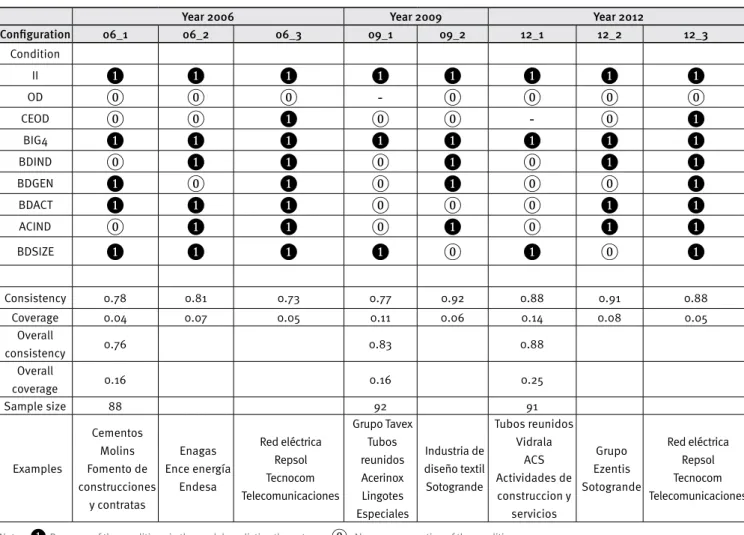
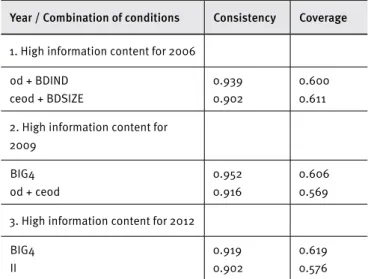
In a similar way to suiciency, we estimate necessity consistency and necessity coverage. Results of suicient conditions and their consistency and coverage indexes are shown in Table 1, while Table 2 presents data related with the necessary conditions.
Table 1.
Analysis of suicient conditions for the outcome high information content of total risk and for 2006, 2009 and 2012
Year 2006 Year 2009 Year 2012
Coniguration 06_1 06_2 06_3 09_1 09_2 12_1 12_2 12_3
Condition
II
❶
❶
❶
❶
❶
❶
❶
❶
OD
⓪
⓪
⓪
-
⓪
⓪
⓪
⓪
CEOD
⓪
⓪
❶
⓪
⓪
-
⓪
❶
BIG4
❶
❶
❶
❶
❶
❶
❶
❶
BDIND
⓪
❶
❶
⓪
❶
⓪
❶
❶
BDGEN
❶
⓪
❶
⓪
❶
⓪
⓪
❶
BDACT
❶
❶
❶
⓪
⓪
⓪
❶
❶
ACIND
⓪
❶
❶
⓪
❶
⓪
❶
❶
BDSIZE
❶
❶
❶
❶
⓪
❶
⓪
❶
Consistency 0.78 0.81 0.73 0.77 0.92 0.88 0.91 0.88
Coverage 0.04 0.07 0.05 0.11 0.06 0.14 0.08 0.05
Overall
consistency 0.76 0.83 0.88
Overall
coverage 0.16 0.16 0.25
Sample size 88 92 91
Examples
Cementos Molins Fomento de construcciones
y contratas
Enagas Ence energía
Endesa
Red eléctrica Repsol Tecnocom Telecomunicaciones
Grupo Tavex Tubos reunidos Acerinox Lingotes Especiales
Industria de diseño textil Sotogrande
Tubos reunidos Vidrala
ACS Actividades de construccion y
servicios
Grupo Ezentis Sotogrande
Red eléctrica Repsol Tecnocom Telecomunicaciones
Notes: ❶Presence of the conditions in the model predicting the outcome ⓪ Absence or negation of the conditions.
Table 2.
Analysis of necessary conditions for the outcome
high information content and for 2006, 2009 and 2012
Year / Combination of conditions Consistency Coverage
1. High information content for 2006
od + BDIND ceod + BDSIZE
0.939 0.902
0.600 0.611
2. High information content for 2009
BIG4 od + ceod
0.952 0.916
0.606 0.569
3. High information content for 2012
BIG4 II
0.919 0.902
0.619 0.576
Note: Sample size is 88 for 2006, 92 for 2009 and 91 for 2012. Lower-case letters indicate the negation or absence of the condition. Variables (conditions) are deined in Exhibit 1.
The conigurations in Table 1 are the diferent paths to achieving high risk disclosure. More than one combination of conditions is suicient for achieving the outcome. Analyses for the intermediate and parsimonious solutions were not conducted in our work, which was limited to the available data without considering any counterfactuals. For each year, diferent combinations show a satisfying overall consistency (surrounding 0.80) and a reasonable overall coverage (0.16 for 2006 and 2009, going up to 0.25 for 2012).
For 2006, three combinations of conditions lead to a high level of information content of total risks. Solution 06_3 includes all the conditions but OD (companies with more than ive signiicant shareholders). Red Eléctrica, Repsol and Tecnocom Telecomunicaciones are companies that have this coniguration. Solution 06_2 is similar to the previous one, but it does not contain CEOD (CEO and president of BoD are not diferent persons in these companies) or BDGEN (low women ratio in BoD in these companies). Corporations such as Enagas, Ence Energía and Endesa it in this recipe. Solution 06_1 excludes OD, CEOD, BDIND (independent members ratio in BoD is low) and ACIND (independent members ratio in audit committee is low). Cementos Molins and Fomento de Construcciones y Contratas are companies with this coniguration.
According to the analysis of necessity (Table 2), there are two diferent combinations leading to high information content for 2006 (od + BDIND or ceod + BDSIZE) which are consistent with analysis of suiciency.
There are two combinations of conditions that produce a high level of content of total risks for 2009. Solution 09_01
only requires the presence of three conditions: II (institutional investment), BIG4 (auditor belongs to one of the Big Four accounting irms) and BDSIZE (large number of members in BoD). Grupo Tavex, Tubos Reunidos, Acerinox and Lingotes especiales are companies that have this coniguration. Interestingly, in Solution 09_02, half of the conditions are present while the other half are missing. Companies with this coniguration are Industria de Diseño Textil and Sotogrande. Results of the necessity analysis (Table 3) show two alternative combinations (BIG4 or od + ceod) and these two conigurations are in accordance with the analysis of suiciency.
For 2012, two combinations of conditions lead to a high level of content of total risks. Solution 12_3 is identical to Solution 06_3 and companies in both solutions coincide to a great extent. Solution 12_2 is much the same as Solution 06_2. Grupo Ezentis and Sotogrande are companies that have this coniguration. And Solution 12_1 only exhibits the inclusion of three conditions: II, BIG4 and BDSIZE. Companies with this combination are Tubos Reunidos, Vidrala, and Actividades de Construcción y Servicios. With regard to the analysis of necessity, BIG4 or II are two individual conditions that would be necessary to obtain the outcome.
As shown in Table 1, the conigurations leading to the outcome high information content of risk for 2009 (one of the years of the recent economic crisis) are quite diferent from the conigurations for 2006 (pre-crisis year) and 2012 (overcoming-crisis year). The third combination of conditions for 2006 and 2012 is identical, and the second is very similar. Likewise, the number of required conditions for 2009 is generally lower compared to 2006 and 2012. It is particularly noteworthy that BDACT is not present in any of the 2009 conigurations, which could be attributed to a low activity of BoD. Condition CEOD is also not included in any of the 2009 recipes, indicating that CEO and BoD president are not diferent persons. On the other hand, II and BIG4 are two conditions included in all of the suiciency combinations we found, regardless of the year. BDSIZE, BDIND and ACIND are present in the majority of the eight recipes. OD is not present in any of them, meaning an ownership dispersion with more than 5 diferent signiicant shareholders.
Table 3.
Analysis of suicient conditions for the
negation of the outcome high information content in
2006, 2009 and 2012
Combination Consistency Coverage
06_1 0.583 0.032
06_2 0.546 0.056
06_3 0.697 0.059
09_1 0.686 0.107
09_2 0.478 0.023
12_1 0.565 0.114
12_2 0.478 0.057
12_3 0.510 0.036
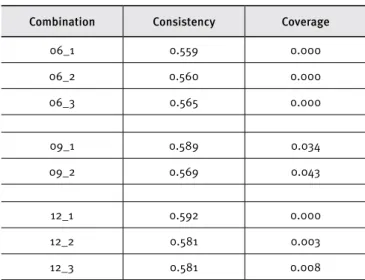
We conducted further robustness tests because another source of problems could arise from a suiciency relation between a condition and the outcome, particularly when there is strong evidence for the existence of a suiciency relation between the negation of the conditions or the prime implicants identiied as suicient and the outcome (Dusa & Alrik, 2013). Table 4 shows that the consistency scores for the negation of the identiied combination of conditions for the three years are low enough to conirm this contradiction. Finally, we performed additional robustness tests (not reported) regarding the analysis of a) the negation of the necessary conditions for the outcome and b) the necessary conditions for the negation of the outcome.
Table 4.
Analysis of suicient conditions for the
negation of the conditions in 2006, 2009 and 2012
Combination Consistency Coverage
06_1 0.559 0.000
06_2 0.560 0.000
06_3 0.565 0.000
09_1 0.589 0.034
09_2 0.569 0.043
12_1 0.592 0.000
12_2 0.581 0.003
12_3 0.581 0.008
In sum, results show that the outcome high information content of risks may result from several diferent combinations
of conditions and, in this respect, there are certain diferences between 2006, 2009 and 2012. The conirmation of Propositions 1 to 3 dealing with the inluence of conditions on the outcome reveal, to a greater or lesser extent, that BoD characteristics (independence, size, activity, duality, and gender diversity), independence of Audit Committee, ownership structure, and auditors quality are associated with high risk disclosure in the CGAR. Additionally, companies that shared a coniguration tend to belong to the same sector.
CONCLUSIONS
This paper contributes to the existing literature that links CG mechanisms and inancial reporting quality by examining the conditions under which the CGAR displays high informative risk disclosure. Our indings show that, in predicting high information content, diferent paths can lead to the same outcome.
The present paper builds on set-theoretic methods to describe complex pathways that can lead a company to produce a CGAR with high information content regarding risks. Our indings include new complex ways to approach conditions for an increase in CGAR quality, which shows support for causal asymmetry. Several causal recipes are related to the outcome or response variable.
solutions seem to be related to the fact that most companies in a given coniguration belong to the same sector.
Furthermore, none of these conditions by itself leads to the outcome; each of them is included in a prime implicant or combination of conditions which produces the outcome. These identiied factors do not determine high information content, but ofer an assessment of what is expected to be important to obtain a CGAR with high information content about risk exposures. Results are robust to several forms of analysis.
Among other limitations, our sample of study includes only listed companies. Expanding the sample with non-listed companies or adopting and international scope would enrich our indinds.
REFERENCES
Barako, G., Hancock, P., & Izan, H. Y. (2006). Factors inluencing
voluntary corporate disclosure by Kenyan companies. Corporate
Governance, 14(2), 107-125. doi:10.1111/j.1467-8683.2006.00491.x
Broberg P., Tagesson T., & Collin, S. (2010). What explains variation in voluntary disclosure? A study of the annual reports of corporations
listed on the Stockholm Stock Exchange. Journal of Management &
Governance, 14(4)351-377. doi:10.1007/s10997-009-9104-y
Bushee, J., & Noe, C. (2000). Corporate disclosure practices, institutional
investors, and stock return volatility. Journal of Accounting Research,
38(2000), 171-202. doi:10.2307/2672914
Cabedo, J. D., & Tirado, J. M. (2004). The disclosure or risk in inancial
statements. Accounting Forum, 28(2), 181-200. doi:10.1016/j.
accfor.2003.10.002
Cabedo, J. D., & Tirado, J. M. (2009). Divulgación de información sobre
riesgos: Una propuesta para su medición. Innovar, 19(34), 121-134.
Carcello, J. V., & Neal, T. N. (2003). Audit committee independence and disclosure: Choice for inancially distressed irms.
Corporate Governance: An international Review, 11(4), 289-299.
doi:10.1111/1467-8683.00327
Comisión Nacional del Mercado de Valores. (1998). Comisión especial para el estudio de un código ético de los consejos de administración de las sociedades. Código Olivencia. Spain.
Comisión Nacional del Mercado de Valores. (2003). Informe de la comisión especial para el fomento de la transparencia y seguridad en los mercados y en las sociedades cotizadas. Informe Aldama. Spain.
Comisión Nacional del Mercado de Valores. (2006). Código unificado de buen gobierno de las sociedades cotizadas. Spain.
Comisión Nacional del Mercado de Valores (2015). Código unificado de buen gobierno de las sociedades cotizadas. Spain
Davis, J., Choorman, F., & Donaldson, I. (1997). Toward a stewardship
theory of management. Academy of Management Review 22(1), 20-47.
Deumes, R., & Knechel, W. R. (2008). Economic incentives for voluntary reporting on internal risk management and control systems.
Auditing: A Journal of Practice and Theory, 27(1), 35-66. doi:10.2308/
aud.2008.27.1.35
Directive 2006/46/EC of the European Parliament and of the Council of 14 June 2006 amending Council Directives 78/660/EEC on the annual accounts of certain types of companies, 83/349/EEC on consolidated accounts, 86/635/EEC on the annual accounts and consolidated accounts of banks and other inancial institutions and 91/674/EEC on the annual accounts and consolidated accounts of insurance undertakings
Domínguez, L. R., & Gámez, L. C. N. (2014). Corporate reporting on risks:
Evidence from Spanish companies. Revista de Contabilidad-Spanish
Accounting Review, 17(2), 116-129. doi:10.1016/j.rcsar.2013.10.002
Dusa, A., & Alrik, T. (2013). Qualitative comparative analysis with R. New York, USA: Springer.
Dusa, A., & Alrik, T. (2014). QCA: A package for qualitative comparative analysis. R package version 1.1-3. Retrieved from http://CRAN.R-project.org/package=QCA
Domínguez-de la Concha Castañeda, M., & Cauzo-Bottala, L. (2015). Consequences of CEO change: Long term efects on top management
team and irm performance. Revista Española de Financiación y
Contabilidad, 44(1), 72-96. doi:10.1080/02102412.2014.987447
Fama, E. F., & Jensen, M. C. (1983). Separation of ownership and control.
Journal of Law and Economics, 26(2), 301-325.
García-Castro, R., Aguilera, R. V., & Ariño, M.A. (2013). Bundles of irm
corporate governance practices: A fuzzy set analysis. Corporate
Governance: An International Review, 21(4), 390-407. doi:10.1111/
corg.12024
García-Meca, E., & Sanchez-Ballesta, J. P. (2010). The association of board independence and ownership concentration with voluntary
disclosure: A meta-analysis. European Accounting Review, 19(3),
603-627. doi:10.1080/09638180.2010.496979
Giner, B. (1997). The inluence of company characteristics and accounting
regulation on information disclosed by Spanish irms. The European
Accounting Review, 6(1), 45-68. doi:10.1080/096381897336863
Gómez, J. C., Iñiguez, R., & Poveda, F. (2006). Revelación voluntaria de información y características de las sociedades cotizadas en el
mercado de capitales español. Revista Española de Financiación y
Contabilidad, 131, 8-32.
Gul, F., & Leung, S. (2004). Board leadership, outside director’s expertise
and voluntary corporate disclosures. Journal of Accounting and
Public Policy, 23(5), 351-379. doi:10.1016/j.jaccpubpol.2004.07.001
Healy, P., & Palepu, K. (2001). Information asymmetry, corporate disclosure, and the capital markets: A review of the empirical
disclosure literature. Journal of Accounting and Economics, 31(1-3),
405-440. doi:10.1016/S0165-4101(01)00018-0
Ho, W.-R., & Wang, Y.-C. (2008). The relationship between corporate
governance and inancial crisis. Journal of Accounting, Finance and
Management Strategy, 4(1), 63-84.
Hsu, S., Woodside, A., & Marshall, R. (2013). Critical tests of multiple
theories of cultures’ consequences. Journal of Travel Research, 52(6),
679-704. doi:10.1177/0047287512475218
Institute of Chatered Accountants in England and Wales. (1997). Financial reporting of risk: Proposals for a statement of business risk. London, UK: ICAEW.
Institute of Chatered Accountants in England and Wales. (2011). Reporting business risks: Meeting expectations. London, UK.
Järvinen, J., Lamberg, J., Murmann, J., & Ojala, J. (2009). Alterna-tive paths to competiAlterna-tive advantage: A fuzzy-set analysis of the
origins of large irms. Industry and Innovation, 16(6), 545-574.
doi:10.1080/13662710903371066
Jensen, M. C., & Meckling, W. H. (1976). Theory of the irm: Managerial
behavior, agency costs and ownership structure. Journal of Financial
Economics, 3(4), 305-360. doi:10.1016/0304-405X(76)90026-X
Kothari, S. P., & Lester, R. (2012). The role of accounting in the inancial
crisis: Lessons for the future. Accounting Horizons, 26(2), 335-351.
doi:10.2308/acch-50134
Leuz, C., & Verrecchia, R. E. (2000). The economic consequences of
increased disclosure. Journal of Accounting Research, 38(Suppl.),
91-124. doi:10.2307/2672910
Ley 24/1988, 28 de July, del Mercado de Valores. Artículo 116 se modiicó por la Ley 2/2011 y por el R. D. Legislativo 1/2010 que aprueba el texto refundido de la Ley de Sociedades de Capital vigente que contempla el IAGC.
Ley 26/2003, de 17 de julio, por la que se modiican la Ley 24/1988, de 28 de julio, del Mercado de Valores, y el texto refundido de la Ley de Sociedades Anónimas, aprobado por el Real Decreto Legislativo 1564/1989, de 22 de diciembre, con el in de reforzar la transparencia de las sociedades anónimas cotizadas.
Ley Orgánica 3/2007, 22 de March 2007, para la Igualdad Efectiva de Mujeres y Hombres. (2007). BOE nº 71, 23/3/2007.
Ley 2/2011, de 4 de marzo, de Economía Sostenible.
Ley 31/2014, de 3 de diciembre, por la que se modiica la Ley de sociedades de capital, para la mejora del gobierno corporativo
Linsley, P. M., & Shrives, P. J. (2006). Risk reporting: A study of risk
disclosures in the annual reports of UK companies. The British
Accounting Review, 38(4), 387-404. doi:10.1016/j.bar.2006.05.002
Magnan, M., & Markarian, G. (2011). Accounting, governance and the
crisis: Is risk the missing link? European Accounting Review, 20(2),
215-231. doi:10.1080/09638180.2011.580943
Manzaneque, M., Priego, A. M., & Merino, E. (2016). Corporate governance efect on inancial distress likelihood: Evidence from Spain. Spanish Accounting Review, 19(1), 111-121. doi:10.1016/j. rcsar.2015.04.001
Monterrey, J., & Sánchez, M. A. (2008). Gobierno corporativo y calidad
de la información contable: Evidencia empírica española. Revista de
Contabilidad, 11(1), 67-100.
Oliveira, J., Rodrigues, L., & Craig, R. (2011). Risk-related disclosures by non-inance companies: Portuguese practices and
disclo-sure characteristics. Managerial Auditing Journal, 26(9), 817-839.
doi:10.1108/02686901111171466
Orden ECO/3722/2003, 26 December 2003. (2003). Sobre el IAGC y otros instrumentos de información de las sociedades anónimas cotizadas y otras entidades.
Pomeroy, B., & Thornton, D. B. (2008). Meta-analysis and the accounting literature: The case of audit committee independence and inancial reporting quality. European Accounting Review, 17(2), 305-330. doi:10.1080/09638180701819832
Probohudono, A. N., Tower, G., & Rusmin, R. (2013). Risk disclosure during the global inancial crisis. Social Responsibility Journal, 9(1), 124-137. doi:10.1108/17471111311307859
Pucheta-Martinez, M. C., & Fuentes, C. de. (2007). The impact of audit committee characteristics on the enhancement of the quality of inancial reporting: An empirical study in the Spanish context. Corporate Governance: An International Review, 15(6), 1394-1412. doi:10.1111/j.1467-8683.2007.00653.x
R Core Team. (2014). R: A language and environment for statistical computing. R Foundation for Statistical Computing, Vienna, Austria. Retrieved from http://www.R-project.org
Ragin, C. C. (1987). The comparative method: Moving beyond qualitative and quantitative strategies. Berkeley, USA: University of California Press.
Ragin, C. C. (2000). Fuzzy set social science. Chicago, USA: University of Chicago Press.
Ragin, C. C. (2008). Redesigning social inquiry: Fuzzy sets and beyond. Chicago, USA: University of Chicago Press.
Real Decreto Legislativo 1/2010, de 2 de julio, por el que se aprueba el texto refundido de la Ley de Sociedades de Capital.
Rodriguez-Perez, G. (2004). Factores explicativos de la revelación voluntaria de información sobre fuentes de ventaja competitiva empresarial. Revista Española de Financiación y Contabilidad, 33(122), 705-739.
Ruiz, I., Lafarga, J., & Jiménez, S. M. (2001). Características de la información revelada sobre riesgos en España. Actualidad Financiera, 6(4), 29-48.
Stevenson, I. (2013). Does technology have an impact on learning? A fuzzy set analysis of historical data on the role of digital repertoires
in shaping the outcomes of classroom pedagogy. Computers &
Education, 69, 148-158. doi:10.1016/j.compedu.2013.07.010
Vis, B. (2012). The comparative advantages of fsQCA and regression
analysis for moderately large-N analyses. Sociological Methods &
Research, 41(1), 168-198. doi:10.1177/0049124112442142
Woodside, A. (2013). Moving beyond multiple regression analysis to algorithms: Calling for adoption of a paradigm shift from symmetric to asymmetric thinking in data analysis and crafting
theory. Journal of Business Research, 66(4), 463-472. doi:10.1016/j.