1 We wish to express our deep appreciation to the parents and children who gave so generously of their time. We also wish to thank the International Research and Exchanges Board (IREX, with funds provided by the U.S. Department of State [Title VIII]), and the Spencer Foundation for grants awarded to the first author, and to the University of North Carolina at Greensboro for the granting of a Kohler Fund Award, Research Assignment, and Excellence Foundation Summer Research Award to the first author. We also thank Sheryl Scrimsher for her helpful feedback on an earlier draft.
2 Address: Correspondence concerning this article should be addressed to Jonathan Tudge. Department of Human Development and Family Studies. The University of North Carolina at Greensboro, Greensboro, NC 27402-6170 - USA. E-mail: [email protected]
Parents’ Participation in Cultural Practices With Their Preschoolers
1Jonathan Tudge2 (The University of North Carolina at Greensboro, USA),
Sherrill Hayes, (University of Newcastle, UK), Fabienne Doucet (Harvard University, USA), Dolphine Odero (Egerton University, Kenya), Natasha Kulakova (The Institute of Ethnology and
Anthropology, Moscow, Russia), Peeter Tammeveski (The Pennsylvania State University, USA), Marika Meltsas (The University of Tartu, Estonia) and Soeun Lee (Chungbuk National University, Korea)
ABSTRACT - In this article we discuss cross-cultural similarities and variations in parents’ engagement in the everyday
activities in which their preschool-age children engage, focusing on mothers’ and fathers’ presence in the same setting as their children, the impact of their presence on the types of activities in which the children engaged, and the extent of mothers’ and fathers’ involvement with their children in those activities. The data were gathered from different societies -the United States, Korea, Russia, Estonia, and Kenya. They reveal that -the children were involved primarily in play (more than in lessons, work, or conversation), and this was unaffected by the presence of either parent. However, parents were relatively less likely to be involved in their children’s play than in the other activities. Mothers, not surprisingly, were more likely to be found in the same setting as their children and, even when taking account of their greater presence, were more likely to be involved with their children than were fathers.
Key words: Culture; social class; preschoolers’ activities; parental practices; mothers and fathers.
in interviews or in response to questionnaires about their children or their approach to parenting. In particular, the study of practices involves a focus on what people do on a regularly-occurring basis. As practices are often repeated they come to be imbued with cultural meaning and value -as is clear when one acts in a way different from the norm. Practices are also likely to vary according to parental goals, and this variation is seen most clearly when examining dif-ferent cultural groups, whose goals for children are deter-mined in part by environmental (LeVine, 1988, 1989) or socioeconomic (Draper & Harpending, 1987; Whiting & Whiting, 1975) factors.
In our view, culture consists of a group of people who are viewed by others or who view themselves as constitut-ing a group by virtue of the fact that they share values, beliefs, and practices, who share a similar range of access to resources, and who attempt to pass on those values, be-liefs, and practices to the young of the group. This defini-tion allows us to think of cultural groups as being distin-guished not only because they are from different societies but as groups that exist within specific societies, by virtue of variations in region, race, ethnicity, or socioeconomic status. It is also important to recognize, echoing Marx, that people are not only the products of culture but its producer. As Youniss (1994) argued:
The position advanced here is not that of a social determin-ism in which the sociological macrostructure - for instance, social class membership - defines individuals. Social class does not determine rearing practices; only parents do this by weighting options and making choices based on their knowl-edge. (p. 47)
Our view of the cultural ecology of young children is thus similar to Super and Harkness’ (1986) conception of the “developmental niche” (the individual child’s cultural A few years ago Harkness and Super (1995) argued that
everyday, regularly-occurring, activities are important to study both in their own right and as key to understanding what is considered culturally appropriate within any com-munity.
The activities that routinely take place within different set-tings are key to understanding parents’ cultural construction of child life and development. Activities, routines, or cultural practices involved in the care and rearing of children instan-tiate cultural themes of importance to parents, and in this way they communicate cultural messages. (Harkness &
Su-per, 1995, p. 226)
setting), Weisner’s (1984) “ecocultural niche” (family ad-aptation processes, occurring in cultural settings) and to Cole’s (1995) view of “activity.”
Given the interrelatedness of cultural context and prac-tices, which change over time, we believe that an appropri-ate theoretical foundation for any study that seeks to study parenting in context must be one that is systemic and en-courages the study of mutual influences of each of these factors. A number of theories satisfy such a requirement, including that of Vygotsky (1987, 1997) and Bronfenbrenner (1989, 1993, 1995; Bronfenbrenner & Ceci, 1994; Bronfenbrenner & Morris, 1998). Of the two theories, Bronfenbrenner’s is easiest to operationalize, and much of Bronfenbrenner’s work has been devoted as much to dis-cussions of how to engage in theoretically-appropriate re-search as to theoretical formulation.
Theoretical framework
The theory centers around a Process-Person-Context-Time (PPCT) model, of which the first term is the most impor-tant (Bronfenbrenner & Morris, 1998). Proximal processes constitute the “engines of development” (Bronfenbrenner, 1993) and consist of the interactions “between an active, evolving biopsychological human organism and the per-sons, objects, and symbols in its immediate environment” (Bronfenbrenner, 1995, p. 620). Examples that Bronfen-brenner (1995; BronfenBronfen-brenner & Morris, 1998) cited in-clude parent-child and child-child activities, group or soli-tary play, reading, and so on. In other words, proximal pro-cesses are the essence of everyday activities in which chil-dren are typically involved, often with others. Process in this sense has to do with what occurs in the course of ev-eryday activities on the part of developing individuals and their social partners.
These typically occurring activities are clearly what oth-ers have termed practices on the grounds that they consti-tute the “stuff” of everyday life (Cole, 1995); in the course of children engaging in these activities with others who are more skilled, the children come to understand what is (and what is not) considered appropriate within the particular culture. As discussed earlier, one cannot understand activi-ties or practices without knowing the context within which those activities are carried out. This is true in Bronfenbren-ner’s theory too.
Bronfenbrenner’s (1989, 1995) conception of context is broader than most, involving an interconnected layering. At the center is the microsystem - the context in which everyday activities take place in conjunction with the vari-ous other social actors who inhabit that context. Microsys-tems are homes, or classrooms, or groups of friends, or places of worship - anywhere the developing individual spends a good deal of time in face to face interaction with one or more other people, and with the objects and sym-bols that feature in that context. There is a tendency to fo-cus on development within a single microsystem - on de-velopment within the family, or at school, or with the peer
group. Bronfenbrenner recognized, however, not only that development takes place in a variety of microsystems, but that interconnections (or the lack of such interconnections) between microsystems also needs to be studied. He termed these types of studies mesosystem analyses.
As mentioned ealier, those who study activities or prac-tices argue that one also needs to understand the cultural context in which these activities take place. Further, activi-ties derive their meaning not so much from the particular microsystems or mesosytems in which they occur as from the broader culture in which those systems are situated. Culture, for Bronfenbrenner (1993), is defined as a macro-system, a group of people who share values and beliefs, as well as “resources, hazards, lifestyles, opportunity struc-tures, life course options and patterns of social interchange” (p. 25). By this definition, culture can be considered both at the societal level (as in the cultural groups studied by most cross-cultural researchers) and when examining dif-ferent within-society cultural groups. Such groups may differ by race, ethnicity, region, or on socioeconomic grounds.
Although it is clearly necessary to study activities in context, Bronfenbrenner (1995; Bronfenbrenner & Morris, 1998) has argued that one must also understand what the participating individuals bring to the activities in which they engage. Parents’ decisions to encourage their children to participate in certain types of activities and to discourage them from participating in others stems in part from their values for their children (the qualities they wish their chil-dren to have) and their beliefs about how to bring those values into reality. Where do these values and beliefs come from? As cultural anthropologists would argue, they must be considered a cultural phenomenon, for cultures are marked by the fact that members of a cultural group share values that distinguish them from other cultural groups. The expression of those values occurs, of course, while engag-ing in activities within microsystems. As Cole (1985) ar-gued about Vygotsky’s concept of the zone of proximal development, the expression of parents’ values as they en-gage in activities with their children is the crucible in which culture and development occur.
an influence on the ways in which other people deal with the developing individual and the goals, values, and expec-tations they have for that individual.
The final element in Bronfenbrenner’s model is time, a recognition not only that to study development means to ex-amine it over time (necessitating longitudinal research) but that we must always consider the developing system within its historical context. In our research we have explicitly tried to use Bronfenbrenner’s ecological theory as the foundation for the methods we have used and for the types of variables we have considered important to include in our measures. In this paper, however, we are going to concentrate on proximal pro-cesses in different macrosystems, with macrosystem being considered at both the societal and socioeconomic levels, fo-cusing on parents’ extent of involvement with their children in the various activities in which the children are engaged.
The Role of Mothers and Fathers
Why focus on parents? We do not wish to suggest that the only people who are important in a child’s life are his or her biological parents - siblings, teachers, extended family members, and peers all may play large roles (Howes & Clements, 1994; Howes & Tonyan, 1999; Taylor, Jackson, & Chatters, 1997; Tobin, Wu, & Davidson, 1989; Wakschlag & Chase-Lansdale, 1996; Weisner, 1987). However, as Bronfenbrenner and Morris (1998) argued: “The principal persons with whom young children interact ‘on a fairly regu-lar basis over extended periods of time’ are parents” (p. 997). Moreover, there has been a growing interest over the past 20 years regarding the extent to which fathers are in-volved with their young children (Lamb, 1997). Our data allow us to examine the extent to which mothers and fa-thers are both available to and engaged with their young children, and we are able to do this while examining the everyday activities in which children are involved in a vari-ety of different cultural groups.
Lamb and his colleagues (Lamb, Pleck, & Levine, 1985; Marsiglio, Day, & Lamb, 1997) argued that parents’ involve-ment with their children can be differentiated as engageinvolve-ment, accessibility, and responsibility. Engagement involves direct caregiving, assistance, playing with, or talking to the child, accessibility (or availability) means simply being in the same location as the child and thus being potentially available to the child, and responsibility has to do with knowing what the child needs and making decisions on behalf of the child. Determining levels of responsibility is a difficult task, and thus the majority of research has focused on engagement or availability (Doherty, Kouneski, & Erickson, 1998).
“Use of time”, diary, and observational studies reveal that fathers typically, in many industrialized nations at least, are available to their children far less frequently than are mothers, and engaged with their children even less (Lamb, 1987; Lewis, 1997; McBride & Mills, 1993; Pleck, 1997). Much of this research relies on self reports from the par-ents (often only from the mothers), with observational data collected in laboratories more often than in a naturalistic
setting, at least in the United States (Dessen & Lewis, 1998; Mackey, 1996; Volling & Belsky, 1991). In the cultural-anthropological literature, by contrast, the research relies far more on observations in natural settings. For example, in their report of the cross-cultural “Six Cultures” research, Whiting and Edwards (1988) showed that mothers were about twice as often available as were fathers, although the amount of cultural variability was high, with Indian and Kenyan fathers almost never involved with their young chil-dren whereas involvement was much greater in Mexico, the Philippines, and Okinawa.
Fathering may be viewed by many as a “secondary ac-tivity” (Lewis, 1997) when one compares the amount of time that mothers and fathers spend caring for children, but there is little compelling evidence that what mothers and fathers do with their preschool-age children is very differ-ent, even though there is wide individual variation among fathers in the extent of their engagement (Lewis & Dessen, 1999). However, according to Lewis, scholars continue to assume that fathers are more likely to engage in rough and tumble play with their children and that they treat boys and girls differently, with presumed implications for sex-role development.
In this project we made extensive observations of chil-dren in their everyday settings, and so are able to examine the different types of activities in which they engage. We are also able to examine mothers’ and fathers’ availability to and involvement with their children in these activities and can study this in a variety of different societies and, within societies, social class groups. We are thus able to examine the extent to which mothers’ or fathers’ availabil-ity changes the types of activities in which children engage and the types of activities in which mothers and fathers actually engage with their children.
Methods
Participants
particu-lar communities chosen. We therefore did not include or exclude families on the basis of family structure (single or two-parent families), number of siblings, presence of ex-tended family members, etc.
Greensboro, NC, USA. This city consists of about 200,000 inhabitants, located approximately 250 miles (400 km) south of Washington, DC. Participants were recruited from birth records if they lived in one of two areas (each 2-3 square kilometers) judged to be relatively homogeneous in terms of housing and racial (European-American) background. A total of 20 families with young children participated from these two communities (one middle class, the other work-ing class). Acceptance rates from those initially contacted were quite high (64% and 78% in the middle class and work-ing class communities), and the two groups of families which participated consisted of 11 middle class families and nine working class families with children aged from 30-48 months. The families were clearly differentiated by educa-tion (no working class parent had a college degree whereas virtually all middle class parents had at least a degree) and occupation criteria, using Hollingshead (1975) rankings.
Suwon, South Korea. This town of about 700,000 in-habitants is located approximately 70 kilometers from Seoul, and is one of the satellite cities around the capital, with a branch of Seoul National University situated there. Two communities were selected; in one lived families who were mostly well educated (most of whom had at least a college degree) and in which the fathers had professional occupa-tions, whereas in the other lived primarily working class parents, none of whom had completed a college education. Inspection of birth records was not possible in Suwon, and community representatives helped us to locate potential participants. Families had to meet the same educational and occupational criteria as was the case in Greensboro. Twelve families participated in Suwon, divided equally by com-munity and gender. However, recruitment was far more dif-ficult in Suwon than in the other cities. Of 36 families who were contacted in the middle class community, 13 (36%) were willing to participate, but seven of the children were enrolled in preschools that did not permit observations. In the working class community, 16 families were contacted, of whom seven (44%) were willing to participate, but one was enrolled in a preschool that did not permit observa-tions (Tudge, Hogan, Lee, et al., 1999). The clearly lower acceptance rates in Suwon are most likely related to the fact that mothers almost exclusively look after their chil-dren while young, and Korean families are less willing to have strangers enter the home.
Obninsk, Russia. This town is situated about 100 kilo-meters south of Moscow, and has approximately 120,000 inhabitants. As is true of all cities in the former Soviet Union, it was not possible to find areas of the city that were differ-entiated by social class, type of occupation, and so on. Well educated professional families are likely to live next door to less educated workers. Inspection of birth records was not possible, so we used initial contacts to recruit via a
“snowball” technique. Half of the 12 Russian families who participated consisted of parents who had the equivalent of a US college education or higher and whose primary occu-pation was judged to be professional (many parents held more than one job, as a way of supplementing their income). The other half had no more than the equivalent of high school in the United States and worked in the non-professional sphere. In other respects, these two groups of families were quite similar. For example, they lived in very similar apart-ment complexes in the same areas of town, and incomes were also similar. It is thus clear that, although in terms of education and occupation the two groups in Russia differed greatly from each other, in terms of income and housing the two groups of Russian families did not differ at all. This was in marked contrast to the groups of US, Kenyan, and Korean families (Tudge, Hogan, Lee, Meltsas, Tammeveski, Kulakova, Snezhkova, & Putnam, 1999).
Tartu, Estonia. This city, of approximately 100,000 in-habitants, is located 180 kilometers south of Tallinn, the capital of Estonia. As was the case in Greensboro, two ar-eas of the city were selected, one of which consists solely of apartment complexes and the other from an area of single-family houses, both new and old. Each area is smaller than its Greensboro equivalents, approximately 1 square kilo-meter, but with a similar or higher density of families. Each area was bounded by large roads or by the river. Families were located from the birth records, as was the case in Greensboro. Workers at the local ministry supplied names and addresses and occasionally some basic demographic details (such as educational level) of families living in the relevant streets and with children of the approximate age. Of the 34 families who were contacted, 67% agreed to par-ticipate, from which 20 families were selected, equally di-vided by social class. As was the case in Obninsky, the fami-lies were clearly differentiated by educational level and by occupational status, but were not differentiated by income or neighborhood (Tudge, Hogan, Lee, et al., 1999).
Observations
Families were asked to keep their daily routines unchanged as much as possible during the observation period. Each child (aged between 28 and 50 months) was observed, wher-ever he or she was, for 20 hours over the course of a week to capture the equivalent of an entire waking day. We thought it important to observe for the full day, in order to discover the range of activities in which these children engaged and the range of settings in which they were placed. We also wanted to limit the likelihood that the participants would change their behavior, something more likely to occur dur-ing short-lived observations (Tudge, Hogan, & Etz, 1999). Observations were continuous in 2- and 4-hour blocks, but activities were only coded during 30-second “windows” every 5½ minutes, using modified spot observations (Tudge, Sidden, & Putnam, 1990). During any 30-second window, more than one activity could occur and could be coded. All observers were from the cultural group being observed, and were trained to reliability by the first author.
Activities were coded as being “available to” the child if they occurred within his or her ear- or eye-shot. Children were coded as being “involved in” the activities if they were physically participating or were observing. As well as ob-serving which activities were available to the child and which he or she became involved in, we coded how activi-ties were initiated and by whom, the manner in which the child became involved in any activity, any partners in ac-tivity, their respective roles, and so on. These analyses are based on approximately 180 observations for each child and do not include the final two hours of observation which were videotaped.
The activities in which we were interested were lessons (4 categories), work (5 categories), play, exploration, and entertainment (10 categories), conversation (3 categories), and “other” (6 categories, including sleeping, eating, etc.)3.
In brief, lessons were defined as involving the deliberate attempt to impart or receive information in four areas: aca-demic (spelling, counting, learning shapes and colors, etc.); interpersonal (teaching etiquette or “proper” behavior); skill/ nature (how things work, why things happen); and religious lessons. Work was defined as “activities that either have economic importance or contribute to the maintenance of life” (Tudge et al., 1990) and was broken down into work involving no technology, clear technology (such as sweep-ing with a broom), or more complex technology (such as using a vacuum cleaner). Play (including exploration and entertainment) was defined as activities that were being engaged in for fun or for their own sake, with no apparent curriculum (which would constitute a lesson) or sense that the activity had economic importance (work). Types of play included pretend/role play, play with an academic object (such as looking at a book), playing with objects typically designed for children, playing with adult objects, other types
of play (such as chase or rough and tumble), and watching television. Thus a child looking at a book or being read to would be coded as engaging in “play with an academic object” whereas the child asking what a particular word was, or being asked to name the colors would be coded as being involved in an academic lesson. Conversation was defined as talk that was not related to the on-going activity and had a sustained or focused topic. Talking that was an integral part of play, work, or a lesson was therefore not coded as conversation, but if children talked about some other activity or an earlier bout of play, while engaging in play, would be coded as engaging in both play and conver-sation.
We were also interested in the partners, if any, who were engaged with the children in the activities in which they were involved. The level of engagement varied from doing the activity with the child, with all participants taking a more or less equal role in it, to one person watching an-other who was more actively involved. In the latter case, we coded someone as a partner whether that person was observing the child (who was more actively engaged) or being observed by the child. For the most part, however, partners were actively involved with the child in an activ-ity. Multiple partners could be coded as being engaged in any one activity with the child. If the child was not in-volved in an on-going activity by definition he or she could have no partner. We were also interested in knowing whether the child’s mother and/or father were in the setting with the child, irrespective of whether she or he were partnering the child in an activity. If they were present in the setting they were coded as being “available” to the child.
Results
Where were these children situated? Not surprisingly, and as displayed in Figure 1, for most of our observations they were in or around the home. Expressed in percentages, to account for variations in observations in which the location was recorded (ranging from 160 to 200), the children were at home from a low of about 2/3 of the time for the Greens-boro White middle class children to over 80% of the time, in the case of the Tartu middle class children and in the case of the Kisumu working class children. The children
were least likely to have been found in other people’s homes, ranging from 2.6% of the observations among the Obninsk middle class children to 9.5% for the working class White Greensboro children.
The data were far more variable in the case of being observed in some type of formal preschool setting or in a public space (such as a park, or at a shop or library). The Suwon working class children, Tartu middle class children, and children from the Kisumu working class backgrounds were never or rarely observed in preschool. Children from Greensboro, particularly those from middle class families, were most likely to spend time in some type of preschool or other formal child-care setting. The situation was also quite variable with regard to observations in public spaces. Suwon and Obninsk children were more likely to be situ-ated in a public space (shopping or in a park) than were the Greensboro and Tartu children, and the Kisumu children least likely of all.
The activities in which the children were engaged have been discussed in more detail in earlier publications (Tudge & Putnam, 1997; Tudge, Doucet, Odero, Tammeveski, Lee, Meltsas, & Kulokova, 1999; Tudge, Hogan, Lee, et al., 1999). In brief, however, and as displayed in Figure 2, the children in each group were far more likely to be found in play than in any other activity, followed by work, conver-sation, and lessons. Because the number of observations varied somewhat we have expressed the data as percent-ages of observations (the percentpercent-ages do not sum to 100 because we have not included in these analyses the cases in which the children were involved in the “other” category). The observations of play ranged from a low of 45% among the Greensboro middle class children to a high of over 73% for the working class Suwon children. Obninsk and Tartu children were more likely to be involved in lessons than were children from the other cities, but it is also worth not-ing that middle class children in each city were more likely to be involved in lessons than were their working class counterparts. The same was true with regard to conversation -middle class children were consistently more likely to be involved in conversation than were working class children. By contrast, working class children were more likely to be
involved in work in Greensboro, Suwon, and (most clearly) in Kisumu. However in the two Eastern European cities middle class children were more likely to be observed en-gaged in work than were working class children.
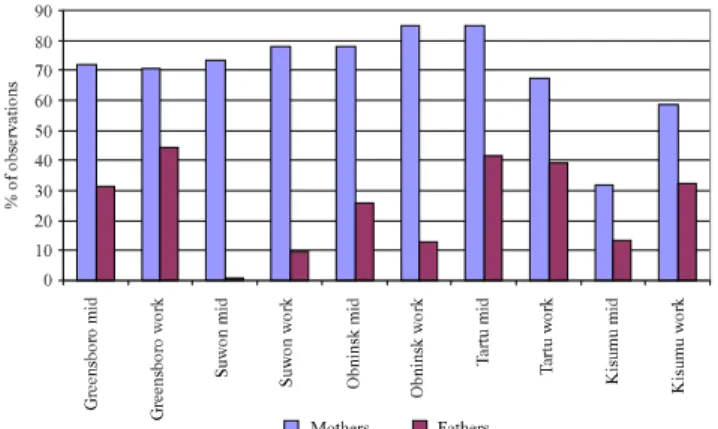
Of greater interest in this paper, however, is the influ-ence of parental presinflu-ence on the types of activities in which the children were involved. As can be seen from Figure 3, mothers were far more likely to be in the same setting than were fathers, though there were wide variations among the groups. This was most apparent in the case of Suwon, where the middle class Korean fathers were almost never in the same setting as their children when observations were con-ducted, whereas the mothers were in those settings more than 70% of the observations. Fathers were more likely to be in the same setting as their children in Tartu and in Greensboro (particularly in the working class homes) than in the other cities.
We next wanted to know how these children spent their time when their mothers and fathers were with them. As displayed in Figure 4, when the mothers were available the proportions of the various types of activities in which the children were involved were similar to those of the children’s days in general, regardless of the mothers’ presence. Be-cause the Suwon middle class fathers were so rarely in the setting their data have not been displayed. However, there tended to be a somewhat greater proportion of lessons, work, and conversation in all groups, and correspondingly a
Figure 4. Activities in which children were involved when parents were in
the setting (proportion of observations).
Figure 3. Parents in the same setting as children according to cultural groups.
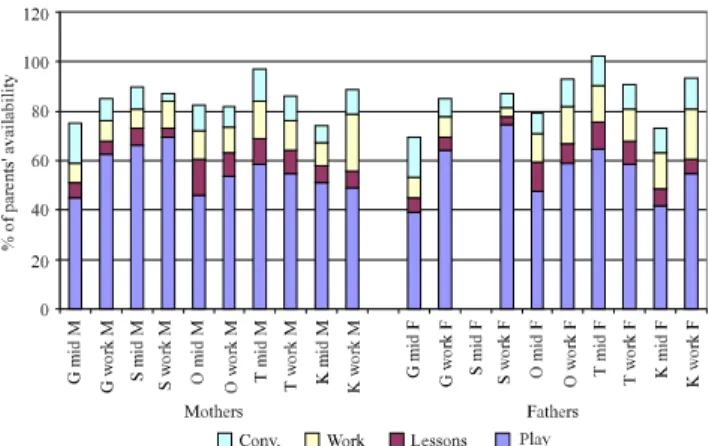
smaller proportion of play, when the mother was in the same setting. The fathers were with their children a smaller pro-portion of the time and therefore, not surprisingly, a smaller proportion of activities occurred while fathers were present. However, when expressed, as in Figure 5, as a proportion of the time that the parents were available to the children by being in the same setting with them, it is clear that the chil-dren were as likely to engage in these various activities when their mothers or their fathers were in the setting with them. Figure 5 does indicate that in some cases (Suwon work-ing class families and in Tartu) the children were slightly more likely to be engaged in play when their fathers were in the same setting than when their mothers were. How-ever, the differences in extent of play were minimal, and from these data it would appear that fathers’ presence, when compared to that of the mothers, has little impact on the type of activitiy in which the children are engaged.
Of more interest, however, is the extent to which the parents were actively engaged with their children in the various activities. Simply being present in the house but paying no attention to the child presumably means having less direct impact on the child’s development. It is immedi-ately apparent from examining Figure 6 that mothers were far more likely than were fathers to engage with their chil-dren in the various activities. It is also clear that both moth-ers and fathmoth-ers were, relative to the extent to which the children engaged in these types of activities, less likely to participate in their children’s play than they were to en-gage with them in lessons, work, or conversation. That is particularly true in the case of Kisumu.
These data provide a good sense of the extent to which mothers and fathers in these different groups actively en-gaged with their children over the course of a typical week. However, they are less effective at providing an understand-ing of the extent to which mothers and fathers engaged dif-ferentially with their children given their presence in the setting. In other words, although it is clear that fathers were far less likely than mothers to spend time in the company of their preschool-aged children, is it the case that they en-gaged in different types of activities with their children when they were present?
To answer this question, we examined mothers’ and fa-thers’ participation in activities with their children as a pro-portion of the extent to which they were present in the same setting as their children. As displayed in Figure 7, it is clear that in all cases except Kisumu, fathers were less likely than mothers to be involved in these activities with their children, even when expressed proportionally to their pres-ence. Mothers, in other words, were more likely than fa-thers not only to be around their children, and to engage actively with them, but even when fathers were in the same setting as their children they were less likely to be involved in these activities.
Discussion
We presented these data in a purely descriptive fashion be-cause they do not lend themselves to inferential statistics, which allow researchers to generalize from randomly-drawn samples to the populations from which the samples were drawn. These families were not members of randomly se-lected samples; however, they consisted of groups that were purposefully selected from specific communities. Our aim was to recruit all the families that met our requirements from those communities and, with the exception of the Suwon communities, we were quite successful. We were
Figure 5. Activities in which children were involved when parents were in
the setting (proportion of availability).
Figure 6. Activities in which parents were involved with their children
(proportion of observations).
Figure 7. Activities in which parents were involved with their children
therefore dealing with small populations, rather than samples drawn from wider populations. At the population level, a difference is simply a difference, not one that need be inferred by reference to a test of statistical significance. We do not think that our data are not generalizable, how-ever, and relate only to the specific groups we studied. The fact that in such different cultural contexts our findings were similar suggests that we may have observed a relatively widespread phenomenon.
As the literature has indicated, the fathers in this study were actively involved with their young children far less often than were the mothers. This was the case in societies as diverse as the United States, Kenya, Korea, Russia, and Estonia. In part this is because fathers were around their children much less frequently than were mothers - approxi-mately half as much in Greensboro, Tartu, and Kisumu, and a good deal less than half in Suwon and Obninsk. Dif-ferent reasons help explain why this should be the case. In Korea mothers of young children do not typically work outside the home, whereas fathers work long hours. Many of the Suwon fathers only returned from work after their children had gone to bed, and often worked away from home on the weekends. By contrast, prevailing cultural norms in both Russia and Estonia involve both mothers and fathers working outside the home. In the United States it has be-come increasingly common for mothers of young children to have a paying job if not a career, but economic consider-ations seem as likely to play a role as the belief that self-fulfillment involves having a career, and about half of the mothers in the middle class Greensboro families did not work outside the home whereas all but one of the working class mothers did. In Russia, perhaps not surprisingly given the dramatic events of the final decade of the twentieth cen-tury and the resulting impoverishment of many families, several of the fathers of these children were no longer liv-ing at home either havliv-ing left for good or havliv-ing left to find employment elsewhere. The Kenyan middle class may be numerically far smaller than its US counterpart, but it was typically the case that the Kisumu middle class mothers did not work outside the home, whereas their working class counterparts did. As Lewis and Dessen (1998) argued, it is important to understand the impact on the family system of both parents working outside the home, when both parents are more likely to share (though by no means equally) re-sponsibility for engaging with their children, compared to families in which the mother works only within the home. The discrepancy in extent of parental availability to their children is wide enough to make it clear that mothers were still the main caregivers for their preschool-aged children in this diverse group of families. Nonetheless, when taking account of fathers’ lesser availability (and expressing the data as a proportion of availability) it did not seem to be the case that children’s engagement in activities was much changed by the fathers’ presence. Irrespective of the par-ents’ presence the proportion of activities in which the chil-dren were involved appeared quite similar when compar-ing activities in all settcompar-ings with those in which they
en-gaged when the mother was present and with those in which the father was present. In each group, the children were more likely to play than do anything else, even though the proportions of lessons, work, and conversation went up somewhat when the parents were available to them.
However, when we focused not simply on what the chil-dren were engaged in while the parents were available to them but on activities in which the parents were engaged as a partner, our data painted a striking picture. Mothers were far more likely than fathers to be engaged with their chil-dren, dramatically so in the case of Suwon and Obninsk. Again, given what we found in terms of the differential extent of availability, these data were not that surprising. What was surprising was that even when the data were ex-pressed as a proportion of availability it was still the case that mothers were far more likely to be involved with their children than were fathers, with the single exception of the Kisumu middle class families. Moreover, it is clearly not the case that when fathers were with their young children they were more likely to play with them than were moth-ers. Although parents were more likely to be involved with their children in play and entertainment than in any other single activity, their involvement in play constituted 50% or less of their total involvement. In other words, although we observed far more examples of play than lessons, work, or conversation parents were proportionally more likely to be involved in the latter activities.
they engaged have been presented elsewhere (Tudge, Doucet, et al., 1999), as have data on the parents’ values and beliefs (Tudge, Hogan, Lee, et al., 1999; Tudge, Hogan, Snezhkova, Kulakova, & Etz, 2000), and the extent to which parents engaged differentially with boys and girls (Hayes, 2000). We have not yet presented data on how parents and other social partners were drawn into activities by the chil-dren, how the children became involved, or variations in the ways in which mothers and fathers engaged with their children, but we have the opportunity to examine this from the videotapes filmed in each family. Moreover, we are not yet able to present complete data on the most interesting part of the work - the consequences of engaging in activi-ties and engaging with social partners on subsequent devel-opment - but because the project is longitudinal we are in the process of gathering data from teachers and parents once the children have started to attend formal schooling.
Nonetheless, as one small piece in a larger puzzle, we have tried to focus on children’s engagement in their ev-eryday activities in conjunction with social partners who might be expected to play a significant role in their devel-opment. In particular, we have provided good observational evidence of the relatively limited role taken by fathers with their young children. Despite cultural (both societal and socioeconomic) variation in the patterns in virtually all groups, mothers were more likely than fathers to spend time in the company of their children. Moreover, even when fa-thers were present, they were less likely to be actively in-volved with their children than were mothers. In future pub-lications we hope to be able to report the consequences of such variations in parental engagement. For now, however, we hope that we have helped to answer the call of Dessen and Lewis (1998) for more research on mothers’ and fa-thers’ engagement with their young children’s everyday activities in a variety of cultural contexts.
References
Bronfenbrenner, U. (1989). Ecological systems theory. In R. Vasta (Ed.), Annals of child development (Vol. 6, pp. 187-249). Greenwich, CT: JAI Press.
Bronfenbrenner, U. (1993). The ecology of cognitive develop-ment: Research models and fugitive findings. In R. Wozniak & K. Fischer (Eds.), Development in context: Acting and
think-ing in specific environments (pp. 3-44). Hillsdale, NJ: Erlbaum.
Bronfenbrenner, U. (1995). Developmental ecology through space and time: A future perspective. In P. Moen, G. H. Elder, Jr. & K. Lüscher (Eds.), Examining lives in context: Perspectives
on the ecology of human development (pp. 619-647).
Wash-ington, DC: American Psychological Association.
Bronfenbrenner, U., & Ceci, S. (1994). Nature-nurture reconceptual-ized in developmental perspective: A bioecological model.
Psychological Review, 101, 568-586.
Bronfenbrenner, U., & Morris, P. A. (1998). The ecology of de-velopmental processes. In W. Damon (Series Ed.) & R. M. Lerner (Vol. Ed.), Handbook of child psychology: Vol. 1.
Theo-retical models of human development (5th ed., pp. 993-1028).
New York: John Wiley.
Cole, M. (1985). The zone of proximal development: Where cul-ture and cognition create each other. In J. V. Wertsch (Ed.),
Culture, communication and cognition: Vygotskian perspec-tives (pp. 146-161). Cambridge: Cambridge University Press.
Cole, M. (1995). The supra-individual envelope of development: Activity and practice, situation and context. In W. Damon (Series Ed.), M. Goodnow, P. J. Miller, & F. Kessel (Vol. Eds.),
New directions for child development: Vol. 67. Cultural prac-tices as contexts for development (pp. 105-118). San
Fran-cisco: Jossey-Bass.
Dessen, M. A., & Lewis, C. (1998). Como estudar a família e o pai? [How can we understand families and fathers?]. Paidéia
Cadernos de Psicologia e Educação [Paidéia: Journal of Psy-chology and Education], 14, 105-121.
Doherty, W. J., Kouneski, E. F., & Erickson, M. F. (1998). Re-sponsible fathering: An overview and conceptual framework.
Journal of Marriage and the Family, 60, 277-292.
Draper, P., & Harpending, H. (1987). Parent investment and the child’s environment. In J. B. Lancaster, J. Altmann, A. S. Rossi, & L. R. Sherrod (Eds.), Parenting across the life span:
Bioso-cial dimensions (pp. 207-231). New York: Aldine.
Harkness, S., & Super, C. M. (1995). Culture and parenting. In M. H. Bornstein (Ed.), Handbook of parenting: Vol 2.
Biol-ogy and ecolBiol-ogy of parenting (pp. 211-234). Mahwah, NJ:
Erlbaum.
Hayes, S. W. (2000). Everyday interactions of North American
preschoolers and their fathers: Gender, social class, and mother’s influence. Unpublished master’s thesis, The
Univer-sity of North Carolina at Greensboro.
Hollingshead, A. B. (1975). Four factor index of social status. Working paper, Yale University, New Haven, CT.
Howes, C., & Clements, D. (1994). Adult socialization of children’s play in child care. In H. Goelman & E. V. Jacobs (Eds.), Children’s play in child care settings (pp. 20-36). Al-bany, NY: State University of New York Press.
Howes, C., & Tonyan, H. (1999). Peer relations. In L. Balter & C. S. Tamis-LeMonda (Eds.), Child psychology: A handbook of
con-temporary issues (pp. 143-157). Philadelphia: Psychology Press.
Lamb, M. E. (Ed.). (1987). The father’s role: Cross-cultural
per-spectives. Hillsdale, NJ: Erlbaum.
Lamb, M. E. (Ed.). (1997). The role of the father in child
develop-ment. New York: John Wiley.
Lamb, M. E., Pleck, J. H., & Levine, J. A. (1985). The role of the father in child development: The effects of increased paternal involvement. In B. Lahey & A. Kazdin (Eds.), Advances in
clini-cal child psychology (Vol. 8, pp. 229-266). New York: Plenum.
LeVine, R. A. (1988). Human parental care: Universal goals, cul-tural strategies, individual behavior. In W. Damon (Series Ed.), R. A. LeVine, P. M. Miller, & M. M. West (Vol. Eds.), New
directions for child development: Vol. 40. Parental behavior in diverse societies (pp. 3-12). San Francisco: Jossey-Bass.
LeVine, R. A. (1989). Cultural environments in child develop-ment. In W. Damon (Ed.), Child development today and
Lewis, C. (1997). Fathers and preschoolers. In M. Lamb (Ed.),
The role of the father in child development (3rd ed., pp.
121-142). New York: Wiley.
Lewis, C., & Dessen, M. A. (1999). O pai no contexto familiar [Fathers in family life]. Psicologia: Teoria e Pesquisa, 15, 9-16.
Mackey, W. C. (1996). The American father: Biocultural and
de-velopmental aspects. New York: Plenum.
Marsiglio, W., Day, R. D., & Lamb, M. E. (1997).
Conceptualiz-ing fatherhood: The social construction of paternal involve-ment. Paper presented at Theory Construction and Research
Methods Pre-conference Workshop, National Council on Fam-ily Relations. Washington, D.C.
McBride, B. A., & Mills, G. (1993). A comparison of mother and father involvement with their preschool age children. Early
Childhood Research Quarterly, 8, 457-477.
Miller, P. J., & Goodnow, J. J. (1995). Cultural practices: Toward an integration of culture and development. In W. Damon (Se-ries Ed.), J. J. Goodnow, P. J. Miller, & F. Kessel (Vol. Eds.),
New directions for child development: Vol. 67. Cultural prac-tices as contexts for development (pp. 5-16). San Francisco:
Jossey-Bass.
Odero, D. A. (1998). Everyday activities and social partners of
Luo children in an urban Kenyan setting: The roles of cul-ture, class, and gender. Unpublished doctoral dissertation, the
University of North Carolina at Greensboro.
Pleck, J. H. (1997). Paternal involvement: Levels, sources, and consequences. In M. E. Lamb (Ed.), The role of the father in
child development (3rd ed., pp. 66-103). New York: Wiley.
Super, C. M., & Harkness, S. (1986). The developmental niche: A conceptualization at the interface of child and culture.
In-ternational Journal of Behavioral Development, 9, 545-569.
Taylor, R. J., Jackson, J. S., & Chatters, L. M. (Eds.). (1997).
Fam-ily life in Black America. Thousand Oaks, CA: Sage
Publica-tions.
Tobin, J. T., Wu, D. Y. H., & Davidson, D. H. (1989). Preschool
in 3 cultures. New Haven, CT: Yale University Press.
Tudge, J., Doucet, F., Odero, D., Tammeveski, P., Lee, S., Meltsas, M., & Kulakova, N. (1999). Desenvolvimento infantil em contexto cultural: O impacto do engajamento de pré-escolares em atividades do cotidiano familiar [Child development in cultural context: The impact of preschoolers’ engagement in everyday family activities]. Interfaces: Revista de Psicologia,
2, 23-32.
Tudge, J., Hogan, D., & Etz, K. (1999). Using naturalistic observa-tions as a window into children’s everyday lives: An ecological approach. In F. M. Berardo (Series Ed.) & C. Shehan (Vol. Ed.), Contemporary perspectives on family research: Vol. 1.
Through the eyes of the child: Re-visioning children as active agents of family life (pp. 109-132). Stanford, CT: JAI Press.
Tudge, J., Hogan, D. M., Lee, S., Meltsas, M., Tammeveski, P., Kulakova, N., Snezhkova, I. A., & Putnam, S. A. (1999). Cul-tural heterogeneity: Parental values and beliefs and their preschoolers’ activities in the United States, South Korea, Russia, and Estonia. In A. Göncü (Ed.), Children’s
engage-ment in the world (pp. 62-96). New York: Cambridge
Univer-sity Press.
Tudge, J., Hogan, D., Snezhkova, I., Kulakova, N., & Etz, K. (2000). Parents’ childrearing values and beliefs in the United States and Russia: The impact of culture and social class.
Infant and Child Development, 9, 105-121.
Tudge, J., & Putnam, S. A. (1997). The everyday experiences of North American preschoolers in two cultural communities: A cross-disciplinary and cross-level analysis. In J. Tudge, M. Shanahan, & J. Valsiner (Eds.), Comparisons in human
de-velopment: Understanding time and context (pp. 252-281).
New York: Cambridge University Press.
Tudge, J., Sidden, J., & Putnam, S. A. (1990). The cultural
ecol-ogy of young children: Coding manual. Unpublished
manu-script, Greensboro, NC.
Volling B.L., & Belsky, J. (1991). Multiple determinants of father involvement during infancy in dual earner and single-earner families. Journal of Marriage and the Family, 53, 461-474.
Vygotsky, L. S. (1987). The collected works of L. S. Vygotsky. In R. W. Rieber & A. S. Carton (Eds.), Problems of general
psy-chology (Vol. 1). New York: Plenum.
Vygotsky, L. S. (1997). The collected works of L. S. Vygotsky. In R. W. Rieber (Ed.), The history of the development of higher
mental functions (Vol. 4). New York: Plenum.
Wakschlag, L. S., & Chase-Landsdale, P. L. (1996). Not just “Ghosts in the Nursery”: Contemporaneous intergenerational relationships and parenting in young African-American fami-lies. Child Development, 67, 2131-2147.
Weisner, T. S. (1984). Ecocultural niches of middle childhood: A cross-cultural perspective. In W. A. Collins (Ed.),
Develop-ment during middle childhood. The years from six to twelve
(pp. 335-369). Washington, DC: National Academy Press.
Weisner, T. S. (1987). Socialization for parenthood in sibling care-taking societies. In J. Lancaster, A. Rossi, & J. Altman (Eds.),
Parenting across the lifespan (pp. 237-270). New York: Aldine.
Whiting, B. B. (1963). Six cultures: Studies of child rearing. Cam-bridge: Harvard University Press.
Whiting, B. B., & Edwards, C. P. (1988). Children of different
worlds: The formation of social behavior. Cambridge: Harvard
University Press.
Whiting, B. B., & Whiting, J. W. M. (1975). Children of six
cul-tures: A psycho-cultural analysis. Cambridge: Harvard
Uni-versity Press.
Youniss, J. (1994). Rearing children for society. In W. Damon (Se-ries Ed.) & J. Smetana (Vol. Ed.), New directions for child
velopment, Vol. 66. Beliefs about parenting: Origins and de-velopmental implications (pp. 37-50). San Francisco:
Jossey-Bass.
Received February 28, 2000 Revision received June 26, 2000 Final version August 25, 2000