449
Research on
multimodality in the
context of highly
qualiied national
scientiic journals: a
cartographic study
Pesquisa em
multimodalidade no contexto
de periódicos cientíicos
nacionais altamente
qualiicados: um estudo
cartográico
Resumo: Contemporary social practices are increasingly permeated by a variety of semiotic resources or, in other words, by the combination of verbal and non-verbal languages - multimodality. However, it was not until recent times that multimodality received the status of a ield (BEZERRA; NASCIMENTO, 2013). The present study then aims at mapping the studies on multimodality published in ive A1 national scientiic journals that were developed in Brazil in the period from 2009 to 2013 in terms of 1) theoretical and methodological trends; 2) genres investigated; 3) generic aspects approached; and 4) the geographical distribution of the studies in Brazil. To do so, the abstracts and the articles of the experimental studies were considered in the analysis. The results indicate that there was a small amount of publication related to the ield. However, it was possible to note a growth in the number of studies in the period investigated. The majority of these studies are comprised in the social semiotic basis (BEZEMER; JEWITT, 2010) investigating mainly genres (MOTTA-ROTH, 2008) on the media sphere, especially magazine cover and advertisement. The publications are mostly ailiated to institutions on the
SANTOS, Katia Simonetti dos. Research on multimodality in the context of highly qualiied national scientiic journals: a cartographic study. Entrepalavras, Fortaleza, v. 7, p. 449-477, jan./jun. 2017.
450
449-477 jan/jun
2017
Southeast region. It may be possible to argue that UFMG is the university in the Southeast region that is closest to holding a niche of investigation on multimodality, since there is a pattern in terms of theory use. The present study intends to contribute to the consolidation of the ield in the national context as well as, pedagogically, help researchers and people interested in multimodality.
Palavras-chave: Cartograia. Multimodalidade. Periódicos cientíicos nacionais.
Abstract: Práticas sociais contemporâneas são cada vez mais permeadas por uma variedade de recursos semióticos, ou seja, pela combinação de linguagens verbal e não-verbal – multimodalidade. No entanto, apenas recentemente a multimodalidade recebeu o status de campo de pesquisa (BEZZERA; NASCIMENTO, 2013). Assim, a presente pesquisa tem por objetivo mapear estudos sobre multimodalidade publicados em cinco revistas cientíicas nacionais Qualis A1, desenvolvidos no Brasil no período de 2009 a 2013 em termos de 1) tendências teóricas e metodológicas; 2) gêneros investigados; 3) aspectos genéricos analisados; e 4) distribuição geográica desses estudos no país. Para tal mapeamento, os resumos bem como os artigos completos foram considerados. Os resultados indicam que embora seja pequeno, é possível perceber um aumento no número de estudos publicados no período investigado. A maioria das publicações está alocada na base sociossemiótica (BEZEMER; JEWITT, 2010), investigando principalmente gêneros (MOTTA-ROTH, 2008) na esfera midiática, com ênfase especial nas capas de revista e publicidade. As publicações são, na maioria, ailiadas a instituições na região Sudeste. Ao considerar padrões teórico-metodológicos, é possível declarar que a UFMG é a mais provável universidade da região Sudeste a conigurar um nicho de investigação em multimodalidade. Ao traçar esse mapa, a presente pesquisa intende contribuir para a consolidação da área de estudo bem como, pedagogicamente, ajudar pesquisadores e interessados em multimodalidade a encontrarem estudos prévios, grupos de pesquisa, universidades que estudam o tópico, gêneros e aspectos genéricos investigados e também padrões em termos de literatura.
Keywords: Cartography. Multimodality. National scientiic journals.
Introduction
People are constantly involved in social practices that require
diverse semiotic abilities and knowledge in order to achieve mutual
understandings. On a website, for example, it may be necessary to be
able to read written texts in connection with images, with the layout
of the page in order to interpret the meaning(s) being exchanged. In
this view, “it is now no longer possible to understand language and its
uses without understanding the efect of all modes of communication that are copresent in any text” (KRESS, 2000, p.337). Multimodality is so considered as “comprising a broad ield of inquiry uniied by
the claim that people construct meaning and communicate through a range of resources that may include, but go beyond verbal language”
(NASCIMENTO, 2012).
451
IS
S
N
2
2
3
7
-6
3
2
always multiple” (KRESS; van LEEUWEN, 2006, p. vii), multimodality was not immediately given the status of a ield of study (BEZERRA; NASCIMENTO, 2013). Publications have been proposed since the 1990s (O’TOOLE, 1994; KRESS; van LEEUWEN, 1996; 2006), but these
frameworks were not until recently “adopted, explored and extended in
multimodal approaches to communication” (BEZERRA; NASCIMENTO, 2013, p. 156).
Considering the importance of multimodality in contemporary society and the recency of the multimodal discourse analysis as a
ield of study, the present study aims at investigating the studies on multimodality developed in Brazil in a ive-year period – from 2009 to 2013. This study considers the context of ive highly qualiied national scientiic journals in order to provide a map of the: 1) theoretical and methodological basis that underlies the studies; 2) genres investigated; 3) generic aspects1 approached; and 4) geographical distribution of these studies in national territory.
It is important to highlight that this work is part of an umbrella project titled Critical Genre Analysis and implications for multiliteracies2 (HENDGES, 2012, GAP/CAL nº 031609) which aims at developing genre analyses from the perspective of Critical Genre Analysis (MOTTA-ROTH, 2005, 2006, 2008) with implications to the pedagogy of multiliteracies. In this perspective, several multimodal genres have been analyzed, such as comic strips, pop science news, English textbooks, the academic poster, the audiovisual research article. The present study as well as other studies included in the umbrella project intend to contribute to the consolidation of the still young ield of multimodal discourse analysis. In order to accomplish the objectives of this research, the theoretical and methodological trends will be identiied considering the approaches to multimodality proposed by Bezemer and Jewitt (2010). The genres and the generic aspects will be mapped, when necessary, on the view of Critical Genre Analysis (MOTTA-ROTH, 2005, 2006, 2008). The pedagogical implications of the present study will be projected in relation to the pedagogy of multiliteracies (THE NEW LONDON GROUP, 1996) perspective. These bases are discussed in section 2.
1 In order to avoid misunderstandings, the term “generic aspect” will be used in the
452
449-477 jan/jun
2017
Review of literature
Multilitaracies
In contemporary life, social practices are increasingly pervaded by diferent semiotic modes, in other words, by the combination and interaction of verbal and non-verbal languages (BEZERRA; NASCIMENTO, 2013). At school, for example, Kress and van Leeuwen (2006) point out that images are highly encouraged by teachers in the early years of primary schooling (in the sense of illustration), but they start giving space to written expressions by the end of this period. In the secondary schooling, images make more part of school subjects in a specialized representation (maps, diagrams, charts).
In this sense, although the social practices lived by students in
the school context comprise images as one mode of meaning, their role in each context is not really taught and, most importantly, “assessment
continues to be based on writing as major mode” (KRESS and van LEEUWEN, 2006, p.16). Outside school, the image “plays an ever-increasing role” (KRESS; van LEEUWEN, 2006, p.17):
whether in the print or electronic media, whether in newspapers, magazines, CD-ROOMs, or websites, whether as public relations materials, advertisements or as informational materials of all kinds, most texts now involve a complex interplay of written text, images and other graphic or sound elements, designed as coherent (often at the irst level visual rather than verbal) entities by means of layout. But the skill of producing multimodal texts of this kind, however central its role in contemporary society, is not taught in schools. (KRESS; van LEEUWEN, 2006, p. 17).
A number of studies have then presented the knowledge on multimodality as essential to an efective social interaction in genres (UNSWORTH, 2001; IEDEMA, 2003; BEZERRA; NASCIMENTO, 2013). These studies consider that:
being able to read a multimodal text is very important in a society where people are constantly bombarded with images and verbal language put together in a myriad of layouts across modes, media and genres, especially with the solidiication of the internet. (BEZERRA; NASCIMENTO, 20013, p.138).
To take account of these issues in contemporary life, The New London Group (1996) proposes the concept of multiliteracies, which
453
IS
S
N
2
2
3
7
-6
3
2
and the increasing saliency of cultural and linguistic diversity” (p.63). Based on this concept, they create a pedagogy of multiliteracies that
focuses on the teaching and learning of modes of representation that go
much beyond verbal language. In this view, “language and other modes
of meaning are dynamic representational resources, constantly being remade by their users as they work to achieve their various cultural
purposes” (THE NEW LONDON GROUP, 1996, p. 64). Language is then
no longer approached as monolingual and monocultural.
Multimodal discourse analysis emerges as increasingly important
in multiliteracies studies, since it takes the responsibility of combing linguistic, visual, audio, gestural and spatial modes of meaning and of
explaining their relationship in a meaning-making context (THE NEW LONDON GROUP, 1996). Diferent approaches to multimodality have
then been developed.
Approaches to multimodality
Jewitt (2009) initially systematized the approaches to multimodality into three main diferent approaches: 1) social semiotic multimodal analysis; 2) multimodal discourse analysis; and 3)
multimodal interactional analysis.
The irst approach, social semiotic multimodal analysis, is originally associated with the work of Kress and Van Leeuwen (1996; 2006). In their book titled Reading Images: The Grammar of Visual Design
(1996), the authors initially used Halliday’s theories of social semiotics and systemic functional grammar to build and ofer “a framework to describe the semiotic resources of images and analyze how these resources can be conigured to design interpersonal meaning, to present the world in speciic ways, and to realize meaning” (JEWITT, 2009, p. 29). In social semiotic multimodal analysis, there is an
emphasis on “how the context of communication and the sign-maker
shaped signs and meaning” (JEWIT, 2009, p. 29), which means that the
focus is centered on “the sign-maker and their situated use of modal
resources” (JEWIT, 2009, p. 30). In this approach, “signs, modes and meaning-making are treated as relatively luid, dynamic and open systems intimately connected to the social context of use” (JEWIT, 2009, p.30). Mode is in this perspective understood as “shaped by the daily social interaction of people” (JEWITT, 2009, p. 21) in a speciic
454
449-477 jan/jun
2017
The second approach, multimodal discourse analysis, is associated with the works of O’Toole (1994), O’Halloran (2004), and Baldry and Thibault (2006) (all cited in JEWITT, 2009). In this perspective, O’Toole (1994, cited in JEWITT, 2009) used Halliday’s
systemic functional grammar to build a “framework for the analysis of paintings using a constituent structure approach with ranks including
pictures, igure and member” (JEWITT, 2009, p. 31). O’Halloran (2004, 2005, cited in JEWITT, 2009) used and extended this framework “to
describe the grammatical systems that constitute the meaning potential
of semiotic resources and the metafunction […]” (JEWITT, 2009, p.32). In this sense, the approach emphasizes “the metafunctional systems
underlying semiotic resources and the integration of system choices in
multimodal phenomena […]” (JEWITT, 2009, p.32). The focus is, thus, on the system and the system in use (semiotic resource not mode) in a hierarchical organization. So, analytically it is on:
how a system achieves this focus, how the metafunctions are realized through the systems of meaning which constitutes the meaning potential of semiotic resources, and how system choices integrate in multimodal phenomena to create meaning in the context of the situation and the context of culture (JEWITT, 2009, p. 32).
The third approach, multimodal interactional analysis, is associated with Interactional socio-linguistics (particularly Scollons’ work on mediated discourse, but it also includes Gofman, Gumperez, Tannen, cited in JEWITT, 2009), Kress and Van Leeuwen’s work on multimodality (2001, cited in JEWITT, 2009) and digital technology (JEWITT, 2009). This approach emphasizes “the notion of context and situated interaction” (JEWITT, 2009, p. 33). In this sense, the focus
is “on the action taken by a social actor with or through multimodal
meditational means […]” (JEWITT, 2009, p.33). The attention in
this approach is on the interaction which is considered as combining
linguistic elements as well as gesture, gaze, posture, movement, space and objects in a speciic situation (JEWITT, 2009). Also, in contrast
with the previous approaches, modal systems are not a concern but the interplay between modes, since “mode, sign-makers, and context are
too intimately connected to tear apart” (JEWITT, 2009, p.34).
These three approaches categorized by Jewitt (2009) – 1) social semiotics multimodal analysis, 2) multimodal discourse analysis and 3)
455
IS
S
N
2
2
3
7
-6
3
2
the study of multimodal genres. One year later, in 2010, Bezemer and Jewitt reviewed this categorization and proposed two new multimodal
approaches to multimodality: the social-linguistic and the social
semiotic approach (BEZEMER, JEWITT, 2010). For the purpose of the present study in mapping the approach(es) adopted by research on multimodality developed in Brazil, these two perspectives will be
considered to locate the theoretical and methodological basis underlying each research that constitutes the corpus.
In the social-linguistic approach, diferent modes of communication (gesture, gaze) other than language are addressed but in diferent degrees (BEZEMER, JEWITT, 2010). The “central units of analysis are usually linguistic units (e.g. ‘intonation unit’) or units deined in linguistic terms (e.g. a ‘turn’ is deined in terms of ‘who is speaking’)” (BEZEMER; JEWITT, 2010, p. 4). These diferent modes
are concerned with “examining situated language and language use in
interaction” (BEZEMER, JEWITT, 2010, p.4). Social-linguistic approaches include the works on “conversation analysis (PSATHAS, 1995), interactional sociology (GOFFMAN, 1981), interactional sociolinguistics (GUMPERZ, 1999), linguistic anthropology (DURANTI, 1997), micro-ethnography (ERICKSON, 2004) and linguistic micro-ethnography (CREESE, 2008)” (BEZEMER; JEWITT, 2010, p.2).
The social semiotic approach, on the other hand, presents
as starting point the idea of extending “the social interpretation of language and its meaning to the whole range of modes of
representation and communication employed in a culture” (KRESS, 2009; van LEEUWEN, 2005 cited in BEZEMER; JEWITT, 2010, p.4). Based on this view, three theoretical assumptions are stated: 1)
“social semiotics assumes that representation and communication always draw on a multiplicity of modes, all of which contribute to
meaning” (BEZEMER; JEWITT, 2010, p. 4). So, it is central to analyze and describe each meaning-making resource used in speciic contexts
and to develop explanations on how these resources make meaning
(BEZEMER; JEWITT, 2010); 2) “multimodality assumes that all forms of communication (modes) have, like language, been shaped through their cultural, historical and social uses to realize social functions” (BEZEMER; JEWITT, 2010, p. 5); and 3) “the meanings realized by
any mode are always interwoven with the meanings made with those other modes co-present and co-operating in the communicative
456
449-477 jan/jun
2017
For the second and third stages of this study, mapping the
genres and the generic aspects that are investigated in these studies, the analysis will be guided by the concept of genre proposed within
the framework of Critical Genre Analysis (MOTTA-ROTH, 2005, 2006, 2008), briely reviewed in section 2.3.
Critical Genre Analysis
In contemporary life, there is “an increasing interest on the analysis of diferent discursive genres of social life from activities and
social roles recurrent in daily life in a diversity of cultural contexts”
(MOTTA-ROTH, 2008, p. 342). In this interest, Critical Genre Analysis “combines the theoretical framework from Genre Analysis, Systemic Functional Linguistics and Critical Discourse Analysis” (MOTTA-ROTH, 2008, p. 375). This combination has resulted in an expansion in the concept of the genre in the 2000s:
this expansion demands that the analysis consider the production, distribution and consumption conditions of texts, as well as, focus on texts that circulate in society considering the background of the historical moment. The purposes and economical organization of social groups are considered in terms of daily life, business, means of production, ideological positions, etc., that determine the content, style and composition of genres3 [...] (MOTTA-ROTH, 2008, p. 351).
Considering this view, genres “refer to relatively stable kind
of ‘enunciados’ (cf.: Bakhtin, 1952-1953/1992 a; b), used to speciic purposes in a speciic social context. These are social processes that guide to recognizable and shared conventions and expectations (cf.: Grabe 2002: 250)” (MOTTA-ROTH, 2008, p.351).
Having these theoretical frameworks as bases, the data from
the present study was collected and analyzed following the procedures discussed in section 3.
Methods
The corpus
The corpus of the present research consists of abstracts
and articles of studies on multimodality published in five highly
qualified national journals – Linguagem em (Dis)curso (LemD),
457
IS
S
N
2
2
3
7
-6
3
2
Gragoatá, Revista Brasileira de Linguística Aplicada (RBLA), Ilha do Desterro (Ilha) and Documentação de Estudos em Linguística Teórica e Aplicada (DELTA). All five journals are classified in the A1 level (Qualis) attributed by Coordination for the Improvement of Higher Education Personnel4 (CAPES). The abstracts and articles
were available online and were collected in the journals website considering the period from 2009 to 2013.
These speciic journals were chosen considering two main criteria: 1) the nature of the journal; and 2) acceptability through time. The irst criteria refers to the selection of journals that cover a wide range of topics in order to verify the status of multimodality in diferent research ields. The second refers to the selection of important journals to the Laboratory for Research and Teaching of Reading and Writing5
(LabLeR), to which our research group is ailiated. This importance can be visualized when considering the number of studies published in these journals by members of LabLeR: considering the same relevant period of time for the current investigation, 2009 to 2013, all ive journals present publications by researchers from LabLeR. LemD and RBLA, for example, published three studies ailiated to the lab, while Gagoatá, Ilha and DELTA published one each. This criterion was considered in
order to check what is being published on multimodality beyond the work of our group.
Contextualization of the object of study
In Brazil, the national scientiic journals are evaluated and classiied on the basis of the Qualis system. According to CAPES (2009),
Qualis “is a set of procedures used by Capes to evaluate the quality of the
production of the post-graduation programs in Brazil”. The journals are classiied from the highest level of quality – A1 – to the lowest level – C. This classiication is available in WebQualis, “an application that
allows the classiication and search of Qualis in each area as well as the publication of the criteria used to classify journals and proceedings” (CAPES, 2009). Using this application to search the A1 journals in the area
4 The original citation is “tal expansão demanda que as análises considerem as condições de produção, distribuição e consumo do texto, e focalizem os textos que circulam na sociedade contra o pano de fundo do momento histórico. Olham-se as inalidades e a organização econômica dos grupos sociais, em termos de vida cotidiana, negócios, meios de produção, formações ideológicas, etc., que determinam o conteúdo, o estilo e a construção composicional dos gêneros [...] (MOTTA-ROTH, 2008, p. 351).
458
449-477 jan/jun
2017
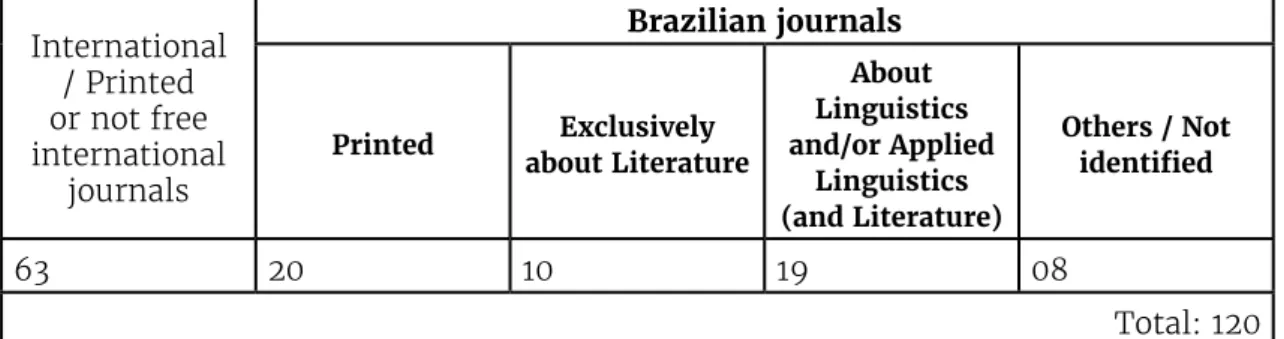
of Languages/Linguistic, the system provided a list with 120 journals (download in April, 2014). These journals were organized according to ive categories (Table 1).
Table 1. Classiication of national scientiic journals in the area of Languages/ Linguistic at the A1 level
International / Printed or not free international
journals
Brazilian journals
Printed Exclusively about Literature
About Linguistics and/or Applied
Linguistics (and Literature)
Others / Not identiied
63 20 10 19 08
Total: 120
For the purpose of the present research, only Brazilian journals that included studies on Linguistics and/or Applied Linguistics were
considered. Once these were identiied, the following criterion was the relevance of the title to the research group of LabLeR, as explained earlier, which led to the selection of ive titles. Information on these ive journals is given in the next subsections.
Linguagem em (Dis)curso
Linguagem em (Dis)curso (LemD), a publication of the
Universidade do Sul de Santa Catarina (UNISUL), focuses on “issues related to the ields of text and discourse” (LemD, 2014). Besides articles, the journal publishes presentations, essays, reviews,
editorials and retrospectives. However, for the purpose of the present
analysis, only the genre research article was mapped. From 2009 to 2013, a total of 103 articles were published by LemD in ifteen issues.
Gragoatá
Gragoatá is a publication of both the post-graduation program
in language studies and the post-graduation program in literary studies from Universidade Federal Fluminense (UFF). The journal publishes
research articles and reviews that are relevant to the linguistic and
459
IS
S
N
2
2
3
7
-6
3
2
Revista Brasileira de Linguística Aplicada
Revista Brasileira de Linguística Aplicada (RBLA), a publication
from Universidade Federal de Minas Gerais (UFMG), “encourages research in the ield of Applied Linguistics” (RBLA, 2014). Besides articles, the journal publishes reviews and interviews. In the eighteen issues published between 2009 and 2013, RBLA brings 192 articles.
Ilha do Desterro
Ilha do Desterro is a journal linked to the post-graduation
program from the Universidade Federal de Santa Catarina (UFSC) that
publishes, since 1979, original articles and reviews on the areas of English language, Literature and Cultural Studies.
The journal has released ten issues and a total of 112 articles. In relation to the issue 57, the nine studies published do not present abstract. For this reason, they were not considered part of this research sample, since the abstracts are the units that were initially analyzed to deine whether the journals present or not a multimodal study.
DELTA
Documentação de Estudos em Linguística Teórica e Aplicada (DELTA) is a publication from Pontifícia Universidade Católica de São Paulo (PUC-SP) “addressed to all areas of study concerning language and speech, whether theoretical or applied” (DELTA, 2014).
The journal publishes a wide variety of genres such as articles,
reviews, booknotes, debates, round tables. Considering exclusively the
number of articles, D.E.L.T.A has released 14 issues and a total of 105
articles.
Analytical procedures
460
449-477 jan/jun
2017
Secondly, the abstracts selected were classiied according to
nationality, that is to say, whether they were reporting a national or
international study by considering the author’s institutional ailiation. Only the national studies are relevant to this research, since the objective is to map the studies on multimodality in the Brazilian context.
Thirdly, the studies were classiied as theoretical or experimental. In this research, only the experimental ones were taken into account, since the objective here is to have a map of the genres that have already been investigated in order to ofer subsidy to language teaching. Typically, only experimental studies, as opposed to theoretical ones, develop the analysis of an object of study such as a genre.
Fourthly, the inal sample of abstracts and articles was analyzed
in order to identify, if possible, the four categories mentioned in the
objectives 1) theoretical and methodological trends; 2) genres being investigated; 3) the generic aspects being studied; and 4) the geographic distribution of the studies all over Brazil.
Lastly, the data was quantitatively and qualitatively analyzed in
order to verify if there is predominance in one or more categories, if it
is possible to ind any pattern in the studies. As a inal result, this study should provide a map of the multimodal studies developed in Brazil in terms of national journals.
Results and discussion
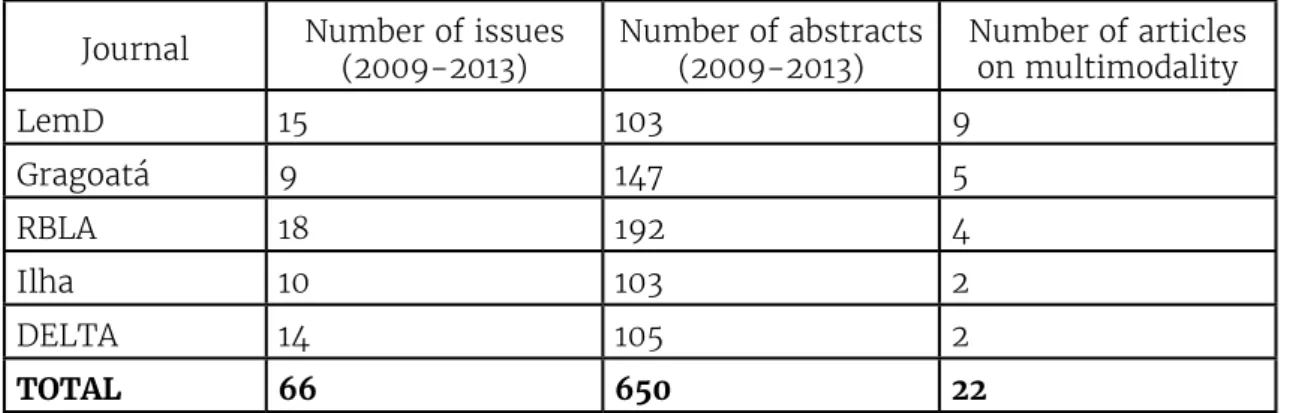
The results of the present study reveal that in the ive national journals selected for the analysis, only 22 articles out of a total of 650, are related to multimodality (Table 2).
Table 2.Number of experimental studies on multimodality in the ive national journals between 2009-2013
Journal Number of issues(2009-2013) Number of abstracts (2009-2013) Number of articles on multimodality
LemD 15 103 9
Gragoatá 9 147 5
RBLA 18 192 4
Ilha 10 103 2
DELTA 14 105 2
TOTAL 66 650 22
461
IS
S
N
2
2
3
7
-6
3
2
3,38% of the articles published in ive years address this topic. At least two reasons can be related to this low frequency. First, research on multimodality is in its infancy (BEZERRA; NASCIMENTO, 2013). Second, the wide variety of topics covered in the journals indicates that there is space to publish studies developed in diferent research groups, but multimodality does not seem to be a very addressed issue (Gragoatá, for example, includes linguistics and literature, Ilha covers English, literature and cultural studies and DELTA addresses theoretical and applied linguistics).
If, on the one hand, the average of studies on multimodality is low,
there has been a growth of interest on the topic in the investigated period
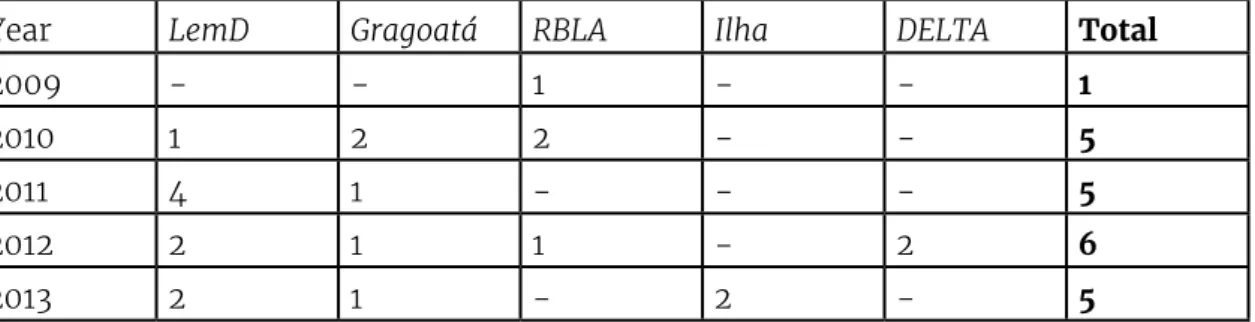
(2009-2013). Table 3 reveals this intensiication in the total amount of publications per year. Even though the rise was not continuous (there was a slight drop in 2013), in 2010 and 2011 the number of exemplars grew to ive per year and then to six in 2012 as compared to 2009, when
there was only one study published.
Table 3. Number of experimental studies on multimodality across time
Year LemD Gragoatá RBLA Ilha DELTA Total
2009 - - 1 - - 1
2010 1 2 2 - - 5
2011 4 1 - - - 5
2012 2 1 1 - 2 6
2013 2 1 - 2 - 5
Table 3 also shows that the interest on the ield has grown when each journal is considered separately. DELTA and Ilha include the topic in the later years (2012, 2013) and since 2010, LemD, Gragoatá and RBLA regularly publish at least one yearly article on multimodality. These 22
articles are then investigated in terms of the four aspects presented in
the objective of this study.
Theoretical and methodological trends
462
449-477 jan/jun
2017
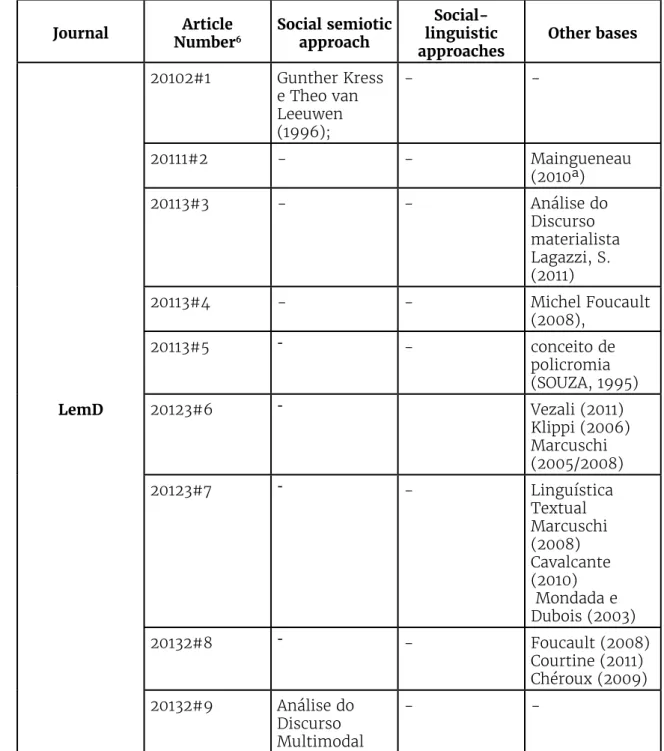
in each study. The studies that could not be related to one of these two perspectives were classiied as ‘other bases’. This third classiication
congregates authors and publications used in the articles to provide the theoretical and methodological frameworks for their analysis, but it does not assure that there was a focus on multimodality in the study or that these frameworks were used for the investigation of images other
than verbal language. These results are shown in Table 4.
Table 4.Theoretical and Methodological basis in the corpus of the experimental multimodal studies
Journal NumberArticle 6 Social semiotic approach
Social-linguistic approaches
Other bases
LemD
20102#1 Gunther Kress e Theo van Leeuwen (1996);
-
-20111#2 - - Maingueneau
(2010ª)
20113#3 - - Análise do
Discurso materialista Lagazzi, S. (2011)
20113#4 - - Michel Foucault
(2008),
20113#5 - - conceito de
policromia (SOUZA, 1995)
20123#6 - Vezali (2011)
Klippi (2006) Marcuschi (2005/2008)
20123#7 - - Linguística
Textual Marcuschi (2008) Cavalcante (2010) Mondada e Dubois (2003)
20132#8 - - Foucault (2008)
Courtine (2011) Chéroux (2009) 20132#9 Análise do
Discurso Multimodal
-
463
IS
S
N
2
2
3
7
-6
3
2
Gragoatá
201028#10 - - Bakhtin
(1959-1961/2003)
201029#11 - - Hénault (2006)
Greimas (1983) Greimas & Courtés (2008)
201131#12 - - Barthes (2003)
201233#13 - - Gestalt
Barthes (2008)
201334#14 - - Debord(1997);
Lacan (1998)
RBLA
20092#15 Kress e Van Leeuwen (2006)
-
-20101#16 - - Lemke (1995,
1998a, 1998b)
20102#17 - - Conceitos
Bakhtinianos 20104#18 Kress (2003)
Anstey; Bull (2010) Cope; Kalantzis (2000)
-
-Ilha
201364#19 Kress and van Leeuwen (1996, 2006) Mitchell’s (1995)
-
-201364#20 Kress& van Leeuwen (2001; 2006) Kress (2010)
-
-DELTA
2012si#21 Kress e van Leeuwen (1996)
-
-2012si#22 Kress & van Leeuwen (2006)
Hodge & Kress (1988)
Argyle (1975, ARGYLE & COOK, 1976)
-
464
449-477 jan/jun
2017
Table 4 reveals that the majority of studies on multimodality (thirteen of the twenty-two) are classiied in the “other bases” category. Two scientiic journals require special attention in this classiication
because of the number of studies that consider theoretical bases other
than the ones proposed by Bezemer and Jewitt (2010): LemD (six studies of nine) and Gragoatá (all ive studies). It is important to highlight
that all these studies consider semiotic modes other than the linguistic one and this could indicate a movement towards the consolidation of multimodality as a research area. However, their frameworks are not
typical and mainly recognized as focusing on multimodal aspects, since
they do not present categories for the analysis of images, such as the ones
used in the social semiotic and social-linguistic approaches (the two main perspectives within multimodality). In other words, images were
considered in the investigation, but the theoretical and methodological bases may not cover their analysis as they covered verbal language.
The second category in recurrence is the social semiotic approach which underlies the total number of studies on multimodality in DELTA and Ilha and a small number in RBLA and LemD (two for each journal). It is important to consider that the majority of studies presenting a
social semiotic approach use at least one of the Reading Images: The Grammar of Visual Design editions written by Kress and van Leeuwen in 1996 (irst edition) and 2006 (second edition): seven studies of eight. Such recurrence may be explained since the social semiotic approach is initially associated with the work of these authors (JEWITT, 2009).
Gragoatá is the only journal that does not present studies using the social semiotic approach. Also, the studies were published in diferent years (2010, 2011, 2012 e 2013). So, it may be possible to argue that this journal is more inclined to develop and publish researches on
“alternative bases”.
Table 4 also reveals that the social linguist approach is not often used in the analysis of non-verbal language in the context of these ive journals, since none of the studies of the corpus presented it in the literature review section. Also, based on the data, it seems uncommon
to combine two or more approaches in a same study.
465
IS
S
N
2
2
3
7
-6
3
2
Genres Investigated
The genres investigated in the 22 publications were mapped considering irstly a) the researchers deinitions of their object(s) of study as genre (example 1); secondly b) the critical genre analysis (MOTTA-ROTH, 2008) approach to genres (example 2); and thirdly c) situations in which the genres could not be identiied (example 3).
As shown in example 1, the article presents a discussion on the concept of genre using it to deine the object under analysis – MSN Messenger – as a digital genre. In such cases, explicit reference to the object of study as a genre was considered to map the genre under
investigation in the study.
Example 1. Extract from 20101#16 article
Aqui cabe, portanto, levantarmos uma discussão recente, que surgiu praticamente ao mesmo tempo que os gêneros digitais: se os, então, denominados “gêneros digitais”,
como e-mail, MSN Messenger, o blog, entre outros, seriam,
de fato, gêneros digitais ou se deveriam ser considerados apenas como suportes, ou meios digitais, para a produção e divulgação de gêneros digitais. Muito embora entendamos
alguns dos argumentos daqueles que defendem essa segunda
posição, muito ligada, a nosso ver, a uma visão tradicional de compreensão dos gêneros, defendemos neste trabalho uma outra visão: a de que esses suportes digitais seriam também gêneros digitais. (My emphasis)
In Example 2, on the other hand, the article does not make reference to the concept of genre. So, the objects under investigation will be considered according to Critical Genre Analysis understandings on such genre. Therefore, example 2 does not make explicit reference to the lag and logo as a genre, but it was classiied as one in the
present study because it is seen as a recurrent social process/action in
our society that is recognized by its conventional function and material
466
449-477 jan/jun
2017
Example 2. Extract from 20092#15 article
Na seção seguinte, após um breve histórico sobre o MST, será feita uma discussão sobre a construção da identidade coletiva por meio do modo visual a partir da noção de multimodalidade. Na sequência, serão analisadas algumas imagens que foram escolhidas, tendo-se em mente essa construção identitária. Primeiramente, a bandeira e seu logotipo, pois se constituem
provavelmente na imagem do MST mais veiculada pela mídia em geral e pelo próprio movimento. Como resultado, a bandeira transformou-se num poderoso ícone de autorrepresentação do sem-terra. Em seguida, serão analisadas as capas de duas
edições da Revista Sem Terra. A razão de sua escolha deve-se ao
fato de que, de alguma maneira, as imagens nelas impressas
demonstram uma busca pelo MST de atrair pessoas cuja identiicação com o movimento não é imediatamente óbvia, pois utilizam uma linguagem mais abstrata que em muito
difere de seu discurso ativista, fortemente centrado no modo
verbal. Por im, será examinada a relação entre fotos e legendas
em algumas imagens também retiradas de exemplares da revista[…]. (Myemphasis)
Lastly, example 3 refers to an article in which it was not possible to identify the object under analysis as a genre, although there was an object being investigated. Therefore, in such cases, the publication will
not be considered in the “genre investigated” category of analysis.
Example 3. Extract from 20124#18 article
WebQuests são ambientes multimodais de aprendizagem
colaborativa que incentivam os participantes a interagir no
processo de desenvolvimento de projetos on-line pelo uso da
web e de seus recursos. Representam um modelo de pesquisa
orientada, focada na busca de informações para resolver uma situação problema, realizada no espaço da internet (DODGE; MARCH, 2007; DODGE, 2008). As fontes de pesquisa são
recomendadas por meio dos links fornecidos para que os
467
IS
S
N
2
2
3
7
-6
3
2
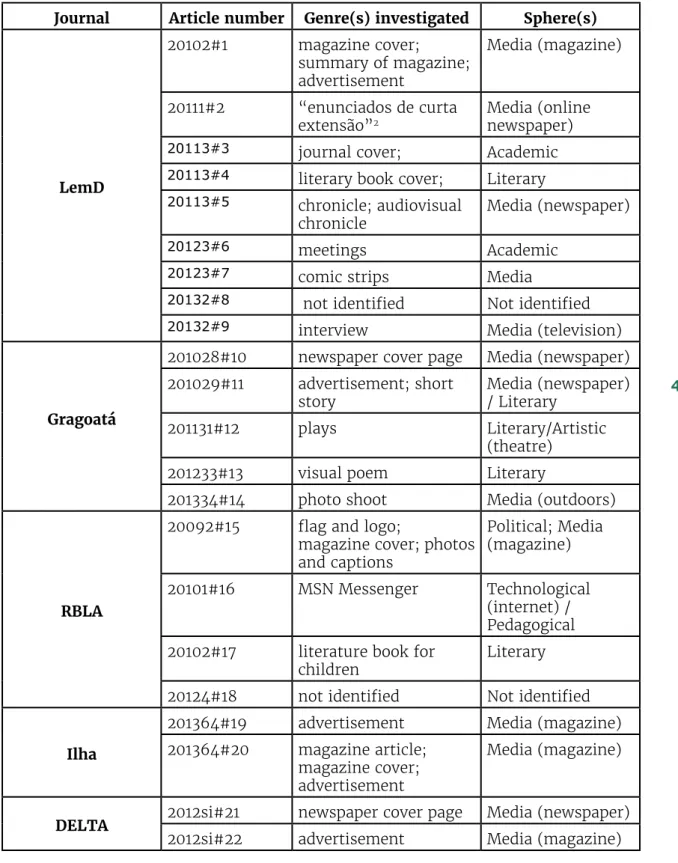
Based on these criteria, a number of diferent genres were identiied, as shown in Table 5.
Table 5 - Genres and spheres investigated in the corpus of the experimental studies on multimodality
Journal Article number Genre(s) investigated Sphere(s)
LemD
20102#1 magazine cover; summary of magazine; advertisement
Media (magazine)
20111#2 “enunciados de curta
extensão”2 Media (online newspaper)
20113#3 journal cover; Academic 20113#4 literary book cover; Literary 20113#5 chronicle; audiovisual
chronicle
Media (newspaper)
20123#6 meetings Academic 20123#7 comic strips Media
20132#8 not identiied Not identiied 20132#9 interview Media (television)
Gragoatá
201028#10 newspaper cover page Media (newspaper) 201029#11 advertisement; short
story
Media (newspaper) / Literary
201131#12 plays Literary/Artistic (theatre)
201233#13 visual poem Literary
201334#14 photo shoot Media (outdoors)
RBLA
20092#15 lag and logo;
magazine cover; photos and captions
Political; Media (magazine)
20101#16 MSN Messenger Technological (internet) / Pedagogical 20102#17 literature book for
children
Literary
20124#18 not identiied Not identiied
Ilha
201364#19 advertisement Media (magazine) 201364#20 magazine article;
magazine cover; advertisement
Media (magazine)
DELTA 2012si#21 newspaper cover page Media (newspaper)
468
449-477 jan/jun
2017
The results show that a massive quantity of genres comes from
the media sphere: twelve of the nineteen studies in which the genre
could be identiied. Two genres require a special attention since they are the most investigated: advertisement (ive studies) and magazine cover (three studies). This high frequency suggests that, although social practices are becoming more multimodal (BEZERRA; NASCIMENTO, 2013), the focus is still on genres that are obviously multimodal, that is to say, in which images clearly play a central role in realizing the genre. Perhaps, this emphasis may be explained by the recurrence of such genres in people’s daily life since it is possible to ind them in several contexts, such as magazines, newspapers, websites, outdoors,
pamphlets, shops.
It is also relevant to consider that although these two genres
were studied in several exemplars of the corpus, a wide range of other genres are also investigated under the media sphere, such as the comic
strip, the audiovisual chronicle, the newspaper page cover. This result shows the versatility of this sphere in holding a big number of diferent genres. Another important aspect is that all ive journals present at
least one genre belonging to the media sphere.
The second sphere in recurrence is the literary with ive genres
under investigation: literary book cover, plays, visual poem, short story
and literature book for children. Gragoatá covers three of these ive genres. This amount of publications in Gragoatá may be explained by the fact that the journal covers the ield of literature in addition to linguistics/applied linguistics. Only DELTA and Ilha do not consider
genres under this sphere in their publications, since it is not in the
scope of these journals as stated on their websites.
Among the twenty-two studies, two belong to the third criteria: situation in which no genre could be identiied. The focus of the
analysis in these two publications is not in a genre, but in a happening
(enunciado-acontecimento) and in a multimodal environment. Therefore
they could not be considered in the present analysis.
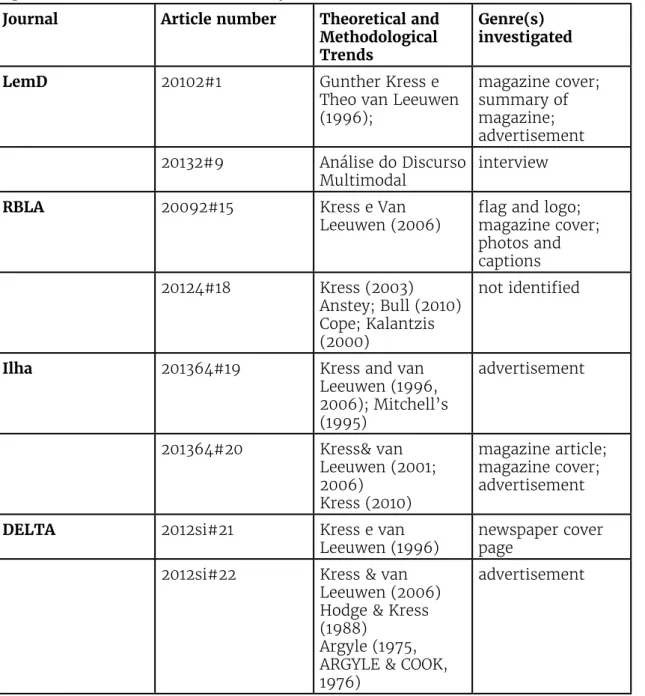
When crossing the data from the theoretical and methodological
trends with the genres investigated, it is possible to observe an interesting
469
IS
S
N
2
2
3
7
-6
3
2
Table 6. Genres investigated under the social semiotic approach in the corpus of the experimental studies on multimodality
Journal Article number Theoretical and Methodological Trends
Genre(s) investigated
LemD 20102#1 Gunther Kress e
Theo van Leeuwen (1996);
magazine cover; summary of magazine; advertisement 20132#9 Análise do Discurso
Multimodal interview
RBLA 20092#15 Kress e Van
Leeuwen (2006) lag and logo; magazine cover; photos and captions 20124#18 Kress (2003)
Anstey; Bull (2010) Cope; Kalantzis (2000)
not identiied
Ilha 201364#19 Kress and van
Leeuwen (1996, 2006); Mitchell’s (1995)
advertisement
201364#20 Kress& van Leeuwen (2001; 2006)
Kress (2010)
magazine article; magazine cover; advertisement
DELTA 2012si#21 Kress e van
Leeuwen (1996) newspaper cover page 2012si#22 Kress & van
Leeuwen (2006) Hodge & Kress (1988)
Argyle (1975, ARGYLE & COOK, 1976)
advertisement
By identifying the genres under investigation, it is relevant to see which aspect of these genres is actually being analyzed in each of these studies in the corpus. These results are discussed in the following section.
Generic Aspects
In order to locate the generic aspects being investigated in each of the 22 publications that belong to the corpus of the present study, only the objective(s) in the articles were considered.
470
449-477 jan/jun
2017
that underlie these studies. Therefore, for lack of time, space and
patterns, these results will not be shown and discussed. However, it would be interesting to consider, in further developments of the current study, what aspects are investigated only for the two most frequent
genres - advertisements and magazine covers.
The next stage of investigation refers to the geographical
distribution of these studies in the national territory.
Geographical distribution
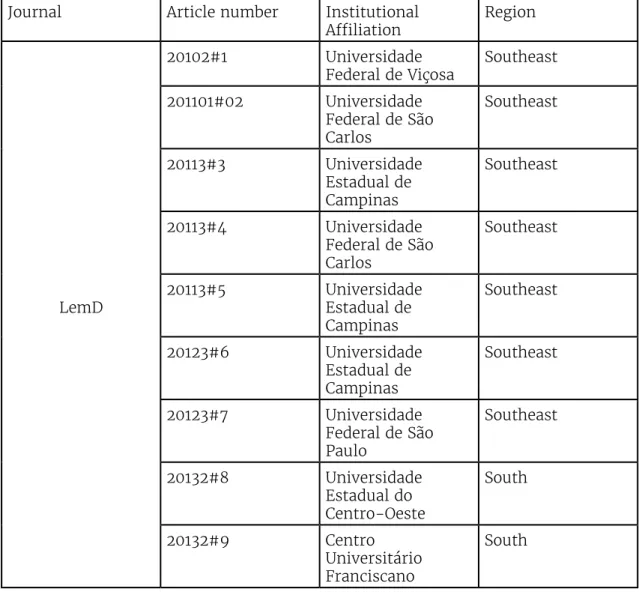
The studies were analyzed in terms of geographic distribution by considering the authors’ institutional ailiation. Table 7 details these data.
Table 7. Geographic distribution of experimental studies on multimodality
Journal Article number Institutional
Ailiation Region
LemD
20102#1 Universidade
Federal de Viçosa Southeast 201101#02 Universidade
Federal de São Carlos
Southeast
20113#3 Universidade Estadual de Campinas
Southeast
20113#4 Universidade Federal de São Carlos
Southeast
20113#5 Universidade Estadual de Campinas
Southeast
20123#6 Universidade Estadual de Campinas
Southeast
20123#7 Universidade Federal de São Paulo
Southeast
20132#8 Universidade Estadual do Centro-Oeste
South
20132#9 Centro
Universitário Franciscano
471
IS
S
N
2
2
3
7
-6
3
2
Gragoatá
201028#10 Universidade
Católica de Pelotas South 201029#11 Not mentioned --201131#12 Not mentioned --201233#13 Not mentioned --201334#14 Universidade de
Caxias do Sul South
RBLA
20092#15 Universidade
Federal do Sergipe Northeast 20101#16 Universidade
Federal de Mato Grosso do Sul
Midwest
20102#17 Universidade Federal de Minas Gerais
Southeast
20124#18 Universidade Federal de Minas Gerais
Southeast
Ilha 201364#19 Universidade Federal de Santa Catarina
South
201364#20 Universidade Federal de Minas Gerais
Southeast
DELTA
2012si#21 Universidade
Federal de Viçosa Southeast 2012si#22 Universidade
Federal de Minas Gerais
Southeast
The results presented in Table 7 show that the Southeast region stands in irst position in terms of the number of publications on
multimodality, since twelve articles derive from universities located
there. The most prominent states on this region are Minas Geraisand
São Paulo, since they hold all twelve publications (six for each state). This region is followed by the South with ive publications spatially distributed in all the three states of the region (three publications in Rio Grande do Sul and one in both Santa Catarina and Paraná). Both the Midwest and Northeast regions together present only one study on the
topic.
472
449-477 jan/jun
2017
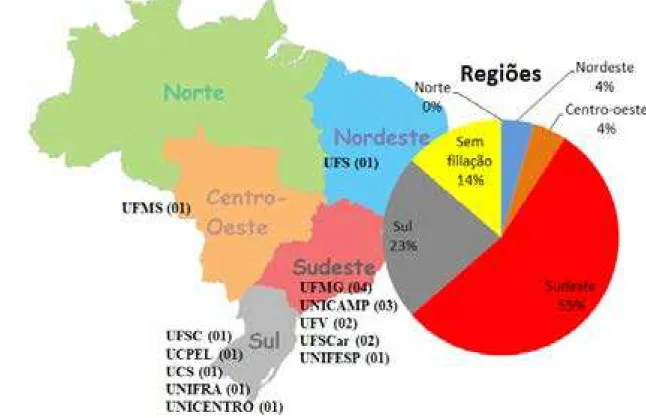
that interest on this area of study is not isolated, but of national
relevance, as visually represented in Figure 1.
Figure 1. Spatial distribution of experimental studies on multimodality in Brazil Considering each journal, there seems to be no direct relation
between each title and the geographical origin of the studies on
multimodality they publish. RBLA, for example, despite being ailiated to a Southeastern university from Minas Gerais, contains exemplars from three diferent regions (Northeast, Midwest, Southeast).
The data also reveal that the studies are spread in diferent universities in each region. South, for example, holds ive publications ailiated to ive diferent educational institutions. UFMG is the university that outstands, since it hosts four of the twelve studies. In this view, except UFMG and perhaps Unicamp (three publications), there seems to be no research niches on multimodality in terms of universities. If, on the one hand, it is not reliable to airm the existence of research
groups on multimodality, it may be possible to consider that this topic
is drawing attention of researchers in many diferent educational
institutions.
Two interesting patterns could be addressed when crossing the
473 IS S N 2 2 3 7 -6 3 2
location. Firstly, the identiication of three studies ailiated to UFMG as belonging to the social semiotic approach. Apart from being the
university with the highest number of publications on multimodality,
almost all of them (three in four) use the same theoretical and
methodological basis to the analysis of genres. Considering these data,
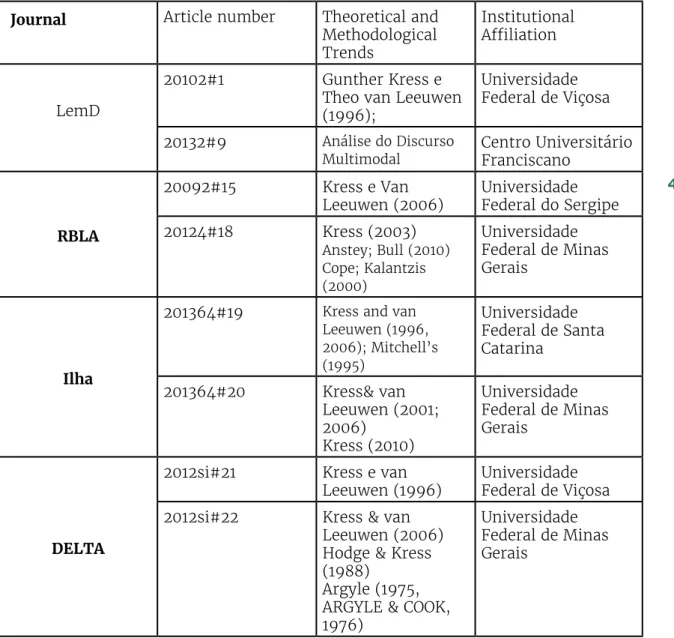
UFMG is the closest university to be classiied as holding a research niche on multimodality. Secondly, adding the three studies ailiated to UFMG and the two to UFV, these ive publications using the social semiotic approach conigures Minas Gerais as the state holding the majority of studies in such approach (Table 8).
Table 8. Relation between social semiotic approach and institutional ailiation of experimental studies on multimodality
Journal Article number Theoretical and
Methodological Trends
Institutional Ailiation
LemD
20102#1 Gunther Kress e Theo van Leeuwen (1996);
Universidade Federal de Viçosa
20132#9 Análise do Discurso
Multimodal Centro Universitário Franciscano
RBLA
20092#15 Kress e Van
Leeuwen (2006) Universidade Federal do Sergipe 20124#18 Kress (2003)
Anstey; Bull (2010) Cope; Kalantzis (2000)
Universidade Federal de Minas Gerais
Ilha
201364#19 Kress and van Leeuwen (1996, 2006); Mitchell’s (1995)
Universidade Federal de Santa Catarina
201364#20 Kress& van Leeuwen (2001; 2006)
Kress (2010)
Universidade Federal de Minas Gerais
DELTA
2012si#21 Kress e van
Leeuwen (1996) Universidade Federal de Viçosa 2012si#22 Kress & van
Leeuwen (2006) Hodge & Kress (1988)
Argyle (1975, ARGYLE & COOK, 1976)
Universidade Federal de Minas Gerais
The other combinations, such as genres investigated and the
474
449-477 jan/jun
2017
Final remarks
The present research aimed at the investigation of the
experimental studies on multimodality developed in the national
context considering ive years (2009 – 2013). To do so, the corpus of the research counted with ive Brazilian scientiic journals – LemD, Gragoatá, RBLA, Ilha and DELTA - in order to map the 1) theoretical and methodological basis that underlies the studies; 2) the genres investigated; 3) the generic aspects approached; and 4) the geographical
distribution of these studies.
In summary, the results reveal that in a total of 650 abstracts
scanned for key words typically connected to studies on multimodality,
only 22 could be identiied. Although the small amount of publications on
multimodality, it was possible to note a growth in the number of studies
in the period investigated (one study to six studies). When addressing the theoretical and methodological trends, considering Bezemer and Jewitt’s (2010) classiication of the approaches to multimodality, it was
possible to observe that the social semiotic basis outstands in relation
to the social linguistic (despite the fact that the majority of the studies belong to bases other than these two). This approach conigures an
interesting pattern when combined with the genres investigated: almost all these studies are connected to the media sphere, especially
magazine cover and advertisements. When considering the geographic distribution, the Southeast region holds the majority of the studies from the corpus, with special attention to the states of Minas Gerais and São Paulo. Another interesting pattern can be observed by crossing the studies on multimodality classiied in the social semiotic with the geographic distribution. This combination suggests that UFMG is the
closest university to be considered as a niche of study on multimodality.
This study, similarly to the previous studies developed within the umbrella project and/or by our research group at LabLeR, such as the
analysis of the relation between verbal and non-verbal texts in electrical
engineering research articles (NASCIMENTO, 2002); analysis of comic strips from the perspective of multimodality (CATTO; HENDGES, 2010), analysis of the image in popular science news (HENDGES; NASCIMENTO; MARQUES, 2014), this study has the intention of contributing to the consolidation of the still young area of multimodality (BEZERRA; NASCIMENTO, 2013) in the Brazilian context.
475
IS
S
N
2
2
3
7
-6
3
2
analysis also intend to contribute, in terms of pedagogical applications,
to help students and researchers interested in the ield of multimodality to ind previous studies, research groups, universities interested in the
topic, genres and generic aspects already investigated, theoretical and methodological approaches used by providing them with a panorama of
the ield in the context of A1 national journals.
Three considerations in relation to the limitations of the present study need to be addressed: irst, we understand that the number of journals selected and the corpus of the present research is still small to fulill the purpose of this study in such a national magnitude and,
for this reason, further research needs to be conducted. However, these results can be considered an initial view of studies on multimodality in
the speciic context of A1 national context. Second, we tried to delimit
keywords to reach the largest number of studies on multimodality when scanning the abstracts. However, it is highly possible that these words
have not covered all the studies considering multimodal aspects. Third, for lack of time, other national journals or even diferent contexts could not be included in the present study. In light of these considerations, further research about the situation of multimodality in Brazil is necessary to provide a wider view of the ield in our country and a more
solid amount of data for language teaching within the perspective of
multiliteracies (THE NEW LONDON GROUP, 1996).
References
BEZEMER, J.; JEWITT, C. Multimodal analysis: key issues. In: LITOSSELITI, L.
(Ed.). Research methods in linguistics. London: Continuum, p.180-197, 2010.
BEZERRA, F. A. S.; NASCIMENTO, R. G. do. The role of multimodality labs in
multiliteracy projects.Ilha do Desterro, v.64, p.135-171, 2013.
CAPES. Available at:
http://www.capes.gov.br/servicos/sala-de-imprensa/36-noticias/2550-capes-aprova-a-nova-classiicacao-do-qualis. Accessed in April, 2014. 2009.
CATTO; N. R.; HENDGES; G. R. Análise de gêneros multimodais com foco em
tiras em quadrinho. Signum, n. 13/2, p. 193-217, 2010.
DELTA. About the journal. Available at http://www.scielo.br/scielo.
php?script=sci_serial&pid=0102-4450&lng=en&nrm=iso . Accessed on April, 2014. 2014.
GRAGOATÁ. Policies. Available at http://www.gragoata.uf.br/index.php/
476
449-477 jan/jun
2017
HENDGES, G. R. Projeto GAP/CAL 031609 - Análise crítica de gêneros e
implicações para os multiletramentos. Santa Maria: Universidade Federal de Santa Maria, 2012.
HENDGES; G. R.; NASCIMENTO; R. G.; MARQUES, P. M. A gramática da imagem como ferramenta na análise crítica de gêneros midiáticos. In: SEIXAS; L.; PINHEIRO; N. F. (Orgs.). Gêneros: Um diálogo entre Comunicação e Linguística. Insular: Florianópolis, 2014.
IEDEMA, R. Multimodality, resemiotization: extending the analysis of discourse as multi-semiotic practice. Visual Communication, v.2, n.1, p.29-57, 2003.
JEWITT, C. Diferent approaches to multimodality. In: JEWITT, C. The
Routledge handbook for multimodal analysis. London: Routledge, p.28-39, 2009.
KRESS, G. Multimodality: challenges to thinking about language. TESOL
Quarterly, v.34, p. 337-340, 2000.
KRESS, G.; van LEEUWEN, T. Reading images. 1. ed. London: Routledge, 1996.
KRESS, G.; van LEEUWEN, T. Reading images.2. ed. London: Routledge, 2006.
LEMD. Editorial policies. Available at http://www.portaldeperiodicos.unisul.
br/index.php/Linguagem_Discurso/about/editorialPolicies . Accessed in April, 2014. 2014.
MOTTA-ROTH, D. Questões de metodologia em análise de gênero. In
KARWOSKI, A. M.; GAYDECKA, B.; BRITO, K. S. (Orgs.).Gêneros textuais:
relexões e ensino. Rio de Janeiro: Lucerna, 2005.
MOTTA-ROTH, D. Questões de metodologia em análise de gênero. In
KARWOSKI, A. M.; GAYDECKA, B.; BRITO, K. S. (Orgs.).Gêneros textuais:
relexões e ensino.2 ed. Revista a Aumentada. Rio de Janeiro: Lucerna, p. 145-163, 2006.
MOTTA-ROTH, D. Análise crítica de gêneros: contribuições para o ensino e a
pesquisa de linguagem. D.E.L.T.A., v. 24, n.2, p. 341-383, 2008.
NASCIMENTO; R. G. A interface texto verbal e texto não-verbal no artigo
acadêmico de engenharia elétrica. 2002, 115 f. Dissertação (Mestrado em Letras). Universidade Federal de Santa Maria, Santa Maria, 2002.
NASCIMENTO, R. G. Research genres and multiliteracies: channeling the
audience’s gaze in powerpoint presentations. 2012, 231f. Tese (Doutorado em Letras Inglês).Universidade Federal de Santa Catarina, Florianópolis, 2012.
O´TOOLE, M. The language of displayed art. Leicester: Leicester University
Press, 1994.
RBLA. Editorial policies. Available at http://periodicos.letras.ufmg.br/index.
477
IS
S
N
2
2
3
7
-6
3
2
THE NEM LONDON GROUP. A Pedagogy of multiliteracies: designing social
futures. Harvard Educational Review, v.66, n.1, p. 60-92, 1996.
UNSWORTH, L. Teaching multiliteracies across the curriculum: changing
contexts of texts and image in classroom practice. Buckingham: Open University, 2001.