Arq Neuropsiquiatr 2007;65(4-B):1126-1129
1126
CHRONIC DAILY HEADACHE
Stress and impact on the quality of life
José Carlos Busto Galego
1, Avelina Maria Moraes
2,
José Antonio Cordeiro
3, Waldir Antonio Tognola
1ABSTRACT-Objective: To evaluate the stress presence and its influence in the quality of life of patients with chronic daily headache (CDH). Method: A hundred patients with at least 18 years old, with primary head-ache with duration greater than 4 hours a day, and frequency of 15 or more days monthly for at least three months were studied. Lipp´s Inventory of Stress Symptoms and the Medical Outcomes Study Short Form (SF-36) were used. Results: Stress was observed in 90% of the patients; nearly half of them was in the phase almost exhaustion. Patients with stress when compared with the ones with no stress presented significant-ly lower scores in all the domains of SF-36; except in physical functioning. The resistance phase presented scores significantly higher than almost exhaustion; except for bodily pain. Conclusion: The majority of the patients presented stress with significant reduction in their quality of life. Consequently, the stress could be related with both the development and the maintenance of CDH.
KEY WORDS: chronic daily headache, stress, quality of life.
Cefaléia crônica diária: estresse e impacto sobre a qualidade de vida
RESUMO-Objetivo: Avaliar a presença de estresse e sua influência na qualidade de vida dos pacientes com cefaléia crônica diária (CCD). Método: Foram estudados 100 pacientes com idade mínima de 18 anos, apre-sentando cefaléia primária com duração maior que 4 horas e freqüência de 15 ou mais dias por mês, há pelo menos três meses. Foram aplicados o Inventário de Sintomas de Estresse de Lipp e o Questionário SF-36 de Pesquisa em Saúde (SF-36). Resultados: Estresse foi observado em 90% dos pacientes; aproximadamente metade deles estava na fase de quase exaustão. Pacientes com estresse comparados àqueles sem estresse, apresentaram pontuações significativamente menores em todas as escalas do SF-36; exceto em capacidade funcional. A fase de resistência apresentou pontuações significativamente maiores que quase exaustão; ex-ceto para dor corporal. Conclusão: A grande maioria dos pacientes apresentou estresse com redução sig-nificativa na qualidade de vida. Consequentemente, o estresse poderia estar relacionado tanto no desen-volvimento como na manutenção da CCD.
PALAVRAS-CHAVE: cefaléia crônica diária, estresse, qualidade de vida.
Department of Neurological Sciences, Medical School of São José do Rio Preto, São José do Rio Preto SP, Brazil: 1Ph.D., Professor, Clinical Neurology, Medical School of São José do Rio Preto; 2Psychologist; 3PhD, Professor, Epidemiology Departament, Medical School of São José do Rio Preto.
Received 5 July 2007. Accepted 14 September 2007.
Dr. José Carlos Busto Galego - Rua Professor Nelson I. Bento Lutaif 145 - 15091-550 São José do Rio Preto SP - Brasil. E-mail: [email protected]
The term chronic daily headache (CDH) compris-es a group of headachcompris-es that manifcompris-ests in 15 or more days a month, lasting more than 4 hours, including the headaches associated with the excessive use of medication1. The prevalence in the general
popula-tion ranges from 3 to 5%, and women are the most affected2-4. Several factors are related with CDH
devel-opment: abnormal profi le of the personality; stress; the excessive use of symptomatic medication; arteri-al hypertension; the use of contraceptives or estro-gen replacement and traumatic life events5.
Exces-sive use of medication is considered the main
progres-sion factor for the CDH stage6, however, the stress is
mentioned as one of the most frequent factors in pre-cipitating and worsening headache episodes7,8. Stress
represents the tension sensation, anguish and discom-fort that an individual can experiment. Those sensa-tions would be consequence of important emotional events and or physical and mental disorders. Basical-ly, stress development depends on both the interpre-tation of the triggering factors and the coping strat-egies. The personality characteristics can also deter-mine the individual’s answer to stress9. At
Arq Neuropsiquiatr 2007;65(4-B)
1127
Chronic headache: stress and quality of life Galego et al.
alert, resistance and exhaustion. Due to the fact that the resistance phase is very extensive, Lipp et al.10
pro-posed a fourth phase of stress development namely the almost exhaustion. Therefore in Lipp´s model, the stress could develop in the following way: alert phase, resistance, almost exhaustion and exhaustion.
Headache is a subjective complaint that in its prima-ry form is not detected by specifi c examinations; more-over, it does not increase the mortality. Impairments associated with headaches were considered less signif-icant than those attributed to the systemic chronic dis-eases. However, patients with chronic headaches com-plain about signifi cant well-being impairment with damage in their quality of life11. Most studies have
re-ported the consequences of migraine in the quality of life12-17; few reported the quality of life of patients
with CDH18-22. When compared to the general
popu-lation, the patients with CDH present signifi cant re-duction in all SF-36 domains22. Besides daily headache,
other factors such as depression, anxiety and stress can affect the quality of life of patients with CDH. The objective of this study was to evaluate the stress presence and its infl uence in the quality of life of patients with CDH.
METHOD
A hundred patients, both sexes, at least 18 years old were prospectively studied. They were assisted at the head-ache inpatient unit of Hospital de Base, São José do Rio Pre-to, SP. The inclusion criterion was the presence of primary headache, with duration greater than 4 hours a day and frequency of 15 or more days monthly for at least three months. The patients were admitted in the study consec-utively, after their informed and free consent term on the research objectives. This project was approved by the Com-mittee of Ethics in Research of Medical School, São José do Rio Preto, SP.
The diagnosis of the type or types of the present
head-aches was made according to The International Classifi
ca-tion of Headache Disorders, 2nd Edition23.
In the selected patients, Lipp´s Inventory of Stress Symp-toms for Adults (ISSL)24 was applied to observe the presence
and the stress level; the Medical Outcomes Study Short Form (SF-36) 25, to evaluate the quality of life.
ISSL, a research instrument, validated by Lipp and Guevara in 199426, is used to evaluate if the patient has stress, in which
phase is (alert, resistance, almost exhaustion or exhaustion) and if the symptoms indicate physical or psychological stress. SF-36, a generic questionnaire, translated and
validat-ed for the Portuguese language27 is used to evaluate the
quality of life related to health. It has 36 items that include 8 domains: physical functioning, role physical, bodily pain, general health, vitality, social functioning, role emotional and mental health. Each SF-36 domain presents a fi nal score ranging from 0 to 100. Zero indicates the worst life quality related to the health and 100 the best.
Patients with chronic organic diseases were not includ-ed in the study. In the statistical analysis, comparisons of
two means were performed by the test t and medians were
compared by Mood’s Median Test. The level of signifi cance
0.05 was adopted.
RESULTS
At the fi rst consultation, the patients’ mean age was 38.8 years with an 11.7 standard deviation, rang-ing from18 to 73 years. Figure 1 shows the distribution according to gender and the patients’ age groups with CDH. Women were the majority in this group (87%). The mean duration of CDH was 4.0 years with standard deviation of 5.6 years, varying between three months and 30 years of duration.
Applying the criteria of the second edition of the International Classifi cation of Headaches, 17 different types of diagnosis were necessary to classify all the 100 patients with CDH. Table 1 shows the distribution of the different types of diagnosis obtained.
The stress presence, the stress phase and the type of the predominant symptom (psychological or physi-cal) were observed in the patients through ISSL. Stress was found in 90% of the patients. The distribution of the patients´ stress phases is showed in Figure 2. Among those that presented stress, the prevalence of symptoms in 94.5% was psychological; in 3.3% phys-ical, and in 2.2% combined symptoms.
Fig 1. The patients´ age and gender.
Arq Neuropsiquiatr 2007;65(4-B)
1128
Chronic headache: stress and quality of life Galego et al.
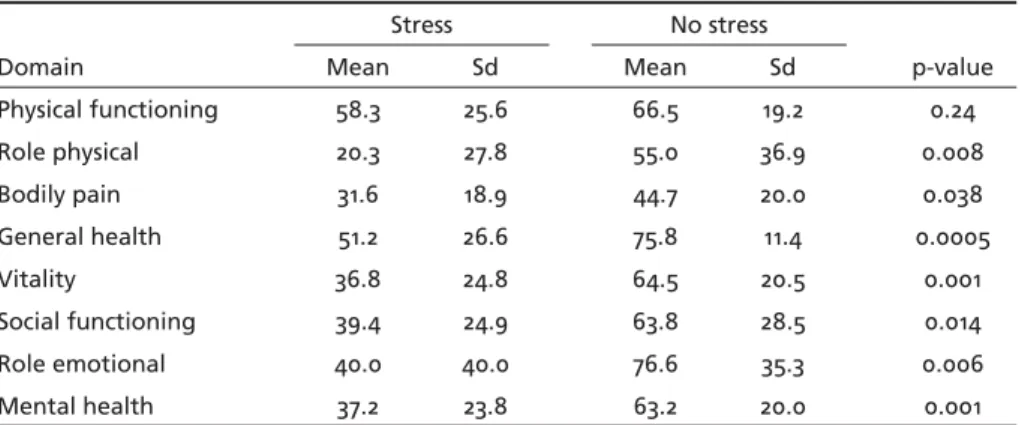
Table 2 shows the comparison of SF-36 scores among the patients with CDH who presented and did not present stress. The patients with stress pre-sented scores signifi cantly lower in all SF-36 domain (testt for two samples), except for the physical func-tioning domain.
Stress phases were compared with the scores in the eight domains of the SF-36 obtained by the patients. This comparison was made between the resistance, al-most exhaustion and exhaustion phases since only two patients were found in the alert phase of stress (Fig 3).
DISCUSSION
Primary chronic headaches as migraine and ten-sion-type headache are frequently associated to the psychological stress7,8. In relation to CDH, Galego et
al.28 found the emotional stress as the main
precipi-tating factor (75%) of headache to transformed mi-graine. Stress is also mentioned as a development fac-tor for CDH6.
In our study, stress was observed in 90% of the patients, and the great majority (94.5%) presented the symptoms of psychological stress. This suggests that the anxiety symptoms, tension, distress, insom-nia, diffi culties with the memory, excessive concern, emotional instability and relaxing diffi culties are fre-quent in patients with CDH.
According to the distribution of stress phases, ap-proximately half (51.1%) of the patients was in the phase of almost exhaustion. In that phase, the patients although presenting some distress and other symptoms, they are still able to work, but with some limitation29.
Comparing SF-36 scores among patients with CDH presenting stress and the ones without stress; except for the domain physical functioning, the fi rst present-ed scores signifi cantly lower in all the domains. This may indicate the stress negative infl uence on the qual-ity of life of the patients with CDH.
We also compared the stress phases with the scores obtained by the patients in each of the SF-36 domains. Except for the bodily pain domain, the patients have presented scores signifi cantly higher in the resistance phase than those in the phase of almost exhaustion. However, the patients in the exhaustion phase, except for role physical, have not presented signifi cant differ-ences comparing with those in the resistance phase.
Compared to the resistance phase, the patients in the exhaustion phase should also present an inferior quality of life, this is what is expected. Due to its own defi nition, in exhaustion phase there is a lack of re-sistance with psychological and physical exhaustion
Table 1. Diagnostic types in CDH.
Diagnostics Number of pacients
M+CTTH 25
M+CTTH+PMOH 21
M+PCM+PMOH 9
M+MA+CTTH 6
PM+CTTH 6
M+MA+CTTH+PMOH 6
MA+CTTH 5
pCTTH+ PMOH 5
CTTH 4
M+CM 3
NDPH 2
PM+CTTH+PMOH 2
M+MA+PCM+PMOH 2
M+MA+ETTH 1
HC 1
M+MA+CM 1
MA+CTTH+PMOH 1
M, migraine; MA, migraine with aura; CM, chronic migraine; PCM, prob-able chronic migraine; PM, probprob-able migraine; pCTTH, probprob-able chronic tension-type headache; PMOH, probable medication overuse headache; CTTH, chronic tension-type headache; ETTH, episodic tension-type head-ache; NDPH, new daily persistent headhead-ache; HC, hemicrania continua.
Table 2. Comparative analysis between stress and quality of life.
Domain
Stress No stress
p-value
Mean Sd Mean Sd
Physical functioning 58.3 25.6 66.5 19.2 0.24
Role physical 20.3 27.8 55.0 36.9 0.008
Bodily pain 31.6 18.9 44.7 20.0 0.038
General health 51.2 26.6 75.8 11.4 0.0005
Vitality 36.8 24.8 64.5 20.5 0.001
Social functioning 39.4 24.9 63.8 28.5 0.014
Role emotional 40.0 40.0 76.6 35.3 0.006
Arq Neuropsiquiatr 2007;65(4-B)
1129
Chronic headache: stress and quality of life Galego et al.
and, consequently, some diseases can appear29. In this
phase, the individual may become anergic with no satisfactorily answer to negative or positive environ-mental stimuli. This may suggest that in the exhaus-tion phase of the stress, the SF-36 quesexhaus-tionnaire could be less sensitive in measuring the life quality with fewer reliable results.
In our study the great majority of patients present-ed stress with signifi cant reduction in their quality of life. Consequently, the stress could be considered as a factor either in the development and maintenance of daily or almost daily headaches. Therefore, iden-tifying the presence and the stress level of patients with CDH can provide important information for the therapeutic approaches.
REFERENCES
1. Silberstein SD, Lipton RB, Solomon S, Mathew NT. Classifi cation of daily and near-daily headaches: Proposed revisions to the IHS criteria. Head-ache 1994;34:1-7.
2. Scher AI, Stewart WF, Liberman J, Lipton RB. Prevalence of frequent headache in a population sample. Headache 1998;38:497-506. 3. Castillo J, Muñoz P, Guitera V, Pascual J. Epidemiology of chronic
dai-ly headache in the general population. Headache 1999;39:190-196. 4. Lanteri-Minet M, Auray JP, EI Hasnaoui A, Dartigues JF, et al.
Preva-lence and description of chronic daily headache in the general popula-tion in France. Pain 2003;102:143-149.
5. Mathew NT, Stubits E, Nigam MR. Transformation of episodic migraine into daily headache: analysis of factors. Headache 1982;22:66-68. 6. Mathew NT. Transformed migraine, analgesic rebound, and other
chron-ic daily headaches. Neurol Clin 1997;15:167-186.
7. Rasmussen BK. Migraine and tension-type headache in a general pop-ulation: precipitating factors, female hormones, sleep paĴ ern and rela-tion to lifestyle. Pain 1993;53:65-72.
8. Spierings EL, Ranke AH, Honkoop PC. Precipitating and aggravating fac-tors of migraine versus tensio-type headache. Headache 2001;41:554-558. 9. Stronks DL, Tulen JH, Pepplinkhuizen L, et al. Personality traits and
psy-chological reactions to mental stress of female migraine patients. Cepha-lalgia 1999;19:566-574.
10. Lipp MN. O modelo quadrifásico do stress. In Lipp MN (org). Mecan-ismos neuropsicofi siológicos do Stress: teoria e aplicações clínicas. São Paulo: Casa do Psicólogo, 2003: 17-21.
11. Solomon GD, Skobieranda FG, Gragg LA. Quality of life and
well-be-ing of headache patients: measurement by the medical outcomes study instrument. Headache 1993;33:351-358.
12. Osterhaus JT, Towsend RJ. The quality of life of migraineurs: a cross sec-tional profi le. Cephalalgia 1991;11(Supl 11):S103-S104.
13. Dahlof C, Dimenas E. Migraine patients experience poorer subjective well-being/ quality of life even between aĴ acks. Cephalalgia 1995;15:31-36. 14. Michel P, Dartigues JF, Lindoulsi A, Henry P. Loss of productivity and
quality of life in migraine suě erers among French workers: results from the GAZEL cohort. Headache 1997;37:71-78.
15. Terwindt GM, Ferrari MD, Tħ huis M, Groenen SM, Picavet HS, Launer LJ. The impact of migraine on quality of life in the general population. The GEM study. Neurology 2000;55:624-629.
16. Lipton RB, Stewart WF, Sawyer MB, Edmeads JG. Clinical utility of an instrument assessing migraine disability: the migraine disability assess-ment (MIDAS) questionnaire. Headache 2001;41:854-861.
17. Lipton RB, Bigal ME, Kolodner K, Stewart WF, Liberman JN, Steiner TJ. The family impact of migraine: population-based studies in the USA and UK. Cephalalgia 2003;23:429-440.
18. Solomon GD, Skobieranda FG, Gragg LA. Does quality of life diě er among headaches diagnoses? Analysis using the medical outcome study instrument. Headache 1994;34:143-147.
19. Cavallini A, Micieli G. Bussone G, Rossi F, Nappi G. Headache and qual-ity of life. Headache 1995;35:29-35.
20. Monzon MJ, Lainez MJ. Quality of life in migraine and chronic daily headache. Cephalalgia 1998;18:638-643.
21. Meletiche DM, Lofl and JH, Young WB. Quality of life: diě erences be-tween patients with episodic and transformed migraine. Headache 2001;41:573-578.
22. Guitera V, Muñoz P, Castillo J, Pascual J. Quality of life in chronic daily headache: a study in general population. Neurology 2002;58:1062-1065. 23. Classifi cation CommiĴ ee of the International Headache Society. Classi-fi cation and diagnostic criteria for headache disorders, cranial neural-gia and facial pain. Second Edition. Cephalalneural-gia 2004;(Supl 1):S1-S160. 24. Lipp MN. Manual do inventário de sintomas de stress para adultos de
Lipp (ISSL). São Paulo: Casa do Psicólogo; 2000.
25. Ware JE Jr, Sherbourne CD. The MOS 36-item Short-Form Health sur-vey (SF-36): I. Conceptual framework and item selection. Med Care 1992;30:473-483.
26. Lipp MN, Guevara AJ. Validação empírica do inventário de sintomas de stress. Estudos de Psicologia 1994;11:42-49.
27. Ciconelli RM, Ferraz MB, Santos W, Meinão I, Quaresma MR. Tradução para a língua portuguesa e validação do questionário SF-36. Rev Bras Reumatol 1999;39:143-150.
28. Galego JC, Cipullo JP, Cordeiro JA, Tognola WA. Clinical features of ep-isodic migraine and transformed migraine: a comparative study. Arq Neuropsiquiatr 2002;60:912-916.
29. Lipp MN. O modelo quadrifásico do stress. In Lipp MN (org). Mecan-ismos neuropsicofi siológicos do stress: teoria e aplicações clínicas. São Paulo: Casa do Psicólogo, 2003:17-21.