Received on 03/05/2009. Approved on 10/04/2010. We declare no conflict of interest.
Instituto de Ciências da Saúde and Instituto de Ciências Humanas, Letras e Artes. Universidade Feevale, Novo Hamburgo, Brazil.
1. Physical Therapist, Master’s Degree in Environmental Quality at Universidade Feevale, Adjunct Professor of the Physical Therapy Course at Universidade Feevale 2. Biomedical Instituto de Ciências da Saúde, Universidade Feevale
3. Psychology Undergraduate student, Instituto de Ciências Humanas, Letras e Artes, Universidade Feevale 4. B.Sc. in Biomedical Sciences, Master’s Degree in Environmental Quality at Universidade Feevale
5. Psychologist, Master’s Degree and Ph.D. in Psychology; Full Professor of the Psychology Course, and Master’s Degree in Accessibility and Social Inclusion at Universidade Feevale
6. Biologist, Master’s Degree and Ph.D. in Genetics and Molecular Biology; Full Professor of the Psychology and Biomedical Sciences Courses, and Master’s degree in Environmental Quality at Universidade Feevale
Correspondence to: Fabiana Michelsen de Andrade. Pró-Reitoria de Pesquisa, Tecnologia e Inovação – PROPI, Sala 201 F. Universidade Feevale; RS 239, nº 2755. Vila Nova, Novo Hamburgo, RS. CEP 93352-000. Phone: +55 51 3586-8800, ext. 8938/ Fax: +55 51 3586-8800, ext. 9000.
E-mail: [email protected]
Association between environmental
quality, stress and APOE gene variation in
ibromyalgia susceptibility determination
Roze Mary Ribas Becker1, Vanessa Kappel da Silva2, Fernanda da Silva Machado2, Adriana Freitag dos Santos3,
Daiane Cristine Meireles3, Michelle Mergener4, Geraldine Alves dos Santos5, Fabiana Michelsen de Andrade6
ABSTRACT
Introduction: Fibromyalgia is a multifactorial disease, of which etiology is based on interaction between genetic suscep-tibility and environment. However, few studies attempted to identify the risk factors. Objective: To investigate the genetic inluence and its interaction with environmental quality and stress, as possible risk factors for ibromyalgia development. Patients and Methods: This cross-sectional study investigated two groups of women, of which 47 had a clinical diagnosis of ibromyalgia, and 41 women comprising thre control group, all from the town of Novo Hamburgo, RS. The apolipo -protein E (APOE) gene polymorphism was analyzed in DNA extracted from total blood, in both samples. Environmental factors were studied through Lipp’s Inventory of Stress Symptoms for Adults and by applying the WHOQOL-100 domain V. Results: Among the patients, more women had high stress levels when compared to the control sample (P < 0.001); mo-reover, the average scores of the WHOQOL-100 domain V, which analyze environment quality, were lower in this group (P < 0.001). APOE genotypic and allelic frequencies were similar between the two groups. Multivariate analysis showed that low WHOQOL-100 scores increase the chance of disease development by 57.7 times (P < 0.001), and that high stress levels were related with the disease (OR = 197.2; P < 0.001). This approach pointed out an interaction between stress and presence of E*2 allele (P = 0.028). Fibromyalgia was much more frequent in patients with high stress levels that were E*2 non-carriers (estimated OR = 265.1), when compared to patients with the same stress level, but E*2 carriers (estimated OR = 1.06). Conclusion: E*2 allele presence could have a protective action regarding the association between ibromyalgia and stress.
Keywords: ibromyalgia, stress,environmental quality,gene x environment interaction, apolipoprotein E.
INTRODUCTION
Fibromyalgia (FM) is a disease characterized by a clinical history of generalized muscle pain for more than three months and by
speciic tender points. The diagnosis is basically clinical1 with no evidence of laboratory or imaging abnormalities. According
to Neumann and Buskilla,2 the prevalence of ibromyalgia in
different countries is estimated at 2% in general population. The syndrome prevalence increases with age (approximately 1% in women aged 18 to 29 years and 7% in women aged 70 to 79
years). To date, no scientiic investigation seeking to determine
being necessary, but not enough to trigger it.2,3 This genetic predisposition, when associated with environmental factors, among which are stressor agents related to psychosocial and emotional aspects, seem to increase the risk for symptom
triggering and aggravation. Wood4 stated that ibromyalgia
has been called a “stress-related disorder” due to the fact that its symptom onset and/or exacerbation occur in the context of stressor events. Van Houdenhove et al.5 determined that stress was an etiopathogenic factor for FM, as long as it was associated with genetic predisposition factors.
In spite of this evidence, the genes involved with the disease are yet to be determined, as well as how the gene variability interacts with environmental factors. These investigations are
mainly related to serotonergic system genes,6,7 but no study
has attempted to correlate the apolipoprotein E (APOE) gene
with ibromyalgia.
The role of APOE on stress response and its association with chronic pain has been recorded by both clinical8,9 and experimental studies.10,11 These studies have demonstrated that APOE levels are related with stress response, induced pain in animal models and different types of chronic pain in humans. Still, no study had attempted to associate the variation of apo
E protein type, codiied by three different alleles called E*2, E*3 and E*4, with ibromyalgia susceptibility.
Therefore, the present study aims at investigating whether
the environmental quality and stress levels are
ibromyalgia-related factors and also whether any of the APOE gene
al-leles is associated with the risk of developing ibromyalgia.
Additionally, the interaction among these three variables will be tested, in order to determine the association among them
as well as their inluence on ibromyalgia.
PATIENTS AND METHODS
Patients
The sample consisted of 41 adult female individuals, with a
clinical diagnosis of ibromyalgia according to the criteria es
-tablished by the American College of Rheumatology (ACR),1
with a mean age of 47.93 ± 11.21 years. The exclusion criteria
included the presence of cognitive deicit and motor incapa -city. Patients underwent psychological evaluation aimed at determining stress levels through the Lipp Stress Symptom
Inventory for Adults (ISSL)12 and answered a questionnaire
on environmental quality (WHOQOL-100 domain V),13 which
was applied retrospectively, i.e., patients were asked to answer the questions based on the time period before symptom onset.
The control sample consisted of 49 adult female indivi-duals, with a mean age of 41.48 ± 10.78 years. All control individuals were evaluated regarding clinical symptoms and presence of tender points at palpation. The control sample only included individuals that did not meet the criteria for a clinical diagnosis of fibromyalgia,
accor-ding to the ACR criteria.1 Moreover, control individuals
were submitted to a psychological assessment through the ISLL to determine stress levels and the volunteers also answered the questionnaire on environmental quality (WHOQOL-100 domain V).
All individuals included in the study live in the town of Novo Hamburgo, state of Rio Grande do Sul, Brazil and the FM patients are treated at the Physical Therapy Clinic and/or Extension Project that treats FM patients at Centro Universitário Feevale.
Genotyping methods
DNA from both samples was extracted from total blood,
following the technique described by Lahiri and Nurnberger.14
The APOE exon 4 polymorphism was genotyped through the
PCR/RFLP technique, as described by de Andrade et al.,15 at
the Laboratory of Genetics and Molecular Biology of Centro Universitário Feevale. This genotyping method detects the presence of three possible alleles in the APOE gene, called E*2, E*3 E and*4, and their combination results in the possible existence of three homozygous genotypes (E*2/ E*2, E*3/ E*3 and E*4/ E*4), and three different heterozygous ones (E*2/ E*3, E*2/ E*4 and E*3/ E*4) in the sample.
Environment-related quality of life assessment method
The World Health Organization has developed a tool to evaluate quality of life through a multicentric project called WHOQOL-100. The Portuguese version of this tool has been developed at the Department of Psychiatry and Forensics of Universidade Federal do Rio Grande do Sul (UFRGS) and published by Fleck et al.13
The WHOQOL-100 consists of 6 domains, of which one – Domain V (Environment) – was selected for the present study. This domain evaluates the following aspects: physical
safety and protection; home environment; inancial resources;
availability and quality of social and health care; opportunity to acquire new information and skills; participation in and opportunities of recreation and leisure activities; physical
Behavioral stress assessment method: the Lipp stress symptom inventory for adults (ISSL)
According to Lipp,12 this inventory aims at objectively identi-fying whether the individual has stress symptoms and if they are predominantly physical or psychological. This inventory also establishes which stress phase the individual currently presents: alarm, resistance, near exhaustion and exhaustion. The alarm
phase identiies the moment when the individual is getting ready to face the problem or lee from it, preserving his existence. At
the second phase, resistance, the individual is trying to adapt in
order to survive and ind balance and sensations of weariness
and fatigue appear. The third phase is that of almost exhaustion, when the individual cannot deal with unremitting stressor events and starts to get ill. When the situation becomes even worse, the fourth and last phase appears, exhaustion, in which all of
the individual’s adaptive energy has been spent and which de -termines the onset of the most severe diseases.
Statistical methods
The WHOQOL domain V score, as well as the separate asses-sment of each aspect, were carried out according to the test instructions (available at http://www.ufrgs.br/psiq/whoqol85.
html). Thus, the inal scores of each volunteer varied from 0
to 20 for each aspect and also in Domain V, in general.
To assess the genetic and environmental inluence separately,
t test and chi-square test were used. To assess genetic and
envi-ronmental inluence together, the multivariate logistic regression
was used. The regression model used in the study was the
“ba-ckward stepwise” model, after the removal of the least signiicant
variable for each analysis, starting with the interactions. The simple variables included in the model were stress levels
(codi-ied as ‘1’ - exhaustion or near exhaustion and ‘0’ - no stress or resistance), WHOQOL domain V scores codiied according to
the 50th percentile, as ‘1’ for values < 13.05, and ‘0’ for values > 13.05) and APOE genotypes as two dummy variables (E*2 allele carriers and E*4 allele carriers). The tested interactions were all the possible ones among the simple variables included
in the model (a total of ive). All tests were carried out with the
software SPSS for Windows, release 11.0.
Ethical implications
The present project was submitted to and approved by the Ethics Committee of Centro Universitário Feevale, # 2.02.02.06.346, and sample collection were started only after project approval. All volunteers signed the Free and Informed Consent Form before study enrollment.
RESULTS
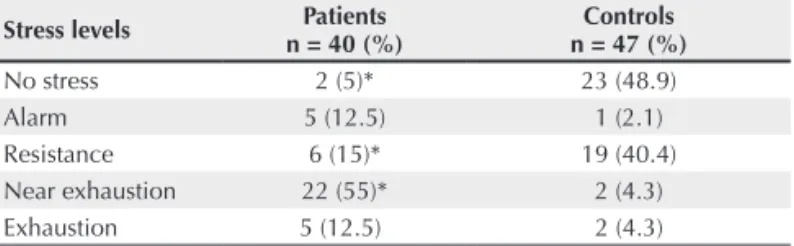
Table 1 shows that stress levels differ signiicantly between
FM patients and controls (P < 0.001). Most patients (62.5%) are at the “Exhaustion” or “Near Exhaustion” level, whereas this group corresponds to 8.6% of the control sample; moreo-ver, almost half of the control individuals (48.9%) showed no stress, when compared to only 5% of the FM patients in the same category.
Table 1
Lipp Stress Symptom Inventory for Adults (ISSL): comparison of stress levels between patients and controls
Stress levels n = 40 (%)Patients n = 47 (%)Controls
No stress 2 (5)* 23 (48.9)
Alarm 5 (12.5) 1 (2.1)
Resistance 6 (15)* 19 (40.4)
Near exhaustion 22 (55)* 2 (4.3)
Exhaustion 5 (12.5) 2 (4.3)
χ2 = 44.75; P < 0.001. At the residual analysis, significant comparisons between patients and controls (P < 0.01)*.
The mean WHOQOL questionnaire scores for both groups are shown in Figure 1 and it is possible to observe that there
was a statistically signiicant difference between patients and
controls (P < 0.001, Figure 1), with controls presenting a better environmental domain quality (14.43 ± 1.96) when compared to patients (11.48 ± 2.15).
Figure 1
Boxplot of WHOQOL questionnaire Domain V scores in patients with FM (11.48 ± 2.15) and controls (14.43 ± 1.96), calculated from all means.
Control
P < 0,001
Domain
V score
49
Patient 41 N
-22
20
18
16
14
12
10
8
Table 2
Comparison of APOE allelic and genotypic
frequencies between patients and controls
Patients (n = 38) Controls (n = 40) P Alleles
E*2 14.5% 12.5%
E*3 84.2% 85% 0.82
E*4 1.3% 2.5%
Genotypes
E*2/E*2 - 1 (2.5%)
E*2/E*3 11 (28.9%) 8 (20%) 0.59
E*3/E*3 26 (68.4%) 29 (72.5%)
E*3/E*4 1 (2.7%) 2 (5%)
Table 3
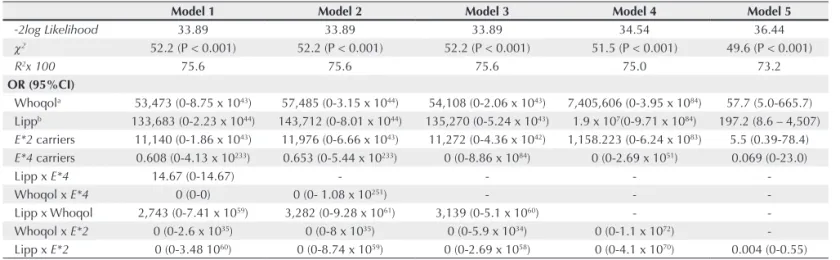
Multiple logistic regression analysis: backward modeling technique
Model 1 Model 2 Model 3 Model 4 Model 5
-2log Likelihood 33.89 33.89 33.89 34.54 36.44
χ2 52.2 (P < 0.001) 52.2 (P < 0.001) 52.2 (P < 0.001) 51.5 (P < 0.001) 49.6 (P < 0.001)
R2x 100 75.6 75.6 75.6 75.0 73.2
OR (95%CI)
Whoqola 53,473 (0-8.75 x 1043) 57,485 (0-3.15 x 1044) 54,108 (0-2.06 x 1043) 7,405,606 (0-3.95 x 1084) 57.7 (5.0-665.7)
Lippb 133,683 (0-2.23 x 1044) 143,712 (0-8.01 x 1044) 135,270 (0-5.24 x 1043) 1.9 x 10⁷(0-9.71 x 1084) 197.2 (8.6 – 4,507)
E*2 carriers 11,140 (0-1.86 x 1043) 11,976 (0-6.66 x 1043) 11,272 (0-4.36 x 1042) 1,158.223 (0-6.24 x 1083) 5.5 (0.39-78.4)
E*4 carriers 0.608 (0-4.13 x 10233) 0.653 (0-5.44 x 10233) 0 (0-8.86 x 1084) 0 (0-2.69 x 1051) 0.069 (0-23.0)
Lipp x E*4 14.67 (0-14.67) - - -
-Whoqol x E*4 0 (0-0) 0 (0- 1.08 x 10251) - -
-Lipp x Whoqol 2,743 (0-7.41 x 1059) 3,282 (0-9.28 x 1061) 3,139 (0-5.1 x 1060) -
-Whoqol x E*2 0 (0-2.6 x 1035) 0 (0-8 x 1035) 0 (0-5.9 x 1034) 0 (0-1.1 x 1072)
-Lipp x E*2 0 (0-3.48 1060) 0 (0-8.74 x 1059) 0 (0-2.69 x 1058) 0 (0-4.1 x 1070) 0.004 (0-0.55)
a Totalscores of WHOQOL domain V were divided according with the 50th percentile as < 13.05 (1) and > 13.05 (0); b Stresslevels were recodified as exhaustion or near exhaustion (1) and no stress or resistance (0).
the lowest conidence intervals for the odds ratio (OR) values.
Thus, Table 4 demonstrates the most adequate regression
model, with the interpretation of the identiied interaction. These data conirmed the inluence of the environment on the disease, as we identiied individuals with the assessed
domain scores < 13.05 (50th percentile), that is, individuals with bad environmental quality had a 57.7-higher chance of
developing FM (P = 0.001). Similarly, the association be
-tween FM and stress was conirmed by this analysis (OR = 197.2; P = 0.001), but no interaction between stress levels and environment was identiied. This analysis demonstrated that
the presence of the two rare APOE alleles (E*2 and E*4) is
not related, individually, with the chance of developing FM,
but that there is a signiicant interaction between the presence of the E*2 allele and stress levels (P = 0.028). Therefore,
the calculation of OR estimated in each group demonstrated
that in the group of women who were E*2-allele carriers and
had high stress levels, the chance of developing the disease was 1.06, whereas in the group of non-carriers, but who still had high stress levels, this chance increased to 265.1, thus
demonstrating the protective role of the E*2 allele presence.
DISCUSSION
The present study aimed at investigating the association betwe-en stress levels, betwe-environmbetwe-ental quality, APOE gbetwe-ene variation
and how these variables interacted to inluence FM susceptibi -lity. As FM is a multifactorial etiology syndrome that remains poorly understood, the increase in the number of studies on its bases, physiological as well as genetic and environmental ones, is of utmost importance.
Table 2 shows the analysis of APOE polymorphism
in-luence on FM susceptibility. Therefore, the frequencies of the
three alleles (E*2, E*3 and E*4) and of four genotypes were compared between patient and control samples. This univariate
analysis showed that, as there is no statistically signiicant difference, it was not possible to prove the isolated inluence
of this gene on the disease.
Aiming at evaluating whether the isolated factors in-vestigated in the study (stress, environmental quality and
APOE polymorphism) had any influence on FM when
assessed together, a multivariate logistic regression was carried out, which included interaction variables. Table 3 shows the parameters of each model tested by the backward modeling technique. Based on these data, it is possible to observe that the parameters related to the different models are
practically not modiied after the removal of the interaction va
-riables, and that all regressions performed are highly signiicant
The use of Lipp Stress Symptom Inventory for Adults (ISSL) showed a high stress level among patients. Although the
asso-ciation between ibromyalgia and stress has been pointed out in
the literature3,4, to date no study had investigated this association in Brazilian patients. The present study demonstrated a very high number (95%) of women with FM that presented some level of stress, when compared to 51.2% in the control sample. These
igures are much higher than those identiied in other Brazilian
studies. Moreira et al.16, when investigating infertile women,
identiied that almost 62% presented some level of stress. Santos
and Alves Jr.,17 when evaluating Master’s Degree students in the
state of Sergipe, Brazil, identiied a value of 40.7%, although with a signiicant variation between the genders: 80% of the
women and 18% of the men. Another study that demonstrated that stress is more frequently observed in women is the one performed by Calais et al.18, in a sample of young individuals from the city of Campinas, state of Sao Paulo, Brazil, showing that 79% of young female individuals had stress, when com-pared to 52% of young male individuals. Therefore, the data demonstrated that the association between stress and FM is quite strong, as to date, the highest frequency of stress found in Brazilian studies was that observed in our sample.
However, some studies have shown that women are much more prone to stress and as our sample consists of women only, that could have been a confounding factor. To test this hypothesis, our sample was compared to a control sample that also consisted
exclusively of women, whose identiied stress frequency (51.2%) was within a variation range that had been previously identiied
by other studies with healthy women, of around 36%.16,17
Regarding stress levels, a disturbing proportion of our patient sample was at the two upper stress levels – exhaustion and near exhaustion 67.5%), when compared to 8.6% in our
control sample. These igures are higher than all data found in
the Brazilian literature: among infertile women, this frequency
was 12.7%,16 whereas in healthy women this frequency was
zero or close to zero in young individuals,17,18 7.4% among adult
women,16 up to 15% and 23% in adult individuals living in Sao
Paulo (capital and countryside, respectively).19 Therefore, we
realize that the stress data identiied by the present analysis are within the variation range already identiied for healthy
individuals, but are much higher than any previously recorded value, when related to FM patients. This fact demonstrates the important association between the disease and stress, but unfortunately, it is not possible to suggest a cause-and-effect relation, as both possibilities are likely: FM can increase the chance of developing stress, as well as stress onset can increase the chance of developing FM. That is a hypothesis that must be further tested with longitudinal and prospective studies.
The existing literature demonstrates that FM is a multifac-torial disease and thus, the WHOQOL domain V was chosen to assess the association between the environment and the chance of disease onset. As the type of question used in this tool allows it to be adapted for a past period of time, this method was used to perform a retrospective investigation and, therefore, the ques-tionnaire was applied to patients based on the period prior to the
disease development. This approach allowed the inal results on
the environment to be correlated with the disease onset, and not as a consequence of the disease. Hence, it was possible to detect a
signiicantly lower environmental quality in patients, when com -pared to the control sample (P < 0.001). Evidently, as in any other retrospective study, there is a possibility that the patients were not capable of consistently answering the questionnaire, based on
their healthy life period, but were inluenced by the disease. On
the other hand, a subjective analysis of the researchers that applied the tool demonstrated that the patients tended to be excessively optimistic regarding the period prior to symptom onset, as they compared their lives with the current period. Nevertheless, the data demonstrated a strong association between environment and
Table 4
Parameters of the multiple logistic regression analysis best model
OR (95% CI) P beta
WHOQOLa 57.7 (5.0 – 665.7) 0.001 4.06
Lippb 197.2 (8.6 – 4.507) 0.001 5.28
E*2 carriers 5.5 (0.39 – 78.4) 0.205 1.71
E*4 carriers 0.069 (0 – 23.0) 0.367 -2.68
Lippb x E*2 0.004 (0 – 0.55) 0.028 -5.50
Interpretation of Lippa x E*2 interaction beta OR - high stress levels (beta Lipp = 1) and E*2 carriers (beta Lippa x E*2 = 1) = 5.28 + (-5.50) 0.06 1.06 - high stress levels (beta Lipp = 1) and E*2 non-carriers (beta Lippa x E*2 = 0) = 5.28 + 0 5.58 265.1 a Total scores of WHOQOL domain V were divided according with the 50th percentile as < 13.05 (1) and > 13.05 (0);
FM, and the values observed for patients and controls are within the variation range found in the literature.20-23
The association between the WHOQOL domain V scores and other diseases, although not assessed retrospectively, has been investigated by several studies carried out worldwide.
However, few studies have identiied a signiicant association
between the domain V scores and some disease or characteristic. The association between decreased environmental quality and
Parkinson’s disease has been identiied by Valeikiene et al.,23 although Schestatsky et al.24 did not identify any difference between patients and their caregivers. One investigation with automobile factory workers from Malaysia demonstrated that the domain V scores were positively correlated with work control, social support, physical health, psychological status and social relations, and negatively correlated with work demand, stress, anxiety and depression.22 On the other hand, this domain scores
were not signiicantly associated with treatment adherence for type
2 diabetes mellitus,25 osteoarthritis,23 successful aging process,26 physical exercises in radiotherapy patients,21 narcolepsy27 and systemic lupus erythematosus.28 Most of these studies determined
signiicant associations between the investigated diseases and the
scores of other WHOQOL domains, demonstrating that the tool
is eficient, but that apparently, the environment is not associated with these characteristics. Thus, this analysis speciically demons -trated the importance of the association between the environment
and FM, as we found a signiicant association that is not always
found in the literature, and had not been investigated regarding this disease in any previous international study.
The last objective of the present study was to assess whether the variation in the apolipoprotein E gene could be associated with FM onset. This gene was chosen due to its role in stress
response and also due to the pain threshold modiication,
demonstrated in both human studies and animal models.8-11
Additionally, a brief literature review showed that the polymorphism found in this gene is linked to the increased
susceptibility to several diseases, such as Alzheimer’s,29,30
Parkinson’s,31 cholelithiasis,32 atherosclerosis,33 bone density,34 rheumatoid arthritis,35 depression in elderly,36 schizophrenia
and bipolar disorder,37 among others. Still, to date, no study
had tried to determine the association between the APOE gene and FM susceptibility in any population, although other genes have been associated with the disease, such as the 5HT2A
serotonin receptor6 and the HLA region.38 The present study
data did not demonstrate a signiicant association between
the presence of the gene rare alleles (E*2 and E*4) and FM susceptibility (Table 3). However, when a multivariate analysis was performed, seeking to detect an association between FM, the APOE gene, environmental quality and stress levels, a
signiicant interaction was identiied between the presence of
the E*2 allele and stress levels (Table 4).
There have been no studies in the literature that can be compared with this analysis. Moreover, caution is necessary when interpreting these data due to limitations inherent to the Lipp questionnaire and the low statistical power caused by the small sample size, which results in an excessive increase in
identiied OR values. Therefore, although our data suggest an
interaction between stress and APOE gene, caution is necessary when interpreting them, especially regarding the magnitude of the estimated OR values.
Firstly, as the applied stress inventory is adequate to detect current symptoms, or at most, of the previous days, it has the limitation of not being able to be applied retrospectively. Therefore, it becomes impossible to establish a causal relation
for the strong association between stress and ibromyalgia,
so that either of the two characteristics can trigger the other. Therefore, the protective role of the E*2 allele presence can be interpreted as protection against the disease onset in women with high stress levels or as protection against high-stress level
development in patients with ibromyalgia. The only way to
test these hypotheses would be to carry out a prospective study, which must be greatly encouraged regarding future research on this subject. Additionally, there is obviously a possibility that the
present data relect a type I error, caused by the small sample size.
In spite of the discussed limitations, the importance of
the present study lies mainly in the fact that it is the irst
one to investigate the association between the APOE gene
and ibromyalgia. The data shown here have demonstrated a signiicant inluence of the E*2 allele, of which presence
acts as a protective factor for the association between stress
and ibromyalgia. However, determining which of the two
events was the causative agent was not the objective of the present study. Moreover, a review of apo E physiological role
demonstrates that it has inluence on stress physiology, at least in animal models, which supports the inluence identiied in our sample. However, we believe that interaction identiied in
the present study can be used as a basis for hypothesis inves-tigation in larger samples, thus contributing to the increase in
knowledge on ibromyalgia etiology.
REFERÊNCIAS REFERENCES
1. Wolfe F, Smythe HA, Yunus MB, Bennett RM, Bombardier C, Goldenberg DL. The American College of Rheumatology 1990 criteria for the classiication of ibromyalgia: report of the multicenter criteria committee. Arthritis Rheum 1990; 33(2):160-72.
3. Buskila D. Genetics of chronic pain states. Best Pract Res Clin Rheumatol 2007; 21(3):535-47.
4. Wood BP. Stress and dopamine: implications for the pathophysiology of chronic widespread pain. Med Hypotheses 2004; 62:420-4. 5. van Houdenhove B, Egle U, Luyten P. The Role of Life Stress in
Fibromyalgia. Curr Rheumatol Rep 2005; 7:365-70.
6. Bondy B, Spaeth M, Offenbaecher M, Glatzeder K, Stratz T, Schwarz M et al. The T102C polymophism of the 5-HT2A-Receptor Gene in Fibromyalgia. Neurobiol Dis 1999; 6:433-9.
7. Frank B, Niesler B, Bondy B, Späth M, Pongratz DE, Ackenheil M et al. Mutational analysis of serotonin receptor genes: HTR3A and HTR3B in ibromyalgia patients. Clin Rheumatol 2004; 23:338-44. 8. VanderPutten DM, Cameron BM, Merril CR. Increased
apolipoprotein-E concentrations in individuals suffering chronic low back syndrome identiied by two-dimensional gel electrophoresis. Appl Theor Electrophor 1993; 3:247-52.
9. Cameron BM, VanderPutten DM, Merril CR. Preliminary study of an increase of a plasma apolipoprotein E variant associated with peripheral nerve damage. A inding in patients with chronic spinal pain. Spine 1995; 20:581-9.
10. Gordon I, Ben-Eliyahu S, Rosenne E, Sehayek E, Michaelson DM. Derangement in stress response of apolipoprotein E-deicient mice. Neurosci Letters 1996; 206:212-4.
11. Choudhuri R, Cui L, Yong C, Bowyer S, Klein RM, Welch KM et al. Cortical spreading depression and gene regulation: relevance to migraine. Ann Neurol 2002; 51:499-506.
12. Lipp MN. Manual do inventário de sintomas de stress de Lipp. São Paulo: Casa do Psicólogo, 2000.
13. Fleck M, Louzada S, Xavier M, Chachamovich E, Vieira G, Santos L et al. Desenvolvimento e aplicação da versão em português do instrumento de avaliação de qualidade de vida da Organização Mundial da Saúde (WHOQOL-100). Revista HCPA 1999; 19(1):9-24. 14. Lahiri DK, Nurnberger JI. A rapid non-enzymatic method for the
preparation of HMW DNA from blood for RFLP studies. Nucleic Acids Res 1991; 19:5444.
15. de Andrade FM, Larrandaburu M, Callegari-Jacques SM, Gastaldo G, Hutz MH. Association of apolipoprotein E polymorphism with plasma lipids and Alzheimer´s disease in a Southern Brazilian population. Br J Med Biol Res 2000; 33:529-37.
16. Moreira SNT, Melo COM, Tomaz G, de Azevedo GD. Estresse e ansiedade em mulheres inférteis. Rev Bras Ginecol Obstet 2006; 28(6): 358-64.
17. Santos AF, Alves Jr A. Estresse e estratégias de enfrentamento em mestrandos de ciências da saúde. Psicologia: Relexão e crítica 2007; 20 (1):104-13.
18. Calais SL, de Andrade LMB, Lipp MEN. Diferenças de Sexo e Escolaridade na Manifestação de Stress em Adultos Jovens. Psicologia: Relexão e crítica, 2003; 16(2):257-63.
19. da Silva EAT, Martinez A. Diferença em nível de stress em duas amostras: capital e interior do estado de São Paulo. Estudos de PsicologiaCampinas, 2005; 22(1):53-61.
20. dos Santos ECM, França Jr I, Lopes F. Quality of life of people living with HIV/AIDS in São Paulo, Brazil. Rev Saúde Pública 2007; 41(Supl. 2):1-7.
21. Hwang JH, Chang HJ, Shim YH, Park WH, Park W, Huh SJ et al. Effects of Supervised Exercise Therapy in Patients Receiving Radiotherapy for Breast Cancer. Yonsei Med J 2008; 49(3):443-50.
22. Rusli BN, Edimansyah BA, Naing L. Working conditions, self-perceived stress, anxiety, depression and quality of life: A structural equation modelling approach. BMC Public Health 2008; 8:48. 23. Valeikiene V, Ceremnych J, Alekna V, Juozulynas A. Differences
in WHOQOL-100 domain scores in Parkinson´s disease and osteoarthritis. Med Sci Monit 2008; 14(4):CR221-7.
24. Schestatsky P, Zanatto VC, Margis R, Chachamovich E, Reche M, Batista RG et al. Quality of life in a Brazilian sample of patients with Parkinson’s disease and their caregivers. Rev Bras Psiquiatr 2006; 28(3):209-11.
25. Martínez YV, Prado-Aguilar CA, Rascón-Pacheco RA, Valdivia-Martínez JJ. Quality of life associated with treatment adherence in patients with type 2 diabetes: a cross-sectional study. BMC Health Services Research 2008; 8:164.
26. de Moraes JFD, de Azevedo e Souza VB. Factors associated with the successful aging of the socially-active elderly in the metropolitan region of Porto Alegre. Rev Bras Psiquiatr 2005; 27(4):302-8. 27. Rovere H, Rossini S, Reimão R. Quality of life in patients with
narcolepsy - a WHOQOL-Bref study. Arq Neuropsiquiatr 2008; 66(2-A):163-7.
28. Khanna S, Pal H, Pandey RM, Handa R. The relationship between disease activity and quality of life in systemic lupus erythematosus. Rheumatology 2004; 43:1536-40.
29. Laws SM, Hone E, Gandy S, Martins RN. Expanding the association between the APOE gene and the risk of Alzheimer´s disease: possible roles for APOE promoter polymorphisms and alterations in APOE transcription. J Neurochem 2003; 84:1215-36.
30. Bertram L, Mcqueen MB, Mullin K, Blacker D, Tanzi R. Systematic meta-analyses of Alzheimer disease genetic association studies: the AlzGene database. Nat Genet 2007; 39:17-23.
31. Huang X, Chen PC, Poole C. APOE-[epsilon] 2 allele associated with higher prevalence of sporadic Parkinson disease. Neurology 2004; 62:2198-202.
32. Hasegawa K, Terada S, Kubota K, Itakura H, Imamura H, Ohnishi S et al. Effect of apolipoprotein E polymorphism on bile lipid composition and the formation of cholesterol gallstone. Am J Gastroenterol 2003; 98:1605-9.
33. Paternoster L, González NA, Lewis S, Sudlow C. Association between apolipoprotein E genotype and carotid intima-media thickness may suggest a speciic effect on large artery atherothrombotic stroke. Stroke 2008; 39:48-54.
34. Lee SI, Lee SY, Yoo WH. Association of apolipoprotein E polymorphism with bone mineral density in postmenopausal women with rheumatoid arthritis. Rheumatology (Oxford) 2005; 44:1067-8. 35. Maury CP, Liljeström M, Tiitinen S, Laiho K, Kaarela K, Ehnholm C.
Apolipoprotein E phenotypes in rheumatoid arthritis with or without amyloidosis. Amyloid 2001; 8:270-3.
36. Yen YC, Rebok GW, Gallo JJ, Yang MJ, Lung FW, Shih CH. ApoE4 allele is associated with late-life depression: a population-based study. Am J Geriatr Psychiatry 2007; 15:858-68.
37. Digney A, Keriakous D, Scarr E, Thomas E, Dean B. Differential changes in apolipoprotein E in schizophrenia and bipolar I disorder. Biol Psychiatry 2005; 57:711-5.