Eliana Auxiliadora Magalhães Costa
Ediná Alves Costa
Instituto de Saúde Coletiva. Universidade Federal da Bahia. Salvador, BA, Brasil
Correspondence:
Eliana Auxiliadora Magalhães Costa Rua Piauí, 269, apto. 902 – Pituba 41830-270 Salvador, BA, Brasil E-mail: [email protected] Received: 9/28/2011
Approved: 4/17/2012
Article available from: www.scielo.br/rsp
Risk and sanitary safety:
analysis on medical product
reprocessing in hospitals in
Salvador, Northeastern Brazil
ABSTRACT
OBJECTIVE: To analyze the technical conditions for medical product reprocessing in hospitals.
METHODS: This was a descriptive study on multiple cases in materials and sterilization centers at four hospitals in the city of Salvador, Southeastern Brazil, in 2010. Semi-structured interviews were conducted and direct observations were made, based on a regulatory model for medical product reprocessing that was drawn up with the technique of consensus verifi cation as the reference standard. The analytical categories used in this study were: management of the practice of medical product reprocessing; reprocessing protocols; monitoring of the sterilization process; and capacity for product tracking. These categories were scored according to their degree of conformity with the regulatory model for reprocessing used.
RESULTS: General inadequacy of the technical conditions for medical product reprocessing was observed, with regard to the structural conditions of the materials and sterilization centers studied and the work process conditions, along with organizational and managerial diffi culties that interfered with the practices analyzed.
CONCLUSIONS: The practices of medical product reprocessing in the hospitals analyzed constitute a risk for the patient users. Risk management systems need to be introduced in these hospitals, with greater sanitary control by the state, in order to protect patients’ health.
DESCRIPTORS: Consumer Product Safety. Equipment Reuse. Safety. Sterilization. Equipment Safety. Health Surveillance. Safety Management.
INTRODUCTION
Among the events associated with reprocessing and reuse of medical products are infection, presence of endotoxins, biofi lms, loss of the integrity of the material and other matters.4,7-13
There are numerous public health problems relating to reprocessing of medical products. The present inves-tigation sought to answer the question: How is the reprocessing of medical products done in hospitals in Salvador (capital of the State of Bahia, Northeastern Brazil)? It is presumed that the reprocessing of medical products in healthcare services is conditional on exis-tence of a system with an organic-functional structure that attends to the intrinsic safety requirements for this activity and that, in the absence of such a system, could exacerbate the risks to the health of the user population.
The objective of this study was to analyze the technical conditions for reprocessing medical products.
METHODS
This was a holistic descriptive study on multiple cases,14 evaluating technical quality. The analysis unit was the technical conditions for reprocessing medical products in hospitals in the city of Salvador, called “cases” in this methodology, in 2010.
Two hospitals in the Sentinel Network of the National Sanitary Surveillance Agency (Anvisa – Agência Nacional de Vigilância Sanitária) were randomly drawn among the four such hospitals located in Salvador (cases 1 and 2). Another two non-sentinel hospitals of similar size and characteristics were also randomly drawn. These were identifi ed through data from the National Registry of Healthcare Establishments (CNES – Cadastro Nacional de Estabelecimentos de Saúde) and from the Health Department of the State of Bahia (SESAB) (cases 3 and 4). Four multiple cases were formed. Sentinel hospitals were evaluated because they form part of a cooperation program with Anvisa aimed at management of risks and surveillance of adverse events relating to products, drugs and care processes.
The hospitals were contacted by telephone, to schedule a visit to gather data. A letter was sent to the board of each hospital, with information on the objectives of the research and a consent statement for the data gathering. The data were obtained by the researcher by means of applying a form at a semi-structured interview with the key informer (the person with technical responsibility for reprocessing of medical products), and through direct in loco observation based on an observation guide.
An alternative regulatory model was drawn up and was used as the reference standard due to questioning of the
a Agência Nacional de Vigilância Sanitária. Resolução RE No. 2.605, de 11 de agosto de 2006. Contém a lista de produtos que não podem ser
reprocessados. Diário Ofi cial da União. 2006; 14 ago.
Brazilian legislation on the reprocessing of medical products. This model was created using the technique of consensus verifi cation with two diagrams. The fi rst classifi ed the products for the purposes of reprocessing, either as reprocessable products or as non-reprocessable products, according to criteria relating to the possibility of cleaning and maintaining the integrity and functio-nality of the articles, regardless of whether they were considered to be reusable or single-use. The second diagram presented a logical model of the sequential stages of the reprocessing of medical products, adapting the decontamination methods to the concepts of risk analysis, evaluation and control and constituting the risk management.
The regulatory model that was used made it possible to exclude the list of products for which reuse or repro-cessing is prohibited in Brazil, like the one that exists in the current regulatory standarda. The criteria used in selecting the products on this list are unclear and the list is diffi cult to update, due to continual launching of products on the market.
The analytical categories constructed were: 1) manage-ment of the practice of medical product reprocessing; 2) reprocessing protocols with defi nitions of the clean-sing, disinfection and/or sterilization processes on the products; 3) monitoring of the sterilization process; and 4) capacity for product tracking.
Each category was constructed with the independent variables that infl uenced the technical conditions for the reprocessing of the medical products. The categories were scored as one (1) if they were in conformity with the response of the proposed regulatory model and zero (0) if the response was inadequate, thus totaling 87 points, allocated according to the categories described. The greater the number of questions in the analytical category was, the greater its score was, which did not mean that one category had greater importance or value in relation to the other. After scoring each category, the percentages of responses in conformity with the regulatory model were calculated.
The present study was submitted to the Research Ethics Committee of each of the hospitals studied and was approved by all of them.
RESULTS
Two hospitals were considered to be size 4 (cases 1 and 4) and two, size 3 (cases 2 and 3). The hospitals in the Sentinel Network provide general healthcare and the two state facilities provide specialized hospital care: one of these was a reference hospital for surgical-clinical cardiology and nephrology (case 3); and the other was a reference hospital for emergency traumatology (case 4). The hospitals had their own material and sterilization centers (MSCs) and carried out the reprocessing of their medical products internally.
The MSCs carried out the cleansing, disinfection and sterilization activities on the medical products in a decentralized manner (cases 1, 3 and 4), i.e. other units of the hospital also carried out some of these processes. In all cases, the MSC was coordinated by a nurse. This person with technical responsibility only partially knew the current legislation on medical product reprocessing
in case 2; in case 4, this professional was unaware of the legislation. In these hospitals, the service coordinator was unaware whether the medical products used in the institution were registered with Anvisa.
Sanitary inspections carried out by the Sanitary Surveillance of Bahia (VISA-BA) were reported in cases 1 and 3. These hospitals received reports of non--conformities regarding the reprocessing of medical products. In two hospitals (cases 2 and 4), the respective individuals with technical responsibility were unaware whether VISA-BA inspected the MSCs where they worked. There was no registry of sanitary surveillance actions in these organizations.
None of the cases had a committee or group responsible for management of medical products in the institution.
Out of the four cases, two presented all the recommended areas for the activities performed by a MSC (cases 1 and 3). In all cases, there was a physical barrier between the areas considered contaminated and clean. The fl oor, wall, door and ceiling conditions were inadequate in three cases (2, 3 and 4). The temperature and relative air humidity were, equally, inadequate in the areas of
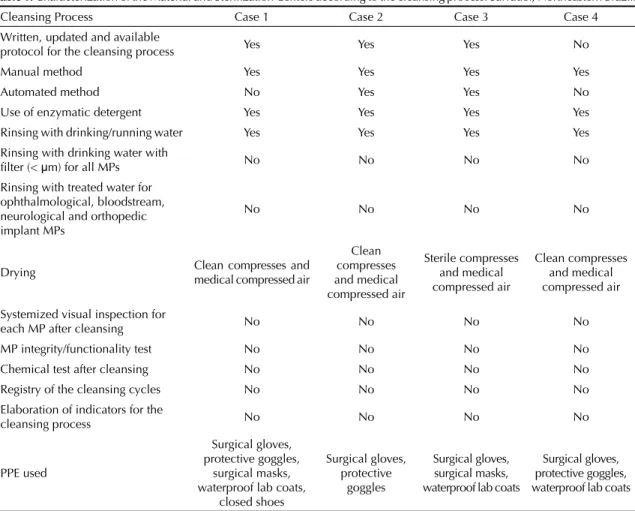
Table 1. Characterization of the Material and Sterilization Centers according to the cleansing process. Salvador, Northeastern Brazil.
Cleansing Process Case 1 Case 2 Case 3 Case 4 Written, updated and available
protocol for the cleansing process Yes Yes Yes No
Manual method Yes Yes Yes Yes
Automated method No Yes Yes No
Use of enzymatic detergent Yes Yes Yes Yes Rinsing with drinking/running water Yes Yes Yes Yes Rinsing with drinking water with
fi lter (< μm) for all MPs No No No No Rinsing with treated water for
ophthalmological, bloodstream, neurological and orthopedic implant MPs
No No No No
Drying Clean compresses and medical compressed air
Clean compresses and medical compressed air
Sterile compresses and medical compressed air
Clean compresses and medical compressed air
Systemized visual inspection for
each MP after cleansing No No No No
MP integrity/functionality test No No No No Chemical test after cleansing No No No No Registry of the cleansing cycles No No No No Elaboration of indicators for the
cleansing process No No No No
PPE used
Surgical gloves, protective goggles,
surgical masks, waterproof lab coats,
closed shoes
Surgical gloves, protective
goggles
Surgical gloves, surgical masks, waterproof lab coats
Surgical gloves, protective goggles, waterproof lab coats
all the MSCs studied. The lighting was adequate in all the cases. The air ventilation system was centralized in two cases (2 and 3), inadequate in case 3, and absent in cases 1 and 4. The operational fl ow of the activities was unidirectional, with no crossing between clean and dirty activities in two cases (1 and 3), but it was inadequate in cases 2 and 4. There were sinks for the MSC profes-sionals to wash their hands during the work activities in two cases (2 and 3), but not in the other two (1 and 4).
In all the MSCs of the hospitals studied, the taps for cleaning contaminated products provided cold water; none of them had hot water, which is necessary when using enzymatic detergents. Case 3 had a tap with a device to clean cannulated products. The articles for performing the cleansing manually (sponges, brushes and straws) were in a good condition for use in only two cases (1 and 3), and were inadequate in cases 2 and 4, which made it diffi cult to create mechanical friction and
remove external dirt from the contaminated products. The work benches presented dimensions compatible with the activities to be carried out in three (1, 2 and 3) of the four cases (Table 1).
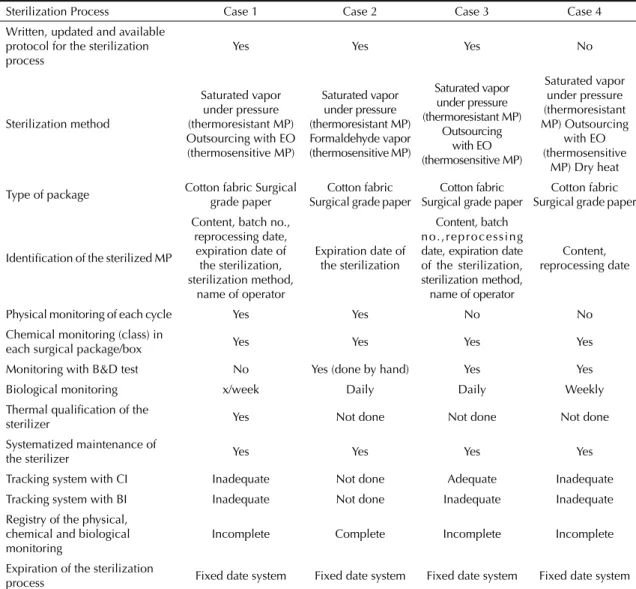
None of the MSCs had a drinking water system with a bacterial fi lter (fi lters < 5 μm) to retain microbial content in the water used to clean the articles. There were no image intensifi er lenses that would allow detailed viewing of the articles after cleansing, so as to examine them for any presence of residues and to perform a visual evaluation of the physical integrity of the clean products. There was a source of medical compressed air to dry the products with internal structures (Table 2).
The plastic containers that held detergent and disinfectant solutions were identifi ed according to the type of solution and presented a lid in only one case (3). In the other cases, these containers were used without lids, and without
Table 2. Characterization of the Material and Sterilization Centers according to the sterilization process. Salvador, Northeastern Brazil. Sterilization Process Case 1 Case 2 Case 3 Case 4 Written, updated and available
protocol for the sterilization process
Yes Yes Yes No
Sterilization method
Saturated vapor under pressure (thermoresistant MP) Outsourcing with EO (thermosensitive MP)
Saturated vapor under pressure (thermoresistant MP) Formaldehyde vapor (thermosensitive MP)
Saturated vapor under pressure (thermoresistant MP)
Outsourcing with EO (thermosensitive MP)
Saturated vapor under pressure (thermoresistant MP) Outsourcing
with EO (thermosensitive
MP) Dry heat
Type of package Cotton fabric Surgical grade paper
Cotton fabric Surgical grade paper
Cotton fabric Surgical grade paper
Cotton fabric Surgical grade paper
Identifi cation of the sterilized MP
Content, batch no., reprocessing date,
expiration date of the sterilization, sterilization method,
name of operator
Expiration date of the sterilization
Content, batch no.,reprocessing date, expiration date of the sterilization, sterilization method,
name of operator
Content, reprocessing date
Physical monitoring of each cycle Yes Yes No No Chemical monitoring (class) in
each surgical package/box Yes Yes Yes Yes Monitoring with B&D test No Yes (done by hand) Yes Yes Biological monitoring x/week Daily Daily Weekly Thermal qualifi cation of the
sterilizer Yes Not done Not done Not done Systematized maintenance of
the sterilizer Yes Yes Yes Yes
Tracking system with CI Inadequate Not done Adequate Inadequate Tracking system with BI Inadequate Not done Inadequate Inadequate Registry of the physical,
chemical and biological monitoring
Incomplete Complete Incomplete Incomplete
Expiration of the sterilization
process Fixed date system Fixed date system Fixed date system Fixed date system
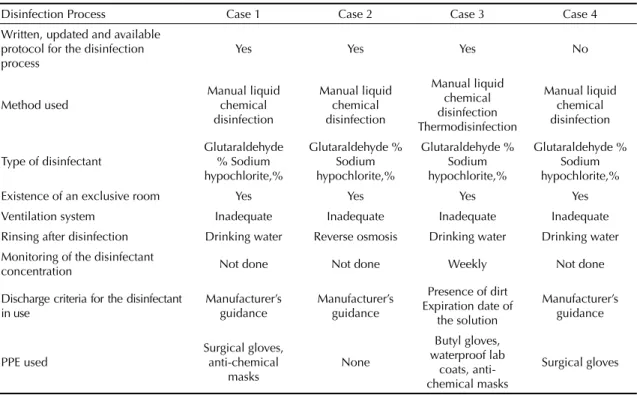
labeling giving the name, concentration or date of the dilution of the germicide solutions. These are inadequate practices that increase the potential for various risks. There were no ultrasonic washers (indispensable for washing cannulated products) or automated driers in any of the cases. Thermal sealers, which are necessary for adequate sealing of paper packages, were present in all cases, but there was no temperature control on the equi-pment or control over the quality of the sealing (Table 3).
None of the MSCs had scales for the necessary weight control for packages to be sterilized.
In all cases, medical products on the Anvisa RE list no. 2605/2006,a which categorizes the single-use products for which reprocessing is prohibited, were found to be undergoing reprocessing and reuse. Case 1 was reprocessing disposable scalpels with the blade fi xed
to the handle and disposable surgical compresses; case 2, non-dismountable needles with plastic components, Shaiver blades < 3 mm, non-dismountable tweezers and scissors for video-laparoscopy and plastic cardiac punch devices; case 3, hemodynamic catheters and thorax drains; and case 4, surgical gathering pouches, surgical fi elds, non dismountable trocars and skin expanders with valves (Table 4).
The classifi cation of the hospitals according to their technical conditions for medical product reprocessing is presented in Table 5.
DISCUSSION
The present study differs from others on reprocessing of medical products because here, these practices are
Table 3. Characterization of the Material and Sterilization Centers according to the disinfection process. Salvador, Northeastern Brazil.
Disinfection Process Case 1 Case 2 Case 3 Case 4
Written, updated and available protocol for the disinfection process
Yes Yes Yes No
Method used
Manual liquid chemical disinfection
Manual liquid chemical disinfection
Manual liquid chemical disinfection Thermodisinfection
Manual liquid chemical disinfection
Type of disinfectant
Glutaraldehyde % Sodium hypochlorite,%
Glutaraldehyde % Sodium hypochlorite,%
Glutaraldehyde % Sodium hypochlorite,%
Glutaraldehyde % Sodium hypochlorite,% Existence of an exclusive room Yes Yes Yes Yes Ventilation system Inadequate Inadequate Inadequate Inadequate
Rinsing after disinfection Drinking water Reverse osmosis Drinking water Drinking water Monitoring of the disinfectant
concentration Not done Not done Weekly Not done
Discharge criteria for the disinfectant in use
Manufacturer’s guidance
Manufacturer’s guidance
Presence of dirt Expiration date of
the solution
Manufacturer’s guidance
PPE used
Surgical gloves, anti-chemical
masks
None
Butyl gloves, waterproof lab
coats, anti-chemical masks
Surgical gloves
PPE: personal protective equipment
Table 4. Characterization of the Material and Sterilization Centers according to analytical categories of the reprocessing of medical products. Salvador, Northeastern Brazil.
Analytical categories Case 1 (%)
Case 1 (%)
Case 3 (%)
Case 4 (%)
Mean performance Management of the medical product reprocessing practices 33.3 22.2 55.6 33.3 36.1
assessed from a sanitary safety viewpoint. Therefore, it presents a broader perspective of risk control and public health, using a regulatory model developed as a reference standard.
The results from this investigation ratify the emblematic questions that involve reuse of the medical products presented in the case descriptions and prove the initial proposition of this study.
None of the four hospital organizations studied presented adequate technical conditions for reproces-sing of medical products, according to the regulatory model developed. Three presented inadequate technical conditions for reprocessing and one presented a need to adapt its technical conditions.
Inadequacies in the technical conditions for repro-cessing of medical products were observed in all the categories selected for evaluation, except in the traceability of the products (in one case). The smal-lest percentages of conformity were observed in the management of practices and in the protocols for reprocessing. These data indicate that the rationality of practicing product reprocessing is debatable when done in facilities that lack structural conditions to carry out basic reprocessing and reuse activities. These basic but crucial activities include validated cleansing and product function and integrity tests, and lead to actions that can be considered to be more elaborate (such as monitoring and traceability).
The low performance percentages for management of the practices and protocols for medical product repro-cessing refl ect the structure and process inadequacies of the MSCs studied, such as fl aws in cleaning, disinfec-tion and sterilizadisinfec-tion activities. These are refl ections of diffi culties of a managerial and organizational nature in the MSCs, which are consequent to lack of investments and limited input of material resources.
Medical products do not seem to be a prioritized topic in these hospitals’ policies, since there is no institu-tional involvement in information on the processing of products, its results and the consequences for patients and healthcare professionals, or even with regard to which medical devices are reused and reprocessed, how this is done and how many times it is done. These decisions are delegated and limited to the MSC without the broad commitment and responsibility that this issue demands.
None of the MSCs carried out systematized visual inspection of the products that were in a reusable condition, or any integrity and functionality tests, which are necessary for preventing risks relating to cleansing failure and possible alterations to the characteristics of products that have been subjected to multiple reprocessing cycles. Investigation of the functionality of reprocessed medical products requires specific knowledge and specialized equipment, which is rarely found in hospital services. Nevertheless, it is imperative that Brazilian MSCs should incorporate the culture of evaluating and validating the cleaning process, which is currently restricted to sterilization, through adopting the practice of systematic visual inspection, even in the simplest facilities. Chemical tests are necessary in order to prove the absence of organic and inorganic loads in critical products (i.e. those that have a high risk of transmitting infections if inadequately decontaminated) and in devices with a complex confi guration, in which visual examination is not possible or suffi cient. The practice of cleansing associated with integrity and functionality tests needs to be the main and defi ning stage for all medical product processing, whether done on single-use articles or on reusable ones, as proposed in the regulatory model.
The practice of reprocessing single-use medical products that are listed by Anvisa shows that hospitals are infringing the normative standards that regulate the reprocessing of products in this country. Even though sanitary inspections had taken place in two of the MSCs studied, this infraction was not detected, which endangers the quality of the sanitary surveillance action and its capacity to identify the risks associated with reprocessing of medical products in MSCs in Bahia.
The risks relating to reprocessing of articles are valid both for products considered to be for single use and for those considered to be capable of reprocessing or multiple use, given that most of the adverse events, or infection outbreaks, are related to fl aws in the repro-cessing stages and not to the reprorepro-cessing itself.5,10,11 The work processes of an MSC require planning and risk management, and this is only possible with an adequate physical-operational structure and, most of all, professionals who are committed to the issue. The safety of patients who use these devices depends on this.
This study has introduced the concept of residual risk into the topic of reuse of medical products. The
Table 5. Classifi cation of hospitals according to the technical conditions of medical product reprocessing. Salvador, Northeastern Brazil. Classifi cation Case 1 Case 2 Case 3 Case 4 Adequate technical conditions (81% to 100%) 0 0 0 0
concept may facilitate understanding of the factors that contribute towards occurrences of adverse events relating to health technologies and can be used as a planning, surveillance and coordination instrument by healthcare service professionals and managers. These individuals will be able to understand that, if residual risk is a condition inherent to reprocessed medical products, risk control needs to be concentrated in the work processes within MSCs.
Thus, the debate on the possibility or impossibility of reprocessing products that are considered to be for single use ceases to make sense. Based on the assumption that residual risk exists in the processing of both reusable products and single-use articles, hospital managers will know that the decision on the reprocessing and reuse must be based on the organi-zational capacity of the facilities. The defi nition of which materials will be reused will then be supported by controls that are adequate for evaluate the products and by monitoring the decontamination processes.
Incorporation of the concept of residual risk in medical products forces MSC professionals to act in
a systematized manner, applying risk management actions at all levels, cycles and stages of the reproces-sing of these products. Based on the risk references, a certain degree of rationality regarding use of materials can be adopted. Thus, MSCs will have a highlighted function within hospital organizations, as autonomous facilities that defi ne and carry out processes, without which other hospital services would not function.
1. Alfa MJ, Howie R. Modeling microbial survival in buildup biofi lm for complex medical devices. BMC Infect Dis. 2009;9:56. DOI:10.1186/1471-2334-9-56
2. Amarante JMB, Toscano CM, Pearson ML, Roth V, Jarvis WR, Levin AS. Reprocessing and reuse of single-use medical devices used during hemodynamic procedures in Brazil: a widespread and largely overlooked problem. Infect Control Hosp Epidemiol. 2008;29(9):854-8. DOI:10.1086/590357
3. Fireman Z. Biopsy forceps: reusable or disposablew? J Gastroenterol Hepatol. 2006;21(7):1089-92. DOI:10.1111/j.1440-1746.2006.04429.x
4. Forte L, Shum C. Comparative cost-effi ciency of the EVOTECH endoscope cleaner and reprocessor versus manual cleaning plus automated endoscope reprocessing in a real-world Canadian hospital endoscopy setting. BMC Gastroenterol. 2011;11:105. DOI:10.1186/1471-230X-11-105
5. Greene VW. Reuse of medical devices labeled for single-use. In: Mayhall GC. Hospital epidemiology and infection control. 3.ed. Philadelphia: Lippincott Williams & Wilkins; 2004. p.1535-45.
6. Grosskopf V, Jakel C. Legal framework conditions for the reprocessing of medical devices. GMS Krankenhhyg Interdiszip. 2008;3(3):Doc24.
7. Kraft M. Framework conditions and requeriments to ensure the technical functional safety of reprocessed medical devices. GMS Krankenhhyg Interdiszip. 2008;3(3):Doc23.
8. Kramer A, Assadian O. Ethical and hygienic aspects of the reprocessing of medical devices in Germany. GMS Krankenhhyg Interdiszip. 2008;3(3):Doc25.
9. Miller MA, Gravel D, Paton S. Reuse of single-use medical devices in Canadian acute-care healthcare facilities. Can Commun Dis Rep. 2001;27(23):193-9
10. Ribeiro SMCP. Cenário do reprocessamento de artigos de uso único: situação no Brasil e no mundo. In: Associação Paulista de Estudos e Controle de Infecção Hospitalar. Reprocessamento de artigos de uso único. São Paulo: APECIH; 2008. p.1-7.
11. Tessarolo F, Caola I, Nollo G, Antolini R, Guarrera GM, Caciagli P. Effi ciency in endoxin removal by a reprocessing protocol for electrophysiology catheters based on hydrogen peroxide plasma sterilization. Int J Hyg Environ Health. 2006;209(6):557-65. DOI:10.1016/j.ijheh.2006.05.001
12. Tessarolo F, Caola I, Fedel M, Stacchiotti A, Caciagli P, Guarrera GM, et al. Different experimental protocols for decontamination affect the cleaning of medical devices: a preliminary electron microscopy analysis. J Hosp Infect. 2007;65(4):326-33. DOI:10.1016/j.jhin.2006.10.015
13. Vickery K, Pajkos A, Cossart Y. Removal of biofi lm from endoscopes: evaluation of detergent effi ciency. Am J Infect Control. 2004;32(3):170-6. DOI:10.1016/j.ajic.2003.10.009
14. Yin RK. Estudo de caso: planejamento e métodos. 3.ed. Porto Alegre: Bookman Companhia Editora; 2005.
REFERENCES
Based on the doctoral thesis of Eliana Auxiliadora Magalhães Costa, presented to the Public Health Institute of the Universidade Federal da Bahia on March 1, 2011.