Review Article
Fluoride concentration in bottled water:
a systematic review
Concentração de fluoreto na água engarrafada:
uma revisão sistemática
Ceci Queluz Venturini
1, Paulo Frazão
11 Department of Public Health Practice, Public Health School, Universidade de São Paulo (USP), São Paulo (SP), Brazil.
Study carried out at Faculdade de Saúde Pública of Universidade de São Paulo (USP), São Paulo (SP), Brazil.
Correspondence: Paulo Frazão – Faculdade de Saúde Pública , Universidade de São Paulo, Av. Dr Arnaldo, 715 – Cerqueira Cesar – CEP: 01246-904 – São Paulo (SP), Brazil – E-mail: [email protected]
Financial support: Brazil – CNPq 304251/2012-7. Conflict of interests: nothing to declare.
Abstract
This study aimed to summarize major methodological features and main findings described in the studies on fluoride concentration monitoring in bottled water, published in specialized journals between 2008 and 2012, highlighting their implications for public health surveillance. A systematic review was conducted searching scientific articles in the databases: Lilacs, PubMed and Scopus. Twenty-two articles from the world’s main continents were included: 68.2% informed both the number of samples and brands collected; 81.8% examined products collected in only a city or metropolitan area; 77.3% assessed the outcomes using a sound criterion; 45.5% compared the values of fluoride measured in the sample and those informed in the label, being noted significant discrepancies. In conclusion, the discrepancy between the found amount and the informed concentration in the label was quite common reinforcing the warnings raised by several researchers. The parameters that define hazard to health and instruct the content of labelling should be revised. There is an important room for improvement of the methodological procedures in further studies. Keywords: fluoride; fluoridation; surveillance; bottled water.
Resumo
O objetivo foi sumarizar as principais características metodológicas e os principais achados descritos em estudos sobre monitoramento da concentração de fluoreto em água engarrafada publicados em revistas científicas especializadas entre 2008 e 2012, examinando suas implicações para a vigilância em saúde pública. Uma revisão sistemática foi realizada buscando artigos nas bases de dados: Lilacs, PubMed e Scopus. Vinte e dois artigos dos principais continentes do mundo foram incluídos: 68,2% informaram tanto o número de amostras como de marcas recolhidas; 81,8% examinaram produtos coletados em somente uma cidade ou área metropolitana; 77,3% avaliaram os achados usando critério lícito; 45,5% compararam os valores observados na amostra com aqueles informados no rótulo, sendo notadas discrepâncias significativas. A discrepância entre o valor observado e o divulgado no rótulo do produto foi bastante comum, reforçando as advertências reclamadas por vários pesquisadores. Os parâmetros que definem risco para saúde e instruem o conteúdo da rotulagem deveriam ser revisados. Observou-se importante espaço para melhorar os procedimentos metodológicos em futuros estudos.
▄
INTRODUCTIONBottled water can be deined as water obtained directly from a natural source, ground or not, that undergoes process of packing into an appropriated vessel for its distribution in the market, and consumption by individuals and families in households and also public spaces such as kindergarten, schools, workplaces, health units, restaurants and areas of high circulation of people, such as bus stations, airports etc. According to the amount of mineral salts, trace elements and other constituents and parameters, the water can be considered only natural or natural and mineral, both classiied as bottled water1.
he consumption of bottled water has increased in the last years worldwide. Between 2006 and 2011, the global consumption changed from 178 billion to more than 231 billion of liters. China, Indonesia and hailand are examples of countries where the consumption in the period grew more than 10%. In Brazil, the increase was also above of global average and the consumption surpassed from 12.5 billion to more than 17 billion of liters during the same time2.
he reasons for utilizing of bottled water vary. Evidence from diferent studies summarized by Ward el al.3 showed that smell, appearance, taste and convenience are more important factors to explain the consumers’ preference than health features related. An investigation on water consumption patterns among US children showed that tap water represented 60% of drinking water volume whereas bottled water reached 40%. Non‑Hispanic white children mostly consumed tap water, whereas Mexican‑American children mostly consumed bottled water4. Among Brazilian adolescents that declared daily intake of water, 30 percent pointed bottled water as main source5.
he replacement of tap water consumption by bottled water can represent a risk for child dentition according to the luoride concentration6,7. Bottled water surveillance can be deined as the continuous and vigilant public health assessment and review of its safety and acceptability. his kind of assessment does not exclude or replace the bottled water supplier’s responsibility. herefore, it is essential to monitor the water quality regarding luoride amount and to assess the needed of surveillance measures directed to protection of population health.
Several studies have been published with that purpose, however, no critical balance was produced on the knowledge released in the recent years across scientiic articles. In addition, a systematic review could provide knowledge on research gaps in the existing literature to aid planning future research.
he aim was to summarize major methodological features and main indings described in the studies on luoride concentration monitoring in bottled water published in specialized journals between 2008 and 2012 highlighting their implications for public health surveillance.
▄
METHODSA systematic review was undertaken to assess the studies on luoride concentration in bottled water. Systematic reviews are a method of knowledge synthesis that require a clearly formulated question and use systematic and explicit methods to identify, select, critically appraise, and extract and analyze data from relevant research. hey can be used to address diverse research questions such as what are the beneits and harms of a determined treatment in pregnant women or what is the prevalence of a determined condition in 5‑6‑year‑old children. Tricco et al.8 describe diferent types of systematic reviews according to the research questions selected and methods utilized. his review systematic consisted of a narrative synthesis involving a structured interrogation and a summary of the indings of included studies. he review included observational studies and scientiic articles in English, Portuguese and Spanish that were identiied by electronic search at SCOPUS, a database of peer‑reviewed scientiic literature, and also health sciences bibliographic information databases such as LILACS and PUBMED. he syntaxes of searching strategies were adapted for each database.
Two search keys were used for SCOPUS: 1‑ “Bottled Water” and “Fluorides”, both as keywords; 2‑ “Fluorides” as keyword and “Bottled Water” and “Surveillance” as terms in any ield. Six syntaxes were used for LILACS: 1‑ “Fluorides” as subject descriptor and “Bottled Water” as word in any ield; 2‑ Fluorides” as subject descriptor and “Water” as word in any ield; 3‑ “Fluoridation” as subject descriptor and “Bottled Water” as word in any ield; 4‑ “Fluoridation” as subject descriptor; 5‑ Fluorides” and “Surveillance” and “Bottled Water” as words in any ield; 6‑ “Fluorides” and “Surveillance” as words in any ield. Two search strategies were utilized for PUBMED: 1‑ “Fluorides”
as keyword and “Drinking Water” and “Surveillance” as terms in any ield; 2‑ “Fluorides” as keyword and “Bottled Water” as term in any ield.
A form was specially elaborated for the data extraction. he irst author carried out the data extraction and the second revised the form illing and checked the content. he included articles were analyzed according to the following logical categories: study place; number of samples; number of brands; collecting time of samples; covered area; analytical method for measuring luoride concentration (electrometric and colorimetric); reference criterion for values’ assessment and also agreement between labelling and observed luoride amount. Risk of bias was not assessed as one of the objectives was to analyze major methodological features. he narrative synthesis was organized based on the mentioned logical categories.
▄
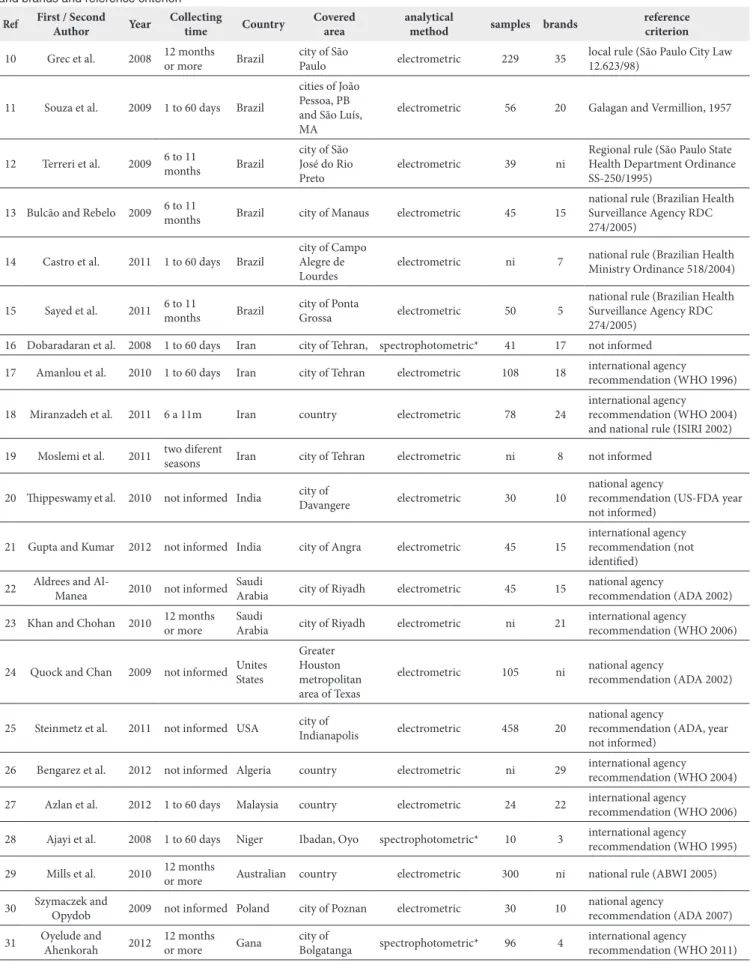
RESULTSFigure 1 shows the searching lowchart. Seventy‑eight eligible records were identiied from 622 ones, ater applying pre‑deined exclusion criteria to the title/abstract. Twenty‑two articles were included ater removing of duplicates, full text evaluation, and hand‑searching of reference lists in the included articles. Out of them, six were from Brazil10‑15 four from Iran16‑19 and two from India20,21, Saudi Arabian22,23, and United States of America24,25. he remaining comprised one for each country: Algeria26; Malaysia27; Niger28; Australian29; Poland30; and Ghana31. Table 1 shows the studies’ characteristics according to the country,
Table 1. Characteristics of the included studies according to the country, covered area, collecting time, analytical method, number of samples and brands and reference criterion
Ref First / Second Author Year
Collecting
time Country
Covered area
analytical
method samples brands
reference criterion
10 Grec et al. 2008 12 months
or more Brazil
city of São
Paulo electrometric 229 35
local rule (São Paulo City Law 12.623/98)
11 Souza et al. 2009 1 to 60 days Brazil
cities of João Pessoa, PB and São Luís, MA
electrometric 56 20 Galagan and Vermillion, 1957
12 Terreri et al. 2009 6 to 11 months Brazil
city of São José do Rio Preto
electrometric 39 ni
Regional rule (São Paulo State Health Department Ordinance SS‑250/1995)
13 Bulcão and Rebelo 2009 6 to 11 months Brazil city of Manaus electrometric 45 15
national rule (Brazilian Health Surveillance Agency RDC 274/2005)
14 Castro et al. 2011 1 to 60 days Brazil
city of Campo Alegre de Lourdes
electrometric ni 7 national rule (Brazilian Health Ministry Ordinance 518/2004)
15 Sayed et al. 2011 6 to 11 months Brazil city of Ponta Grossa electrometric 50 5
national rule (Brazilian Health Surveillance Agency RDC 274/2005)
16 Dobaradaran et al. 2008 1 to 60 days Iran city of Tehran, spectrophotometric* 41 17 not informed
17 Amanlou et al. 2010 1 to 60 days Iran city of Tehran electrometric 108 18 international agency recommendation (WHO 1996)
18 Miranzadeh et al. 2011 6 a 11m Iran country electrometric 78 24
international agency
recommendation (WHO 2004) and national rule (ISIRI 2002)
19 Moslemi et al. 2011 two diferent seasons Iran city of Tehran electrometric ni 8 not informed
20 hippeswamy et al. 2010 not informed India city of Davangere electrometric 30 10
national agency
recommendation (US‑FDA year not informed)
21 Gupta and Kumar 2012 not informed India city of Angra electrometric 45 15
international agency recommendation (not identiied)
22 Aldrees and Al‑Manea 2010 not informed Saudi Arabia city of Riyadh electrometric 45 15 national agency recommendation (ADA 2002)
23 Khan and Chohan 2010 12 months
or more
Saudi
Arabia city of Riyadh electrometric ni 21
international agency recommendation (WHO 2006)
24 Quock and Chan 2009 not informed Unites
States
Greater Houston metropolitan area of Texas
electrometric 105 ni national agency
recommendation (ADA 2002)
25 Steinmetz et al. 2011 not informed USA city of Indianapolis electrometric 458 20
national agency
recommendation (ADA, year not informed)
26 Bengarez et al. 2012 not informed Algeria country electrometric ni 29 international agency
recommendation (WHO 2004)
27 Azlan et al. 2012 1 to 60 days Malaysia country electrometric 24 22 international agency recommendation (WHO 2006)
28 Ajayi et al. 2008 1 to 60 days Niger Ibadan, Oyo spectrophotometric* 10 3 international agency recommendation (WHO 1995)
29 Mills et al. 2010 12 months or more Australian country electrometric 300 ni national rule (ABWI 2005)
30 Szymaczek and Opydob 2009 not informed Poland city of Poznan electrometric 30 10 national agency recommendation (ADA 2007)
31 Oyelude and
Ahenkorah 2012
12 months
or more Gana
city of
Bolgatanga spectrophotometric* 96 4
international agency recommendation (WHO 2011)
covered area, collecting time, analytical method, number of samples and brands and reference criterion.
Among the studies from Brazil, two referred to cities at Southeast region10,12, two were from Northeast region11,14, and the two remaining were from South15 and North13 regions.
In relation to sampling, 15 (68.2%) studies informed both the number of samples and brands whereas three informed only the number of samples and three only the number of brands. he average number of samples was 99.4 ranging from ten28 to 45825 samples. he average number of brands was 16.1 ranging from three28 to 3510. Considering these 15 studies, the ratio between samples and brands was in average 5.8 ranging from 1.127 to 24.031 samples for each brand under analysis.
Seven (31.8%) articles did not mention the timeframe related to the sample collecting. Among those that described the period, six collected samples from one to sixty days; four between six to eleven months and four collected during twelve months or more. Samples of one study19 were collected in two diferent seasons.
Regarding the covered area, four (18.2%) studies only examined brands and samples from diferent country areas (Algeria, Malaysia, Iran, Australian). he majority (81.8%) examined products collected in only a city or metropolitan area of the country.
he ion‑selective electrode technique was utilized in 19 (86.4%) studies. he spectrophotometric method with SPADNS reagent was used in three studies16,28,31.
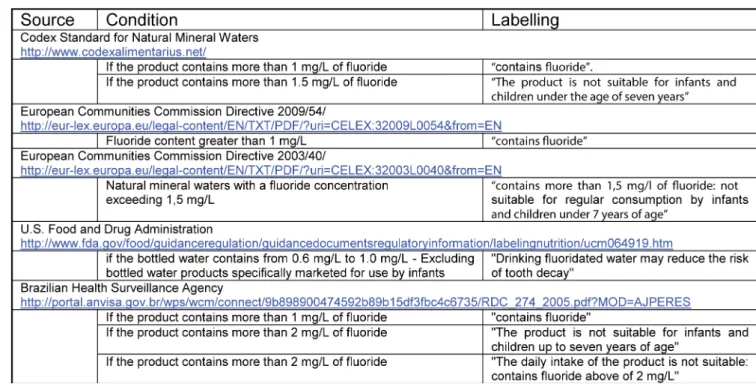
he reference criterion for assessment was not mentioned or was inconsistently mentioned (e.g. using not applicable criterion) in three studies12,14,16. One study11 assessed the luoride values based on a criterion proposed in 1957 by Galagan and Vermillion. Seventeen (77.3%) researches assessed the outcomes using a sound criterion. One study10 utilized legislation locally approved; four examined based on pertinent national regulation13,15,26,29; and the thirteen remaining studies employed recommendations from international agencies such as World Health Organization (WHO) and European Communities; or from USA agencies such as American Dental Association, Environmental Protection Agency and Food and Drug Administration. he more mentioned supporting recommendation was based on WHO that indicates until 1.5 mg/L of luoride as a safe potable water. Figure 2 shows standards related to labelling approved by some agencies cited in the included articles.
he values of luoride concentration measured in the sample and those informed in the label were compared in ten (45.5%) studies. Signiicant discrepancies were noted in nine of them. Out of ten studies, six were undertaken in countries with national legislation on the issue and all of them presented the mentioned discrepancy. Diferences were negligible in only one study30.
From the viewpoint of public health surveillance, 19 (86.4%) studies mentioned explicitly the needed of control on luoride concentration in bottled water due to its risk for human dentition. Mention related to this aspect was not observed in only three researches24,27,31.
▄
DISCUSSIONhe consumption of bottled water has increased in the last years and the luoride concentration monitoring is important for prevention and control of dental caries and dental luorosis in populations. his need was acknowledged by the majority of the included studies due to the risk for human dentition.
Owing to the focus of this study directed to public health surveillance, the present review was restricted to the period between 2008 and 2012. Although limited to ive years, articles from the world’s ive main continents were identiied and some relevant theoretical and methodological features emerged from the analysis.
Overall an international framework for packaged water regulation is provided by the Codex Alimentarius Commission of the World Health Organization and the Food and Agriculture Organization of the United Nations9. he Codex Alimentarius Commission has developed a standard for natural mineral waters. It describes the product and its compositional and quality factors, including prescribed treatments, limits for certain chemicals, hygiene, packaging and labelling32. Moreover, some countries have proper legislation. It is worth noting that a city (São Paulo city) has speciic law regulating the issue33.
he main contribution of this systematic review is that the found results showed signiicant discrepancies between the measured luoride concentration and the informed amount in the product’s label independently of the existence of speciic legislations. Besides, it constitutes an irregularity; this situation may induce the public to consume a product with the intention of obtaining some beneit that the bottle water could not really provide. his inding reinforces the warnings raised by several researchers and also reveals the needs of a periodical checking in order to conirm the accomplishment of the legislation10,14,17,18,20‑23,25,26,29.
Furthermore, the parameters that deine hazard to health and instruct the content of labelling were diverse and should be revised as many of them can represent exposure to dental luorosis of esthetic signiicance for the children. European communities tolerate bottled water up to 5.0 mg/L of luoride as a maximum acceptable and recommend a sentence of caution in the label for the consumption of products that contain more than 1.5 mg F/L by children under seven years of age. he Codex Alimentarius Commission makes the same recommendation9. he FDA does not require bottled water manufacturers to list the luoride content on the label, but does require that luoride additives to be listed. Imported bottled water to which no luoride is added shall not contain luoride in excess of 1.4 mg F/L whereas that to which luoride is added shall not contain luoride in excess of 0.8 mg F/L. Fluoride levels of bottled water packaged in the United States shall be based on the annual average of maximum
daily air temperatures at the location where the bottled water is sold at retail. Brazilian Health Surveillance Agency do not have a value from which the luoride level of bottled water is considered unsafe and unacceptable, but requires for products containing more than 2 mg F/L that a sentence shall be showed in the product’s label warning all people for the damage in case of daily intake1.
According to a research that examined review studies published between 2000 and 200934, it is worth to note that children under eight years of age will remain at risk for dental luorosis if these recommendations were maintained. he prevalence of luorosis of esthetic signiicance was estimated to be 10.0% (95% CI: 5.0; 17.9) and 12.5% (95% CI: 7.0; 21.5) for child/adolescent population exposed to 0.7 and 1.0 mg F/L in the drinking water, respectively. herefore, some specialists have claimed the review of the quality standards for mineral water commercialized in Brazil12‑14. An exception within this general picture is the São Paulo city, one of the world’s most populated cities where the public supply water has been luoridated since 1985. he City Council approved in 1998 a legislation that prohibits the commercialization of bottle water with concentration above 0.8 mg F/L10,33.
▄
CONCLUSIONhe results show that legislation is necessary but not suicient. hey reinforce the warnings raised by several researchers and show the relevancy of luoride concentration surveillance in bottled water. he parameters that deine hazard to health
and instruct the content of labelling were diverse and should be revised as many of them can represent avoidable exposure to dental luorosis of esthetic signiicance for the children. Moreover, there is an important room for improvement of the methodological procedures in further studies.
▄
REFERENCES1. Agência Nacional de Vigilância Sanitária. Resolução nº 274, de 22 de setembro de 2005. Aprova o Regulamento Técnico para Águas Envasadas e Gelo. Diário Oficial da União [Internet], Brasília, 23 de setembro de 2005 [cited 2014 June 18]. Available from: http://portal.anvisa.gov.br/wps/ wcm/connect/9b898900474592b89b15df3fbc4c6735/RDC_274_2005. pdf?MOD=AJPERES
2. Rodwan‑Junior JG. Bottled water 2011: the recovery continues [Internet]. New York: International Bottled Water Association; 2012. [cited 5 set 2014]. Available from: http://www.bottledwater.org/files/2011BWstats.pdf
3. Ward LA, Cain OL, Mullally RA, Holliday KS, Wernham AGH, Baillie PD, et al. Health beliefs about bottled water: a qualitative study. BMC Public Health. 2009;9(1):196. http://dx.doi.org/10.1186/1471‑2458‑9‑196. PMid:19545357.
4. Drewnowski A, Rehm CD, Constant F. Water and beverage consumption among children age 4‑13y in the United States: analyses of 2005–2010 NHANES data. Nutr J. 2013;12(1):85. http://dx.doi.org/10.1186/1475‑ 2891‑12‑85. PMid:23782914.
5. Scabar LF, Amaral RC, Slater B, Frazão P. Ingestão de água e bebidas por adolescentes: comparação de uma medida autoaplicável com recordatórios de 24 horas. Rev Bras Odontol. 2014;71:28‑34.
6. McGuire S. Fluoride content of bottled water. N Engl J Med. 1989;321(12):836‑ 7. http://dx.doi.org/10.1056/NEJM198909213211220. PMid:2770819.
7. Villena RS, Borges DG, Cury JA. Avaliação da concentração de flúor em águas minerais comercializadas no Brasil. Rev Saúde Pública. 1996;30(6):512‑8. http://dx.doi.org/10.1590/S0034‑89101996000600004. PMid:9302820.
8. Tricco AC, Tetzlaff J, Moher D. The art and science of knowledge synthesis. J Clin Epidemiol. 2011;64(1):11‑20. http://dx.doi.org/10.1016/j. jclinepi.2009.11.007. PMid:20189767.
9. World Health Organization. Food and Agriculture Organization. Codex Alimentarius Commission. Codex Standard for Natural Mineral Waters 108‑1981 [Internet]. [cited 2014 June 19]. Available from: https://www. google.com/url?q=http://www.codexalimentarius.org/input/download/ standards/223/CXS_108e.pdf&sa=U&ei=nFw1VcXJKcimNvXdgJgO&v ed=0CBAQFjAG&client=internal‑uds‑cse&usg=AFQjCNFYtOLArWnI QxliHYAZ8mOrYgFM8A
10. Grec RHC, Moura PGM, Pessan JP, Ramires I, Costa B, Buzalaf MAR. Fluoride concentration in bottled water on the market in the municipality of São Paulo. Rev Saúde Pública. 2008;42(1):154‑7. http://dx.doi.org/10.1590/ S0034‑89102008000100022. PMid:18200355.
11. Souza CFM, Paredes SO, Forte FDS, Sampaio FC. Fluoride content of bottled water commercialized in two cities of northeastern Brazil. Braz J Oral Sci. 2009;8:206‑9.
12. Terreri ALM, Santos CCM, Lopes MRV, Silva RFM, Rodrigues JCS. Avaliação da concentração de flúor em águas minerais engarrafadas disponíveis no comércio. Rev Inst Adolfo Lutz. 2009;68(3):354‑8.
13. Bulcão LN, Rebelo MAB. Evaluation of the fluoride concentration in mineral water and guaraná ‑based soft drinks in Manaus, Amazonas. Rev Odonto Ciênc. 2009;24:240‑3.
14. Castro TA, Sampaio FC, Forte FDS. Fluoretos em diferentes fontes de águas para consumo humano em Campo Alegre de Lourdes‑BA. Rev Bras Ciênc Saúde. 2011;15:421‑8.
15. Sayed N, Ditterich IRG, Pinto MHB, Wambier DS. Concentração de flúor em águas minerais engarrafadas comercializadas no município de Ponta Grossa‑PR. Rev Odontol UNESP. 2011;40:182‑6.
16. Dobaradaran S, Mahvi AH, Dehdashti S. Fluoride content of bottled drinking water available in Iran. Fluoride. 2008;41:93‑4.
17. Amanlou M, Hosseinpour M, Azizian H, Khoshayand MR, Navabpoor M, Souri E. Determination of fluoride in the bottled drinking waters in Iran. Iran J Pharm Res. 2010;9(1):37‑42. PMid:24363704.
18. Miranzadeh MB, Hassanzadeh M, Miranzadeh SD, Hassanzadeh M, Dehqan S. Determination of total dissolved solid (TDS), nitrate and fluoride in 24 brands of Iranian bottled waters. Int J Phys Sci. 2011;6:5128‑32.
19. Moslemi M, Khalili Z, Karimi S, Shadkar MM. Fluoride concentration of bottled water and tap water in Tehran, Iran. J Dent Res Dent Clin Dent Prospects. 2011;5(4):132‑5. PMid:22991622.
20. Thippeswamy HM, Kumar N, Anand SR, Prashant GM, Chandu GN. Fluoride content in bottled drinking waters, carbonated soft drinks and fruit juices in Davangere city, India. Indian J Dent Res. 2010;21(4):528‑30. http://dx.doi.org/10.4103/0970‑9290.74206. PMid:21187619.
21. Gupta P, Kumar A. Fluoride levels of bottled and tap water sources in Angra city, India. Fluoride. 2012;45:307‑10.
22. Aldrees AM, Al‑Manea SM. Fluoride content of bottled drinking waters available in Riyadh, Saudi Arabia. Saudi Dent J. 2010;22(4):189‑93. http:// dx.doi.org/10.1016/j.sdentj.2010.07.003. PMid:23960496.
23. Khan NB, Chohan NA. Accuracy of bottled drinking water label content. Environ Monit Assess. 2010;166(1‑4):169‑76. http://dx.doi.org/10.1007/ s10661‑009‑0993‑7. PMid:19475483.
24. Quock RL, Chan JT. Fluoride content of bottled water and its implications for the general dentist. Gen Dent. 2009;57(1):29‑33. PMid:19146140.
25. Steinmetz JEA, Martinez‑Mier EA, Jones JE, Sanders BJ, Weddell JA, Soto‑Rojas AE, et al. Fluoride content of water used to reconstitute infant formula. Clin Pediatr (Phila). 2011;50(2):100‑5. http://dx.doi. org/10.1177/0009922810379908. PMid:21242202.
26. Bengharez Z, Farch S, Bendahmane M, Merine H, Benyahia M. Evaluation of fluoride bottled water and its incidence in fluoride endemic and non‑ endemic areas. e‑SPEN J. 2012;7:e41‑e45.
28. Ajayi AA, Sridhar MKC, Adekunle LV, Oluwande PA. Quality of packaged waters sold in Ibadan, Nigeria. Afr J Biomed Res. 2008;11:251‑8.
29. Mills K, Falconer S, Cook C. Fluoride in still bottled water in Australia. Aust Dent J. 2010;55(4):411‑6. http://dx.doi.org/10.1111/j.1834‑7819.2010.01262.x. PMid:21133940.
30. Szymaczek JO, Opydob J. Fluoride content of bottled waters recommended for infants and children in Poland. Fluoride. 2009;42:233‑6.
31. Oyelude OE, Ahenkorah S. Quality of sachet water and bottled water in bolgatanga municipality of Ghana. Res J Appl Sci Eng Technol. 2012;4:1094‑ 8.
32. Codex Alimentarius. Codex Alimentarius: International Food Standards [Internet]. [cited 2014 June19]. Available from: http://www.codexalimentarius. org/
33. São Paulo. Prefeitura Municipal de São Paulo. Lei Municipal nº 12.623, de 6 de Maio de 1998. Proíbe a comercialização de água mineral com teor
de flúor acima de 0,8 mg/l no município e dá outras providências. Diário Oficial do Município de São Paulo [Internet]. São Paulo, 1998. [cited 2014 June19]. Available from: http://www3.prefeitura.sp.gov.br/cadlem/ secretarias/negocios_juridicos/cadlem/integra.asp?alt=13051998L%20 126230000
34. Frazão P, Peres MA, Cury JA. Drinking water quality and fluoride concentration. Rev Saúde Pública. 2011;45(5):964‑73. PMid:21789449.
35. Bratovcic A, Odobasic A, Catic S. The advantages of the use of ion‑selective potentiometry in relation to UV/VIS spectroscopy. Agric Conspec Sci. 2009;74:139‑41.
36. Freitas VPS, Brígido BM, Badolato MIC, Mazon EMA, Alaburda J. Estudo comparativo de soluções‑tampão para determinação de fluoreto em águas para diálise. Rev Inst Adolfo Lutz. 2003;62:207‑12.