Aromatase gene and its effects on growth, reproductive and maternal ability
traits in a multibreed sheep population from Brazil
Ana Maria Bezerra Oliveira Lôbo
1, Raimundo Nonato Braga Lôbo
1,2and Samuel Rezende Paiva
3 1Departamento de Zootecnia, Universidade Federal do Ceará, Fortaleza, CE, Brazil.
2
Embrapa Caprinos e Ovinos, Sobral, Ceará, Brazil.
3
Embrapa Recursos Genéticos e Biotecnologia, Brasília, DF, Brazil.
Abstract
We determined the polymorphism C242T of the aromatase gene (Cyp19) and its allelic frequency, as well as the ef-fect of the variants on productive and reproductive traits in 71 purebred Santa Inês sheep, 13 purebred Brazilian So-mali sheep, nine purebred Poll Dorset sheep, and 18 crossbred 1/2 Dorper sheep. The animals were genotyped using the PCR-RFLP technique. The influence of the animal’s genotype on its performance or on the performance of its lambs was analyzed by the least square method. Another factor assessed was the importance of the animal’s ge-notype in analysis models for quantitative breeding value estimates, and whether there were differences among the averages of breeding values of animals with different genotypes for this gene. In the sample studied, no AA individu-als were observed; the AB and BB frequencies were 0.64 and 0.36, respectively. All Brazilian Somali sheep were of genotype BB. All 1/2 Dorper BB animals presented a lower age at first lambing, and the Santa Inês BB ewes pre-sented a lower lambing interval. In these same genetic groups, AB ewes prepre-sented higher litter weight at weaning. This is evidence that BB ewes have a better reproductive performance phenotype, whereas AB ewes present a better maternal ability phenotype. However, in general, animals with genotype AB presented better average breed-ing values than those with genotype BB.
Key words:body weight, lambing interval, PCR-RFLP, polymorphism, SNP, litter weight.
Received: July 29, 2008; Accepted: February 17, 2009.
Introduction
The aromatase cytochrome P450 enzyme is responsi-ble for estrogen biosynthesis by conversion or aromati-zation of androgens into estrogens. Estrogen is a hormone with important endocrine, paracrine and autocrine activi-ties, involved not only in the regulation of male and female reproduction, but also in other characteristics, such as fat deposition (Heine et al., 2000; Jones et al., 2000) and growth (Simpsonet al., 2000).
In the granulosa cells, aromatase is essential for folli-culogenesis and, consequently, for oocyte quality. Aro-matase is also related, through the aromatization of androgens into estrogens, with the estrus stimulus and the development of the mammary glands. In the ovarian folli-cles, the theca produces androgens that accumulate when the estrogen synthesis by the granulosa cells is inadequate. This accumulation seems to promote an inhibitory effect on the follicular structures, and consequently, the follicles be-come atretic and die. In many species, estrogen biosyn-thesis in the brain has been correlated to sexual behavior,
such as mating responses and frequently a pronounced di-morphism between males and females (Simpson et al., 1994).
Some studies performed in cattle have indicated that the estrogens play an important role in the maintenance of pregnancy (Wendorfet al., 1983) and in the beginning of parturition (Hoffmannet al., 1979; Thorburn and Challis, 1979). Estrogen synthesis begins with the mitochondrial cholesterol and androgen substrates, such as androstene-dione, that are turned into estrogens by the enzyme aro-matase (Conley and Hinshelwood, 2001).
The geneCyp19that codifies the aromatase P450 en-zyme in sheep has been mapped to bands q24-q31 of chro-mosome 7 (Payenet al., 1995; Goldammeret al., 1999). In exon 3, which is located in codon 69, a silent C/T transition was detected in several animals (Vanselowet al., 1999). In sheep,Cyp19is transcribed from four different promoters (P1.1, P1.4, P1.5 and P2) that present organ-specific activi-ties. P2 is mainly active in granulosa cells, P1.5 and P1.1 are active in the placenta, and P1.4 is active in the brain (Vanselowet al., 1999; 2001).
Studies in humans have shown that a mutation in gene
Cyp19seems to be associated with bone maturation and consequently with linear growth (Morishimaet al., 1995;
Send correspondence to Raimundo Nonato Braga Lôbo. Embrapa Caprinos e Ovinos, Estrada Sobral Groaíras km 4, Caixa Postal 145, 62011-970 Sobral, CE, Brazil. E-mail: [email protected].
Caraniet al., 1997). These studies established that estro-gen, and not androestro-gen, is responsible for the progress of bone maturation.
The aim of this study was to determine the presence and the allelic frequency of polymorphism C242T (AJ012153) in the aromatase gene in a multibreed sheep population from Brazil. In addition, the effects of the vari-ants on growth, reproductive and maternal ability traits were assessed. The importance of the knowledge of the ani-mal’s genotype in the analysis models for estimating the quantitative breeding values of studied traits, and the exis-tence of differences among the averages of these breeding values in animals with different genotypes for this gene were also evaluated.
Materials and Methods
Blood samples
For DNA analysis, blood samples were collected from 71 purebred Santa Inês sheep (eight males and 63 fe-males), 13 purebred Brazilian Somali sheep (all fefe-males), nine purebred Poll Dorset sheep (two males and seven fe-males), and 18 crossbred 1/2 Dorper sheep (all females). These animals, 10 rams and 101 ewes, were raised in a herd (Gaasa Agropecuária Ltda.) located in Inhumas, Goiás, Brazil, under semi-intensive conditions. This herd is con-trolled by the Breeding Program for Meat Goats and Sheep (Programa de Melhoramento Genético de Caprinos e Ovi-nos de Corte - GENECOC), of Embrapa (Brazilian Agri-cultural Research Corporation) Caprinos e Ovinos.
Genotyping
DNA was extracted using the salting out protocol (Milleret al., 1988). The PCR-RFLP technique was used to determine the presence and the allelic frequency of the C242T (AJ012153) polymorphism in the Cyp19gene (aro-matase). A 140 bp fragment of the gene was amplified us-ing the primers described by Vanselow et al. (1999), in agreement with the sequence deposited in GenBank (AJ012153): primer 1-5’ - CCA GCT ACT TTC TGG GAA TT - 3’; primer 2-5’ - AAT AAG GGT TTC CTC TCC ACA - 3’. The polymorphism was determined by endonuclease digestion of the amplified fragment with the
Bsp143Ienzyme (isochizomerDpnII).
The PCR amplification reaction was carried out in an Eppendorf thermocycler, in a final reaction volume of 25 mL; each reaction contained 5 pmol of each primer, 1.5 U Taq DNA polymerase (Phoneutria), 100mM of each dNTP, 2.5 mM MgCl2, 1X buffer, and 25, 50 or 100 ng
ovine genomic DNA, depending on the sample. The ampli-fication program consisted of an initial denaturation step (94 °C for 2 min), 35 denaturation (94 °C for 15 s), anneal-ing (55 °C for 30 s) and elongation (70 °C for 2 min) cycles, followed by a final elongation step (70 °C for 5 min). The amplified products were submitted to electrophoresis on
4% agarose gels and visualized under an UV transillu-minator, after staining with ethidium bromide.
A 10mL aliquot of PCR products was digested in a to-tal volume of 20mL with 5 U ofDpnII (Biolabs) and 1X buffer for 14 h at 37 °C, followed by inactivation for 20 min at 65 °C. The digestion products were also electrophoresed on 4% agarose gel and visualized by ethidium bromide staining.
Statistical analyses
In order to determine the influence of the genotype of the animal on its performance or on the performance of its lambs (lambs of the 101 ewes), statistical analyses were made using the least square method of the GLM procedure of the SAS software (SAS Institute Inc., 1996). The genetic groups of the lambs tested were: Santa Inês (of Santa Inês ewes), 3/4 Santa Inês (of 1/2 Santa Inês ewes), 3/4 Dorper (of 1/2 Dorper ewes), and 7/8 Dorper (of 3/4 Dorper ewes). The growth traits analyzed were: birth weight (BW), wean-ing weight (WW), slaughter weight (SW), yearlwean-ing weight (YW), weight gain from birth to weaning (GBW), weight gain from weaning to slaughter (GWS), and weight gain from weaning to yearling (GWY). These traits were evalu-ated in all animals (lambs and ewes). In ewes, the reproduc-tive and maternal traits analyzed were: age at first lambing (AFL), lambing interval (LI), gestation length (GL), lamb-ing date (LD; number of days between the beginnlamb-ing of the breeding season and the lambing), litter weight at birth (LWB), and litter weight at weaning (LWW).
Body weights and weight gains were adjusted for sea-son and year of birth, sex (in the case of lamb performance), and birth type (single, twin, triple). BW, WW and GBW were adjusted for age classes (1 to 6) of the dam at lambing. WW, SW and YW were adjusted for age at measurement as covariate. These weight gains were also adjusted for the re-spective ages. AFL was adjusted for season and year of birth, animal birth type and lambing type (one male lamb, one female lamb, two male lambs, two female lambs, one male and one female lamb, three lambs regardless of sex). LI, LD, GL, LWB and LWW were adjusted for season and year of birth, lactation number and lambing type (as de-scribed above). LWW was also adjusted for the age at weaning as covariate.
genotype information, and Li was the restricted likelihood maximum for models with genotype information. The -2 Log LR value was compared to thec2tabulated value, with one degree of freedom; the test was considered significant whenever the calculated value was higher than the tabu-lated value.
Finally, the differences among breeding values of the genotyped animals were determined by variance analysis.
Results
The PCR digestion products of 111 samples revealed only two genotypes for theCyp19polymorphism: AB and BB. Genotype AB presents three fragments, of 140, 82 and 58 bp, respectively, whereas genotype BB presents only one fragment, of 140 bp. Figure 1 presents a sample of 13 genotyped animals.
The frequencies of genotypes AB and BB were 0.64 e 0.36, respectively. Table 1 shows the frequencies for alleles A and B, according to the genetic groups analyzed.
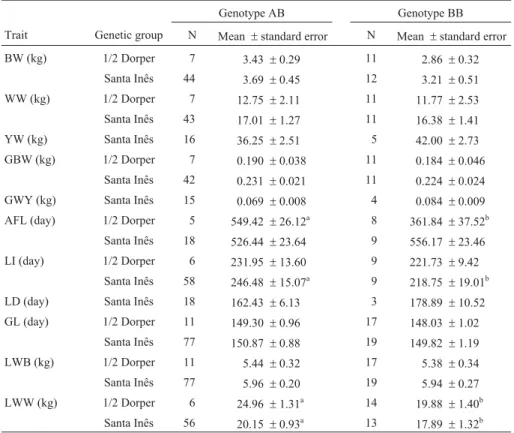
Table 2 presents the averages of the traits measured in the animals genotyped for gene Cyp19. Data on perfor-mance were available only for the animals of the 1/2 Dorper and Santa Inês genetic groups. No difference was observed regarding weight or weight gain among animals of different genotypes. However, some differences were observed for some traits in some genetic groups. In 1/2 Dorper, the BB animals presented lower AFL (p < 0.05). In the Santa Inês breed, animals with this same genotype also presented lower LI. For the maternal trait LWW, AB animals weaned heavier litters.
Table 3 presents the averages of traits measured in the lambs of genotyped ewes. Lambs of BB 1/2 Dorper ewes presented lower averages for BW, WW and GBW, while lambs of BB Santa Inês ewes presented lower averages only for WW.
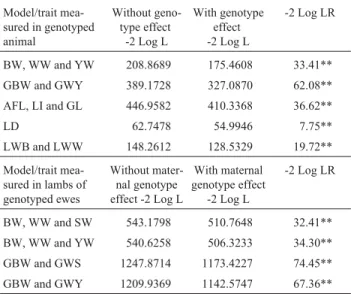
Table 4 presents the values of the likelihood ratio test (LR) for models including or not the effect of the aromatase gene in the analysis for estimating the breeding values of the studied traits. For all traits and models considered, the utilization of the aromatase genotype effect was important. The inclusion of the genotype information allowed a better fitting of the analyses of the measured traits, both in the genotyped animal itself and in the lambs of genotyped ewes. A significant decrease (p < 0.01) in -2 Log L was found when the genotype information was included.
The comparison between the averages of breeding values estimated for growth, reproductive and maternal traits, according to the two genotypes observed for the aromatase gene, is presented in Table 5. Considering the breeding values estimated in genotyped animal, except for weaning weight (maternal effect), weight gain from wean-ing to slaughter, weight gain from weanwean-ing to yearlwean-ing, age at first lambing and gestation length, there were differences in the averages of breeding values.
Regarding growth traits, the animals with genotype AB presented, on average, higher breeding values than those with genotype BB. Similarly, the lambs of ewes with genotype AB presented higher breeding values than those of mothers with genotype BB, except for GWS.
With regard to reproductive traits, there were differ-ences only in LI and LD. The animals with genotype AB presented better breeding values for LI (lower) and worse breeding values for LD (higher). Ewes with genotype AB presented a higher maternal ability than those with geno-type BB. Their values for LWB and LWW were superior by 0.099 kg and 0.319 kg, respectively. This trend was con-firmed in the analysis that considered the effect of the ma-ternal genotype on the breeding values of their lambs. The expected progeny differences regarding BW, WW and GBW were, respectively, 0.06 kg, 0.08 kg and 1.79 g/day higher for lambs of AB ewes than for lambs of BB ewes.
Discussion
Coincidently, all rams of the herd sampled in this work had genotype AB. There were no AA animals in the analyzed sample, probably due to the low frequency of al-lele A. Vanselowet al.(1999) studied purebred ovine ani-mals from Europe and identified three genotypes, with a frequency of 0.74 for allele A and 0.26 for allele B in Hun-garian Merino animals, and a frequency of 1.00 for allele A
Table 1- Allelic frequencies of the breeds studied.
Genetic group Number of animals
Frequency of allele A
Frequency of allele B
1/2 Dorper 18 0.194 0.806
Poll Dorset 9 0.390 0.610
Santa Inês 71 0.400 0.600
Brazilian Somali 13 0.000 1.000
Table 2- Least square means for traits measured in animals with genotypes AB and BB for the aromatase gene.
Genotype AB Genotype BB
Trait Genetic group N Mean ±standard error N Mean ±standard error
BW (kg) 1/2 Dorper 7 3.43 ±0.29 11 2.86 ±0.32
Santa Inês 44 3.69 ±0.45 12 3.21 ±0.51
WW (kg) 1/2 Dorper 7 12.75 ±2.11 11 11.77 ±2.53
Santa Inês 43 17.01 ±1.27 11 16.38 ±1.41
YW (kg) Santa Inês 16 36.25 ±2.51 5 42.00 ±2.73
GBW (kg) 1/2 Dorper 7 0.190 ±0.038 11 0.184 ±0.046
Santa Inês 42 0.231 ±0.021 11 0.224 ±0.024
GWY (kg) Santa Inês 15 0.069 ±0.008 4 0.084 ±0.009
AFL (day) 1/2 Dorper 5 549.42 ±26.12a 8 361.84 ±37.52b
Santa Inês 18 526.44 ±23.64 9 556.17 ±23.46
LI (day) 1/2 Dorper 6 231.95 ±13.60 9 221.73 ±9.42
Santa Inês 58 246.48 ±15.07a 9 218.75 ±19.01b
LD (day) Santa Inês 18 162.43 ±6.13 3 178.89 ±10.52
GL (day) 1/2 Dorper 11 149.30 ±0.96 17 148.03 ±1.02
Santa Inês 77 150.87 ±0.88 19 149.82 ±1.19
LWB (kg) 1/2 Dorper 11 5.44 ±0.32 17 5.38 ±0.34
Santa Inês 77 5.96 ±0.20 19 5.94 ±0.27
LWW (kg) 1/2 Dorper 6 24.96 ±1.31a 14 19.88
±1.40b
Santa Inês 56 20.15 ±0.93a 13 17.89
±1.32b
a,b
Means with different superscripts are statistically different (p < 0.05;ttest); BW = birth weight, WW = weaning weight, YW = yearling weight, GBW = weight gain from birth to weaning, GWY = weight gain from weaning to yearling, AFL = age at first lambing, LI = lambing interval, GL = gesta-tion length, LD = lambing date, LWB = litter weight at birth, LWW = litter weight at weaning; N = number of observagesta-tions.
Table 3- Least square means for traits measured in lambs of ewes genotyped for the aromatase gene.
Genotype AB Genotype BB
Trait Genetic group N Mean ±standard error N Mean ±standard error
BW (kg) 1/2 Dorper 17 4.25 ±0.21a 38 3.22
±0.13b
1/2 Santa Inês 1 3.82 ±0.69 28 3.36 ±0.17
3/4 Dorper 17 3.41 ±0.26 14 3.34 ±0.27
Santa Inês 126 3.89 ±0.10 22 3.61 ±0.17
WW (kg) 1/2 Dorper 12 16.93 ±0.69a 30 14.42
±0.47b
1/2 Santa Inês 1 14.59 ±5.02 22 13.04 ±1.37
3/4 Dorper 8 16.51 ±1.51 11 13.09 ±1.62
Santa Inês 91 15.54 ±0.41a 16 13.86
±0.81b
SW (kg) Santa Inês 11 30.54 ±1.17 2 32.74 ±2.39
YW (kg) Santa Inês 12 36.54 ±4.01 4 37.91 ±8.14
GBW (kg) 1/2 Dorper 12 0.264 ±0.012a 30 0.224 ±0.008b
1/2 Santa Inês 1 0.191 ±0.092 22 0.190 ±0.021
3/4 Dorper 8 0.274 ±0.033 11 0.198 ±0.035
Santa Inês 91 0.236 ±0.009 16 0.211 ±0.017
GWS (kg) Santa Inês 11 0.202 ±0.010 2 0.240 ±0.020
GWY (kg) Santa Inês 10 0.056 ±0.009 4 0.053 ±0.016
a,b
(none for allele B) in Lacaune animals. To our best knowl-edge, besides the study of Vanselowet al.(1999), there is no other report in the literature on aromatase gene frequen-cies in ovine. In all animals sampled, except Brazilian So-mali, polymorphism for the aromatase gene was observed. High aromatase activity in trophoblast of preimplan-tation pig embryos is associated with maternal recognition of pregnancy and the occurrence of superficial implantation in pigs, sheep, cows, roe deer, ferrets, cats, rabbits and a plains viscacha (Gadsbyet al., 1980).
In male mice, Wanget al.(2001) observed that ele-vatedCyp19expression was followed by an increase in the intratesticular levels of estradiol. These authors concluded that aromatase seems to be a physiological target of Dax-1 (an orphan nuclear receptor that represses transcription by steroidogenic factor-1, SF-1) in Leydig cells, and increased
Cyp19expression may account, in part, for infertility and Leydig cell hyperplasia (LCH) inDax1-deficient mice.
Gestagens and estrogens are important regulators of pregnancy and parturition. Vanselowet al.(2004) reported that in cattle and sheep Cyp19 transcripts were found at high concentrations in the placenta and at a very low con-centration in the corpus luteum. According to Luo and Wiltbank (2006), in bovine,Cyp19A1(aromatase) is regu-lated by multiple pathways, including estrogen receptors and cAMP/protein kinase A induced by FSH hormone acti-vation in granulosa cells. These inter and intracellular regu-latory mechanisms may be critical for normal follicle growth and dominant follicle selection.
All these pieces of evidence allow concluding that the polymorphism produces differences in aromatase activity, justifying the differences observed in reproductive perfor-mance (AFL and LI) and in maternal ability (LWW) of some genetic groups studied here. Aromatase inhibition rapidly decreases both appetitive and consummatory as-pects of male sexual behavior (Cornilet al., 2006; Roselliet al., 2006). Therefore, such enzyme activity differences among animals could produce a difference in AFL and in LI. On the other hand, it is known that traits measured until weaning are subject to strong maternal influence. Thus, our
Table 4- Logarithm values of the likelihood function (-2 Log L) and val-ues for likelihood rate (LR) test for the studied traits, according to the re-spective model.
Model/trait mea-sured in genotyped animal
Without geno-type effect
-2 Log L
With genotype effect -2 Log L
-2 Log LR
BW, WW and YW 208.8689 175.4608 33.41**
GBW and GWY 389.1728 327.0870 62.08**
AFL, LI and GL 446.9582 410.3368 36.62**
LD 62.7478 54.9946 7.75**
LWB and LWW 148.2612 128.5329 19.72**
Model/trait mea-sured in lambs of genotyped ewes
Without mater-nal genotype effect -2 Log L
With maternal genotype effect
-2 Log L
-2 Log LR
BW, WW and SW 543.1798 510.7648 32.41**
BW, WW and YW 540.6258 506.3233 34.30**
GBW and GWS 1247.8714 1173.4227 74.45**
GBW and GWY 1209.9369 1142.5747 67.36**
**p < 0.01; BW = birth weight; WW = weaning weight; SW = slaughter weight; YW = yearling weight; GBW = weight gain from birth to weaning; GWS = weight gain from weaning to slaughter; GWY = weight gain from weaning to yearling; AFL = age at first lambing; LI = lambing interval; GL = gestation length; LD = lambing date; LWB = litter weight at birth; LWW = litter weight at weaning.
Table 5- Comparison between averages of breeding values estimated for growth, reproductive and maternal traits of a multibreed population of sheep, according to the genotype for the aromatase gene.
Genotypes
Trait AB BB
Breeding values estimated in genotyped animal
Birth weight - direct effect (kg) 0.205a 0.003b
Birth weight - maternal effect (kg) 0.015a -0.085b
Weaning weight - direct effect (kg) 0.722a -0.048b
Weaning weight - maternal effect (kg) -0.072a -0.237a
Yearling weight (kg) 1.060a -0.754b
Slaughter weight (kg) 1.000a -0.778b
Weight gain from birth to weaning - direct effect (g/day)
8.182a 2.907b
Weight gain from birth to weaning - maternal effect (g/day)
1.887a -4.043b
Weight gain from weaning to slaughter (g/day) -3.335a -2.505a
Weight gain from weaning to yearling (g/day) 1.685a 0.422a
Age at first lambing (day) 1.605a 1.375a
Lambing interval (day) -5.653a -3.673b
Lambing date (day) 0.2790a 0.0646b
Gestation length (day) -0.0825a -0.0934a
Litter weight at birth (kg) 0.128a 0.029b
Litter weight at weaning (kg) 0.282a -0.037b
Breeding values estimated in lambs of genotyped ewes
Birth weight - direct effect (kg) 0.190a -0.030b
Birth weight - maternal effect (kg) 0.034a -0.082b
Weaning weight - direct effect (kg) 0.745a -0.027b
Weaning weight - maternal effect (kg) -0.025a -0.185b
Yearling weight (kg) 1.181a -0.704b
Slaughter weight (kg) 1.043a -0.539b
Weight gain from birth to weaning - direct effect (g/day)
9.670a 4.722b
Weight gain from birth to weaning - maternal effect (g/day)
1.750a -1.828b
Weight gain from weaning to slaughter (g/day) -2.986b 0.619a
Weight gain from weaning to yearling (g/day) 2.129a 0.687b
analyses of weight and weight gains until weaning corrobo-rate the findings for LWW,i.e., that AB aromatase gene ewes tend to present greater maternal ability. However, in Black-and-White and Jersey cattle, Jedrzejczak et al.
(2006) did not observe any association between the
CYP19-PvuII polymorphism and milk production traits. The better fitting of models with the inclusion of the aromatase gene genotype suggests that whenever informa-tion about the animal genotype is available should be in-cluded in the models for estimating genetic parameters and breeding values. It is important to point out that the small number of genotyped animals in this study did not permit greater considerations about the estimated parameters. However, the inclusion of the genotype was important for the comparative analysis. Thus, as a larger number of geno-typed animals becomese available from future studies, this information can and should be included in the analysis models for estimates of quantitative breeding values.
Overall, differences among breeding values were ob-served according to the genotype for the aromatase gene. Using this information could improve the breeding values estimates. The use of the animal’s genotype or of the geno-type of its mother in the analysis will depend on the amount of available information or of the trait itself. We suggest that traits under larger maternal influence should be ana-lyzed using the information of the mother’s genotype. On the other hand, traits that are more subject to the effect of the individual’s genes should be evaluated by including the information of this individual’s genotype. It is also worth pointing out that the use of the mother’s genotype multi-plies the data available for analysis, once a ewe has several lambs, and this information can be used in the analyses of the traits of these lambs.
In this study, the genotype was included as fixed ef-fect, so in future investigations other analyses could be made, as suggested by Muir (2007), combining mixed models utilizing a second random genetic effect for type, once there is sufficient recorded information on geno-type and phenogeno-type.
The heterozygotes for the aromatase gene showed, on average, better breeding values than the BB homozygotes. The estimated breeding values are due to additive genetic action. However, as in this population there is a participa-tion of many breeds and their crossbreeding, it is possible that non-additive genetic effects were present in these esti-mates. The combination of breeds promotes higher hete-rosis, due to the increase of heterozygosis in the population. This could explain the superiority of heterozygote animals.
The results of this study point to a so far not eluci-dated difference among sheep with different genotypes for the aromatase gene. Future investigations may reveal whether this polymorphism is responsible for differences in the performance of animals and thus help in the selection of superior animals.
Acknowledgments
Financial support was provided by Conselho Nacio-nal de Desenvolvimento Científico e Tecnológico (CNPq) and Embrapa Caprinos e Ovinos.
References
Boldman KG, Kriese LA, Van Vleck DL, Van Tassell CP and Kachman SD (1995) A Manual for Use of MTDFREML. A set of programs to obtain estimates of variances and cova-riances [Draft]. USDA/Agricultural Research Service, Lin-coln, 120 pp.
Carani C, Qin K, Simoni M, Faustini-Fustini M, Serpente S, Boyd J, Korach KS and Simpson ER (1997) Effect of testosterone and estradiol in a man with aromatase deficiency. N Engl J Med 337:91-95.
Conley AJ and Hinshelwood M (2001) Mammalian aromatases. Reproduction 121:685-695.
Cornil CA, Taziaux M, Baillien M, Ball GF and Balthazart J (2006) Rapid effects of aromatase inhibition on male repro-ductive behaviors im japanese quail. Horm Behav 49:45-67. Gadsby JE, Heap RB and Burton RD (1980) Oestrogen
produc-tion by blastocyst and early embryonic tissue of various spe-cies. J Reprod Fertil 60:409-17.
Goldammer T, Brunner RM, Vanselow J, Zsolnai A, Fürbass R and Schwerin M (1999) Assignment of the bovine aroma-tase encoding gene CYP19 to 10q26 in goat and 7q24-q31 in sheep. Cytogenet Cell Genet 85:258-259.
Heine PA, Taylor JA, Iwamoto GA, Lubahn DB and Cooke PS (2000) Increased adipose tissue in male and female estrogen receptor-alpha knockout mice. Proc Natl Acad Sci USA 97:12729-12734.
Hoffmann B, Wagner WC, Hixon JE and Bahr J (1979) Observa-tions concerning the functional status of the corpus luteum and the placenta around parturition in the cow. Anim Reprod Sci 2:253-266.
Jedrzejczak M, Szatkowska I, Zych S, Grzesiak W, Czer-niawska-Piatkowska E and Dybusi A (2006) Evaluation of associations of the polymorphism in the placenta-specific promoter 1.1 of the CYP19gene in Black-and-White and Jersey cattle with milk production traits. Arch Tierz Dum-merstorf 49:311-314.
Jones ME, Thorburn AW, Britt KL, Hewitt KN, Wreford NG, Proietto J, Oz OK, Leury BJ, Robertson KM, Yao S,et al. (2000) Aromatase-deficient (ArKO) mice have a phenotype of increased adiposity. Proc Natl Acad Sci USA 97:12735-12740.
Luo W and Wiltbank MC (2006) Distinct regulation by steroids of mssenger RNAs forFSHRandCYP19A1in bovine granu-losa cells. Biol Reprod 75:217-225.
Miller SA, Dykes DD and Polesky HF (1988) A simple salting out procedure for extracting DNA from human nucleated cells. Nucleic Acids Res 16:1215.
Morishima A, Grumbach MM, Simpson ER, Fisher C and Qin K (1995) Aromatase deficiency in male and female siblings caused by a novel mutation and the physiological role of estrogens. J Clin Endocrinol Metab 80:3689-98.
under alternative trait and genomic parameters. J Anim Breed Genet 124:342-355.
Payen E, Saidi-Mehtar N, Pailhoux E and Cotinot C (1995) Sheep gene mapping: Assignment of ALDOB, CYP19, WT and SOX2 by somatic cell hybrid analysis. Anim Genet 26:331-333.
Rao CR (1973) Minimum variance quadratic unbiased estimation of variance components. J Mult Anal 1:445-452.
Roselli CE, Schrunk JM, Stadelman HL, Resko JA and Stormshak F (2006) The effect of aromatase inhibition on the sexual differentiation of the sheep brain. Endocrine 29:501-511. SAS Institute Inc (1996) SAS/STAT. User’s Guide,v. 6.11. 4th
ed., v.2. SAS Institute Inc., Cary, 842 pp.
Simpson E, Rubin G, Clyne C, Robertson K, O’Donnell L, Jones M and Davis S (2000) The role of local estrogen biosyn-thesis in males and females. Trends Endocrinol Metab 11:184-188.
Simpson ER, Mahendroo MS, Means GD, Kilgore MW, Hinshel-wood MM, Graham-Lorence S, Amarneh B, Yuji I, Fisher CR, Michael MD, et al. (1994) Aromatase cytochrome P450, the enzyme responsible for estrogen biosynthesis. Endocr Rev 15:342-355.
Thorburn GD and Challis JR (1979) Endocrine control of parturi-tion. Physiol Rev 59:863-918.
Vanselow J, Zsolnai A, Fésus L, Schmidt P and Schwerin MA (1999)Bsp143I PCR-RFLP in exon 3 of the ovine aromatase gene (CYP19). Anim Genet 30:382-405.
Vanselow J, Fürbass R, Zsolnai A, Kalbe C, Said HM and Schwerin M (2001) Expression of the aromatase cytochro-me P450 encoding gene in cattle and sheep. J Steroid Biochem Mol Biol 79:279-288.
Vanselow J, Fürbass R, Rehbock F, Klautschek G and Schwerin M (2004) Cattle and sheep use different promoters to direct the expression of the aromatase cytochrome P450 encoding gene, Cyp19, during pregnancy. Domest Anim Endocrin 27:99-114.
Wang ZJ, Jeffs B, Ito M, Achermann JC, Yu RN, Hales DB and Jameson JL (2001) Aromatase (Cyp19) expression is up-regulated by targeted disruption ofDax1.Proc Natl Acad Sci USA 98:7988-7993.
Wendorf GL, Lawyer MS and First NL (1983) Role of the adre-nals in the maintenance of pregnancy in cows. J Reprod Fertil 68:281-287.
Associate Editor: Pedro Franklin Barbosa