Kinetic characterization of glucose aerodehydrogenase from
Aspergillus niger
EMS-150-F after optimizing the dose of mutagen for enhanced production of enzyme
Huma Umbreen, Muhammad Anjum Zia, Samreen Rasul
Enzyme Biotechnology Laboratory, Department of Chemistry and Biochemistry, University of Agriculture, Faisalabad, Pakistan.
Submitted: March 12, 2012; Approved: April 4, 2013.
Abstract
In the present study enhanced production of glucose aerodehydrogenase fromAspergillus nigerhas been achieved after optimizing the dose of chemical mutagen ethyl methane sulfonate (EMS) that has not been reported earlier. Different doses of mutagen were applied and a strain was developed basing upon the best production. The selected strainAspergillus nigerEMS-150-F was optimized for nutri-ent requiremnutri-ents in order to produce enzyme through fermnutri-entation and the results showed the best yield at 2% corn steep liquor (CSL), 36 hours fermentation time, pH 5, 30°C temperature, 0.3% KH2PO4, 0.3% urea and 0.06% CaCO3. The enzyme was then purified and resulted in 57.88 fold
puri-fication with 52.12% recovery. On kinetic characterization, the enzyme showed optimum activity at pH 6 and temperature 30°C. The Michaelis-Menton constants (Km, Vmax, Kcatand Kcat/Km) were
20 mM, 45.87 U mL-1, 1118.81 s-1and 55.94 s-1mM-1, respectively. The enzyme was found to be thermaly stable and the enthalpy and free energy showed an increase with increase in temperature and
DS* was highly negative proving the enzyme fromA. nigerEMS-150-F resistant to temperature and showing a very little disorderliness.
Key words:glucose aerodehydogenase, mutagenesis, production, purification, thermal stability.
Introduction
Microbial glucose aerodehydrogenase is currently re-ceiving much attention due to its wide applications in chemical, pharmaceutical, food, beverage, clinical chemis-try, biotechnology and other industries. It is also called as glucose oxidase and catalyzes the oxidation ofb-D-glucose to gluconic acid by utilizing the molecular oxygen with si-multaneous production of hydrogen peroxide. Of several microbial enzymes known for causing the oxidation of glu-cose, the best known is glucose aerodehydrogenase (Ban-keret al., 2009). Glucose aerodehydrogenase is naturally produced enzyme by some insects as honey bee (Santoset al., 2005) and grass hopper (Jacques, 2005) etc. It has been extracted from various micro-organisms as Penicillium notatum,Penicillium chrysosporium,Penicillium amaga-sakiense(Wittet al., 2000),Aspergillus nigerandBotrytis cinerea(Liuet al., 1998) but majority of its commercial preparations are being obtained from A. niger
(Hatzini-kolaouet al., 1996). It is successfully for industrial scale because it is metabolically versatile strain and is regarded as the mostly used and important species of fungus for pro-duction and extraction of catalytic proteins (Zia, 2007). It is stable on mutagenesis and does not cause problems on treatment with mutagens (Boschet al., 1995).
The main problems that are often complained about the enzyme production and stability are low productivity and loss of activity at increased temperature and fluctuat-ing pH at industrial processes. To overcome such obstruc-tions, mutated strains rather than native one are preferred to ferment such enzymes having better industrial effective-ness.A. nigeris a versatile fungus for mutagenesis for in-creased enzyme production (Crognalet al., 2006). Only a few reports are there that describe the mutagenesis and se-lection of A. niger for increased production of glucose aerodehydrogenase, but none has been reported yet about optimizing a chemical mutagen dose (EMS) with an in-creased and a stable activity of the enzyme. In the present
Send correspondence to M.A. Zia. Enzyme Biotechnology Lab., Department of Chemistry and Biochemistry, University of Agriculture, Faisalabad-38040, Pakistan. E-mail: [email protected].
study enhanced production, kinetic and thermodynamic stability has been reported after optimizing the dose of ethyl methane sulfonate (EMS)i.e. a potent mutagen for microbes.
Materials and Methods
All the chemicals and reagents used in this research work were of analytical grade and purchased from Oxoid, Sigma, Fluka and Riedel-de Haen etc. The organisms (par-ent Aspergillus nigerEBL and mutant Aspergillus niger EMS-150-F) were procured from Enzyme Biotechnology Lab., Department of Chemistry and Biochemistry, Univer-sity of Agriculture, Faisalabad. The parent strain was iso-lated from soil and was verified by Department of Pathology, University of Agriculture Faisalabad, Pakistan. Stock culture was maintained on Potato-Dextrose-Agar media (PDA) and refrigerated at 4 °C until its use.
The spores ofAspergillus nigerEBL from PDA me-dia were inoculated in a conical flask having 50 mL of Vogel’s media (pH 5.5), which was kept in a rotary shaker at 120 rpm and 30 °C temperature for 24-36 hours (Ziaet al., 2010). To get the enhanced production of glucose aerodehydrogenase the organism was subjected to ethyl methane sulfonate (EMS) exposure (Khattab and Bazaraa, 2005) at dose of 100, 150, 200 and 250 mM. Each specific dose of 1 mL was added in 9 mL of Vogel’s inoculum in a flask. The fractions of 1 mL were collected at different time intervals of 30, 60, 90, 120, 150 and 180 min. The fractions collected were centrifuged twice for 15 min. at 10,000 rpm so as to give out the mutagen from spores in the suspension (Khattab and Bazaraa, 2005; Zia, 2007). The EMS exposed culture was inoculated on PDA media containing 1% triton X-100 as colony restrictor (Rakariyatham et al., 2006; Iftikharet al., 2010). In order to get the dose with best glu-cose aerodehydrogenase production, enzyme diffusion zone test was employed on agar media containing o-diani-sidine and horseradish peroxidase, which gives brown color (Khattab and Bazaraa, 2005).
The best selected strain, A. niger EMS-150-F was used in submerged fermentation for optimization of glu-cose aerodehydrogenase production media. These parame-ters include carbon sources at various levels [corn steep li-quor (CSL), molasses, rice polishing and sludge), fermentation period (18, 36, 45, 70 and 96 hrs.), pH (4, 4.5, 5, 5.5, 6, 6.5 and 7), temperature (4, 20, 30, 37 and 45 °C), urea (0, 0.1, 0.3, 0.5, 0.7 and 0.9%), KH2PO4(0, 0.1, 0.3,
0.5, 0.7 and 0.9%), CaCO3(0, 0.01, 0.03, 0.06, 0.09 and
0.12%) and MgSO4.7H2O (0, 0.01, 0.02, 0.03, 0.04, 0.5 and
0.06%)]. These trials were carried out in triplicate and after each step of optimization the enzyme was checked for ac-tivity (Worthington, 1988) based on the principle that the velocity of the reaction is determined by an increase in absorbance at 460 nm that is resulted by the oxidation of o-dianisidine through a peroxidase coupled system. One
unit causes the oxidation of onem-mole of o-dianisidine in one minute at 30 °C and pH 6.0 under the specified condi-tions. Biuret method was used to estimate protein content of the samples (Rasulet al., 2011).
Purification and characterization
Crude extract of the enzyme was saturated at 60-80% ammonium sulfate then was subjected to DEAE-cellulose and Sephadex G-150 for purification that was analyzed by SDS-PAGE (Shinet al., 1993; Sukhachevaet al., 2004). Optimum pH was determined by assaying the mutant de-rived enzyme at 4-8.5 pH range and at different tempera-tures (4, 20, 30, 37 and 45 °C) to seek the optimal values (Sukhacheva et al., 2004). Activation energy was deter-mined by assaying at different temperatures ranging from 20-80 °C and entering data in Arhennius plot (Lino and Teresa, 1998). The Mechalis-menton kinetic constant Km
and Vmax, Kcatand Kcat/Kmwere determined by assaying the
different concentrations of glucose (12, 15, 18, 21, 24%) as described (Leiteret al., 2004).
For the determination of thermal denaturation of the enzyme the method described (Rajokaet al., 2006) was fol-lowed. Data obtained was plotted in first order plot and was analyzed. The thermodynamic parameters for thermosta-bility were calculated by rearranging the Eyring’s absolute rate equation derived from the transition state theory.
Statistical analysis
Data obtained was analyzed by statistical method de-scribed by Steelet al.(1997). MS Excel and slide write plus softwares were used to draw graphs.
Results and Discussion
Development of the superior strains through muta-genesis has become a recurrently used practice. Strain de-velopers have searched for improved strains among random survivors of mutagenesis. Microbiologist and biochemists often try to apply some practices that may be through physi-cal or chemiphysi-cal means so as to improve certain required characteristics in a strain and to decrease or eliminate the factors that are undesirable (Gadgilet al., 1995). Although chemical and physical mutagenesis induce mutations non-randomly causing the mutations that are not site or gene specific and may have their effect more at some sites than has been expected but it is still cost effective procedure for strain development with desired characteristics (Rowlands, 1984). Ethyl methane sulfonate is a carcinogen which has been documented and reported to cause mutagenesis in mi-croorganisms (Lino and Teresa, 1998; Rakariyathamet al., 2006).
dose of mutagen is required as the results of kill curve (Ta-ble 1) have shown an increase in killing with time and in-crease in dose. The best dose was found to be 200 mM with killing %age of 79.4 at 150 min EMS exposure. The dose with 250 mM EMS resulted in killing %age less than that of 200 mM dose which can be attributed to the development of resistance against the chemical mutagen developed with time. Khataab and Bazaraa (2005) also used EMS as mutagen but have used only a single dose of 200 mM that also showed in an increase in activity after mutagenesis and resulted in an augmented resistance with further exposure to the mutagen.
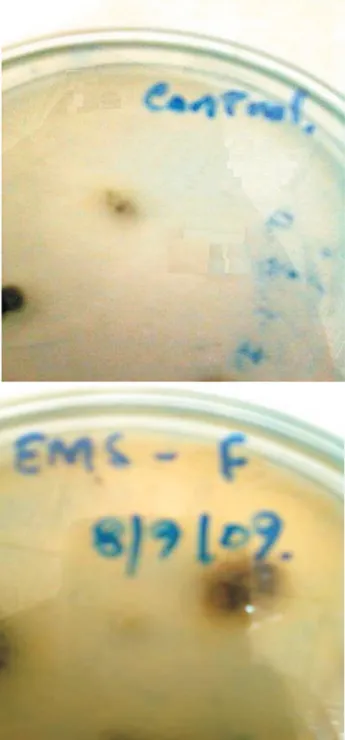
For the selection of mutant, after mutagenesis the di-lutions were plated on agar media containing 1% triton X-100 to restrict the colonies that was also used earlier (Elkeles et al., 1994; Khattab and Bazaraa, 2005). Plate screening method was used to check the potential of the colonies to grow and then enzyme diffusion zone test was employed to screen and to identify the mutant strain. The zone size of the EMS-150-F was found to be 16 mm as compared to the control which was 9 mm (Figure 1). The zone size analyzed for EMS treated strain was the maxi-mum with 14 mm (Khattab and Bazaraa, 2005), which clearly indicates the dominance of enzyme obtained in the present study, as there is a strong relation between the activ-ity and zone size in enzyme diffusion zone test.
Production of enzyme
As the mutant strainA. nigerEMS-150-F may has a modified genotype so optimization of culture condition is necessary to reveal the actual potential. Therefore a series of consecutive experiments were performed in shaken flasks to determine the effect of medium composition on glucose aerodehydrogenase from this mutant strain (Pe-truccioliet al., 1997). The effect of using different carbon sources is very imperative for the fermentation process. There is always a quest for an economical but with better production substrate. During the fermentation process of microbes, the carbon source acts as the most important nu-trient for building of the material required for the synthesis of the cells and is also a vital as energy provider. Out of four carbon sources used, CSL at 2% was found to be the best with optimum activity.
Fermentation time is an important factor for the syn-thesis of the enzyme from the microorganism, as there co-mes a time when running down of nutrients in the medium
or amassing of some auto-toxic products in the medium may bound the enzyme production rate. The present study has resulted in highest activity at 36 hours of fermentation while Banker et al. (2009) have observed an optimum growth at 96 hours after which a drastic decline was ob-served, while in a study of glucose aerodehydrogenase pro-duction from mutant Penicillium funiculosum, the maximum yield of enzyme was observed at 52 hours of cul-tivation. Thus an improved enzyme production has been obtained without wasting too much time in the present study.
Figure 1- Enzyme diffusion zone test for control and EMS-150-F.
Table 1- Optimization of mutagen dose, formulated from kill curve.
Dose Killing % age (%±SEM) Optimum dose (min.)
100 mM 65±0.362 120
150 mM 71.64±0.147 150
200 mM 79.4±0.132 150
The optimum production was obtained at pH 5 and 30 °C temperature, while Sabiret al.(2007) observed the optimum pH to be 6 and Hamidet al.(2003) found it to be 3. The difference can be attributed to the mutated strain having pre-requisite different from that of natural one. The concentration of urea as nitrogen source in growth medium is of extensive importance for the production of enzyme from fungi. The microorganisms require an adequate sup-ply of nitrogen source for various metabolic activities. The optimum activity of enzyme was observed at 0.3% of urea, which is in accordance with that of (Rasulet al., 2011).
Different concentrations of MgSO4.7H2O were tested
out for their consequence on activity of glucose aerodehy-drogenase from A. niger EMS-150-F that resulted in a downfall effect with increase in concentration of MgSO4. It
has been demonstrated the same conclusion suggesting that addition of Mg+ strongly inhibits production of glucose aerodehydrogenase (Petruccioliet al., 1997). CaCO3
be-sides acting as buffering agent provides support for growth and also substantially induces glucose aerodehydrogenase activity. Results depict an abrupt increase in activity of the enzyme fromA. nigerEMS-150-F at 0.06% of calcium car-bonate. The increase in activity by adding calcium carbon-ate is due to the fact that it causes a transfer of metabolism from glycolytic pathway to direct oxidation of glucose by enzyme (Liuet al., 2001). Potassium and phosphate salts were supplemented to the medium to enhance the produc-tion of enzyme in growth culture. KH2PO4as potassium
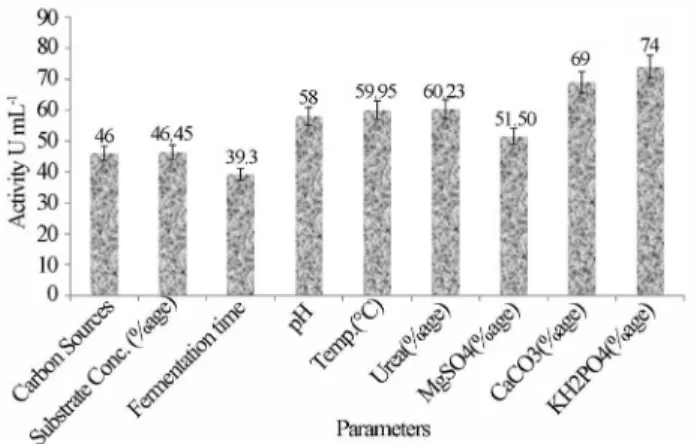
and phosphorus source was found to bestow an optimum production at 0.3%, showing cost-benefit ratio of the pro-duction in the present study. All of these results are statisti-cally significant and have been shown in Figure 2.
Purification of glucose aerodehydrogenase
After ammonium sulfate precipitation and desalting, specific activity was increased to 45.07 U mg-1. The en-zyme produced by the mutant strainA. nigerEMS-150-F had attained 2.58 fold purification and 94.15% recovery as compared to the crude enzyme. Ion exchange chromatogra-phy exploits differences in signs and magnitude of net elec-tric charge of protein at given pH. DEAE-cellulose resulted in 73.12 fold purification and %age recovery was obtained to be 74.59. After the purification of the enzyme through ion exchange chromatography it was further purified by gel filtration chromatography that isolates the proteins accord-ing to molecular size. It resulted in the highest specific
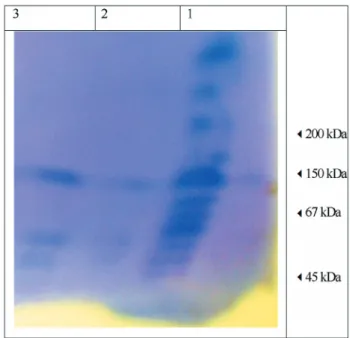
ac-tivity of 1962.59 U mg-1 having 112.59 fold purification and 67.07% recovery (Table 2). The purity of the enzyme was analyzed by SDS-PAGE that indicated that enzyme is a dimer and both monomers have the molecular weight near 67 kDa (Figure 3).
Such findings are in accordance with the results of various researchers (Sukhacheva et al., 2004; Bhatti and Saleem, 2009; Rasulet al., 2011) who found an increase of specific activity of glucose aerodehydrogenase after each purification step. Bhatti and Saleem (2009) have obtained a specific activity of 280 U mg-1, with 16.47 fold purification and 15% yield after complete purification of the enzyme fromPenicillium notatumthat is far less than that is ob-served in the present study.
Characterization of enzyme
In view of the fact that pH shows a prevailing task in the activity, as glucose aerodehydrogenase from Aspergillus niger was found to loss its activity by 12% when kept at pH higher than 8 in a stability test performed earlier (Ferreiraet al., 2005). So a pH range from 4-8.5 was checked for optimum enzymatic activity. The results ob-tained have depicted that enzyme showed a good activity between the pH range of 4-8.5, with activity of 39.7 U mL-1 at pH 6 (Figure 4). These results are exactly same where op-timum pH was obtained at 6 for A. niger glucose aero-dehydrogenase (Koet al., 2002).In contrast the enzyme produced fromA. nigerEMS-150-F in the present study is stable as compared to obtained from Penicillium pinophilumthat was found unstable in pH range of 2-4 and
Figure 2- Change in activity (U mL-1±SEM) of the enzyme with gradual
optimization of nutrients forA. nigerEMS-150-F.
Table 2- Purification summary of glucose aerodehydrogenase fromA. nigerEMS-150-F.
Purification Step Activity (U mL-1) Protein (mg mL-1) Specific activity (U mg-1) Fold purification % age recovery
Crude 79 4.53 17.43 1 100
Ammonium sulfate desalted 74.38 1.65 45.07 2.58 94.15
DEAE-cellulose 58.93 0.046 1274.63 73.12 74.59
above 7 (Randoet al., 1997). In another study on glucose aerodehydrogenase, the results had shown that the rate of reaction augmented with raise in pH of the medium, how-ever as the pH became immense, the rates started to decline and showed a greatest at pH 6.5 (Lino and Teresa, 1998).
Change in temperature causes a change in the activity of the enzyme, so the enzyme fromA. nigerEMS-150-F was observed for its stability on the basis of temperature. It was observed that enzyme had an optimum temperature of 30 °C (Figure 5). The energy of activation derived from the Arhennius plot (Figure 6) was 7.45 kJ mol-1. The enzyme is active over a wide range depicting it a stable for industrial scale production and to accept the higher temperatures, if employed. Similarly glucose aerodehydrogenase fromP. amagassakienseshowed a wide range of the temperature for enzyme performance (Wittet al., 1998). Glucose aero-dehydrogenase catalyzed reaction was deliberated at
di-verse temperatures from 25-60 °C that resulted in increased reaction velocities with increase in temperature (Lino and Teresa, 1998). It further obtained activation energy of 28.9 kJ mol-1, showing higher activation energy as com-pared to the present study. So, it can be concluded that glu-cose aerodehydrogenase from A. niger EMS-150-F is superior as compared to earlier studied reports as it necessi-tates a lesser amount of energy to start up the reaction.
Glucose aerodehydrogenase from fungal sources (Aspergillus niger) has a low Km ranging from
0.11-33 mM. The values observed in the present study have clear indication of the above described results and are in ac-cordance with it (Figure 7). The values obtained are 20 mM, 45.87 U mL-1, 1118.81 s-1and 55.94 s-1mM-1for Km, Vmax, Kcatand specificity constant, respectively,
evalu-ating the enzyme perfect for the production and exploit as catalyst at industrial level. It is further reported that enzyme from mutantAspergillus nigerhave Kmand Vmaxas 28 mM,
60 U mL-1, respectively (Zia, 2007). A low Kmvalue in the
present study as compared to the earlier ones depicts its higher affinity and specificity for glucose as substrate.
Each enzyme is thermodynamically stable within a particular temperature and pH range and can transform its activity from higher to lower at some transition tempera-ture. The development of methodologies that can increase
Figure 3- SDS-PAGE of glucose aerodehydrogenase (Lane 1 is marker
and purified enzyme loaded in duplicate Lanes 2 & 3).
Figure 4- Effect of pH (±SEM) on glucose aerodehydrogenase fromA.
nigerEMS-150-F.
Figure 5- Effect of temperature (°C±SEM) on glucose
aerodehy-drogenase fromA. nigerEMS-150-F.
Figure 6- Arhennius plot for energy of activation of glucose
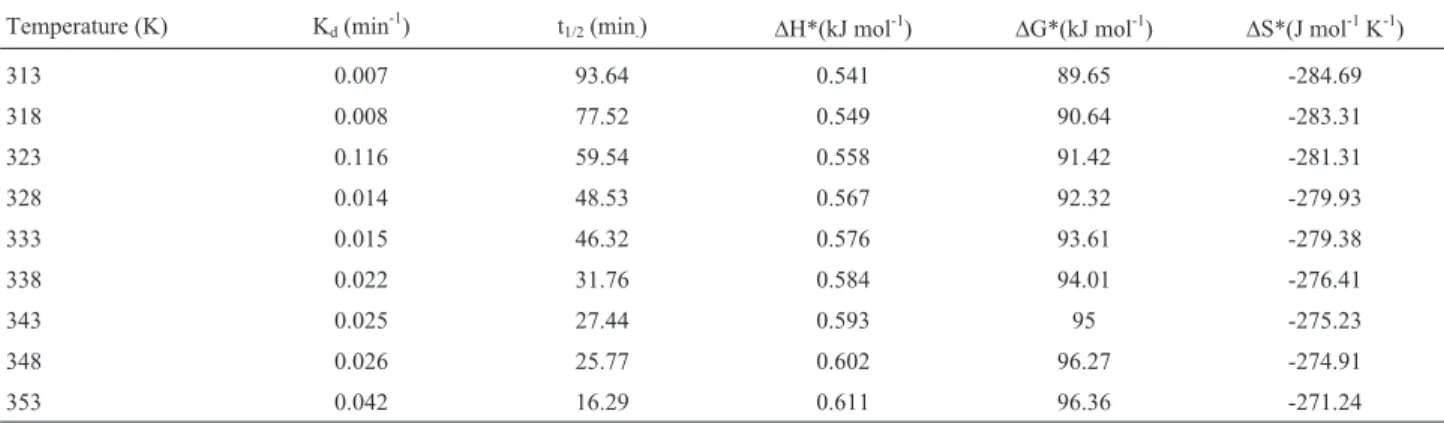
enzyme stability is an important goal in enzyme technol-ogy. The enzyme from EMS-150-F was thermally stable as at 40 °C with half life of 93.64 min which gradually de-creased with increase in temperature to 80 °C (Figure 8). Protein molecules show only a certain degree of stability especially at elevated temperatures. Thermal denaturizing of multimeric enzymes is paralleled by the distraction of non-covalent bonds leading to subunit dissociation with an affiliated augmentation in the enthalpy of activation (Ro-driguez-Nogales, 2004; Srivastavaet al., 2005). The folding of enzyme configuration causes a raise in mess, un-certainty or entropy of activation (Vieille and Zeikus, 1996). The results obtained in the present study (Table 3; Figure 8) have portrayed that enthalpy has increased in the range of 0.541-0.611 kJ mol-1with increase in temperature from 40-80 °C (313-353 K). The Gibb’s free energy calcu-lated had also a constant trend to increase with rise in tem-perature, with its maximum value at 80 °C i.e. 96.36 kJ mol-1presenting that the enzyme has exhibited the resis-tance against thermal unfolding at higher temperatures. The entropy of the system was found to be -271.24 J mol-1K-1at 80 °C. The decidedly negative value of entropy of inactiva-tion (DS*) observed for glucose aerodehydrogenase in the present case has suggested that there was negligible disor-derliness, indicating that enzyme is thermodynamically much stable. In contrast to the results in the present study Bhatti and Saleem (2009) and Zia (2007) have observed
higher entropy with -96.12 and -11.92 J mol-1K-1 respec-tively showing more randomness with increase in temperature as a result of opening of the enzyme structure. Comparison with the other studies clearly indicates the present enzyme as more ordered in transition state and more resistant and stable at higher temperatures.
Conclusion
On the basis of the above described results it can be concluded appropriately that mutagenesis with 200 mM EMS has resulted in such glucose aerodehydrogenase from Aspergillus niger EMS-150-F that has a higher activity. This modified novel enzyme is kinetically and thermody-namically much stable enzyme which can resist at higher temperature (40-80 °C) and has a wide pH range (4-8) re-quired for production at industrial scale. It has lower activa-tion energy to avoid the losses of energy just to start up the working of the enzyme. The enzyme is unique with its higher half life and resistance against thermal unfolding at higher temperatures that are usually required for its produc-tion processes. Moreover, it has a negligible randomness
Table 3- Kinetic and thermodynamic parameters for irreversible thermal inactivation of glucose aerodehydrogenase fromA. nigerEMS-150-F.
Temperature (K) Kd(min-1) t1/2(min.) DH*(kJ mol-1) DG*(kJ mol-1) DS*(J mol-1K-1)
313 0.007 93.64 0.541 89.65 -284.69
318 0.008 77.52 0.549 90.64 -283.31
323 0.116 59.54 0.558 91.42 -281.31
328 0.014 48.53 0.567 92.32 -279.93
333 0.015 46.32 0.576 93.61 -279.38
338 0.022 31.76 0.584 94.01 -276.41
343 0.025 27.44 0.593 95 -275.23
348 0.026 25.77 0.602 96.27 -274.91
353 0.042 16.29 0.611 96.36 -271.24
Figure 8- Irreversible thermal denaturation of glucose
aerodehydro-genase fromA. nigerEMS-150-F.
Figure 7- Line-weaver Burk plot for glucose aerodehydrogenase fromA.
depicting its ability to survive at the higher temperatures that are often complained by the enzyme users as bio-catalyst and its production and availability at assorted lev-els.
Acknowledgments
This research work was financially supported by Higher Education Commission, Pakistan, through grant No. 1119 to Dr. M. Anjum Zia and done for M.Phil. theses of Huma Umbreen and Samreen Rasul, carried out at En-zyme Biotechnology Lab., Univ. of Agriculture, Faisa-labad.
References
Banker SB, Bule MV, Singhal RS, Ananthanarayan L (2009) Glu-cose oxidase: an overview. Biotechnol Adv 27:489-501. Bhatti HN, Saleem N (2009) Characterization of glucose oxidase
from Penicillium notatum. Food Technol Biotehnol 47:331-335.
Bosch A, Marrona RA, Yantorno OM (1995) A simple descriptive model of filamentous fungi spore germination. Process Biochem 30:599-606.
Crognal S, D’Annibal A, Federici F, Fenice M, Quaratino D, Petruccioli M (2006) Olive oil mill wastewater valorisation by fungi. J Chem Technol Biotechnol 81:1547-1555. Elkeles A, Rosenberg E, Ron EZ (1994) Azide resistant mutant in
Acinitobactor calacoaceticusA2 are defective in protein se-cretion. FEMS Microbiol Lett116:211-224.
Ferreira LFP, Taqueda ME, Converti A, Vitolo M, Pessoa Jr A (2005) Purification of glucose oxidase from Aspergillus nigerby liquid-liquid cationic reversed micelles extraction. Biotechnol Prog 21:868-874.
Gadgil NJ, Daginawala HF, Chkrabarti T, Khanna P (1995) En-hanced cellulose production by a mutant of Trichoderma reesei. Enz Microbiol Technol 17:942-946.
Hamid HM, Rehman K, Zia MA, Asgher M (2003) Optimization of various parameters for the production of glucose oxidase from rice polishing using Aspergillus niger. Biotechnol 2:1-7.
Hatzinikolaou DG, Hansen OC, Macris BJ, Tingey A, Kekos D, Goodenough P, Stougaard P (1996) A new glucose oxidase fromAspergillus niger: characterization and regulation stu-dies of enzyme and gene. Appl Microbiol Biotech 46:371-381.
Iftikhar T, Niaz M, Hussain Y, Abbas SQ, Ashraf I, Zia MA (2010) Improvement of selected strains through gamma irra-diation for enhanced lipolytic potential. Pak J Bot 42:2257-2267.
Jacques MM, Bede JC (2005) Influence of diet on larval beet armyworm Spodoptera exiguaglucose oxidase activity. J Ins Sci 5:1-9.
Khattab AA, Bazaraa WA (2005) Screening, mutagenesis and protoplast fusion ofAspergillus nigerfor the enhancement of extracellular glucose oxidase production. J Ind Microbiol Biotechnol 32:289-294.
Ko JH, Hahm MS, Kang HA, Nam SW, Chung BH (2002) Secre-tory expression and purification ofAspergillus nigerglucose oxidase in Saccharomyces cerevisiaemutant deficient in PMR1 gene. Protein Exp Purif 25:488-493.
Leiter E, Marx F, Pusztahelyi T, Haas H, Pocsi I (2004) Penicillium chrysogenum glucose oxidase: A study on its anti-fungal effects. J Appl Microbiol 97:1201-1209. Lino MR, Teresa PN (1998) Isolation of hyperxylanolytic
Cellulomonas flavigenamutant growing in continuous cul-ture. Biotechnol Lett 20:443-446.
Liu JZ, Huang YY, Liu J, Weng LP, Ji LN (2001) Effect of metal ions on simultaneous production of glucose oxidase and catalase byAspergillus niger. Lett Appl Microbiol 32:16-19. Liu S, Oelejekaus S, Gerhardt B, Tudzynki B (1998) Purification and characterization of glucose oxidase ofBotrytis cinerea. J Physiol Mol Plant Pathol 53:123-132.
Petruccioli M, Piccioni P, Fenice M, Federicci F (1997) Glucose oxidase, catalase and gluconic acid production by immobi-lized mycelium of Penicillium variabile. Lett Biotechnol 16:939-942.
Rajoka MI, Rehman K, Tabish T, Zia MA (2006) Purification and characterization of caprine kidney uricase possessing novel kinetic and thermodynamic properties. World J Microbiol Biotechnol 22:289-291.
Rakariyatham N, Butr-Indr B, Niamsup H, Shank L (2006) Im-provement of myrosinase activity of Aspergillus sp. NR4617 by chemical mutagenesis. Electro J Biotechnol 9:815-821.
Rando D, Kohring GW, Giffhorn F (1997) Production, purifica-tion and characterizapurifica-tion of glucose oxidase from a newly isolated strain of Penicillium pinophilum. Appl Microbiol Biotechnol 48:34-40.
Rasul S, Zia MA, Sheikh MA, Iftikhar T (2011) Enhanced pro-duction and characterization of a novel b-D-glucose-oxy-gen-1-oxidoreductase by usingA. nigerUV-180-C mutant strain. Afr J Biotechnol 10:14522-14533.
Rodriguez-Nogales JM (2004) Kinetic behavior and stability of glucose oxidase entrapped in liposomes. J Chem Technol Biotechnol 79:72-78.
Rowlands RT (1984) Industrial strain development: mutagenesis and random screening procedure. Enz Microbiol Technol 6:3-10.
Sabir S, Bhatti HN, Zia MA, Shaikh MA (2007) Enhanced pro-duction of GOD usingP. notatumand rice polishing. Food Technol Biotechnol 45:443-446.
Santos KS, Delazari SL, Mendes MA, Souza BM, Malaspina O, Palma MS (2005) Profiling the proteome complement of the secretion from hypopharyngeal gland of Africanized nurse honey bees (Apis malifera L.). Insect Biochem. Molec 35:85-91.
Shin KS, Youn HD, Han YH, Han SO, Hah YC (1993) Purifica-tion and characterizaPurifica-tion of D-glucose oxidase from white rot fungusPleurotus ostreatus.Eur J Biochem 215:747-752. Srivastava R, Brown JQ, Zhu H, Mc-Shane MJ (2005) Stabiliza-tion of glucose oxidase in alginate microspheres with photo-reactive diazoresin nanofilm coatings. Biotechnol Bioeng 91:124-131.
Steel, RGD, Torrie JH, Dickey DA (1997) Principles and Proce-dures of Statistics - a Biometrical Approach. 3rd Ed. McGraw-Hill, New York.
Vieille C, Zeikus JG (1996) Thermozymes: Identifying molecular determinants of protein structural and functional stability. Trends Biotechnol 14:183-190.
Witt S, Wohlfahrt G, Schomberg D, Hecht HJ, Kalisz HM (2000) Conserved arginine-516 ofPenicillium amagasakiense glu-cose oxidase is essential for the efficient binding ofb- D glu-cose. Biochem J 347:553-559.
Witt S, Singh M, Kalisz HM (1998) Structural and kinetic proper-ties of non- glycosylated recombinant Penicillium amagasakiense glucose oxidase expressed in Escherichia coli. Appl Environ Microbiol 64:1405-1411.
Worthington CC (1988) Worthington Enzyme Manual: Glucose oxidase assay. Worthington Biochem Coop, Lakewood, USA.
Zia MA, Rahman K, Sheikh MA, Khan IA (2010) Chemically treated strain improvement of Aspergillus niger for en-hanced production of glucose oxidase. Int J Agri Biol 12:964-966.
Zia MA (2007) Mutagenesis of Aspergillus niger for hyper-production of glucose oxidase to prepare glucose diagnostic kit. Faisalabad, Pakistan. (Ph.D. thesis, Dept. of Chem. and Biochem., Uni. of Agri. Faisalabad).