Sneddon´s syndrome (SS) is characterized by the
combination of ischemic cerebrovascular episodes
and a widespread livedoid eruption. Although this
association was first described in a patient in 1960 by
Champion and Rook
1, only later, in 1965, did
Sned-don suggest this association in six new cases
2. SS is
more common in women between 20 and 42 years
of age
3and can be accompanied by other
manifes-tations such as systemic hypertension, acrocyanosis,
Raynaud’s phenomenon
4, secondary headaches
3-5,
ve-nous thrombosis
4, valvulopathy
4, a history of
spon-taneous abortions
3,6, seizures
3,7, renal involvement
8,
and vascular dementia
9,10. Antiphospholipid
antibod-ies can also be found at a highly variable
frequen-cy
3,4,11.
The frequency of headache is not significantly
higher in persons with positive anti-phospholipid
an-tibodies compared with the negative cohort (43% vs.
32%), with a female to male ratio of 3.5:1. The
asso-ciation with SS and primary headaches, such as
mi-CLINICAL, NEUROVASCULAR AND
NEUROPATHOLOGICAL FEATURES
IN SNEDDON´S SYNDROME
Jaqueline Luvisotto Marinho
1, Élcio Juliato Piovesan
2, Moacir Pereira Leite Neto
2,
Luiz Roberto Kotze
3, Lúcia de Noronha
3, Carlos Alexandre Twardowschy
2,
Marcos Christiano Lange
2, Rosana Hermínia Scola
2, Viviane H. Flumignan Zétola
2,
Edison Matos Nóvak
2, Lineu César Werneck
2ABSTRACT - Sneddon’s syndrome (SS) is characterized by ischemic cerebrovascular episodes and livedo re-Sneddon’s syndrome (SS) is characterized by ischemic cerebrovascular episodes and livedo re-ticularis. It is more common in young women and can also be associated with valvulopathy, a history of more common in young women and can also be associated with valvulopathy, a history of spontaneous abortion, renal involvement and vascular dementia. We describe three cases of young wom-en with this disease. The patiwom-ents had repeated ischemic cerebral episodes, livedo reticularis and throm-ischemic cerebral episodes, livedo reticularis and throm- throm-bocytopenia. CT and MRI showed strokes and cerebral atrophy. Autopsy in one of the patients revealed. CT and MRI showed strokes and cerebral atrophy. Autopsy in one of the patients revealedCT and MRI showed strokes and cerebral atrophy. Autopsy in one of the patients revealed cerebral infarctions. Anticardiolipin antibodies were detected in two patients. Antiphospholipid antibod-Anticardiolipin antibodies were detected in two patients. Antiphospholipid antibod-nticardiolipin antibodies were detected in two patients. Antiphospholipid antibod-ies may be found in some patients with ischemic cerebrovascular events and livedo reticularis. SS may thus be associated with antiphospholipid syndrome. We described three new cases of SS and discuss the patho-physiology of this disease.
KEY WORDS: antiphospholipid syndrome, cerebrovascular diseases, neuroimaging, neuropathology, Sned-don’s syndrome.
Características clínicas, neurovasculares e neuropatológicas na síndrome de Sneddon
RESUMO - A síndrome de Sneddon é caracterizada por episódios cerebrovasculares isquêmicos e livedo reticular, sendo mais comum em mulheres jovens, e pode também apresentar valvulopatia, história de aborto, envolvimento renal e demência vascular. Descrevemos três mulheres jovens com esta entidade. Os pacientes apresentavam história de ataques isquêmicos cerebrais, livedo reticular e trombocitopenia. To-mografia computadorizada e ressonância magnética de crânio mostraram infartos e atrofia cerebral nos pacientes estudados. A autópsia revelou em um dos pacientes presença de infartos cerebrais. Anticorpos anticardiolipina foram observados em duas pacientes. Há pacientes com eventos cerebrovasculares isquê-micos e livedo reticular nos quais anticorpos antifosfolípides são detectados. Então SS pode estar associa-da com a síndrome antifosfolípide, porém em alguns pacientes estes anticorpos não são detectados. Nós descrevemos três novos casos de SS e discutimos os mecanismos fisiopatológicos desta síndrome.
PALAVRAS-CHAVE: doenças cerebrovasculares, neuroimagem, neuropatologia, síndrome antifosfolípide, síndrome de Sneddon.
1Ribeirão Preto Faculty of Medicine, University of São Paulo, Ribeirão Preto SP, Brazil; 2Department of Clinical Medicine,
Neurol-ogy Division, Hospital de Clínicas, Federal University of Paraná, Curitiba PR, Brazil (UFPR); 3
Department of Pathology, Hospital de Clínicas, UFPR, Brazil.
Received 15 September 2006, received in final form 28 November 2006. Accepted 6 February 2007.
graine occurs in 27.5% of the cases when SS is
fol-lowed of headache
12. Livedo reticularis often
pre-cedes the cerebrovascular events, whose onset
usu-ally occurs before the age of 45 years. These events
consist of ischemic strokes or transient ischemic
at-tacks, which affect mainly medium-sized arteries and
are seen particularly in the territory of the middle
and posterior cerebral artery
4,5,13-15. Intracerebral,
subarachnoid or intraventricular hemorrhages have
also been reported
16,17.
In this paper we describe three cases of Sneddon’s
syndrome including clinical, neuroimaging and
neu-ropathological features.
METHOD
The cases were followed up in the Neurology Division of the Hospital das Clínicas of Federal University of Paraná (UFPR) from 1992 to 2006. The patients underwent clinical and neurological examination (Table 1). Extensive laborato-ry analysis was performed. Echocardiography, transcranial
doppler, cranial computed tomography (CT), magnetic res-onance imaging of the brain (MRI) and cerebral angiogra-phy were also carried out. Diagnosis was based on the pres-ence of livedo reticularis and ischemic cerebral events, as evidenced by clinical history, neurological and clinical ex-amination and neuroimaging tests. In the first patient this was also evidenced by autopsy, which included macroscop-ic and mmacroscop-icroscopmacroscop-ic analysis. The sections were stained with hematoxylin and eosin (H&E) and other routine stains. The limitation of this study is that we did not determine the factor V of Leiden mutations in our patients.
All subjects, or family of them, provided written in-formed consent, as required by appropriate local (and na-tional) committees on the protection of research subjects.
Cases
Case 1 – A 24-year-old woman with a history of epi-lepsy and repeated strokes, of which the first at the age of 18 years, was referred to the Neurology Division of the Hospital das Clínicas (UFPR) for study. Five years later her first stroke, the patient had a new episode and was ad-mitted to hospital with right hemiplegia, right-central
fa-Table 1. Clinical and epidemiological features of three cases of Sneddon’s syndrome.
Clinical features Case # 1 Case # 2 Case # 3 Gender Female Female Female Age 24 years 29 years 42 years Previous stroke First at 18 years First at 29 years Yes History of livedo Since childhood + + History of spontaneous abortion One Two One History of smoking – + +
(+) yes, (–) no.
Fig 2. Cranial CT showing volumetric reduction of the cerebral hemispherium and hypodense areas in the right-temporal, left-frontal and bilateral occipital regions compatible with infarc-tions (arrows) in patient number one (A) and an area of cere-bral infarction in the left parietal region (arrows) in patient number two (B). T2-weighted MRI showing area in keeping with cranial CT (arrows) in patient number two (C) and cerebral atrophy with anomalous signals in the subcortical white matter
in patient number three in coronal (D) and axial sections (E). Fig 3. Cerebral microscopy in patient number one shows
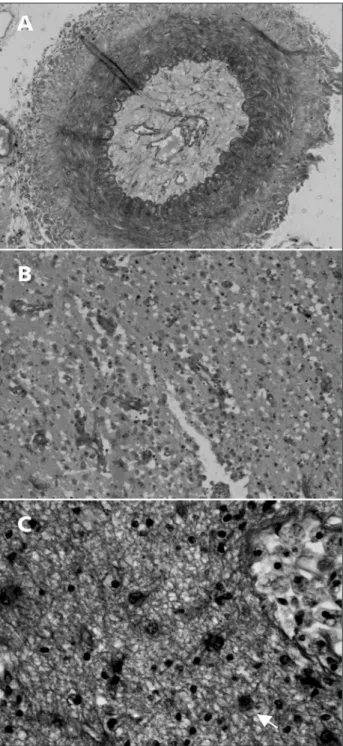
orga-nized thrombosis in small and medium-caliber arteries with re-canalization (H&E, original magnification: x100) (A); areas of recent infarction with alteration of the usual staining charac-teristics, liquefactive necrosis and lipid-laden histiocytes (H&E, original magnification: x100) (B); and areas of old infarctions with gliosis and a large number of gemistocytic astrocytes (ar-row) (H&E, original magnification: x400) (C).
cial palsy, aphasia and dysphagia. Livedo reticularis was ob-served, particularly on the arms and legs (Fig 1A). Cranial CT showed ischemic strokes (Fig 2A). Acetylsalicylic acid was maintained, and treatment with corticoids, oral anticoag-ulants and anti-hypertensive agents was introduced. The patient was discharged from hospital with a diagnosis of Sneddon´s syndrome.
Four weeks later the patient started to develop holo-cranial headache followed by decreased consciousness. Her blood pressure was 170/110 mmHg at admission. The neu-rological examination showed mental confusion, dyspha-sia, dysphagia, left facial paralysis with crural paraparesis, spasticity on the right side, bilateral extensor plantar
re-sponse, generalized hyperreflexia and bilateral Hoffmann’s sign. The results of cranial CT and blood tests are shown in Tables 2 and 3.
Table 2. Blood tests of three patients with Sneddon’s syndrome.
Tests Case # 1 Case # 2 Case # 3 Anticardiolipin antibodies Negative IgG 13.1 GPL
IgM 22.4 MPL
IgG negative IgM 11.7 MPL Lupus anticoagulant Negative Negative Slightly positive VDRL Negative 1:4 Negative FTA-Abs – IgG and IgM negative – Antinuclear factor Negative 1:160 (multiple
nuclear dot pattern)
Negative
Anti-DNA antibody Negative – Negative Anti-SM/anti-RNP/Anti-La and anti-Ro antibodies – Negative – Rheumatoid factor – Normal – LE cells Negative Negative – Platelet count 18,000-36,000 17,000-64,000 150,000 C and S proteins – – C protein normal
S protein 185% (VR 70-123%) Antithrombine III – – Normal C3-C4-CH50 Normal Normal Normal HIV serology Negative Negative Negative Cytomegalovirus, listeria and toxoplasmosis serology Negative Negative – Hepatitis B and C serology – Negative – Lactic acid Normal Normal _ Thyroid function Normal Normal – C-reactive protein – Normal Normal Blood sedimentation rate – Normal Normal Cerebrospinal fluid Normal Normal Normal
Table 3. Neuroradiologic and pathological features of three patients with Sneddon’s syndrome.
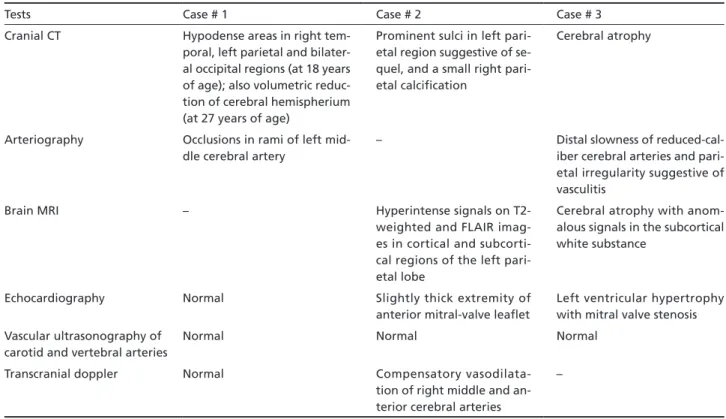
Tests Case # 1 Case # 2 Case # 3 Cranial CT Hypodense areas in right
tem-poral, left parietal and bilater-al occipitbilater-al regions (at 18 years of age); also volumetric reduc-tion of cerebral hemispherium (at 27 years of age)
Prominent sulci in left pari-etal region suggestive of se-quel, and a small right pari-etal calcification
Cerebral atrophy
Arteriography Occlusions in rami of left mid-dle cerebral artery
– Distal slowness of reduced-cal-iber cerebral arteries and pari-etal irregularity suggestive of vasculitis
Brain MRI – Hyperintense signals on T2-weighted and FLAIR imag-es in cortical and subcorti-cal regions of the left pari-etal lobe
Cerebral atrophy with anom-alous signals in the subcortical white substance
Echocardiography Normal Slightly thick extremity of anterior mitral-valve leaflet
Left ventricular hypertrophy with mitral valve stenosis Vascular ultrasonography of
carotid and vertebral arteries
Normal Normal Normal
Transcranial doppler Normal Compensatory vasodilata-tion of right middle and an-terior cerebral arteries
upper digestive hemorrhage followed by hypotension. On the fifty-third day the patient had subconjunctival haem-orrhage, ecchymosis on the arms, legs and trunk, and mas-sive proteinuria. Two days later the patient had alternate periods of apathy and psychomotor agitation. The follow-ing day, despite the treatment, she progressed to shock fol-lowed by death.
The post-mortem examination revealed recent cerebral infarctions located in the left frontal pole (measuring 4 x 4 x 4 cm), the right-anterior cerebral-artery territory (5 x 4 x 2 cm) and the right hippocampus. There were also old ce-rebral infarctions in the left-anterior cece-rebral-artery terri-tory and in the temporal, occipital and insular regions. Ce-rebral sulci and ventriculi were enlarged, but the ceCe-rebral gyri were narrowed. No areas of hemorrhage were found. The cerebellum and brainstem had no abnormalities. Mi-croscopy also showed important cerebral alterations (Fig 3). Acute thrombotic non-infectious endocarditis of the mitral valve with fibrosis, suggesting a recurrent process, as well as pericardial effusion (200 mL) and cardiac ventricular hy-pertrophy (heart weight, 350 g) were found. Membrano-proliferative glomerulonephropathy with hyaline tubular vacuolar degeneration and hyaline casts as well as mild re-nal arteriolosclerosis with old infarctions and acute hem-orrhagic cystitis were also observed.
Case 2 – A 29-year-old woman was referred with right hemiplegia, and hemiparesthesia. Two years before the stroke, the patient presented thrombocytopenia (50,000 platelets/mL) and a history of two spontaneous abortions. Although she used prednisone for six months, platelet count did not increase. Clinical examination showed live-do reticularis, Raynaud’s phenomenon and muscle strength grade IV on the right side. The results of blood and neu-roradiologic tests are shown in Tables 2 and 3 and Figs 2B and 2C.
Heparin was replaced by oral anticoagulant, but the pa-tient continues to suffer from thrombocytopenia and is be-ing assisted in the outpatient ward.
Case 3 – A 42-year-old woman with a history of epilepsy and two stroke events was admitted to the Neurology Di-vision for investigation. At admission the patient present-ed with right hemiparesis, right hemiparesthesia and sec-ondary headache. The patient had a history of spontaneous abortion and hypertension and had taken carbamazepine 200 mg tid, phenytoin 300 mg qd, asperin 100 mg qd and captopril 25 mg bid. Clinical examination revealed livedoClinical examination revealed livedo reticularis (Figs 1B, 1C and 1D), Raynaud’s phenomenon and reduced muscle strength on the right side. Blood and neu-roradiologic tests are shown in Tables 2 and 3 and Figs 2D and 2E.
DISCUSSION
Patients with ischemic cerebrovascular events,
livedo reticularis and antiphospholipid antibodies
are considered by some authors to have primary
an-tiphospholipid syndrome
6,18-20while for other authors
these antibodies are involved in the pathogenesis of
Sneddon´s syndrome
3. Studies of patients with
Sned-don’s syndrome revealed elevated
antiphospholip-id-antibody levels in 57% of patients matched with
normal controls
11. However, in some patients these
antibodies are repeatedly not found
20,21, indicating
that Sneddon’s syndrome may be a distinct entity
or perhaps a group of different disorders
14because
there are clinical differences in patients with or
with-out antiphospholipid antibodies
4,6,22. It is essential to
keep this point in mind, as some important clinical
features that are described in patients with
Sned-don’s syndrome are found in patients with primary
antiphospholipid syndrome or systemic lupus
erythe-matosus
4,23.
According to Francès and Piette
4,
thrombocyto-penia is a common feature of primary
antiphospho-lipid syndrome and of Sneddon´s syndrome in
pa-tients with antiphospholipid antibodies, but is not
a feature of cases in which these antibodies are not
found. This could explain the persistent
thrombocy-topenia observed in the second patient, as
thrombo-cytopenia, livedo reticularis and stroke are described
in a large number of patients with antiphospholipid
syndrome
23,24-26. However, venous thrombosis was not
found in these three patients although it is an
impor-tant feature of antiphospholipid syndrome
23,26.
The first and third patients had cerebral atrophy,
which is described in Sneddon’s syndrome as a
pro-gressive complication due to involvement of small
arteries
20. Nonetheless, in primary antiphospholipid
syndrome the neurological findings are stable
be-cause the affected arteries are larger than those
af-fected in Sneddon’s syndrome
20. However, the
ab-sence of cerebral atrophy in the second patient does
not exclude a diagnosis of Sneddon’s syndrome.
Other features described in Sneddon’s
syn-drome
3,4,6-8were also found in these three patients
and contributed to the diagnosis; these included
hy-pertension, renal and cardiac disorders, Raynaud’s
phenomenon, seizures and a history of spontaneous
abortions. The first patient had livedo reticularis and
seizures for the first time during her childhood, as
described in Sneddon’s syndrome
3,7.
Although the pathogenesis of Sneddon’s
syn-drome with the presence of antiphospholipid
anti-bodies may be explained in a similar manner to the
pathogenesis of antiphospholipid syndrome
27-30, the
significance of the presence of these antibodies in
both syndromes is unclear
31,32.
severity of Sneddon’s syndrome as well as the
impor-tance of the differential diagnosis of ischemic
cere-brovascular events in young patients, particularly in
cases where antiphospholipid antibodies cannot be
detected.
REFERENCES
1. Champion RH, Rook A. Livedo reticularis. �roc R �oc �ed 1���������1��roc R �oc �ed 1���������1� ��2.
2. �neddon IB. Cerebrovascular lesions and livedo reticularis. Br � �er�Br � �er� matol 1����77�18��18�.
�. Bolayir E, Yilmaz A, Kugu N, Erdogan H, Akyol �, Akyuz A. �neddon´s syndrome� clinical and laboratory analysis of 1� cases. Acta �ed �ka�Acta �ed �ka� yama 2��4��8������.
4. Francés C, �iette �C. �he mystery of �neddon syndrome� relationship�he mystery of �neddon syndrome� relationship with antiphospholipid syndrome and systemic lupus erythematosus. � Autoimmun 2����1��1���14�.
�. Boesch ��, �lörer AL, Auer A� et al. �he natural course of �neddon’s syndrome� clinical and magnetic resonance imaging findings in a pro� spective six year observation study. � Neurol Neurosurg �sychiatry 2����74��42��44.
�. Kalashnikova LA, Nasonov EL, Kushekbaeva AE, Gracheva LA. Anticar�Anticar� diolipin antibodies in �neddon´s syndrome. Neurology 1����4��4�4�4�7. 7. Flöel A, Imai �, Lohmann H, Bethke F, �underkötter C, �roste �W.
�herapy of �neddon’s syndrome. Eur Neurol 2��2�48�12��1�2. 8. �acário F, �acário �C, Ferro A, Gonçalves F, Campos �, �arques A.
�neddon´s syndrome� a vascular systemic disease with kidney involve� ment? Nephron 1��7�7���4��7.
�. �tockhammer G, Felber �R, Zelger B, et al. �neddon´s syndrome� diag� nosis by skin biopsy and �RI in 17 patients. �troke 1����24��8�����. 1�. Geschwind �H, Fitz�atrick �, �ischel ��, Cummings �L. �neddon´s
syndrome is a thrombotic vasculopathy� neuropathologic and neuro� radiologic evidence. Neurology 1����4����7����.
11. Kalashnikova LA, Korczyn A�, �havit �, Rebrova �, Reshetnyak �, Chapman �. Antibodies to prothrombin in patients with �neddon’s syn� drome. Neurology 1�������22��22�.
12. �ietjen GE, Al�Qasmi ��, Gunda �, Herial NA. �neddon´s syndrome��neddon´s syndrome� another migraine�stroke association? Cephalalgia 2����2��22��2�2.Cephalalgia 2����2��22��2�2. 1�. Zaccariotti VA, �artins LF, da Costa V, �ilva NA, da Casas AA, de
�elo��ouza �E. �neddon’s syndrome� report of � cases. Arq Neurop��neddon’s syndrome� report of � cases. Arq Neurop� siquiatr 1�������82�87.
14. Karagülle A�, Karadag �, Erden A, Erden I. �neddon´s syndrome� �R imaging findings. Eur Radiol 2��2�12�144�14�.
1�. Hilton �A, Footitt �. Neuropathological findings in �neddon´s syn� drome. Neurology 2�������1181�1182.
1�. Aquino Gondim FA, Leacock R�, �ubrammanian �A, Cruz�Flores �. Intracerebral hemorrhage associated with �neddon´s syndrome� is ischemia�related angiogenesis the cause? Case report and review ofCase report and review of the literature. Neuroradiology 2����4����8��72.Neuroradiology 2����4����8��72.
17. �errano��ozo A, Gómez�Aranda F, Franco��acías E, �errano�Cabrera A. Hemorragia cerebral en el síndrome de �neddon� caso clínico y re� visión de la bibliografia. Rev Neurol 2��4����7�1�7��.Rev Neurol 2��4����7�1�7��.
18. �umi Y, �zaki Y, Itoh �, Katayama H, �anaka �. Cerebral blood flow���EC� in a patient with �neddon’s syndrome. Ann Nucl �ed 1����1��1���112.
1�. Levine �R, Langer �L, Albers �W, Welch K�A. �neddon´s syndrome� an antiphospholipid antibody syndrome? Neurology 1�88��8�7�8�8��. 2�. Fetoni V, Grisoli �, �almaggi A, Carriero R, Girotti F. Clinical and neu� roradiological aspects of �neddon´s syndrome and primary antiphos� pholipid antibody syndrome� a follow�up study. Neurol �ci 2����21� 1�7�1�4.
21. �zmyrka�Kaczmarek �, �aikeler �, Benz �, Koetter I. Familial inflama� tory �neddon´s syndrome� case report and review of the literature. Clin Rheumatol 2����24�7��82.
22. Francés C, �apo �, Wechsler B, Laporte �L, Biousse V, �iette �C. �ned� don’s syndrome with or without antiphospholipid antibodies� a com� parative study in 4� patients. �edicine (Baltimore) 1����78�2���21�. 2�. �iyakis �, Lockshin ��, Atsumi �, et al. International consensus state�
ment on an update of the classification criteria for definite antiphos� pholipid syndrome (A��). � �hromb Haemost 2����4�2������. 24. Hawkins C, Gatenby �, �uck R, �anta G, Andrews C. Cerebrovascular
disease associated with antiphospholipid antibodies� more questions than answers. � Autoimmune �is 2���, ���, doi�1�.118�/174��2��7���� (available from� <http�//www.jautoimdis.com/content/�/1/�>). 2�. Hachulla E, Leys �, �eleume �F, �ruvo ��, �evulder B. �anifestations
neurologiques associées aux anticorps antiphospholipides� ou que reste�t�il du neurolupus? Rev �éd Interne 1����1��121�1��.Rev �éd Interne 1����1��121�1��.
2�. Cervera R, �iette ��C, Font �, et al. Antiphospholipid syndrome� clinical and immunologic manifestations and patterns of disease expression in a cohort of 1,��� patients. Arthritis Rheum 2��2�4��1�1��1�27. 27. �inharay R. �neddon´s syndrome� additional neurological feature in
antiphospholipid (Hughes´) syndrome. �ostgrad �ed � 2����7�����. 28. Ruiz�Irastorza G, Khamashta �A. �troke and antiphospholipid syn��troke and antiphospholipid syn�
drome� the treatment debate. Rheumatology 2����44��71��74. 2�. Groot �G, �erksen RH�W. �he antiphospholipid syndrome� clinical
characteristics, laboratory features and pathogenesis. Curr �pin Infect �is 2����18�2���21�.
��. �rtel �. �hrombosis and the antiphospholipid syndrome. HematologyHematology 2����4�2�4�8.
�1. �artins da �ilva A, Rocha N, �into �, et al. �remor as the first neurologi��remor as the first neurologi� cal manifestation of �neddon´s syndrome. �ov �isord 2����2�� 248�2�1. �2. Ayoub N, Esposito G, Barete �, �oria C, �iette ��C, Francès C. �rotein Z