785
https://doi.org/10.1590/0004-282X20170137
ARTICLE
The critical influence of nocturnal breathing
complaints on the quality of sleep after
stroke: the Pittsburgh Sleep Quality Index
and STOP-BANG
A influência crítica das queixas respiratórias noturnas na qualidade final do sono após
acidente vascular cerebral: índice de qualidade de sono de Pittsburgh e STOP-BANG
Giuliano da Paz Oliveira
1, Eliana Regina Lottemberg Vago
1,2, Gilmar Fernandes do Prado
1, Fernando
Morgadinho Santos Coelho
1,2Sleep quality influences health and poor quality of
sleep can worsen clinical conditions and impair
treat-ment and rehabilitation in stroke patients
1,2,3. The impact
of poor sleep quality in prevalent diseases such as stroke
is enormous
4,5,6.
Sleep-related respiratory disturbances after stroke are
very common (40-80%)
7. They frequently worsen
neuro-logic recovery and impair quality of life
8,9. Sleep-related
respiratory disturbances are independent risk factors
for new strokes, as well as other cardiovascular events.
The main sleep-related respiratory disturbance is
obstruc-tive sleep apnea, which is characterized by repeated
inter-ruption of ventilation during sleep due to pharyngeal
air-way closure with consequent sleep fragmentation and
intermittent hypoxia. Obstructive sleep apnea is
corre-lated with hypertension, diabetes, obesity, stroke, heart
1Universidade Federal de São Paulo, Departamento de Neurologia e Neurocirurgia, São Paulo SP, Brasil; 2Universidade Federal de São Paulo, Departamento de Psicobiologia, São Paulo SP, Brasil.
Correspondence: Fernando Morgadinho Santos Coelho; Departamento de Neurologia e Neurocirurgia da UNIFESP; Rua Napoleão de Barros, 925 / 2º andar; 04024-002 São Paulo SP, Brasil; E-mail: [email protected]
Conflict of interest: There is no conlict of interest to declare.
Received 28 March 2017; Received in inal form 16 June 2017; Accepted 08 August 2017.
ABSTRACT
In stroke patients particularly, many factors, such as sleep-related respiratory disturbances, can impair sleep. Cheap and easy-to-use tools
have been created to identify sleep quality and sleep disturbances in patients after stroke. This study described the scores of the sleep
apnea screening questionnaire – STOP-BANG – in patients after a stroke, and correlated the indings with sleep quality measured by the
Pittsburgh Sleep Quality Index (PSQI). The scores of the STOP-BANG and PSQI were 4.3 ± 1.8 and 7.6 ± 3.9, respectively. The STOP-BANG
scores were higher in poor sleepers (4.5 ± 1.6 versus 3.5 ± 1.9; p = 0.032). Logistic regression analysis was used to identify predictors of
subjective sleep quality (PSQI) and the STOP-BANG as a predictor of poor quality sleep, with a relative risk of 1.6, controlled for age and sex.
This study indicated that sleep quality was largely inluenced by sleep breathing problems, which were well identiied by the STOP-BANG,
especially in younger stroke patients.
Keywords:
stroke; sleep; surveys and questionnaires.
RESUMO
Especialmente em pacientes com acidente vascular cerebral (AVC), muitos fatores prejudicam o sono, como distúrbios respiratórios
do sono (DRS). Ferramentas mais baratas foram usadas para identificar a qualidade do sono e distúrbios do sono após AVC. Este
estudo verificou a influência das queixas DRS na qualidade do sono após AVC utilizando questionários. Nós investigamos a qualidade
do sono eo risco de Apneia Obstrutiva do Sono com o Índice de Qualidade do Sono de Pittsburgh (PSQI) e Stop-Bang em 68 pacientes
após AVC. As pontuações de STOP-BANG e PSQI foram de 4,3 ± 1,8 e 7,6 ± 3,9, respectivamente. As pontuações de STOP-BANG foram
mais elevadas em pacientes com sono ruim (4,5 ± 1,6 versus 3,5 ± 1,9; p = 0,032). A regressão logística caracterizou o STOP-BANG
como preditor de um sono de má qualidade.Estes achados confirmam a influência das queixas respiratórias noturnas na qualidade
do sono após AVC.
786
Arq Neuropsiquiatr 2017;75(11):785-788attack and a higher incidence of death
4,10,11. The prevalence
of obstructive sleep apnea is three-to-four times higher in
patients after a stroke
12.
he high cost and prevalence of stroke associated with a
greater frequency of sleep disorders justify eforts to deter
-mine the best option to identify this overlap. he diagnosis
and treatment of sleep disorders is a ield that has expanded
considerably over recent years.
Unfortunately, the traditional investigation of sleep
disturbance is expensive and complicated. his makes it
impossible to perform sleep studies for the major portion
of stroke patients, in almost all parts of world. However,
the physical and cognitive impairment of stroke patients
with sleep disorders always needs to be considered in the
clinical approach
2,13. hus, cheaper and easier-to-use tools
have been created to identify sleep quality and sleep
dis-turbances in patients after stroke – namely, the Pittsburgh
Sleep Quality Index (PSQI) and the sleep apnea screening
questionnaire – STOP-BANG
14,15.
he PSQI is the most complete questionnaire for deter
-mining sleep quality, with seven components: subjective
sleep quality, latency, duration, eiciency, sleep disorders,
use of sleep medication and daytime dysfunction. Part of the
PSQI covers sleep-related respiratory disturbances; however,
it is frequently not used in clinical practice due its length.
For an exclusively sleep-related respiratory disturbance
investigation, the STOP-BANG can be used. his question
-naire is easier to use in clinical practice
15,16.
he aim of this study was to describe the scores of the
STOP-BANG questionnaire in patients after stroke and
cor-relate the indings with sleep quality measured by the PSQI.
METHODS
Sample and ethics
Seventy-ive patients who had had a stroke (ischemic
and hemorrhagic) within the last year, over 18 years of age,
who attended the Neurovascular Clinic of the Universidade
Federal de São Paulo (UNIFESP) consecutively, between
March and June 2016, were invited to participate. his study
was reviewed and approved by the Institutional Research
Ethics Committee of UNIFESP (CAAE: 55362516.6.0000.5505).
he study exclusion criteria were: 1) patients younger
than 18 years old; 2) uncontrolled psychiatric illness; 3)
con-fusion or severe cognitive impairment; 4) aphasia; 5) use of
sedative or hypnotic medications and 6) more than one year
after stroke event. Seven patients were excluded: ive patients
due to aphasia and two patients due to dementia. Informed
consent was obtained from all 68 patients studied.
Study design
his was a cross-sectional, observational study, in a single
center – the Department of Neurology, Neurovascular Clinic
of UNIFESP. Every assessment was made by illing out forms
and questionnaires with the patient.
Demographic characteristics (age and gender),
anthro-pometric features (weight, height, body mass index (BMI),
and a measurement of neck circumference, and clinical
characteristics (smoking status, diagnosis of systemic
arterial hypertension, diabetes mellitus and restless legs
syndrome) were obtained. Systemic arterial hypertension
was defined as a systolic blood pressure of 140 mm/Hg or
higher or a diastolic blood pressure of 90 mm/Hg or higher,
or regular use of antihypertensive medication. Diabetes
mellitus was defined as a fasting blood glucose
concentra-tion of 126 mg/dl or higher or current use of antidiabetic
medication. Restless legs syndrome was defined based on
International Restless Legs Syndrome Study Group
con-sensus criteria
17.
he clinical characteristics of stroke; neurological impair
-ment score on the National Institutes of Health Stroke Scale
(NIHSS); etiologic classiication according Trial of Org 10172
in Acute Stroke Treatment (TOAST), validated in Brazil; and
evaluation of the degree of disability according to the
modi-ied Rankin Scale (mRS) were noted
18,19,20.
All patients answered the PSQI and STOP-BANG
ques-tionnaires, validated in Brazil
14,15,21,22,23,24.
Statistical analysis
Data analysis was performed using the SPSS 15.0
(Statistical Package for Social Science Software), considering
a signiicance level of less than 5% for all statistical tests.
Data were expressed as mean and standard deviation:
age, BMI, NIHSS, mRS, STOP-BANG, and PSQI. We
deter-mined the prevalence of arterial hypertension, diabetes
mel-litus, current smoking, restless legs syndrome, complaint of
pain and poor quality of sleep in this population. he prev
-alence of ischemic and hemorrhagic strokes, as well as the
classiication of ischemic strokes was made according the
TOAST criteria.
he Mann-Whitney test was used to compare good sleep
-ers (PSQI ≤ 5) and poor sleep-ers (PSQI > 5). Logistic regres
-sion analysis was applied considering the STOP-BANG score
as an independent variable and sleep quality measured by the
PSQI as the dependent variable, controlled for age and sex.
RESULTS
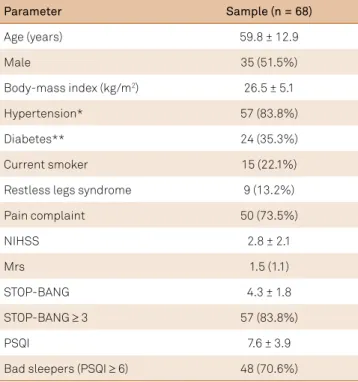
The mean age was 59.8 ± 12.9 years, 51.5% were male,
the BMI was 26.5 ± 5.1 kg/m
2, with the interview done
787
Nome autores et al. Nome do artigo abreviado
criteria for restless legs syndrome, and 48 (70.6%) had
poor sleep quality (Table 1).
Sixty-four (94.1%) patients had ischemic stroke and four
(5.9%) had hemorrhagic stroke. he TOAST etiology classi
-ied the strokes as occlusion of small vessels (32.8%), incon
-clusive (26.6%), large artery atherosclerosis (18.8%),
cardio-embolic (15.6%), and other causes (6.3%).
he STOP-BANG and PSQI scores were 4.3 ± 1.8 and
7.6 ± 3.9, respectively. Good sleepers (PSQI ≤ 5) were com
-pared with poor sleepers (PSQI > 5). No signiicant diferences
were seen between good or poor sleepers for sex, presence of
hypertension, diabetes mellitus, smoking, restless legs
syn-drome or the etiologic classiication of stroke by TOAST. he
STOP-BANG scores were higher in poor sleepers than good
sleepers (4.5 ± 1.6 versus 3.5 ± 1.9; p = 0.032).
Logistic regression analysis was used to identify
pre-dictors of subjective sleep quality (PSQI score) making the
STOP-BANG a predictor of a poor-quality sleep, at p < 0.05
and relative risk of 1.6, controlled for age and sex (Table 2).
DISCUSSION
We found that the STOP-BANG score worked as a
predic-tor of a poor quality of sleep with a relative risk of 1.6, relect
-ing the impact of nighttime breath-ing problems on the sleep
quality of post-stroke patients.
Quality of sleep is an important issue in stroke patients.
Complaints of insomnia and increased sleep latency have
been identiied as predictors of a poor quality of sleep in
patients after stroke
2. Interestingly, self-reported
question-naires were better as predictors of sleep quality than sleep
studies in patients with obstructive sleep apnea
25.
he identiication and treatment of predictors of poor
sleep quality after stroke is very important, due to the
poten-tial impact on the patient’s quality of life. According to the
PSQI, 70.6% of our patients were considered poor sleepers
(7.6 ± 3.9 points).
On the other hand, the sensitivity of the STOP-BANG
questionnaire (three or more airmative answers) for
obstructive sleep apnea detection was 83.6%. his conirms
that our patients had a higher risk of nocturnal breathing
complaints after stroke. In fact, the higher scores of the
STOP-BANG in poor sleepers (4.5 ± 1.6) compared with
good sleepers (3.5 ± 1.9) indicate the large inluence of
nocturnal breathing problems on the quality of sleep after
stroke in our cohort.
In contrast to the PSQI, the STOP-BANG is a practical
tool: it is short, has an easy-to-remember mnemonic and a
simple calculable scoring system. Furthermore, patients have
relatively little diiculty in answering it, giving a high overall
response rate
26. he identiication of impaired sleep quality
and frequency of sleep disturbances in patients with stroke
can lead to corrective measures, such as the establishment of
proper routines and habits, as well as more appropriate time
for therapeutic interventions
27,28.
We are unaware of previous studies addressing the
impact of nighttime respiratory problems measured by the
STOP-BANG questionnaire in the sleep quality of patients
after stroke. However, a few limitations must be highlighted.
he characteristics of sleep analyzed were determined exclu
-sively by self-reported data, without conirmation through
complementary tests. In addition, we included both
isch-emic and hemorrhagic stroke patients, although they have
diferent pathophysiological mechanisms
29.
his study indicates that sleep quality was greatly inlu
-enced by sleep-related breathing problems, which were well
identiied by the STOP-BANG questionnaire, especially in
younger stroke patients.
Table 2.
Logistic regression analysis considering the
STOP-BANG scores as an independent variable and sleep
quality measured by the Pittsburgh Sleep Quality Index as the
dependent variable, controlled for age and sex.
Variables
Beta
coefficient
RR
95%CI
p
STOP-BANG (each score)
0.478
1.61
1.03–2.51
0.035
Age (each year)
-0.023
0.98
0.93–1.02
0.340
Male sex
0.821
2.27 0.50–10.20 0.284
Table 1.
Demographic data and characteristics.
Parameter
Sample (n = 68)
Age (years)
59.8 ± 12.9
Male
35 (51.5%)
Body-mass index (kg/m
2)
26.5 ± 5.1
Hypertension*
57 (83.8%)
Diabetes**
24 (35.3%)
Current smoker
15 (22.1%)
Restless legs syndrome
9 (13.2%)
Pain complaint
50 (73.5%)
NIHSS
2.8 ± 2.1
Mrs
1.5 (1.1)
STOP-BANG
4.3 ± 1.8
STOP-BANG
≥
3
57 (83.8%)
PSQI
7.6 ± 3.9
Bad sleepers (PSQI
≥
6)
48 (70.6%)
788
Arq Neuropsiquiatr 2017;75(11):785-788References
1. Coca A, Messerli FH, Benetos A, Zhou Q, Champion A,
Cooper-DeHoff RM et al. Predicting stroke risk in hypertensive patients with coronary artery disease: a report from the INVEST. Stroke. 2008;39(2):343-8. https://doi.org/10.1161/STROKEAHA.107.495465 2. Da Rocha PC, Barroso MT, Dantas AA, Melo LP, Campos TF.
Predictive factors of subjective sleep quality and insomnia complaint in patients with stroke: implications for clinical practice. An Acad Bras Cienc. 2013;85(3):1197-206. https://doi.org/10.1590/S0001-37652013005000053 3. Ma VY, Chan L, Carruthers KJ. Incidence, prevalence, costs, and
impact on disability of common conditions requiring rehabilitation in the United States: stroke, spinal cord injury, traumatic brain injury, multiple sclerosis, osteoarthritis, rheumatoid arthritis, limb loss, and back pain. Arch Phys Med Rehabil. 2014;95(5):986-95.e1. https://doi.org/10.1016/j.apmr.2013.10.032
4. Yaggi HK, Concato J, Kernan WN, Lichtman JH, Brass LM, Mohsenin V. Obstructive sleep apnea as a risk factor for stroke and death. N Engl J Med. 2005;353(19):2034-41. https://doi.org/10.1056/NEJMoa043104 5. St-Onge MP, Grandner MA, Brown D, Conroy MB, Jean-Louis G,
Coons M et al. Sleep duration and quality: impact on lifestyle behaviors and cardiometabolic health: a scientiic statement from the American Heart Association. Circulation. 2016;134(18):e367-86. https://doi.org/10.1161/CIR.0000000000000444
6. Mohsenin V, Culebras A. Sleep-related breathing disorders and risk of stroke. Stroke. 2001;32(6):1271-8. https://doi.org/10.1161/01.STR.32.6.1271
7. Pasic Z, Smajlovic D, Dostovic Z, Kojic B, Selmanovic S. Incidence and types of sleep disorders in patients with stroke. Med Arh. 2011;65(4):225-7. https://doi.org/10.5455/medarh.2011.65.225-227 8. Suh M, Choi-Kwon S, Kim JS. Sleep disturbances
after cerebral infarction: role of depression and fatigue. J Stroke Cerebrovasc Dis. 2014;23(7):1949-55. https://doi.org/10.1016/j.jstrokecerebrovasdis.2014.01.029 9. Hermann DM, Siccoli M, Brugger P, Wachter K, Mathis J,
Achermann P et al. Evolution of neurological, neuropsychological and sleep-wake disturbances after paramedian thalamic stroke. Stroke. 2008;39(1):62-8. https://doi.org/10.1161/STROKEAHA.107.494955 10. Young T, Peppard PE, Gottlieb DJ. Epidemiology of obstructive sleep
apnea: a population health perspective. Am J Respir Crit Care Med. 2002;165(9):1217-39. https://doi.org/10.1164/rccm.2109080 11. Young T, Palta M, Dempsey J, Skatrud J, Weber S, Badr S.
The occurrence of sleep-disordered breathing among middle-aged adults. N Engl J Med. 1993;328(17):1230-5. https://doi.org/10.1056/NEJM199304293281704
12. Hermann DM, Bassetti CL. Role of sleep-disordered breathing and sleep-wake disturbances for stroke and stroke recovery. Neurology. 2016;87(13):1407-16. https://doi.org/10.1212/WNL.0000000000003037 13. Wright KP Jr, Hull JT, Hughes RJ, Ronda JM, Czeisler CA. Sleep
and wakefulness out of phase with internal biological time impairs learning in humans. J Cogn Neurosci. 2006;18(4):508-21. https://doi.org/10.1162/jocn.2006.18.4.508
14. Marti-Soler H, Hirotsu C, Marques-Vidal P, Vollenweider P, Waeber G, Preisig M et al. The NoSAS score for screening of sleep-disordered breathing: a derivation and validation study. Lancet Respir Med. 2016;4(9):742-8. https://doi.org/10.1016/S2213-2600(16)30075-3 15. Coelho FM, Pradella-Hallinan M, Palombini L, Tuik S, Bittencourt
LR. The STOP-BANG questionnaire was a useful tool to identify OSA during epidemiological study in São Paulo (Brazil). Sleep Med. 2012;13(4):450-1. https://doi.org/10.1016/j.sleep.2012.01.008
16. Kojic B, Burina A, Sinanovic O. One year outcome of acute stroke patients with sleep apnea. Med Arch. 2015;69(3):149-52. https://doi.org/10.5455/medarh.2015.69.149-152
17. Allen RP, Picchietti DL, Garcia-Borreguero D, Ondo WG, Walters AS, Winkelman JW et al. Restless legs syndrome/Willis-Ekbom disease diagnostic criteria: updated International Restless Legs Syndrome Study Group (IRLSSG) consensus criteria: history, rationale, description, and signiicance. Sleep Med. 2014;15(8):860-73. https://doi.org/10.1016/j.sleep.2014.03.025
18. Caneda MA, Fernandes JG, de Almeida AG, Mugnol FE. [Reliability of neurological assessment scales in patients with stroke]. Arq Neuropsiquiatr. 2006;64(3A):690-7. Portuguese. https://doi.org/10.1590/S0004-282X2006000400034 19. Adams HP Jr, Bendixen BH, Kappelle LJ, Biller J, Love BB,
Gordon DL et al. Classiication of subtype of acute ischemic stroke. Deinitions for use in a multicenter clinical trial. TOAST. Trial of Org 10172 in Acute Stroke Treatment. Stroke. 1993;24(1):35-41. https://doi.org/10.1161/01.STR.24.1.35
20. Cincura C, Pontes-Neto OM, Neville IS, Mendes HF, Menezes DF, Mariano DC et al. Validation of the National Institutes of Health Stroke Scale, modiied Rankin Scale and Barthel Index in Brazil: the role of cultural adaptation and structured interviewing. Cerebrovasc Dis. 2009;27(2):119-22. https://doi.org/10.1159/000177918 21. Douglass AB, Bornstein R, Nino-Murcia G, Keenan S, Miles L,
Zarcone VP Jr et al. The Sleep Disorders Questionnaire. I: creation and multivariate structure of SDQ. Sleep. 1994;17(2):160-7. https://doi.org/10.1093/sleep/17.2.160
22. Reis R, Teixeira F, Martins V, Sousa L, Batata L, Santos C et al. Validation of a Portuguese version of the STOP-Bang questionnaire as a screening tool for obstructive sleep apnea: analysis in a sleep clinic. Rev Port Pneumol (2006). 2015;21(2):61-8. https://doi.org/10.1016/j.rppnen.2014.04.009
23. Buysse DJ, Reynolds CF 3rd, Monk TH, Berman SR, Kupfer DJ. The Pittsburgh Sleep Quality Index: a new instrument for psychiatric practice and research. Psychiatry Res. 1989;28(2):193-213. https://doi.org/10.1016/0165-1781(89)90047-4
24. Bertolazi AN, Fagondes SC, Hoff LS, Dartora EG, Miozzo IC, de Barba ME et al. Validation of the Brazilian Portuguese version of the Pittsburgh Sleep Quality Index. Sleep Med. 2011;12(1):70-5. https://doi.org/10.1016/j.sleep.2010.04.020
25. Wells RD, Day RC, Carney RM, Freedland KE, Duntley SP. Depression predicts self-reported sleep quality in patients with obstructive sleep apnea. Psychosom Med. 2004;66(5):692-7. https://doi.org/10.1097/01.psy.0000140002.84288.e1
26. Boynton G, Vahabzadeh A, Hammoud S, Ruzicka DL, Chervin RD. Validation of the STOP-BANG Questionnaire among patients referred for suspected obstructive sleep apnea. J Sleep Disord Treat Care. 2013;2(4). https://doi.org/10.4172/2325-9639.1000121 27. Chung F, Yegneswaran B, Liao P, Chung SA, Vairavanathan S,
Islam S et al. STOP questionnaire: a tool to screen patients for obstructive sleep apnea. Anesthesiology. 2008;108(5):812-21. https://doi.org/10.1097/ALN.0b013e31816d83e4
28. Chung F, Subramanyam R, Liao P, Sasaki E, Shapiro C, Sun Y. High STOP-Bang score indicates a high probability of obstructive sleep apnoea. Br J Anaesth. 2012;108(5):768-75. https://doi.org/10.1093/bja/aes022 29. Westerlund A, Lagerros YT, Kecklund G, Axelsson J, Åkerstedt T.