DOI: 10.1590/0004-282X20150022
ARTICLE
Evaluation of the SLICS use in the treatment
of subaxial cervical spine injuries
Avaliação do SLICS no tratamento das lesões da coluna cervical sub-axial
Halisson Y. F. da Cruz1, Andrei F. Joaquim1, Helder Tedeschi1, Alpesh A. Patel2
Cervical spine trauma can potentially result in serious neurological injury such as tetraplegia or severe disability. Sub-axial cervical spine trauma (SCST), involving the spine levels of C3 to C7, accounts for the majority of cervical spine injuries, comprising about 65% of fractures and 75% of all
dis-locations that afects the spine1.
In an attempt to improve clinical results and compare
treatment modalities, numerous classiication systems that
describe these injuries, try to predict stability, and also help with the choice of the treatment to be performed2,3,4. However, no one of them is universally accepted. One potential reason
for the lack of a universal classiication is that the treatment of
SCST is based on a number of variables that include fracture patterns, suspected mechanism of injury, spinal alignment,
neurologic injury, and expected long-term stability, which
dif-icults reliability and reproducibility.
Considering this, the Spine Trauma Study group proposed
the Sub-axial Cervical Spine Injury Classiication System (SLICS). his system is based on the evaluation of three major
injury characteristics as follows: (1) injury morphology, deter-mined by the pattern of spinal column disruption on available imaging studies, (2) integrity of the discoligamentous soft tis-sue complex (DLC) represented by both anterior and poste-rior ligamentous structures as well as the intervertebral disc,
and (3) patient’s neurologic status. he system proposes a se -verity score grading, from the least to the most severe injury pattern1. he inal score can help in the choice of conserva
-tive versus surgical treatment. he presence of morphological
1Universidade Estadual de Campinas, Departamento de Neurologia, Campinas SP, Brazil;
2Northwestern University, Department of Orthopedic, Chicago IL, USA.
Correspondence: Halisson Y F da Cruz; Rua Olinda Alves, 819 / casa 17 - Rita Vieira; 79052-440 Campo Grande MS, Brasil; E-mail: [email protected]
Conflict of interest: There is no conlict of interest to declare.
Received 14 November 2014; Received in inal form 06 january 2015; Accepted 26 January 2015.
ABSTRACT
The SLICS (Sub-axial Cervical Spine Injury Classiication System) was proposed to help in the decision-making of sub-axial cervical spine trauma (SCST), even though the literature assessing its safety and eficacy is scarce. Method: We compared a cohort series of patients sur-gically treated based on surgeon’s preference with patients treated based on the SLICS. Results: From 2009-10, 12 patients were included. The SLICS score ranged from 2 to 9 points (mean of 5.5). Two patients had the SLICS < 4 points. From 2011-13, 28 patients were included. The SLICS score ranged from 4 to 9 points (mean of 6). There was no neurological deterioration in any group. Conclusion: After using the SLICS there was a decrease in the number of patients with less severe injuries that were treated surgically. This suggests that the SLICS can be helpful in differentiating mild from severe injuries, potentially improving the results of treatment.
Keywords: sub-axial cervical spine, SLICS, spinal cord injury, spine trauma, classiication, treatment.
RESUMO
O SLICS (Sub-axial Cervical Spine Injury Classiication System) foi proposto para auxílio na tomada de decisão no tratamento do traumatismo da coluna cervical sub-axial. Contudo, existem poucos trabalhos que avaliem sua segurança e eicácia. Método: Realizamos estudo compara-tivo de série histórica de pacientes operados baseados na indicação pessoal do cirurgião com pacientes tratados baseados na aplicação do SLICS. Resultados: Entre 2009-10, 12 pacientes foram incluídos. O SLICS escore variou de 2 a 9 pontos (média de 5,5) com dois pacientes com escore menor que 4. Entre 2011-13, 28 pacientes foram incluídos. O escore de SLICS variou de 4 a 9 pontos, com média de 6. Conclusão: Obser-vamos que após o uso do SLICS houve uma diminuição do número de pacientes operados com lesões mais estáveis. Isso sugere que o SLICS pode ser útil para auxiliar a diferenciação de lesões leves das graves, eventualmente melhorando os resultados do tratamento.
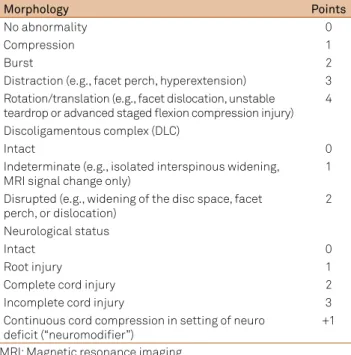
abnormalities is scored as: 0- no abnormality, 1- compres-sion, 2- burst fractures, 3- distraction, and 4- translation or
rotation. he components of the DLC include the interver -tebral disc, anterior and posterior longitudinal ligaments,
interspinous ligaments, facet capsules, and ligamentum la
-vum. he integrity of these soft tissue constraints is direct -ly proportional to spinal stability and is scored as 0- for in-tact, 1- for indeterminate and 2- with disruption. Neurologic injury is the third component of the SLIC system and is in-herently an important indicator of the severity of spinal
col-umn injury and may be the single most inluential predictor
of treatment. Patients neurologically intact receive 0- point,
1- for cervical root injury, 2- for complete neurological dei -cit, and the presence of an incomplete neurologic injury re-ceives the highest point score of 3. In the presence of ongoing root or cord compression the authors proposed an additional
1 point. Additionally, confounding factors can inluence the
treatment decision including medical comorbidities,
pres-ence of ankylosing spondylitis, difuse idiopathic hyperosto -sis, osteoporo-sis, previous surgery, and degenerative disease1.
he SLICS score is presented in Table 1.
Surgical versus non-surgical treatment is suggested by a threshold value of the SLICS score. If the total score is < 4 (1 to 3), non-operative treatment is recommended. If the
total is ≥ 5, operative treatment is recommended. his treat -ment may consist of realign-ment, neurological decompres-sion (when indicated), and stabilization. Cases with a total score of 4 may be treated either operatively or non-operative-ly based upon surgeon and patient preferences.
Based on the potential beneits of the score, the purpose
of this study is to evaluate the impact of SLICS in patients treated surgically for SCST.
METHOD
he spine trauma database at the University of Campinas, Campinas-SP, Brazil was used. he institution is a tertiary trauma center. here were two group of patients:
Group 1: From 2009 to 10, these patients were treated according to the treating surgeon’s preference, based on per-sonal decisions for conservative versus surgical treatment
but not guided by the SLICS score. he SLICS was applied
retrospectively on this group;
Group 2: From 2011-13, the SLICS was used to guide the treatment (patients with four or more points were referred to surgical treatment).
Inclusion criteria
Patient’s age (> 17), presence of sub-axial cervical injury treated surgically (main level of trauma from C3 to C7), and complete radiological and clinical data for retrospective
ap-plication of the SLICS. he medical records and radiological
data were considered adequate for retrospective application of the SLIC when the three injury characteristics of the SLIC could be scored properly, with a CT scan or a CT and MRI.
Exclusion criteria
Incomplete radiographic or clinical data, pathological frac-tures (infection, cancer), isolated upper cervical trauma (occiput to C2), isolated transverse process or spinous process fractures,
chronic or age determinate fractures, isolate MRI indings, and
severe systemic trauma with death prior to surgical treatment.
Demographic data included
Age, gender, injury characteristics and treatment details were recorded, including trauma ethiology, fracture level (in segmental trauma we considered the upper vertebra as the level of injury), neurological status, surgical approach and complications. Follow-up included clinical assessment of the neurological status, at least one post-operatory CT scan with reconstruction to check instrumentation and serial plain ra-diographs at 1, 3, 6 months and them anually.
he SLICS from 2009 to 10 was scored retrospectively
based on clinical and radiological data reviewed by two authors (HYFC and AFJ). From 2011-13, the SLICS was applied by AFJ.
Neurological status was scored according to the American Spinal Injury Association (ASIA) Impairment Scale (AIS) in:
complete neurological deicit (AIS A), incomplete (AIS B, C or
D), or intact (AIS E)5.
Confounding factors (e.g., ankylosing spondylitis, difuse
idiopathic hyperostosis, osteoporosis, previous surgery, and degenerative disease) were noted if present.
Outcomes of treatment during follow-up, the approach used, as well as, complications directed related to the
sur-gical procedure (neurolosur-gical deicit and sursur-gical complica -tions) were recorded. Institutional ethical committee approv-al was obtained prior to initiation of the study (129/2011). Table 1. The Subaxial Cervical Spine Injury Classiication System.
Morphology Points
No abnormality 0
Compression 1
Burst 2
Distraction (e.g., facet perch, hyperextension) 3 Rotation/translation (e.g., facet dislocation, unstable
teardrop or advanced staged lexion compression injury) 4
Discoligamentous complex (DLC)
Intact 0
Indeterminate (e.g., isolated interspinous widening, MRI signal change only)
1 Disrupted (e.g., widening of the disc space, facet
perch, or dislocation)
2
Neurological status
Intact 0
Root injury 1
Complete cord injury 2
Incomplete cord injury 3
Continuous cord compression in setting of neuro deicit (“neuromodiier”)
RESULTS
A total of 12 patients were surgically treated and had total radiological and clinical data for inclusion on this study from 2009-10. From 2011-13, twenty eight patients were treated surgically based on the SLIC score and were included.
Surgical group 2009-2010 – (12 patients)
From a total of 21 operated patients from 2009-10, only 12 cases surgically treated were included because consider-ing our inclusion criteria. Nine (75%) were male and 3 (25%) were female. Table 2 summarizes the results of this group.
he follow up ranged from 1.8 to 65.5 months (mean of
24.5). Patient’s age ranged from 17 to 60 years (mean 29.5).
Regarding the level of injury, one patient (8.3%) had in -jury at C4, 4 (33.3%) at C5, 5 (41.6%) at C6, 2 (16.6%) at C7 and no one at C3. In two patients the trauma was caused by mo-tor vehicle rollover and in one case by a momo-torcycle accident. Another two patients had falls from heights, four patients were hit by cars and three had dived into shallow water.
Preoperatively, 5 patients (41.6%) were AIS E, 1 (8.3%) AIS D, 1 (8.3%) AIS C, 1 (8.3%) AIS B and 4 (33.3%) AIS A. No pa
-tients had neurological worsening. At the inal follow up, two patients (28.5% of the patients with neurological deicits) im -proved the AIS status (AIS B to C and B to D).
he SLICS score in this group ranged from 2 to 9 points
(mean of 5.5, median of 5.75 and SD ± 2.05). Two patients (16.6%) with a SLICS of less than 4 points were operat-ed, one with SLICS of 2 points (2 burst + 0 for DLC + 0 for neurological status) and other with a SLICS of 3 points (0 for morphology + 0 for DLC + 3 for incomplete
neuro-logic injury ‒ AIS D). Four patients (33.3%) had 5 points, two (16.6%) 6 points, one (8.3%) 7 points, two (16.6%) 8 points, and one (8,3%) had 9 points.
Six patients (50%) underwent an anterior approach and the other six (50%) underwent a posterior approach, with the objective of spinal realignment, stabilization and decompres-sion. Combined approaches (anterior and posterior) were not used from 2009-10.
Complications included postoperative wound infection af-ter instrumented posaf-terior cervical fusion in 1 patient
(neu-rologically intact) and one tracheoesophageal istula requiring direct surgical repair of the esophagus. here were no deaths.
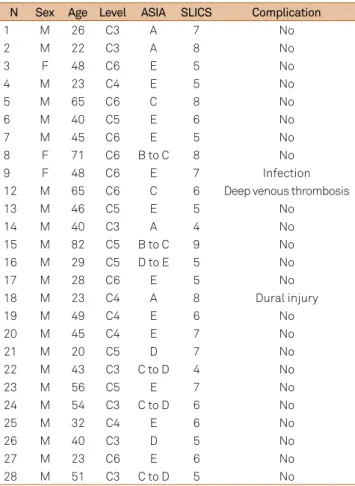
Surgical group 2011-2013 – (28 patients)
Data from the 28 cases of cervical spine trauma treated
surgically based on the SLICS score from 2011-2013 is
pre-sented in Table 3. Follow-up was obtained in all 28 patients,
ranging from 0.1 to 24 months (mean of 6.1).
Patients’ age ranged from 20 to 82 years (mean 41.5). Twenty-ive (89.3%) were male and 3 (10.7%) were female.
Regarding the level of injury, 8 patients (28.6%) had the trauma at C3, 5 (17.9%) at C4, 7 (25%) at C5, 8 (28.6%) at C6 and no one at C7. he main cause of trauma was car
accidents in twelve patients (42.9%), nine patients (32.1%) fell from heights, in three cases (10.7%) the cause was motorcy-cle accidents, two (7.15%) dove into shallow water and two (7.15%) had direct traumas.
Preoperatively, 12 patients (42.9%) were AIS E, 4 (14.3%) AIS D, 5 (17.9%) AIS C, 2 (7.15%) AIS B and 5 (17.9%) AIS A. No patients had neurological worsening.
At the inal follow up, the AIS score was: 13 (46.64%) AIS
E, 6 (21.4%) AIS D, 4 (14.3%) AIS C, and 5 (17.9%) AIS A. Table 2. Summary of the 12 patients surgically treated from 2009-2010.
N Sex Age Level AIS SLICS Complications
1 M 31 C6 A 7 Infection
2 M 38 C5 E 5 No
3 M 53 C4 E 5 No
4 F 28 C6 E 5 No
5 M 20 C5 B to C 8 No
6 M 17 C5 B to D 8 Tracheoesophageal istula
7 F 43 C5 D 3 No
8 M 23 C6 E 2 No
9 M 60 C6 C 9 No
10 M 43 C7 E 6 No
11 F 21 C7 A 5 No
12 M 22 C6 A 6 No
Table 3. Summary of the 28 patients surgically treated from 2011-2013.
N Sex Age Level ASIA SLICS Complication
1 M 26 C3 A 7 No
2 M 22 C3 A 8 No
3 F 48 C6 E 5 No
4 M 23 C4 E 5 No
5 M 65 C6 C 8 No
6 M 40 C5 E 6 No
7 M 45 C6 E 5 No
8 F 71 C6 B to C 8 No
9 F 48 C6 E 7 Infection
12 M 65 C6 C 6 Deep venous thrombosis
13 M 46 C5 E 5 No
14 M 40 C3 A 4 No
15 M 82 C5 B to C 9 No
16 M 29 C5 D to E 5 No
17 M 28 C6 E 5 No
18 M 23 C4 A 8 Dural injury
19 M 49 C4 E 6 No
20 M 45 C4 E 7 No
21 M 20 C5 D 7 No
22 M 43 C3 C to D 4 No
23 M 56 C5 E 7 No
24 M 54 C3 C to D 6 No
25 M 32 C4 E 6 No
26 M 40 C3 D 5 No
27 M 23 C6 E 6 No
A total of six out of eleven (54.5%) patients with
incom-plete neurological deicit (AIS B-C-D) improved their ASIA
status during the follow-up (Table 3).
he SLICS score in this group ranged from 4 to 9 points (mean of 6, median of 6 and SD ± 1.4). he two patients with a
SLICS of 4 points had a central cord syndrome without frac-tures or dislocations.
Twelve patients (42.9%) underwent an anterior approach, thirteen (46.4%) a posterior approach and three (10.7%) a combined approach. No preoperative traction was used in any case of this series.
Complications directed related with surgery in this group included one wound infection (posterior approach) requiring surgical debridement. One patient had a deep venous
throm-bosis prior to surgery and received an inferior vena cava ilter
and another patient the diagnosis of an intraoperative dural
tear treated with ibrin glue and muscle graft.
DISCUSSION
Despite the technological advances in surgical
tech-niques for spinal instrumentation, classiication of SCST re -mains largely descriptive, lacking standardization and usu-ally correlates poorly with clinical outcomes1.
Historically, one of the irst comprehensive classiica -tion systems for spinal injuries was credited to Holdsworth2.
His system was the irst to emphasize the importance of the
posterior ligamentous complex (PLC) in long term stability (noteworthy, the evaluation of the ligamentous complex is one of the three main categories evaluated by the SLICS).
In 1982, Allen et al.3 subsequently proposed their
mecha-nistic classiication scheme for subaxial injuries, which was also based upon the indings of plain radiographs. A total of six main categories were deined by Allen: compressive lex
-ion, vertical compress-ion, distractive lex-ion, compressive ex
-tension, distractive ex-tension, and lateral lexion. A potential and important limitation of the Allen’s classiication is con -sidering only plain radiographs to interpret the mechanism of injuries, which can result in low reliability and poor clinical outcome relationship6.
he AO Spine group also extrapolated their thoracolumbar
system for cervical injuries, classifying them into three main groups: group A, with compression and burst fractures, group B with distractive injuries and group C, with rotational injuries.
his system is widely adopted and can help surgeons in de -scribing injuries, although it is criticized by not considering the role of the neurological status in the decision-making process7.
he sub-axial injury classiication system (SLICS) was developed by Vaccaro et al. to deine a classiication system
for SCST that conveys information about injury patterns and severity as well as treatment considerations and prognosis, such as neurological status and the role of the ligamentous complex in long-term stability1,8,9.
he SLICS had already demonstrated validity in previ -ous studies: in a retrospective clinical study of patients with SCST treated, 14 patients were treated non-surgically (C), whereas 24 were treated surgically (S). In the C group, the SLIC score ranged from 0 to 5 points (mean 1.07; median 1). Just one patient had an SLIC score greater than 2 (7.1% of the patients). In the S group, the SLIC score ranged from 1 to 10 points (mean 5.6; median 6). Just 2 patients had an SLICS
score smaller than 4 (both with 1 point each, 8.3% of the total
group). All the other 22 (accounting for 91.6%) patients had
an SLICS of 4 or more points. he SLIC score matched the
treatment chosen (non surgical or surgical) with more than 90% of agreement between them10.
A prospective application of the SLICS in a consecutive
series of 37 patients with SCST to deine injuries and guide
surgical decision is also reported. Patients with four or more points were surgically treated, whereas patients with less than 4 points were conservatively managed. Twenty-three patients were included in the non-surgical group: 14 (61%) of them with some follow-up at the original institution. Follow-up ranged
from three to ive months (mean of 4.42; median 4). he SLICS
score ranged from 0 to 6 points (mean and median of 1). One patient with a SLICS of 6 points refused surgery11.
In the surgical group: twenty-ive patients were operated,
follow-up after hospital discharge was obtained in 23 (92%)
pa-tients (range from one to 24 months, mean of 5.82 months). he SLICS score in the surgical group ranged from 4 to 9 points
(mean and median of 7). No patients had neurological
worsen-ing. Eight out of 13 patients with incomplete deicits had some
improvement in the ASIA score. In this study the SLICS system
was identiied as being safe and efective at preventing neuro -logical deterioration and, in most patients, led to clinically rel-evant improvements in neurological function11.
Although our study has some limitations, such as rela-tive small sample and single center involved, we could ob-serve a trend that, after the use of the SLICS, there were no patients operated with low injury score (group 2011-2013) compared with 2 of 12 patients (16.67%) treated with mild
in-juries (group 2009-10). his can suggest that SLICS may help
surgeons with the standardization of care as well as with the choice of more unstable patterns for surgical treatment.
he SLICS is a comprehensive and useful tool to guide
SCST treatment by spine surgeons. Larger prospective mul-ticenter studies including conservative and surgically
References
1. Vaccaro AR, Hulbert RJ, Patel AA, Fisher C, Dvorak M, Lehman Jr RA et al. The subaxial cervical spine injury classiication system: a novel approach to recognize the importance of morphology, neurology, and integrity of the disco-ligamentous complex. Spine (Phila Pa 1976) 2007;32(21):2365-74. http://dx.doi.org/10.1097/BRS.0b013e3181557b92
2. Holdsworth F. Fractures, dislocations, and fracture-dislocations of the spine. J Bone Joint Surg Am. 1970;52:1534-51.
3. Allen Jr BL, Ferguson RL, Lehmann TR. A mechanistic classiication of closed, indirect fractures and dislocations of the lower cervical spine. Spine (Phila Pa 1976) 1982;7:1-27.
4. Harris JH, Edeiken-Monroe B, Kopansiky DR. A practical classiication of acute cervical spine injuries. Orthop Clin North Am.1986;17(1):15-30.
5. Marino RJ, Barros T, Biering-Sorensen F, Burns SP, Donovan WH, Graves DE et al. International standards for neurological classiication of spinal cord injury. J Spinal Cord Med. 2003;26(1):50-6.
6. Whang PG, Patel AA, Vaccaro AR. The development and evaluation of the subaxial injury classiication scoring system for
cervical spine trauma. Clin Orthop Relat Res. 2011;469:723-31. http://dx.doi.org/10.1007/s11999-010-1576-1
7. Magerl F, Aebi M, Gertzbein SD, Harms J, Nazarian S. A
comprehensive classiication of thoracic and lumbar injuries. Eur Spine J. 1994;3(4):184-201. http://dx.doi.org/10.1007/BF02221591
8. Joaquim AF, Patel AA, Vaccaro AR. Cervical injuries scored according to the subaxial injury classiication system: an analysis of the literature. J Craniovertebr Junction Spine. 2014;5(2):65-70. http://dx.doi.org/10.4103/0974-8237.139200
9. Joaquim AF, Patel AA. Subaxial cervical spine trauma: evaluation and surgical decision-making. Global Spine J. 2014;4(1):63-70. http://dx.doi.org/10.1055/s-0033-1356764
10. Joaquim AF, Lawrence B, Daubs M, Brodke D, Patel AA. Evaluation of the subaxial injury classiication system. J Craniovertebr Junction Spine. 2011;2(2):67-72. http://dx.doi.org/10.4103/0974-8237.100057