The DC field components of horizontal and vertical electric dipole
sources immersed in three-layered stratified media
D. Llanwyn Jones, C. P. Burke
Physics Department, King’s College, Strand, London, WC2R 2LS Received: 24 September 1996 / Accepted: 3 December 1996
Abstract. Formulas for computing the Cartesian com-ponents of the static (DC) fields of horizontal electric dipoles ( HEDs) and vertical electric dipoles ( VEDs) located in the central zone of a three-layer horizontally stratified medium are derived and presented in a summary form suitable for immediate computation. Formulas are given for the electric and magnetic field components in the upper and central regions. In the general case the computation involves the summation of a convergent infinite series. For the particular case of an infinitely thick central region (corresponding to the two-layer problem), the analysis produces relatively simple closed-form equations for the field components which are suitable for a ‘hand calculation’. Specimen calcula-tions for dipoles in seawaters are included and the derived results are compared with computations made using an ac model.
1 Introduction
The subject of the electromagnetic fields excited by buried or submerged radiation sources is of interest both for remote sensing and for communication purposes. Current elements or probes with various configurations may be utilised as sources. Additionally, it is known that earthquakes generate a characteristic precursor at ultra-low (and higher) frequencies (e.g. Molchanov et al., 1992; Parrot et al., 1995) and the formulas presented here may be of value in estimating the source magnitude from measurement of ULF fields on the Earth’s surface. A seminal paper dealing with the ac fields of a submerged source for the three-layer case is that of Weaver (1967). An excellent compendium of simplified formulas for the two-layer case is given in Kraichman’s book (1976) and further formulas for this model have
been published in a series of papers by Bannister (see e.g. Bannister, 1984). Developments in relation to the ocean/lithosphere environment have been presented, for example, by Chave and Cox (1982) and Fraser-Smith
et al.(1988). Often in geophysics, point current sources and sinks are used to produce subsurface fields for remote sensing, and the configuration used is such that the source acts essentially as a dipole (Wait 1982, 1993). An important feature of the ac formulation is the presence of ‘lateral waves’ which aid the propagation of the fields. These waves are not present in the dc case. A large number of relevant mathematical and practical results for ac and dc are presented by Wait (1982), but the dc formulas in this paper (for the three-layer case) have not been published previously. Here we concen-trate upon these dc (or static) solutions which apply for vanishing small values of r=k.
The mathematical background to our formulation is that developed by Sommerfeld (1967) and, particularly, Wait (1987). In Burke and Jones (1992, 1993, 1994), we considered an ac radiation source located in seawater – the central region of a three-layered horizontally strati-fied medium. We assumed a time-harmonic source dipole moment of angular frequency x, and presented integral formulas of the Sommerfeld type for the two-component Hertz vector Px;0;Pz which is required for the solution in the case of horizontal electric dipole (HED) radiation source and the single-component Hertz vector 0;0;Pz needed for the vertical electric dipole (VED). We also gave explicit formulas from which the Cartesian components of the E and B fields can be computed by quadrature. The field expressions are the sum of two parts – an analytic primary contribution which is the field produced in a medium of infinite extent, and an integral secondary contribution arising from the presence of the interfaces. These previous formulas are valid at any wave frequency, including, particularly, the dc case,x0.
For the dc case, we show that the integral formulas can be evaluated analytically using Laplace transforms. This process leads to an infinite series expansion suitable Correspondence to:D. Llanwyn Jones
(email) [email protected]
for computation. Each term of the infinite series corresponds to a particular image of the source in the upper or the lower interface. Needless to say, the application of the infinite series produces a much faster algorithm for computing the field components at dc than any involving numerical integration.
It is customary to determine dc solutions by deriving formulas for a scalar electric potential and a vector magnetic potential. In this paper, however, we derive dc analytic formulas from our pre-existing ac equations derived from a Hertz vector. In part, this work was undertaken to validate our ac field derivations and computer code (Burke and Jones, 1992, 1993). The results for the various dc field components are given in a compact tabular form for reference and computational purposes. We also give specimen numerical data.
2 The physical model
We first consider an HED of current moment Id`( Am) placed in the central (conducting) layer of a three-layer, horizontally stratified medium. The upper region is taken to be free space and the lower two regions are conductors with conductivitiesr2 andr3 (S/m),
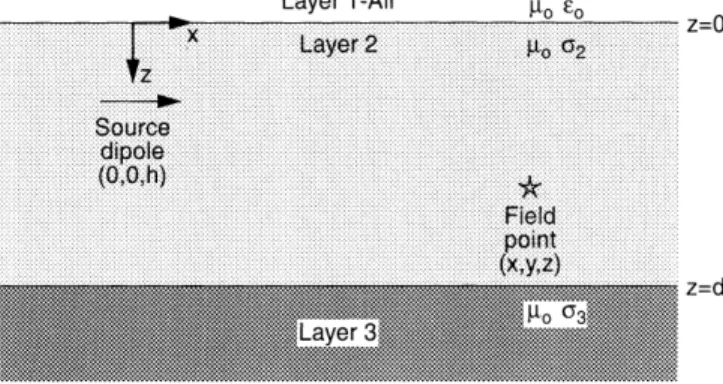
respec-tively. The three regions could represent a geophysical air-overburden-basement or an oceanic air-sea- seabed problem. Cartesian co-ordinates are used withzdirected downwards, z0 being the upper interface. The magnetic permeability is assumed to be that of free space everywhere, so the dc fields of a magnetic dipole source are unaffected by the interfaces and are the same as those of a magnetic dipole located in free space. The three layers are of infinite extent in the x and y directions. The geometry is illustrated in Fig. 1.
The HED source isx-directed and located at 0;0;h. The central region is of thicknessd; the upper and lower regions are assumed to be of infinite thickness. Fields are to be computed at the point x;y;z with ÿ1 zd, i.e. anywhere in layers 1 or 2. If it is assumed that r2 r3 (or, alternatively, thatd ! 1), only the upper
interface affects the solution. This is termed the ‘two-layer’ or ‘thick-‘two-layer’ solution in distinction to the ‘thin-layer’ solution obtained for finite d for which both interfaces (upper and lower) materially affect the field components.
3 The field equations for the HED
3.1 Derivation of the HED dc field equations
In Burke and Jones, 1992, §3 (henceforth Ref. 1), general equations were presented for the two components of the Hertz vector in layer i, Pxi and Pzi, produced by an HED source dipole located in layer i2. Using the notation of this previous paper, we now consider the limit x!0 to deduce the appropriate formulas for the dc case. When the formulas for the components of the Hertz vector have been established, the static E and H field vectors can be computed in any layer from the standard expression (e.g. Stratton, 1941),
E k2Pgrad divP; 1
Hr3curlP; 2
where k2 ÿixl0r3 andr3 rix is the complex conductivity of the layer in which the field is to be computed. At dc, in layer 2, r3r2 and is real, but in
layer 1, r3ix0, and some care has to be taken in evaluating the limit of the right-hand side of Eq. (1) as x!0.
3.1.1 HED fields in layer 2
At dc, the Sommerfeld parameter u k2ÿk212 which
appears in the ac formulation (Ref. 1) may be replaced byk. Thus, for the dc case, the components of the Hertz vector in layer 2 are written in the form,
Px2M Z 1
0
eÿkjzÿhjBeÿkzCekz
J0 kqdk; 3
Pz2M @ @x
Z 1
0
TeÿkzSekz
ÿ 1
J0 kqdk; 4
where MId`= 4pr2;q2x2y2 and J
0 is the Bessel
function of the first kind of order zero.
Explicit expressions for the four coefficientsB, C, S
andTwere given in Ref. 1. These expressions involved, h and z, together with the layer conductivities which enter the equations in terms of the interfacial reflection coefficients for horizontal Rijand vertical polarisation
Rjjij for fields incident from layer i onto the interface with layer j. It is immediately seen from the results of Ref. 1 that asx!0,
R21R230; 5a
and
Rjj21 ÿ1; Rjj23 r3ÿr2= r3r2: 5b
It follows from the first two of these that the coefficients
BandCin the expression forPx2 are both zero, so that
Px2is unaffected by the presence of the interfaces. It then
follows from Sommerfeld’s ac formula [Sommerfeld, 1967, p242, Eq. (14)] that, at dc, Px2 is expressible in
closed form:
Px2 M Z 1
0
eÿkjzÿhjJ0 kqdkM q2 hÿz2
h iÿ1
2
: 6
It is noted that this integral can be also be represented as a known Laplace transform; see, for example, Abramo-witz and Stegun (1968, Transform #29:3:55; p. 1024), which gives a direct way of obtaining the result of Eq. (6) for the dc case. Equation (6) gives the primary field of the dipole, i.e. the field of a dipole located in a medium of infinite extent.
When the differential in Eq. (4) is evaluated, the expression forPz2 becomes
Pz2 ÿM
x q
Z 1
0
kÿSekzTeÿkz1J1 kqdk; 7
J1 being the Bessel function of the first kind of order
one. At dc, the coefficientsSand Tare (Ref. 1)
S ÿ Rjj23=Djjk eÿk 2dheÿk 2dÿh
8a
and
T ÿ 1=Djjk eÿkhÿRjj23eÿk 2dÿh
; 8b
where Djj1Rjj23eÿ2kd.
We now expand the factor 1=Djj as a geometric progression
1=DjX
1
n0 ÿRjj23
n
eÿ2ndk: 9
It then follows thatPz2 can be expressed as the sum of
four terms:
Pz2 X4
i1
Pz i2Pz 12Pz 22P z32P z42; 10a
with
P z12 M x q
Z 1
0
eÿk hzX
1
n0 ÿRjj23
n
eÿ2ndkJ1 kqdk;
10b
P 2z2 ÿM
x q
Z 1
0
Rjj23eÿ
k 2dÿhzX1
n0 ÿRjj23
n
eÿ2ndkJ1 kqdk;
10c
P 3z2 M x q
Z 1
0
Rjj23eÿ
k 2dhÿzX 1
n0 ÿRjj23
n
eÿ2ndkJ1 kqdk;
10d
P z42 M x q
Z 1
0
Rjj23eÿk 2dÿhÿzX
1
n0 ÿRjj23
n
eÿ2ndkJ1 kqdk:
10e
Consider the termP z12. This may be written as
P z12M x q
Z 1
0 X1
n0 ÿRjj23
n
exp ÿkrn1J1 kqdk; 11
where rn12ndhz.
As was the case for Eq. (6), the integral in Eq. (11) can be evaluated using a tabulated result for the Laplace transform (Abramowitz and Stegun, 1968, Transform #29.3.56, p. 1024) viz:
Z 1
0
aeÿstJ1 atdtps2a2ÿsps2a2ÿ1:
For small values of a=s, greater numerical accuracy is obtained by recasting the right-hand side of this formula using the identity:
s2a2 p
ÿs
s2a2 p
ÿ1
a2s2a2sps2a2ÿ1:
Puttingaq; tkandsrn1, it follows that
P z12 M xX
1
n0 ÿRjj23
n
rn21q 2
rn1
r2n1q2 q
:
12a It is noted that for a thick central layer, with h and z finite so that dhqz, only then0 term of this series expansion survives. This term is that produced by the image of the source dipole in the upper interface and is a secondary field component. Further secondary components are produced by the higher values ofn.
Applying the same technique to the remaining terms in Eq. (10), we obtain
P z22 M xX
1
n1 ÿRjj23
n
rn22q 2
rn2
r2n2q2 q
;
12b
P z32 ÿM xX
1
n1 ÿRjj23
n
rn23q2rn3
r2
n3q2 q
;
12c
P z42 ÿM x X1
n1 ÿRjj23
n
rn24q 2
rn4
r2n4q2 q
;
12d with rn22ndÿhz; rn32ndhÿzand rn4 2nd ÿhÿz.
Note that in Eq.(12b–d) the summations do not include the termn0. These three terms thus make no contribution to the solution when d is very large, provided that hand zare finite.
The solution presented is, in fact, a geometrical-optics (or images) formula which, as is well known, is valid when the reflection coefficient is independent of the ‘angle of incidence’. In the given formulation this angle of incidence is embodied within the Sommerfeld ‘dum-my’ variable k. The images associated with a positive sign precedingzin the formulas forrniare in layer 1 and those with a negative sign are in layer 3.
3.1.2 HED dc fields in layer 1
Again, referring to the ac formulas presented in Ref. 1, it is easily seen that, at dc, the Hertz vector components Px1andPz1in the air-space (layer 1) may be represented
in the form
Px1 M Z 1
0
A ekzJ0 kqdk; 13
Pz1M @ @x
Z 1
0
R ekzJ0 kqdk; 14a
ÿM x q
Z 1
0
kR ekzJ1 kqdk: 14b
Application of the boundary conditions across the interfaces z0 and zd (as described in Ref. 1) produces the following results for the two coefficientsA and Rasx!0:
A ÿ ir2=xe0eÿkh; 15a
R ÿ ir2=xe0 ST 1=k ir2=xe0eÿkh: 15b
Hence, as x!0, both A and R, and thus Px1 and
Pz1! 1. However, Eqs. (1) and (2) must give finite
values for the dc fieldsEandH. In Eq. (1)k2P!0 and in Eq. (2)ixe0r 2Pis clearly finite. We will now show that in Eq. (1), rr 1Pis also finite.
3.1.2.1 Calculation of r 1Pand henceE. From Eqs. (13) and (14) and the elementary formula
r 1P @Px=@x @Pz=@z it is found that
r 1P ÿM x q
Z 1
0
k AkRekzJ1 kqdk: 16
In Eq. (16) the factorAkRis indeterminate asx!0 if Eq. (15) is used. To resolve this indeterminacy we return to the boundary condition that both Ex and Ey and hencer 1Pis continuous across the interfacez0. At dc this requires that
AkReÿkhk SÿT
2=Djj
eÿkhÿRjj23eÿk 2dÿh
; 17
and thus
r 1P ÿ2M x q
Z 1
0
k=Djj
eÿkhÿRjj23eÿk 2dÿh
2ekzJ1 kqdk:
In this formula the integrand may be cast into the same form as that previously expanded [Eq. (10)] by noting that it is equivalent to
r 1Pÿ2Mx q
@ @z
Z 1
0
1=Djj
eÿk hÿzÿR23jj eÿk 2dÿhÿz
2J1 kqdk: 18 Proceeding as in Sect. 3.1.1, we then find the following series expansion formula for Eq.(18).
r 1P ÿ2Mx @ @z
X1
n0
ÿRjj23 n
rn23q2rn3
r2
n3q2
q
"
X1
n1
ÿRjj23 n
r2n4q2rn4
r2
n4q2
q
#
: 19
By evaluating the gradient of Eq. (19) in accordance with Eq. (1), we obtain the series expansion formulas for the electric field components in layer 1. These are given in Sect.4.2. Note that the n0 term in Eq. (19) represents the sum of the primary (or direct) field plus the ‘thick-layer’ field corresponding to d ! 1, these being equal for a point in layer 1. Also only the images in layer 3 contribute to the field in layer 1 [rn1andrn2are
absent in Eq. (19)].
3.1.2.2 Calculation of H (or B). H is given by Eq. (2) with r3 ixe0 for layer 1. From Eq.
(15),ixe0Ar2eÿkh andixe0R ÿr2 1=keÿkh. It then
follows that [as for Eq. (6)],
ixe0Px1 Mr2 Z 1
0
eÿk hÿzJ0 kqdk
Mr2 q2 hÿz2
h iÿ1
2
;
20
and
ixe0Pz1Mr2
x q
Z 1
0
eÿk hÿzJ1 kqdkMr2x
2 q2 hÿz2 hÿzq2 hÿz2
h i1
2
ÿ1
:
21 The magnetic field components in layer 1 may now be computed asH r 2 ixe0P, thexandzcomponents
of the vector P being given by the closed form expressions, (20) and (21). Interestingly, these dc magnetic field components are independent of d; r2
and r3 (note that Mr2Id`=4p). The field formulas
derived from Eqs. (20) and (21) are given in Sect. 4.2.
4 Recipes for computing the HED dc field components
4.1 HED DC Fields in Layer 2
The field equations for computing E and Bl0H, derived from the formulas of Sect. 3 are given in Tables 1 and 2. The field components are computed using the tables as follows.
a) First compute the primary (direct) field produced by the source dipole using the equations in Table 1, [derived from Eq. (6)]. These are the fields produced by the source if located in a medium of conductivity r2
which is of infinite thickness. These results are well known and can be put in the form presented in the table using formulas presented in many standard texts (e.g. Stratton, 1941, p. 436).
(the ‘thick-layer’ case). This is done by using the formulas of Table 2 with i1 and n0. These for-mulas are obtained from the n0 term of Eq. (12a). The only value ofrni required is thus
r01hz:
Add these field values to those obtained in stage (a). The result is that for the fields produced by a source at finite depth within an infinitely thick central layer, and the fields are thus affected by the upper interface only. The source of this term is the image dipole located in layer 1 at a distancehabove the upper interface.
c) To find the field for the general thin-layer or three-layer case the results of Table 2 are used in the following manner. If F represents any one of the field formulas given in the second column of Table 2 compute the double summation:
X1
n1 X4
i1
Fni
" # :
Repeat this calculation for the five finite components in Table 2. The convergence of the summation depends on the value ofR (which is the reflection coefficient of the
lower interface, Rjj23) and on the spatial parameters, particularly the layer thicknessd (Rsmall and/ordlarge gives rapid convergence). The double summation com-putes the fields given by the n>0 terms of Eq. (12) which are the fields of the multiple images of the source in the upper i1;2and lower i3;4layers.
The final result is obtained by adding the field produced in step (c) to that produced at step (b). If the i-summation is first computed for n1 and the result added to that of step (b), the convergence can be tested following each successive n-summation enabling a sim-ple algorithm to be devised for terminating the summa-tion with a machine of any given precision.
d) Note: if the middle layer is infinitely thick but the source dipole is near the base so that h0dÿh z0dÿz are finite, the fields can be computed as the primary field [as in (a)] plus a secondary term which is the i4; n1 term in Table 2. This follows because r142dÿhÿzh0z0 is the only finite rni in this
situation.
4.2 HED dc fields in the upper region (layer 1)
The fields in the upper region (produced by a source in layer 2) are computed as follows. Note that asz<0, a negative value of zis to be used for all calculations in this region.
a) Compute the primary fields from the formulas of Table 1.
b) For the electric field components, the secondary fields for the two-layer (or ‘thick-layer’) case are the same as the primary fields. Thus, for the electric components, multiply the results obtained in (a) by two to get the primary plus ‘thick layer’ contributions.
For the magnetic field components, the secondary fields for the two-layer case can be computed using the B-formulas of Table 2 withSi 1 and replacingrniby hÿz(remember that a negative value ofzis to be used so hÿz is always a positive quantity). The calculated values are then added to those produced by step (a).
c) The calculation is now complete for the magnetic fields because there are no ‘thin-layer’ contributions.
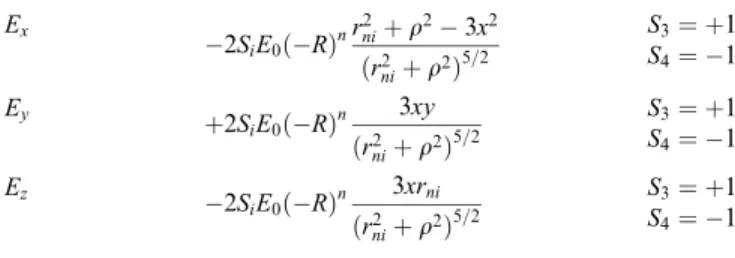
In the case of the electric fields the secondary ‘thin-layer’ contribution to be added to that produced in step (b) is calculated by using the formulas of Table 3 and computing the double summation
X1
n1 X4
i3
Fni
" # :
Table 1.Layer-2 primary fields of the HED
ExE0 3x2=D5ÿ1=D3
EyE03xy=D5
EzE03x zÿh=D5
Bx0
By ÿB0 zÿh=D3
BzB0y=D3
E0106Id`= 4pr2 givingEinlV=m
B0100Id` givingBin nT
D2q2 zÿh2;
q2x2y2
Table 2.Layer-2 secondary field terms for the HED
Ex ÿE0 ÿRn
r2niq2ÿ3x2
r2
niq2 ÿ 15=2
Ey E0 ÿRn
3xy r2
niq2 ÿ 15=2
Ez SiE0 ÿRn
3xrni r2
niq2 ÿ 15=2
Si 1;i1;2 Si ÿ1;i3;4 Bx SiB0 ÿRn
xy
q4
rni 2r2ni3q
2
r2
niq2
3=2 ÿ2
" #
Si 1;i1;2 Si ÿ1;i3;4
By ÿSiB0 ÿRn
x2 q4
rni 2r2ni3q2 r2
niq2
3=2 ÿ2
" #
(
1
rni2 q2rni r2niq2
1=2
)
Si 1;i1;2 Si ÿ1;i3;4
Bz 0
E0;B0andqare as defined in Table 1
R r3ÿr2= r3r2;
rn12ndhz;rn22ndÿhz;
rn32ndhÿz;rn42ndÿhÿz;n1;2;3. . .
Note: Asx!0 andy!0 soq!0 ;Bx!0 and only the second
term in thefgforByis finite.
Table 3.Layer-1 secondary field terms for the HED
Ex
ÿ2SiE0 ÿRn
r2
niq2ÿ3x2 r2
niq2
5=2
S3 1
S4 ÿ1
Ey
2SiE0 ÿRn
3xy r2niq25=2
S3 1
S4 ÿ1
Ez ÿ
2SiE0 ÿRn
3xrni r2
niq2
5=2
S3 1
(Note that the second summation is only taken over i3 and 4 in this situation. Except for the sign and a factor of two, the formulas in Table 3 are the same as those in Table 2.)
5 The vertical electric dipole
The vertical electric dipole ( VED) is taken to be z-directed (i.e. z-directed downwards) and located at the point (0,0,h). Otherwise the situation is as described in Sect. 2.
Because, in this case, there is complete azimuthal symmetry, the field formulas are less involved than is the case for the HED. The boundary conditions can be satisfied with a single-component Hertz vector Pzi i1;2;3 in each of the three layers, which is written in the same form as that for Pxi for the HED. Initially it is advantageous to use cylindrical polar co-ordinates q;u;z. The cylindrical polar components evaluated using Eqs. (1) and (2) are, explicitly:
Eq @2Pz=oqoz;Ez k2 @
2
@z2
Pz;Hu ÿr3@Pz=@q;
22 all other field components being zero. The boundary conditions for the VED thus reduce to the continuity of k2Pz andoPz=ozacross each of the two interfaces. The solution for the VED at dc then proceeds analogously to that for the HED and we will not detail the algebraic processes involved here.
5.1 VED dc fields in layer 2
It is found that, at dc, the Hertz vector in layer 2 is expressible in the form of Eq. (10a) with
P z12 ÿMX
1
n0 ÿRjj23
n r2
n1q2 q
; 23a
P z22 MX
1
n1 ÿRjj23
n r2n2q2 q
; 23b
P z32 MX
1
n1 ÿRjj23
n r2n3q2 q
; 23c
P z42 ÿMX
1
n1 ÿRjj23
n r2
n4q2 q
; 23d
from which the field components in layer 2 can be computed using Eq. (22). The results are presented in Sect. 6.1.
5.2 VED dc fields in layer 1
In layer 1, it is found that Pz1 may be written as
[compare Eq. (19) for the HED, noting that r 1P1 @Pz1=@z]:
Pz12M "
X1
n0 ÿRjj23
n r2n3q2 q
ÿX1
n1 ÿRjj23
n r2
n4q2
q #
: 24
In Eqs. (23) and (24) the rni (with i3;4) are defined following Eq. (12). In Eq. (22), for layer 1;r30 at dc (andPz1is finite). It follows thatHuis zero in this layer. This is to be expected from Amperes law, because of the symmetry and the fact that there are no currents in layer 1. The electric field components, as computed from Eqs. (22) and (24) are presented in Sect. 6.2.
6 Recipes for computing the VED dc field components
6.1 DC VED fields in layer 2
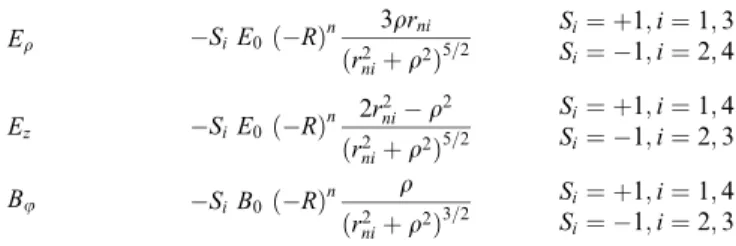
The formulas for the VED fields in layer 2 are listed in Tables 4 and 5. The results in Table 4 are those of Table 1 modified for a z-directed dipole. Computation proceeds exactly as described in Sect. 4.1 except that Tables 4 and 5 are used in place of Tables 1 and 2, respectively. The cylindrical polar components Eq;Bu; Ezshould first be calculated to the precision required. Finally, if needed, the Cartesian components may be computed from these using the relations presented in Table 4.
Table 4.Layer-2 primary fields of the VED
EqE03q zÿh=D5
EzE0 3 zÿh2ÿD2=D5
BuB0q=D3
ExxEq=q :EyyEq=q
Bx ÿyBu=q :ByxBu=q:Bz0 E0106 Id`= 4pr2 givingEinlV=m
B0100Id` givingBin nT
D2q2 zÿh2;
q2x2y2
Table 5.Layer-2 secondary field terms for the VED
Eq ÿSiE0 ÿRn
3qrni r2
niq2
5=2
Si 1;i1;3 Si ÿ1;i2;4
Ez ÿSiE0 ÿRn
2r2
niÿq2 r2
niq2
5=2
Si 1;i1;4 Si ÿ1;i2;3
Bu ÿSiB0 ÿRn
q
r2
niq2
3=2
Si 1;i1;4 Si ÿ1;i2;3
ForEx;Ey;BxandBy use the formulas in Table 4; E0;B0andqare as defined in Table 4;
R r3ÿr2= r3r2.
rn12ndhz; rn22ndÿhz;
6.2 DC VED fields in layer 1
In layer 1 there are no magnetic field components for the VED (i.e. B0) so only the electric fields have to be computed. Computations of the electric field compo-nents are made following the procedure described in Sect. 4.2 using theE-field formulas of Tables 4 and 5 as follows.
To compute the sum of the primary plus thick-layer contribution use Table 4, multiplying each of the two electric field components by two. Then add on the result of the summation overnfori3 and 4 (as in Sect. 4.2c) using the E-formulas of Table 5, but again multiplying each field component in Table 5 by two.
7 Specimen calculations and validation
7.1 Specimen Calculations
Specimen calculations for the HED and the VED gave the results presented in Table 6. A single precision algorithm was used and the computation terminated automatically (e.g. atn31 for the layer 2 fields for the HED when the largest field component increment was, at most, 0:5210ÿ5 the existing value of that component)
7.2 Validation
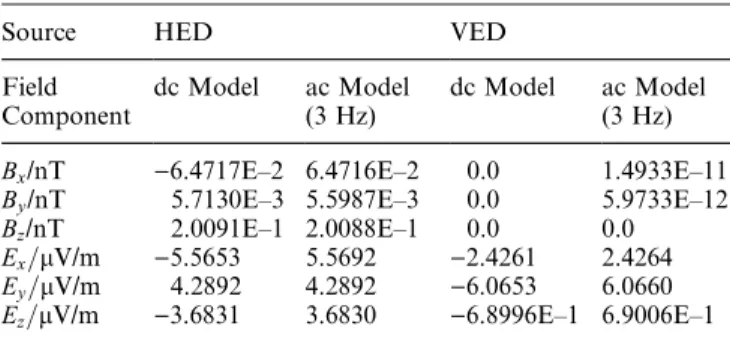
We have tested the dc formulas presented in this paper against our ac model (Burke and Jones, 1993, 1994), which had previously been programmed. This process checks the analytic derivations of the field components from the Hertz vector for the two cases and the resulting computer code. Clearly, the ac model should give the
same results as the dc model at sufficiently low frequencies. We have thus made computations using the dc model and the ac model at a frequency of 3 Hz. The results of the dc calculations and the modulus of the ac values for the various components in layer 1 are given in Table 7. The phase of the ac components (0 orp) also corresponds to the sign of the dc value. The dc and low-frequency ac fields in layer 2 also agreed numerically.
Acknowledgements. The work described here has been supported, in part, by the U.K. Defence Research Agency, Winfrith New-burgh, UK. Topical Editor D. J. Webb thanks S. Lovell and P. R. Bannister for their help in evaluating this paper.
References
Abramowitz, M., and I. A. Stegun, Handbook of Mathematical Functions, Dover Publications, New York, 1968.
Bannister, P. R.,New Simplified Formulas for ELF Subsurface-to-Subsurface Propagation, IEEE J. Ocean. Eng., OE-9,154–163, 1984.
Burke, C. P., and D. Ll. Jones,Electromagnetic Wave Propagation in Three-Layered Media,Technical Report RP921015, 1992.
Burke, C. P., and D. Ll. Jones, ELF Propagation in Deep and Shallow Sea Water, AGARD Conf. Proc. 529, AGARD (NATO), Neuilly sur Seine, France, pp 11.1–11.8, 1993.
Burke, C. P., and D. Ll. Jones,A Signal-to-Noise Model for ELF Propagation in Sub-Surface Regions, IEEE J. Ocean. Eng.,19,
353–359, 1994.
Chave, A. D., and C. S. Cox,Controlled Electromagnetic Sources for Measuring Electrical Conductivity Beneath the Oceans,J. Geophys. Res.,87,5327–5338, 1982.
Fraser-Smith, A. C., A. S. Inan, O. G. Villard and R. G Joiner,
Seabed Propagation of ULF/ELF Electromagnetic Fields from Harmonic Dipole Sources Located on the Seafloor,Radio Sci.,
23,931–943, 1988.
Kraichman, M. B., Handbook of Electromagnetic Propagation in Conducting Media, U.S. Government Printing Office, Washing-ton, DC 20402, Stock No. 008-040-00074-5, 1976.
Molchanov, O. A., Yu. A Kopytenko, P. V. Voronov, E. A. Kopytenko, T. Matiashvili, A. C. Fraser-Smith, and A. Bernardi,
Results of ULF Magnetic Field Emission Near the Epicenter of Spitac (Ms6:9) and Loma Prieta (Ms7:1) Earthquake, A Comparative Analysis, Geophys. Res. Lett., 19, 1495–1498, 1992.
Parrot, M., A. C. Fraser-Smith, O. A. Molchanov, and T. Yoshino,
Electromagnetic effects associated with earthquakes and volca-nic eruptions, EOS Trans. Am. Geophys. Union, 76,233, 1995.
Sommerfeld, A., Partial Differential Equations in Physics, Aca-demic Press, London, New York, 1967.
Table 6.Specimen calculations
Fields in Layer 2
Parameters:Id` 1 Am,r24 S/m,r3=r20:15,h2:0 m,
d13:0 mx;y;z50:0,)100.0, 11.0
HED – Number of terms used = 31. Relative Tolerance = 0.5E–05
Bx;By;Bz=pT = 0.60937 )2.4926 )7.0864
Ex;Ey;Ez/nV/m = 57.826 )118.01 5.5129 VED – Number of terms used = 35.Relative Tolerance = 0.50E–05
Bx;By;Bz=pT = 0.11092 5.54601E–02 0.00 Ex;Ey;Ez/nV/m =)0.98227 1.9645 )0.39477 Fields in Layer 1
Parameters:Id` 1 Am,r24 S/m,r3=r20:15,h2:0 m,
d13:0 m x;y;z5:0,)10.0,)10.0
HED – Number of terms used = 13. Relative Tolerance = 0.5E–05
Bx;By;Bz=pT = 62.946 88.785 )226.66
Ex;Ey;Ez/nV/m =)7803.4 )5157.0 )6514.0 VED – Number of terms used = 24. Relative Tolerance = 0.1E–06
Bx;By;Bz=pT = 0.00 0.00 0.00
Ex;Ey;Ez/nV/m =)5945.2 11890.4 5164.4
Table 7.Validation of dc model against the ac model (layer 1)
Source HED VED
Field Component
dc Model ac Model (3 Hz)
dc Model ac Model (3 Hz)
Bx/nT )6.4717E–2 6.4716E–2 0.0 1.4933E–11
By/nT 5.7130E–3 5.5987E–3 0.0 5.9733E–12 Bz/nT 2.0091E–1 2.0088E–1 0.0 0.0 Ex=lV/m )5.5653 5.5692 )2.4261 2.4264
Ey=lV/m 4.2892 4.2892 )6.0653 6.0660
Stratton, J. A.,Electromagnetic Theory, McGraw-Hill, New York, 1941.
Wait, J. R., Geo-Electromagnetism, Academic Press, London, New York, 1982.
Wait, J. R.,Electromagnetic Wave Theory, John Wiley, New York 1987.
Wait J. R.,Basic Radiation Fields, Radiosci.,4 (No. 4), 90–94, 1993.