Properties of the Surface Layer of Thin Films
of Polyaniline Doped With Phosphoric Acid
Almedina Modrić
-
Šahbazović
1, Izet Gazdić
1,
Suada Sulejmanović
21
Department of Physics, Faculty of natural sciences and mathematics, University of Tuzla, Bosnia and Herzegovina
2
Department of Physics, Faculty of natural sciences and mathematics, University of Sarajevo, Bosnia and Herzegovina
Abstract – This study deals with estimation of the surface free energy of thin films of polyaniline doped with phosphoric acid, by measuring contact angles. Synthesis of polyaniline (PANI) with phosphoric acid (PA) was performed at room temperature of 20°C, and at 0°C. Thin films were obtained by means of a spin coater, applying the synthetized mixture on a glass substrate. By measuring the contact angle, first between ethylene glycol and a film and then between distilled water and a film, we thus calculated the polar, dispersion and total surface free energy. It was proved and demonstrated that the surface free energy depends on the temperature at which the solution (from which the thin films are obtained later) was synthesized.
Keywords: polyaniline, phosphoric acid, thin films, contact angle, surface free energy
1. Introduction
Polymers are condensed systems of
macromolecules, which means that they exist in solid and liquid forms, and cannot exist in a gaseous aggregate state. Some polymers after certain modifications may become conductive. The conductive polymers exhibit electrical and optical properties of metals or semiconductors, while retaining good mechanical properties.
DOI: 10.18421/TEM53-05
https://dx.doi.org/10.18421/TEM53-05
Corresponding author:Izet Gazdić,
Department of Physics, Faculty of natural sciences and mathematics,University of Tuzla, Bosnia and Herzegovina Email:[email protected]
© 2016 Almedina Modrić-Šahbazović, Izet
Gazdić, Suada Sulejmanović, published by UIKTEN. This work is licensed under the Creative Commons Attribution-NonCommercial-NoDerivs 3.0 License.
The article is published with Open Access at
www.temjournal.com
The conductivity of polymers, as well as the possibility of their doping towards the whole range of conductivity from insulators to metals, was discovered in 1976 by the chemists MacDiarmid and Hideki Shirakawa and the physicist Alan J. Heeger, who were jointly awarded the Nobel Prize in 2000, for the discovery of conductive polyacetylene [1]. It is known that polyaniline (PANI) in its undoped state is an insulator, and that by doping it can be converted into a conductive state with a relatively high conductivity.
Conductive PANI is produced by direct oxidative polymerization of aniline (C6H5NH2) with the appropriate chemical oxidant (potassium bichromate, ammonium persulfate, peroxide sulfate, hydrogen peroxide, ...) or by electrochemical oxidation on the electrodes made of different materials [2,3]. The oxidation is generally performed in an acidic medium.
It is known that materials on the surface exhibit somewhat different properties than in their interior, and the reason for this is the cohesion and adhesion forces. The aim of this paper is to explain one of the properties of materials on their surface, and that is the surface free energy.
which is called the surface energy. Since the equilibrium state corresponds to minimum potential energy, and each system tends to come to a state of equilibrium, thus the liquid surface also tends to come in a state of equilibrium, i.e., to obtain the minimum value (to gather together). This force is called the surface tension and refers to the force between liquid and solid bodies, or a solid body and air, as well as between two liquids. It is also called the inter-phase tension, which represents a measure of the reflectance between two materials [4].
The contact angle θ is a measure of the
wettability of a solid by a liquid. That is the angle between the tangent drawn from a point to the contour of a liquid droplet wetting a solid body surface. When the contact angle is 0° the liquid will completely wet the surface (cos θ = + 1), and when the angle equals 180° the wetting will not exist (cos θ = -1). Of course, these cases can be excluded, because a drop on the surface due to the action of various external factors cannot achieve these values.
Figure 1. Contact angle on the border of three phases
2. Material and Methods
PANI-PA was obtained by chemical oxidation of aniline in an aqueous (1M) 85% solution of phosphoric acid (H3PO4), wherein the ammonium peroxisulfate (NH4)2S2O4 (APS) was used as an oxidizing agent [5]. The synthesis of PANI-PA was carried out at 0°C and room temperature (20°C) [6]. Thin films of PANI-PA were obtained by using the spin coater (Model P-6708D, Specialty Coating Systems, Indianapolis, IN) whose rotational speed can reach 8000 rev/min [7]. A mixture of polyaniline was applied to a glass surface. 10 films were obtained from each mixture synthesized at 0°C and 20°C, at different speeds of rotation.
The surface free energy, that is, its polar and disperse part, is determined indirectly by measuring the contact angle between a liquid with known surface free energy and the tested surface. In our case this is the contact angle between distilled water and a thin film of PANI-PA, and between the ethylene-glycol and the same film. The measurement was conducted for all 10 films in both series (at 0°C and 20°C).
All the methods for calculating the surface free energy were based on the use of Young's equation. In our work we used the method by Owens, Wendt, Rabel and Kaelbleu (OWRK method) [8].
Surface free energy is calculated according to the following relation:
(
)
plv p s
p lv p s d
lv d s
d lv d s lv
γ
γ
γ
γ
γ
γ
γ
γ
θ
γ
+
+
+
=
+
cos
4
4
1
where:
γd
- disperse component of the surface free energy
γp
- polar component of the surface free energy γlv - surface free energy of liquid
γs - surface free energy of the surface θ - contact angle
3. Experimental results and Discussion
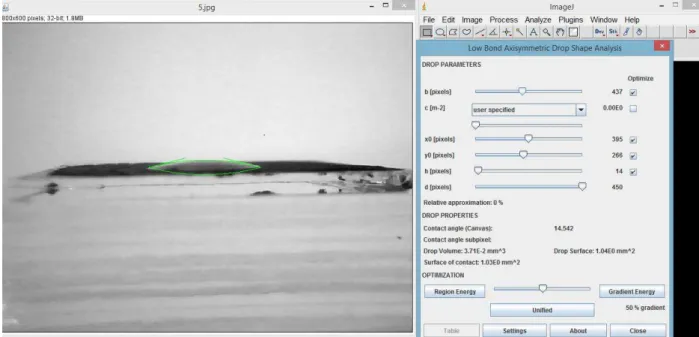
A drop of distilled water is applied on the surface of the thin film PANI-PA. Immediately after this application of the drop, we measured the contact angle between the distilled water and the film surface. The contact angle was measured in the program ImageJ. The same was done with ethylene glycol. Figure 2 shows an example of measuring the contact angle (between ethylene glycol and the film that was formed from the solution synthesized at room temperature) in this program, for one of the films. Based on the measured contact angle between the distilled water and the film, and between the ethylene glycol and the film, and based on their known surface energies, by the given formula we calculated also the surface free energy (its polar and disperse parts) of the thin film PANI-PA. The measurement was carried out for all 10 films at 0°C, and 10 films at 20°C.
θ –kontaktni ugao T - tangent
Liquid drop
Figure 2. Example of measuring the contact angle in the program ImageJ, between ethylene glycol and the film created from the solution synthesized at room temperature
Table 1. Results of measuring the contact angle for ethylene glycol and water, on thin films PANI- PA prepared from the solution synthesized at 0°C, and calculation of surface free energies of these films for the measured angles.
Nr. of measurement
Rotation speed (rpm)
Contact angle H2O
Contact angle ethylene glycol
γsp[mJ/m2] γsd[mJ/m2] γs[mJ/m2]
1 100 13.76 11.32 82.52542 2.171369 84.69679
2 300 15.78 13.25 81.56625 2.203657 83.76991
3 500 10.59 12.11 85.15572 1.808533 86.96426
4 600 19.46 12.22 77.37715 2.863975 80.24113
5 700 11.61 12.12 84.47646 1.889262 86.36572
6 800 9.60 11.46 85.49655 1.796164 87.29272
7 1100 11.92 10.29 83.55338 2.082021 85.6354
8 2000 14.82 12.00 81.89811 2.222684 84.1208
9 2500 19.44 12.68 77.58789 2.805375 80.39327
10 4000 14.94 13.60 82.48679 2.065015 84.5518
Table 2. Results of measuring the contact angle for ethylene glycol and water, on thin films PANI-PA prepared from the solution synthesized at 20°C, and calculation of surface free energies of these films for the measured angles.
Nr. of measurement
Rotation speed (rpm)
Contact angle H2O
Contact angle ethylene glycol
γsp
[mJ/m2] γsd[mJ/m2] γs[mJ/m2]
1 100 32.76 16.69 61.04922 5.765996 66.81522
2 300 30.88 11.57 61.86959 6.03237 67.90196
3 500 27.45 12.5 67.28043 4.702116 71.98255
4 600 34.22 12.79 57.06314 7.227344 64.29048
5 700 27.73 14.54 67.72426 4.449902 72.17416
6 800 32.68 13.32 59.71176 6.445337 66.15709
7 1100 49.44 12.43 31.73248 18.05636 49.78884
8 2000 37.54 13.10 51.75213 8.847416 60.59955
9 2500 43.22 11.92 41.8771 12.81117 54.68827
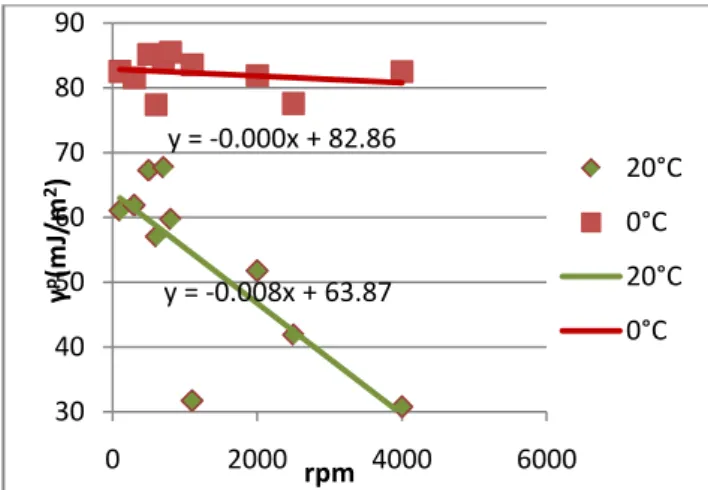
Figure 3. Polar component (of the surface free energy) dependence on the number of rotations, for films made
from the solution synthesized at 0°C and 20°C.
Figure 4. Disperse component (of the surface free energy) dependence on the number of rotations, for films made
from the solution synthesized at 0°C and 20°C.
Figure 5. The total surface free energy dependence on the number of rotations, for films made from the solution
synthesized at 0°C and 20°C.
The values of contact angles for all the films (in both cases), and their surface free energies (both polar and dispersed parts) are represented in the tables 1 and 2. Figures 3, 4 and 5 show that the dependence of the surface free energy (including the polar and disperse components) of the thin films resulting from the solution synthesized at 0°C, on the number of rotations is almost linear, i.e. constant. The surface free energy of the thin film formed from solution which was synthesized at higher temperature (20°C) is reduced with the rotation speed (Figure 5) and much lower than the surface free energy of the thin film formed from the solution synthesized at 0°C. The reason for lower surface free energy is that with an increasing temperature the kinetic energy of particles also increases, they move faster, and therefore links between molecules become weaker [9].
Direct connection between surface tension (and hence the surface free energy) and temperature can be represented by the equation:
3 2
1
−
⋅
=
C o TT
T
σ
σ
, where:σT - surface tension at the measured temperature σo - surface tension at 0°C
TC - Curie temperature
4. Conclusion
Based on the results obtained we can conclude that contact angles (whether it refers to ethylene glycol or distilled water) do not depend on the speed of rotation at which the film originated. The surface free energy of the films of polyaniline doped with phosphoric acid, which were created from the synthesized solution at 0°C, is equal. Some slightly different dependence is shown by the films formed from solution which was synthesized at 20°C. From Figure 5 we can see that the surface free energy for these films slightly decreases with an increasing speed of rotation. The reason for this difference in surface free energies between films synthesized at 0°C and 20°C is that the films formed from the solution synthesized at 20°C were obtained some time earlier, and it is well known that polymers can age. Also, from Figure 5, a conclusion can be drawn that a reduction in the surface free energy occurs with the increase of temperature at which the solution for film creation is synthesized.
y = -0.008x + 63.87 y = -0.000x + 82.86
30 40 50 60 70 80 90
0 2000 4000 6000
γ p(m J/ m 2) rpm 20°C 0°C 20°C 0°C
y = 0.003x + 5.128
y = 5E-05x + 2.128
0 5 10 15 20
0 1000 2000 3000 4000 5000
γ d(mJ /m 2) rpm 20°C 0°C 20°C 0°C
y = -0.005x + 69.00 y = -0.000x + 84.99
40 50 60 70 80 90
0 2000 4000 6000
References
[1]. MacDiarmid, A. G. (2001). Synthetic metals: a novel
role for organic polymers. Synthetic Metals, 125(1),
11-22.
[2]. Genies, E. M., Boyle, A., Lapkowski, M., & Tsintavis,
C. (1990). Polyaniline: a historical survey. Synthetic
Metals, 36(2), 139-182.
[3]. Wallace, G. G., Teasdale, P. R., Spinks, G. M., &
Kane-Maguire, L. A. (2008). Conductive electroactive
polymers: intelligent polymer systems. CRC press. [4]. S Đorđević, V. Dražić,1989, Fizička hemija,
Tehnološko-metalurški fakultet Beograd.
[5]. Gazdić, I., Avdić, S., Sulejmanović, S., Bikić, S., &
Modrić-Šahbazović, A. Temperature Dependence of
the Conductivity of Polyaniline Samples.Journal of
Trends in the Development of Machinery and Associated Technology, 17(1), 77-80.
[6]. Izet Gazdić, Almedina Modrić-Šahbazović, Testing of Electrical Conductivity of Thin Films of Polyaniline Doped with Phosphoric Acid, International Journal of Engineering and Managment Research, Volume-6, Issue-3, May-June 2016.
[7]. Izet Gazdić, Almedina Modrić-Šahbazović, Senada
Avdić, Suada Sulejmanović, Reproducibility of Obtaining thin Films of Polyaniline by Direct Doping TEM Journal -Technology, Management, Informatics, ISSN: 2217-8309. eISSN: 2217-8333, Vol.4, No.2, May 2015.
[8]. Dörfler, H.-D.,2002.- Grenzflächen und kolloid-disperse Systeme – Physik und Chemie, Springer – Verlag, Berlin.