Article
J. Braz. Chem. Soc., Vol. 23, No. 10, 1853-1857, 2012. Printed in Brazil - ©2012 Sociedade Brasileira de Química 0103 - 5053 $6.00+0.00
A
*e-mail: [email protected], [email protected]
7,8-Secolignans from
S
c
hisandra neglecta
and Their Anti-HIV-1 Activities
Xuemei Gao,a,bHuaixue Mu,aRuirui Wang,cQiufen Hu,*,a Liumeng Yang,c
Yongtang Zheng,cHandong Sunb and Weilie Xiao*,a,b
aKey Laboratory of Chemistry in Ethnic Medicinal Resources, State Ethnic Affairs Commission &
Ministry of Education, Yunnan University of Nationalities, Kunming 650031, P. R. China
bState Key Laboratory of Phytochemistry and Plant Resources in West China, Kunming Institute of Botany,
Chinese Academy of Sciences, Kunming 650204, P. R. China
cKunming Institute of Zoology, Chinese Academy of Sciences, Kunming 650223, P. R. China
Quatro novas 7,8-secoligninas (neglectahenols A-D), juntamente com duas 7,8-secolignanas conhecidas, foram isoladas de folhas e caules de Schisandra neglecta. As estruturas foram elucidadas por métodos espectroscópicos, incluindo a técnica de RMN (ressonância magnética nuclear) em uma e duas dimensões. As atividades anti-HIV-1 (vírus da imunodeficiência humana tipo 1) das 7,8-secoligninas e dos neglectahenols também foram testadas, e todos mostraram atividades moderadas.
Four new 7,8-secolignans (neglectahenols A-D), together with two known 7,8-secolignans, were isolated from leaves and stems of Schisandra neglecta. The structures were elucidated by spectroscopic methods, including extensive one and two dimension NMR (nuclear magnetic resonance) techniques. 7,8-Secolignans and neglectahenols A-D were also tested for their anti-HIV-1 (human immunodeficiency virus type 1) activities, and all of them showed modest activities.
Keywords: Schisandra neglecta, 7,8-secolignan, anti-HIV-1 activities
Introduction
The genus Schisandra, comprising twenty three species
of scandent and woody vines, is widely distributed in East
Asia.1 Fruits and stems of Schisandra plants are commonly
used in traditional Chinese medicine for the treatment of hepatitis, diabetes, diarrhea and cough and used as an
astringent remedy.2 Phytochemically, plants of the genus
Schisandra are a rich source of lignans3 and triterpenoids.4
Schisandra neglecta, one species of this genus, is a climbing plant mainly distributed in Southwest China. Previous chemical investigations of this plant led to the isolation of a number of dibenzocyclooctadiene lignans that showed anti-HIV-1 (human immunodeficiency virus
type 1) and anti-HBV (hepatitis B virus) activities.5-7
In our continuous investigation of new biologically potent active compounds from the same plant, six
7,8-secolignans (1-6) were isolated, including four new
ones named neglectahenols A-D (1-4). The structures of
the new compounds 1-4 were established by means of
mass spectrometry (MS) and extensive nuclear magnetic resonance (NMR) analyses data. In addition, the anti-HIV-1
activities of compounds 1-4 were evaluated. In this work,
the isolation and structural elucidation as well as the anti-HIV activities of these compounds are reported.
Results and Discussion
A 70% aq. acetone extract prepared from leaves and
stems of S. neglecta was partitioned between EtOAc and
H2O. The EtOAc layer was subjected repeatedly to
column chromatography on silica gel, Sephadex LH-20, RP-18 and preparative HPLC (high performance liquid
chromatography) to afford compounds 1-6, including
four new 7,8-secolignans named neglectahenols A-D
(1-4), together with two known 7,8-secolignans,
marphenol B (5)8 and 7,8-secoholostylone B (6).9 The
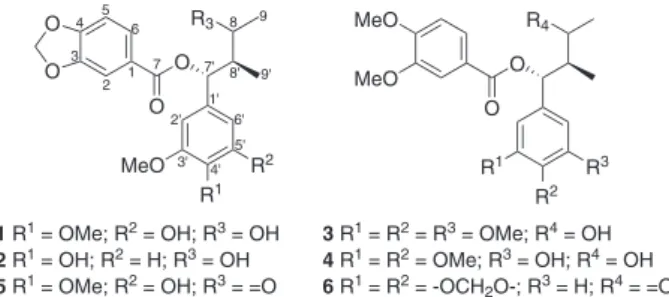
structures of compounds 1-6 are shown in Figure 1.
Compound 1 was obtained as a white amorphous
by HRESIMS (high resolution electrospray ionization
mass spectrometry) m/z 427.1372 [M + Na]+ (calcd.
427.1369). Its 1H and 13C NMR (Table 1) spectra showed
signals of 24 hydrogens and 21 carbons, respectively, corresponding to two aromatic rings (a 3', 4'-dimethoxy-5'-hydroxybenzyl and a piperonyl), one carbonyl carbon
(dC 165.4), two methyl groups (dC 9.5, 22.2), one methine
carbon (dC 45.1) and two oxidated methine carbons (dC 65.0,
79.2) which were in accordance with the molecular formula
C21H24O8. Strong absorption bands accounting for hydroxy
group (3475 cm-1), carbonyl group (1708 cm-1) and aromatic
groups (1658, 1574, 1523 and 1475 cm-1) were also
observed in its IR spectrum. The UV spectrum of 1 showed
absorption maxima at276 and 210 nm which confirmed
the existence of the aromatic functions. In the HMBC (heteronuclear multiple-bond correlation spectroscopy)
spectrum, correlations were found from H-7' (dH 6.40) with
C-1' (dC 133.2), C-2' (dC 103.9) and C-6' (dC 109.7), which
positioned the 3',4' -dimethoxy-5'-hydroxyphenyl group at C-7'. The HMBC correlations of aromatic protons H-2 (dH 7.59), H-6 (dH 7.85) with C-7 (dC 165.4) suggested that
another aromatic ring was attached to C-7. Moreover, the
HMBC correlation of H-7' (dH 6.40) with C-7 (dC 165.4)
indicated that C-7' coupled to C-7 through ester
group. The above information implied that 1 should
be a 7,8-secolignan.8,9 The spin system of H-7'/H-8'/
H-8/H-9 and H-8'/H-9' in the 1H-1H COSY (correlation
spectroscopy) spectrum further confirmed the above
deduction. By comparison, the1H and 13C NMR spectral
data of 1 are similar to those of marphenol B.8 The only
difference is that the carbonyl carbon C-8 (dC 209.5) in
marphenol B was replaced by an oxidated methine carbon (dC 65.0) in 1. According to the chemical shift of dC 65.0 and
the molecular formula of 1, a hydroxyl group should be
located at C-8. Thus, the structure of 1 wasestablished as
shown and given the name as neglectahenol A.
Compounds 2-4 (neglectahenols B-D) wereall obtained
as white amorphous powders. By comparison of their IR,
UV, 1H and 13C NMR and ROESY (rotating frame nuclear
Overhauser effect spectroscopy) spectra with those of 1,
compounds 2-4 were also assigned as 7,8-secolignans.
The obvious chemical shift differences resulted from the substituent group variations in the aromatic rings.
Compound 2 had the molecular formula C20H22O7 as
revealed by its HRESIMS data (m/z 397.1270 [M + Na]+,
calcd. 397.1263). The 1H and 13C NMR spectra were similar
to those of 1. Analysis of HSQC, 1H-1H-COSY and HMBC
spectra of 2 showed chemical shift differences from the
substituents at C-4' and C-5' in aromatic rings. A hydroxyl group replaced the methoxyl group at C-4' and no substituent
at C-5' in 2 was indicated by the downfield chemical shift
of C-4' (dC 148.6) and the HMBC correlations of H-5' (dH
7.11) with C-4' and C-6'. Compound 3 showed a
quasi-molecular ion peak at m/z 457.1832 [M + Na]+ (calcd.
457.1838) in its HRESIMS, corresponding to the molecular
formula of C23H30O8. The NMR spectrum of 3 was similar
to those of 1, except for the substituents at C-3, C-4 and
C-5' on the two aromatic rings. A methoxyl group at C-5' O
O
O
O R3
R1
R2
MeO
1 2 3
4 5 6
7
8 9
1' 2'
3' 4' 5' 6' 7' 8' 9'
1 R1 = OMe; R2 = OH; R3 = OH
2 R1 = OH; R2 = H; R3 = OH
5 R1 = OMe; R2 = OH; R3 = =O
O MeO
MeO
O R4
R2
R3
R1
3 R1 = R2 = R3 = OMe; R4 =OH
4 R1 = R2 = OMe; R3 = OH; R4 =OH
6 R1 = R2 = -OCH
2O-; R3 = H; R4 = =O
Figure 1. The structures of compounds 1-6.
Table 1. 13C NMR data of compounds 1-4 (d in ppm, 125 MHz, C 5D5N)
Position 1 2 3 4 Position 1 2 3 4
1 125.3 s 125.7 s 122.5 s 122.6 s 4' 137.3 s 148.6 s 139.4 s 137.4 s
2 109.7 d 109.4 d 113.5 d 113.6 d 5' 150.3 s 116.3 d 153.5 s 150.7 s
3 148.3 s 148.0 s 150.6 s 151.0 s 6' 109.7 d 121.8 d 105.6 d 109.9 s
4 152.3 s 153.6 s 154.6 s 154.7 s 7' 79.2 d 79.1 d 79.0 d 79.2 d
5 108.4 d 108.1 d 111.3 d 111.7 d 8' 45.1 d 45.1 d 45.0 d 45.5 d
6 125.7 d 124.6 d 124.5 d 124.8 d 9' 9.5 q 9.3 q 9.8 q 9.4 q
7 165.4 s 165.9 s 165.5 s 165.7 s MeO-3 56.0 q 55.8 q
8 65.0 d 65.0 d 65.1 d 65.0 d MeO-4 56.2 q 55.8 q
9 22.2 q 22.4 q 22.6 q 21.8 q MeO-3' 55.9 q 55.7 q 55.7 q 55.7 q
1' 133.2 s 134.3 s 133.7 s 133.2 s MeO-4' 60.3 q 60.9 q 60.7 q
2' 103.9 d 113.5 d 105.6 d 103.9 d MeO-5' 55.7 q
in 3 replaced the hydroxyl group at C-5' in 1 as indicated
by HMBC correlations of MeO-5' (dH 3.90) with C-5'.
Furthermore, HMBC correlations of two methoxy groups (dH
3.68 and 3.80) with C-3 and C-4, respectively, showed their
locations at C-3 and C-4. The molecular formula of 4 was
determined as C22H28O8 from its HRESIMS at m/z 443.1675
[M + Na]+ (calcd. 443.1682). The functional groups in the IR,
UV and NMR spectra were similar to those of compound 1.
The obvious difference was the replacement of two methoxy
groups in 4 with a methylenedioxy group in 1. HMBC
correlations from the two methoxy protons (dH 3.81, 3.86) to
C-3 and C-4 implied that two methoxy groups were attached at C-3 and C-4, respectively, instead of a methylenedioxy
group attached at C-3 and C-4 in compound 1. On the basis
of the above analysis, the structures of 2-4 were established
as shown in Figure 1.
There is a hydroxyl group at C-8 in compounds
1-4 while two known compounds (marphenol B8 and
7,8-secoholostylone B9) have a keto-carbonyl at C-8.
Therefore, there are three stereogenic centers at the side
chain in compounds 1-4 instead of two stereogenic centers
at this side chain in two known compounds.8,9 Since
the coupling constants (H-7' and H-8', J 10.3 Hz) and
ROESY correlations (Figure 2) of 1 were similar to those
of marphenol B8 and 7,8-secoholostylone B,9 in which
absolute configuration was unambiguously established by CD (circular dichroism) and ROESY experiments, the
relative configurations at C-7' and C-8' of 1-4 should be the
same as those of marphenol B8 and 7,8-secoholostylone B.9
It was not possible to determine the relative configuration at C-8 on the basis of coupling constants and ROESY
spectra since the C−C bonds can rotate randomly. A
Mosher analysis could be useful to establish the absolute configuration at C-8. However, after carrying out the bioassays, no enough amounts of compounds remained for derivatization.
Since certain of 7,8-secolignans from Schisandra genus
species exhibit potential anti-HIV activities,8 the new
compounds 1-4 were tested for their potencies in preventing
the cytopathic effects of HIV-1 in C8166 cells. Cytotoxicity was measured in parallel with the determination of antiviral
activity, using azidothymidine (AZT) as a positive control.10
The results are shown in Table 2, compounds 1-4 showed
therapeutic index (TI) values of 58.65, 26.36, 23.71 and 25.85, respectively. The TI values of all compounds are higher than these of reported 7,8-secolignans, marphenol A,
marphenol B and 7,8-secoholostylone B.8 The results
indicated that the reduction of keto-carbonyl to hydroxyl group at C-8 may enhance the anti-HIV activity of these compounds.
Experimental
General experimental procedures
Optical rotations were measured with a Horiba SEPA-300 polarimeter. UV spectra were obtained using a Shimadzu UV-2401A spectrophotometer. A Tenor 27 spectrophotometer was used for scanning IR spectroscopy with KBr pellets. 1D and 2D NMR spectra were recorded on DRX-500 spectrometers with TMS (tetramethylsilane) as internal standard. Unless otherwise
specified, chemical shifts (d) were expressed in ppm with
reference to the solvent signals. HRESIMS was performed on an API QSTAR time-of-flight spectrometer and a VG Autospec-3000 spectrometer, respectively. Preparative HPLC was performed on a Shimadzu LC-8A preparative liquid chromatograph with a ZORBAX PrepHT GF
(21.2 mm × 25 cm, 7 µm) column or a Venusil MP C18
(20 mm × 25 cm, 5 µm) column. Column chromatography
was performed with silica gel (200-300 mesh, Qing-dao Marine Chemical, Inc., Qingdao, China), Lichroprep RP-18 gel (40-63 µm, Merck, Darmstadt, Germany) and MCI gel (75-150 µm, Mitsubishi Chemical Corporation, Tokyo, Japan). The fractions were monitored by TLC (thin layer chromatography), and spots were visualized by heating Si
gel plates sprayed with 5% H2SO4 in EtOH.
Plant material
The leaves and stems of S. neglecta were collected in
on Lijiang Country, Yunnan Province, People’s Republic
Table 2. Anti-HIV activities of the 7,8-secolignans
Compound CC50 / (µg mL-1) EC
50 / (µg mL-1) TI
1 186.5 3.18 58.65
2 111.3 4.22 26.36
3 91.8 3.87 23.71
4 107.0 4.14 25.85
AZT > 200 0.029 > 6896.55
CC50: median cytotoxic concentration; EC50: concentration for 50% of maximal effect; TI: CC50/EC50
O
OMe OH MeO
HO
H H
H H H
O
O
O
of China, in September 2009. The identification of the plant material was verified by Prof. Xi-Wen Li of Kunming Institute of Botany, Chinese Academy of Sciences. A voucher specimen (KIB 09-9-34) was deposited in the State Key Laboratory of Phytochemistry and Plant Resources in West China, Kunming Institute of Botany, Chinese Academy of Sciences.
Extraction and isolation
The air-dried and powdered leaves and stems of
S. neglecta (4.0 kg) were extracted four times with 70%
aqueous Me2CO (4 × 5 L) at room temperature and filtered,
with the filtrate evaporated under reduced pressure and partitioned with EtOAc (4 × 5 L). The EtOAc partition (212 g) was applied to silica gel (200-300 mesh) column
chromatography, eluting with a CHCl3-MeOH gradient
system (20:1, 9:1, 8:2, 7:3, 6:4, 5:5), to give six fractions A-F. The further separation of fraction B (9:1, 52.5 g) by silica
gel column chromatography, eluted with CHCl3:acetone
(20:1-2:1), yielded mixtures A1-A7. Fraction A2 (9:1, 36 g) was subjected to silica gel column chromatography using petroleum ether-acetone and semi-preparative
HPLC (65% MeOH-H2O, flow rate 12 mL min
-1) to give
5 (17.2 mg)and 6 (21.4 mg). Fraction A3 (8:2, 15.8 g)
was subjected to silica gel column chromatography using petroleum ether-acetone and semi-preparative HPLC (60%
MeOH-H2O, flow rate 12 mL min
-1) to give 1 (16.4 mg),
2 (8.64 mg), 3 (10.6 mg) and 4 (8.25 mg).
Anti-HIV-1 assay
The cytotoxicity assay against C8166 cells (CC50,
concentration for 50% of maximal effect) was assessed using the MTT method and anti-HIV-1 activity was evaluated by the inhibition assay for the cytopathic effects of HIV-1 (EC50).10
Neglectahenol A (1)
White amorphous powder; [α]D26.5 +22.6 (c 0.22,
MeOH); UV (MeOH) lmax/nm (log ε): 210 (4.26), 276
(3.88), 340 (2.78); IR (KBr) nmax/cm-1 3475, 3065, 2938,
2854, 1708, 1658, 1574, 1523, 1475, 1392, 1345, 1258,
1135, 1027, 982, 876; 1H NMR (500 MHz, C
5D5N) d 7.59
(1H, d, J 1.8 Hz, H2), 6.87 (1H, d, J 8.2 Hz, H5), 7.85
(1H, dd, J 1.8, 8.2 Hz, H6), 4.63 (1H, m, H8), 1.41 (3H, d,
J 6.4 Hz, H9), 6.91 (1H, s, H2'), 7.27 (1H, s, H6'), 6.40 (1H,
d, J 10.3 Hz, H7'), 2.36 (1H, m, H8'), 1.05 (3H, d, J 6.6 Hz,
H9'), 3.82 (3H, s, MeO-3'), 3.75 (3H, s, MeO-4'), 5.99, 6.01
(2H, s, −OCH2O−); 13C NMR data, Table 1; positive ESIMS
m/z 427 [M + Na]+; HRESIMS m/z 427.1372 [M + Na]+,
(calcd. C21H24NaO8 for 427.1369).
Neglectahenol B (2)
White amorphous powder; [α]D
26.5 +18.4 (c 0.20,
MeOH); UV (MeOH)lmax/nm (log ε) 210 (4.19), 275
(3.86), 340 (2.82); IR (KBr) nmax/cm
-1 3482, 3047, 2932,
2875, 1712, 1655, 1577, 1526, 1474, 1397, 1344, 1261,
1130, 1024, 987, 874; 1H NMR (500 MHz, C
5D5N) d 7.78
(1H, d, J 1.8 Hz, H2), 6.89 (1H, d, J 8.1 Hz, H5), 7.89
(1H, dd, J 1.8, 8.2 Hz, H6), 4.64 (1H, m, H8), 1.42 (3H,
d, J 6.4 Hz, H9), 7.35 (1H, d, J 1.8 Hz, H2'), 7.11 (1H, d,
J 8.1 Hz, H5'), 7.25 (1H, dd, J 1.8, 8.1 Hz, H6'), 6.37 (1H,
d, J 10.4 Hz, H7'), 2.37 (1H, m, H8'), 1.01 (3H, d, J 6.8 Hz,
H9'), 3.88 (3H, s, MeO-3'), 5.94, 5.96 (2H, s, −OCH2O−),
11.01 (1H, s, Ar−H); 13C NMR data, Table 1; positive
ESIMS m/z 397 [M + Na]+; HRESIMS m/z 397.1270
[M + Na]+ (calcd. C
20H22NaO7 for 397.1263).
Neglectahenol C (3)
White amorphous powder; [α]D26.5 +18.9 (c 0.21,
MeOH); UV (MeOH) lmax/nm (log ε): 210 (4.21), 275
(3.93), 340 (2.76); IR (KBr) nmax/cm-1 3486, 3042, 2935,
2871, 1716, 1653, 1579, 1554, 1525, 1470, 1394, 1345,
1266, 1134, 1058, 1020, 980, 877; 1H NMR (500 MHz,
C5D5N) d 7.44(1H, d, J 1.8 Hz, H2), 7.04 (1H, d, J 8.2 Hz,
H5), 7.66 (1H, dd, J 1.8, 8.2 Hz, H6), 4.47 (1H, m, H8),
1.33 (3H, d, J 6.4 Hz, H9), 6.48 (2H, s, H-2', H6'), 5.33
(1H, d, J 10.3 Hz, H7'), 2.55 (1H, m, H8'), 1.06 (3H, d,
J 6.8 Hz, H9'), 3.68 (3H, s, MeO-3), 3.80 (3H, s, MeO-4),
3.87 (3H, s, MeO-3'), 3.80 (3H, s, MeO-4'), 3.90 (3H, s,
MeO-5'),; 13C NMR data, Table 1; positive ESIMS m/z 457
[M + Na]+; HRESIMS m/z 457.1832 [M + Na]+, (calcd.
C23H30NaO8 for 457.1838).
Neglectahenol D (4)
White amorphous powder; [α]D
26.5 +16.9 (c 0.20,
MeOH); UV (MeOH) lmax/nm (log ε): 210 (4.15), 275
(3.87), 340 (2.69); IR (KBr) nmax/cm
-1 3483, 3039, 2930,
2874, 1713, 1656, 1575, 1551, 1526, 1467, 1398, 1351,
1269, 1137, 1038, 1027, 979, 872; 1H NMR (500 MHz,
C5D5N) d 7.49(1H, d, J 1.8 Hz, H2), 7.02 (1H, d, J 8.2 Hz,
H5), 7.67 (1H, dd, J 1.8, 8.2 Hz, H6), 4.63 (1H, m, H8),
1.42 (3H, d, J 6.4 Hz, H9), 6.89 (1H, s, H2'), 7.30, (1H, s,
H6'), 6.37 (1H, d, J 10.3 Hz, H7'), 2.36 (1H, m, H8'), 1.03
(3H, d, J 6.8 Hz, H9'), 3.81 (3H, s, MeO-3), 3.86 (3H, s,
MeO-4), 3.96 (3H, s, MeO-3'), 3.85 (3H, s, MeO-4'), 11.10
m/z 443 [M + Na]+; HRESIMS m/z 443.1675 [M + Na]+,
(calcd. C22H28NaO8 for 443.1682).
Supplementary Information
13C and 1H NMR and DEPT spectra of neglectahenols
A-D and HSQC, HMBC, 1H-1H COSY, ROESY and
HRESIMS spectra of neglectahenol A are available free of charge at http://jbcs.sbq.org.br as PDF file.
Acknowledgments
This project was financially supported by the NSFC (30830115) and the project from the Chinese Academy of Sciences (KSCX2-EW-Q-10).
References
1. Saunders, R. M. K.; Syst. Bot. Monogr. 2000, 58, 1.
2. Yao, D.M.; Zhang, J. B.; A Coloured Atlas of the Chinese Materia Medica Specified in Pharmacopoeia of the People’s
Republic of China; Guangdong Science & Technology Press: Guangdong, China, 1995 ed., p. 78.
3. Chang, J. B.; Reiner, J.; Xie J. X.; Chem. Rev. 2005, 105, 4581. 4. Xiao, W. L.; Li, R. T.; Huang, S. X.; Pu, J. X.; Sun, H. D.; Nat.
Prod. Rep. 2008, 25, 871.
5. Chen, M.; Xu, X. M.; Liao, Z. H.; Dong, L.; Li, L.; Huang, C. Z.;
Molecules2008, 13, 548.
6. Chen, M.; Liao, Z. Z.; Xu, X. M.; Wen, Y.; Sun, M.; Zhang, H. X.; Ma, W. X.; Molecules2008, 13, 1148.
7. Duan, Y. X.; Cao, J. L.; Wen, R. R.; Yang, G. Y.; Pu, J. X.; Sun, H. D.; Xiao, W. L.; Li, G. P.; J. Asian Nat. Prod. Res. 2011, 13, 592.
8. Zhang, X. J.; Yang, G. Y.; Wang, R. R.; Pu, J. X.; Sun, H. D.; Xiao, W. L.; Zheng, Y. T.; Chem. Biodivers.2010, 7, 2692. 9. da Silva, T.; Lopes, L. M. X.; Phytochem.2004, 65, 751. 10. Wang, J. H.; Tam, S. C.; Huang, H.; Ouyang, D. Y.; Wang, Y. Y.;
Zheng, Y. T.; Biochem. Biophys. Res. Commun.2004, 317, 965.
Submitted: February 2, 2012