Sho
rt
R
ep
or
t
J. Braz. Chem. Soc., Vol. 21, No. 9, 1766-1769, 2010. Printed in Brazil - ©2010 Sociedade Brasileira de Química 0103 - 5053 $6.00+0.00
*e-mail: [email protected]
Two New
ent
-Kaurane Diterpenoids from
Albizia mollis
(Wall.) Boiv.
Zhong-Quan Cheng,a,b Dan Yang,a Yu-Qing Liu,a Jiang-Miao Hu,a He-Zhong Jiang,a
Peng-Cheng Wang,a Ning Li,c Jun Zhoua and You-Xing Zhao*,a
aState Key Laboratory of Phytochemistry and Plant Resources in West China, Kunming Institute of
Botany, the Chinese Academy of Sciences, Kunming 650204, P. R. China
bGraduate School of the Chinese Academy of Sciences, Beijing 100049, P. R. China cSchool of Life Sciences, Anhui University, Hefei 230039, P. R. China
Dois novos diterpenos com esqueleto caurano, 3α,16β-17-tri-hidróxi-ent-caurano 3-O-β-D -glucopiranosídeo e ácido 2β,3α-di-hidróxi-ent-caur-15-eno-17-óico 3-O-β-D-glucopiranosídeo, foram isolados das cascas de Albizia mollis (Wall.) Boiv. As estruturas destes dois cauranos foram elucidadas por métodos espectroscópicos uni e bidimensionais e por espectrometria de massas.
Two new kaurane diterpenoids, 3α, 16β, 17-trihydroxy-ent-kaurane 3-O-β-D-glucopyranoside and 2β,3α-dihydroxy-ent-kaur-15-en-17-oic acid 3-O-β-D-glucopyranoside, were isolated from the bark of Albizia mollis (Wall.) Boiv. The structures of two new compounds were elucidated by extensive 1D- and 2D-NMR spectroscopic methods in combination with MS experiments.
Keywords:Albizia mollis, kaurane diterpenoids, mollisside A, mollisside B
Indroduction
Plant species of Albizia are known for their traditional medicinal uses as medicaments of mind unrest, insomnia, physique damage, carbuncle gall in many parts of tropic zone. In China, Albizia mollis, popularly named “maoyehehuan” is one of representative plant species of this family. This plant is well known for its sedative and sleeping pill properties.1 The previous chemical investigations on Albizia species have led to the isolation of lignans,2-5 lavonoids,6-9 saponins,10 alkaloids,11 together with other secondary metabolites.12 In search for new and bioactive compounds from A. mollis, the chemical investigation of this plant, collected from Kunming Botanical Garden, Yunnan Province, People’s Republic of China, led to the isolation of two new compounds. This report describes the isolation and structural elucidation of two new ent-kaurane diterpenoids named mollissides A (1) and B (2).
Results and Discussion
Mollisside A (1) was isolated as white powder. Its molecular formula was determined to be C26H44O8 with ive
Cheng et al. 1767 Vol. 21, No. 9, 2010
of C-3 glycoside and β-orientations of H-5 and H-9. The
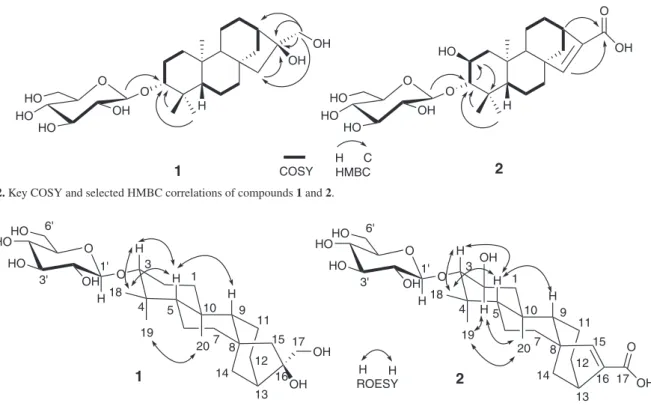
α-orientation of CH2OH-17 (dc 70.6) in 1 was elucidated by comparison of the 13C NMR data with those reported dc 69.8 for α-orientation and dc 66.2 for β-orientation at C-17.14 Based on the above evidences, compound 1 was identiied as 3α, 16β, 17-trihydroxy-ent-kaurane 3-O-β-D- glucopyranoside, named Mollisside A.
Mollisside B (2) was determined to have a molecular formula C26H40O9 on the basis of the positive HRFABMS (m/z 519.2565 [M+Na]+) and 13C NMR (DEPT) spectra, which possessed seven unsaturation degrees. Its IR
spectrum showed a broad band (3518-2930 cm-1) and absorption 1691 cm-1 for a carboxyl and 1607 cm-1 for a double bond. The 1H NMR spectrum of compound 2 exhibited three methyls at d 0.88 (3H, s), 1.12 (3H, s), 1.16 (3H, s), one anomeric proton of β-type sugar at d 4.32 (1H, d, J 7.8 Hz) and one oleinic proton at d 6.48 (1H, s). The 13C NMR spectroscopic data (Table 1) revealed 26 carbon atoms, including one carboxyl (C-17 at d 164.1) and two oleinic carbons (C-16 at d 139.9, C-15 at d 154.7). Comparison of these NMR data with mollisside A showed that compound 2 had the similar skeleton of compound
Table 1. 1H and 13C NMR spectroscopic data for mollisside A (1) and mollisside B (2)
1 2
dC dH dC dH
1 43.1 1.40 (m), 1.43 (d, 2.4) 47.5 0.83 (d, 12.0), 2.22 (dd, 5.0, 13.0)
2 27.2 1.72 (m), 1.95 (m) 68.1 3.00 (overlapped), 3.75 (ddd, 5.0, 9.3, 12.0)
3 90.9 3.15 (dd, 1.2, 4.4) 96.1 3.00 (d, 9.3)
4 40.2 - 41.6
-5 56.9 0.80 (d, 11.6) 56.1 0.93 (d, 10.7)
6 20.7 1.35 (m), 1.45 (m) 19.6 1.39 (m)
7 40.0 0.90 (m), 1.85 (m) 39.3 1.66 (m)
8 48.3 - 51.4
-9 58.6 1.05 (overlapped) 48.0 1.10 (overlapped)
10 44.6 - 41.2
-11 19.8 1.95 (m), 1.60 (d, 6.4) 19.7 1.66 (m)
12 27.9 1.45 (m), 1.85 (m) 26.5 1.63 (m)
13 42.3 2.03 (d, 3.6) 41.9 2.87 (s)
14 39.2 1.03 (m), 1.98 (d, 11.6) 44.3 1.39 (m), 2.17 (d, 9.6)
15 53.1 1.38 (m) 154.7 6.48 (s)
16 80.7 - 139.9
-17 70.6 3.27 (m), 3.38 (d, 11.2) 164.1
-18 28.7 1.03 (s) 28.9 1.12 (s)
19 16.9 0.83 (s) 17.9 0.88 (s)
20 18.2 1.07 (s) 19.4 1.16 (s)
1′ 106.8 4.30 (d, 7.8) 106.4 4.32 (d, 7.8)
2′ 75.6 3.20 (m) 75.5 3.35 (m)
3′ 77.7 3.26 (m) 78.1 3.31 (m)
4′ 71.6 3.24 (m) 71.4 3.33 (m)
5′ 78.2 3.34 (d, 12.0) 78.2 3.30 (m)
6′ 62.8 3.67 (dd, 2.0, 12.0),
3.84 (dd, 5.2, 12.0)
62.4 3.67 (dd, 3.5, 11.5), 3.85 (d, 11.5)
OH 1 2 7 8 10 11 13 14 15 16 17 18 19 20 O HO 2 OH OH O 1 2 7 8 10 11 13 14 15 16 17 18 19 20 1 O HO HO OH HO O O HO HO OH HO 1' 3' 6' 1' 3' 6' 4 4 H H H H
Two New ent-Kaurane Diterpenoids from Albizia mollis (Wall.) Boiv. J. Braz. Chem. Soc. 1768
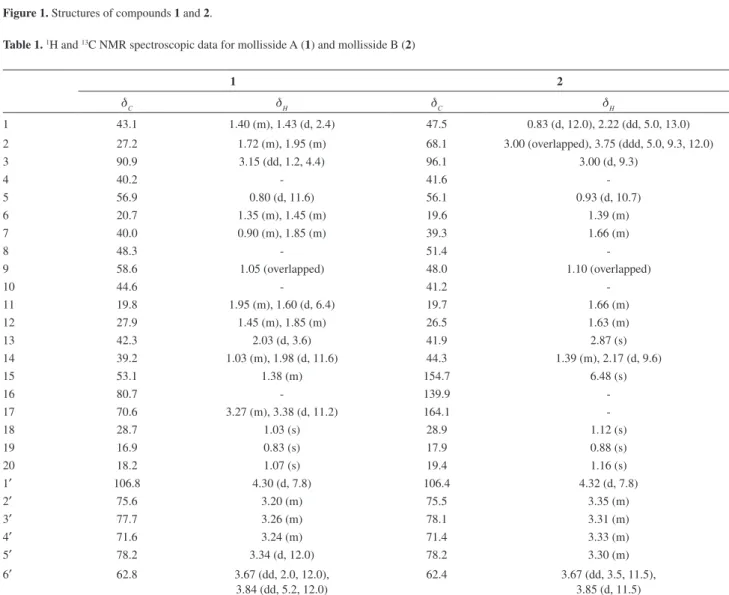
1 except for the distinct differences of chemical shift of C-2 (d 68.1) adjacent one oxygenated group and C-17, C-15 and C-16 conforming the α, β-unsaturation ketone system. The linkage of the glucose moietiy to C-3 (d 96.1) was determined by the HMBC correlations from H-1′
(d 4.32), H-18 (d 1.12) and H-19 (d 0.88) to C-3 (Figure 2). Besides, the relative coniguration of 2 was elucidated by a ROESY experiment and by comparison of the NMR data with 1. The α-orientation of H-2 was established by key ROESY correlations of H-2/H-1α, H-2/H-19 and H-2/H-20 (Figure 3) and the coupling constant J 9.3 Hz observed in the signal corresponding to H-3 (interaction axial- axial with H-2). Moreover, the β-orientations of H-3, H-5 and H-9 were conirmed by ROESY between H-3/H-5, H-3/H-18 and H-5/H-9. Based on the above evidences, the structure of 2 was elucidated as 2β,3α -dihydroxy-ent-kaur-15-en-17-oic acid 3-O-β-D-glucopyranoside, named Mollisside B.
Experimental
General experimental procedures
Melting points were measured on a XRC-1 micro-melting point apparatus and were uncorrected. MS spectra were obtained on a VG Auto Spec-3000 mass spectrometer. 1D and 2D NMR spectra were recorded on Bruker AM-400 MHz and DRX-500 MHz spectrometers,
with chemical shifts (d) in ppm relative to TMS as internal standard and coupling constants in hertz (Hz). IR spectra were measured with a Bio-Rad FTS-135 spectrometer with KBr pellets. UV spectra were measured on a Hitachi UV-3210 spectrophotometer. Silica gel (200-300 mesh) for column chromatography was product of the Qingdao Marine Chemical Ltd., Qingdao, P. R. China. Sephadex LH-20 for chromatography was purchased from Amersham Biosciences. Reversed-phase chromatography was with RP-18 (LiChroprep, 40-63 μm, Merck, Darmstadt, Germany).
Plant material
The bark of A. mollis was collected in Kunming Botanical Garden, Yunnan Province, People’s Republic of China, in September 2007, and authenticated by Professor Xun Gong. A voucher specimen (ZM080920) has been deposited in the Herbarium of Kunming Institute of Botany, Chinese Academy of Sciences.
Extraction and isolation
The air-dried and powdered bark of A. mollis (18.0 kg) was extracted three times each with 20 L of 95% EtOH under relux for 3 h. The extract was evaporated and the residue (1050 g) was resuspended in 15 L of H2O and partitioned successively with EtOAc (3×5 L) and n-BuOH
2 OH OH O 1 O HO HO OH HO H OH O O HO HO OH HO H O HO H C HMBC COSY
Figure 2. Key COSY and selected HMBC correlations of compounds 1 and 2.
H H H OH OH O O HO HO OH HO 1 3 4 5 7 8 9 10 11 13 14 15 16 17 12 18 19 20 H 1' 3' 6' 1 H H H O O HO HO OH HO 1 3 4 5 7 8 9 10 11 13 14 15 16 17 12 18 19 20 H 1' 3' 6' 2 OH O H H ROESY OH H
Cheng et al. 1769 Vol. 21, No. 9, 2010
(3×5 L) to yield EtOAc extract (300 g), n-BuOH extract (640 g), respectively. Part of n-BuOH extract (500 g) was applied to a silica gel column chromatography (200-300 mesh) eluted with CHCl3/CH3OH/H2O (10:3:0.5, v/v) to give seven fractions. Fraction 3 (45 g) was puriied by column chromatography silica gel with CHCl3/CH3OH/ H2O (5:3:1, v/v) to give four fractions, fraction 2 were puriied on RP-18 with 40% →100% aqueous CH3OH, and on Sephadex LH-20 with CH3OH/CH3Cl 1:1 to afford compound 1 (17 mg), fraction 3 were puriied on RP-18 with 30% →70% aqueous CH3OH, and on Sephadex LH-20 with CH3OH to afford compound 2 (15 mg).
Mollisside A
White powder, mp 292-294 °C; [α]D21 +6.3116 (c 0.101, CH3OH); UV (CH3OH) λmax/nm (log ε): 193(3.587), 205 (3.829), 277 (3.250); IR (KBr) νmax/cm-1: 3420, 2937, 1166, 1074, 1020; 1H NMR (400 MHz, CD
3OD) and
13C NMR (100 MHz, CD3OD) see Table 1; HRESIMS (negative ion) m/z 483.2959 [M-1]− (Calc. for C
26H44O8, 483.2957); FABMS (negative ion) m/z(%) 483[M-1]− (100), 391 (5), 323 (15), 282 (5), 159 (6), 113 (5).
Mollisside B
White powder, mp 270-271 °C; [α]D21−1.5989 (c 0.246, CH3OH); UV (CH3OH) λmax/nm (log ε): 196 (3.393), 203 (4.108), 276 (2.890); IR (KBr) νmax/cm-1: 3518, 3380, 3190, 2980, 2930, 1691, 1607, 1073, 1037; 1H NMR (500 MHz, CD3OD) and 13C NMR (125 MHz, CD
3OD) see Table 1; HRESIMS (positive ion) m/z 519.2565 [M+Na]+ (Calc. for C26H40O9Na, 519.2570); FABMS (negative ion) m/z(%): 495[M-1]− (100), 400 (5), 335 (5), 281(6), 123 (4).
Acid hydrolysis of compounds 1 and 2
Compounds 1 (3 mg) and 2 (3mg) in 50% MeOH (2 mL) containing 5% HCl were each heated in a boiling water-bath for 5 h, then cooled for few minutes. The mixture was washed with EtOAc (2 × 2 mL). The H2O layer was concentrated in vacuo to give a residue. The residue and authentic sugar were dotted to the plate developed with CHCl3/CH3OH/H2O (5/3/0.5, v/v), and phenylenediamine-aniline-phosphoric acid used as spray reagent, followed by heating at 80 oC. From compounds 1 and 2 glucose was detected, Rf: glucose 0.45.
Supplementary Information
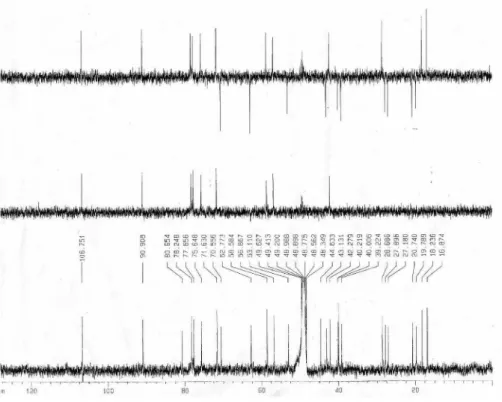
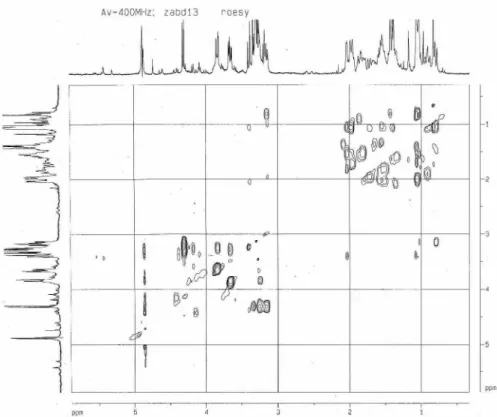
Supplementary data including 1H, 13C NMR (DEPT), HMQC, HMBC, COSY, and ROSEY MS for compounds 1 and 2 are available free of charge at http://jbcs.sbq.org.br as PDF ile.
Acknowledgments
This research was supported by the fund (P2008-ZZ22) of State Key Laboratory of Phytochemistry and Plant Resources in West China. We thank the analytical group of the State Key Laboratory of Phytochemistry and Plant Resources in West China, Kunming Institute of Botany, Chinese Academy of Sciences, for measurements of all spectra.
References
1. Committee of Flora of China; Flora of China, vol. 39, Science Press: Bejing, 1988, p.55.
2. Kinjo, J.; Fukui K.; Higuchi, H.; Nohara, T.; Chem. Pharm. Bull. 1991, 39, 1623.
3. Kinjo, J.; Higuchi, H.; Fukui, K.; Nohara, T.; Chem. Pharm. Bull. 1991, 39, 2952.
4. Higuchi, H.; Fukui, K.; Kinjo, J.; Nohara, T.; Chem Pharm. Bull. 1992, 40, 534.
5. Ito, A.; Kasai, R.; Yamasaki, K.; Duc, N.; Nham, N. T.; Phytochemistry 1994, 37, 1455.
6. Candy, H. A.; Brookes, K. B.; Bull, J. R.; McGarry, E. J.; McGarry, J. M.; Phytochemistry 1978, 17, 1681.
7. El-Mousallamy, A. M. D.; Phytochemistry 1998, 48, 759. 8. Pal, B. C.; Achari, B.; Yoshikawa, K.; Arihara, S.; Phytochemistry
1995, 38, 1287.
9. Debella, A.; Haslinger, E.; Schmid, M. G.; Bucar, F.; Michl, G.; Abebe, D.; Kunert, O.; Phytochemistry 2000, 53, 885. 10. Carpani, G.; Orsini, F.; Sisti, M.; Verotta, L.; Phytochemistry
1989, 28, 863.
11. Rukunga, G. M.; Waterman, P. G.; Phytochemistry 1996, 42, 1211.
12. Ueda, M.; Yamamura, S.; Tetrahedron Lett. 1999, 40, 7823. 13. Toshiko, S.; Takao, M.; Yasuhisa, S.; Chen, C. M.; Chem.
Pharm. Bull. 1983, 31, 3865.
14. Liu, G.; Muller, R.; Ruedi, P.; Helv. Chim. Acta 2003, 86, 420.
Submitted: January 11, 2010
Su
pp
le
m
enta
ry
Inf
or
m
ati
on
J. Braz. Chem. Soc., Vol. 21, No. 9, S1-S10, 2010. Printed in Brazil - ©2010 Sociedade Brasileira de Química 0103 - 5053 $6.00+0.00
*e-mail: [email protected]
Two New
ent
-Kaurane Diterpenoids from
Albizia mollis
(Wall.) Boiv.
Zhong-Quan Cheng,a,b Dan Yang,a Yu-Qing Liu,a Jiang-Miao Hu,a He-Zhong Jiang,a
Peng-Cheng Wang,a Ning Li,c Jun Zhoua and You-Xing Zhao*,a
aState Key Laboratory of Phytochemistry and Plant Resources in West China, Kunming Institute of
Botany, the Chinese Academy of Sciences, Kunming 650204, P. R. China
bGraduate School of the Chinese Academy of Sciences, Beijing 100049, P. R. China cSchool of Life Sciences, Anhui University, Hefei 230039, P. R. China
Two New ent-Kaurane Diterpenoids from Albizia mollis (Wall.) Boiv. J. Braz. Chem. Soc.
S2
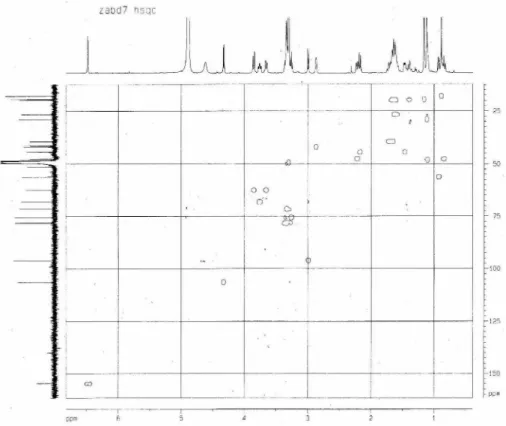
Figure S3.HSQC spectrum of 1 (CD3OD).
Cheng et al. S3 Vol. 21, No. 9, 2010
Figure S5. 1H, 1H COSY spectrum of 1 (CD 3OD).
Two New ent-Kaurane Diterpenoids from Albizia mollis (Wall.) Boiv. J. Braz. Chem. Soc.
S4
Figure S7. FABMS(-) spectrum of 1 (CD3OD).
Cheng et al. S5 Vol. 21, No. 9, 2010
Two New ent-Kaurane Diterpenoids from Albizia mollis (Wall.) Boiv. J. Braz. Chem. Soc.
S6
Figure S9. 1H NMRspectrum of 2 (500MHz, CD 3OD).
Cheng et al. S7 Vol. 21, No. 9, 2010
Figure S12.1H, 1H COSY spectrum of 2 (CD 3OD).
Two New ent-Kaurane Diterpenoids from Albizia mollis (Wall.) Boiv. J. Braz. Chem. Soc.
S8
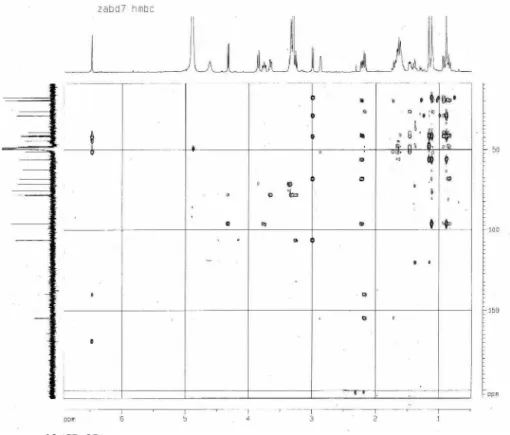
Figure S13. HMBCspectrum of 2 (CD
3OD).
Figure S14. ROSEY spectrum of 2 (CD
Cheng et al. S9 Vol. 21, No. 9, 2010
Figure S16. IR spectrum of 2 (KBr pellet).
Two New ent-Kaurane Diterpenoids from Albizia mollis (Wall.) Boiv. J. Braz. Chem. Soc.
S10