Article
J. Braz. Chem. Soc., Vol. 24, No. 4, 685-689, 2013. Printed in Brazil - ©2013 Sociedade Brasileira de Química 0103 - 5053 $6.00+0.00
A
http://dx.doi.org/10.5935/0103-5053.20130091*e-mail: [email protected], [email protected]
2"-Ethyl-furanoflavone Derivatives from the Stems of
Cassia fistula
and their Cytotoxicity
Xue-Mei Gao,a Yan-Qiong Shen,a,b Xiang-Zhong Huang,a Li-Ying Yang,a Li-Dan Shu,a Qiu-Fen Hu*,a,b and Gan-Peng Li*,a
aKey Laboratory of Chemistry in Ethnic Medicinal Resources, State Ethnic Affairs Commission & Ministry of Education, Yunnan University of Nationalities, Kunming 650031, Yunnan,
People’s Republic of China
bKey Laboratory of Tobacco Chemistry of Yunnan Province, Yunnan Academy of Tobacco Science, Kunming 650106, Yunnan, People’s Republic of China
Duas novas 2"-etil-furanoflavonas chamadas fistulaflavonas A e B juntamente com seis furanoflavonas conhecidas foram isoladas das hastes da Cassia fistula. As estruturas foram elucidadas por métodos espectroscópicos, incluindo as técnicas de NMR 1D e 2D e espectrometria de massa com ionização por electrospray de alta resolução (HRESIMS), e comparação com dados da literatura. Todos os compostos foram avaliados com relação a citotoxicidade para cinco linhas de células tumorais humanas. Um dos compostos mostrou potente citotoxicidade contra células SHSY5Y e MCF7, com valores de IC50 de 2,6 e 2,7 µmol L
-1, respectivamente.
Two new 2"-ethyl-furanoflavones named fistulaflavones A and B together with six known furanoflavones were isolated from the stems of Cassia fistula. The structures were elucidated by spectroscopic methods including extensive 1D, 2D NMR and high resolution electrospray ionization mass spectrometry (HRESIMS) techniques, and comparison with literature data. All the compounds were evaluated for their cytotoxicity against five human tumor cell lines. One of the compounds showed potent cytotoxicity against SHSY5Y and MCF7 cells with IC50 values of
2.7 and 2.6 µmol L-1, respectively.
Keywords: Cassia fistula, 2"-ethyl-furanoflavones, furanoflavones, cytotoxicity
Introduction
Cassia fistula L., (Leguminosae) is an ornamental tree with beautiful yellow flowers. This plant can be found in various countries in Asia, South Africa, Mexico, China, West Indies, East Africa and Brazil.1 In China, it has been
widely used as traditional Chinese medicine for treatment of diarrhea, gastritis, ringworm and fungal skin infections.2,3
Previous phytochemical studies of C. fistula have shown the presence of anthraquinones,4,5 steroids,6 chromones7,8 and
flavonol derivatives.9 With the aim at searching for new
natural compounds from medicinal plants, the stems of C. fistula were investigated and two new 2"-ethyl-furanoflavones (1-2) and six known furanoflavones (3-8) were isolated. The structures of the isolated compounds were established by spectroscopic methods including extensive
1D (1H, 13C and DEPT) and 2D (one-bond HSQC and
long-range HMBC) NMR techniques and high resolution electrospray ionization mass spectrometry (HRESIMS), and by comparison with literature data. This work deals with the isolation, structural characterization of these compounds and their cytotoxicity against five human tumor cell lines.
Results and Discussion
The stems of C. fistula were extracted with 70%
aqueous acetone. The extract was subjected repeatedly to column chromatography on silica gel, Sephadex LH-20, RP-18 and semi-preparative RP-HPLC (reverse-phase high performance liquid chromatography) separation to afford two new furanoflavones named fistulaflavones A and B (1-2),
together with six known furanoflavones (3-8). Structures
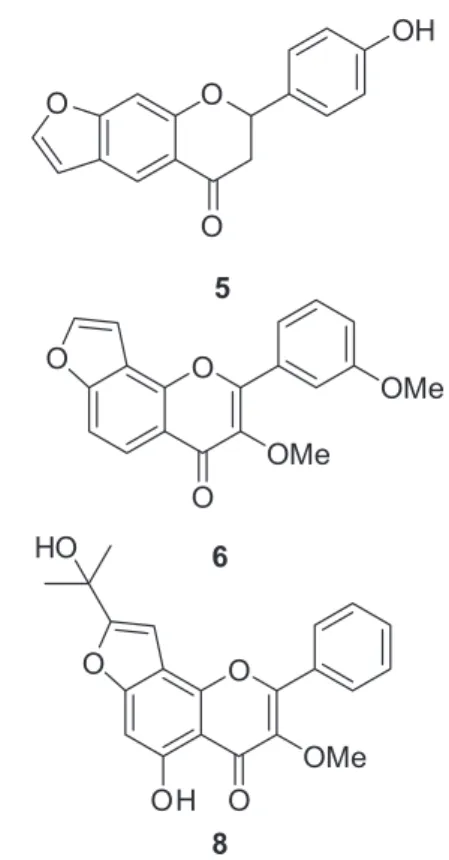
of compounds 1-8 were as shown in Figure 1, and the
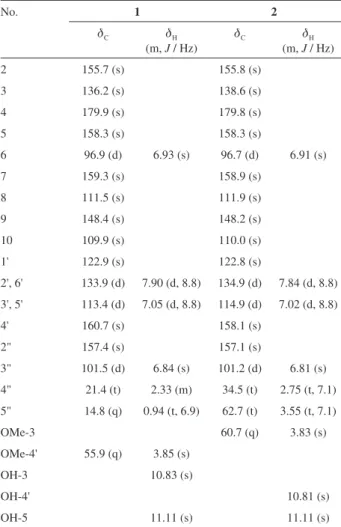
listed in Table 1. The known compounds were identified as 3,4'-dimethoxy-5-hydroxy-7,8-[2"-(2-hydroxyethyl)
furan]-flavone (3),10
3,4'-dimethoxy-5-hydroxy-7,8-(2"-ethyl furan)-flavone (4),11
furano-(2",3":7,6)-4'-hydroxyflavanone (5),12 pachycarin D (6),13 5-hydroxy-
2"-isopropenyl-3-methoxyfurano-(2",3":7,8)-flavone
(7)14 and 5-hydroxy-2"-(1-hydroxy-1-methylethyl)-
3-methoxyfurano-(2",3":7,8)-flavone (8)14 by comparison
with literature data.
Compound 1 was obtained as an orange gum. Its
HRESIMS spectrum in the positive mode revealed a quasi molecular ion at m/z 375.0843 [M + Na]+, and assigned the
molecular formula of C20H16O6, corresponding to thirteen
degrees of unsaturation. Its IR spectrum exhibited the
presence of hydroxy group (3420 cm-1), carbonyl group
(1662 cm-1) and aromatic ring (1615, 1557, 1450 cm-1).
Its 1H, 13C and DEPT NMR spectra showed signals for 20
carbon and 16 hydrogen atoms (Table 1). The 13C NMR
signals [dC 155.7 (s), 136.2 (s), 179.9 (s), 158.3 (s), 96.9
(d), 159.3 (s), 111.5 (s), 148.4 (s), 109.9 (s), 122.9 (s), 133.9 (d, 2C), 113.4 (d, 2C), 160.7 (s), 157.4 (s), 101.5 (d)], the
1H NMR signals [d
H 6.93 (s, 1H), 6.84 (s, 1H), 7.90 (d, 2H, J 8.8 Hz), 7.05 (d, 2H, J 8.8 Hz)] for six aromatic protons,
one methoxy group at dC 55.9 (q), dH 3.85 (s) and two
chelated hydroxyl group at dH 10.83 (brs) and 11.11 (brs)
indicated the presence of a 2"-substituted furanoflavone.12,14
The signals at dC [21.4 (t), 14.8 (q)], dH [2.33 (m) and 0.94 (t,
J 6.9 Hz)] suggested an ethyl group at C-2", whose carbons were numbered as 4" and 5". The HMBC correlations of H-4" (dH 2.33, m) with C-2" (157.4, s) and C-3" (dC 101.5,
d), of H-3" (6.84, s) with C-4" (dC 21.4, t) confirmed the
ethyl group located at C-2". Cross peaks (Figure 2) of H-3" (dH 6.84, s) to C-7 (dC 159.3, s), C-8 (dC 111.5, s) and C-9 (dC
148.4, s) were also observed in compound 1. This allowed
us to conclude that the 2"-ethylfurano moiety was fused in an angular manner on the aromatic ring at positions C-7 and
C-8. The HMBC correlations of the methoxy protons (dH
3.85, s) with C-4' (160.7, s) revealed that the methoxy group should be located at C-4'. Two chelated hydroxy groups were assigned to C-3 and C-5 on the basis of HMBC correlations
between the hydroxy proton (dH 10.83, brs) and C-2 (dC
155.7, s), C-3 (dC 136.2, s), and C-4 (dC 179.9, s), as well as
those between the other hydroxy proton (dH 11.11, brs) and
C-5 (dC 158.3, s), C-6 (dC 96.9, d) and C-10 (dC 109.9, s).
Two doublets [7.90 (d, J 8.8, 2H) and 7.05 (d, J 8.8, 2H)] and two singlets [(dH 6.93 (s), 1H and 6.84 (s), 1H)] in the 1H
NMR spectrum also supported the substituent positions
in compound 1. Thus, the structure of compound 1 was
established as 3,5-dihydroxy-4'-methoxy-7,8-(2"-ethyl furan)-flavone and named as fistulaflavone A.
Compound 2 was obtained as an orange gum, and showed
a quasi molecular ion at m/z 391.0790 in the HRESIMS
data, corresponding to the molecular formula C20H16O7.
Comparison of 1D NMR spectra of compound 2 with those
Gao et al. 687 Vol. 24, No. 4, 2013
of compound 1 showed the presence of signals for a primary
alcohol at dH 3.55 (t, J 7.1 Hz) and dC 62.7 (t), and the
absence of the signal for an aliphatic methyl group. Other differences were the downfield-shift of the C-3 resonance from dC 136.2 (s) to dC 138.6 (s), and the upfield-shift of
C-4' from dC 160.7 (s) to dC 158.1 (s), thus indicating a
different pattern of substitution at these two carbons for
compounds 1 and 2. Analysis of the HMBC spectrum of
compound 2 showed a methoxy group located at C-3, and
two hydroxy groups located at C-4' (dH 10.83) and C-5
(dH 11.11). Accordingly, the structure of fistulaflavone B
was determined as 3-methoxy-4',5-dihydroxy- 7,8-[2"-(2-hydroxyethyl) furan]-flavone.
Since several flavone derivatives exhibited potential
cytotoxicity,15-17 compounds 1-8 were tested for their
cytotoxicity against five human tumor cell lines (NB4, A549, SHSY5Y, PC3, and MCF7) using the MTT (yellow dye 3-(4,5-dimethyl-
2-thiazolyl)-2,5-diphenyl-2H-tetrazoliumbromide) method as previously
reported18 and Taxol® (paclitaxel) as positive control.
The results were shown in Table 2. Compounds 2, 5,
6 and 8 showed no activity (IC50 values > 10 µmol L
-1,
concentrations that induce 50% inhibition of cell growth)
for all tested tumor cell lines. Compound 3 showed potent
cytotoxicity against SHSY5Y and MCF7 cells with IC50
values of 2.7 and 2.6 µmol L-1, respectively. Compounds
1, 4 and 7 showed modest cytotoxicity with IC50 below
10 µmol L-1 for some selected cell lines.
Experimental
General experimental procedures
UV spectra were obtained using a Shimadzu UV-2401A spectrophotometer. 1D and 2D NMR spectra were recorded on a Bruker DRX-500 NMR spectrometer with tetramethylsilane (TMS) as an internal standard.
Unless otherwise specified, chemical shifts (d) are
expressed in ppm with reference to the solvent signals. HRESIMS spectra were performed on a VG Autospec-3000 spectrometer. Semi-preparative HPLC was performed on a Shimadzu LC-8A preparative liquid chromatograph with
Zorbax PrepHT GF (21.2 × 250 mm) or Venusil MP C18
Table 1. 1H and13C NMR data (500 and 125 MHz, respectively) of
compounds 1 and 2 in C5D5Na
No. 1 2
dC dH
(m, J / Hz)
dC dH
(m, J / Hz)
2 155.7 (s) 155.8 (s)
3 136.2 (s) 138.6 (s)
4 179.9 (s) 179.8 (s)
5 158.3 (s) 158.3 (s)
6 96.9 (d) 6.93 (s) 96.7 (d) 6.91 (s)
7 159.3 (s) 158.9 (s)
8 111.5 (s) 111.9 (s)
9 148.4 (s) 148.2 (s)
10 109.9 (s) 110.0 (s)
1' 122.9 (s) 122.8 (s)
2', 6' 133.9 (d) 7.90 (d, 8.8) 134.9 (d) 7.84 (d, 8.8)
3', 5' 113.4 (d) 7.05 (d, 8.8) 114.9 (d) 7.02 (d, 8.8)
4' 160.7 (s) 158.1 (s)
2" 157.4 (s) 157.1 (s)
3" 101.5 (d) 6.84 (s) 101.2 (d) 6.81 (s)
4" 21.4 (t) 2.33 (m) 34.5 (t) 2.75 (t, 7.1)
5" 14.8 (q) 0.94 (t, 6.9) 62.7 (t) 3.55 (t, 7.1)
OMe-3 60.7 (q) 3.83 (s)
OMe-4' 55.9 (q) 3.85 (s)
OH-3 10.83 (s)
OH-4' 10.81 (s)
OH-5 11.11 (s) 11.11 (s)
aHydrogenation pattern of the carbons determined by DEPT in comparison
with the HSQC spectrum.
Figure 2. Selected HMBC (H → C) correlations of compound 1.
Table 2. The IC50 values for the compounds from the C. fistula
Compound IC50 / (µmol L
-1)
NB4 A549 SHSY5Y PC3 MCF7
1 8.7 > 10 9.47 > 10 9.6
2 > 10 > 10 > 10 > 10 > 10
3 8.9 5.9 2.7 8.3 2.6
4 > 10 5.5 > 10 6.9 8.2
5 > 10 > 10 > 10 > 10 > 10
6 > 10 > 10 > 10 > 10 > 10
7 > 10 4.9 8.6 > 10 5.9
8 > 10 > 10 > 10 > 10 > 10
Taxol 0.03 0.02 0.2 0.2 0.1
(20 × 250 mm) columns. Column chromatography (CC) was performed on silica gel (200-300 mesh, Qing-dao
Marine Chemical, Inc., Qingdao, People’s Republic of
China), Lichroprep RP-18 gel (40-63 µm, Merck, Darmstadt, Germany), Sephadex LH-20 (Sigma-Aldrich, Inc, USA) and MCI gel (75-150 µm, Mitsubishi Chemical Corporation, Tokyo, Japan). The fractions were monitored by thin layer chromatography (TLC), and spots were visualized by heating silica gel plates sprayed with 5% H2SO4 in EtOH.
Plant material
The stems of Cassia fistula L. (Leguminosae)
were collected at Xishuangbangna Prefecture, Yunnan Province, People’s Republic of China, in September 2010. The identification of the plant material was verified by Dr. Yuan N., Kunming Institute of Botany, Chinese Academy of Sciences. A voucher specimen (YNNU 10-9-25) was deposited in our Laboratory.
Extraction and isolation
The air-dried and powdered stems of C. fistula (8 kg)
were extracted four times with 70% aqueous acetone (4 × 8 L) at room temperature and filtered. The filtrate was evaporated under reduced pressure, and the crude extract (522 g) was applied to CC on silica gel (150-200 mesh),
eluting with CHCl3-MeOH gradient systems (20:1, 9:1, 8:2,
7:3, 6:4, 5:5) to give six fractions A-F. Further separation of
fraction B (CHCl3-MeOH 9:1, 22.8 g) using CC on silica
gel, eluted with petroleum ether-acetone (9:1-1:2) yielded mixtures B1-B6. Fraction B2 (5.3 g) was subjected to CC on silica gel using petroleum ether-acetone and semi-preparative
HPLC, eluting with an isocratic system (62% MeOH-H2O,
flow rate 12 mL min-1) to give 4 (11.2 mg), 6 (21.9 mg) and
7 (13.4 mg). Fraction B3 (4.6 g) was subjected to CC on
silica gel using petroleum ether-acetone and semi-preparative
HPLC, eluting with an isocratic system (55% MeOH-H2O,
flow rate 12 mL min-1) to give 2 (7.6 mg), 3 (12.2 mg), 5
(12.8 mg) and 8 (24.6 mg). Further separation of fraction
C (8:2, 31.5 g) by CC on silica gel, eluted with petroleum ether-acetone (9:1-1:2) and yielded mixtures C1-C6. Fraction C4 (5.7 g) was subjected to CC on silica gel using petroleum ether-acetone and semi-preparative HPLC, eluting with an
isocratic system (46% MeOH-H2O, flow rate 12 mL min-1)
to give 1 (11.5 mg).
Cytotoxicity assay
The cytotoxicity tests were performed against NB4, A549, SHSY5Y, PC3 and MCF7 tumor cells by MTT
(yellow dye
3-(4,5-dimethyl-2-thiazolyl)-2,5-diphenyl-2H-tetrazoliumbromide) assay using Taxol® as the positive
control.18 Firstly, 2500 cells suspended in 100 µL MEM
medium were seeded, in a 96-well plate. After 24 h incubation, fresh medium containing various concentrations of each compound were added into the 96-well plate to
replace the old medium. The OD595 values of the control
groups at 0 and 72 h together with the compound treated groups at 72 h from the MTT assay were measured using a plate reader.
Fistulaflavone A (1)
Orange gum; UV (MeOH) λ
max/nm (log ε) 370 (3.90),
258 (4.15), 210 (4.54); IR (KBr) ν
max/cm
-1 3420, 2925,
1662, 1615, 1557, 1450, 1358, 1224, 1155, 1005, 765, 688; 1H and 13C NMR data (C
5D5N, 500 and 125 MHz), see
Table 1. Positive ESIMS m/z 375 [M + Na]+; HRESIMS
m/z 375.0843 [M + Na]+ (calcd. for C
20H16O6Na, 375.0845).
Fistulaflavone B (2)
Orange gum; UV (MeOH) λ
max/nm (log ε) 370 (3.94),
255 (4.18), 210 (4.59); IR (KBr) ν
max/cm
-1 3416, 2922,
1662, 1618, 1558, 1453, 1355, 1220, 1156, 1002, 768, 682; 1H and 13C NMR data (C
5D5N, 500 and 125 MHz), see
Table 1. Positive ESIMS m/z 391 [M + Na]+; HRESIMS
m/z 391.0790 [M + Na]+ (calcd. for C
20H16O7Na, 391.0794).
Supplementary Information
The 1H and 13CNMR spectra of 1 and 2 are available
free of charge at http://jbcs.sbq.org.br as PDF file.
Acknowledgments
This project was supported financially by the Excellent Scientific and Technological Team of Yunnan High School (2010CI08), the Yunnan University of Nationalities Green Chemistry and Functional Materials Research for Provincial Innovation Team (2011HC008), and Open Research Fund Program of Key Laboratory of Ethnic Medicine Resource Chemistry (Yunnan University of Nationalities) (2010XY08).
References
1. Duraipandiyan, V.; Ignacimuthu, S.; J. Ethnopharmacol. 2007, 112, 590.
2. Rajan, S.; Baburaj, D. S.; Sethuraman, M.; Parimala, S.; Ethnobotany2001, 6, 19.
Gao et al. 689 Vol. 24, No. 4, 2013
4. Abo, K. A.; Adeyemi, A. A.; Sobowale, A. O.; Afr. J. Med. Med. Sci. 2001, 30, 9.
5. Aurapa, S.; Wandee, G.; Int. J. Biomed. Pharm. Sci. 2009, 3, 42.
6. Sartorelli, P.; Andrade, S. P.; Melhem, M. S. C.; Prado, F. O.; Tempone, A. G.; Phytother. Res. 2007, 21, 644.
7. Kuo, Y. H.; Lee, P. H.; Wein, Y. S.; J. Nat. Prod. 2002, 65, 1165. 8. Jothy, S. L.; Zakaria, Z.; Chen, Y.; Lau, Y. L.; Latha, L. Y.; Shin,
L. N.; Sasidharan, S.; Molecules2011, 16, 7583.
9. Bahorun, T.; Neergheen, V. S.; Aruoma, O. I.; Afr. J. Biotechnol.
2005, 4, 1530.
10. Hu, Q. F.; Li, Y. K.; Yang, L. Y.; Shen, Y. Q.; Shu, L. D.; Chinese pat. CN 102675330A20120919 2012.
11. Tan, J. L., Chen, Y. K.; Su, Z. B.; Wang, L.; Yang, G. Y.; Zhang, C. M.; Miu, M. M.; Chinese pat. CN 102584845A20120718
2012.
12. Liu, H.; Bai, Y. J.; Chen, Y. Y.; Zhao, Y. Y.; China J. Chin. Mat. Med. 2008, 33, 1410.
13. Shao, W. Y.; Huang, X. F.; Zhou, Y. F.; Guan, S. Y.; Chen, F. T.; Zhao, S. Z.; Chin. J. Instrum. Anal. 2001, 20, 8.
14. Cavalcante, M. G. B.; Silva, R. M.; Bandeira, P. N.; dos Santos, H. S.; Pessoa, O. D. L.; Braz-Filho, R.; Albuquerque, M. R. J. R.; J. Braz. Chem. Soc. 2012, 23, 301.
15. Norat, T.; Riboli, E.; Eur. J. Clin. Nutr. 2003, 57, 1.
16. Molinski, T. F.; Dalisay, D. S.; Lievens, S. L.; Saludes, J. P.; Nat. Rev. Drug Discovovery2009, 8, 69.
17. Amado, N. G.; Fonseca, B. F.; Cerqueira, D. M.; Neto, V. M.; Abreu, J. G.; Life Sci. 2011, 89, 545.
18. Mosmann, T.; J. Immunol. Methods1983, 65, 55.
Submitted: November 28, 2012