Article
J. Braz. Chem. Soc., Vol. 22, No. 6, 1150-1155, 2011. Printed in Brazil - ©2011 Sociedade Brasileira de Química 0103 - 5053 $6.00+0.00
A
*e-mail: [email protected]
Quantitative Analysis of Plasticizers in a Wastewater Treatment Plant:
Inluence of the Suspended Solids Parameter
Nathália C. Viecelli, Eduardo R. Lovatel, Eduardo M. Cardoso and Irajá Nascimento Filho*
Centro de Ciências Exatas e Tecnológicas, Instituto de Saneamento Ambiental, Universidade de Caxias do Sul, Rua Francisco Getúlio Vargas, 1130,
95070-560 Caxias do Sul-RS, Brazil
A ocorrência de ftalato de di(2-etilhexila) (DEHP) e bisfenol A (BPA) em águas residuais da estação de tratamento da Universidade de Caxias do sul (ETE-UCS) foi investigada neste trabalho. Durante cinco meses, cinco amostras dos pontos de entrada e saída da ETE-UCS foram coletadas e submetidas à extração líquido-líquido (LLE). Os extratos orgânicos foram analisados por cromatograia a gás com detecção por ionização em chama (GC/FID). As eiciências de remoção da ETE-UCS foram de 37,79 e 19,90% para BPA e DEHP, respectivamente. As concentrações médias no ponto de saída foram 52,52 e 20,00 mg L-1 para BPA e DEHP, respectivamente. As
concentrações altas dos analitos, no ponto de saída da ETE podem estar relacionadas com a remoção baixa dos sólidos suspensos das amostras brutas. Para conirmar esta hipótese, outras cinco amostras dos pontos de entrada e saída da ETE-UCS também foram submetidas à LLE, com e sem o procedimento de pré-iltração. A remoção de DEHP foi de 74,44% sendo a concentração média no ponto de saída de 6,01 mg L-1. Para as amostras não pré-iltradas a remoção de DEHP
foi de 40,96% sendo a concentração média no ponto de saída de 17,04 mg L-1.
This study investigated the occurrence of di(2-ethylhexyl)phthalate (DEHP) and bisphenol A (BPA) in the wastewater treatment plant of the University of Caxias do Sul (WWTP-UCS). During ive months, ive wastewater samples from the inlow and outlow points were collected and submitted to liquid-liquid extraction (LLE). The organic extracts were analyzed by gas chromatography with lame ionization detection (GC/FID). The removals grades were 37.79 and 19.90% for BPA and DEHP, respectively. The average concentrations at the outlow points were 52.52, and 20.00 mg L-1, for BPA and DEHP, respectively. These high target compound contents
at the exit point may be due to the low removal of suspended solids from the raw samples (only 42.72% removal). To conirm this hypothesis, other ive samples also from the inlow and out low points were submitted to LLE extraction with and without the preiltration step. The DEHP removal in the iltered samples was 74.44% and the median DEHP concentration at the outlow point was 6.01 mg L-1. For the uniltered samples, the DEHP removal was 40.96% and the median
DEHP concentration at the outlow point was 17.04 mg L-1.
Keywords:liquid residues, gas chromatography, bisphenol A, di(2-ethylhexyl)phthalate
Introduction
Plasticizers are organic compounds added to polymers to facilitate processing and increase flexibility and toughness of the inal product by internal modiication of the polymer molecule. Phthalates, including DEHP, are a family of plasticizers and dominate polymer production.
DEHP can interfere in the functioning of the endocrine system and in the mechanism of hormone action. Endocrine deregulators or endocrine disruptors may cause reproductive
anomalies (morphological and functional gonadal dysfunction, infertility and decreased libido) and congenital malformations.1-3 Bornehag et al.4 reported associations
between dust concentrations of speciic phthalate esters in house dust and asthma, rhinitis, and eczema in children. Phthalate esters were also detected in the serum of young Puerto Rican girls with premature breast development.5
their water or lipid solubility.6 As plasticizers are used in
packaging, clothing, ilms, paints, adhesives, cosmetics, ink printers and many other products, they are widespread in virtually all environments. DEHP was also detected in mineral, ultra pure and tap waters,7 municipal solid waste
compost,8 sewage and wastewater treatment sludge,9 river
sediments,6 landill leachate10,11 and swine slaughterhouse
wastewaters.12
Bisphenol A (BPA), 4,4´-(1-methylethylidene)- bisphenol, is widely employed as a monomer in the production of polycarbonate and some epoxy resins13 that
are commonly employed as adhesives and cover materials. BPA improves some physical properties of polymeric materials, such as resistance, hardness, and thermal stability. BPA is an antioxidant highly resistant to chemical degradation and its environmental persistence may be due to the low vapor pressure and relatively low octanol-water partitioning coeficient. Under anaerobic conditions, BPA can be considered non biodegradable.14 BPA can interact
with humans and wildlife and cause adverse effects. Among the examples of these adverse effects are the formation of additional female organs, enlarged accessory sex glands, morphological and functional gonadal dysfunction and interference in the functioning of the endocrine system.1,2,7,15-18 Recently, Zalko et al.19 stated that BPA is
readily absorbed and metabolized by the skin. The trans-dermal route is expected to contribute substantially to BPA exposure in human, when direct contact with BPA (free monomer) occurs. Braun et al.20 had evaluated the
variability and predictors of urinary BPA concentrations during pregnancy. According to the authors, by occupation, cashiers had the highest BPA concentrations (geometric mean: 2.8 μg g-1). Consuming canned vegetables at least
once a day was associated with higher BPA concentrations (geometric mean: 2.3 μg g-1) compared to those consuming
no canned vegetables (geometric mean 1.6 μg g-1). High
molecular weight phthalate in urine and tobacco smoke metabolite in serum concentrations were positively associated with BPA concentrations.
Most of the plasticizers that enter the treatment plants are adsorbed by the waste sludge and biodegraded.21 On
the other hand, the plasticizers remaining in the aqueous phase are much less biodegraded. Thus, these compounds can persist in the environment and contaminate supericial and groundwater.
There are many studies reporting the removal of plasticizers from wastewaters.22-25 Due to its physicochemical
characteristics such as water solubility and octanol-water partitioning coeicent, DEHP and BPA (in a less extent) must be highly adsorbed in the parculate matter, in wastewaters. Thus, the removal of suspended solids seems
to be the main parameter monitoring when the removal of DEHP and BPA is focused.
However, as far as we know, no investigation of the inluence of the suspended solids parameter in the removal efficiency of plasticizers from wastewaters has been found in the literature. In order to study this inluence, the experimental procedures were divided into two sections. In the irst one, ive wastewater samples from the inlow and outlow points were collected for ive months and submitted to LLE and the instrumental analysis was performed by GC/ FID. In the second one, other ive samples from the inlow and outlow points were submitted to LLE with and without the pre-iltration step, and also analyzed by GC/FID.
Experimental
Samples and materials
The WWTP-UCS treats around 100 m3 d-1 of wastewater
generated at the university (ca. 20,000 people). The treatment system comprises an aeration lagoon (hydraulic residence time: 4 d), a sedimentation lagoon (hydraulic residence time: 2 d) and two maturation lagoons (total hydraulic residence time: 26.9 d). In the irst experimental section, the wastewater samples were collected once a month (from December 2008 to April 2009) from the inlow and outlow points of the WWTP-UCS located in Caxias do Sul, Rio Grande do Sul, Southern Brazil, in glass bottles (1 L capacity) with caps protected by aluminum foil to prevent contamination. The sampling period was from 8:00 am to 6:00 pm, every 2 h. The total volume was of 6 L. All the samples were mixed and 1 L sample was collected from the mixture (composite sample). Figure 1 shows the sampling points in the WWTP-UCS.
The samples were maintained at 4 °C and protected from light until the extraction procedures were performed
at most 24 h after the collection. The same procedures were adopted for other ive wastewater samples collected once a month (from March 2009 to July 2010) for the second experimental section. All solvents and reagents were of analytical grade and the solvents were distilled twice in glass apparatus. All glass materials were washed with n-hexane, acetone and dichloromethane and dried at 120 °C for 4 h. Plastic or rubber materials were not used to avoid contact with samples or solvents.
Sample extraction
For the irst experimental section, aliquots of 100 mL of the composite samples were iltered through a 0.45 μm iberglass mesh ilter. After this, hydrochloric acid was added until pH ca. 2.0. The samples were then extracted three times with n-hexane (20 mL) by shaking for 5 min. The combined extracts were dried with anhydrous sodium sulfate and evaporated to 1.0 mL. For the second experimental section, the samples were divided into two 100 mL aliquots and submitted to the same extraction procedures as described above, except that the second aliquot was not pre-iltered. The extracts of both experimental sections were analyzed by GC/FID. During the entire experimental period, extraction blanks were analyzed by GC/FID and peaks of the target compounds were not detected.
Instrumental analysis
A PerkinElmer gas chromatograph, model Autosystem XL (Massachusetts, USA), with a lame ionization detector was used for identiication of the target compounds by comparison of the retention times of the samples peaks and the standard compounds (> 90% purity, Merck Co., Rio de Janeiro, Brazil). The quantiication was done by the internal normalization method. An Elite-5 (Massachusetts, USA) fused silica capillary column (30 m × 0.25 mm i.d. crossbond 5% diphenyl-95% dimethyl polysiloxane, 0.25 μm ilm thickness) was used for the GC separation employing the following oven temperature program: 150 °C (5 min hold) heating to 220 °C at 3 °C min-1 and heating to 300 °C
at 10 °C min-1 (5 min hold). The injector and detector
temperatures were 250 and 300 °C, respectively. The injection volume was 1.0 µL (n = 3) in the split mode (1:50).
Recovery grade and detection limit
For the irst experimental section, the recovery yields of DEHP and BPA were measured by the extraction of real samples spiked with a standard solution (net concentration of the target compounds of 20 mg L-1). For the second
experimental section the recovery grade of DEHP (standard solution of 20 mg L-1) was measured in the same way. The
detection limit was evaluated by successive dilutions of the standard solutions (100 mg L-1).
Results and Discussion
First experimental section
The detection limit of DEHP was 0.5 mg L-1and the
detector response was linear between 0.5 and 25 mg L-1
(r = 0.913; equation: y = 0.424x – 0.078). For BPA, the detection limit was 0.02 mg L-1 and the detector response
was linear between 0.05 and 1.0 mg L-1 (r = 0.96; equation:
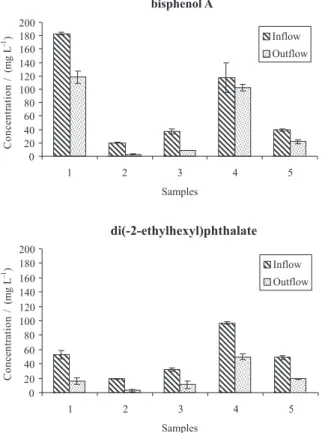
y = 2.296x – 0.765). Figure 2 shows the concentrations of the target compounds at the inlow and outlow points of the WWTP-UCS.
The results shown in Figure 2 suggest that the biological treatment employed in the WWTP-UCS does not remove the target compounds efficiently. Figure 3 shows the removal rates of the target compounds.
These low removal rates may be due to some physico-chemical characteristics of the target compounds (Table 1). Since BPA and DEHP have low vapor pressures26,27 losses
by evaporation were ruled out.
DEHP present the lowest water solubility. Therefore, high adsorption of this compound to the surface of the suspended solid particles and organic matter must be expected. Marttinen et al.28 had studied the sorption of
DEHP to different particle size fractions in sewage by serial membrane iltration. Most of the DEHP (71-84%) was attached to the 0.1-41 μm particles and approximately 10-27% of the DEHP was sorbed on particles larger than 41 μm. Less than 6% of the DEHP was in the fraction below 0.1 μm and readily available for microbial degradation.
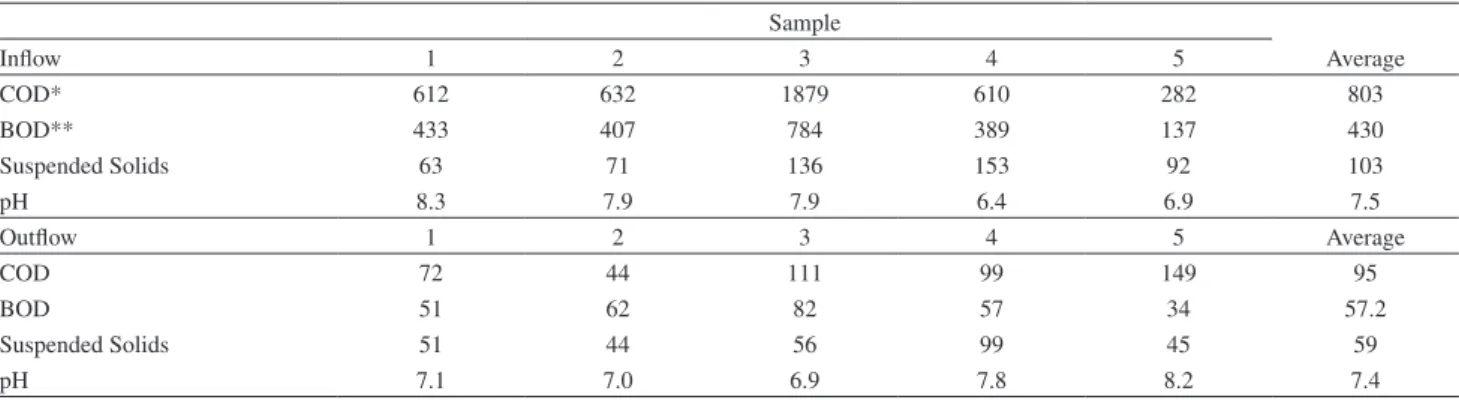
Table 2 shows the physicochemical characteristics of the samples analyzed in the present work.
The COD and BOD removals were relatively high (88.17 and 86.70%, respectively). On the other hand, the suspended solids remain high at the outlow point (only 42.72% removal). These samples characteristics can enhance the DEHP partitioning in the suspended solids and explain the high median concentration of these compounds at the outlow point. The total concentration of hydrophobic contaminants is normally higher in samples with a higher
suspended solids content.28 This trend is conirmed by the
data in Figure 4.
The highest concentrations of the target compounds were detected when the suspended solids parameter was
Table 1. Physicochemical characteristics of the target compounds
Compound log KOW Molar mass / (g mol-1) Vapor pressure / Pa Solubility in water / (mg L-1) Reference
BPA 3.4 228.29 5.3×10⁻⁶ 120-300 26
DEHP 5.22 390.56 5.47×10⁻⁴ 0.041 27
Table 2. Physicochemical characteristics of the samples (mg L-1 when applicable)
Sample
Inlow 1 2 3 4 5 Average
COD* 612 632 1879 610 282 803
BOD** 433 407 784 389 137 430
Suspended Solids 63 71 136 153 92 103
pH 8.3 7.9 7.9 6.4 6.9 7.5
Outlow 1 2 3 4 5 Average
COD 72 44 111 99 149 95
BOD 51 62 82 57 34 57.2
Suspended Solids 51 44 56 99 45 59
pH 7.1 7.0 6.9 7.8 8.2 7.4
*Chemical oxygen demand. **Biochemical oxygen demand.
Figure 3. Removal rate of the target compounds. Error bars represent ± standard deviations.
the surface of the suspended solid particles and organic matter must be expected. In this way, the preiltration step can remove an important fraction of the contaminant from the sample, before the extraction procedure starting. Figure 7 shows that, 80.07 and 64.75% of the DEHP contained in the inlow and outlow samples, respectively, also higher, except for BPA. The suspended solids in water
can form colloidal suspensions with strong electrostatic interactions. Colloidal particles often carry an electrical charge and therefore attract or repel each other. The charge of both the continuous and the dispersed phase, as well as phase mobility are factors affecting this interaction. The chemical structures of the target compounds (Figure 5) can explain the strong contaminant-colloid particle interaction.
The hydroxyl groups in the BPA structure can undergo hydrogen bonding with the water molecules. In this way, chemical interactions among BPA molecules and colloid particles are not feasible. On the other hand, DEHP have a less polar structure and low possibility of forming hydrogen bonds with water. In this way, the adsorption to the colloid particles by electrostatic interaction is favored.
Sorption to suspended solids may vary considerably according to the speciic solid and the concentration of chemicals. Thus, the correlations between plasticizer concentrations and suspended solids at the end-point of treatment in the plants are not linear.28-31 However, a positive
relationship among higher plasticizer concentrations and higher suspended solids content can be observed. Therefore, further research must be performed, focusing on this subject.
Second experimental section
The recovery yields were 75.95% (± 5.13) and 91.60% (± 1.37) for the iltered and uniltered samples, respectively. Regarding the iltered samples, the average concentrations of DEHP at the inlow and outlow points were 8.29 and 6.01 mg L-1, respectively. For the uniltered samples the
average concentrations were 41.61 and 17.04 mg L-1
respectively. The limit of quantiication was 1.0 mg L-1.
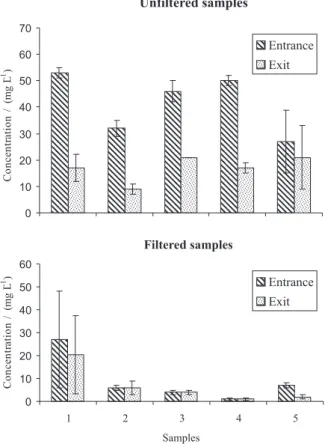
Figure 6 shows the DEHP concentrations in the uniltered and iltered samples.
The results shown in Figure 6 suggest that the preiltration step can inluence negatively the amount of the extracted DEHP. Since DEHP has low water solubility (Table 1) a high adsorption of this chemical to
Figure 6. DEHP concentrations in the uniltered and iltered samples. Error bars represent ± standard deviations.
Figure 7. Mean concentrations of DEHP of the uniltered and iltered samples at the inlow and outlow points. Error bars represent ± standard deviations.
were retained in the pre-iltration step (i.e. the suspended solids fraction).
The sources of the target compounds in the WWTP-UCS may be cleaning agents used in the laboratories (loor or furniture cleaning, glassware cleaning, etc.), personal hygiene materials (like soaps, handcreams and cosmetics that often contain phthalates) and chemical residues form the laboratories. If plasticizers are part of a plastic matrix, they could be expected to be unavailable for biodegradation.21
Conclusions
The amounts of plasticizers in the inlow and outlow samples exceed the limit allowed by oficial regulators, such as US-EPA, and this may be due to the physicochemical characteristics of the sample, mainly suspended solids. The results suggest that more attention must be paid to the removal of the suspended solids as a way to reduce the amounts of the target compounds in wastewater treatment plants. Additional treatment (such as advanced oxidation processes or locculation) may minimize the amounts of the target compounds in the efluent.
Our next steps will be to evaluate how the organic matter content can affect the plasticizers partitioning in the studied samples, additional treatments to reduce the contaminants concentrations and develop new studies for the identiication of the plasticizers sources.
Acknowledgments
The authors thank the Conselho Nacional de Desenvolvimento Cientíico e Tecnológico (CNPq) and the Universidade de Caxias do Sul.
References
1. Nelson, P.; Occup. Environ. Med. 2003,60, 541. 2. Mantovani, A.; Chemosphere1999, 39, 1293. 3. Gray, J. R.; J. Clin. Oncol. 2002, 20,4129.
4. Bornehag, C.; Sundell, J.; Weschler, C. J.; Sigsgaard, T.; Lundgren, B.; Hasselgren, M.; Hägerhed-Engman, L.; Environ. Health Perspect. 2004, 112, 1393.
5. Colón, I.; Caro, D.; Bourdony, C.J.; Rosario O.; Environ. Health Perspect. 2000,108, 895.
6. Möder, M.; Popp, P.; Pawliszyn, J.; J. Microcol. Sep. 1998,10, 225.
7. Bauer, M. J.; Herrmann, R.; Sci. Total Environ. 1997, 208, 49. 8. Akon, H.; Yoon B.; Takayuki, K.; Mariko, H.; Maya, M.;
Takashi, N.; J. Appl. Polym. Sci. 2004, 94, 1737.
9. Gonzalez-Vila, F. J.; Saiz-Jimenez, C.; Martin F.; J. Environ. Qual.1982,11, 251.
10. Boyd, S. A.; Sommers, L. E.; Nelson, D. W.; Soil Sci. Soc. Am. J. 1979, 43, 893.
11. Nascimento, I. F.; von Muhlen, C.; Schossler, P.; Caramão, E. B.; Chemosphere 2003, 50, 657.
12. Aguilar, C. P.; Peruzzolo, M.; Di Luccio, M.; Dallago, R. M.; Nascimento, I. F.; Environ. Monit. Assess. 2006,116, 103. 13. Yamamoto, T.; Yasuhara, A.; Shiraishi, H.; Nakasugi, O.;
Chemosphere2001, 42, 415.
14. Li, J.; Zhou, B.; Liu, Y.; Yang, Q.; Cai, W.; J. Hazard. Mater. 2008, 151, 389.
15. Forbes, V. E.; Selcka, H.; Palmqvista, A.; Aufderheide, J.; Warbritton, R.; Poundsc, R.; Thompson, N.; Hoeven, N.; Caspers, N.; Ecotoxicol. Environ. Saf. 2007, 66, 309. 16. Baird, C.; Environmental Chemistry, Freeman and Company:
New York, 1999.
17. Huang, Q. G. W. J. W.; Environ. Sci. Technol. 2005, 395, 6029. 18. Suzuki, N.; Hattori A.; Life Sci.2003, 73, 2237.
19. Zalko, D.; Jacques, C.; Duplan, H.; Bruel, S.; Perdu, E.; Chemosphere2010, doi:10.1016/j.chemosphere.2010.09.058.
20. Braun, J. M.; Kalkbrenner, A. E.; Calafat, A. M.; Bernert, J. T.; Ye, X.; Silva, M. J.; Barr, D. B.; Sathyanarayana, S.; Lanphear, B. P.; Environ. Health Perspect. 2010, 119, 131. doi: 10.1289/ ehp.1002366.
21. Staples, C. A.; Peterson, D. R. In The Handbook of Environmental Chemistry;Charles, A. S., ed.; Springer: New
York, 2003.
22. Wintgens, T.; Gallenkemper, M.; Melin, T.; Water Sci. Technol. 2004,50, 1.
23. Fernandez, M. P.; Noguerol, T.; Lacorte, S.; Buchanan, I.; Piña B.; Anal. Bioanal. Chem. 2008,393, 957.
24. Fauser, P.; Vikelsoe, J.; Sorensen, P. B.; Carlsen, L.; Water Res. 2003,37, 1288.
25. Zheng, Z.; He, P.; Shao, L.; Lee, D.; Water Res. 2007,41, 4696. 26. Zhang, C.; Huang, G.; Yu, J.; Wang, Q.; Li, J.; Xi, B.; Liu, H.;
Chemosphere2006, 65, 1490.
27. Cousins, I. T.; Mackay, D.; Parkerton, T. F. In The Handbook of Environmental Chemistry;Charles, A. S., ed.; Springer: New
York, 2003.
28. Marttinen, S. K.; Kettunen, R. H.; Sormunen, K. M.; Rintala, J. A.; Water Res. 2003,37, 1385.
29. Oliver, R.; May, E.; Williams, J.; Water Res. 2005,39, 4436. 30. Clara, M.; Windhofer, G.; Hartl, W.; Braun, K.; Simon, M.;
Gans, O.; Scheffknecht C.; Chovanec, A.; Chemosphere2010, 78, 1078.
31. Sirivithayapakorn, S.; Thuyviang, K.; Bull. Environ. Contam. Toxicol. 2010, 84, 503.
Submitted: November 26, 2010