90 Brazilian Journal of Physics, vol. 34, no. 1, March, 2004
The Water Factor in the Protein-Folding Problem
L.F.O. Rocha
1, M.E. Tarrag´o Pinto
2, and A. Caliri
3 1Universidade Estadual Paulista, IBILCE, Departamento de F´ısicaRua Cristov˜ao Colombo 2265, Jardim Nazareth, 15054-000, S˜ao Jos´e do Rio Preto, SP, Brazil 2Pontif´ıcia Universidade Cat´olica do Rio Grande do Sul, Departamento de F´ısica Te´orica e Aplicada
Av. Ipiranga, 6681, Partenon, 90.619-900, Porto Alegre, RS, Brazil. 3Universidade de S˜ao Paulo, FCFRP, Departamento de F´ısica e Qu´ımica
Av. do Caf´e S/N, Monte Alegre, 14040.903, Ribeir˜ao Preto, SP Brazil
Received on 20 October, 2003.
Globular proteins are produced as a linear chain of aminoacids in water solution in the cell and, in the same aqueous environment, fold into their respective unique and functional native structures. In spite of this, many theoretical studies have tried to explain the folding process in vacuum, but in this paper we adopt an alternative point of view: the folding problem of heteropolymers is analyzed from the solvent perspective. The thermody-namics of the folding process is discussed for a non homogeneous system composed by the chain and solvent together; hydrophobic effects, modulated by the polar/nonpolar attributes of the residue sequence and by its corresponding steric specificities, are proposed as basic ingredients for the mechanisms of the folding process. These ideas are incorporated in both lattice and off-lattice models and treated by Monte Carlo simulations. Configurational and thermodynamical results are compared with properties of real proteins. The results suggest that the folding problem of small globular protein can be considered as a process in which the mechanism to reach the native structure and the requirements for the globule stability are uncoupled.
1
Introduction
We still know little about the liquid that is of fundamen-tal importance in biological processes. Particularly in the protein-folding problem, the unusual physical proprieties of water are determinant. For example, almost all proteins denature if their medium is changed from water to another solvent, as ethanol, or even in aqueous solutions contain-ing a sufficient amount of sodium dodecyl sulfate or urea. In addition, proteins denature by simply changing intensive parameters of their solutions, such as pH, temperature, and pressure. Many physical properties of water, such as its high surface tension, specific heat, and heat of vaporiza-tion, are surprising if compared with its direct analogous H2S and CH4; it is impressive that water presents one of
the largest known heat capacities [1] given the small size of its molecules. The effects of its special structural possibili-ties in either the bulk of pure water or when in contact with others substances [2] are also unique.
Such physical properties of water, concerning room tem-perature, are among the main reasons for referring to the protein-folding process as one of the most perplexing mys-teries in science. Indeed, the task of describing how a par-ticular long strand of amino acids twists and folds into its very specific three-dimensional structure has proved to be a considerable intellectual challenge, but the“...perplexing mystery...”status is somewhat exaggerated, although
com-prehensive: several distinct scientific and technological branches are interested in this problem, which, once under-stood, could lead to a better understanding of diseases and uncover possible cures. The technological implication of this problem for the pharmaceutical industry, for example, is so impressive that one of the leader computer companies started, in 1999, a research project worth one hundred mil-lion American dollars, in order to build a supercomputer – the blue gene– with more than one million processors, pri-marily dedicated to deal with this question.
L.F.O. Rochaet al. 91
native structure and the requirement for the globule stability are uncoupled.
2
Hydrophobicity and the globular
protein-folding problem
The peculiar desafinity of oil (a nonpolar substance) for wa-ter is historically known since Pliny the Elder (first century A.D.), but the first reference to the word “hydrophobicity” is not clear; it appeared at least as early as 1915, although it had been defined differently from that which is currently in use [3]. Through time, people from different technological and scientific branches have employed the term “hydropho-bic effect” with distinct meanings, sometimes confusing. Some refer to it simply as desafinity of oil for water; or-dering of water around nonpolar solute; or, still, free energy involved in transferring a nonpolar solute from a nonpolar environment into water. Anyway, the rigorous understand-ing of the so called “hydrophobic effect”, at molecular level, is still in progress.
2.1
The hydrophobic effect
The term ”hydrophobic effect ” was coined by Charles Tanford [4] and it refers to the surprising thermodynamics of mixing nonpolar substances with water (oil/water mix-ing phenomenon). Recent advances suggest that the ap-parent “aversion” of nonpolar substances to water comes, indeed, from the versatility of water molecules in avoiding the reduction of hydrophobic bonds among water molecules [5]: on the contrary to common sense, there is an ener-getic preference for nonpolar substances to aggregate with water than with themselves, but it is the water-water in-teraction, through (relatively) strong hydrogen bonds, that ultimately segregates the nonpolar species from the water bulk, as macroscopically observed through the minimiza-tion of the nonpolar-water interface. For large enough ex-tensions of nonpolar-water interfaces, bond breaking is in-evitable and the local distribution of hydrogen bonds be-comes asymmetric; in order to minimize the system’s po-tential energy, the hydrogen bonds are redistributed into the water bulk direction. This process is substantially the same as that observed at the air-water interface, easily identified by water’s high surface tension. However, for small enough nonpolar molecules (extensions.1 nanometer), hydrogen bonds simply involve the molecule, resulting in a practically unaffected average number of hydrogen bonds . This mech-anism explains, for instance, the higher solubility of small nonpolar solutes[6].
The versatility of water molecules in avoiding the loss of hydrogen bonds comes from its peculiar interactional properties, which are orientation dependent; it also in-volves –under the conditions of many physical and biolog-ical processes– a relevant amount of energy, 10 - 20 KJ, is necessary to break 1 mol of hydrogen bonds. About 1.9 ˚A separates the hydrogen (donor) of one molecule from the
oxygen (acceptor) of the other, and, considering all four electron pairs involved, the water structure may be consid-ered tetrahedral. As a consequence, one water molecule may be bounded up to four other molecules, potentially forming an extensive hydrogen bonding network. The term hydrophobic, commonly used to label substances that appar-ently repel water, is therefore not appropriate. There is no repulsion between water and such substances; rather, the ob-served apparent “aversion” is owing to the strong hydrogen bonding between water molecules, also responsible for wa-ter’s high specific heat, and heat of vaporization. Nonethe-less, it is too late for any corrections: the term hydrophobic is going to be continuously used, but not with its etymolog-ical meaning.
Water’s tetrahedral-type structure and the extension of the hydrophobic bond explain its anomalous packing den-sity, namelyφw = 0.36.This figure is very small if com-pared with the protein’s interior packing densityφp = 0.75 (which is greater than closest packing of spheres φcp =
0.74) or the cyclohexane φch = 0.44. At 4◦C and at-mospheric pressure, each molecule of water is surrounded only by 4 or 5 other molecules; for closest packing of hard spheres, this number is 12 and for many simple liquid it is 8 or10; therefore, one can conclude that water has a very open structure [7].
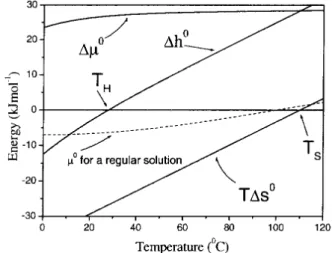
Figure 1. Molar free energy transfer, ∆µ0 = ∆h0 −T∆s0,
of a nonpolar substance into water as a function of temperature; schematic representation. The free energy change is large and positive in the intire range for liquid water; atTh ≃ 250C, and
Ts ≃1200C the enthalpic and entropic changes are zero, respec-tively. For comparasion, the molar free energy transfer for a regular solution is also shown schematically (dashed line).
Much of what is understood about the hydrophobic ef-fect comes from studies on the oil/water partitioning of small nonpolar solutes. At equilibrium, the molar free energy of phase i = 1 and phase i = 2 are equals:
µ0
1+RTln(c1) =µ02+RTln(c2), whereµ0i is the affin-ity of the solute for phasei,andci is the concentration of solute in phasei.The difference∆µ0 =µ0
2−µ01of molar
92 Brazilian Journal of Physics, vol. 34, no. 1, March, 2004
concentration of solute, that is ∆µ0 = RTln(c1/c2). For
nonpolar solutes in its on phase, ∆µ0 is interpreted as the
transfer free energy to change the solute from the nonpolar phase into water. For small nonpolar molecules (pentane, for example) ,∆µ0 is positive (therefore, oil/water mixing
is not a spontaneous process),and varies slightly with tem-perature, from about 23to28 KJmol−1, for temperatures ranging from zero to 1000C. Its enthalpic∆h0and entropic T∆s0 components (∆µ0 = ∆h0−T∆s0) change almost
linearly along the entire interval of temperature of liquid water, which gives a nearly constant molar heat capacity in this temperature range. Fig.1 shows a schematic representa-tion of the main characteristics of the hydrophobic effect [2] (mixing of nonpolar solute in water).
2.2
The folding process
Under physiological conditions (namelly, adequate pH and temperature) many proteins fold by themselves, that is, they fold without intermediation of any biological machin-ery. This experimental observation suggests that the folding problem may be described only by chemical and physical parameters, despite its complexity. However, even consider-ing the anomalous behavior of water and its solutions, most of the models used in studying the folding problem has tried to include water only implicitly, by integrating, a priori, the solvent degrees of freedom. This simplified treatment is de-rived through statistical mechanics, by first writing the con-figurational partition function of the entire system, which is constituted by a protein molecule in the presence of the sol-vent:
Z = X
{Ri} X
{rj}
exp[−E(R1,... RN;r1, ... rm)/kBT], (1)
where E is the total potential energy function, kB is the Boltzmann constant,T is the absolute temperature, and the summation involves the coordinates of the chain{Ri} and the coordinates of the solvent{rj}(treated here as discrete variables for simplicity). The partition function may be re-written as
Z = X
{Ri}
exp[−Φ({Ri})/kBT], (2)
with
Φ({Ri}) =−kBln
X
{rj}
exp[−E(R1...RN;r1...rm)/kBT].
(3) The functionΦ({Ri})can be seen as the free energy for the hypothetical case in that the chain is maintained “frozen” in a particular configuration through the set{Ri}of fixed coor-dinates{dRi/dt= 0}. Therefore, at this point, one has two possible ways of focusing the problem, from the statistical mechanics point of view:
(i)- One may see the free energyΦas potential of mean
force [8], obtained by the summation over the solvent degree
of freedom, that isΦ(R1...RN)is averaged over all possible solvent coordinates{rj}.This is what is assumed in most simplified models of protein folding: the solvent factor is averaged out and appears implicitly as a potential of mean force, and so the problem is reduced to intra-chain interac-tions through the potential of mean force Φ.However, al-thought this approach has been extensively employed, even for dealing with the dynamical aspect of the problem, a definitive potential of mean force was never found: it is not feasible to condense all solvent-chain information (in an operational manner) in a single function of the chain coordinates{Ri} and at the same time, keep the problem treatable. Therefore, simplified potentials of mean force are commonly employed in considering solvent implicitly. Anyway, the price to be paid for using this approach is that of having to consider the solvent at macroscopic equilibrium with the chain during all the process.
(ii)-On the other hand, if one considers that the solvent should play a more explicit role in the dynamic process of folding, an alternative approach is then to emphasize the solvent-chain interactions. The details of how the correct chain’s segments get together and keep in contact, clearly has to do with the stereochemical pattern encoded in the chain sequence. But, before getting into the details of this alternative view of the folding problem, let us analyze its in-terplaying parts through some thermodynamic quantities, in order to associate the hydrophobic effect –as observed in the nonpolar/water system– with the chain-solvent equilibrium state.
2.3
Thermodynamics of the folding process
Indeed, theoretical studies and experimental evidences point to the hydrophobic effect as the main folding driving force generator[9] [10]. One of the most convincing arguments comes from the thermodynamic analysis of the folding
⇋ unfolding reaction. Measurements of thermodynamic
amounts may provide insights about the relevant forces in-volved in the protein stability and folding process. In this analysis, it is usual to consider the enthalpic and entropic changes through the folding process, taking separately the chain and solvent contributions by writing the entire free en-ergy changes∆G=Gf olded−Gunf oldedbetween the final folded structure and the initial unfolded conformation, as
∆G= ∆Hchain+ ∆Hsolvent−T∆Schain−T∆Ssolvent; (4) the enthalpic changes∆H also means∆H = Hf olded−
Hunf olded,as well as∆S =Sf olded−Sunf olded.The in-teraction energy between chain and solvent and among those solvent molecules affected by the chain presence are all con-tained in∆Hchain. It is necessary to bear in mind, however, that this procedure of breaking down a full thermodynamic quantity into a sum of components is not a rigorous method; indeed, special conditions, such as free energy additivity, are
a priori assumed. But our interest here is only to provide
L.F.O. Rochaet al. 93
process, and so we proceed without major considerations about.
First, we consider the polar (p) groups (side-chains). In this case, the entalpic change between the folded structure and the unfolded conformation is positive, ∆Hchainp > 0, that is, the chain enthalpic change contributes to the unfold conformation. The reason is that these groups, as the back-bone, form much more hydrogen bonds and salt interactions when exposed to water than among themselves. On the other hand ∆Hsolventp < 0,favoring the folded structure. The amount∆Hsolventp is negative because the water molecules interaction with themselves is stronger than with the chain. Therefore, the terms in the sum∆Hchainp +∆H
p
solvent com-pete and, although close to zero, the sum usually favors the folded structure slightly, that is:∆Hchainp +∆Hsolventp .0, indicating that the water molecules interaction with them-selves prevails.
The chain entropic change is negative, that is, −T∆Schainp >0, because the chain in the unfolded confor-mation has much more assessable configurations than in the folded structure and so it contributes to the unfolded con-formation. However, −T∆Ssolventp < 0 because the wa-ter has more configurational choices with the chain in the folded structure, and so this term favors the folded struc-ture. The balance is found to be slightly negative, that is: ∆Schainp + ∆Ssolventp . 0. Then, summing up the contribution from the chain and solvent, namely ∆Gp =
∆Hchainp +∆Hsolventp −T(∆Schainp +∆Ssolventp ), one usu-ally finds that polar groups favor the unfolded conformation, that is:∆Gp&0.
Now we turn to the nonpolar (ep) groups. As in the polar case, ∆Hchainpe & 0 contributing to the unfold con-formation. Although the chain’s nonpolar groups interact (slightly) stronger with water than with themselves, when the chain is open, the backbone may form more hydro-gen bonds with water than with themselves. But, it is not so favorable to the unfolded conformation as in the po-lar case, because the van der Waals (attractive) interactions are weaker between nonpolar groups and water than among themselves. On the other hand, water molecules interact much more strongly among themselves than with nonpo-lar groups; therefore ∆Hsolventpe < 0,favoring the folded structure. Here, again, the terms in the sum ∆Hchainpe +
∆Hsolventpe compete, slightly favoring the folded structure, that is:∆Hchainpe + ∆He
p
solvent.0.
Following, it is found that the sum∆Schainpe +∆Se p solvent
> 0, that is, it strongly induces the chain into the folded conformation. The term−T∆Schainep >0contributes to the unfolded conformation, like in the polar case, but the sol-vent contribution strongly favors the folded structure, that is −T∆Ssolventep << 0, and is the leading driving force for protein folding. The structural arrangement of wa-ter molecules at the wawa-ter-nonpolar inwa-terface are signifi-cantly affected: due (again) to the stronger water-water teraction (much stronger than the water-nonpolar groups in-teraction), the lost hydrogen bonds are partially compen-sated by redirecting them towards the water bulk.
There-fore, when by thermal fluctuation two nonpolar groups get closer, the resulting reduction of exposed nonpolar surface to water increases the number of hydrogen bonds (a water molecule always “looks” for other water molecules). The net effect is the collapse of the chain, reducing the over-all water-nonpolar interface and increasing the number of possible hydrogen bonds for water molecules; that is, the folded structure increases the solvent entropy. Therefore, adding all the contribution from nonpolar groups, namely
∆Gep= ∆Hep
chain+ ∆He p
solvent−T(∆Se p
chain+ ∆Se p solvent), one finds that it favors the folded structure, that is∆Gep<0. Finally, adding up all terms, at room temperature, it is found that, for proteins, ∆G = ∆Gp+ ∆Gpe is neg-ative, that is, the folding is a spontaneous process. How-ever, the change∆Gis very small, indicating that proteins are marginally stable. For typical proteins, ∆G is found to be between -10 and -50 KJ/mol, which corresponds to few hydrogen bonds. In short, one finds that enthalpic and entropic contributions due to the chain favor the unfold conformation (∆Hchainp > 0; ∆He
p
chain & 0;−T∆S p chain
>0;−T∆Schainep >0); while all terms due to the solvent contribution favor the folded structure (∆Hsolventp < 0;
∆Hsolventep <0; −T∆S p
solvent<0;−T∆Se p
solvent<<0). Then, it seems clear that the solvent plays a dominant role in the spontaneous folding process, and a hypotheses may be now set up: The solvent “folds the chain” in a such way that the number of lost hydrogen bonds is reduced to a min-imum level; the final structure specificity and stability are decurrent from the particular stereochemical instruction en-coded along the chain. Therefore, in the following topic, we will approach the folding problem focusing the solvent part, specially thinking of using the Monte Carlo method.
2.4
Folding of grobule protein driven by the
hydrophobic effect
In order to emphasize the hydrophobic effect as the fold-ing drivfold-ing force generator, let us consider a microcanonical representation of a system constituted by a single chain im-mersed intoN0 solvent molecules (water), a fixed volume
V0, total constant energyE0, andΓ0 accessible states, all
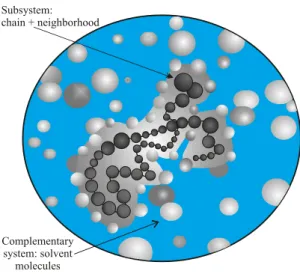
of them evenly probable. The system as a whole (actually a non-homogeneous system) reveals two distinct parts as il-lustrated in Fig.2: (i)- a subsystem constituted by the chain and its neighborhood, and (ii)- the complementary system. The subsystem, in an arbitrary stateα,occupies a volume
Vα,which has all Nα water molecules that ‘perceive’ the chain, and energyEα; the complementary system is consti-tuted by the complementary volumeV′
α,the reminder num-berN′
α of bulk water molecules, energyEα′ and having a numberΓ′
α of accessible states. Clearly,Vα+Vα′ = V0; alsoNα+Nα′ =N0;andEα+Eα′ =E0.The energy of the subsystem is given by the sumEα=Eαcc+Eαcs,where
Ecc
94 Brazilian Journal of Physics, vol. 34, no. 1, March, 2004
Fig.(2)
Subsystem: chain + neighborhood
Complementary system: solvent
molecules
Figure 2. Microanonical system: representation of the chain-water system. The system as a whole hasN0solvent (water) molecules, fixed volume V0, total (constant) energyE0 and Γ0 accessible states, is divided in a subsystem constituted by the chain and sol-vent molecules at its neighborhood, and the complementary system (just solvent molecules).
Therefore, one may assume that along the configura-tional evolution, a given stateαof the system as a whole has probability of occurrence
Pα=
Γ′
α
Γ0,
(5) because, for the same state α,the complementary system can assume Γ′
α distinct states out of Γ0. Therefore, the probability of occurrence of a local specific physical condi-tion, such as a microscopic fluctuation specified by the state
αof the subsystem, depends on the number of accessible states left to the complementary system. Dynamically, this means that along a large enough time interval τ in which a numberℵ(τ)of states are visited , stateαoccursℵ(τ)×
Γ′
α/Γ0 times. As the system as a whole is considered in
macroscopic equilibrium,Pαis then the ‘chance’ of occur-rence of a specific local microscopic fluctuation specified by the subsystem at stateα.Eq.5 can be re-written by tak-ing the natural logarithm of its both sides and after defintak-ing
ln Γ =S/kB, one gets
Pα= exp(−∆S′α/kB), (6) where∆S′
α = S0−Sα′; note that Γ0 = P{α}Γ′α. The amount∆S′
α is not the entropy of the subsystem; the cor-rect thermodynamic corresponding amount is obtained by the ensemble (or temporal) averageS = ∆S′
α =S0−S′. On the other hand, the amountS′
α can be seen as the en-tropy of the whole system when the subsystem is considered ‘frozen’ in stateαexactly as considered in Eq.3. Therefore, through this interpretation, Eq.5 may be used along with the master equation to get a prescription of the transition proba-bility between two (consecutive) states of the whole system.
Tα,β =
Pα
Pβ
= min(1,exp[(Sα′ −Sβ′)]/kB), (7)
where the functionmin(a, b)means the minimum amount betweenaandb,andδS′ =S′
α−Sβ′ is the entropy differ-ence between two distinct states of the system as a whole, namely: the state corresponding to the subsystem ‘frozen’ in stateαand the state corresponding to the subsystem ‘frozen’ in state β. The idea now is to estimate the amount δS′
through experimental data, with respect to the change on the free energy∆G = ∆H −T∆S involved in transfer-ring a solute from a nonpolar environment (interior of a pro-tein) into water (solvent). Such transfer free energy, deter-mined for all 20 natural aminoacids, are used to construct what is called “hydrophobic scales”. Fig.3 shows two of such scales [4]. One was obtained from experimental mea-surements and the other from theoretical calculations. They were chosen here, among tens of others, because they agree qualitatively about which are the ”hydrophobic” and the ”hydrophilic” aminoacids – it is common to find qualitative disagreement between different scales for some aminoacids. Therefore, writing the entropic change of the system as
∆S′ = −(∆G′ −∆H′)/T,one may use experimental
re-sults to weigh distinct configurations . As a first approxi-mation that emphasizes the solvent factor, one may drop the entalpic term and write∆S′≃ −∆G′;particularly, this
ap-proximation becomes exact for models using only hard-core potential for the intra-chain interactions.
However, as discussed above, on considering the ther-modynamics of the folding process, proteins are marginally stable and so some other “non energetic” ingredients must play a role in its overall stability. And, indeed, it is sur-prising how ”hydrophobic potentials ”, constructed from hydrophobic scales, in association with steric effects may mimic the protein process, as it will be considered in the next section.
3
Hydrophobic induction and steric
constraints as two main ingredients
in the folding process
L.F.O. Rochaet al. 95
ValCys TyrPro GlySerGln Arg
LeuMet AlaThr AsnAspLys
Phe
Trp His Glu
1,37 -2,44
-2,46 -2,32
-3,07 -1,68-1,66 -1,34-1,31-0,98-0,42 -0,35-0,18 0 0,050,30 0,87 0,82 1,05 1,35 *
2,1 -2,3
-1,9 -1,9
-2,6 -2,4 -1,5 -0,38-1,6 -1,2-0,67 -0,52-0,64 0 -0,010,22 0,76 0,60 1,2 0,57
H
H H H H H H H H H N N P P P P P
H H P
Residues
hi
3-letter alphabet
Legend- *: e heoretical scale; h: hydrofobicity level of each aminoacid
i
xperimental scale; : t
Fig.(3)
Ile
Figure 3. Hydrophobic scales: there are many distinct scales determined experimentally; these two were choosen because there is a qualitative agreement between them and theoretical calculations.
20 30 40 50 60 70 80
200 300 400 500 600
∆
H (
K
J /
m
o
l)
Temperature (oC)
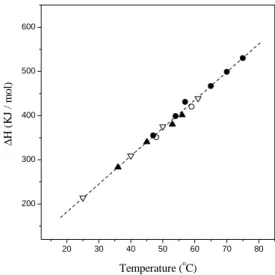
Figure 4. Classical result of the enthalpy change∆Hof the con-formational transition (denaturation) of lysozyme as a function of temperature . There is no difference in heat capacity (slope of the enthalpy change as a function of temperature) upon denaturation induced by temperature (open circles) at constant pH; acid (filled circles) at constant temperature; denaturation by temperature (open triangle) at constant concentration of denaturant guanidine chlo-ride; and denaturation by guanidine chloride (filled triangle) at con-stant temperature. For many proteins studied [9], the same linear dependence∆H with the temperature was found, but with differ-ent slopes for each protein.
compare it with Fig.1. The resulting balance for protein un-folding free energy∆G= ∆H−T∆S,although positive, is surprisingly small. In addition, while in oil/water mixing of small solutes, the temperaturesThin which the enthalpic contibution is zero, and the temperaturesTsin which the en-tropic contibution is zero, are separated by about800C, they are about nearly the same for protein [3]. In oil/water mix-ing, as well as in protein systems, the entropic term is the predominant one, that is|T∆S| >|∆H|,from lower tem-peratures up toTε,in that, by definition,−Tε∆S = ∆H; note that Th < Tε < Ts. The value forTε varies from protein to protein: it is about 100C for T4 lysozyme [11], 260C for myoglobin [12], and about 250C for several other proteins[3]. Such thermodynamic results certainly reinforce the idea that the protein chain folding is driven by the sol-vent’s “entropic forces”; the enthalpic component only starts to favor the folded structure for temperaturesT > Thwhen the unfolding enthalpy change∆Hbecomes positive.
The stability of the native structure of single-domain proteins is measured by the work required for its disruption,
and, for the case of proteins having only two states, namely folded and unfolded, the work required for transition from the native structure to the denatured conformation is given by∆Ge = ∆H −T∆S, the unfolding free energy. But, as already emphasized, the amount∆Geis positive but sur-prisingly small, producing questions such as: Why do glob-ular proteins have to be only marginally stable?; or: Are there any other hidden stabilizing mechanisms that are not revealed by final state thermodynamic amounts? Indeed, it can be observed that, in living cells, there is a continu-ous process of production and degradation of most of their constitutes. Many functional globular proteins are system-atically produced and eliminated, in a wide range of time characteristic (from fraction of second to days, or years). Therefore, the fact that proteins are only marginally stable structures seems to be important for the maintenance of the biologic machinery of life. But, on the other hand, under the same physiological conditions, how can distinct proteins present distinct half-live within the same range of small ther-modynamic stability? A complex combination of factors, such as sensitiveness for local chemical fluctuation, number of covalent cross-links, protein size and shape, etc., would usually be evoked. However, among all these possible fac-tors, a good starting point for investigation seems to be the
steric specificities of the chain because they are present in all
proteins through their elementary constituents: the twenty natural aminoacids presenting a rich repertory of sizes and shapes. Therefore, one gets a simple but consistent propo-sition in order to study the folding process: in the linear se-quence of aminoacids of a particular protein, a stereochem-ical instruction to the solvent should be encoded, dictating
how and in what structure the protein has to be folded. In
the next topic, Monte Carlo simulation results of two models are presented in order to analyze the consequence of consid-ering the hydrophobic effect (entropic forces) and the steric specificities (or constraints) as the two main ingredients in governing the folding process.
3.1
Off-lattice model: the hydrophobic
induc-tion
em-96 Brazilian Journal of Physics, vol. 34, no. 1, March, 2004
ployed, in that the stereochemical diversity of the 20 natural amino acids is reduced to athree-letter alphabet, represent-ing polar (P), hydrophobic (H), and neuter (N) monomers, as depicted in Fig.3, at the same time that all geometri-cal constraints were deliberately eliminated. Technigeometri-cally, the chain-solvent system is represented as a pearl necklace in the solution (the solvent is treated explicitly), in which each monomer is represented by a hard-sphere of diameter
D connected to its neighbors by ideal flexible strings with defined lengthD+ε,whereε ≃ 0.2D. The 12.565 sol-vent molecules are also represented by hard-spheres of the same diameterD. The magnitude of the specific hydropho-bic levels{hi} is equivalent to the one used in the lattice model, with each monomer of the chain having one of three possible values: hP = +1, hH = −2, or hN = 0. The solvent-solvent interaction,es,s,, as well as the
monomer-monomer interaction, em,m, is a hard core-type potential.
The solvent-monomer interaction involves, additionally, the hydrophobic energy,es,m=e0−nshm,wheree0is an ar-bitrary constant,hmis the hydrophobic level of monomerm (hP,hH,orhN),andnsis the number of solvent molecules surrounding it. Note that the energyes,mincreases withns if the monomerm is hydrophobic (hm = hH),decreases if it is hydrophilic (hm=hP), and is indifferent otherwise (hm = hN). Each monomer in the HPN sequence corre-sponds, one by one, to the polar/nonpolar attribute of the 35 amino acids of a real protein, and its corresponding 3-D structure was specially chosen as a target configuration . The polar/nonpolar attribute of each residue was chosen based on the scale proposed in Fig.2, and the configura-tional evolution is governed by Eq.7 above. The amount
δSα,β = ∆Sα −∆Sβ is the system’s entropic change with respect to the transition between the distinct (frozen) chain configurations α and β, and may be expressed by its corresponding changes on energyeα,β,number of water molecules bounded in the chainnα,β,and molecule volume
vα,β,in the formδSα,β= (−δeα,β+µ δnα,β−P δvα,β)/T; see ref. 15 for more details. In the present model, we set
δnα,β = δvα,β = 0and, because only hard-core energies are considered in the inter-monomer interactions,δSα,β de-pends only on the change of the hydrophobic energyδeα,β. Essentially, this change depends on the reorganization of hydrogen bonds in the layer of water molecules between the solvent bulk and the monomers surface[7], establish-ing a linear dependence on the accessible surface area of the residues. In this work, the amountδeα,β is estimated by associating a specific hydrophobic levelγ= 2γ0for hy-drophobic monomers,γ =−γ0for polar ones, andγ = 0
for neuters, for each solvent contact; the amount γ0 < 0
is measured in units ofkBT;the valueγ0 =−1was used in this work. Therefore, each new generated configura-tion, say configurationβ,is obtained from a previous con-figuration αby trying to change the spatial coordinates of a specific chain’s monomer or a solvent molecule, which are chosen randomly along the MC simulation. There are three possible situations to be considered with respect to the chanceT(α→β)in accepting the new configurationβ:
(i)- moving a hydrophobic monomer:
T(α→β) = min{exp(2γ0∆nS/kBT),1}; (8)
(ii)- moving a polar monomer:
T(α→β) = min{exp(−γ0∆nS/kBT),1}; (9)
(iii)-moving a solvent molecule:
T(α→β) = min{exp[γ0(2∆nH−∆nP)/kBT],1},
(10) where ∆nS is the change of the number of solvent molecules in contact with the monomer being moved, and
∆nHand∆nP are, respectively, the change on the number of hydrophobic and polar monomers around of the solvent molecule being moved. The Monte Carlo sampling tech-nique, then, becomes straightforward: each new generated configuration is first checked with respect to the hard-core constraints and, if no superposition is verified, the configura-tion is accepted according toT(α→β),which is calculated by Eqs. 8-10 above.
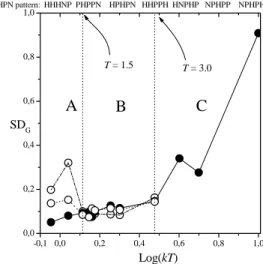
Firstly, in following analysis of the simulation results, the global chain behavior of the packing process is presented through the standard deviationSDG of the average radius of gyrationRGagainstkBT, as shown by Fig.5, which was obtained by using the last105MC steps –representing one
fifth of the total time window tw, namelytw = 5×10⁵ MC steps that corresponds to a total of about6×109
gen-erated configurations. Three distinct regions are identified: For kBT < 1.5 (region A ) the amount SDG depends strongly on the initial conditions. For1.5 ≤ kBT ≤ 3.0 (region B) the globule is well defined; the smaller value for SDG occurs at kBT = 1.5,and then increaes slowly up to kBT = 3.0. Finally for kBT > 3.0 (region C),
SDGchanges rapidly with the temperature until saturating
atkBT &5.0.
¿FromkBT = 1.5, up tokBT = 3.0,the size of the globule can be thermodynamically defined, independently of the initial condition: thermal fluctuations are already sig-nificantly large to disrupt the non-optimized hydrophobic contacts and so, independently of the initial conditions, the chain always collapses into a compact globule-like confor-mation. AtkBT = 2.0,andkBT = 3.0, SDGis only about 3% and 5% lager thanSDGatkBT = 1.5, respectively.
More detailed configurational behaviors are provided by contact maps of four real proteins and for their correspond-ing models, as shown in Fig.6. Owcorrespond-ing to severe topological simplifications introduced by the model used here, two pre-cautions were taken before configurational comparisons: (i)-the inter-monomers distancesdi,j(center of mass), for pro-tein and model, were properly translated and re-scaled to fit the same interval from zero to one, that is,0≤di,j≤1,and (ii)- black regions in the maps correspond to all distances
L.F.O. Rochaet al. 97
-0,1 0,0 0,2 0,4 0,6 0,8 1,0
0,0 0,2 0,4 0,6 0,8 1,0
Sequence: VVIGQ RCYRS PDCYS ACKKL VGKAT GKCTN GRCDC HPN pattern: HHHNP PHPPN HPHPN HHPPH HNPHP NPHPP NPHPH
C
B
A
T = 3.0 T = 1.5
SDG
Log(kT)
Figure 5. The behavior of the Standard DeviationSDGof the ra-dius of gyrationRGagainstkBT. The protein 1-tsk sequence (one letter symbol) and its HP pattern are shown at the top. The physi-cal system as a whole, is represented by a single linear chain of35
units, surrounded by12,565solvent molecules confined in a cubic box. The beads of the chain, as well as the solvent molecules, are hard-spheres of the same diameter, but the monomer-solvent inter-action depends additionally on the hydrophobic attribute of each interacting pair.
The contact map for each model corresponds to a particular configuration chosen among ten of them, taken from the last quarter of the simulation time.
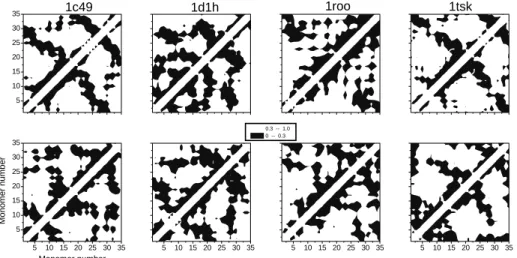
The simulated and real protein maps can not be conclu-sively compared given the severe geometrical changes im-posed into the model. However it is possible to see spe-cific propensities (even though somewhat distorted) in each model’s map, resembling the corresponding real protein’s map. First, it is helpful to recognize the distinct configu-rational peculiarities of the simulated maps, and that they are exclusively due to its distinct HPN patterns. So, hence-forth one is ready to look for the similitudes between the protein’s map and its corresponding model’s map. Note that several contacting residues in the real protein (black re-gions of Fig.6) have corresponding contacting pairs in the model system; many of them presenting a relatively high frequency of contact along the simulation. Although the globule is very compact, it preserves great malleability, in-dicating that the chain is not pinned in any particular con-figuration . The resemblances between proteins and model maps are recurrent, appearing and disappearing from time to time along the simulation; the chain-model configurations shown in Fig.6 were selected for visual purpose only to il-lustrate our arguments. They have, indeed, a short lifetime, but even with similarity alternations between model’s results and the native structure, many contacting pairs of monomers last along the whole simulation time. When the chain is compacted in a globule conformation, an continuous suc-cession of swelling, shrinkage, and twisting of the globule takes place; the chain rambles through the compact config-urational sub-space, eventually visiting configurations that present more resemblances with its respective native con-figuration. More detailed results and comments about this model will appear soon elsewhere.
Therefore, the main virtues of the chain-solvent interac-tions, governed by the hydrophobicity of the residues, are the efficiency to compact the chain maintaining the globule malleable, and, once packed, the capability to induce the chain through conformations near the native state, but with-out providing configurational definition to the globule. In the next topic, dealing with a lattice model, the same type of configurational induction by the hydrophobic effect is re-produced, but with an additional remedy: the introduction of steric interaction specificities.
3.2
Lattice model: steric constraints and its
thermodynamics implications
The intrachain contact energyεi,jbetween a pair of residues
iandj, used in most lattice simplified models, obey the so called segregation principle,2εi,j−εii−εjj ≥0.A particu-lar class of potentials, denominated hydrophobic potentials, has the property of satisfying marginally the segregation principle, through the equal sign, that is,2εi,j−εii−εjj ≡
0. Such potentials are based on a hydrophobic scale for the aminoacids {hi} and, in general, the effective inter-monomer potentials are written asεi,j = hi+hj, that is, a linear combination of the hydrophobicity level of each in-teracting monomer [14]. The interaction potential obtained by this way has an important property: the energy change between two chain configurations is exactly equivalent to that obtained from considering the exclusive chain-solvent interaction [15], in that all lattice sites are occupied by ei-ther monomers or solvent molecules. The model studied here is composed by a single protein-like chain constituted byN = 27monomers, which are effective residues taken from a repertory of stereochemically different elements; the residues occupy consecutive and distinct sites of a three-dimensional infinity cubic lattice; the interactions are as-sumed to occur between nearest-neighbor pairs of residues through a set of contact energy {εi,j = hi + hj} and steric constraints{ci,j}. Together, the set of hydrophobic levels{hi}and steric interactional specificities{ci,j}of the residues, constitute a 10-letter alphabet, as shown in Fig.7. The strength of the interactions{hi}are expressed in units of kBT,(arbitrary energy units).
Compact Self-Avoiding (CSA) configurations, charac-terized by their corresponding relative contact orderχ,are used as native or target structures [13]. The sequence of residues assigned to each structure is determined through a specific “syntax” that emerges from the constraints{ci,j} and from the application of the “hydrophobic inside” rule; see Ref.15 for details.
3.2.1 Heat capacity and configurational activity
98 Brazilian Journal of Physics, vol. 34, no. 1, March, 2004
5 10 15 20 25 30 35
5 10 15 20 25 30
35 1c49
5 10 15 20 25 30 35
5
10
15
20
25
30
35 1d1h
5 10 15 20 25 30 35
5
10
15
20
25
30
35 1roo
5 10 15 20 25 30 35
5
10
15
20
25
30
35 1tsk
5 10 15 20 25 30 35 5
10 15 20 25 30 35
Monomer number
Monom
er
num
ber
5 10 15 20 25 30 35
5
10
15
20
25
30
35
5 10 15 20 25 30 35
5
10
15
20
25
30
35
5 10 15 20 25 30 35
5
10
15
20
25
30
35
0.3 -- 1.0 0 -- 0.3
Figure 6. Contact maps for four globular proteins, namely 1c49, 1dh1, 1r00, and 1tsk. The spatial scales were properly translated and rescaled in such that distancesdi,jfit the range0≤dij≤1(real protein and models). Black and white regions mean distances smaller or equal to 0.3 and larger than 0.3, respectively. Real proteins and models are to be compared by columns. See text for details.
-2.1 -2.0 -1.9 -1.2 -1.1 -1.0 -1.0 -0.9 -0.8 + 0.8
R A H B G F I E D C
R A H R A H B G F R A H G I E A A H A C H C H C D C F I E D C
0
1
2
3
Fig.(7)
s
p
e
c
if
ic
it
ie
s
h :
iclass:
Figure 7. Steric specificities and hydrophobic level for a 10-letter alphabet, namely:{R, A, H, B, G, F, I, E, D, C}. The lines connecting pairs of letters indicate the residues allowed to be first-neighbors in the cubic lattice.The hydrophobic level for each “residue” is indicated at the top of the Figure. When the chain is in the native configuration , those monomers making zero, one, two, and three contacts with the solvent are chosen, respectively, from the classes 0; 1; 2; or 3.
Initially, using only inter-monomers contact potential just asεi,j =hi+hj, the heat capacity curve is broad and its peak occurs at aboutkBT = 0.9, as shown by open cir-cles in Fig.8. This behavior reveals that, as the temperature modifies, the system exchanges relatively small amounts of energy with its surroundings. But, if appropriate steric con-straints are introduced, ε∗
i,j = εi,j +ci,j, the heat ca-pacity curve changes drastically (solid circles): two dis-tinct temperatures stand out, namely that corresponding to
kBTmax≃1.5andTκ< Tmax; the temperatureTmax corre-sponds to the peak of the heat capacity, and atkBTκ ≃ 1, where perturbations are observed (single solid circle out of the curve in Fig. 8). Such fluctuations atTκ have a singu-lar meaning because the simulations always started with the chain in native structure (except for some checking runs), which corresponds to unfolding-like computational experi-ments. For details, see ref. 13.
The change on the chain’s configurational space, im-posed by the steric constraints, is the cause for the
L.F.O. Rochaet al. 99
0,5 1,0 1,5 2,0 2,5 3,0 3,5
0 20 40 60 80
With constraints Without constraints
C/k
Temperature
Figure 8. Heat capacity as a function of kBT (arbitrary energy units) for the system with constraints (steric specificities) and with-out constraints, solid and open circles, respectively: the remarkable change on the shape of the curve indicates that the chain’s configu-rational activity is substantially distinct for each system. Note that atkBTk = 0.93,for the system with constraints (solid circles), the amountC/kBdepends on the initial conditions (see text); for most of all other values ofT the discrepancy between the results for independent simulations is smaller than 3%.
0,5 1,0 1,5 2,0 2,5 3,0
0,0 0,2 0,4 0,6 0,8 1,0
C
o
n
fig
u
ratio
n
al activ
ity
With constraints: total contacts native contacts native frequency
Without constraints: total contacts native contacts frequency in the native
Temperature
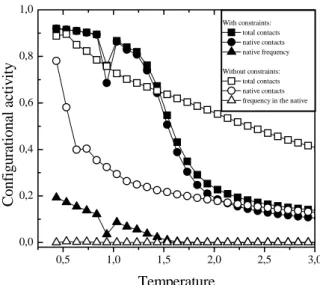
Figure 9. The chain configurational activity as a function ofkBT. Solid and open marks refer to the system with and without con-straints (steric specificities), respectively. The solid and open squares (¥ and✷) represent the normalized average number of total contacts for the unconstrained (Ψu) and constrained (Ψc) system, respectively; the solid and open circles (•and◦) repre-sent the normalized average number of native contacts for the con-strained (Ψ(n)c )and unconstrained (Ψ(n)u ) system, respectively; and the solid and open triangles (Nand △)are the relative frequency in the native state for the constrained (Φc)and unconstrained (Φu) system, respectively.
configurations from the most compact ones is severely re-duced, which explains the sharp peak observed in the heat
capacity curve. Such peak indicates that the chain’s inter-nal energy and entropy exhibit a jump, rapidly changing its corresponding amounts for temperatures aboutT =Tmax.
Now, let us consider the behavior of the average rela-tive number of narela-tive contacts for constrainedΨ(cn)and un-constrainedΨ(un)systems. For the unconstrained one, a rela-tively low value for the average native contacts is observed for most temperatures, as shown in Fig. 9 (open circles). But for low enough temperatures, when the globule is very compact, namely forΨu >0.8,the average number of na-tive contacts is significantly enlarged, withΨ(un)quickly ap-proachingΨu but still Ψ(
n)
u < Ψu. A close look at the configurational evolution along the simulation showed that, even though very compact, that isΨu > 0.8, the globule shows significant malleability: the amountΨ(un) oscillates intermittently between 15 and 80%, whereas the instanta-neousΨuchanges continuously from 60 to 100%.
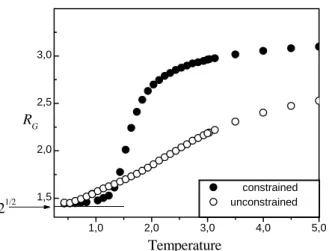
Now, for the constrained system, the number of native contacts Ψ(cn) (solid circles in Fig. 9) closely follows Ψc (solid squares). ForT < Tκ, almost all contacts are na-tive, that is, the conditionΨ(cn)= Ψcis practically satisfied; but even for temperatures as high askBT > 2most of the contacts are native contacts, as displayed by Fig.9. This re-sult should be understood as an effect of steric specificities: forkBT > 1.5 the radius of gyration for the constrained system is significantly larger than that for the unconstrained one [16], as depicted in Fig. 10. So, in average, many chain contacts are local contacts, but such contacts are restricted by the steric constraints that favor the native ones because of the design of sequence. This result also indicates that steric constraints work as a folding guide, inducing the chain to native contacts, even at higher temperatures aboveTmax.
As a remarkable result, we point out that at the peak of heat capacity, kBTmax ≃ 1.5,the average number of na-tive contacts approaches 50%, that isΨ(cn) ≃ 1/2;Fig.9. Therefore,Tmax can be seen as the temperature that sepa-rates two distinct behaviors of the configurational activity: belowTmax,the configurational activity –limited by steric constraints and relatively small thermal fluctuations– de-fines a compact globular shape for the chain (Ψc > 1/2), and quickly becomes denser for smaller temperatures, as for increasing temperatures aboveTmaxthe chain’s globular shape is destroyed because, at this moment, the distended configurations are statistically more significant.
Finally, we analyze the relative frequencyΦat which the chain is found in the native state. It is the ratio Φ =φ(n)/φ
between the numberφ(n)of times the chain was found in
Howe-100 Brazilian Journal of Physics, vol. 34, no. 1, March, 2004
1,0 2,0 3,0 4,0 5,0
1,5 2,0 2,5 3,0
21/2 RG
constrained unconstrained
Temperature
Figure 10. The radius of gyration RG as a function of kBT. For the constrained system, at low temperatures corresponding tokBT .1.3, RGis reduced with respect to the unconstrained system owing to the synergism between energetic (local) minima and topological restrictions. But, above kBT = 1.3the Boltz-mann factor becomes systematically less influential and so the steric constraints considerably affect the original configurational space, swelling the globule. As the steric specificities do not allow many of the local contacts, this effect persists even forT → ∞.
ver, if appropriate steric interactional specificities are intro-duced, they work as a type of topological labyrinth for the native configuration . This configurational barrier increases its efficiency asT decreases fromTmax,and so the relative frequencyΦc in the native state (solid triangles) assumes significant values, reaching 10% aboutkBT = 1; numeri-callyΦcis at least five orders of magnitude larger thanΦu. Note that just atTκ, the valueΦc is smaller than the curve tendency should suggest, which agrees with the comments above, regarding heat capacity.
The same effect on the heat capacity was observed for all CSA target structures, characterized by distinct contact orderχand other topological attributes of the native struc-ture, simulated through unfolding (and also some folding) computational experiments
Results qualitatively equivalent to those described here were observed for many CSA target structures studied[17]. These target structures used in the unfolding (and also some folding) computational experiments were selected in order to cover the entire range of topological attributes, as con-tact order χ. It was observed that the temperature Tmax
of the peak of heat capacity, as well as its values at Tmax
change withχ. As a rule, Tmaxslightly increases with χ,
but other topological characteristics also may be influential, such as the number of structural patterns resembling sec-ondary structures. Yet, with respect to the constrained sys-tem discussed here, the time to reach the native state for the first time is smaller thanTmax, quickly becoming larger as the temperature deviates above or bellow it.
4
Coments and conclusion
In the present work, the hydrophobic effect and classical thermodynamic results of protein folding / unfolding are used as evidence to propose entropic forces and steric
con-straints as two basic ingredients for the folding process;
these premisses emphasize water as the protagonist of the folding process. The entropic forces, or hydrophobic ef-fect, are originated from the versatility of water molecules in re-arranging themselves, as well as their surroundings, in order to minimize the loss of hydrogen bonds. The combi-nation of chemical specificities (polar, nonpolar and neuter residues) and steric interactional specificities of the residues (size and shape), encoded along the chain, are employed here in two simplified (lattice and off-lattice) models; the results from Monte Carlo simulations are compared against properties of real proteins, such as its native structures and characteristic thermodynamic fundamental behavior. First, an off-lattice model is employed to estimate the effective-ness of entropic forces in producing a malleable globule and driving the chain through configurations that intermittently approach the native conformation. Then, a lattice model is used to show that contact energy based in pure hydropho-bic potentials may be efficient, indeed, in packing the chain and in finding the native structure, and also to confirm that this kind of energetic interaction fails to provide configu-rational stability to the globule. A heuristic set of steric specificities is then added to the hydrophobic potential and it is shown that such steric interactional specificities help to select folding pathways and improve the overall stability condition of the globule, in the native structure. Through comparisons between two sets of Monte Carlo simulation results, it is shown that suitable steric specificities dramati-cally change the system’s configurational activity. This ef-fect has the following consequences: (i)– it transforms the original broad curve of the heat capacity, obtained using a pure hydrophobic-type potential as pair contact energy, into a peaked and symmetric curve; and (ii)– it significantly in-creases the frequency in which the chain stays in the native state in five or more orders of magnitude.
L.F.O. Rochaet al. 101
protected from the medium and, as the competition with the solvent is minimized, they effectively contribute to the glob-ule stability; additionally, the overall steric complementari-ness of the residues increases the internal contact area (in-creasing the dispersion forces), at the same time that it re-duces the external contact with the solvent, also producing a net contribution for the stability of the globule.
Acknowledgments
This work was supported, in part, by grant from FAPESP, Proc. No. 00/12107-4.
References
[1] W. Kauzmann, Nature 325, 763 (1987).
[2] N.T. Southall and K.A. Dill, Phys. Chem.B 10(6), 139 (2000).
[3] N.T. Southall, K.A. Dill, and D.J. Haynet; J. Phys. Chem. B
106, 521 (2002).
[4] C. Tanford, The hydrophobic effect John Wiley and Sons, New York, 1980.
[5] D. Chandler, Nature 417, 491 (2002).
[6] K. Lum, D. Chandler and J. D. Weeks; J. Phys. Chem B 103, 4570 (1999).
[7] M. Daune, Molecular Biophysics - Structures in motion Ox-ford University Press, New York, 1999.
[8] M. Karplus and E. Shakhnovich in: Protein Folding, ed. by T.E. Creighton, W.H.Freeman and Company, New York, (1992), cahpter 4.
[9] 1P. L Privalov in: Protein Folding, ed. by T.E. Creighton, W.H. Freeman and Company, New York, (1992), chapter 3.
[10] J.C. Nelson, J.G. Saven, J.S. Moore, and P.G. Wolynes, Sci-ence 277, 1793 (1997).
[11] J.A. Schellman, Biophys. J. 73(6), 2960 (1997).
[12] L.P. Privalovi, Adv. Prot. Chem. 33, 167 (1979).
[13] M.E.P. Tarrag´o, L.F.O. Rocha, R. A. da Silva and A. Caliri, Phys. Rev. E, 67, 031901 (2003).
[14] A.F.P de Araujo, PNAS 96, 12482 (1999).
[15] R. A. da Silva, M.A.A. da Silva and A. Caliri, J. Chem. Phys.
114, 4235 (2001).
[16] A. Caliri and M. A. A. da Silva, J. Chem. Phys. 106, 7856 (1997).