Multiple Scattering Theory for Pion-Nucleus Elastic Scattering and the In-Medium
π
N
Amplitude
A.S. Shalaby1, M. Y. M. Hassan2, and M. M. H. El-Gogary2
1Physics Department, Faculty of Science, Beni Suef University, Egypt. 2Physics Department, Faculty of Science, Cairo University, Egypt
Received on 5 December, 2006
Elastic scattering of positive and/or negative pions (π+ and/orπ−) by nuclei has been studied by means of Glauber’s multiple scattering theory (GMST). The differential, total and total elastic cross sections using both the full series expansion and the first order correction (called optical limit results, OLA) of the Glauber amplitude, have been calculated. The in-mediumπNamplitude (σe f f.,σe f f.) as well as the freeπNone (σf ree,
σf ree) are invoked into the full series calculations of the Glauber amplitude and our results were compared with
the corresponding experimental data. These calculations are carried out for the elastic collisions,π−−
2He4at
incident energy 180 MeV,π±−
3Li6at 240 MeV,π−−6C12at incident energies 180, 200 and 260 MeV,π+− 8O16at 240 and 270 MeV andπ±−20Ca40at energy 292.5 MeV. The comparisons reflect that, except around
the minima, the full series calculations with the in-mediumπNamplitude are better in describing the scattering data than those using the freeπNone and both are better than the optical limit results.
Keywords: Glauber’s multiple scattering theory; Differential cross section; Total cross section; Total elastic cross section; In-mediumπNamplitude.
I. INTRODUCTION
The interaction of pions with nuclei has been actively stud-ied for about twenty years [1-4]. The main focus of this ef-fort to date has been to work at energies at or below the pion production threshold, which occurs for the pion-nucleon (πN) interaction atπkinetic energies of∼175 MeV. At these en-ergies, the basicπNinteraction is completely elastic which is under discussion here. The elastic interaction of pions with finite nuclei and with nuclear matter is of considerable theo-retical interest for a number of reasons [5]. We are dealing here with one of the few examples of multiple scattering by a nucleus of an elementary particle projectile, the main other example of which is provided by the nucleon-nucleus interac-tion. Even as a more repetition of the latter with a different interaction, theπnuclear multiple scattering would therefore be of interest. In particular, theπnuclear interaction is, how-ever, of such a qualitatively different structure compared to the nucleon one, that it must be considered to be of interest in its own right. Also, its connection to the basic processes is clearer and more immediate than in the case of nucleons. Moreover, the absence of poles in the low energy (πN) scat-tering as well as the short range of the (πN) interaction opens the possibility of establishing a very transparent connection between the elementary scattering and the πN scattering, a connection which unfortunately is not so direct in the case of nucleons. The small recoil corrections in the pion case and the absence of a pion spin are also technical advantages compared to nucleons.
A great deal of low energy pion-nucleus elastic scattering data has been accumulated [6-12]. For the most part, the data were obtained for positive pions scattering from nuclear tar-gets spanning a wide range of the periodic table in order to map out general features of elastic scattering. These experi-ments indicate that in the low energy region, the pion mean free path is long and pions penetrate to the nuclear interior [13].
Various authors have investigated pion-nucleus scattering for the purpose of studying nuclear structure and the pion-nucleon interaction inside the nucleus [14, 15]. The main purpose of such investigations is to understand the mean field encountered by the pion while traversing the target nucleus. This field is usually described in terms of either multiple scat-tering processes which depend upon the nuclear charge dis-tributions [16-25] or the complex optical model (OM) poten-tial [26-30]. We will restrict ourselves here to the first one where the projectile undergoes multiple scatterings during its passage through the nucleus. Two independent multiple scat-tering theories have been used to describe the pion elastic scatterings from nuclei. The first is called Watson’s multi-ple scattering theory (WMST) [31-33], the second is the well known Glauber’s multiple scattering theory (GMST) [17-23, 34, 35], which is under discussion here. The theory is based on high-energy Eikonal approximation, in which the interact-ing particles are almost frozen in their instantaneous positions during the passage of the projectile through the target and the trajectory is nearly straightforward. However, because the Glauber theory is principally derived for the higher en-ergy and the small-angle situations, the reliability of its results may be questioned in the case of low energy and large angle. The GMST has the great advantage of leading to straightfor-ward calculations of the elastic pion-nucleus scattering cross-sections from knowledge of free pion-nucleon scattering am-plitude and nuclear densities.
The preliminary applications of GMST were found to have great successes in reproducing the hadron-nucleus scattering data [36-44]. The confidence in this theory encouraged the extension of its application to nucleus-nucleus collisions [45-57].
Following the same procedures as that utilized in our pre-vious works [58, 59] which takes into account the hadron as a projectile, we have studied in our present paper the elastic scattering of positive and/or negative pions (π+and/orπ−) by
different nuclei, like,2He4,3Li6,6C12,8O16and20Ca40at
expansion and the first order correction of the Glauber ampli-tude.
Correlations within the nucleus are of fundamental theoret-ical interest but unfortunately they are difficult to study ex-perimentally. In pion-nucleus scattering they manifest them-selves through a change of the effective pion-nucleon cross section via the so called in-medium πN amplitude [60-64]. Goldberger [65] suggested that the effective total nucleon-nucleon cross section σ(e f f1) of a bound nucleon is less than that of free nucleon because the Paula principle forbids mo-mentum transfer, to a bound nucleon, less than a minimum value sufficient to bring it outside the Fermi sea [66]. The re-lation betweenσ(e f f1) andσas quoted by Goldberger is given byσ(e f f1) =σ³1−7EF
5E ´
whereEF =38.4 MeV which
corre-sponds to Fermi momentumKF=1.38 fm−1and E is the
ki-netic energy of the incident nucleon. Abul-Magd et al. [67] considered that the effective NN scattering amplitude implies that σ(e f f2) +1=α2+1/³1−7EF
5E ´
. However, Glauber [17] and Faldt et al. [68] argued that the effective nucleon-nucleon cross sectionσ(e f f2) should be larger than the free one. It was shown by Glauber that the Pauli correction imply an effective cross sectionσ(e f f2) =σ′(1+xσ′)[66, 69]. This relation is the
golden rule that used in high-energy physics,σ′=σ(1−iα)
is the free pion-nucleon cross section including real and imag-inary parts. The actual numerical value ofxis very much de-bated. As a guide one often uses the result of the Fermi-gas model [17] which givesx∼= KF2
10π ≈0.06 fm−2. It is helpful to study the effect of the in-medium correction on our results.
The present paper contains three more sections. Section II, contains the theoretical expressions used to calculate the differential, total and total elastic cross sections for the con-sidered reactions. Section III includes the results and their discussions. The conclusion is given in section IV. The orbits, lengths and∆-matrices required for carrying out the calcula-tions are exhibited in the appendix.
II. THEORETICAL FRAMEWORK
This section is devoted to obtain the expressions for the dif-ferential (dσ/dΩordσ/dt), total (σT) and total elastic (σel)
cross-sections for the elastic scattering of pion (π+and/orπ−) with light- and medium-weighted nuclei using Glauber’s mul-tiple scattering theory. These expressions are developed by using both the full series expansion of the Glauber ampli-tude and by taking into account the consistent treatment of the center-of-mass (c.m.) correlation.
In this theory, the elastic scattering amplitude between a pion of atomic number ”Zπ” and a target nucleus of mass num-ber ”B” and atomic numnum-ber ”ZB” is given as [48]
FπB(~q) = ik 2πΘ(~q)
Z
d~bexp(i~q·~b){1−exp(iχπB(~b))} (1)
where,~q is the momentum transferred from the pion to the target nucleus B,~kis the incident momentum of the pion, and
~bis the impact parameter vector. Θ(~q)is the center-of-mass
correlation function [48]. χπB(~b)is the phase-shift function
resulting from the interaction of the pion with the target nu-cleus B.
By taking into account the Coulomb phase-shift function in addition to the nuclear one, we can write
χπB(~b) = χn(~b) +χC(~b)
= χn(~b) +χCpt(~b) +χEC(~b), (2)
whereχCpt(~b)is the point charge correction to the Coulomb phase-shift function, which is equal to 2nln(b
2a), a is equal
to 2kb1 , n=ZπZBe2/ℏvis the usual Coulomb parameter and χE
C(~b)is the extended charge correction to the Coulomb phase
shift function. χn(~b) is the nuclear interaction phase-shift
function.
From eqs. (1) and (2), we find
FπB(q) =Θ(~q) ·
fCpt.(q) +i
Z ∞
0 (
kb)2in+1{1−exp(iχE
C(~b) +iχn(~b))}Jo(qb)db ¸
. (3)
In eqs. (1) and (3), the center-of-mass correlation is treated as a global correction (denoted by Θ(~q)) multiplied by the scattering amplitude. Because of Θ(~q) has an exponential form ofq2[48], this leads to unphysical divergence asqgoes
to high values. The largeq-divergence is removed by incor-porating the center-of-mass correlation functionΘ(~q)in the first order calculations [45] or in the fourth order evaluations [47] or in the full series calculations [56], of the Glauber am-plitude. Such consistent treatment in the later case [56] has
modified the phase-shift functions to new forms, which are simply expressed in terms of the uncorrelated ones.
Thus, eqs. (1) and (3) become
FπB(~q) = ik 2π
Z
d~bexp(i~q·~b){1−exp(iχπ¯ B(~b))} (4)
FπB(q) =fCpt.(q) +i Z ∞
0
(kb)2in+1{1−exp(iχ¯E
C(~b) +iχ¯n(~b))}Jo(qb)db, (5)
where ¯χE
C(~b)is the modified extended charge correction to the
Coulomb phase shift function. ¯χn(~b)is the modified nuclear
interaction phase-shift function. (The bars are introduced to distinguish the modified quantities from their corresponding uncorrelated ones).
Assuming the target ground state wave function has the form:
ΨB({~rj}) =ξB(~RB)ΦB({~rintj }),~rintj =~rj−~RB, (6)
whereξB(~RB)andΦB({~rintj })are the wave functions
describ-ing the center-of-mass motion and the internal motion of the target nucleons, respectively.
Accordingly, the modified optical phase-shift function, ¯
χn(~b), can be written in terms of the uncorrelated phase-shift
function, ¯χn(~b), as [47] exp[iχ¯n(~b)] =
Z ∞
0
Jo(qb)Θ(q)qdq Z ∞
0
Jo(qb′)exp[iχ¯n(~b′)]b′db′,
(7) where
Θ(q) = [<ξB(~RB)|e−i~q·~RB|ξB(~RB)>]−1, (8)
and
exp[iχ¯n(~b)] =<ΨB({~r′j})|exp[iχn(~b,{~s′j})]|ΨB({~r′j})> .
(9)
{~s′j} are the projections of the position vectors {~r′j} of the target nucleons on the impact parameter plane. With the defi-nition of the profile function
Γn(~b) =1−exp[iχ¯n(~b)], (10)
the phase-shift function is given by
exp[iχ¯n(~b,~s′1,~s′2, ...,~s′B)] =
B
∏
j=1
[1−Γj(~b−~s′)], (11)
whereΓjrepresents the profile function of scattering between
the pion and the jth nucleon in the target nucleusB. It is re-lated to the pion-nucleon (πN) elastic scattering amplitude fj
by
Γj(~b) =
1 2πikπ
Z
d2qe−(i~q·~b)fj(~q), (12)
wherekπis the wave number of the incident pion.
Assuming for simplicity that all the πN amplitudes are equal (which is approximately true at high energy) and ne-glecting further spin effects, fjcan be parameterized by [56]
fj(~q) = kπσ
4π(i+ρ)e −aq2/2
, (13)
Here,σis the totalπN cross-section,ρis the ratio of the real to the imaginary parts of the forwardπNscattering am-plitude and “a” is taken to be complex; the real part is typically the slope parameter (β2) of theπNelastic scattering
differen-tial cross section while the imaginary part is a free parameter introducing a phase variation of theπNscattering amplitude, which is taken here to be zero.
Inserting eq. (13) into eq. (12), we obtain
Γj(~b−~s′j) =gexp[−(~b−~s′j)2/2a], (14)
with
g= σ
4πa(1−iρ).
To perform the integrations (8) and (9) analytically, con-sider the approximation in which the nucleons inside the tar-get nucleus are completely uncorrelated, then we can write
|ΨB|2=
∏
B j=1ρB(~e′j), (15)
whereρBis assumed to be of single-Gaussian type like,
ρB(~r) = ·α2
B π
¸3/2
exp(−α2Br2), (16)
where “αB” is related to the rms radius by αB=
p
3/2
·
1
<r2 B>1/2
¸
.
Adopting the wave function (15) with the density (16) and using the same analysis as that utilized in our references [55, 56] with the invoking of the description mentioned above, eq. (8) forΘ(q)yield [48]
Θ(q) =exp
·q2
4 1 Bα2
B ¸
, (17)
and eq. (9) after integrating over the variables x and y using the same procedures as that given in Ref. [57] with the can-celing out one of the Gaussians, gives the analytic result
exp[iχn] =1+ B
∑
µ λ
∑
muT(µ,λµ) B
∏
j=1
{Zo}∆1j(µ,λµ), (18)
whereZo, has the form
Zo=−gCBRo×exp(−Wob2),
CB = α2B/π, Ro = 4a2T1×
π2 a11(j,1)
, Wo=ao(j)−
C21(j,1) 4a11(j,1) T1 =
1 2a2(2a2α2
B+Ru(1,1))
, ao(j) =α2B
a11(j,1) = α2B+
1
2a2sg(1,1)−T1, g= σ
4πa(1−iρ) and C1(j,1) =2α 2 B,
where, the indices(µ,λµ)characterize an orbit with an order
of scatteringµand serial indexλµ.Ro,Wo,ao(j),a11(j,1)and C1(j,1)are independent on j, i.e., they are the same for all j. Obviously, Eq. (18) has an advantage in reducing the com-puter CPU time spent in the calculations by restoring Zo at ∆1j=0,1.
In the method of Yin et al.[49], each orbit(µ,λµ)is
rep-resented by a matrix∆(µ,λµ)with element∆1j(µ,λµ)either
equal to “1” or “0”. This matrix∆(µ,λµ)corresponds to one
typical term expressing the multi-cluster elementary collision and its element is equal to “1” ifΓ1jappears in the expansion
term and is equal to “0” if it is absent.T(µ,λµ)is the number
of repetitions (length) of the orbit(µ,λµ), which is determined
by using the properties of the permutation groupG1=S1⊗SB.
Here, “Ru” and “sg” are the row and column sum vectors of the corresponding orbit, respectively.
Eq. (18) is developed by taking the one-particle system as our cluster particle and hence,N1=B(i.e.,µ1: 1→B),N2=1
(i.e.,µ2=1),MA=MN =1,MB=B.
Incorporating the c.m. correlation, the modified phase-shift function, ¯χn(~b)can be expressed as
exp[iχ¯n(~b)] =1+
B
∑
µ
∑
λµT(µ,λµ) B
∏
j=1
{Z¯o}∆1j(µ,λµ). (19)
The form of ¯Zois obtained by inserting the expressions of ZoandΘ(q)into Eq. (7), yielding
¯
Zo=−gCBR¯o×exp(−W¯ob2), (20)
with ¯ Wo=
·
1 Wo
− 1 Bα2
B ¸−1
and R¯o=
Ro×W¯o Wo
.
Finally, the modified extended charge correction to the Coulomb phase-shift, ¯χE
C(~b), has already been derived
ana-lytically in Ref. [47] for a single-Gaussian density where it was found to have the form
¯ χE
C(~b) =nE1(b2/R¯2B), (21)
whereE1(z)is the exponential integral function and,
¯
R2B=R2B(1−B−1); R2B= 1 α2
B
With the results of eqs. (19), (20) and (21), the scattering amplitudeFπB(q)can be obtained by performing the
integra-tion in Eq. (5) numerically. The angular distribuintegra-tion of the elastic scattering is given by
dσ(q¯)
dΩ =|FπB(q¯)| 2
(22) The total elastic cross section,σel, is given by subtracting
the total reaction cross section “σR” from the total cross
sec-tion which is related to the forward scattering amplitude of the elastic scattering by the optical theorem as:
σtot=
4π
k ImFπB(q=0) (23) The reaction cross section is found to has the form [47, 70, 71]
σR=2π Z ∞
0 ³
1− |eiχ¯n(~b)|2´bdb (24)
σel=σtot−σR (25)
With the results of Eqs. (23) and (24), the total elastic cross section,σel, can be easily obtained from Eq. (25).
III. RESULTS AND DISCUSSION
In the framework of the formalisms presented in the above section, we have calculated the differential cross section for a set of elastic nuclear reactions; namely,π−−
2He4at
inci-dent energy 180 MeV,π±−3Li6at 240 MeV, π−−6C12 at
incident energies 180, 200 and 260 MeV,π+−8O16 at 240
and 270 MeV andπ±−
20Ca40 at energy 292.5 MeV. Also,
we have calculated the total cross section for the elastic colli-sions, namely;π+−
3Li6at incident energy 128 and 259 MeV, π+−6C12at 89 MeV,π+−20Ca40 at 292.5 MeV,π−−3Li6
at incident energy 115, 156 and 259 MeV,π−−6C12at
inci-dent energy 115, 120, 259, 260 and 289 MeV andπ−− 20Ca40
at 292.5 MeV. The total elastic cross section is evaluated for the elastic scattering ofπ−with
6C12at incident energies 180,
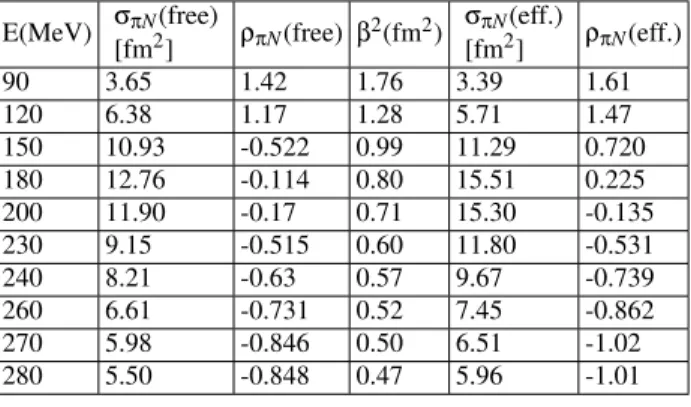
TABLE I: Parameters of the pion-Nucleon amplitude [69, 72].
E(MeV) σπN(free)
[fm2] ρπN(free) β
2(fm2) σπN(eff.)
[fm2] ρπN(eff.) 90 3.65 1.42 1.76 3.39 1.61 120 6.38 1.17 1.28 5.71 1.47 150 10.93 -0.522 0.99 11.29 0.720 180 12.76 -0.114 0.80 15.51 0.225 200 11.90 -0.17 0.71 15.30 -0.135 230 9.15 -0.515 0.60 11.80 -0.531 240 8.21 -0.63 0.57 9.67 -0.739 260 6.61 -0.731 0.52 7.45 -0.862 270 5.98 -0.846 0.50 6.51 -1.02 280 5.50 -0.848 0.47 5.96 -1.01
TABLE II: Nuclear rms radii. Nucleus 2He4 3Li6 6C12 8O16 20Ca40
<r2>1/2(fm) 1.71 2.45 2.453 2.71 3.50
Ref. [47] [58] [47] [47] [47]
G1=S1⊗SBandG2=S1⊗S1. For the above energies, we
used the values of theπNparameters given in Table (1). The values of the rms radii we have used for the present nuclei are given in Table (2).
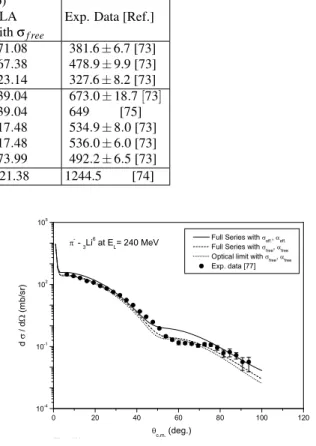
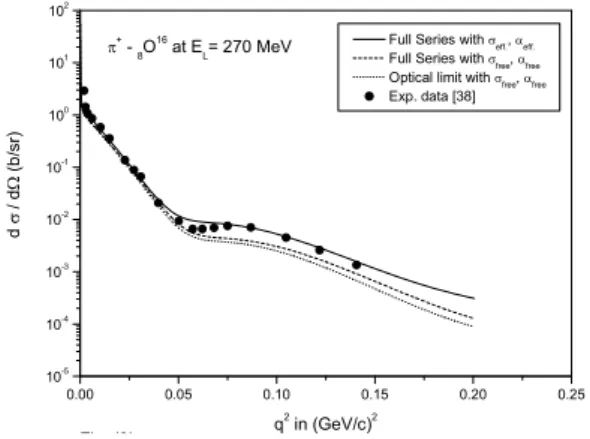
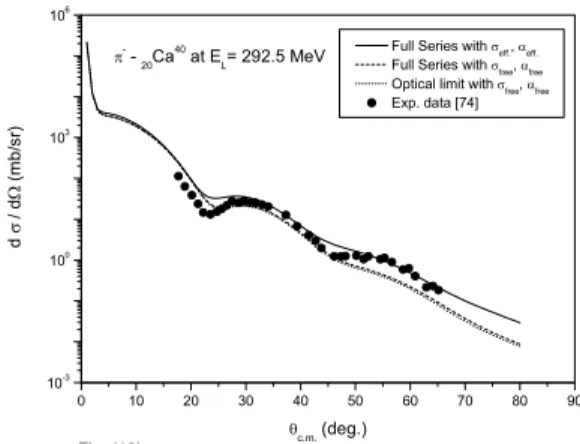
The structure specific to the considered reactions and the corresponding orbits, lengths and∆-matrices are exhibited in the appendix. The center-of-mass correlation is treated here in a consistent way in which its expressing function (Θ(q)) is incorporated in each order of the optical phase-shift expan-sion. Such function is found to have an exact form in the case of the employed single-Gaussian density [48]. To show to what extent the inclusion in-mediumπNscattering ampli-tude affects the angular distribution, we first evaluate it with the freeπN parameters (σf ree,σf ree). Second, we calculate
it with the effective πN ones (σe f f.,σe f f.). The results
ob-tained from these calculations for the considered reactions are shown in Figs. (1-10) as dashed and solid curves, respectively. Fig. 1 contains the results obtained forπ−−
2He4at 180 MeV.
We see from this figure that the predicted angular distribution obtained with the effectiveπNparameters (referred to as solid curve) is much better than that obtained using the freeπNones (referred to as dashed curve). Forπ±−3Li6reaction, the
re-sults obtained, Figs. 2, 3, show that except around the minima, the angular distributions calculated with (σe f f.,σe f f.) are
bet-ter in comparison with that evaluated with (σf ree,σf ree) ones.
In particular, the dashed curves reproduced well the positions of the minima while the solid curves reproduce more satis-factorily the backward angles in comparison with the results shown by the dashed curves. Forπ−−
6C12case, Figs. 4-6,
it is shown that the inclusion of the in-medium effect is more comprehensive in fitting the corresponding experimental data, especially at large angles than that neglecting it. Enlarging the mass of the target nucleus as in theπ+−8O16 reaction,
Figs. 7, 8, the improvement shown here in these figures by the solid curves in comparison with the dashed curves reflects the proper account for the full Glauber series calculation in
FIG. 1: Plots the differential cross section, (dσ/dΩ), versus scatter-ing angle for the elastic scatterscatter-ing ofπ−with2He4at incident energy
180 MeV. The solid curve represents the full series calculations with the in-mediumπNamplitude, the dashed curve represents the full se-ries calculations with freeπNamplitude, the dotted curve represents the first order calculations with freeπNamplitude. The dots are the experimental data.
FIG. 2: The same as Fig. 1 but forπ+with3Li6at incident energy
240 MeV.
addition to the inclusion of the in-mediumπNscattering am-plitude. Forπ±−
20Ca40reaction, Figs. 9, 10, one can easily
see that the in-medium calculations of the angular distribu-tions are still better than that using the free parameters. As we referred before [58, 59] that the use of density distribu-tion more suitable than that employed in our calculadistribu-tions may improve our results. This will be the subject of future work.
TABLE III: A comparison of the total cross-section (σT) results from this work and the corresponding experimental data, for the elastic
scattering ofπ+with some of the considered stable nuclei at different energies.
Nucleus Energy (MeV)
σT(mb)
Full series withσf ree
OLA withσf ree
Exp. Data [Ref.]
3Li6 128259 380.29331.59 371.08323.14 397.7328.1±±13.1 [73]7.3 [73]
6C12 89 464.94 458.24 501.3±24.9 [73] 20Ca40 292.5 1246.85 . 1221.12 1234.3 [74]
TABLE IV: A comparison of the total cross-section (σT) results from this work and the corresponding experimental data, for the elastic
scattering ofπ−with some of the considered stable nuclei at different energies.
Nucleus Energy (MeV)
σT(mb)
Full series withσf ree
OLA withσf ree
Exp. Data [Ref.]
3Li6
115 156 259
380.29 481.00 331.59
371.08 467.38 323.14
381.6±6.7 [73] 478.9±9.9 [73] 327.6±8.2 [73]
6C12
115 120 259 260 289
657.18 657.18 529.91 529.91 485.86
639.04 639.04 517.48 517.48 473.99
673.0±18.7[73]
649 [75] 534.9±8.0 [73] 536.0±6.0 [73] 492.2±6.5 [73]
20Ca40 292.5 1246.86 . 1221.38 1244.5 [74]
TABLE V: A comparison of the elastic cross-section (σel) results
from this work and the corresponding experimental data, for the elas-tic scattering ofπ−with6C12at different energies.
Energy (MeV)
σT(mb)
Full series withσf ree
OLA withσf ree
Exp. Data [Ref.]
180 245.24 235.57 247±11 [29] 200 233.78 224.39 241±11 [29] 230 221.88 211.46 225±17 [29] 260 198.54 187.34 212±18 [29] 280 185.10 . 173.82 199±18 [29]
terms at large momentum transfers.
As an additional check, we have calculated the total cross section (σtot) for the elastic scattering ofπ+ and/orπ−with 3Li6,6C12and20Ca40, and total elastic cross section (σel) for π−−
6C12 at different incident energies. The results of the
calculated total and total elastic cross-sections and the corre-sponding experimental data are listed in Tables (3-5). One can easily see from these tables that the full series calculations for the total and total elastic cross-sections are much better than that calculated by the optical limit approach. This ensures the necessity of including the full multiple scattering series of the Glauber amplitude.
IV. CONCLUSION
In the framework of Glauber’s multiple scattering theory and taking into account the Coulomb contribution and a con-sistent treatment of the center-of-mass (c.m.) correlation, we
FIG. 3: The same as Fig. (1) but forπ−with
3Li6at incident energy
240 MeV.
have investigated the elastic scattering of positive and /or neg-ative pions by nuclei, like,2He4,3Li6,6C12,8O16, and20Ca40
at intermediate energies. We have calculated the differential, total and total elastic cross sections for the considered reac-tions. These calculations are carried out by considering the followings; (i) The full series expansion of the Glauber ampli-tude with freeπNparameters (σf ree,σf ree), (ii) The first order
correction of the Glauber amplitude (OLA) with freeπN pa-rameters (σf ree, σf ree), (iii) The full series expansion of the
Glauber amplitude with the in-mediumπNparameters (σe f f.,
σe f f.). We compared our results with the corresponding
FIG. 4: The same as Fig. (1) but forπ−with6C12at incident energy
180 MeV.
FIG. 5: The same as Fig. (1) but forπ−with
6C12at incident energy
200 MeV.
describing the scattering data rather than that using the free πN one. Also, one can easily see that the full series calcu-lations of the Glauber amplitude are relatively better than the optical limit result (OLA), especially at backward angles.
An overall view of the results shown before, we empha-size that the full series expansion of the Glauber amplitude
FIG. 6: The same as Fig. (1) but forπ−with
6C12at incident energy
260 MeV.
FIG. 7: The same as Fig. (1) but forπ+with8O16at incident energy
240 MeV.
FIG. 8: The same as Fig. (1) but forπ+with
8O16at incident energy
270 MeV.
is not sufficient to bring the Glauber theory closer to the ex-perimental data. It must consider some corrections like; in-mediumπN amplitude, phase-variation parameter of theπN scattering amplitude which has its strongest effect around the diffraction patterns, more realistic density distribution like harmonic-oscillator density. The last two corrections will be
FIG. 9: The same as Fig. (1) but forπ+ with20Ca40 at incident
FIG. 10: The same as Fig. (1) but forπ− with
20Ca40 at incident
energy 292.5 MeV.
done in our future work.
V. APPENDIX
This appendix contains tables in which we present the or-bits, lengths and - matrices employed in our calculations. We obtained them by enumerating and investigating all pos-sible combinations of collisions according to their permuta-tion using the method introduced in Ref. [49]. In the present work, the elastic collisions,π−−
2He4,π±−3Li6,π−−6C12, π+−8O16 andπ±− 20Ca40 have been studied. Each
reac-tion according to its assumed cluster structure needs the or-bits, lengths and∆-matrices of the groupsG1=S1⊗SBand G2=S1⊗S1(defined in chapter II). For the sake of brevity,
we give only the tables of the non-similar groups.
Total number of orbits (including the orbits not shown) = 4. Total number of orbits (including the orbits not shown) = 6. Total number of orbits (including the orbits not shown) = 12.
Total number of orbits (including the orbits not shown) = 16.
Total number of orbits (including the orbits not shown) = 40.
Total number of orbits (including the orbits not shown) = 1. In these tables, the first column represents the order of mul-tiple scattering which ranges from 1 to 1×nwhileλµin the
second column represents the serial index used to number the
orbits of orderµ. The third column represents the length of the orbitT(µ,λµ). In the fourth column the 1×n- digit
bi-nary numbers give the∆-matrices of the groupG=S1⊗Sn.
Then-digits are the elements∆1i,i=1,2, ...,n.
Table 1. Orbits, lengths and∆-matrices forG1=S1⊗S4.
µ λµ T(µ,λµ) ∆(µ,λµ)
1 2
1 1
4 6
1000 1100
By symmetry, the orbits, lengths and ∆-matrices for µ’s which are not shown in our tables could be easily deduced
Table 2. Orbits, lengths and∆-matrices forG1=S1⊗S6.
µ λµ T(µ,λµ) ∆(µ,λµ)
1 2 3
1 1 1
6 15 20
100000 110000 111000
Table 3. Orbits, lengths and∆-matrices forG1=S1⊗S12.
µ λµ T(µ,λµ) ∆(µ,λµ)
1 2 3 4 5 6
1 1 1 1 1 1
12 66 220 495 792 924
100000000000 110000000000 111000000000 111100000000 111110000000 111111000000
from the Tables. This is carried out by using the results for order µ′ =m×n−µ and interchanging the 0’s and 1’s of ∆(µ′,λµ′). The indicesλµandλµ′ are the same and the lengths
T(µ,λµ)andT(µ′,λµ′)are equal. The matrix∆(n,1)has
ele-ments∆1jequal to 1.
Table 4. Orbits, lengths and∆-matrices forG1=S1⊗S16.
µ λµ T(µ,λµ) ∆(µ,λµ)
1 2 3 4 5 6 7 8
1 1 1 1 1 1 1 1
16 120 560 1820 4368 8008 11440 12870
1000000000000000 1100000000000000 1110000000000000 1111000000000000 1111100000000000 1111110000000000 1111111000000000 1111111100000000
[1] C. H. Q. Ingram, in proceedings of the Ninth International Con-ference on High Energy Physics and Nuclear Structure, edited by P. Catillon, P. Radvanyi, and M. Porneuf (North-Holland, Amsterdam, 1982).
[2] R. A. Eisenstein, in proceedings of the Workshop on Nuclear and particle Physics at Energies up to 31 GeV; New and Fu-ture Aspects, edited by J. D. Bowman, L. S. Kisslinger, and R. R. Silbar, Los Alamos National Laboratory Report LA-8775-C, 1981.
[3] R. H. Landau, in proceedings of the English International Con-ference on High Energy Physics and Nuclear Structure, edited by D.F. Measday and A. W. Thomas (North-Holland, Amster-dam, 1979).
[4] D. Marow et al., Phys. Rev. C30, 1662 (1984).
[5] M. Ericson and T. E. O. Ericson, Ann. Phys. (N.Y.) 36, 323 (1966).
Table 5. Orbits, lengths and∆-matrices forG1=S1⊗S40.
µ λµ T(µ,λµ) ∆(µ,λµ)
1 2 3 4 5 6 7 8 9 10 11 12 13 14 15 16 17 18 19 20 1 1 1 1 1 1 1 1 1 1 1 1 1 1 1 1 1 1 1 1 40 780 9880 91390 658008 3838380 18643560 76904685 2.7343888E8 8.4766053E8 2.3118014E9 5.5868535E9 1.2033223E10 2.320693E10 4.0225345E10 6.2852102E10 8.8732379E10 1.1338026E11 1.3128241E11 1.3784653E11
1000000000000000000000000000000000000000 1100000000000000000000000000000000000000 1110000000000000000000000000000000000000 1111000000000000000000000000000000000000 1111100000000000000000000000000000000000 1111110000000000000000000000000000000000 1111111000000000000000000000000000000000 1111111100000000000000000000000000000000 1111111110000000000000000000000000000000 1111111111000000000000000000000000000000 1111111111100000000000000000000000000000 1111111111110000000000000000000000000000 1111111111111000000000000000000000000000 1111111111111100000000000000000000000000 1111111111111110000000000000000000000000 1111111111111111000000000000000000000000 1111111111111111100000000000000000000000 1111111111111111110000000000000000000000 1111111111111111111000000000000000000000 1111111111111111111100000000000000000000
Table 6. Orbits, lengths and - matrices forG2=S1⊗S1.
µ λµ T(µ,λµ) ∆(µ,λµ)
1 1 1 1
[8] S. A. Dytman et al., Phys. Rev. C19, 971 (1979). [9] R. R. Johnson et al., Phys. Lett. B43, 844 (1979). [10] S. H. Dam et al., Phys. Rev. C25, 2574 (1982).
[11] M. Blecher et al., in proceedings of the Ninth International Con-ference on High Energy Physics and Nuclear Structure, Ver-sailles, 1981, edited by P. Catillon, P. Radvanyi, and M. porneuf (North-Holland, Amsterdam, 1982).
[12] F. E. Obenshain et al., in proceedings of the Ninth Interna-tional Conference on High Energy Physics and Nuclear Struc-ture, Versailles, 1981, edited by P. Catillon, P. Radvanyi, and M. porneuf (North-Holland, Amestrdam, 1982).
[13] M. Blecher et al., Phys. Rev. C28, 2033 (1983).
[14] D. S. Koltun,Interaction of pions with nuclei, Advances in Nu-clear Physics, Vol.3(Academic Press, New York, 1970). [15] H. K. Lee and H. McManus, Nucl. Phys. A167, 257 (1971). [16] C. Schmit, Nuovo Cimento Lett.4, 454 (1970); K. Bjornenak
et al., Nucl. Phys. B22, 179 (1970).
[17] R. J. Glauber, Boulder lectures in theoretical physics (Inter-science, New York, 1959) 315;High-Energy Physics and Nu-clear Structure(North-Holland, Amsterdam, 1967) 311. [18] M. M. Sternheim, Phys. Rev.135, B912 (1964). [19] G. Faldt and T. E. O. Ericson, Nucl. Phys. B8, 1 (1964). [20] G. Faldt, Nucl. Phys. B10, 597 (1969).
[21] C. Michael and C. Wilkin, Nucl. Phys. B11, 99 (1969). [22] T. T. Chou, Phys. Rev.168, 1594 (1968).
[23] K. Bjornenak et al., Nucl Phys. B20, 327 (1970).
[24] Li Qing-run, Chen Sheng-zhong, and Zhao En-guang, Physica Energiae Fortis et Physica Nuclearis5, 531 (1981).
[25] Li Qing-run, Chen Sheng-zhong, and Zhao En-guang, Nucl. Phys. A384, 466 (1982).
[26] L. S. Kisslinger, Phys. Rev.98, 761 (1955).
[27] W. F. Baker, H. Byfield, and J. Rainwater, Phys. Rev.112, 1773 (1958).
[28] E. H. Auerbach, D. M. Fleming, and M. M. Sternheim, Phys. Rev.162, 1683 (1967).
[29] F. Binon et al., Nucl. Phys. B17, 168 (1970). [30] M. Krell and S. Barmo, Nucl. Phys. B20, 461 (1970). [31] K. M. Watson, Phys. Rev.89, 575 (1953).
[32] N. C. Francis and K. M. Watson, Phys. Rev.92, 291 (1953). [33] K. M. Watson, Phys. Rev.105, 1388 (1957).
[34] K. Bjornenak et al., Nucl Phys. B22, 179 (1970). [35] W. Czyz, Adv. Nucl. Phys. to be published.
[36] R. J. Glauber and G. Mathiae, Nucl. Phys. B21, 135 (1970). [37] C. Wilikin, Nuovo Cimento Lett.4, 491 (1970).
[38] H. Lesniak and L. Lesniak, Nucl. Phys. B38, 221 (1972). [39] J. P. Auger and R. J. Lombard, Phys. Lett. B45, 115 (1973); G.
Igo, inHigh-Energy Physics and Nuclear Structureedited by D.E. Nagle et al. (AIP, New York, 1975), p. 63.
[40] V. Franco, Phys. Rev. C8, 1690 (1974). [41] W. Czyz, Adv. Nucl. Phys.4, 61 (1971).
[42] R. H. Bassel and C. Wilikin, Phys. Rev.174, 1179 (1968). [43] R. J. Glauber, in proceeding of the Second International
Confer-ence on High-Energy Physics and Nuclear Structure, Rehovoth, 1967, edited by G. Alexander (North-Holland, Amsterdam, p. 311, 1967).
[44] R.J. Glauber, in proceeding of the Third International Confer-ence on High-Energy Physics and Nuclear Structure, Colubia, 1967, edited by S. Devons (Plenum, New York, p. 207, 1970). [45] V. Franco and A. Tekou, Phys. Rev. C16, 658 (1977). [46] G. K. Varma, Nucl. Phys. A294, 465 (1978).
[47] V. Franco and G.K. Varma, Phys. Rev. C18, 349 (1978). [48] W. Czyz and L.C. Maximon, Ann. Phys. (N.Y.)52, 59 (1969). [49] Yichun Yin et al., Nucl Phys. A440, 685 (1985).
[50] Y. Yin et al., Chinese Phys.6, 93 (1986); Phys. Ener. Fort. Phys. Nucl.9, 569 (1985).
[51] V. Franco, Y. Yin, Phys. Rev. C34, 608 (1986).
[52] Zhen-Qiang Tan, Zheng-Jin Lin, Pan-Ning Yan, and Chong. En Wu, J. Phys. G16, 1697 (1990).
[53] Zong-Jin Lin, Shu-Xia Yu, Xiang Zhong Huang, and Chong-En Wu, J. Phys. G17, 1159 (1991).
[56] M. M. H. EL-Gogary et al., Phys. Rev. C61, 044604 (2000). [57] Huang Xiang Zhong, Phys. Rev. C51, 2700 (1995). [58] A. S. Shalaby, Egypt. J. Phys.35, 163 (2004). [59] A. S. Shalaby, Egypt. J. Phys.35, 481 (2004).
[60] G. Q. Li and R. Machleidt, Phys. Rev. C48, 1702 (1993). [61] G. Q. Li and R. Machleidt, Phys. Rev. C49, 566 (1994). [62] T. Alm et al., Nucl. Phys. A587, 815 (1995).
[63] Cai Xiang-zhou et al., Phys. Rev. C58, 572 (1998). [64] E. Friedman et al., Phys. Rev. C72, 034609 (2005). [65] M. L. Goldberger, Phys. Rev.74(1949) 1269. [66] I. M. A. Tag Eldin et al., J. Phys. G16, 1051 (1990). [67] A. Y. Abul-Magd et al., Can. J. Phys.58, 1230 (1980). [68] G. Faldt and A. Ingemarsson, J. Phys. G9, 261 (1983). [69] G. Faldt, Nucl. Phys. A202, 403 (1973).
[70] I. J. Thompson and Y. Suzuki, Nucl. Phys. A693, 424 (2001). [71] B. Abu-Ibrahim and Y. Suzuki, Phys. Rev. C62, 034608 (2000). [72] M. P. Locher, O. Steinmann, and N. Straumann, Nucl. Phys. B
27, 598 (1971).
[73] A. S. Clough et al., Nucl. Phys. B76, 15 (1974).
[74] S. A. E. Khallaf and A. A. Ebrahim, Phys. Rev. C65, 064605 (2002).
[75] Li Qing-Run, Nucl. Phys. A415, 445 (1984).
[76] Tsung-Shung H. Lee, Soumya Chakravarti, Phys. Rev. C16, 273 (1977).