Valence-Shell Angle-Resolved Electron Energy Loss Spectra of SF
6M.L.M. Rocco*a, C.A. Lucasa, H.M. Boechat-Robertyb, A.I. da Silva Jr.c,
and G.G.B. de Souzac
a
Instituto de Química, Universidade Federal Fluminense, Morro do Valonguinho,
24020-150 Niterói - RJ, Brazil; b
Observatório do Valongo, Universidade Federal do Rio de Janeiro, Ladeira Pedro
Antônio 43, 20080-090 Rio de Janeiro - RJ, Brazil c
Instituto de Química, Universidade Federal do Rio de Janeiro, Cidade Universitária,
Ilha do Fundão, 21949-900 Rio de Janeiro - RJ, Brazil
Received: September 2, 1997
Espectros de perda de energia de elétrons foram obtidos para a molécula de hexafluoreto de enxofre na região da camada de valência (0 a 100 eV) com uma variação angular de 1.0° - 15.0°. Os espectros foram medidos para uma energia de impacto de 1 keV. O estudo com variação angular sugere a presença de três transições proibidas na região de energia abaixo de 40 eV. Acima de 40 eV, estruturas interessantes aparecem para maiores ângulos de espalhamento podendo estar asso-ciadas a processos multieletrônicos proibidos. Uma nova estrutura foi observada em 76 eV. A seção de choque elástica absoluta foi obtida através de normalização dos dados relativos com valores experimentais encontrados na literatura. As seções de choque diferenciais inelásticas absolutas foram obtidas para as transições em 11,5 eV e 13,2 eV. A força do oscilador generalizada (FOG) foi determinada para a transição em 11,5 eV no intervalo de K2 entre 0,05 e 1,3 u.a.. O valor experimental da força do oscilador óptica (0,312) para o pico em 11,5 eV, obtido através de extrapolação da curva da FOG, mostra boa concordância com dados da literatura.
Electron-energy-loss spectra of the SF6 molecule have been measured in the valence-shell region
(0 - 100 eV) covering an angular range of 1.0° - 15.0°. The spectra have been measured at an impact energy of 1.0 keV. The angular dependence of the spectra showed the presence of three forbidden transitions in the region below 40 eV. Above 40 eV interesting features appear at higher scattering angles, which can be associated to nondipole many-body processes. A new feature was observed at 76 eV. The absolute elastic differential cross section has been obtained through normalization of the relative data to the experimental values found in the literature. The absolute inelastic differential cross sections for the 11.5 eV and 13.2 eV transitions have been determined. The generalized oscillator strength (GOS) for the 11.5 eV peak has been also determined in the 0.05 to 1.3 a.u. K2 range. The experimentally determined value for the optical oscillator strength (0.312) for the 11.5 eV peak obtained through extrapolation of the GOS curve showed good agreement with the data found in the literature.
Keywords:sulphur hexafluoride, electron energy loss spectroscopy, forbidden transitions, generalized oscillator strength
Introduction
Electron-energy-loss spectroscopy (EELS) has already proved to be a powerful technique in the study of valence
and inner-shell electronic excitations. A great number of atoms and molecules have been studied using the electron impact technique at low and high-resolution conditions1-3. Article
Near zero scattering angle and at high incident electron energies the First Born Approximation (FBA)4 is valid, and electrons behave like pseudophotons5. As a consequence, the electron energy loss spectra are similar to photoabsorp-tion spectra. In fact, under these condiphotoabsorp-tions the energy-loss spectrum shows the same excitation features, but with the relative intensities equal to the Eon-3 times the observed intensities in the optical spectrum, where Eon is the electron energy-loss (which corresponds to the photon excitation energy). This consequently means that although the ob-served features in both spectra will be the same, their relative intensities will be different. A small angle, high incident energy EELS spectrum will consequently furnish essential information on the photoabsorption processes of a given atomic or molecular target4. Moreover, it is also possible, using a single experimental set-up, to measure absorption data covering a broad energy range extending from the ultraviolet to the X-ray range. This is a very useful feature even when compared to synchrotron radiation measurements, which are usually plagued with harmonic contamination. Electron impact spectra obtained at non-zero scattering angles may additionally furnish invaluable spectroscopic information about dipole-forbidden elec-tronic transitions in the valence as well as in the inner-shell excitation regions6. This is a major advantage of this tech-nique over other conventional spectroscopic techtech-niques. Despite the great spectroscopic potentiality of this tech-nique, only a few groups have dedicated their efforts to the study of the angular dependence of valence and core exci-tations induced by electron impact.
In the present paper we address our attention to the SF6 molecule. Although this molecule has been the focus of many studies based on the use of photons7-10 and elec-trons11-13, the first angle-resolved EELS measurements for this compound were published by Ying et al.13 at an impact energy of 2.5 keV. In this work absolute absorption transi-tion probabilities of valence-shell (7-70 eV) electronic transitions have been determined covering an angular range up to 8.5°. With the aim of exploring the valence and inner-valence excitation regions of the SF6 molecule and with the aim of elucidating the still controversial discussion about the assignment of the experimental features, its spec-tra have been studied using the angle-resolved electron impact technique at 1.0 keV incident energy. The energy-loss range extends from zero to 100 eV and the angular range from 1.0° to 15.0°. Using the absolute elastic differ-ential cross section, our data were normalized and the GOS-curves for the 11.5 eV and 13.2 eV transitions were determined.
Experimental
The experimental apparatus used for the present meas-urements has been described elsewhere in detail14,15. Basi-cally it consists of a rotatable electron gun, a neutral gas
beam, a Möllenstedt electron velocity analyser16 fixed on the vacuum chamber wall and a conventional detection system. A crossed-beam geometry is used for the electron-gas collision. The electron beam, produced by a triode-type electron gun, is used without prior energy selection. A typical beam current is 10 µA and the beam diameter, measured at the scattering region, is approximately 0.5 mm. The gas beam is produced by the expansion of a given sample inside the scattering chamber through a hypodermic needle with a 0.2 mm internal diameter.
The scattered electrons are velocity analyzed by the Möllenstedt analyzer and detected by an electron multiplier (Spiraltron, Galileo Electro Optics). The energy resolution of this system was set to 0.6 eV, as determined by the full width at half maximum (FWHM) of the elastic peak. The analyser viewing cone is determined by two parallel, circu-lar apertures of 200 and 50 µm diameter, located, respec-tively, at 120 and 150 mm from the scattering center. The stray magnetic fields in the plane of the measurements have been reduced to less than 10 mG in all directions by three pairs of orthogonal Helmholtz coils.
The residual pressure is of the order of 10-6 torr. When the gas sample is introduced into the scattering chamber the pressure is raised one order of magnitude. For each angle, the spectra are continuously recorded until a good signal to noise ratio is achieved. The background is corrected by subtracting another spectrum, obtained at the same experi-mental conditions, but with the gas sample introduced at a side flange, far from the scattering center. The energy-loss scale is calibrated by using the well-known transition 1s-2p of He at 21.22 eV. The scattering zero-degree angle was checked by measuring the elastic peak area over a 15° range on both the right-hand and left-hand sides with respect to the electron analyzer main geometrical axis. Although a precision mechanism allows the determination of the scat-tered angle with an accuracy of 0.02°, our angular resolu-tion, defined by the set of apertures in front of the Möllenstedt analyzer, is limited to 1.0° in the present experiment. The experimental uncertainties are estimated in the following manner. The maximum statistical uncer-tainty was 1.5%. Fluctuations in the primary beam current and on the sample pressure were of the order of 1.0% and 0.5% respectively. The determination of the area of the peak is also subject to a 2% error. The elastic cross section which was used in the normalization procedure24 has an associated uncertainty of 8%. The overall uncertainty δ, defined as δ = (Ε δi 2)1/2, is equal to 9%, including the error in the extrapolation of the GOS-curve, which was of 5%.
Results and Discussion
The SF6 molecule, as it is well known, belongs to the Oh symmetry point group. The accepted valence electronic configuration for this molecule is13:
(4a1g)2 (3t1u)6 (2eg)4 (5a1g)2 (4t1u)6 (1t2g) 6 (3e
g)4 (1t2u)6 (5t1u)6 (1t1g)6
The experimentally determined ionization potentials are respectively17,18:
44.2; 41.2; 39.3; 27.0; 22.9; 19.8; 18.6; 17.0; 15.7
Figure 1 shows the valence-shell electron energy loss spectrum of the SF6 molecule at the scattering angle of 1.5°, covering the 2-50 eV energy range. Several spectral fea-tures can be observed. The assignment of these feafea-tures has been discussed in detail earlier7-13,19-21. They may be attrib-uted to transitions from the ten valence orbitals into unoc-cupied molecular orbitals and/or Rydberg orbitals, although some discussion still exists in the literatureon the nature of these final states. Some points related to this situation will be addressed below as we discuss our angle-resolved electron energy loss data.
The angular dependence of the valence-shell spectra (2-50 eV) is shown in Fig. 2. The angular range is from 1.5° to 5.5°. Several spectral changes can be observed as the scattering angle, θ, is increased, i.e., as the momentum transfer is increased. The intensity of features located at
11.5 eV, 16.0 eV, 17.0 eV, 19.5 eV and 23.0 eV clearly decreases with increasing scattering angle. On the other hand, features at 13.2 eV and 28.0 eV show an opposite behaviour i.e. they become more intense as the momentum transfer increases. This opposite behaviour demonstrates the different nature of the processes involved in these transitions. The decrease in the relative intensities of these features with momentum transfer suggests a dipole-al-lowed nature for these transitions, while the increase in the relative intensities with momentum transfer could suggest a nondipole nature associated to the transitions.
Recently Ying et al.13 have measured angle-resolved valence-shell (7-70 eV) spectra of the SF6 molecule at an impact energy of 2.5 keV. Comparison to our data shows however some discrepancies concerning the nature of the transitions. Firstly the feature at 23.0 eV of Fig. 2, which shows, as mentioned before, an allowed behaviour, is con-sidered by Ying et al.13 to have nondipole character. It has been however assigned by Sze and Brion12 as having a contribution from the [1t2u,5t1u] → 2t2g and 5a1g → 6t1u allowed transitions. A nondipole behavior is to be expected for the feature at 28.0 eV, which shows a prominent in-crease in intensity as the scattering angle approaches 5.5° (see Fig. 2). The 28.0 eV peak has been assigned to the 4t1u → 2t2g transition12,13.
In disagreement with the work of Ying et al.13, we observe a strong increase in intensity as the momentum transfer increases for the the 13.2 eV transition, indicating
Figure 2. Angle-resolved electron energy-loss spectra of the SF6 mole-cule measured at 1.0 keV and covering the angular range of 1.5° to 5.5°. Figure 1. Electron energy-loss spectrum of the SF6 molecule measured
a nondipole character. Trajmar and Chutjian21 have also observed a forbidden transition at the same excitation en-ergy, working at large scattering angles and very low impact energies. The experimental value of 12.8 eV meas-ured by these authors has been assigned as the 1t1g → 7a1g forbidden transition20. Sze and Brion12 have also observed a very weak structure at about 12.5 eV in their spectrum measured at 3.0 keV and 0°. They have suggested a forbid-den character for this feature. The theoretical work of Hay22 also predicts a nondipole transition to fall into this energy range.
Although many different studies have been performed on the valence-shell region of the SF6 molecule, most are however concentrated in the 10-40 eV energy range8-11, only a few extending to about 60 eV12 or 70 eV as in the recent work of Ying et al.13. None of them, with exception of the work of Ying et al.13, has measured the angular dependence of the valence spectra. The region below 10 eV, has received little attention and has not been studied using angle-resolved EELS, shows the intensification of the band located at about 6 eV in Fig. 2 as the momentum transfer increases. This behaviour could suggest the exist-ence of a dipole-forbidden transition. A feature located at 6.494 eV was observed as a very weak structure in the work of Sze and Brion12, although no possible assignment was suggested by these authors.
Another interesting region in the study of the valence excitations of the SF6 molecule is the region above 40 eV shown in Fig. 3. This is a very complex energy region because not only one-electron processes are allowed but also processes involving more than one electron. All double ionisation potentials lie in this region. A more detailed discussion of the excitation processes appearing in this high energy domain will be presented in a forthcoming publica-tion23.
Figure 3 shows the valence-shell spectrum of the SF6 molecule at higher scattering angles and covering the en-ergy range of 2-100 eV. Above 40 eV three new features can be observed. The fact that they are not observed at small angles could indicate a forbidden nature for these features. The band at about 44 eV was measured by Sze and Brion12 and Ying et al.13, although its assignment is controversial. While a 3t1u → 2t2g transition was assigned by Sze and Brion12, a forbidden character (5a
1g→ 4eg) was suggested by Ying et al.13. Our data corroborate the nondipole char-acter of this transition. The feature at about 60 eV was first observed by Ying et al.13 and attributed to a nondipole many-body transition. Although very weak, it can be ob-served by higher θ in Fig. 3. The feature at about 76 eV in Fig. 3 was observed for the first time. It can be also related to nondipole processes although its assignment is very difficult without help from first principle calculations.
The relative experimental inelastic differential cross sections for the 11.5 eV and 13.2 eV peaks have been made absolute using the elastic differential cross section (EDCS), which was normalized to the absolute elastic differential cross section found in the literature24. In this procedure the interpolation was done using the absolute curve at the scattering angle of 10.5°. At this angle our cross section value was made equal to the absolute value obtaining thus the normalization factor. The experimental elastic differen-tial cross section was measured over a 15° angular range and at an impact energy of 1 keV. Figure 4 shows the absolute elastic differential cross section for the SF6 mole-cule plotted together with the absolute curve. These results are also presented in Table 1 as a function of the scattering angle θ. From these values, it was possible to determine the absolute inelastic differential cross sections for the 11.5 eV and 13.2 eV transitions, which are shown as a function of the scattering angle θ in Fig. 5 and Table 2.
It is now possible to obtain the absolute generalized oscillator strength for both transitions in SF6. Within the First Born Approximation (FBA), the generalized oscilla-tor strength, fon (K), is directly associated to the differential
inelastic cross section (dσ/dΩ)on for the excitation of an atomic or molecular target from the ground state o to an excited state n through the expression4:
Table 1. Elastic Differential Cross Section for the SF6 molecule.
θ EDCS (a02/sr)
This work Dallavalli24
1.5 739.54
2.0 527.13
2.5 451.94
3.5 286.05
4.5 165.12
5.5 81.40
6.5 39.53
7.5 17.05
8.5 13.95
9.5 13.95
10.0 16.37
10.5 15.50
11.5
12.0 19.37
12.5 18.61
13.5 16.28
14.0 16.15
14.5 14.73
15.5 13.18
16.0 10.90
18.0 7.33
20.0 6.51
22.0 6.18
24.0 4.54
26.0 2.72
20.0 1.92
30.0 1.85
32.0 1.71
Figure 4. Absolute elastic differential cross section of SF6 as a function of the scattering angle θ.
Table 2. Absolute Inelastic Differential Cross Section for the 11.5 eV and 13.2 eV transitions in SF6.
Scattering angle (deg.)
Inelastic differential cross section (a.u.)
11.5 eV 13.2 eV
1.5 24.3 11.15
2.5 4.5 4.2
3.5 1.6 1.7
4.5 0.11 0.54
5.5 0.042 0.29
7.5 0.074 0.077
fon(K) = Eon
2 ( k i
k f )
K 2 ( dσ
dΩ)on (1)
where Eon is the excitation energy, K is the momentum transfer, K = ki - kf, and ki and kf are respectively the initial
and the final momentum vectors for the scattering electron. The GOS is independent of the incident energy at energies for which the FBA is valid. Lassettre and Skerbele25 have additionally demonstrated that the GOS tends to the optical oscillator strength (OOS) in the K2 = 0 (optical) limit.
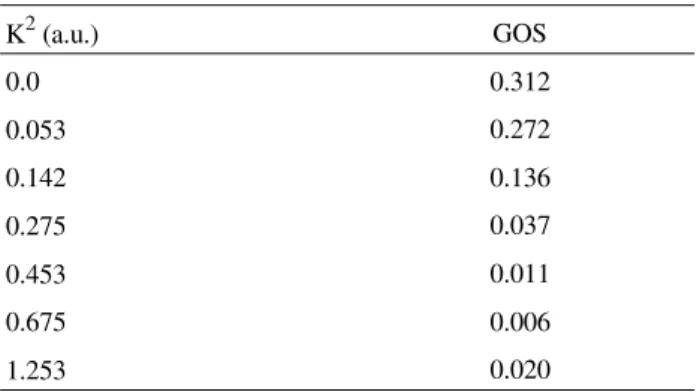
As a first step in the determination of the GOS, the area of the 11.5 eV and 13.2 eV peaks were obtained through a standard deconvolution procedure15. The ratio between the areas of the inelastic and (absolute) elastic peak was deter-mined in the 1.5° to 8.0° angular range. From these values it was possible to determine the GOS using Eq. 1. This method has been successfuly employed in the determina-tion of the GOS values for several atoms and molecules15. A recent theoretical analysis, based on the use of an univer-sal extrapolation formula for the GOS26, has shown, for example, that our experimental values extrapolate nicely to the optical oscillator strength for the C 1s transition in the CO2 molecule27. The absolute GOS results are presented in Fig. 6 and Table 3 as a function of K2. The GOS-curve as a function of K2 was extrapolated to K2 = 0 using the universal formula of Msezane and Sakmar28. A value of 0.312 was obtained for the optical oscillator strength from the data of Fig. 6 for the 11.5 eV transition. This result shows good agreement with the photoabsorption data of Blechschmidt et al.7 (0.33) and Lee et al.8 (0.20) and also with the EELS data of Hitchcock and van der Wiel11 (0.21) and Ying et al.13 (0.23).
In the 0.0 to 1.4 a.u. K2 range, comparison with the experimental results of Ying et al.13 shows a reasonable agreement only at K2 = 0.0139 a.u. (θ = 0.5o) and K2 = 1.13 a.u. (θ = 4.5o). At the moment no additional explanation can be furnished as to the observed disagreement at K2 = 0.349 a.u. (θ = 2.5o)29.
In the case of the 13.2 eV curve (see Fig. 6), a different behavior is observed.Due to the absence of enough experi-mental points covering the K2 range smaller than 0.2 a.u., it can not be definitively concluded that the GOS curve tends to zero as the scattering angle decreases. However, based on the experimental data of Figs. 2 and 3 and also on the discussion previously presented, it seems reasonable to reinforce the dipole-forbidden character of such a transi-tion.
Conclusions
Angle-resolved EELS data have been measured for the valence-shell region (0-100 eV) of the SF6 molecule at an impact energy of 1.0 keV. At large scattering angles non-dipole transitions have been identified, in agreement with previously published results. Particularly above 40 eV,
three bands associated with forbidden processes involving many-body excitations were observed. A band at 76 eV has been observed for the first time. The absolute generalized oscillator strength for the 11.5 eV excitation has been determined in the K2 range from 0.05 to 1.3 a.u. and a value of 0.312 for the optical oscillator strength was derived. The absolute elastic differential cross section has also been determined, through normalization of the relative data us-ing the absolute data found in the literature. The absolute inelastic differential cross sections for the 11.5 eV and 13.2 eV transitions have been also determined.
Figure 6. Generalized oscillator strength (GOS) as a function of K2 for the 11.5 eV and 13.2 eV transitions in SF6. The experimental data of Ying
et al.13 are also presented (see text).
Table 3. Generalized Oscillator Strength for the 11.5 eV transition in SF6.
K2 (a.u.) GOS
0.0 0.312
0.053 0.272
0.142 0.136
0.275 0.037
0.453 0.011
0.675 0.006
Acknowledgments
The authors gratefully acknowledge the financial help from the Financiadora de Estudos e Projetos (FINEP) and Fundação de Amparo à Pesquisa do Rio de Janeiro (FAPERJ). M.L.M. Rocco and G.G.B. de Souza would like to acknowledge the Conselho Nacional de Desen-volvimento Científico e Tecnológico (CNPq) for support.
References
1. Brion, C.E. In Invited Papers of the Twelfth Interna-tional Conference on the Physics of Electronic and Atomic Collisions; Datz, S., Ed.; North-Holland; Am-sterdam, 1982.
2. King, G.C. In Wavefunctions and Mechanisms from Electron Scattering Processes; Gianturco, F.A. and Stefani, G., Ed.; Springer Verlag; Berlin, 1984. 3. King, G.C.; Read, F.H. In Atomic Inner Shell Physics;
Crasemann, B., Ed.; Plenum; New York, 1985. 4. Inokuti, M. Rev. Mod. Phys.1971, 43, 297.
5. Brion, C.E. Comments At. Mol. Phys.1985, 16, 249. 6. Shaw, D.A.; King, G.C.; Read, F.H.; Dvejanovic, D.
J. Phys. B 1982, 15, 1785.
7. Blechschmidt, D.; Haensel, R.; Koch, E.-E.; Nielsen, U.; Sagawa, T. Chem. Phys. Lett.1972, 14, 33. 8. Lee, L.C.; Phillips, E.; Judge, D.L. J. Chem. Phys.
1977, 67, 1237.
9. Sasanuma, M.; Ishiguro, E.; Masuko, H.; Morioka, Y.; Nakamura, M. J. Phys. B 1978, 11, 3655.
10. Holland, D.M.P.; Shaw, D.A.; Hopkirk, A.; MacDon-ald, M.A.; McSweeney, S.M. J. Phys. B 1992, 25, 4823.
11. Hitchcock, A.P.; van der Wiel, M.J. J. Phys. B 1979,
12, 2153.
12. Sze, K.H.; Brion, C.E. Chem. Phys.1990, 140, 439. 13. Ying, J.F.; Daniels, T.A.; Mathers, C.P.; Zhu, H.;
Leung, K.T. J. Chem. Phys. 1993, 99, 3390.
14. De Souza, G.G.B.; Souza, A.C.A. J. Phys. E 1985, 18, 1037.
15. See for example: a) Bielschowsky, C.E.; De Souza, G.G.B.; Lucas, C.A.; Boechat-Roberty, H.M. Phys. Rev. A 1988, 38, 3405; b) Souza, A.C.A.; De Souza, G.G.B. Phys. Rev. A1988, 38, 4488; c) De Souza, G.G.B.; Bielschowsky, C.E.; Lucas, C.A.; Souza, A.C.A. Phys. Rev. A1990, 42, 1363.
16. Peixoto, E.M.A.; De Souza, G.G.B.; Santos, M.C.A.
Optik 1979, 53, 405.
17. Siegbahn, K.; Nordling, C.; Johansson, G.; Hedman, J.; Hedén, P.F.; Hamrin, K.; Gelius, U.; Bergmark, T.; Werme, L.O.; Manne, R.; Baer, Y. ESCA Applied to Free Molecules; Elsevier; New York, 1969.
18. Gelius, U. J. Electron Spectrosc. Relat. Phenom.
1974, 5, 985.
19. Dehmer, L.; Parr, A.C.; Wallace, S.; Dill, D. Phys. Rev. A1982, 26, 3283.
20. Robin, M.B. High Excited States of Polyatomic Mole-cules; Academic; New York, 1985.
21. Trajmar, S.; Chutjian, A. J. Phys. B 1977, 10, 2943. 22. Hay, P.J. J. Am. Chem. Soc.1977, 99, 1013.
23. De Souza, G.G.B.; Rocco, M.L.M.; Boechat-Roberty, H.M. in preparation.
24. Dallavalli, M.J. Ph.D. Thesis, Universidade Federal de São Carlos, São Carlos, São Paulo, 1997; Nogueira, J.C.; Dallavalli, M.J. Proceedings of the Latin Ameri-can School of Physics; World Scientific, 1991; p. 371. 25. Lassettre, E.N.; Skerbele, A. Meth. Exp. Phys.1974,
3, 868.
26. Fomunung, I.W.; Chen, Z.; Msezane, A.Z. Phys. Rev. A1996, 53, 806.
27. Boechat-Roberty, H.M., Bielschowsky, C.E.; De Souza, G.G.B. Phys. Rev. A1991, 44, 1694.
28. Msezane, A.Z.; Sakmar, I.A. Phys. Rev. A 1994, 49, 2405.