*e-mail: [email protected]
Effect of Porogenic Solvent on Selective Performance
of Molecularly Imprinted Polymer for Quercetin
Xingliang Songa,b, Jiangtao Wanga, Jin Zhuc*
a
Ocean University of China, Qingdao, Shandong 266100, China
bLinyi Normal University, Linyi, Shandong 276005, China
c
YTC America Inc., Camarillo, CA 93012, USA
Received: November 18, 2008; Revised: May 13, 2009
Molecularly imprinted polymers (MIP’s) for quercetin were successfully synthesized by a thermal polymerization method using quercetin as template molecule, acrylamide as functional monomer and ethylene glycol dimethacrylate as cross-linker in the presence of four different porogenic solvents: 1,4-dioxane, tetrahydrofuran (THF), acetone, and acetonitrile.The selective performance of obtained MIP’s was evaluated through HPLC analysis. The results indicated that the MIP obtained in THF showed the highest capacity and selectivity. The Scatchard method also supported HPLC results. The results were interpreted by computational quantum chemical analysis through Onsager self-consistent reaction field (SCRF) technique in term of stabilization energy. It was also found that the amount of porogenic solvent used had impact on the adsorption effectiveness of MIP’s.
Keywords:quercetin, molecularly imprinted polymer, porogenic solvent, computational quantum chemical analysis
1. Introduction
Recently, molecular imprinting technique (MIT) becomes one of most powerful methods to determine and separate natural products. The principle of MIT is to utilize the functional groups on a target mol-ecule (also called template molmol-ecule) interacting with complementary functional groups of appropriate functional monomers to assemble its own recognition site, and then this site is “frozen” by polymer-izing functional monomers with a high concentration of cross-linker. Subsequent removal of the template molecule by extraction creates a binding site with the precise spatial arrangement of the functional groups1. This polymeric material will re-bind with template molecule
at high selectivity and affinity constants. The obtained polymer is called molecularly imprinted polymer (MIP). Since it was invented by Wuff et al. in 1972[2], MIT has been potentially used in many
ap-plications such as chiral molecule separation3, biosensor4, biochemical
separation5,6, antibody simulation7, enzyme catalysis simulation8, and
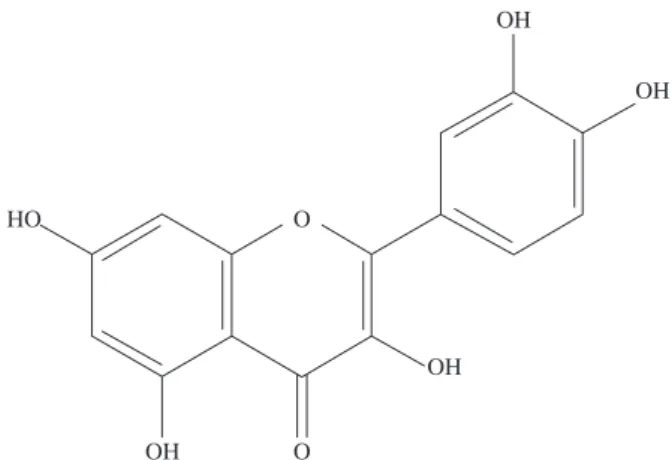
so on. Quercetin (3,3’, 4, 5, 7- penta-hydroxy flavone) is a member of the flavonols subclass and is considered one of the most eminent flavo-nol compounds occurring in wine (see Figure 1). It is the most active compound in flavone class and widely exists in leaves, fruits, and flowers of many plants9. Quercetin is a natural antioxidant because its
hydroxyl groups attached to the aromatic rings can quench the active free radical10. Since it has low concentration and structural similarity
to other flavonols in natural states, it is very difficult to determine and separate. There were some reports on quercetin determination and separation by MIT. Weiss et al. reported that MIP for quercetin was prepared by using quecertin as template molecule, 4-vinylpyridine as functional monomer and ethylene glycol dimethacrylate as cross-linker1. The prepared MIP showed high effectiveness on quercetin
separation. Yan et al. also prepared an effective MIP for quercetin by using acrylamide as a functional monomer11. He et al. reported
the effectiveness of MIP’s prepared by using different functional monomers such as methacrylic acid, acrylamide, and 2-vinylpridine
and found the effectiveness of MIP’s for quercetin was varying with different functional monomers12. The dispersion solvent (porogenic
solvent) was also important for making effective MIP’s because the solvent has different interactions with template molecule and with functional monomers. These interactions will strongly impact on the structure formation of MIP’s and further affect the recognition and separation of the MIP’s for template molecules.
In this paper, we will report the effect of porogenic solvents on MIP separation for quercetin and interpret the results through compu-tational quantum chemical analysis. MIP’s for quercetin will be pre-pared using quercetin as template molecule, acrylamide as functional monomer and ethylene glycol dimethacrylate as cross-linker in the presence of four different porogenic solvents: 1,4-dioxane, tetrahy-drofuran, acetone, and acetonitrile. HPLC and Scatchard method will be used to evaluate the effectiveness of MIP’s for quercetin. Onsager self-consistent reaction field (SCRF) technique will be used to cal-culate the stabilization energy of the porogenic solvents on template molecule, functional monomer and obtained polymer.
2. Experimental
2.1. Chemicals
Quercetin was purchased fromShanghai Sinopharm
Chemi-cal Reagent Co., Ltd. Acrylamide (AA) was supplied from Tianjin Chemical Research Institute.Ethylene glycol dimethacrylate (EGD-MA) was purchased from Sigma–Aldrich (Taufkirchen, Germany). 2,2’-Azo-bisisobutyronitrile (AIBN) was obtained from Shanghai Chemical Reagent Company. Tetrahydrofura, acetone, acetonitrile, 1,4-dioxane, methanol and anhydrous acetic acid were all from Merck (Darmstadt, Germany).The control solution (20 µg·mL–1) of quercetin
300 Song et al. Materials Research
2.2. HPLC analysis
The HPLC-analysis was performed using EasySepTM-1010
HPLC (UnimicroTechnologies Co., Ltd., Shanghai) with a 1010LC liquid delivery pump and a 1010UV ultraviolet/visible variable wavelength detector with a spectral range from 190 to 700 nm. Column was C-18 column (2.1 × 250 mm). Mobile phase was acetonitrile – 0.1 wt. (%) H3PO4 water solution (36:64, V/V), and the column was rinsed with it until a stable baseline was obtained. The detection was carried out with UV at 365 nm. Column oven temperature was controlled at 25 °C. The total flow-rate was main-tained at 0.5mL/min and 20 µL sample was injected.
2.3. Preparation of molecularly imprinted polymer
11In four corked test tubes were respectively added 5 mL porogenic solvents of 1,4-dioxane, THF, acetone and acetonitrile labeled with sample number of P1, P2, P3 and P4. In above four test tubes were added 0.13 g template molecule quercetin (0.4 µmol) and 0.2 g functional monomer acrylamide (2.8 µmol). After the test tubes were shaked in SHA-B Water Bath Isothermal Shaker for half hour, 3.5 mL cross-linker EGDMA (18.5 µmol) and 0.01 g initiator AIBN were added. After degassed for 15 minutes, the test tubes were filled with nitrogen and sealed. The test tubes were immersed into isothermal water bath and the mixtures were thermally polymerized at 60 °C for 24 hours The resulted polymers were then grinted and sieved through 105 µm sieve. To remove template molecule quercetin, the polymer particles were extracted with the mixture of methanol and acetic acid (9:1, V/V) in Soxhlex extractor for 24hours. The extracted polymer particles were then extracted with methanol to remove acetic acid. Finally, the polymer particles (MIP) was dried at 60 °C under vacuum for 24 hours and stored in a desiccator for further use. Four MIP’s were obtained with sample number of P1 (1,4-dioxane), P2 (THF), P3 (acetone) and P4 (acetonitrile). As references, non-imprinted molecular polymers (NMIP’s) were prepared following the same pro-cedure but without addition of template molecule. The corresponding NMIP’s were labeled with number of P5 (1,4-dioxane), P6 (THF), P7 (acetone) and P8 (acetonitrile). The compositions of MIP’s and NMIP’s were shown in Table 1.
2.4. Adsorption determination of MIP’s and NMIP’s for
quercetin
In eight 50 mL Erlenmeyer flasks were respectively added 100 mg of sample P1, P2, P3, P4, P5, P6, P7, and P8. They were then added 25 mL quercetin-methanol solution with concentration of 20 µg.mL–1.
Themixtures were shaked in SHA-B Water Bath Isothermal Shaker.
Every 2 hours, 20 µL solution was taken out for HPLC analysis to measure the concentration of quercetin and determine the adsorption of quercetin in different times.
2.5. Computational quantum chemical analysis
According to calculation method of Gaussian 98® B3LYP/6 -31+ G**,
the stabilization energy of quercetin and acrylamide with different sol-vents was obtained through calculating the interaction energy in gas and solvent. The simulation of solvent effect is based on the Onsager self-consistent reaction field (SCRF) technique13, which supposes that
the solute molecule is embedded into a spherical cavity with radius a0 surrounded and the solvent is represented by a continuous dielectric, characterized by a given dielectric constant. The gas-phase geometry of molecule quercetin and functional monomer is used as its initial guess to start the full optimizations at the same level of B3LYP/6-31+ G** with different dielectric constants of porogenic solvents 2.25, 7.58, 20.7 and 37.5. A radius a0 automatically resorted from quantum mechanical procedures. After stationary points were located, vibrational frequencies were calculated in order to ascertain that each structure was characterized to be the stable structure (no imaginary frequencies). The stabilization energy by solvents is calculated as Esolvation = Ein solvent–Ein gas. The Esolvation
is the stabilization energy by solvents, the relative energy of a complex in a solvent to that in the gas phase. The stabilization energy by solvent was used to evaluate the interaction strength of quercetin with solvent, and acrylamide with solvent. All calculations were carried out with the Gaussian98® program on a Pentium® computer using the default
convergence criteria.
3. Results and Discussion
3.1. Preparation of MIP’s
MIP’s for quercetin were prepared according to literature11, which
reported a successful MIP obtained by using acrylamide as functional monomer, ethylene glycol dimethacrylate (EGDMA) as cross-linker and THF as porogenic solvent through thermal polymerization method. Acrylamide was selected as functional monomer because its MIP showed more adsorption effectiveness for quercetin than other functional monomers such as methacrylic acid11. The ratio of
querce-tin and acrlyamide also affected the effectiveness of adsorption. The MIP obtained at ratio of 1:7 showed the best adsorption for quercetin. 2,2’-Azo-bisisobutyronitrile (AIBN) was used as free radical initiator because its half-life time at 60 °C is around 10 hours14 and was proper
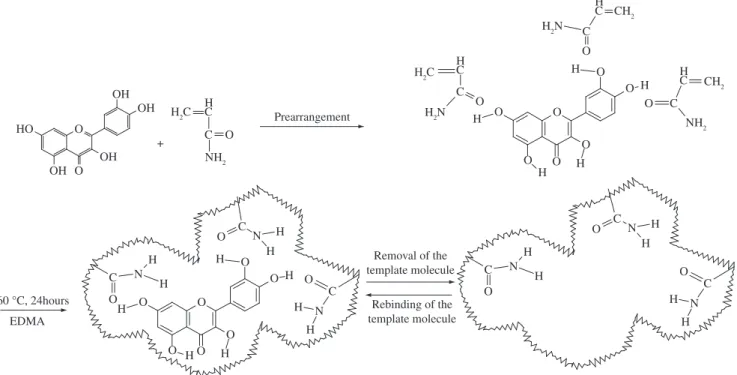
for polymerization time. In order to evaluate the effect of porogenic solvent on the formation of MIP, four porogenic solvents were selected with different polarity. The dielectric constants of 1,4-dioxane, THF, acetone, and acetonitrile are 2.25, 7.58, 20.7 and 37.5, respectively. The generated imprinted polymers and non-imprinted polymers were summarized in Table 1. The synthesis process of MIP can be described in Figure 2. In quercein molecule, there are five hydroxyl groups and one carbonyl group. These groups can form hydrogen bonds with functional groups such as hydroxyl, amino and carbonyl group. In this study, acrylamide was used as functional monomer. During the formation of MIP, amide group of acrylamide will com-bine with template molecule (quercetin) through hydrogen bonds. This spatial structure will be “frozen” after acrylamide polymerizing and cross-linked by EGDMA. Since the hydroxyl groups on carbon number 3 and 5 on quercetin molecule have strong intramolecular hydrogen bonds with carbonyl group on carbon number 4. Only three hydroxyl groups have intermolecular hydrogen bonds with polymer and control the precise imprinting sites. After removal of template molecule, the specific imprinting sites will be maintained. These sites will selectively adsorb quercetin molecule.
3.2. Adsorption of MIP’s and NMIP’s for quercetin
Among the falconoid, quercetin has five hydroxyl groups at-tached to the aromatic rings, along with the electronic delocalization throughout the whole system, which results from the formation of stable radicals10. As commonly known, hydrophobic interactions are
one of the binding mechanisms in order to efficiently recognize the template molecules during MIP selection process. Since the solubil-ity of quercetin in methanol was superior to most of other solvents, a certain concentration of quercetin solution in methanol was used. Quercetin removed MIP’s and NMIP were added into quercetin-methanol solution with the concentration of 20 µg·mL–1 for
adsorp-tion testing. After every two hours, 20 µL soluadsorp-tion was taken out and run HPLC analysis. The adsorption of quercetin would reduce the concentration of quercetin in methanol solution. As to HPLC analy-sis, acetonitrile –0.1 wt.(%) H3PO4 water solution (36:64, V/V) was chosen as aqueous mobile phase. Methanol was eluted first and did not have effect on quercetin separation.
The adsorption of quercetin onto MIP’s was due to precise site recognition and strong interaction between quercetin and functional
group on the imprinted sites. The interaction included van der Waals force and hydrogen bonds. The adsorption results were shown in Figure 3. It was found that the adsorption amount (Q) of quercetin on either MIP’s or NMIP’s was increasing with increasing adsorp-tion time. The adsorpadsorp-tions were fast in the first 6 hoursand then slow down after 10 hours. After 24 hours, assumed adsorption equilibrium was achieved. The fast adsorption in the first few hours was due to rapid recognition of quercetin onto imprinted sites on the surface. When these imprinted sites were occupied, it was becoming difficult for quercetin to penetrate into the polymer and find imprinted sites inside. This would cause the adsorption to slow down.
Although both MIP and NMIP showed similar trend on quercetin adsorption, the adsorption amount was very different. MIP adsorbed much more quercetin than NMIP. This was because MIP had a lot of spatial imprinted sites, which selectively adsorbed quercetin and NMIP has no imprinted sites. This result confirmed the effectiveness of MIP for quercetin. The morphology of MIP and NMIP can be measured by scanning electronic microscopy (SEM) or other methods to prove this observation and will be reported later.The imprinting
Figure 2. The synthesis process of MIP for quercetin.
Table 1. Feed composition of MIP’s and NMIP’s.
Sample# Quercetin/g Acrylamide/g EGDMA/mL (AIBN)/g Porogenic solvents
P1 0.13 0.2 3.5 0.01 1,4-Dioxane
P2 0.13 0.2 3.5 0.01 THF
P3 0.13 0.2 3.5 0.01 Acetone
P4 0.13 0.2 3.5 0.01 Acetonitrile
P5 - 0.2 3.5 0.01 1,4-Dioxane
P6 - 0.2 3.5 0.01 THF
P7 - 0.2 3.5 0.01 Acetone
302 Song et al. Materials Research
factor (QMIP /QNMIP) can be used to evaluate the efficiency of MIP made in different porogenic solvents. QMIP is the saturated amount of quercetin adsorption for MIP and QNMIP is the saturated amount of quercetin adsorption for NMIP preparedin the same porogenic solvent. The imprinting factors were shown in Table 2. It was found that THF as porogenic solvent demonstrated the highest imprinting factor. The order of porogenic solvent on adsorption efficiency was THF > acetone > 1,4-dioxane > acetonitrile.
In order to evaluate the quercetin adsorption of MIP, isothermal adsorption curve was also determined. MIP and NMIP were both prepared in THF. The test was performed at 20 °C. The saturated adsorption (Q) on quercetin was each measured by using various initial concentrations (C) of quercetin-methanol solutions from 10 to 100 µmol.L–1. The saturated adsorption was considered to achieve
af-ter 24 hours adsorption. The isothermal adsorption curve was obtained by plotting each saturated adsorption with various concentrations of quercetin-methanol solution and shown in Figure 4. The results in Figure 4 indicated that the amount of saturated adsorption quickly increased with increasing initial concentration of quercetin-methanol solution. When the initial concentration increased to 70 µmol.L–1, the
amount of saturated adsorption almostreached maximum amount and did not increase much with increasing the initial concentration. NMIP had the same trend as MIP, but its amount of saturated adsorption was much lower.
Scatchard model is a common method to evaluate the adsorp-tion property of MIP. The equaadsorp-tion of Scatchard15 can be expressed
as follow:
Q C/ =(Qmax Q) /Kd (1)
where C (µmol.mL–1) is the equilibrium concentration of quercetin; Q (µmol.g–1) is the equilibrium adsorption amount of each
concen-tration; QMax(µmol.g–1) is the maximum amount of adsorption; and
Kd(µmol.mL–1) is dissociation equilibrium constant at imprinted sites.
Both MIP and NMIP were prepared in THF. The Scatchard plots (Q/C vs. Q) were shown in Figure 5. From the plots in Figure 5, it can be found that it was linear for MIP and nonlinear for NMIP. The
linear response reflected the uniform imprinted sites that solely adsorb quercetin. The linear equation for MIP can be expressed as follow:
Q C/ = 32 32424. Q+98 30464. ,R2=0 9903. (2)
where the slope is –32.32424 (1/Kd) and the intercept is 98.30464 (Qmax/Kd).Kd and Qmax can be calculated as 0.03094 µmol.mL–1 and
3.0414 µmol.g–1,respectively. The nonlinear response for NMIP
indicated that there were no imprinted sites for quercetin.
3.3. Effect of polarity of porogenic solvent on MIP
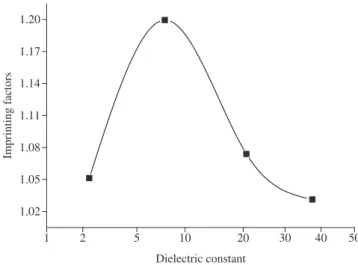
The origin of molecular imprinting technique was from the model of “donor-receptor” and “antibody-antigen” in Biology. The dispersion solvent provides the environment for MIP formation. The polarity of solvent will affect its interaction with template molecule and functional monomer. This interaction will strongly impact on the structure of imprinting sites in MIP. Figure 6 showed the relationship between imprinting factors of obtained MIP’s and dielectric constant of porogenic solvents. It clearly indicated that the medium polar solvent gave better imprinting factor of MIP’s. It means that medium polar solvent such as THF is good porogenic solvent for preparing MIP’s for quercetin.
In order to interpret the experimental results, computional quan-tum chemical analysis was used to calculate stabilization energy of quercetin and acrylamide in various porogenic solvents. The Onsager self-consistent reaction field (SCRF) technique was performed. The stabilization energy of quercetin and acrylamide in different solvents was calculated and shown in Table 3. Equercetin and EAA respectively represented the stabilization energy of quercetin and acrylamide in
Table 2. Imprinting factors of different MIP’s.
Porogenic solvents QMIP/µg.g–1 Q
Control/µg.g
–1 Imprinting factor
1,4-Dioxane 372 353 1.05
THF 480 400 1.20
Acetone 409 381 1.07
Acetonitrile 309 300 1.03
Figure 3. Adsorption of MIP’s and NMIP’s for quercetin with time.
solvent. From the results in Table 3, it was found that the stabilization energy for both quercetin and acrylamide increased with increasing the polarity of solvent. It means that interaction between solvent and quercetin or acrylamide increases with increasing polarity of solvent. In Figure 6, we knew that the MIP with the highest imprint-ing factor was prepared in a medium polar solvent. High polarity of solvent did not produce high imprinting factor. The reason is prob-ably because there is a competition between interaction of quercetin and acrylamide, and their interaction with porogenic solvent. The interaction between quercetin and acrylamide is reduced when the polarity of porogenic solvent increases. The polar solvent will have strong interaction with both quercetin and acrylamide, and cause them less chance to interact with each other. This leads to forming fewer imprinting sites in MIP and reduces its adsorption effectiveness for quercetin. When the solvent is less polar it has less interaction with either template molecule or functional monomer. The interaction of template molecule and functional monomer is strong and the formed MIP will quickly precipitate due to less solubility in less polar sol-vent. Only when the solvent has medium polarity does it have proper
interaction with quercetin and acrylamide. This helps to form uniform imprinting sites in MIP. This was why THF used as porogenic solvent produced better MIP’s than other solvents.
3.4. Effect of amount of porogenic solvent on
quercetin adsorption of obtained MIP
At certain amount of functional monomer, template molecule, and cross-linker, the amount of porogenic solvent used will affect the concentrations and gel point of formed polymer. The morphol-ogy of formed MIP will be changed and this will further affect the adsorption performance of MIP for template molecule. MIP for quercetin prepared in various amounts of THF was evaluated and shown in Figure 7. The results indicated that there was an optimal amount of THF used to obtain best MIP. The optimal THF volume was around 5 mL if there were 0.2 g acrylamide, 0.13 g queretin and 3.5 mL EGDMA in reaction mixture. It means that at low volume of THF below 5 mL, the adsorption effectiveness of resulted MIP for quercetin increased with increasing the volume of THF, and at high volume of THF above 5mL the adsorption effectiveness decreased with increasing the volume of THF. Low volume of THF caused formed polymer to precipitate early and would not form good MIP. High THF volume, however, would dilute the solution and cause imprinted sites more defects.
4. Conclusions
MIP for quercetin was prepared by thermal polymerization method using quercetin as template molecule, acrylamide as func-tional monomer and ethylene glycol dimethacrylate as cross-linker
Table 3. Stabilization energy of solvent with quercetin and acrylamide.
Porogenic Solvents
Dielectric constant/
EAA/kJ.mol–1 E
quercetin/kJ.mol –1
1,4-Dioxane 2.25 3.232 4.782
THF 7.58 4.003 6.898
Acetone 20.7 7.251 9.784
Acetonitrile 37.5 9.177 11.241
Figure 5. Scatchard plots of MIP and NMIP for quercetin.
Figure 6. Imprinting factors of MIP’s for quercetin and dielectric constants of porogenic solvents.
304 Song et al. Materials Research
in the presence of four different porogenic solvents of 1,4-dioxane, tetrahydrofuran, acetone, and acetonitrile. The results indicated that the type of porogenic solvent had big impact on formation of MIP and its quercetin adsorption. The best solvent was THF and the worst solvent was acetonitrile. According to computational quantum chemical analysis in term of the stabilization energy. The MIP obtained in medium polar solvent would demonstrate better molecular recognition ability. The amount of ponogenic solvent used also had impact on adsorption effectiveness of MIP for quercetin. There was an optimal amount of solvent when the amount of template molecule and functional monomer was kept the same.
Acknowledgements
This work is financially supported from Natural Science Founda-tion of Shandong Province, China (No. Y2007B38).
References
1. Weiss R, Molinelli A, Jakusch M and Mizaikoff B. Molecular imprinting and solid phase extraction of flavonoid compounds. Bioseparation. 2002; 10:379-387.
2. Wuff G and Sarhan A. The use of polymers with enzyme-analogous structures for the resolution of racemate. Journal of the Angewandte Chemie International Edition. 1972; 11(3):341-345.
3. Quaglia M, De Lorenzi E, Sulitzky C, Massolini G and Sellergren B. Surface initiated molecularly imprinted polymer films: a new approach in chiral capillary electrochromatography. Analyst. 2001; 126(9): 1495-1498.
4. Ebarvia BS, Binag CA and Sevilla F. Biomimetic piezoelectric quartz sensor for caffeine based on a molecularly imprinted polymer. Analytical & Bioanalytical Chemistry. 2004; 378(5):1331-1337.
5. Zhang ML, Me JP, Zhou Q, Chen GQ and Liu Z. Online solid-phase extraction of ceramides from yeast with ceramide III imprinted monolith. Journal of Chromatography A. 2003; 984(2):173-183.
6. Tan TW, He XJ and Du WX. Adsorption model of metal ion on imprinting chitosan resin. Journal of Chemical Industry and Engineering (China). 2001; 52(2):176 -178.
7. Ye L and Mosbach K. Molecularly imprinted microspheres as antibody binding mimics. Reactive & Functional Polymers. 2001; 48 (12):149-157. 8. Wulff G. Enzyme-like catalysis by molecularly imprinted polymers.
Chemical Reviews. 2002; 102(1):1- 27.
9. Wang YF, Wang XH and Zhu YT. Advancement of researches in quercetin. Natural Product Research and Development. 2003; 15(2):171-173. 10. Russo N, Toscano M and Uccella N. Semiempirical molecular modeling into
quercetin reactive site: structural, conformational, and electronic features. Journal of Agricultural and Food Chemistry. 2000; 48(8):3232-3237.
11. Yan LS, Jing J, Huang ZM, Wen ZD and Liu FT. Preparation of quercetin-imprinted polymer and its property as a sorbent for solid phase extraction. Chinese Journal of Analysis Laboratory. 2006; 25(5):97-100.
12. He JF and Deng QY. Monomers Optimization and properties evaluation of quercetin-imprinted polymer and its application to thin layer chromatography stationary phase. Journal of Chinese Medicinal Materials. 2007; 30(5):588-591.
13. Wong MW, Frisch MJ and Wiberg KB. Solvent effects. 1. The mediation of electrostatic effects by solvents. Journal of the American Chemical Society. 1991; 13:4776-4791.
14. Qiu KY. Free radical initiator and polymerization thermodynamics. Polymer Experiment and Monograph. Beijing: Ed. Polymer Laboratory of Beijing University, Beijing University; 1990.