Monolayer phosphorene under time-dependent magnetic
fi
eld
J.P.G. Nascimento
*, V. Aguiar, I. Guedes
Departamento de Física, Universidade Federal do Ceara, Campus do PICI, Caixa Postal 6030, 60455-760, Fortaleza, CE, Brazil
A R T I C L E I N F O
Keywords:
Phosphorene Time-dependent systems Lewis and Riesenfeld method Landau level
Quantum-mechanical energy expectation values Probability transition
A B S T R A C T
We obtain the exact wave function of a monolayer phosphorene under a low-intensity time-dependent magnetic field using the dynamical invariant method. We calculate the quantum-mechanical energy expectation value and the transition probability for a constant and an oscillatory magneticfield. For the former we observe that the Landau level energy varies linearly with the quantum numbersnandmand the magneticfield intensityB0:No transition takes place. For the latter, we observe that the energy oscillates in time, increasing linearly with the Landau levelnandmand nonlinearly with the magneticfield. Theðk;lÞ→ðn;mÞtransitions take place only forl¼ m:We investigate theð0;0Þ→ðn;0Þandð1;lÞandð2;lÞprobability transitions.
1. Introduction
Since the production of graphene in 2004[1]the properties of single and few layers of two-dimensional (2D) materials have attracted great attention owing to possible applications in nanoelectronics. Along the last decade several single layer crystals were also developed as silicene[2], germanene[3], stannene[4], and the transition-metal dichalcogenides[5]. Recently, phosphorene, a single layer of Black Phosphorus[6]has been extensively studied. Due to its high anisotropy, phosphorene ex-hibits interesting direction-dependent optical and transport properties. Investigations on the energy gap and electronic dispersion of different phosphorene materials can be readily found in Refs.[7–15].
In 2015 Zhou et al.[16]investigated theoretically the Landau levels and magneto-transport properties of a monolayer phosphorene under a perpendicular static magnetic field. By considering B¼B0k and the
Landau gaugeA¼ Byi; they showed that for low-intensityfields the energy of conduction and valence bands varies linearly with the Landau level indexn and the magneticfieldB0:The Landau splittings of the
conduction and valence bands and the respective wavefunctions are different due to the anisotropic effective masses. They also considered the symmetry gauge A¼ ðAx;AyÞand obtained the wave functions in
terms of Laguerre polynomials.
Also in 2015, Zhou et al. [17] studied the Landau levels and magneto-optical conductivity of black phosphorus thinfilms under a perpendicular magneticfield based on an effectivek.pHamiltonian and linear response theory. They also studied the effects of interband and intraband couplings by using the time-independent perturbation theory and numerical calculations.
Here we calculate analytically the expressions for the energy and probability transitions of a monolayer phosphorene in the presence of low-intensity time-dependent magneticfield. We use the same Hamil-tonian as in Ref.[16]withB¼BðtÞ; the symmetry gauge and the Lewis and Riesenfeld method[18]to obtain the exact analytical solution of the time-dependent Schr€odinger equation. We obtain the expressions for the mechanical energy average values and probability transitions between Landau levels. We investigate the cases BðtÞ ¼B0k and BðtÞ ¼ ðB2
0þB21cos2ðνtÞÞ 1=2
k:This paper is outlined as follows. In Section2, we calculate the time-dependent wave functions of phosphorene. In Section
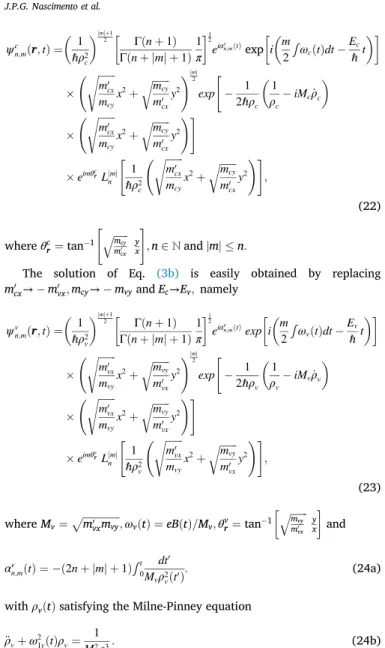
3, we obtain the mechanical energy average values and probability transitions for the constant and oscillating magneticfield. Finally, the concluding remarks are presented in Section4.
2. Eigenfunctions of a single-layer phosphorene in the presence of an external low-intensity magneticfield
The time-dependent Schr€odinger equation of a single-layer phos-phorene in the presence of an external low-intensity magneticfield is given by
iℏ∂tΨ¼HΨ; (1)
whereΨ¼ ½ψcψvT
is a two-component spinor, withψc;vcorresponding
to the envelope functions associated with the probability amplitudes at the respective sublattice sites (the superscriptTdenotes the transpose of the½…vector), and
* Corresponding author.
E-mail address:joaopedro@fisica.ufc.br(J.P.G. Nascimento).
Contents lists available atScienceDirect
Physica B: Condensed Matter
journal homepage:www.elsevier.com/locate/physb
https://doi.org/10.1016/j.physb.2017.11.089
Received 28 September 2017; Received in revised form 24 November 2017; Accepted 27 November 2017 Available online 5 December 2017
H¼ 0 B B B @
Ecþ
1
2
1
m0cx
π2 xþ 1 mcy π2 y 0
0 Ev 1
2 1 m0 vx π2 xþ 1 mvy π2 y 1 C C C A ; (2)
is the Hamiltonian of the system,π¼ ðπx;πyÞ ¼ ðpx eAx;py eAyÞis
the generalized momentum,eis the elementary charge,A¼ ðAx;AyÞis
the magnetic vector potential, m0
cx;mcy;m0vx and mvy are effective
masses related to the free electron mass meðm0cx¼0:167me;mcy¼
0:848me;m0vx¼0:184meandmvy¼1:142meÞ and Ec¼0:34eVðEv¼
1:18eVÞis the conduction (valence) band edge.
From Eq. (1) we obtain the following uncoupled differential equations
iℏ∂tψc
ðx;y;tÞ Ecψcðx;y;tÞ ¼
1 2 1 m0 cx π2 xþ 1 mcy π2 y ψc
ðx;y;tÞ; (3a)
iℏ∂tψv
ðx;y;tÞ Evψvðx;y;tÞ ¼
1 2 1 m0 vx π2 xþ 1 mvy π2 y ψv
ðx;y;tÞ: (3b)
By considering BðtÞ ¼ ð0;0;BðtÞÞ; choosing the gauge Aðr;tÞ ¼ ð1=2ÞrBðtÞ; and redifing the cartesian coordinates as x¼ ðmcy=m0cxÞ
1=4
X andy¼ ðm0
cx=mcyÞ1=4YEq.(3a)reads
ðiℏ∂t EcÞψc
ðX;Y;tÞ ¼
1
2Mc
P2
XþP
2 Y
ωcðtÞ
2 ~Lz
þMcω 2 1cðtÞ
2
X2
þY2
ψcðX;Y;tÞ;
(4)
where PX¼ iℏ∂=∂X;PY¼ iℏ∂=∂Y;Mc¼
ffiffiffiffiffiffiffiffiffiffiffiffiffiffiffi
m0
cxmcy
p
;ωcðtÞ ¼eBðtÞ=Mc; ~
Lz¼XPY YPX;andω21cðtÞ ¼e2B2ðtÞ=4Mc2:
By applying the unitary transformation
ψcðX;Y;tÞ ¼U
1φcðX;Y;tÞ ¼exp
i
1
2ℏL~z∫ωcðtÞdt Ec
ℏt
φcðX;Y;tÞ;
(5)
we can map Eq.(4)into that of a two-dimensional harmonic oscillator with time-dependent frequency, namely
iℏ∂tφcðX;Y;tÞ ¼
1
2Mc
P2
XþP
2 Y
þMcω
2 1cðtÞ
2
X2
þY2
φcðX;Y;tÞ: (6)
Lewis and Riesenfeld showed that an invariant for Eq.(6)is given by Ref.[18]
IðtÞ ¼1
2 " X ρc 2 þ Y ρc 2
þ ðρcPX Mcρ_cXÞ 2
þ ðρcPY Mcρ_cYÞ 2
#
; (7)
whereρcðtÞsatisfies the generalized Milne-Pinney[19,20]equation
€
ρcþω2 1cðtÞρc¼
1 M2 cρ 3 c ; (8)
and only real solutions ofρcðtÞare acceptable to haveIhermitian. According to Lewis and Riesenfeld[18], the invariantIðtÞis supposed to satisfy the eigenvalue equation
Iϕn;mðX;Y;tÞ ¼λn;mϕn;mðX;Y;tÞ; (9)
where λn;m are time-independent discrete eigenvalues and
ϕn;m;ϕn0;m0
¼δnn0δmm0:The solutions of Eq.(6),φc
n;m; are related to the
eigenfunctionsϕn;mofIby
φc
n;mðX;Y;tÞ ¼exp½iαn;mðtÞϕn;mðX;Y;tÞ; (10)
where the phase functionsαn;mðtÞsatisfy the equation
ℏdαn;mðtÞ dt ¼
ϕn;mðX;Y; tÞ i
ℏ∂
∂t H
0ðtÞ
ϕn;mðX;Y;tÞ
; (11)
andH0ðtÞcorresponds to the right-hand side of Eq.(6).
Next, consider the unitary transformation
ϕ0n;mðX;Y;tÞ ¼U2ϕn;mðX;Y;tÞ; (12)
where
U2¼exp
iMcρ_c
2ℏρc
X2
þY2
: (13)
Under this transformation and definingX¼ρcrcosθandY¼ρcrsinθ; Eq.(9)now reads
I0ðtÞσ
n;mðr;θÞ ¼
ℏ2
2
∂2 ∂r2þ
1
r
∂ ∂rþ
1
r2 ∂2 ∂θ2
þr
2
2
σn;mðr;θÞ
¼λn;mσn;mðr;θÞ; (14)
whereI0ðtÞ ¼U
2IðtÞU2y;r2¼X 2þY2
ρ2
c ;θ¼tan 1 Y X and
ϕ0n;mðX;Y;tÞ ¼
1
ρcσn;mðr;θÞ: (15)
We decomposeσðr;θÞin the formσðr;θÞ ¼RðrÞΘðθÞ; whereΘðθÞ ¼ eimθ
;withm 2 ℤ. By defining a new variableu¼r2
ℏand writingσðu;θÞ ¼
RðrÞΘðθÞas
σðu;θÞ ¼ ðℏuÞjmj2e u2vðuÞΘðθÞ; (16) Eq.(14)becomes
u∂
2
vðuÞ
∂u2 þ ðjmj þ1 uÞ
∂vðuÞ
∂u þ
1
2
λn;m
ℏ jmj 1
vðuÞ ¼0; (17)
whose solutions are expressed in terms of associated Laguerre poly-nomial
vðuÞ ¼Ljmj
n ðuÞ; (18)
where
n¼1
2
λnm
ℏ jmj 1
; (19)
n2ℕandjmj n:Observe that for eachn;mcan assume 2nþ1 values.
The normalized eigenfunctions of the invariantIðtÞread
ϕn;mðX;Y;tÞ ¼
Γ
ðnþ1Þ Γðnþ jmj þ1Þ
1
π
1=21
ℏρ2 c jmjþ 1 2 X2
þY2jmj2 eimθ
exp
1
2ℏρc
1
ρc
iMcρ_c
X2
þY2
Ljmj
n
X2
þY2
ℏρ2 c
;
(20)
and the time-independent eigenvalues are written as λn;m¼ℏð2nþ
jmj þ1Þ: The phasesαc
n;mðtÞwhich satisfy Eq.(11)are
αc
n;mðtÞ ¼ ð2nþ jmj þ1Þ∫
t 0
dt0 Mcρ2cðt0Þ
: (21)
ψc n;mðr;tÞ ¼
1
ℏρ2 c
jmjþ
1
2 Γ
ðnþ1Þ Γðnþ jmj þ1Þ
1
π
12 eiαc
n;mðtÞexp
i
m 2∫ωcðtÞdt
Ec ℏt ffiffiffiffiffiffiffi m0 cx mcy s
x2þ
ffiffiffiffiffiffiffi mcy m0 cx r y2 ! jmj 2 exp " 1
2ℏρc
1
ρc
iMcρ_c ffiffiffiffiffiffiffi m0 cx mcy s x2 þ ffiffiffiffiffiffiffi mcy m0 cx r y2 !#
eimθc
rLjmj
n "
1
ℏρ2 c ffiffiffiffiffiffiffi m0 cx mcy s x2 þ ffiffiffiffiffiffiffi mcy m0 cx r y2 !# ; (22)
whereθcr¼tan 1
" ffiffiffiffiffiffi mcy m0 cx q y x #
;n2ℕandjmj n:
The solution of Eq. (3b) is easily obtained by replacing m0
cx→ m0vx;mcy→ mvyandEc→Ev; namely
ψv n;mðr;tÞ ¼
1
ℏρ2 v
jmjþ
1
2 Γ
ðnþ1Þ Γðnþ jmj þ1Þ
1
π
12 eiαv
n;mðtÞexp
i
m 2∫ωvðtÞdt
Ev ℏt ffiffiffiffiffiffiffi m0 vx mvy s x2 þ ffiffiffiffiffiffiffi mvy m0 vx r y2 ! jmj 2 exp " 1
2ℏρ
v
1
ρv
iMvρ_v ffiffiffiffiffiffiffi m0 vx mvy s x2 þ ffiffiffiffiffiffiffi mvy m0 vx r y2 !#
eimθv
rLjmj
n "
1
ℏρ2 v ffiffiffiffiffiffiffi m0 vx mvy s x2 þ ffiffiffiffiffiffiffi mvy m0 vx r y2 !# ; (23)
whereMv¼
ffiffiffiffiffiffiffiffiffiffiffiffiffiffiffi
m0
vxmvy
p
;ωvðtÞ ¼eBðtÞ=Mv;θvr¼tan 1
ffiffiffiffiffiffiffi mvy m0 vx q y x and αv
n;mðtÞ ¼ ð2nþ jmj þ1Þ∫ t 0
dt0 Mvρ2vðt0Þ
: (24a)
withρvðtÞsatisfying the Milne-Pinney equation
€
ρvþω2 1vðtÞρv¼
1 M2 vρ 3 v : (24b)
whereω2
1vðtÞ ¼e2B2ðtÞ=4M2v:For a constant magneticfield Eqs.(22) and (23)agree with those found in Ref.[16].
3. Results and discussion
Using the Cartesian coordinates x as generalized coordinates, the Lagrangian of a particle of massmand chargeqmoving in a electro-magnetic field reads L¼ ðm=2Þx_2þqA⋅x qϕ: The magnetic vector
potentialAand the electric scalar potentialϕare in general functions ofx
andt. According to Ref.[21], the Hamiltonian of this system is the me-chanical energy since the“potential”energy in an electromagneticfield is determined only byϕ:In this case, the canonical momentum isp¼mx_þ
qAand the Hamiltonian reads H¼ ðp eAðr;tÞÞ2=2mþqϕ:Thus, from Eqs.(22) and (23)we obtain the following quantum mechanical energy expectation values for conduction and valence electrons
Ec
n;mðtÞ ¼Ecþ
ℏ
2
m0
cxmcy 1=2
ð2nþ jmj þ1Þ
β2
cþ
e2
B2
ðtÞ
4 ρ
2 c
meBðtÞ
;
(25a)
Ev n;mðtÞ ¼Ev
ℏ
2
m0
cxmcy 1=2
ð2nþ jmj þ1Þ
β2
vþ
e2
B2
ðtÞ
4 ρ
2 v
meBðtÞ
:
(25b)
whereβ2j ¼1þρ
2 jρ_
2 jMj2
ρ2
j .
Thus, for a givenBðtÞone has to solve Eqs.(8) and (24b)to obtain the mechanical energy En;mðtÞ for electrons and holes in a single-layer
phosphorene. First, consider the static caseBðtÞ ¼B0k:The solutions of
Eqs.(8) and (24b)areρc¼ρv¼2
eB0
1=2
and the energy average values
for electrons and holes are given by
Ec
n;m¼Ecþ
ℏeB0
m0
cxmcy 1=2
nþjmj mþ1
2
; (26a)
Ev n;m¼Ev
ℏeB0
m0
vxmvy 1=2
nþjmj mþ1
2
: (26b)
The Landau level energy varies linearly withn;mandB0:For eachn; the indexmtakes 2nþ1 values. From Eq.(26)and for afixedn;we have two situations to consider. Ifm0; we havenþ1 degenerated states while, form<0; nstates are nondegenerated.
For an oscillating magneticfieldBðtÞ ¼ ðB2
0þB21cos2ðνtÞÞ 1=2
k;Eq.(8)
and its solution read, respectively,
€
ρcþ
e2
4M2 c
B2
0þB
2
1cos 2
ðνtÞ
ρc¼
1 M2 cρ 3 c ; (27a)
ρcðtÞ ¼
1
jWjMc
12
MC2
e2
r 8M2
cν 2;
e2
B2 1
16M2 cν
2;νt
þMS2
e2
r 8M2
cν 2;
e2
B2 1
16M2
cν
2;νt 12
; (27b)
wherer¼2B2
0þB21;MCandMSare the even and odd Mathieu functions,
respectively, andW is the Wronskian ofMCandMS:InFig. 1we plot Ec
n;0ðtÞ shifted by Ec for some values of n: We observe thatEcn;0ðtÞ
oscillates with the same period of the oscillating magneticfield,T¼π=v; and increases withn:The oscillation reflects the increasing (decreasing) of the magnetic interaction when the magnetic field increases (decreases).
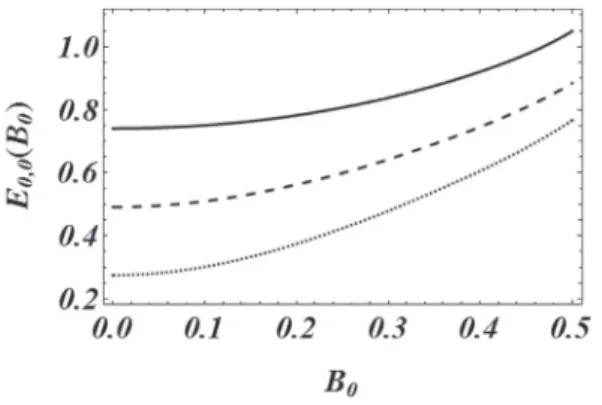
InFig. 2we plotE0;0ðB0Þshifted by Ec;vfor three values oft and
observe thatE0;0ðB0Þdoes not vary linearly withB0:The region defined
by theE0;0ðB0Þ
t¼0andE0;0ðB0Þ
t¼π=2curves define all possible values of
E0;0ðB0Þ; since the period of oscillation isT¼π:
The probability of transition from an initial stateψjk;lðr;t0Þto another
state ψjn;mðr;tÞ ðt>t0Þ reads Pjðk;lÞ→ðn;mÞðtÞ ¼
R
j
ðk;lÞ→ðn;mÞðtÞ 2
; where
Rjðk;lÞ→ðn;mÞðtÞis the amplitude transitionhn;m;tjk;l;t0i; or
Fig. 1.Plots ofEc
Rjðk;lÞ→ðn;mÞðtÞ ¼∬ þ∞
∞dxdy
h
ψj n;mðr;tÞ
i*
ψjk;lðr;t0Þ; (28)
wherejiscto conduction band electrons andvto valence band holes. From Eqs. (22) and (23), defining ρjðtÞ ¼ρj;ρjðt0Þ ¼ρ0;j;ρ_jðtÞ ¼ _
ρj;ρ_jðt0Þ ¼ρ_0;j; as well as
a2 jðtÞ ¼
1
ℏρ2 j
; b2 jðt0Þ ¼
1
ℏρ2 0;j
; (29a)
BjðtÞ ¼iMj
ρjρ_ja2
jðtÞ ρ0;jρ_0;jb 2 jðt0Þ
; (29b)
Aj k;l;n;m¼
1
ℏρ2 0;j
!jljþ21 1
ℏρ2 j
!jmjþ21
Γðkþ1Þ Γðkþ jlj þ1Þ
1
π
12 Γ
ðnþ1Þ Γðnþ jmj þ1Þ
1
π
12 e iαj
n;mðtÞ
eiα
j k;lðt0Þ
exp
i
m 2∫
t 0ωjðt0Þdt0
Ej
ℏt
exp
i
l 2∫
t0
0ωjðt0Þdt0
Ej
ℏt0
;
(29c)
and using X¼r cosðθjrÞandY¼r sinðθjrÞ; where X¼ ðmjy=m0jxÞ 1=4
x
andY¼ ðm0
jx=mjyÞ 1=4y; Eq.(28)reads
Rj
ðk;lÞ→ðn;mÞðtÞ ¼δl;mπAjk;l;n;m∫
∞
0 du u
jljLjlj
n h
a2 jðtÞu
i
Ljklj h
b2 jðt0Þu
i
expn u
2
h
BjðtÞ þa 2 jðtÞ þb
2 jðt0Þ
io
; (30)
where u¼r2 and Ljlj
nðzÞ are the associated Laguerre polynomials. By
considering the generating functions
X∞
i¼0
siLjilj h
a2 jðtÞu
i
¼ 1 ð1 sÞjljþ1exp
a2 jðtÞu
s
ð1 sÞ
; ðjsj<1Þ (31)
and
X∞
β¼0
wβLjlj β
h
b2 jðt0Þu
i
¼ 1 ð1 wÞjljþ1exp
b2 jðt0Þu
w
ð1 wÞ
; ðjwj<1Þ (32)
we found after some algebra
Rjðk;lÞ→ðn;mÞðtÞ ¼δl;mπAjk;l;n;m
X k
p¼0 8
> <
> :
ðnþkþ jlj pÞ!
p!ðk pÞ!ðn pÞ!ð 1Þ
p2jljþ1h
BjðtÞ a 2
jðtÞ b
2 jðt0Þ
ip
h
BjðtÞ a 2 jðtÞ þb
2 jðt0Þ
in ph
BjðtÞ þa 2
jðtÞ b
2 jðt0Þ
ik p
h
BjðtÞ þa2jðtÞ þb 2 jðt0Þ
inþkþjljþ1p
9
> > =
> > ;
;
(33)
indicating that the transitionsðk;lÞ→ðn;mÞare possible only ifl¼m: Observe that for a static magneticfield the transition probability is Pjðk;lÞ→ðn;mÞðtÞ ¼δl;mδk;nand no transitions are allowed, sinceψjk;lðr;t0Þand
ψjn;mðr;tÞare stationary states. However, forBðtÞ ¼ ðB20þB21cos2ðνtÞÞ 1=2
k
some transitions occur as shown inFig. 3(a) and (b). FromFig. 3(a) we observe that Pc
ð0;0Þ→ðn;0ÞðtÞoscillates withtand fort¼pT¼πp=v; with
p¼0;1;2…; the system will remain in the initial state ð0;0Þ: This behavior also reflects the oscillation of the magnetic interaction.The probability for transitionsð0;0Þ→ðn;0Þdecreases with increasingn. In Fig. 3(b) we plot Pc
ð1;lÞ→ð2;lÞðtÞfor some values ofl:We observe that
Pc
ð1;lÞ→ð2;lÞðtÞis symmetric inland increases with increasingjlj:
4. Concluding remarks
We obtained the wave function of electrons and holes in a monolayer phosphorene in the presence of a low-intensity time-dependent magnetic
field. By consideringB¼ BðtÞ; the symmetry gauge and the Lewis and Riesenfeld method the wave functions found for electrons and holes are given by Eqs.(25a) and (25b), respectively. They are expressed in terms of the solutions of the Milne-Pinney equations given by Eqs.(8) and (24b). From the wave functions obtained we calculated the quantum-mechanical energy expectation value and the transition probability for two magneticfields,BðtÞ ¼B0kandBðtÞ ¼ ðB2
0þB21cos2ðνtÞÞ 1=2
k: For a constant magnetic field we observe that the
quantum-Fig. 3.Plots of (a)Pc
ð0;0Þ→ðn;0ÞðtÞfor transitionsn¼0 (solid line),n¼1 (dashed line) andn¼2 (dotted line) and (b)Pcð1;lÞ→ð2;lÞðtÞfor transitionsl¼0 (solid line) andl¼ 1 (dashed line).
In thisfigure we usedℏ¼me¼ν¼e¼ 1 andB0¼B1¼0:5:
Fig. 2.Plots ofE0;0ðB0Þfort¼0 (solid line),t¼π=4 (dashed line) andt¼π=2 (dotted
mechanical energy expectation value scales linearly with the Landau levelsnandmand the magneticfieldB0. In this case, the wave functions
are stationary states and no transitions are allowed. For an oscillatory magnetic field we observe that the quantum-mechanical energy expectation value scales linearly with the Landau levels nandm and nonlinearly with the magneticfield. The nonlinear behavior observed with the magneticfield results from the solutions of the Milne-Pinney equations given by the Mathieu functions. The transition probabilities
ð0;0Þ→ðn;0Þdecrease with increasingn; while those connectingð1;lÞ andð2;lÞincreases with increasingl.
Acknowledgments
The authors are grateful to the National Counsel of Scientific and Technological Development (CNPq) of Brazil forfinancial support.
References
[1] A.E. Bragg, J.R.R. Verlet, A. Kammrath, O. Cheshnovsky, D.M. Neumark, Science 306 (5696) (2004) 666.
[2] B. Lalmi, H. Oughaddou, H. Enriquez, A. Kara, S. Vizzini, B. Ealet, B. Aufray, Appl. Phys. Lett. 97 (2010), 223109.
[3] M.E. Davila, L. Xian, S. Cahangirov, A. Rubio, G. Le Lay, New J. Phys. 16 (2014), 095002.
[4] S. Saxena, R.P. Chaudhary, S. Shukla, Sci. Rep. 6 (2016) 31073.
[5] D. Xiao, G.-B. Liu, W. Feng, X. Xu, W. Yao, Phys. Rev. Lett. 108 (2012), 196802. [6] X. Liu, J.D. Wood, K.-S. Chen, E. Cho, M.C. Hersam, J. Phys. Chem. Lett. 6 (2015)
773.
[7] Y. Takao, H. Asahina, A. Morita, J. Phys. Soc. Jpn. 50 (1981) 3362. [8] A. Morita, Appl. Phys. A 39 (1986) 227.
[9] X. Peng, Q. Wei, A. Copple, Phys. Rev. B 90 (2014), 085402.
[10] A.S. Rodin, A. Carvalho, A.H. Castro Neto, Phys. Rev. Lett. 112 (2014), 176801. [11] R. Fei, V. Tran, L. Yang, Phys. Rev. B 91 (2015), 195319.
[12] J. Dai, X.C. Zeng, J. Phys. Chem. Lett. 5 (2014) 1289.
[13] H. Guo, N. Lu, J. Dai, X. Wu, X.C. Zeng, J. Phys. Chem. C 118 (25) (2014) 14051. [14] D.J.P. de Sousa, L.V. de Castro, D.R. da Costa, J. Milton Pereira Jr., Phys. Rev. B 94
(2016), 235415.
[15] G.O. de Sousa, D.R. da Costa, Andrey Chaves, G.A. Farias, F.M. Peeters, Phys. Rev. B 95 (2017), 205414.
[16] X.Y. Zhou, R. Zhang, J.P. Sun, Y.L. Zou, D. Zhang, W.K. Lou, F. Cheng, G.H. Zhou, F. Zhai, Kai Chang, Sci. Rep. 5 (2015) 12295.
[17] X. Zhou, W.-K. Lou, F. Zhai, K. Chang, Phys. Rev. B 92 (2015), 165405. [18] H.R. Lewis Jr., W.B. Riesenfeld, J. Math. Phys. 10 (1969) 1458. [19] W.E. Milne, J. Res. Natl. Bur. Stand. 43 (1949) 537. [20] E. Pinney, Proc. Am. Math. Soc. 1 (1950) 681.