Brazilian Journal of Physics, vol. 39, no. 2A, August, 2009 453
Modeling long-memory processes by stochastic difference equations and superstatistical approach
B. Kaulakys, M. Alaburda, V. Gontis, and J. Ruseckas
Institute of Theoretical Physics and Astronomy of Vilnius University, A. Goˇstauto 12, LT-01108, Lithuania (Received on 11 March, 2009)
It is shown that the Poissonian-like process with slowly diffusing-like time-dependent average interevent time may be represented as the superstatistical one and exhibits 1/f noise. The distribution of the Poissonian-like interevent time may be expressed asq-exponential distribution of the Nonextensive Statistical Mechanics.
Keywords: 1/fnoise,q-distributions, Point processes, Power-law distributions, Nonlinear stochastic equations
1. INTRODUCTION
The widespread occurrence of processes exhibiting power-law distributions, 1/f noise, as well as scaling behavior in general (see [1–4] and references herein), suggests that a generic, at least mathematical, explanation of such phenom-ena might exist.
The non-Gaussianity is often taken as a signature of fluc-tuator’s interaction [5]. Nevertheless, statistically indepen-dent and noninteracting fluctuators may exhibit non-Gaussian noise, as well [6], especially when the fluctuations are strong [7, 8].
We have proposed stochastic models of 1/fβ noise, with 0.5<β<2, based on the simple point process models [7] and on the nonlinear stochastic differential equations [4, 9].
On the other hand, the non-Gaussian, power-law and long-range processes may be modeled as superstatistical schemes (see, e.g., [10] and references herein). Superstatistical pro-cesses from the superposition of Brownian propro-cesses with Lorentzian spectra and a proper distribution of relaxation times [7], from the superposition of stochastic sequences of different size pulses [11], generated by the stochastic differ-ential equation with fluctuating relaxation rate [12] and by the driven Poisson processes [13] are long-range models with the power-law distributions. They may be useful for analysis of traffic [11], financial [13, 14] and other systems.
Here we show that the Poissonian-like point process with slowly diffusing time-dependent average interevent time, i.e., a special case of the non-homogeneous Poisson process, may be represented as the superstatistical one. The distribution of the Poissonian-like interevent time may be expressed as q -exponential distribution of the Nonextensive Statistical Me-chanics [15–17].
2. POINT PROCESS MODEL
Point process model of 1/fnoise was introduced ten years ago [18, 19]. Later on, it was generalized for 1/fβnoise with 0.5<β<2 [7]. The signal, flow, current etc. in this approach are represented as a sequence of correlated pulses or series of events
x(t) =a¯
∑
kδ(t−tk). (1)
Hereδ(t)is the Diracδ-function and ¯ais an average contri-bution to the signalx(t)of one pulse at the time momenttk.
The model [7] is based on the generic multiplicative
pro-cess for the interevent timeτk=tk+1−tk,
τk+1=τk+γτ2kµ−1+στ µ
kεk (2)
generating the power-law distributed
Pk(τk)∼ταk, α= 2γ
σ2−2µ (3) sequence of the interevent timesτkink-space and 1/fβpower spectral density of the signal (1),
S(f)∼ 1
fβ, β=1+ α
3−2µ. (4)
In this approach the (average) interevent timeτk fluctuates due to the random perturbations by a sequence of uncorre-lated normally distributed random variables {εk} with zero expectation and unit variance;σis the standard deviation of the white noise andγis a coefficient of the nonlinear damp-ing.
Interpretingkas a continuous variable we can transform the difference equation Eq. (2) to the Itˆo stochastic differential equation ink-space,
dτk=γτ2kµ−1dk+στ µ
kdWk. (5)
HereWkis the Wiener process ink-space.
Transition from the occurrence numberkto the actual time tin equation (5) according to the relation dt=τkdkyields the differential equation in the actual timet. For the derivation of such equation we rewrite Eq. (5) in the difference form,
∆τ=γτ2µ−1∆k+στµ√∆kεk. (6)
Introduction into Eq. (6) of the relation∆k=∆t/τyields Itˆo stochastic differential equation for the variableτ(t)as a func-tion of the actual timet,
dτ=γτ2µ−2dt+στµ−1/2dWt, (7) whereWtis a standard Wiener process.
Equation (7) generates the stochastic variableτ, power-law distributed,
Pt(τ) =
Pk(τ) hτki
τ∼τα+1, (8)
454 B. Kaulakys et al.
intensity of the point process (1) averaged over the time inter-valτkis [7]
P(I) =a¯I¯
I3Pk
¯ a I
∼ 1
Iλ, λ=3+α. (9) Motivations for the introduction of the model (1)–(9) are presented in papers [4, 7].
On the other hand, stochastic point processes arise in dif-ferent fields, such as physics, economics, cosmology, ecol-ogy, neurolecol-ogy, seismolecol-ogy, traffic flow, and Internet (see, e.g., [20–28] and references herein).
The proposed point process model [7, 18, 19] can been modified [4, 9] and useful for the modeling and analysis of self-organized systems, atmospheric variability, 1/f noise observed financial markets [13], cognitive experiments, time intervals production in tapping and oscillatory motion of the hand [29] and other systems.
Here we generalize the point process model of 1/f noise and relate it toq-exponential distribution.
3. RELATION TO SUPERSTATISTICS AND NONEXTENSIVE STATISTICAL MECHANICS
Due to divergence of the power-law distribution and the requirement of the stationarity of the process, the stochastic difference equation (2) should be analyzed together with the appropriate restrictions of the diffusion of the interevent time τkin some finite intervalτmin<τk<τmax. By analogy with Ref. [9] we improve Eq. (2) as
τk+1 = τk+σ2
µ+α 2+
1 2
τmin τk −
τk
τmax
τ2kµ−1
+στµkεk. (10)
The associated Fokker-Planck equation gives the steady-state distribution
Pk(τk) =Cexp
− τk τmax−
τmin τk
ταk, α>−1. (11)
The constantCis defined from the normalization C−1 = 2(τminτmax)α+21Kα+1
2
rτmin
τmax
≃ Γ(α+1)τα+1
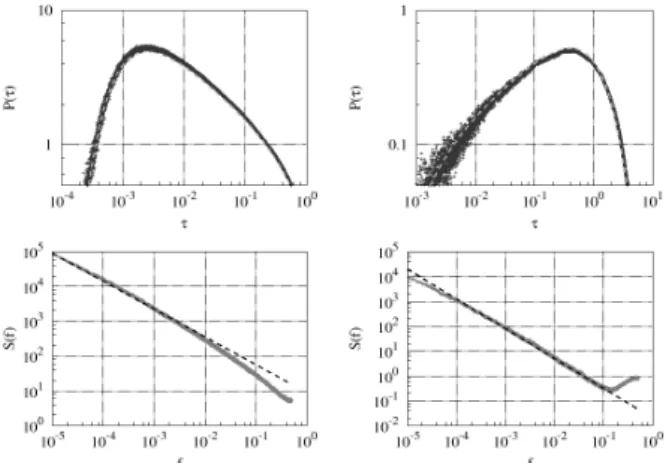
max, τmin≪τmax. (12) HereKν(z)is the modified Bessel function of the second kind. As examples, in figure 1 we show distribution density, P(τ), of the interevent time, τ, and spectrum, S(f), of the point process defined by Eq. (10) coinciding with analytical results.
Further we assume that τk is a slowly diffusing time-dependent average interevent time of the Poissonian-like pro-cess with the time-dependent rate. Within this assumption the actual interevent timeτjis given by the conditional probabil-ity
ϕ(τj|τk) = 1 τk
e−τj/τk, (13) similar to the non-homogeneous Poisson process.
FIG. 1: Distribution density,P(τ), of the interevent time,τ, and the power spectral density,S(f), of the point process defined by Eq. (10) with the parameters τmin=10−3, τmax=1, µ=0.5, σ=10−2;
whereasα=−0.4, left column, andα=0.4, right column, in accor-dance with the theoretical results by Eqs. (11) and (4), respectively, dashed lines.
This additional stochasticity of the actual interevent timeτj by randomization (13) of the concrete occurrence times does not influence the low frequency power spectra of the signal.
The generalized model (10)-(13) represents, however, a more realistic situation, because the concrete event occurs at random time (like in the Poisson case) controlled, neverthe-less, by the Poissonian distribution with the slowly modulated according to equation (10) average interevent time.
FIG. 2: Distribution density,P(τ), of the interevent time,τ, and the spectrum,S(f), of the Poissonian-like point process defined by Eqs. (10) and (13) with the parameters as in figure 1 in accordance with the theoretical results by Eqs. (18), (19) and (4), respectively, dashed lines. The analytical dotted curve according to the exact Eq. (15) coincides with the numerical calculations.
In such a case, the distribution of the actual interevent time τj is expressed analogically to the superstatistical schemes [10, 13],
Pj(τj) = Z
Brazilian Journal of Physics, vol. 39, no. 2A, August, 2009 455
Introduction of Eqs. (11) and (13) into Eq. (14) yields
Pj(τj) =C
Z ∞
0 exp
−τmaxτk −τminτ+τj k
τα−1
k dτk
= 2
τmaxΓ(α+1) τmin
+τj
τmax α/2 Kα 2 rτmin +τj
τmax
. (15)
It has been shown [7, 18, 19] that the small interevent times and clustering of the events [4] make the greatest contribution to 1/fβnoise and the exhibition of the long-range scaled fea-tures. Expansion of Eq. (15) forτmin+τj≪τmax, yields
Pj(τj) = Γ(|α|)
Γ(α+1) 1 τmax
τmin+τ j
τmax
α−|2α|
, α6=0, (16)
and
Pj(τj) =const−1 2ln
τmin+τ j
τmax
, α=0. (17)
From Eq. (16) forα>0 we have
Pj(τj)≃ 1
ατmax =const, α>0. (18)
Therefore, the power-law distribution (3) forα>0 as a re-sult of introduction along with the superstatistical scheme of the second stochastic (non-homogeneous Poisson) pro-cess, according to Eqs. (17) and (18), reduces to the flat, Pj(τj)∼const, distribution.
Forα<0, however, Eq. (16) yields theq-exponential dis-tribution,
Pj(τj) = Γ(−α)
Γ(1+α) 1 τmax
τmin
τmax
α
e−|α|
τj
τmin
q ,
−1<α<0, (19)
with the indexq=1+1/|α|.
In figure 2 we demonstrate that the distribution den-sity, P(τ), of the interevent time, τ, of the superstatistical Poissonian-like point process defined by Eqs. (10) and (13) looks quite different from the distribution density of the au-toregressive point process (10). The power spectral den-sity,S(f), of such non-homogeneous Poissonian-like process, however, is almost the same as of the simple autoregressive point process (10), i.e., the superimposition of the Poissonian distribution does not influence the low-frequency spectrum.
Note, that the special nonlinear stochastic differential equa-tions [14] may generateq-Gaussian distributed signals with 1/fβpower spectrum, exhibiting bursts, similar to the crack-ling processes [30] and observable in long-term memory time series [31, 32].
4. CONCLUSION
The special nonlinear stochastic difference and differential equations generating power-law distributed signals and 1/f noise, due to the appropriate restriction of the diffusion-like motion of the stochastic variable, may result inq-exponential orq-Gaussian distributions of the variable, preserving exhibi-tion of 1/f noise.
Acknowledgements
We acknowledge the support by the Agency for Interna-tional Science and Technology Development Programs in Lithuania and EU COST Action MP 0801.
[1] M. E. J. Newman, Contemp. Phys.46, 323 (2005). [2] H. Wong, Microelectron. Reliab.43, 585 (2003). [3] Scholarpedia,
http://www.scholarpedia.org/article/1/f_noise
(2009).
[4] B. Kaulakys and M. Alaburda, J. Stat. Mech. P02051 (2009). [5] C. E. Parman, N. E. Israeloff, and J. Kakalios, Phys. Rev. Lett.
69, 1097 (1992).
[6] G. T. Seidler, S. A. Solin and A. C. Marley, Phys. Rev. Lett.76, 3049 (1996).
[7] B. Kaulakys, V. Gontis and M. Alaburda, Phys. Rev. E71, 051105 (2005).
[8] V. Orlyanchik, V. I. Kozub and Z. Ovadyahu, Phys. Rev. B74, 235206 (2006).
[9] B. Kaulakys, J. Ruseckas, V. Gontis and M. Alaburda, Physica A365, 217 (2006).
[10] S. M. Duarte Queiros, Brazilian J. Phys.38, 2003 (2008). [11] B. Kaulakys, M. Alaburda, V. Gontis, T. Meˇskauskas
and J. Ruseckas, In: Traffic and Granular Flow’05, Eds. A. Schadschneider, T. Poschel, R. Kuhne, M. Schrecken-berg and D. E. Wolf (Berlin: Springer-Verlag, 2007) p. 603; arXiv:physics/0512068.
[12] B. Kaulakys, M. Alaburda and J. Ruseckas, AIP Conf. Proc.
922, 439 (2007).
[13] V. Gontis, B. Kaulakys and J. Ruseckas, Physica A387, 3891 (2008).
[14] V. Gontis, B. Kaulakys and J. Ruseckas, AIP Conf. Proc. (2009).
[15] C. Tsallis and A. M. C. Souza, Phys. Rev. E67, 026106 (2003). [16] C. Beck, E. G. D. Cohen and H. L. Swinney, Phys. Rev. E72,
056133 (2005).
[17] Nonextensive statistical mechanics: new trends, new perspec-tives. Special issue, Europhysics news36(6) (2005).
[18] B. Kaulakys and T. Meskauskas, Phys. Rev. E58, 7013 (1998). [19] B. Kaulakys, Phys. Lett. A257, 37 (1999).
[20] S. Thurner, S. B. Lowen, M. C. Feurstein, C. Heneghan, H. G. Feichtinger, and M. C. Teich, Fractals5, 565 (1997).
[21] K. L. Schick and A. A. Verveen, Nature (London)251, 599 (1974).
[22] F. Gruneis and H.-J. Baiter, Physica A136, 432 (1986). [23] F. Gruneis, M. Nakao, and M. Yamamoto, Biolog. Cybern.62,
407 (1990).
456 B. Kaulakys et al.
[25] F. Gruneis, Fluct. Noise Lett.7, C1 (2007).
[26] M. Lindman, K. Jonsdottir, R. Roberts, B. Lund, and R. Bod-varsson, Phys. Rev. Lett.94, 108501 (2005).
[27] I. Csabai, J. Phys. A27, L417 (1994).
[28] L. A. N. Amaral, A. Diaz-Guilera, A. A. Moreira, A. L. Gold-berger, and L. A. Lipsitz, Proc. Natl. Acad. Sci. USA 101, 15551 (2004).
[29] D. Delignieres, L. Lemoine, and K. Torre, Human Movement
Science23, 87 (2004).
[30] J. P. Sethna, K. A. Dahmen, and C. R. Myers, Nature410, 242 (2001).
[31] A. Bunde, J. F. Eichner, J. W. Kantelhardt, and S. Havlin, Phys. Rev. Lett.94, 048701 (2005).