O R I G I N A L A R T I C L E UDC: 616.717.5/.9-001-08-036.86 DOI: 10.2298/VSP1502155M
Estimating disability and quality of life after different degrees of hand
and forearm trauma
Procena onesposobljenosti i kvaliteta života posle povreda šake i podlaktice
razli
þ
itog stepena
Marija Marinkoviü, Zlata Janjiü, Jelena Nikoliü
Clinic for Plastic and Reconstructive Surgery, Clinical Center of Vojvodina, Novi Sad, Serbia
Abstract
Background/Aim. Hand injuries comprise up to one fourth
of all injuries and require excellent skills and aggressive physi-cal therapy with still a high potential to cause long term physical and functional disability which affects one’s quality of life. The aim of this study was to evaluate disability and quality of life in patients with different degrees of hand and forearm injuries using the two different scoring sistems and to examine the correlation between them. Methods. This ret-rospective study was performed among patients operated on at our clinic due to acute hand and forearm trauma during the period of two years. Four groups of patients were made ac-cording to the Modified Hand Injury Severity Score (MHISS). One year after the treatment, phone interviews were made with those patients to answer to the Disability of Arm Shoul-der and Hand (quick-DASH) score for estimating disability and to the World Health Organization Quality of Life BREF (WHOQoL-BREF) score to estimate the quality of life regerding four domains: physical, social, environmental and psychological. Results. Out of 182 patients who satis-fied the inclusion criteria, only 60 completely answered to the questionnaires, 46 (17%) men and 14 (23%) women. Most of the patients were in the group with moderate inju-ries according to the MHISS, followed by the group with major and severe injuries. A weak correlation was found between the MHISS and quick DASH score in the group with minor injuries, compared to no correlation between these parameters in other groups. The lowest quality of life was registered in the physical domain, while the highest in the social one. A negative correlation was found among the four domains of the WHOQoL BREF score and quick-DASH score in all the groups. Conclusion. Severity of hand and forearm injuries does not necessarily correlate with patient’s perception of disability. The quality of life was less affected by severity of injury than by the patient’s per-ception of disability.
Key words:
hand injuries; quality of life; disability evaluation; questionnaires.
Apstrakt
Uvod/Cilj. Povrede šake obuhvataju skoro jednu ÿetvrtinu
svih povreda, zahtevaju odliÿnu hiruršku tehniku i upornu fi-zikalnu terapiju, sa i dalje visokim potencijalom da dovedu do dugotrajnih psihofiziÿkih posledica koje utiÿu na kvalitet života pojedinca. Cilj rada bio je procena onesposobljenosti i kvaliteta života nakon povreda šake i podlaktice razliÿite težine koristeýi dva razliÿita sistema bodovanja, kao i uporeĀivanje korelacije rezultata izmeĀu njih. Metode. Ova retrospektivna analiza sprovedena je kod bolesnika operisanih na našoj klinici zbog povrede šake i podlaktice tokom dvogodišnjeg perioda. Boles-nici su bili podeljeni u ÿetiri grupe prema težini povrede, od-nosno prema sistemu bodovanja Modified Hand Injury Severity Score (MHISS). Godinu dana nakon završenog leÿenja, boles-nici su intervjuisani telefonom, i odgovarali su na upitnik Disability of Arm Shoulder and Hand (quick-DASH) koji proce-njuje invalidnost i upitnik World Health Organisation Quality of Life BREF (WHOQoL-BREF) koji procenjuje kvalitet života kroz ÿetiri domena: fiziÿki, socijalni, psihološki i efekat sredine.
Rezultati. Od ukupno 182 bolesnika koji su zadovoljili krite-rijum za ukljuÿivanje u ispitivanje, samo 60 je završilo studiju, 46 (17%) muškaraca i 14 (23%) žena. Najveýi broj bolesnika (46.7%) našao se u grupi sa srednje teškim povredama prema sistemu za bodovanje MHISS, pa u grupi sa teškim i najtežim povredama. UtvrĀena je slaba korelacija izmeĀu sistema za bodovanje MHISS i quick-DASH u grupi sa povredama mi-nimalne težine, ali nije naĀena korelacija izmeĀu MHISS i quick-DASH u ostalim grupama. Najniži kvalitet života zabe-ležen je u fiziÿkom, a najviši u socijalnom domenu. Negativna korelacija ustanovljena je izmeĀu vrednosti ÿetiri domena sis-tema WHOQoL-BREF i quick-DASH u svakoj grupi. Zak-ljuÿak. Težina povrede šake i podlaktice ne mora uvek da bu-de povezano sa bolesnikovim poimanjem onesposobljenosti. Kod veýine bolesnika utvrĀen je slab uticaj težine povrede ša-ke i podlaktice na kvalitet života. Na kvalitet života više utiÿe bolesnikovo shvatanje onesposobljenosti.
Kljuÿne reÿi:
Introduction
Hand injuries comprise between 6.6% and 28.6% of all injuries and have the potential to cause a long-term physical and functional disability 1, as well as emotional impairment 2. Hand injuries are the main cause of work-related disability in young adults 3. Furthermore, a high incidence of hand trau-matism in young adults is found in Vojvodina, which is an agricultural region with the city of Novi Sad as a regional center. Most injuries are the consequence of dealing with ag-ricultural machinery without proper training 4. In adults, hand injuries mean lasting absence from the workplace with a probable invalidity and the need for professional reorienta-tion which is a serious social and economic problem.
However, not every hand trauma results in disability; it certainly depends on the extent of injury. Nowadays, the Hand Injury Severity Score (HISS) is used for estimating the seriousness of hand trauma. HISS score also identifies those patients who would return to workplace soon after injury and who would probably need some aspect of professional reori-entation 5. Recently, the Modified Hand Injury Severity Score (MHISS) has been designed in order to expand HISS score from only hand to also carpus and forearm. According to Urso Baiarda, et al. 2 only 60% of those with major hand injuries defined by MHISS return to work.
Treatment and recovery from hand injury does not rely only on technical skills of surgeon but also on aggressive physical therapy and patient’s compliance. Effectiveness of the treatment can be estimated through objective tests of hand function (like range of motion, strength, etc.). Those tests reflect some level of one’s disability but can often differ from subjective perception of one’s insufficiency. That is why different questionnaires were formulated in order to measure one’s perception of disability. One of the most fre-quently used one is Disability of Arm, Shoulder and Hand (DASH) questionnaire which is validated many times 6–8. Wong et al. 8 showed a high efficiency of DASH score in acute hand injuries, but they also recommend that DASH score should not be the only tool for assessing treatment ef-fectiveness.
Furthermore, modern treatment options are focused not only on short morbidity but also on long term functioning, wellbeing, early returning to work, low costs and quality of life. Concerns about “the quality of life” remain since the 4th century BC, when great philosophers Plato and Aristotle used the term “good life” to describe both an internal and external state of living. However, not until 1960’s was “Health related quality of life” found in medical literature 9. Today, World Health Organization (WHO) defines Quality of Life (QoL) as “perception by individuals of their position in life, in the context of the culture and value systems in which they live and in relation to their goals, expectations, standards and concerns” 10.
The aim of this study was to evaluate disability, through the quick-DASH questionnaire, and quality of life, through WHOQoL-BREF score, in patients with different levels of severity of hand and forearm injuries. Since we assumed that higher disability would induce lower quality of life, our aim
was also to examine the correlation between these two tests for each level of severity of injury.
Methods
This study was conducted as a prospective enquiry at the Clinic for Plastic and Reconstructive Surgery, Clinical Center of Vojvodina in Novi Sad, Serbia. We selected only the patients operated on at our clinic in 2008 and 2009 due to hand or forearm trauma or both, and in whom a year passed after completing the treatment (surgery and physical ther-apy). Patients with isolated bone fractures of hand and fore-arm were not included in the study.
Demographic data and the precise diagnosis were taken from the patients records of the selected patients. According to their diagnosis and MHISS, the patients were divided into four groups, starting from the group 1 with minor injuries to the group 4 with severe injuries. Furthermore, telephone in-terviews were conducted among the patients when they were asked to answer to the short version of DASH questionnaire (quick-DASH) and QoL score designed by WHO (WHO-QoL-BREF questionnaire). Three call attempts were made for contacting patients.
Assessment instruments
The MHISS score was designed by Urso-Bairada et al. 2 in 2008 as a modification of HISS designed by Cempbell and Kay 5 in 1996. The modified score was extended to include not only hand injuries as in the HISS score, but also wrist and forearm injuries, as well. It is validated by its designers to be a good predictor in returning to workplace (Urso). In each in-jury, the integument, bones, tendons and muscles and the neu-rovascular structures are evaluated separately and the scores are calculated for each of these components. The overall MHISS score is the total of the scores for each component. The MHISS score is grouped into four categories: minor (< 20), moderate (21–50), severe (51–100) and major (> 101).
The WHOQoL-BREF questionnaire was formulated by WHO in 1991 10 as an international cross-culturally compa-rable quality of life assessment instrument and has already been translated into multiple languages, including Serbian. It measures a person’s subjective perception about their life ac-cording to their goals, concerns and satisfaction. WHOQOL BREF is constructed of 26 questions which are divided in four domains, representing one’s physical health, psycho-logical health, social relationships and their environment. Each domain scores numeric values so that a higher score represents higher quality of life.
Statistical analysis
Collected data were organized in Word Excel spread sheets. The statistical package SPSS for Windows (ver. 16) was used for statistical analysis. The most important results were highlighted through tables and graphs. To measure the strength of the relationship between the quick-DASH and WHOQoL-BREF results for each group, correlation coeffi-cient “r” was used. The correlation is considered moderate when r is in the range from 0.5 to 0.75 or –0.5 to –0.75 and strong when r ranges from 0.75 to1 or –0.75 to -1. Positive values indicate that when values of one score increase the val-ues of the other score decrease, while negative valval-ues indicate that decreasing of one score will lead to increase of the other.
Results
According to our inclusion criteria, 182 patients were operated on at our clinic due to hand and forearm trauma. However, only 60 patients fulfilled the rest of inclusion crite-ria (a 1-year period after finishing physical therapy), were reached over the telephone, agreed to answer the question-naires and managed to complete them. Among them 46 (77%) were male and 14 (23%) female. The patients were 45.8 (SD = 14.3) years old, on the average for the men 46.5, while for the woman it was a bit less, 43.3 years.
The sides were equally injured, 28 patients had right-and 28 left- side injuries, while two patients had injuries on both sides. The forearm was injured in 26.7% of the patients, the hand was injured in 63.3% of the patients and the rest (10%) had combined hand and forearm injuries.
The median MHISS score was 51.5 (range 6–270). Ac-cording to the values of MHISS, four groups of the patients were made: group 1 (minor severity of injury) of 8 (13.3%) patients with the average MHISS of 11.5 ± 4.9; group 2 (moderate severity of injury) of 22 (46.7%) patients and the average MHISS of 34.04 ± 9.01; group 3 (severe injuries) of 17 (28.3%) patients and the average MHISS of 17.3 ± 1; and group 4 (major severity of injury) of 13 (21.7%) patients, with the average MHISS of 194.6 ± 43 (Table 1).
The results of the quick-DASH score in all four groups are shown in Figure 1. The average quick-DASH score in the group 1 was 12.8, in the group 2–22, in the group 3–17 and in the group 4–46.2. The statistical signifi-cance (p < 0.05) was found between the groups 1 and 2 DASH values and between the groups 2 and 3 quick-DASH values (p = 0.04), and a high statistical significance (p < 0.005) between the groups 3 and 4 quick-DASH val-ues (p = 0.0009).
Fig. 1 – Results of Disabillity of Arm Shoulder and Hand (DASH) score in respect to age distribution.
A minor correlation was found between the values of MHISS score in minor injuries and a corresponding quick-DASH score. There was no other correlation found among these parameters in other groups. This means that severe in-jury does not have to lead to the highest disability since good surgical treatment and physical therapy with patient compli-ance can have excellent results.
The quality of life estimated through WHOQoL-BREF was represented through four, aforementioned domains: physical, psychological, social and environmental. The highest quality of life was found in the social domain, while the lowest was recorded in the physical domain in all four groups of patients (Figure 2). Furthermore, the results
of physical, physiological and environmental health showed a steady decrease as injuries got more severe. Only domain showing improvement with severity of injury was the domain of social relations.
Table 1 Results of Quality of life (QoL) – BREF Questionnare in respect to gender distribution
QoL domains Gender
physical psychological social environmental average
Men 62.13 70.83 78.26 72.17 70.8
Women 52.86 57.14 67.86 58.14 59
All patients 59.97 67.63 75.83 68.9 64.9
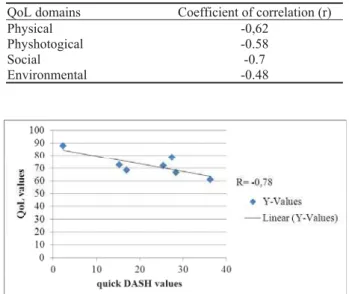
The correlation between quick-DASH scores and WHOQoL-BREF scores was analyzed. The moderate and strong correlations were found between the quick-DASH score and all four domains in the group 1. A negative moder-ate correlation (r = -0.7) was found between environmental health domains and corresponding quick-DASH scores in the groups 2, 3, and 4. There were no other correlations found (Table 2).
Table 2 Correlation between the quick-Disabillity of Arm Shoulder and Hand (DASH) score of each age group and each domain
of Quality of Life (QoL) in corresponding age group
QoL domains Coefficient of correlation (r)
Physical -0,62
Physhotogical -0.58
Social -0.7
Environmental -0.48
Fig. 3 – Correlation between the quick-Disabillity of Arm Shoulder and Hand (DASH) score and assembled Quality of
Life (QoL) scores for every age group.
Discussion
Different instruments are in use today for estimating outcomes of hand trauma. In the last couple of decades, the impact of trauma and its short and long-term consequences are especially emphasized as they often enlarge special needs for patients, enlarge economical expenses while lowering the quality of life 2, 7, 12.
In our study only 60 patients fulfilled inclusion criteria and finished all questionnaires compared to 182 patients op-erated on at our clinic in the observed period. This low re-sponse rate of 32.9% was close to the rere-sponse rate of 40.3% reported by Kovacs et al. 9. It is known that this phenomenon is common in self-administered questionnaires.
The patients examined in this study were 46 years old. In the average compared to the mean age of 35 years re-ported by Kovasc et al. 9 and 38.2 years reported by Chan et al. 1, who also examined patients with acute hand trauma at their clinics. We have no other explanation for higher aver-age aver-age in our study but to assume that older people are still very active and working in our living area.
Isolated hand injuries were present in more than 60% of the cases, isolated forearm injuries in 26%, while combined injuries of the hand and forearm were present in 10%. That is why we decided to use MHISS instead of HISS score. The
main advantage of the MHISS score is the fact that it in-cludes injuries of the forearm, as well. Most patients had moderate injuries followed by severe and major injuries, re-spectively. The lowest number of patients were found in the group with minor injuries, which is probably due to the fact that most of minor injuries are treated ambulatory in local anaesthesia and were, therefore, not included in this study.
In this research a steady linear incline was registered in the quick-DASH results with increasing severity of hand trauma. A discrepancy was noted between the groups 2 and 3, where the group 3 should have had higher results instead of the group 2, as was found in our results. This is probably the consequence of a small number of patients in each group. Nevertheless, a statistical significance was found between the quick-DASH of each group. The average quick-DASH score in the groups 3 and 4 was 47.3. This result is much higher compared to the results shown by Kovacs et al. 9 who measured the quality of life in major and sever hand injuries and whose average DASH score was 28.7 in less than 3 years after finishing the treatment.
A weak correlation was found between the values of quick-DASH and MHISS which corresponds to the previous results shown between HISS score and DASH by Kovacs et al. 9.
All four domains of WHOQoL-BREF showed similar distribution in all the examined groups except in the group 4 with the rise in the social domain, while physical, psycho-logical and environmental domains were decreased. The lowest quality of life was registered in physical and the high-est in social domain in all four groups. This means that the patients were satisfied with social support they received but were unhappy with physical status as was expected. These results correspond with the results shown by van Delft-Schreurs et al. 13, who also documented that QoL depends more on sociodemographic factors (as living alone…) rather than on rehabilitation time after the accident or the severity of injury or injured body area 14.
Our assumption was that higher disability would induce lower quality of life 14, 15, meaning that the results of quick-DASH would have negative correlation with the results of WHOQoL-BREF. However, analyses were not persuasive. A negative correlation was registered in environmental and most of physical and psychological domains but with a moderate to low statistical significance. It is interesting that a positive cor-relation was registered, mostly in the social domain.
The study had a few limitations. Despite the fact that the whole number of patients was 60, when they were di-vided into 4 groups according to the MHISS, those groups appeared to be small for representative statistical analysis.
Conclusion
decrease with more severe injuries, implying lower quality of life in those domains, it appears that the quality of life was little affected by the severity of hand and forearm injuries in the majority of patients. Social aspect of the quality of life showed improvement as injuries got worse. A negative cor-relation with moderate or no statistical significance was found between the quick-DASH and WHOQoL-BREF in the
patients with moderate, severe and major injuries. This means that higher disability can, but not necessarily, lead to lower quality of life. Interestingly, a high correlation be-tween these two tests was found in patients with minor inju-ries. Further research on a larger sample of patients is needed to confirm these results and also to identify factors that affect one’s perception of disability.
R E F E R E N C E S
1. Chan JC, Ong JC, Avalos G, Regan PJ, McCann J, Groarke A, et al. Illness representations in patients with hand injury. J Plast Re-constr Aesthet Surg 2009; 62(7): 927î322.
2. Urso-Baiarda F, Lyons RA, Laing JH, Brophy S, Wareham K, Camp D. A prospective evaluation of the Modified Hand Injury Se-verity Score in predicting return to work. Int J Surg 2008; 6(1): 45î50.
3. Barker M, Power C, Roberts I. Injuries and the risk of disability in teenagers and young adults. Arch Dis Child 1996; 75(2): 156î8.
4. Janjiý Z, Nikoliý J, Marinkoviý M. Hand injuies with agricutural machinery as an indicator of the social level of a region. Trakt i Pog Maš 2008; 13(3): 57î63. (Serbian)
5. Campbell DA, Kay SP. The Hand Injury Severity Scoring Sys-tem. J Hand Surg (Br) 1996; 21(3): 295î8.
6. Institute for work and health: The Quick DASH. 2006. Avail-able from: http://www.dash.iwh.on.ca
7. Libberecht K, Lafaire C, Van Hee R. Evaluation and functional assessment of flexor tendon repair in the hand. Acta Chir Belg 2006; 106(5): 560î5.
8. Wong JY, Fung BK, Chu MM, Chan RK. The use of Disabilities of the arm, shoulder and hand questionnaire in rehabilitation after acute traumatic hand injury. J Hand Ther 2007; 20(1): 49î56, quiz 56.
9. Kovacs L, Grob M, Zimmermann A, Eder M, Herschbach P, Henrich G, et al. Quality of life after severe hand injury. J Plast Re-constr Aesthet Surg 2011; 64(11): 1495î502.
10. Study protocol for World Health Organization project to de-velop a Quality of life assessment instrument (WHOQOL). Qual Life Res 1993; 2(2): 153î9.
11.Van-Stevens L, Munneke M, Spauwen P, Linde H. Assesment of Acitivities in Patients with hand injury: A review of instru-ments in use. Hand Ther 2007; 12(1): 4î14.
12.Schier JS, Chan J. Changes in life roles after hand injury. J Hand Ther 2007; 20(1): 57î68, quiz 69.
13.van Delft-Schreurs CC, van Bergen JJ, de Jongh MA, van de Sande P, Verhofstad MH, de Vries J. Quality of life in severely injured pa-tients depends on psychosocial factors rather than on severity or type of injury. Injury 2014; 45(1): 320î6.
14. Cederlund RI, Ramel E, Rosberg HE, Dahlin LB. Outcome and clinical changes in patients 3, 6, 12 months after a severe or ma-jor hand injury-can sense of coherence be an indicator for reha-bilitation focus? BMC Musculoskelet Disord 2010; 11: 286. 15.Alves AL, Salim FM, Martinez EZ, Passos AD, De Carlo MM,
Scarpelini S. Quality of life in trauma victims six months after hospital discharge. Rev Saude Publica 2009; 43(1): 154î60. (English, Portuguese)