(Annals of the Brazilian Academy of Sciences)
Printed version ISSN 0001-3765 / Online version ISSN 1678-2690
www.scielo.br/aabc
Characterization of granite and limestone powders for use as fillers in bituminous mastics dosage
BRENO BARRA1, LETO MOMM1, YADER GUERRERO1 and LIEDI BERNUCCI2 1Programa de Pós-Graduação em Engenharia Civil/PPGEC, Universidade Federal de Santa Catarina/UFSC,
Rua João Pio Duarte Silva, s/n, 88040-970 Florianópolis, SC, Brasil 2
Escola Politécnica da Universidade de São Paulo/EPUSP, Departmento de Engenharia de Transportes, Rua Prof. Almeida Prado, Trav. II, 83, 05508-970 São Paulo, SP, Brasil
Manuscript received on April 25, 2013; accepted for publication on December 10, 2013
ABSTRACT
This paper discusses the importance of studies on materials known as fillers from different mineral origins, used in asphalt mixes, specifically in the formulation of mastics. The research was carried out on samples of limestone and granite rock filler and asphalt binder (50/70). The samples were evaluated through semi-quantitative chemical analyses by X-ray fluorescence, granulometry by low angle laser emission, scanning electron microscopy, softening point tests, penetration tests, and asphalt binder and aggregate-mastic adhesion tests. The results highlighted convergent trends, indicating that the active behavior of the fillers in the mastic formulation is not related to the size of the particles, but rather to their form, surface texture, specific surface area and mineralogical nature, allowing the filler activity concept to be divided into two components: physical (hardening) and chemical (adhesion).
Key words: characterization, fillers, granite, limestone, bituminous mastics.
Correspondence to: Breno Barra
E-mail: [email protected] / [email protected]
INTRODUCTION
In general, fillers are added to asphalt mixes to fill in the voids formed by the larger aggregate particles, in order to stabilize these particles and
to increase the post-compaction resistance of the
mixes. The most diffuse technical analysis on the factors responsible for these effects indicated that the most important parameter is the granulometry (Al-Suhaibani et al. 1992).
The role of filling in the voids formed by the
larger particles in the arrangement of the aggregate
gradations is attributed to the small-sized particles, specifically under 75µm and above 40µm, and
these small particles are also related to the increase
in the rigidity and the post-compaction resistance of the mixes (Aashto 2000).
On the other hand, some researchers have found
that the smaller particles of the filler, under 37µm
(Radford 1916) and especially under 20µm (Motta and Leite 2000), or even all of them together (Ruiz 1943), remain in suspension and form mastics when they are mixed with the asphalt binders, adsorbing
part of their components, provoking an increase in
the binder viscosity and consequently improving the rigidity of the mixes (Rao and Sen 1973). Puzinauskas (1969) supports that both functions are developed simultaneously by the fillers, subdividing their behavior in two parts: inert and active.
Although there have been extensive scientific
approaches to determining their characteristics, the
behavior of fillers is still a controversial subject among researchers worldwide, particularly with regards to the factors that influence the physical and
chemical actions of the active component of these
materials, when they are added to the asphalt mixes, specifically in the formulation of mastics (Sebaaly et al. 2003, Santana 1995, Anderson et al. 1992).
In this context, the objective of this research
is to discuss the importance of studies on materials
known as fillers from different mineral origins, such as limestone and granite powders, specifically
in the formulation of mastics used in asphalt
mixes, evaluating their chemical and physical
characteristics in interactive processes.
The results of this study emphasize the importance of investigating the way in which the addition of fillers modifies the physical and chemical characteristics of asphalt binders in
mastic formulations, highlighting positive and negative aspects.
MATERIALS AND METHODS
Limestone and granite powders were the materials
chosen to be studied in this research, because of their ample use in many Engineering activities, especially in the pavement sector where they
undertake the roll of filler in the formulation of asphalt mastics destined to improve the
mechanical behaviour of asphalt mixes to be
applied in the field.
Furthermore, the asphalt binder 50/70 was used to formulate the granular-asphalt binder and granular-mastic systems.
The analysis of filler types and mastics was
carried out through the following test methods:
semi-quantitative chemical analysis by X-ray fluorescence, granulometry by low angle laser emission, scanning electron microscopy (SEM), softening point, penetration, aggregate-asphalt binder adhesion and
aggregate-mastic adhesion tests.
RESULTS AND DISCUSSION
The experimental analysis carried out to characte-rize the granite and the limestone powders are described in the following sections.
SEMI-QUANTITATIVE CHEMICAL ANALYSIS BY X-RAY FLUORESCENCE
The mineralogical compositions of the two fillers (limestone and granite powders) were determined by semi-quantitative chemical analysis using X-ray fluorescence and the results obtained are described below.
The granite powder samples were composed
of quartz (35.0%), albite (33.0%), zinnwaldite (12.0%), microclinium (18.0%) and caulinite (2.0%). It is important to emphasize that the feldspate group comprises the minerals albite and
microclinium, while the mica group includes the
mineral zinnwaldite. All of the minerals defined in the semi-quantitative analysis are rich in silica contents and, hence, they are electronegative and classified as felsic or acidic minerals.
The limestone powder samples were composed
of calcite (90.0%), dolomite (6.0%) and quartz (4.0%).
Calcite has one of the most common mineral
compo-sitions, comprising calcium carbonate (CaCO3), usually white or uncolored, but sometimes gray, red, green, blue or yellow. Dolomite is a double calcium-magnesium carbonate (CaMg(CO3)2) composed of rhombohedric crystals which can be rose, white, gray, green, brown, black, or uncolored (Dpm/Unesp 2012). From this description it can be inferred that
calcite is associated with positive electrical charges
(electropositive) and thus limestone powder was also used as a filler in this research.
GRANULOMETRIC ANALYSIS BY LOW ANGLE LASER EMISSION
In order to verify the percent distribution of the filler particles (limestone and granite powders) with higher precision, granulometric analysis by way of
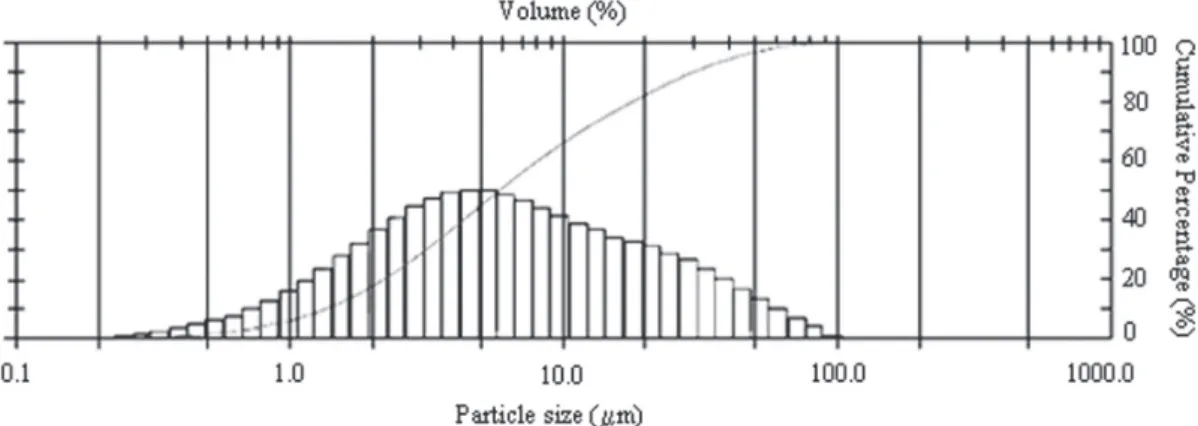
The histograms shown in Figures 1 and 2 indicate that the percentage of particles under 37µm and 20µm (indicated by the curved line) reached the following cumulative values: 94.82% and 84.81% for the limestone powder and 43.77% and 22.87% for the granite powder, respectively. The tests also provided values for the specific surface areas of
these materials, which were, 0.7225m2/g (limestone powder) and 0.1311m2/g (granite powder).
SCANNING ELECTRON MICROSCOPY
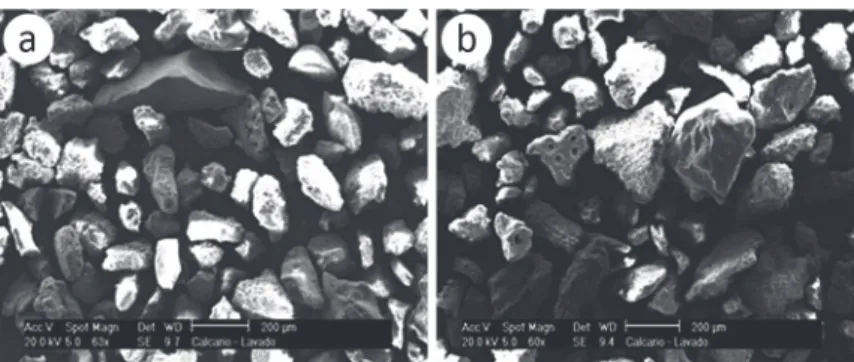
The form and texture of the filler particles were verified by the analysis of images captured through scanning electron microscopy (SEM) (Figures 3 and 4).
In Figures 3 and 4 it is possible to note the non-spherical form of the particles and they are rounded
with sharp indentations with a rough superficial texture and specific points of high porosity. These characteristics acting together contribute to a good adhesion between the filler and the asphalt binder.
SOFTENING POINT TEST
The softening point tests (Abnt Nbr 6560 2008)
were carried out on the mastics formulated with
the addition of limestone and granite powders, both with 6.0% (by weight) of asphalt binder content,
in order to make more precise comparisons of the effects related to the incorporation of each material.
The quantity of 6.0% was chosen based on the
aggregate gradation of the asphalt mixes used in
the research developed by Barra (2009), which was formulated with 6.0% of particles passing through the 0.075mm sieve size.
Fig. 1 - Percent distribution of the limestone powder particles.
The experimental procedure comprised three
distinct stages: analysis of pure asphalt binder samples and samples with 6.0% of fillers added tested on the same day as the mastic formulation, and samples with 6.0% of fillers added tested five days after the mastic formulations. The aim of this latter procedure was to verify whether during this period any long-range chemical reaction could contribute decisively to the modification of the original characteristics of the asphalt binders.
To minimize the dispersion of the results during each stage of the above-mentioned experimental
procedure, the samples were produced from the same mixing procedure and tested with the same
flame height, without interruptions between
the sample and water exchanges, maintaining a progressive increase in the water temperature of
0.5°C per minute. It is emphasized that the results shown in Table I are the averages of 20 tests (total of 20 pairs of samples) for each stage and for each filler type, respectively, totalizing 100 tests.
Analyzing the results obtained with pure asphalt binder samples, it is important to emphasize
that according to the softening point test standard
(Abnt Nbr 6560 2008) the asphalt binder 50/70 used in the research reaches values above the minimum recommended (46.0 °C) by the referred
technical standard in relation to softening point,
and the result for the pure asphalt binder sample submitted to the tests was 49.5 °C, i.e., 3.5 °C above the minimum limit specified.
Interpreting the behavioral trends of the mastics in Table I, the addition of filler has a Fig. 4 - SEM micrographs of the granite powder particles: magnification of (a, b) 180 times.
Fig. 3 - SEM micrographs of the limestone powder particles: magnifications of (a) 63 times and (b) 60 times.
Stage Sample type Average
(°C)
First Pure asphalt binder 49.5
Second Mastic with limestone powder 51.8
Mastic with granite powder 52.1
Third Mastic with limestone powder 54.0
Mastic with granite powder 53.0
TABLE I
notable influence, with an increase of 2.6 °C and 2.3 °C in the softening point values being observed for the samples tested on the same day on which
the addition of granite and limestone powders,
respectively, were carried out, in comparison to the pure asphalt binder samples.
For the mastics tested five days after the addition of the fillers, a slight increase in the values was verified, but with greater repeatability for all of the tests, in comparison to the results obtained in the first stage. This suggests that a rest period should be applied after the formulation of the mastics to provide a suitable arrangement of the filler particles, in order to an interface contact to occur and a chemical bond with the asphalt binder to be formed, guaranteeing more stability in terms of the mastic behavior.
These results enable the following verifications:
since the ionic characteristic of the granite powder differs from that of the limestone powder and, as
mentioned above, the electronegative materials (granite powder) have lower chemical activity than the electropositive materials (limestone powder), it would be expected that if this chemical
characteristic prevails in the hardening process, the mastics with limestone powder added would present higher values than those with granite
powder. However, this was not the case, even five days after the addition process.
Another factor which did not contribute to the mastic hardening process, in contrast to findings by applying some of the approaches described above, was the quantity of filler particles under 37µm or 20µm, since despite these two materials having
very different percentages of particles under these dimensions, as illustrated in Figures 1 and 2, they had very similar behaviors.
The specific surface area was not an important
parameter in terms of differentiating the active
behaviors of the filler types tested. In relation to the modification of the original physical characteristics of the asphalt binder, specifically the viscosity, there
were no notable differences in the results related to the filler that presented the largest specific surface
area, i.e., the limestone powder, compared with the
other filler, as expected.
PENETRATION TEST
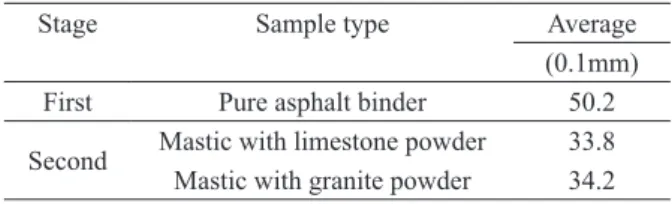
The penetration tests (Abnt Nbr 6576 1998) were
performed using the formulation procedures
described above for the softening point tests. However, they were carried out applying only two of the stages detailed in Table I, that is, with pure asphalt binder samples and with mastics containing 6.0% (by weight) of equal amounts of granite and
limestone powders.
The tests with the mastic samples were
carried out on the same day as the addition of fillers, as shown in Table II, and the average
values were calculated after performing 10
tests for each stage and for each filler type, respectively, totalling 30 tests.
Stage Sample type Average
(0.1mm)
First Pure asphalt binder 50.2
Second Mastic with limestone powder 33.8
Mastic with granite powder 34.2
TABLE II
Results for the penetration tests.
The results for the softening point tests in
Table I show only a slight hardening five days after the addition of filler. Thus, since the asphalt binder and the filler samples used in the penetration tests
were the same as those used in the softening point
tests, it can be inferred that the same behavioral trend would be observed in the penetration tests, and consequently this procedure was not repeated.
Both mastic samples with 6.0% of fillers main-tained the same behavioral trend, despite the expected reduction of the penetration values, presenting very close results, thus confirming the above remarks
regarding the softening point test results.
ADHESION TEST
In order to verify that the fillers promoted adhesion in the aggregate (formed by crushed granite rock
particles)-asphalt binder and aggregate-mastic systems, the specifications of the test standard (Dner-me 78/94 1994) were considered and the
tests were conducted in two stages: evaluating
the adhesion in the aggregate-pure asphalt binder system and, subsequently, in the aggregate-mastic (with 6.0% of limestone and granite powders, respectively) system. The results are given in
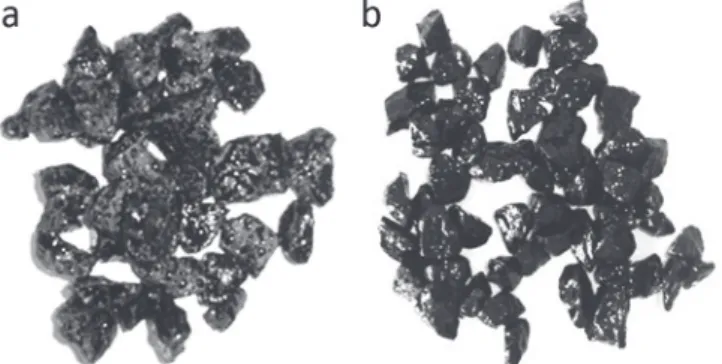
Figure 5.
Fig. 5 - Samples analyzed in the adhesion tests with (a)
aggregate-pure asphalt binder system and (b) aggregate-mastic system with 6.0% of limestone powder.
In Figure 5 it is clear that the mineralogical nature
of the fillers is an important factor in the adhesion of the aggregate-asphalt binder and aggregate-mastic systems. This Figure illustrates the occurrence of two events, which are, the detachment of the film from the pure asphalt binder and the mastic with 6.0% of granite
powder from the surface of the crushed granite rock
particles, i.e., these two systems presented the same behavior in terms of adhesion. On the other hand, the mastic with 6.0% of limestone powder presented better efficiency in terms of adhesion to the crushed granite rock particles, although a few and very small
detached points do appear in the samples.
Detached points occurred because the fillers comprised of rocks with electropositive characteristics (such as calcite) adsorbed the molecules of the asphalt binder by chemisorption and during this process the filler particles start to react chemically with the naphthenic acids of the asphalt binders, forming calcium naphthenate,
which is insoluble in water (Santana 1995) and protects the asphalt binder film that covers the
aggregate particles.
The same acid characteristics are inherent and
intrinsic to the asphalt binder and to the crushed
granite rock particles. Therefore, the granite powder does not achieve the same success as the
limestone powder, the latter having favorable chemical characteristics as mentioned above.
The cohesive and interfacial adhesion in
Thus, considering these chemical aspects, it is
possible to infer that the mineralogical nature of the
material is the main factor determining the degree
of adhesion of the fillers to the asphalt binders and
is the reason for the limestone powder providing
more efficient adhesion than the granite powder. Regarding the specific surface area, although this variable presented no correlation regarding the modification of the physical characteristics of the asphalt binders, considering the chemical characteristics of the fillers, there was a notable
improvement in the adhesion in the
aggregate-mastic system, directly related to the occupation of the area by unit mass, in which the limestone powder (0.7225m2/g) presented better results than the granite powder (0.1311m2/g).
This finding is due to the increase in the specific surface area which contributes to potentializing the chemical adsorption of the asphalt binder by the filler by increasing the interfacial contact area between the two surfaces of the materials, amplifying the electrical field of molecular interaction most favorable to the aggregate-asphalt binder system adhesion, since these aspects have compatibility with the ionic characteristic considered suitable for filler particles, i.e., electropositivity.
CONCLUSIONS
Based on the results of the tests carried out in this
research, it can be concluded that the active behavior of the fillers is due to the simultaneous integration of two components: physical and chemical.
The physical component was found to be influenced mainly by the form and texture of the
particles, which guarantee a firm adhesion of the
asphalt binder film to the surface of the particles,
forming mastics which are harder than the pure
asphalt binder samples. These conditions lead to the modification of the asphalt binder viscosity as verified by the results for the softening point and penetration tests. The porosity, despite being a physical characteristic which also contributes
to a better adhesion of the fillers to the asphalt binders, could not be studied in detail from the
tests carried out.
In relation to the chemical component, the
increase in the electrical field provided by the larger specific surface area together with the mineralogical nature of the fillers were decisive
characteristics in terms of the increase in the
electrical field of molecular attraction and the formation of the ionic bonds related to the Lewis acid-base interactions, respectively.
On analyzing the physical aspects, the two filler samples (limestone and granite powders) had almost identical behaviors, and the results for the modification of the original characteristics of the asphalt binder did not show significant differences. Chemically, however, the differences were very notable, the best adhesive behavior being verified
for the mastics formed with the addition of the
filler which provided the largest electrical field of
molecular interaction and with positive electrical
charge (cationic), i.e., the limestone powder.
Hence, the results of this research indicate that
the adhesion action of the filler is not related to the size of the particles but instead to their form and
mineralogical nature. In addition, the texture and
specific surface area are variables which need to be
considered in this context.
ACKNOWLEDGMENTS
We would like to thank the Universidade Federal de
Santa Catarina (UFSC) and the Escola Politécnica da Universidade de São Paulo (EPUSP) for
allowing us to use their material and premises, as well as the Conselho Nacional de Desenvolvimento
Científico e Tecnológico (CNPq) for the financial
support of this research.
RESUMO
misturas asfálticas, mais especificamente na formulação de mástiques. Os testes laboratoriais foram executados com amostras finamente pulverizadas de rocha calcária e granítica, além do ligante betuminoso classificado
como 50/70. As amostras foram avaliadas a partir dos seguintes testes: análise química semi-quantitativa por
fluorescência de raio-X, granulometria por emissão de raio laser de baixo ângulo, microscopia eletrônica
de varredura, ponto de amolecimento, penetração,
adesividade dos sistemas agregado-ligante betuminoso puro e agregado-mástique. Os resultados obtidos enfatizam tendências convergentes, indicando que a
comportamento ativo dos fíleres na formulação dos mástiques não está relacionado com o tamanho das
partículas, mas sobretudo com a sua forma, textura superficial, área da superfície específica e natureza
mineralógica, permitindo que o conceito de atividade dos fíleres possa ser dividido em duas componentes:
física (enrijecimento) e química (adesão).
Palavras-chave: caracterização, fíleres, granito, calcário, mástique betuminoso.
REFERENCES
AASHTO. 2000. Hot-mix asphalt paving handbook. American
Association of State Highway Transportation Officials.
Washington, DC: United States National Research
Council (U.S.), 219 p.
ABNT NBR 6560. 2008. Especificações dos cimentos asfálticos de petróleo (CAP) - ensaio de ponto de amolecimento anel e bola. Associação Brasileira de Normas Técnicas. ABNT NBR 6576. 1998. Especificações dos cimentos asfálticos
de petróleo (CAP) - ensaio de penetração. Associação
Brasileira de Normas Técnicas.
AL-SUHAIBANI A, AL-MUDAIHEEM J AND AL-FOZAN F. 1992.
Effect of filler type and content on properties of asphalt concrete mixes. American Society for Testing and Materials (ASTM). ASTM STP 1147, Philadelphia: Richard C Meininger, Philadelphia, USA, p. 107-129.
ANDERSON DA, DONGRE R AND CHRISTENSEN DW. 1992. Effect of minus N°200-sized aggregate on fracture
behavior of dense-graded hot-mix asphalt. Philadelphia: American Society for Testing and Materials (ASTM). ASTM STP 1147, Philadelphia: Richard C Meininger, Philadelphia, USA, p. 154-176.
BARRA BS. 2009. Avaliação da Ação da Água no Módulo
Complexo e na Fadiga de Misturas Asfálticas Densas.
Tese de Doutorado. Universidade Federal de Santa
Catarina (UFSC). Florianópolis, Brasil. (Unpublished). DPM/UNESP. 2012. Departamento de Petrologia e
Metalogenia da Universidade Estadual de São Paulo. Museu de Minerais e Rochas Heinz Ebert, Portal Campus
Rio Claro. http://www.rc.unesp.br/museudpm. Last access
in March 2013.
DNER-ME 78/94. 1994. Agregado Graúdo: Adesividade
ao ligante betuminoso. Rio de Janeiro: Departamento
Nacional de Estradas de Rodagem.
MOTTA LMG AND LEITE LFM. 2000. Efeito do fíler nas
carac-terísticas mecânicas das misturas asfálticas. Gramado, RS: 11º Congresso Pan-Americano de Engenharia de Trânsito
e Transporte, p. 1019-1030.
PUZINAUSKAS VP. 1969. Filler in asphalt mixtures. Maryland,
USA: The Asphalt Institute - Research Report 69-2.
RADFORD TA. 1916. The construction of road and pavements.
New York: Edited by McGraw-Hill Company, Inc. 5th
ed., 432 p.
RAO SK AND SEN BR. 1973. Evaluation of mineral fillers for
asphalt paving mixtures. Highway Research Record 468:
100-108.
RUIZ C. 1943. Sobre las propriedades mecanicas del sistema
filler-betún. Argentina: LEMIT, Série II 8: 220-240.
SANTANA H. 1995. Considerações sobre os Nebulosos
Conceitos e Definições de Filler em Misturas Asfálticas. Cuiabá, MT: Anais da 29a
Reunião Anual de Pavimentação
(RAPv), Vol. 1, Associação Brasileira de Pavimentação (ABPv).
SEBAALY PE, HITTI E AND WEITZEL D. 2003. Effectiveness of lime in hot-mix asphalt pavements. Transportation