Universidade do Minho
Escola de Psicologia
Maria Clara Pires Vieira
The Way of St. James: Perspectives on the
Walk through the lens of Self-Regulation
outubro de 2019 UMinho | 2019 Mar ia V ieir a The W ay of S t. James: P er spectiv es on t he W alk t hr ough t he lens of Self-R egulation
Maria Clara Pires Vieira
The Way of St. James: Perspectives on the
Walk through the lens of Self-Regulation
Dissertação de Mestrado
Mestrado integrado em Psicologia
Trabalho realizado sob a orientação do
Professor Doutor Pedro Rosário
e da
Doutora Jennifer Cunha
Universidade do Minho
Escola de Psicologia
ii
DIREITOS DE AUTOR E CONDIÇÕES DE UTILIZAÇÃO DO TRABALHO POR TERCEIROS Este é um trabalho académico que pode ser utilizado por terceiros desde que respeitadas as regras e boas práticas internacionalmente aceites, no que concerne aos direitos de autor e direitos conexos. Assim, o presente trabalho pode ser utilizado nos termos previstos na licença abaixo indicada.
Caso o utilizador necessite de permissão para poder fazer um uso do trabalho em condições não previstas no licenciamento indicado, deverá contactar o autor, através do RepositóriUM da Universidade do Minho. Licença concedida aos utilizadores deste trabalho
Atribuição-NãoComercial-SemDerivações CC BY-NC-ND
iii
Agradecimentos
Em primeiro lugar gostaria de agradecer aos meus orientadores a disponibilidade para me ajudarem a fazer deste o melhor trabalho possível. Agradeço ao GUIA, especialmente à Ritinha, que com um pouco da sua leveza e com uma generosidade gratuita, me ensinou a perseverar pacientemente no meu objetivo.
A toda a minha família, aos meus pais, irmãos, cunhados, sobrinha e avós, que mesmo não entendendo do tema, se esforçaram sempre para que eu tivesse as melhores condições possíveis para realizar este trabalho e que com a alegria que transmitiam, me tiravam um peso dos ombros todos os dias.
Às minhas colegas de investigação, à Ana, Vânia e Raquel, convosco partilhei preocupações e vitórias. Obrigada pelo companheirismo.
Aos meus colegas de vida, à Soraia, à Sara, à Diana, ao Divo, ao Rui e ao Kevin. Todas as palavras serão poucas para agradecer.
A toda a família CABista, que com olhar atento me acompanham diariamente, sempre com alegria, amizade e ânimo. Que bom é ter-vos na minha vida.
Ao Júlio, obrigada por percorreres este Caminho de mãos dadas comigo. Que assim seja para sempre.
E, tudo quanto fizerdes, fazei-o de todo o coração (…).
iv
STATEMENT OF INTEGRITY
I hereby declare having conducted this academic work with integrity. I confirm that I have not used plagiarism or any form of undue use of information or falsification of results along the process leading to its elaboration.
I further declare that I have fully acknowledged the Code of Ethical Conduct of the University of Minho.
University of Minho, October 18th, 2019,
v
Caminho de Santiago: Perspetivas através das lentes da autorregulação
Resumo
O crescente número de peregrinos no Caminho de Santiago tem levado a um maior interesse por parte de investigadores nesta temática. Contudo, é sentida uma carência de estudos na área psicológica. Esta investigação tem como objetivo compreender o processo que organiza a experiência dos peregrinos no Caminho de Santiago nas suas etapas: planificação, execução e avaliação, através do Modelo da Autorregulação. Foram analisadas 32 entrevistas de peregrinos e os resultados revelaram um particular destaque ao interesse e valor da peregrinação, ao planeamento estratégico, às estratégias utilizadas, à monitorização metacognitiva, à autoavaliação e, por fim, à autossatisfação. Espera-se que o aumento do conhecimento sobre o processo possa contribuir para incrementar a qualidade desta peregrinação, ajudando peregrinos e organizadores de peregrinações.
vi
The Way of St. James: Perspectives on the Walk through the lens of Self-Regulation Abstract
The growing number of pilgrims on the Way of St. James leads to a greater study interest by researchers. However, studies in the psychological domain are limited. Using the self-regulated learning framework, this research aims to understand the process of the Way of St. James stressing the three components: planning, execution and evaluation of the experience. The interviews of 32 pilgrims were analyzed, and the results show a particular emphasis on the interest and value of the pilgrimage, the strategic planning, the strategies used, the metacognitive monitoring, the self-assessment and, finally, self-satisfaction. Increasing knowledge of these complex process is expected to increase the quality of this pilgrimage by helping pilgrims and pilgrim organizers.
vii Contents
Introduction ... 8
Pilgrimage ... 8
Saint James’ Way: The Scenario ... 8
Pilgrimage and Self-Regulation ... 10
Purpose of the Study ... 12
Method... 13 Participants ... 13 Data Collection ... 13 Data Analysis ... 14 Results ... 14 References ... 22 List of figures Figure 1. Phases and subprocesses of self-regulation………11
Running head: THE WAY OF ST. JAMES
8
The Way of St. James: Perspectives on The Walk Through the Lens of Self-Regulation
Each year thousands of men and women from more than sixty countries (e.g., Japan, USA, Australia, Brazil, Germany) make a long journey by foot or by bicycle at least of 100 kilometers across northern Spain, following the medieval pilgrimage road known as the Camino de Santiago (also known as El Camino, The Way of St. James or Saint James’ Way). Their final destination is the Cathedral of Santiago de Compostela, where can be found the remains of the apostle James (Frey, 1998). To reach this goal, pilgrims walk about 20 to 40 kilometers per day for several consecutive days undertemperatures that in winter can be of -4 °C and in summer can reach 45 °C. Achieving the final destination walking in these harsh weather conditions requires pilgrims’ motivation, but also, robust self-regulation skills. To the authors knowledge the psychological aspects of this pilgrimage process have been receiving limited attention by researchers (e.g., Amaro, Antunes, & Henriques, 2018); still, we believe that it would be helpful to understand the self-regulatory processes that occur prior, during and at the end of the path; this knowledge is expected to deep our comprehension on this pilgrimage process using psychological lens and hopefully help pilgrims and pilgrimage organizers on their journey.
Pilgrimage
Pilgrimage is probably as old as religion itself and is consequently the oldest type of tourism (Vázquez de la Torre, Naranjo, & Carranza, 2012). It is still a concept closely linked to religion so, according to the Document of the Holy See on ‘Pilgrimage of 2000’ (Rebic, 2002), a pilgrimage is defined as “a journey undertaken for religious reasons to a place that is considered sacred (locus sacre) for acting there in a special way God or other deities, to perform there certain religious acts, devotion and penance”. More recently, Fernandes (2018), referred that "more than a physical path, pilgrimage is a journey to the depths of our being, sacred space where we can rediscover who we are. It can be a path of solitude or community; (…) We learn to put in the backpack only what is essential for life” (p. 44).
In the literature, there are as many definitions of “pilgrimage” as of pilgrims, but it is interesting to learn the root of the word that comes from Latin: peregrinus (pelegrinus in the Middle Ages), or per-ager which means "to walk through the fields" or "beyond borders," invoking someone who comes from abroad. This sense was in vogue until the eleventh century: the peregrinus was someone who had no "city right". Later the word evolved to describe the journey to a sacred place, which may also be related to an inner and spiritual walk (Fernandes, 2018).
Saint James’ Way: The Scenario
The Way of St. James exists since 813 AD and the path leads to the tomb of St. James the Greater located in the furthest north-western corner of Europe at the Galician city of Santiago de Compostela. It
THE WAY OF ST. JAMES
9
is one of the most important Christian pilgrimage centers since the Middle Ages along with Rome and Jerusalem. There are ten different pilgrimage routes to Santiago de Compostela, seven of which can be travelled by bicycle, on horseback or on foot, two by sea; and finally, “the inner route or interior pathway” representing the changes that every pilgrim is likely to experience along the Way. “The Saint James’ Way (…) is not just a pilgrimage route. (…) In fact, it is said that the Way brings you back to your roots.” (Pedrotti, 2012). This quote illustrates the reason why the tradition says that every route begins at home and ends at the Plaza del Obradoiro, where the Cathedral of Saint James is located (Pedrotti, 2012; Perrín, 2017). Another particularity is that the authorities at Santiago give a certificate, the Compostela, to those who have travelled at least 100 kilometers to Santiago on foot or by horse, or 200 kilometers by bicycle (Reader, 2007).
Due to the importance and popularity of the Way of St. James, this topic merited the attention of researchers from various disciplines such as geography, anthropology, sociology, theology (Lois-González & Santos, 2015; Warfield & Hetherington, 2018) and medicine (Felkai, 2019).
Why is walking the Way of St. James a unique experience?
There are several features that may help explain the uniqueness of this pilgrimage. First, the importance of the Way of St. James over the last decades is an unquestionable fact (Frey, 1998; Tilson, 2005; Gusmán, Lopez, Lois-González, & Santos, 2017). For example, for the last two decades, there has been a substantial growth in the number of pilgrims in the Way (Lois-González & Santos, 2015), from less than 3, 000 in 1987 to over 300, 000 in 2018 (Oficina de Acogida al Peregrino de Santiago de Compostela, 2018). Second, this pilgrimage is open with no restrictions of, for example, gender, nationality, social status or economic level. While walking the Way, there is no difference between a general manager and a blue-collar worker of the same office; they are all pilgrims, all walking the same path (Pedrotti, 2012; Damari & Mansfeld, 2016). Third, regarding the nature of the this pilgrimage, literature refers that the Way of St. James is not exclusively a religious path with deep significance to Catholics, but an experience that may be relevant for non-Catholics as well as for non-religious believers (Graham & Murray, 1997; Lois-González & Santos, 2015; Nilsson & Tesfahuney, 2016; Amaro et al., 2018). Fourth, it’s unanimous that this pilgrimage challenges walkers in a physical, spiritual and a psychological way (Havard, 2017). Pedrotti (2012) found that pilgrims search for something undefined but reported as positive, invigorating and somehow revolutionary. The experience of the Way of St. James poses psychological challenges to pilgrims (e.g., setting goals, managing volition and emotion to attain goals) likely to merit the attention of researchers.
THE WAY OF ST. JAMES
10 Pilgrimage and Self-Regulation
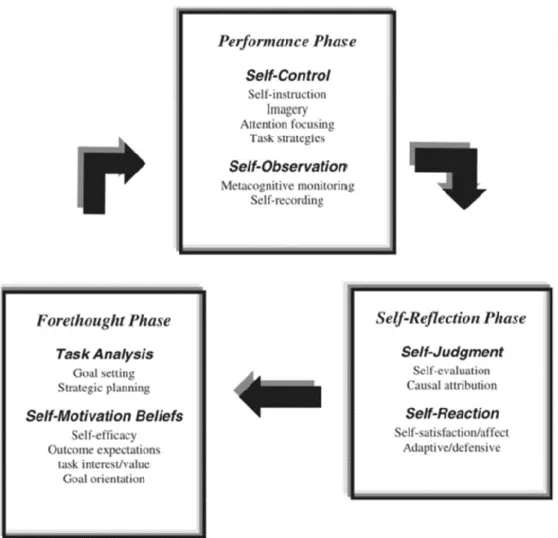
The pilgrims have a common general goal: to reach the sanctuary. To attain goals in life, Winne (1997) refers that every person needs to self-regulate their behaviors. Self-regulation (SR) may be defined as efforts made to manage one's thoughts, emotions, and behaviors in the pursuit of long-term goals (Pina, Rosário, & Tejada, 2010).In this sense, we may say that pilgrims self-regulating their behaviors analyze the demands of the task, select the resources to face them and seek support whenever necessary to achieve their goals. What may help distinguishing effective from ineffective forms of SR is the quality and quantity of one's self-regulatory processes (Zimmerman, 2000). For this reason, it is crucial to understand how these processes are structurally interrelated and cyclically sustained. Zimmerman’s model of SR (2008) provides a relevant theoretical framework for this study (see Figure 1). Zimmerman's model of cyclical SR describes how individuals set goals, monitor their progress and reflect on their performance following an interactivity loop. Cyclic feedback from previous performance is used to make personal, behavioral, and contextual adjustments in subsequent performance; in other words, each of the phases is influenced by the one that immediately precedes, and influences the following (Zimmerman, 2000).
From a social cognitive perspective, self-regulatory processes and associated beliefs fall into three cyclical phases termed by Zimmerman (2000) as: forethought, performance or volitional control, and self-reflection processes. According to this cyclical model, the forethought phase refers to the processes that precede the efforts to act and prepare the next, that is the execution of the task. There are two linked categories of forethought: (1) task analysis and (2) self-motivational beliefs (Zimmerman, 2000). Task analysis involves the a) setting of goals and b) strategic planning which refer to select or create methods that are appropriate for the task and its setting (Zimmerman & Campillo, 2003). In this phase there are also several associated self-motivational beliefs: a) self-efficacy, which refers to personal beliefs about having the means to learn or perform effectively (Bandura, 1997), b) outcome expectations, which refer to beliefs about the ultimate ends of performance (Bandura, 1997), c) task interest/value, refers to consider the task important and d) goal orientation that stresses whether the focus is on the process or in the product (i.e. output). Forethought phase influences the performance phase that integrates the processes that occur during task execution, subsuming (1) self-control and (2) self-observation (Zimmerman, 2000). Self-control processes, such as a) self-instruction, b) imagery, c) attention focusing, and d) task strategies, help learners and performers to focus on the task and optimize their effort. Self-observation refers to a person's tracking of specific aspects of their own performance, the conditions that surround it, and the effects produced (Zimmerman & Paulsen, 1995). Performance phase influences
self-THE WAY OF ST. JAMES
11
reflection phase, encompassing the processes that occur in the end of the action: (1) self- judgment and (2) self-reaction. Self-judgment involves a) self-evaluating one's performance based on a criterion (i.e., standards, past performance) and b) attributing causal significance to the results that are linked closely to two key forms of self-reactions: i) self-satisfaction and ii) adaptive reactions. In fact, when facing outputs, too improve results individuals can make adjustments to their behavior or rather display defensive reactions and avoid making any changes (Zimmerman, 2000).
Figure 1. Phases and subprocesses of self-regulation (Zimmerman, 2008, p. 178).
Understanding the structure and functioning of this cycle of phases and subprocesses of SR (Zimmerman, 2008) is fundamental to the definition of the role of pilgrims and to the assignment of their active role in the process. Self-regulatory processes integrate the concepts of motivation and cognition, emphasizing their interrelation. This idea is expressed in the literature as Will & Skill (motivation and competence), understood as the two faces of the same coin (Pintrich & Schunk, 2002; Zimmerman, 2000). McCombs and Marzano (1990) defined will as an “‘self-actualized’ state of motivation, an internal
THE WAY OF ST. JAMES
12
self-generated desire resulting in an intentional choice that is a) based on self-system awareness and values, b) motivated by personal self-development and self-determination goal, and c) integrally related to affect and mood.” (p. 52). These authors also defined skill in the domain of self-regulation as an acquired cognitive or metacognitive competency that develops with training and/or practice and effort. Pilgrims must realize that they are creative agents, responsible for and capable of achieving the goals. This will component is needed to enhance self-regulation, but it is not enough. Pilgrims, need, despite will, the skill to attain self-set goals (McCombs & Marzano, 1990).
Purpose of the Study
Despite limited, prior research on the Way of Saint James has been focused on one side of the coin (will) (e.g., Amaro et al., 2018); the current study aims to explore the whole process of self-regulation during the pilgrimage by examining the will and skill facets of self-regulation. Extant research is focused on trying to understand the motivation that leads the pilgrim to pilgrimage (e.g., Amaro et al., 2018), the analysis of the pilgrims experience against that of tourists (e.g., Lois-González & Santos, 2015), and, lastly, Damari and Mansfeld (2016) investigated several types of pilgrims (ranging from traditional pilgrims to ‘post-postmodern’ ones) in order to get an understanding of their shared experiences. Still, there is limited information linking the concept of pilgrimage to the psychological area (Warfield & Hetherington, 2018). Furthermore, previous research under the self-regulation framework has been mostly focused on the educational area such as the application of this theory to schools and universities (Rosário et al., 2018; Rosário, Fuentes, Beuchat, & Ramaciotti, 2016; Zimmerman, 2002); and to our knowledge there is no research on pilgrimage grounded on a psychological framework to understand this phenomenon. This study addresses this gap in the literature by analyzing the experience of pilgrims on the Way of St. James using a SR framework.
Our purpose is to understand the process of pilgrimage on the Way of St. James in their three stages: preparation, execution and finalization. These three phases were analyzed against the three cyclical phases of the SR model. The following research questions were grounded on the latter (i.e. forethought, performance, and self-reflection) and guided the current study:
1. How pilgrims of The Way of St. James prepare themselves for this journey? 2. What leads people to remain moving on to reach their goal?
THE WAY OF ST. JAMES
13 Method Participants
The present study is part of a larger investigation about the perspectives of pilgrims and people who were responsible to assist these pilgrims on the Way of St. James. Given the purposes of the current study only pilgrims data were analyzed. Initially, the sample consisted of 37 participants but three were excluded from the study for not having traveled at least 100 kilometers (minimum to receive the Compostela certificate; see Reader, 2007) and two for not having reported their personal experience as pilgrims but as pilgrimage organizers. In this way, the final sample comprised 32 individuals, who travelled at least 100 kilometers, beginning at distinct starting point (e.g., Porto, Valença, Sarria). All pilgrims made the pilgrimage by foot at least once in their(s) pilgrimages and all made the pilgrimage at least once in a group. At the time of the interview, pilgrims had completed the pilgrimage at different years/months ago (e.g., two years ago, three months ago). The average number of times pilgrims had walked the Way of St. James was 2.41, ranging from once to 12 times.The pilgrims were portuguese and aged between 16 and 52 years (M = 32.03, DP = 10.00) and from this pool, 21 were women (65.6%). Regarding their education, 71.9% participants had at least a bachelor degree and 25.0% were students.
Data Collection
Considering the qualitative nature of the goals of this investigation, data was collected using a semi-structured interview. The interviewer met the interviewee at the time and location of the latter's convenience as in the facilities of a University in the north of Portugal in a quiet room. The interviewer informed participants on the steps of the interview and all filled in the informed consent, in accordance with the Declaration of Helsinki. Confidentiality issues were also addressed as well as the possibility to give up in any time of the interview.
A semi-structured interview with a set of socio-demographic and five open questions was conducted in order to collect data and answer our research questions. The first part of the interview provided information about the gender, age, education, occupation, as well as information regarding how many times, if any they had completed this pilgrimage.
How was the preparation (physical, spiritual, psychological, logistics) to take the journey? What strategies/guidelines have you followed in your preparation for this pilgrimage? What does help you going through the Way of St. James?
Tell me about a situation that has been very positive for you during thejourney. Tell me about a situation that has been very negative for you during thejourney.
THE WAY OF ST. JAMES
14 Data Analysis
Participants’ answers were transcribed verbatim to digital format for later coding, and the analysis was performed with the assistance of the software NVivo. A thematic analysis was carried out following the steps indicated by Braun and Clarke (2006). The answers were coded based on a codebook purposely adapted for this study. This codebook was built following a deductive process at a semantic level (Braun & Clarke, 2006). Themes (i.e., Forethought Phase, Performance Phase, Self-Reflection Phase), subthemes (e.g., Task Analysis, Self-observation, Self-Judgment) and sub-sub-themes (e.g., Strategic Planning, Task strategies, Self-evaluation)were based on the model by Zimmerman (2008).
The criterion used to identify the themes was the frequency of participants that mentioned certain ideas related to the various themes. Categories were reported using Consensual Qualitative Research (CQR) analysis following the criteria by Hill et al. (2005, p. 12), using labels of general and typical outcomes. A general outcome means the theme is present in responses from 31 (96.9%) or 32 (100%) participants. A typical outcome means the theme emerged in responses from at least 16 (50.0%) but no more than 30 (93.8%) out of the 32 participants. Our goal was to found patterns among pilgrims’ speeches, so variant outcomes (between 2 and 15 cases) and rare categories (2 or 3 cases) were not reported. In sum, the themes and subthemes described in the results section are those that were mentioned by at least half of the participants.
Two researchers with experience in self-regulation coded the transcripts independently. Afterwards, both met to discuss any discrepancies found in the coding process and reach an agreement (e.g., one researcher coded “It was not stop to eat, it was stop to pray (…). It helped a lot to calm down.” (P11) as Task Strategies and the other one did not). Researchers reread all transcripts following the common codification process to check all the coded material for a final time (Braun & Clarke, 2006). Finally, Cohen’s κ coefficient showed an interrater agreement of 0.87, which is considered “almost perfect” according to Landis and Koch (1977, p. 165).
Results
Interviews provided data that helped researchers answer the research questions grounded on the three phases of the self-regulatory process: forethought phase, performance phase, and self-reflection phase. A summary of the themes, including descriptions and exemplar quotes from the participants interviews, is provided below.
Theme 1: Forethought Phase | How pilgrims of The Way of St. James prepare themselves for this journey?
THE WAY OF ST. JAMES
15
The pilgrims walking the Way of St. James reported their preparatory processes prior to engage in the pilgrimage, and two themes were identified in their answers: task interest/value and strategic planning. The majority of pilgrims stressed the interest and value of the pilgrimage: “When I was invited it was something I had been looking forward to for years and I had never done it before” (P17). Participants reported the idea of travelling The Way of St. James as an old and dreamed wish, and they just needed the occasion to do it. The following quotation illustrates this idea “I was totally thrilled, I felt an immense urge to take the path. I already knew what to expect, and I was truly needing it.” (P39) which shows that even those who had already done the journey previously, felt a strong desire and a renewed interest in repeating the experience.
While describing the type of preparation they had done, aspects were stressed as follows. Some pilgrims (n =19) reported their low engagement while preparing their journey focusing particular aspects. Their explanations addressed distinct aspects of preparation such as the physical “I think it is not a physical preparation that is required.” (P38), the psychological, “I didn't know that the path was psychologically demanding.” (P21), or the spiritual aspect, “I didn't need to prepare myself spiritually.” (P6).
About half of the pilgrims mentioned have done a general preparation such as searching the internet for what they needed to take in the journey, what precautions they should take before leaving or during and after the walk, getting advice from other pilgrims who had already made the way, exploring hostels along the way, strategic stopping points and shopping, among other behaviors to collect general information instrumental for the journey. Some of those pilgrims reported having only focused their physical preparation (n =13) (e.g., walking for long distances a few weeks before the pilgrimage) not mentioning any preparation of a distinct nature (e.g., psychological or spiritual). Finally, other pilgrims focused their preparation report on logistics (n =13); these participants mentioned aspects such as packing, collecting detailed information on what materials they should take in the bag pack, on the number of kilometers to walk each day or their efforts to look for hostel locations or spots to pause and rest.
Theme 2: Performance Phase | What leads people to remain moving on to reach their goal?
When pilgrims spoke about their experience along the way, almost all of them reported behaviors that could be understood under the label of self-controlling strategies. For example, pilgrims mentioned strategies that helped them throughout the path and allowed to reach the Santiago cathedral (the ultimate goal), such as being in a group of pilgrims: "[In general, it helped] the people around me (P13)", "The others… helped a lot!" (P17); keeping the group of fellow travelers with high spirits: "the strategy is
THE WAY OF ST. JAMES
16
basically this, we always try to keep the group animated." (P18); praying and reflecting: "and it was not a stop to eat, it was stop to pray, to say our prayers. It helped a lot to calm down". (P11), "’never miss the moments of reflection’, we always said to each other." (P22); trying to keep the step at the right pace:
“as walking strategies we tried not to stop too long.” (P3), getting up early to start the way with a cooler
weather: "leave [the hostels] too early to avoid the highest heat hours." (P3); being focused on the following and on the final goal: "[it helps] set a goal and every day just think about reaching it." (P1); having the goals clearly outlined in your head: "we had to try to get out on time, arrive on time, and organize our time to achieve that." (P1).
Participants reported that these strategies were fundamental so that the experience of the path would not be “just walking”, but rather an opportunity to take advantage of other dimensions of the experience of the pilgrimage, such as: the partnership of the pilgrim group, the beautiful landscape, the inner growth, and thus to have a more complete experience of the Way of St. James.
Moreover, several pilgrims mentioned to have engaged in brief on-task reflections focused on what they were experiencing. For example, reflections on the challenges and instantaneous needs that they had along the Way, the opportunity to be in silent and to be available to reflect on the distinct challenges of the experience such as physical or logistics ones. To cope with the challenges of the tasks at hand, pilgrims displayed metacognitive monitoring: “If we’re going at this rate, I can do it today, but I can't do it tomorrow, I can't keep this mentality of fast-moving for a long time, I have to go comfortable.” (P11). Another pilgrim reported a mental exercise used to help him accomplish everyday goals. The focus of the exercise was on reflecting on the impact of his actions at every moment: “On this day, where could I have improved, when did I help others, when was I a real pilgrim?” (P22).
Theme 3: Self-reflection Phase | How pilgrims evaluate their journey?
Concerning the efforts made to evaluate the experience, all pilgrims made comments and considerations, showing self-reflection about their pilgrimage. Participants stressed the importance of the group to help them complete the path “above all, I think it [the group] helps the person or people with whom we walk the Way” (P1).
Several participants said that despite walking the St. James Way is a personal journey, the peers play an important role for them to achieve proximal and the final goal: "The motivation and joy we can get with the people who walk with us is essential because, this joy, this desire to arrive, to share all the things of the Way, I think it is a great motivation." (P1). The role of the pilgrim group was mentioned to be of a various nature: help balance the difficulties and challenges throughout the path; encourage each other to keep in the track and avoid giving up by using support messages: "[we were saying to each other]
THE WAY OF ST. JAMES
17
look, there is little time left" (P210); talking to each other to distract from the suffering and pain resulting from the journey: "if we talk to someone else, it is better" (P30) or even by making silence at the right time. Participants also noted the importance of engaging on a spiritual and psychological preparation, indicating that these modes of preparation served as a shield to the physical challenges they faced along the way: "if I had done this spiritual preparation I would still have started this journey more strong " (P1), “I think, therefore, it is not a matter of physical preparation or whatever, I think it is really a mental matter (…) what we are or are not able to do mentally (…) and I think this is the greatest help to get there, the greatest thing we need to make the Way to Santiago: having in mind, what I want to achieve regardless of all…” (P38). Most pilgrims expressed surprised at how resilient they had been even though their physically harsh experience on the pilgrimage: "the first day was something I don't even know how we could do it, but then we learn we did it, our legs hurt, our feet hurt, but we got it!" (P14), and another “I was a bit amazed with my resilience." (P22).
While analyzing their experience, pilgrims reported to have changed as a person in result of their experience during the Way: “I have become a different person and feel even stronger as an individual person (P22); they also stressed the inward nature of this process “It is very important, because in terms of inner strength there is a rediscovery of ourselves” (P23).
Several answers of the pilgrims were identified as belonging to the sub-theme self-satisfaction/affect. Participants mentioned that the experience of the St. James journey had been very positive; moreover, they also referred that even the negative aspects were turned into positive ones. The physical limitations or the lack of comfort were mentioned as examples by participants, “the pain in the legs and on the foot is positive because not everything in life is perfect and we suffer, so I think it’s good to have a lit bit of that pain in this context.” (P28). However, many pilgrims stressed the physical pain they felt along the journey as uncomfortable and as a source of disaffection. Finally, the interest and willingness to repeat the experience was shared by all pilgrims: “I always say, next year I'm here again, God willing!” (P2).
Discussion
Prior research about the Way of St. James had mainly focused on pilgrims’ motivations (Lois-González & Santos, 2015;Amaro et al., 2018) and on differences between pilgrims and tourists (Cazaux, 2011; Lois-González & Santos, 2015). There is lack of literature about the process of the Way of St. James stressing the three components: planning, execution and evaluation of the journey. To the authors’ knowledge, the current study was the first to explore these three phases of the Way of St. James. Thus,
THE WAY OF ST. JAMES
18
this study adds to the literature by examining the perspectives of pilgrims about the preparation, the execution and the evaluation of the pilgrimage.
All pilgrims mentioned to value the pilgrimage experience by itself and some reported that walk the Way as “an old dream”. These findings are consistent with the literature on SR stressing the relevance of considering a task for its intrinsic properties rather than of its instrumental qualities (Deci & Ryan, 1985; Lepper & Hodell, 1989). Current data is also consistent with most studies about pilgrimage showing a revived interest in the pilgrimage experience and the steady growth of pilgrims (Reader, 2007; Schnell & Pali, 2013; Shinde, 2007), namely those walking the Way of St. James (Nilsson & Tesfahuney, 2016). Still, and interestingly only some participants reported to have engaged in a strategical preparation plan. Despite Havard (2007) alert that “a lack of preparedness can lead to discomfort, injury and even the premature termination of a pilgrimage” (p. 9), pilgrims whose answers did not indicate displaying efforts to plan the pilgrimage in detail, tend not to reveal any kind of regret.
The reasons that may help explain the lack of preparation of the current pilgrimage are threefold as follows. For example, Yates (2013) suggests that pilgrims may be over confident to meet the challenges of the journey because they rely on the aggressive and sophisticated marketing campaigns offering equipment to meet physical challenges of pilgrimage. Another aspect that may help explain this finding is related to the fact that participants did their pilgrimage in a group. These pilgrims might have underestimated the importance of the forethought phase because they were relying on the organizers of the pilgrimage, that would take care of the planning for them. In fact, when traveling in a group, one or two organizers are responsible for the preparatory phase, setting a plan which is likely to include, for example, best routes and detailed maps, reservations of accommodations for each night, timetables and spots to rest and restaurants to have meals. This pack of information is presented to pilgrims and may discourage their efforts to prepare the walking journey. This is consistent with the fact that the majority of participants mentioned to have made general planning actions by looking on internet for general tips and suggestions on things to pack. In addition, our participants reported to have experience of the St. James Way; in fact, the average number of times they did the Way was 2,41. Pilgrims with a vast experience may devalue preparation of the following pilgrimages. Participants may rely on their experience developing a sense of self-efficacy that could prevent further planning. Literature indicates that previous experience of success leads people to believe in their ability to perform a similar task in the future (Zimmerman, 2000).
Globally, pilgrims reported behaviors indicate a lack of agency focused on the preparation of the journey. Effective planning involves selecting strategies that are appropriate for a particular task and
THE WAY OF ST. JAMES
19
setting (Zimmerman & Cleary, 2009); however, some answers of our pool indicated purposive personal efforts and actions directed at displaying pilgrims’ skills to attain their self-goals (see Zimmerman, 2000). These findings related to lack of personal agency to set effective plans may call the attention of researchers and of the organizers of pilgrimages to the need of promoting pilgrims’ personal agency and engagement on the first phase of the SR process.
Regarding the experience of the path itself, many pilgrims mentioned behaviors and sequences of activities purposely displayed to attain goals (Zimmerman & Rocha, 1987). Moreover, pilgrims answers also evidenced the use of metacognitive monitoring to improve their performance. Metacognitive monitoring refers to a person’s mental tracking which involves aspects of their own performance, conditions that surround it, and effects that it produces (Zimmerman & Paulsen, 1995). Our findings are
consistent with the work by Zimmerman and Cleary (2009), positing that robust metacognitive monitoring facilitates the adoption of strategies responsive to the on-going challenges. Moreover, as Pressley, Woloshyn and Associates (1995) alert, appropriate strategies enhance performance by aiding cognition, controlling affect, and directing motoric execution. Pilgrims mentioned an array of strategies varying in nature and frequency of use to cope with the challenges of the pilgrimage (e.g., waking up early, drinking plenty of fluids, wearing comfortable clothing, and praying in silent). This diversity of task strategies to cope with similar challenges is consistent with literature posing that no self-regulatory strategy will work equally well for all persons (Zimmerman, 2000). Finally, after answering the questions regarding preparation and execution, pilgrims mentioned their efforts to evaluate the pilgrimage. Participants answers are consistent with self-evaluation strategies in the sense that their reports compared the actual outputs of the experience with the goal set (Zimmerman, 2000).
While addressing the final phase of the SR process, participants referred to have learned skills that they were not aware of. Weinstein, Acee, and Jung (2011) define skills as knowledge about something and knowing how to use strategies and other thinking skills including knowing about the performance demands of different types of tasks; for example, knowing about one’s own personal strengths and weaknesses. Participants mentioned to have improved their social skills: “What have I improved? My relationships with others” (P21); their cognitive skills: “I found out things about myself that I never thought to find, so it was a way of truly meeting myself” (P29); or their physical skills: “I thought I couldn't make it; I had to stop, but eventually I did it.” (P30). These positive self-evaluations were likely to lead pilgrims to feel efficacious and motivated to continue to work actively because of their trust on their capability to make further progress and attain goals (Schunk, 1991). The latter may also help justify why the majority of the pilgrims in our study did the pilgrimage more than once.
THE WAY OF ST. JAMES
20
Prior research indicates that self-evaluative moments may have a more powerful effect on activities that are highly valued by individuals (Simon, 1979). After a self-reflection period, most of the pilgrims mentioned to have changed as a person. The literature corroborates this idea. For example, Slavin (2003) says “such journeys, like the Camino (…) subtly change the person who makes them” (p. 14); and Collins-Kreiner (2010) defends that pilgrims are “motivated to undergo an experience which will add more meaning to their lives” (p. 446).Nilsson and Tesfahuney (2016) explain that the idea of a renewal self may occur because the experience of holy places, in this case the Way of St. James, promotes the people touches inner-self and instigates the existential meaning.
The relevant role of the group in helping pilgrims attain their final goal was shared by participants. Participants expressed the instrumentality of this mode of walking the Way (group) as a task strategy, but also reported satisfaction related to the positive impact of being in a group on their performance along the Way. This finding is consistent with literature stating that be enrolled in a group sharing interests, values, and emotions and setting common goals is likely to influence and foster the completion of the task (Fredricks, Blumenfeld, & Paris, 2004; Elffers, Oort, & Karsten, 2012). Moreover, the “pilgrimage community” is said to provide solidarity, shelter, and a feeling of brotherhood among the pilgrims, and plays a central and supportive role in the whole experience (Damari & Mansfeld, 2016;Turner & Turner, 1978).
Interestingly, despite the relevance of the group for participants and the help provided in sustaining ones’ behaviors towards the self-set goals, participants stressed the personal and agent role of each of the travelers as a hallmark of this pilgrim experience “The path is always travelled only by us, but we are never alone” (P22). For example, participants mentioned reflections on their metacognitive efforts to elaborate on their dissatisfaction (e.g., back pain, walking wet under a rain shower) changing discomfort into a positive learning experience. These inner reflections were reported to be personal and intimate as outcomes of personal agency (McCombs & Marzano, 1990). Participants did not associate personal reflections as products of shared conclusions for the whole group.
Another topic of interest that draw attention is the number of students doing the Way of St. James. Twenty-five per cent of the participants were students, and all of them enrolled in a pilgrimage organized by the school. Despite anecdotal and in need of further confirmation, we were informed by the managers of hostels for pilgrims that the number of pilgrimages organized by schools during summer is growing. Some schools are providing opportunities for students to develop skills while doing a demanding journey (Beeman, 2017; Bernay, 2019; Havard, 2017). Teachers and school administrators could consider this pilgrimage as an opportunity to work SR strategies in class and promote the transfer of this strategic
THE WAY OF ST. JAMES
21
knowledge to the challenges students are likely to face of the Way; and vice versa, promote the transfer of the lessons learned along the way to their school work.
Despite the strengths of the current study, some limitations should be acknowledged. The lack of knowledge about some topics: the starting point of every participant would have helped to compare longer distances, the time of the year they had travelled, how many kilometers they had done in one day and the fact of pilgrims making the way divided in different times. Future studies may consider these variables, specially this last one in order to compare this experience with pilgrims that make the pilgrimage at once, since they walk less days in a row. Other interesting variables such as perseverance in the whole experience, altruism and transference of what pilgrims learned to other fields of daily life could be interesting to study once that were ideas highlighted for these participants.
In sum, the current study provides valuable information which may help deepen our understanding of these three phases and of the pilgrimage of the Way of St. James itself. Furthermore, findings are expected to inform pilgrims and pilgrimage organizers’ practices and, hopefully, improve the quality of pilgrimage.
THE WAY OF ST. JAMES
22 References
Amaro, S., Antunes, A., & Henriques, C. (2018). A closer look at Santiago de Compostela's pilgrims through the lens of motivations. Tourism Management, 64, 271-280. doi:10.1016/j.tourman.2017.09.007
Bandura, A. (1997). Self-efficacy: The exercise of control. New York, NY, US: W. H. Freeman.
Beeman, C. (2017) What said the way? (Qué dice el camino?) Broadening the concept of education through experiences in opposing ontologies while walking to Santiago. Foro de Educación 15(23), 25-42. doi:10.14516/fde.567
Bernay, R. (2019). Following the inner camino: An autoethnographic study. New Zealand Journal of Educational Studies, 54(2), 157-178. doi:10.1007/s40841-019-00134-3
Braun, V., & Clarke, V. (2006). Using thematic analysis in psychology. Qualitative Research in Psychology, 3(2), 77-101.doi:10.1191/1478088706qp063oa
Cazaux, F. (2011).To be a pilgrim: A contested identity on Saint James' way. Tourism, 59(3), 353-367. Collins-Kreiner, N. (2010). Researching pilgrimage: Continuity and transformations. Annals of Tourism
Research, 37(2), 440-456.doi:10.1016/j.annals.2009.10.016
Damari, C., & Mansfeld, Y. (2016). Reflections on pilgrims' identity, role and interplay with the pilgrimage environment. Current Issues in Tourism, 19(3), 199-222. doi:10.1080/13683500.2014.957660
Deci, E., & Ryan, R. M. (1985). Intrinsic motivation and self-determination in human behavior. New York, NY, US: Plenum.
Elffers, L., Oort, F., & Karesten, S. (2012). Making the connection: The role of social and academic school experiences in students' emotional engagement with school in post-secondary vocational education. Learning and Individual Differences, 22(2), 242-250. doi:10.1016/j.lindif.2011.08.005
Felkai, P. (2019).Medical problems of way of St. James pilgrimage. Journal of Religion and Health, 58(2), 566-571. doi:10.1007/s10943-018-00744-z
Fernandes, L. F. (2018). Peregrinos de Santiago. Lisboa, Portugal: Paulus.
Fredricks, J., Blumenfeld, P., & Paris, A. (2004). School engagement: Potential of the concept, state of the evidence. Review of Educational Research, 74(1), 59-109. doi:10.3102/00346543074001059
Frey, N. (1998). Pilgrim stories: On and off the road to Santiago. Berkeley, CA, US: University of California Press.
Graham, B., & Murray, M. (1997). The spiritual and the profane: The pilgrimage to Santiago de Compostela. Cultural Geographies, 4(4), 389-409. doi:10.1177/147447409700400402 Gusmán, I., Lopez, L., Lois-González, R., & Santos, X. (2017). The challenges of the first European cultural
itinerary: The way to St. James. Almatourism - Journal of Tourism, Culture and Territorial Development, 8(6), 1-19. doi:10.6092/issn.2036--5195/6034
Havard, M. (2017). Grit or Grace: Packing for the camino de Santiago. International Journal of Religious Tourism and Pilgrimage, 5(2), 5-9.doi:10.21427/D7MX4M
Hill, C., Knox, S., Thompson, B., Williams, E., Hess, S., & Ladany, N. (2005). Consensual qualitative research: An update.Journal of Counseling Psychology, 52(2), 196-205. doi:10.1037/0022-0167.52.2.196
Landis, J.R., & Koch, G.G. (1977). The measurement of observer agreement for categorical data. Biometrics, 33(1), 159-174. doi:10.2307/2529310
Lepper, M. R., & Hodell, M. (1989). Intrinsic motivation in the classroom. In C. Ames & R. Ames (Eds.), Research on motivation in education (pp. 255-296). Hillsdale, NJ, US: Erlbaum.
THE WAY OF ST. JAMES
23
Lois-González, R., & Santos, X. (2015). Tourists and pilgrims on their way to Santiago. Motives, caminos and final destinations. Journal of Tourism and Cultural Change, 13(2), 149-164. doi:10.1080/14766825.2014.918985
McCombs, L. B., & Marzano, R. J. (1990). Putting the Self in Self-Regulated Learning: The self as agent in integrating will and skill. Education Psychologist, 25(1), 51-69. doi:10.1207/s15326985ep2501_5
Nilsson, M., & Tesfahuney, M. (2016). Performing the ‘‘post-secular” in Santiago de Compostela. Annals of Tourism Research, 57, 18-30. doi:10.1016/j.annals.2015.11.001
Oficina de Acogida al Peregrino de Santiago de Compostela. (2018). Informe estadístico. Retrieved April
30, 2019 from
http://oficinadelperegrino.com/wp-content/uploads/2016/02/peregrinaciones2018.pdf
Perrín, R. (2017). St James, son of Zebedee, an apostle with many iconograpies. In A. M. Pazos (Ed.), Translating the Relics of St James: From Jerusalem to Compostela (pp.159-160). Oxford, United Kingdom: Routledge.
Pedrotti, F. (2012). Concept design - An innovative approach to learning: The case of Saint James’ way as a playground for meaningful learning experiences. Journal of Tourism Consumption and Practice, 4(2), 25-40.
Pina, F., Rosário, P., & Tejada, J. (2010). Impacto de un programa de autorregulación del aprendizaje en estudiantes de grado. Revista de Educación, 353, 571-588.
Pintrich, P., & Schunk, D. (2002). Motivation in Education. Englewood Cliffs, NJ, US: Prentice Hall. Pressley, M., Woloshyn, V., & Associates. (1995). Cognitive strategy instruction that really improves
children's academic performance (2nd edition). Cambridge, MA, US: Brookline Books.
Reader, I. (2007). Pilgrimage growth in the modern world: Meanings and implications. Religion, 37(3), 210-229.doi:10.1016/j.religion.2007.06.009
Rebic, A. (2002, August, 1).The document of the Holy See on: “Pilgrimage 2000” [Web bog post]. Retrieved from https://www.medjugorje.org/pilgrimage2000.htm
Rosário, P., Núñez, JC., Rodriguez, C., Cerezo, R., Fernandez, E., Tuero, E., & Hogemann, J. (2018). Analysis of instructional programs in different academic levels for improving self-regulated learning SRL through written text. Studies in Writting Series, 34(9), 201-230. doi:10.1163/9789004270480_010
Rosário, P., Fuentes, S., Beuchat, M., & Ramaciotti, A. (2016). Autorregulación del aprendizaje en una clase de la universidad: Un enfoque de infusión curricular. Revista de Investigación Educativa, 34(1), 31-49. doi:10.6018/rie.34.1.229421
Schnell, T., & Pali, S. (2013). Pilgrimage today: the meaning-making potential of ritual.Mental Health, Religion & Culture, 16(9), 887-902. doi:10.1080/13674676.2013.766449
Schunk, D. H. (1991). Goal setting and self-evaluation: A social cognitive perspective on self-regulation, In M. Maehr, & P. R. Pintrich (Eds.), Advances in motivation and achievement (Vol.7, pp. 85-113. Greenwich, CT, US: Jai Press.
Shinde, K. (2007). Pilgrimage and the environment: Challenge in a pilgrimage centre. Current Issues in Tourism, 10(4), 343-365. doi:10.6088/ijes.2013030600043
Simon, K. (1979). Self-evaluative reactions: The role of personal valuation of the activity. Cognitive Therapy and Research, 3(1), 111-116. doi:10.1007/BF01172725
Slavin, S. (2003). Walking as spiritual practice: The pilgrimage to Santiago de Compostela. Body & Society, 9(3), 1-18. doi:10.1177/1357034X030093001
Tilson, D. J. (2005). Religious-spiritual tourism and promotional campaigning: A church-state partnership for St. James and Spain. Journal of Hospitality & Leisure Marketing, 12(1), 9-40, doi:10.1300/J150v12n01_03
THE WAY OF ST. JAMES
24
Turner, V., & Turner, E. (1978). Image of pilgrimage in Christian culture. New York, NY, US: Columbia University Press.
Vázquez de la Torre, G. M., Naranjo, L. M., & Carranza, R. C. (2012). Analysis of the pilgrim profile in Spain: Two case studies. International Journal of Applied Science and Technology, 2(4), 23-29 Warfield, H., & Hetherington, K. (2018). Pilgrimage as Transformative Process. Leiden, The Netherlands:
Brill.
Weinstein, C., Acee, T., & Jung, J. (2011). Self-regulation and learning strategies. New Directions For Teaching and Learning, 126, 45-53. doi:10.1002/tl.443
Winne, P. H. (1997). Experimenting to bootstrap self-regulated learning. Journal of Educational Psychology, 89, 397-410. doi:10.1037//0022-0663.89.3.397
Yates, S. (2013) Pilgrim Tips and Packing List. Camino de Santiago. Charleston, SC, US: CreateSpace Independent Publishing Platform.
Zimmerman, B. J. (2000). Attaining self-regulation. A social cognitive perspective. In M. Boekaerts, P. Pintrich, & M. Zeidner (Eds.), Handbook of self-regulation (pp. 13-39). San Diego, CA, US: Academic press.
Zimmerman, B. J. (2002). Becoming a self-regulated learner: An overview. Theory Into Practice, 41(2), 64-70. doi:10.1207/s15430421tip4102_2
Zimmerman, B. J. (2008). Investigating self-regulation and motivation: Historical background, methodological developments, and future prospects. American Educational Research Journal, 45(1), 166-183.doi:10.3102/0002831207312909
Zimmerman, B. J., & Campillo, M. (2003). Motivating self-regulated problem solvers. In J. Davidson & R. Sternberg (Eds.), The Psychology of Problem Solving (pp. 233-262). New York, NY, US: Cambridge University Press.
Zimmerman, B. J., & Cleary, T. J. (2009). Motives to self-regulate learning: A social cognitive account. In K. R. Wenzel & A. Wigfield (Eds.), Educational psychology handbook series. Handbook of motivation at school (pp. 247-264). New York, NY, US: Routledge/Taylor & Francis Group. Zimmerman, B. J., & Paulsen, A. S. (1995). Self-monitoring during collegiate studying: An invaluable tool
for academic self-regulation. In P. Pintrieh (Ed.), New directions for teaching and learning (No. 63, pp. 13-27). San Francisco, CA, US: Jossey-Bass.
Zimmerman, B. J., & Rocha, J. (1987). Mode and type of toy elaboration strategy training on kindergartners’ retention and transfer learning. Journal of Applied Developmental Psychology, 8(1), 67-78. doi:10.1016/0193-3973(87)90021-9