Repositório ISCTE-IUL
Deposited in Repositório ISCTE-IUL: 2019-02-13Deposited version: Post-print
Peer-review status of attached file: Peer-reviewed
Citation for published item:
Almeida, I. D., Silva, J. M. & Möhring, M. M. (2018). Student evaluation of teaching effectiveness: implications for scholars in operations management. In 25th EurOMA – To Serve, to Produce and to Servitize in the Era of Networks, Big Data, and Analytics. Budapest: Euroma.
Further information on publisher's website: http://euroma2018.org/
Publisher's copyright statement:
This is the peer reviewed version of the following article: Almeida, I. D., Silva, J. M. & Möhring, M. M. (2018). Student evaluation of teaching effectiveness: implications for scholars in operations
management. In 25th EurOMA – To Serve, to Produce and to Servitize in the Era of Networks, Big Data, and Analytics. Budapest: Euroma.. This article may be used for non-commercial purposes in accordance with the Publisher's Terms and Conditions for self-archiving.
Use policy
Creative Commons CC BY 4.0
The full-text may be used and/or reproduced, and given to third parties in any format or medium, without prior permission or charge, for personal research or study, educational, or not-for-profit purposes provided that:
• a full bibliographic reference is made to the original source • a link is made to the metadata record in the Repository • the full-text is not changed in any way
The full-text must not be sold in any format or medium without the formal permission of the copyright holders.
Serviços de Informação e Documentação, Instituto Universitário de Lisboa (ISCTE-IUL) Av. das Forças Armadas, Edifício II, 1649-026 Lisboa Portugal
Phone: +(351) 217 903 024 | e-mail: [email protected] https://repositorio.iscte-iul.pt
1
Student Evaluation of Teaching Effectiveness:
Implications for Scholars in Operations Management
Isabel Duarte de Almeida ([email protected]) Universidade Lusíada, (CLISSIS-UL), Lisboa, Portugal
Instituto Universitário de Lisboa (ISCTE-IUL), BRU-UNIDE, Lisboa, Portugal J. M. Vilas-Boas da Silva ([email protected])
Instituto Universitário de Lisboa (ISCTE-IUL), BRU-UNIDE, Lisboa, Portugal Monika Maria Möhring ([email protected])
Management und Kommunikation, Technische Hochschule Mittelhessen (THM), Friedberg, Germany
Abstract
Many times, teaching rating by students are the most influential measure of the quality of teaching departments, courses and teachers to assess how curricula changes are perceived by students. This study seeks biases introduced by background variables. If these are relevant, then student evaluations as a valid indicator of teaching effectiveness for the purpose of quality improvement and assurance could be questioned. The research purpose is (i) to appreciate the suitability of business student ratings in assessing teaching performance, and (ii) to explore limitations of current practices considering student evaluation as a primary university tool to assess teaching effectiveness.
Keywords: Business Teaching Assessment; Student ratings; Ethical student’s behaviour.
Introduction
Business Schools (BS) have become a global marketplace for students and are influenced by a growing number of competitors (AACSB, 2002). Moreover, market forces such as globalization, technology, and new workplace requirements affect and change business education (Friga et al, 2003). To ensure that management education is able to deal with global, technological and market changes, BS should use updated curricula, course materials and internationally competitive teaching models (Colff, 2004).
With the surge in public demand for accountability in higher education, particularly in BS due to the global business environment, and the growing concern for quality of university teaching, the practice of collecting student ratings of teaching has been widely adopted by universities as part of their quality assurance system. Student evaluations of teaching effectiveness are used to provide: (i) formative feedback to faculty for improving teaching, course content and structure; (ii) a summary measure of teaching effectiveness for promotion and tenure decisions; (iii) information to students for the selection of courses and teachers (Marsh and Roche, 1993). Research on student evaluations of teaching effectiveness often examines issues like the development and validity of an evaluation instrument (Marsh, 1987), the validity (Cohen, 1981) and reliability (Feldman,
2
1977) of student ratings in measuring teaching effectiveness and the potential bias of student ratings (Abrami and Mizener, 1983; Haski-Leventhal et.al, 2017; Nargundkar and Shrikhande, 2014; Tollefson et al., 1989).
In many universities, student ratings are used as one (and sometimes the only and often the most influential) measure of teaching effectiveness. In other words, the quality of teaching departments, courses and teachers are judged on the basis of student ratings they have received. So, concerning this, the research purpose that arise, is to know to what
extent student ratings can be used for making fair and valid comparative judgements about the instructional effectiveness of teachers, courses and departments.
There is the possibility that background characteristics (or factors that have nothing to do with the lecturer’s behaviour or effective teaching), or even, poor ethical values and odd critical thinking from students could bias business and management student ratings. If so, in both cases, student evaluations as a valid indicator of teaching effectiveness, whether for formative (quality improvement) or summative (quality assurance) purposes, could be called into question (Kornell.and.Hausman, 2016).
Bearing in mind the evidence on the biases introduced by background variables into student evaluations, the present study address the following set of questions, namely:
RQ1) Does the characteristics of the course itself such as the impact of electivity, level of course, subject area and workload, amongst others, influence teaching ratings?
RQ2) The characteristics of the teacher, for instance, rank and experience, the reputation and research skill, along with more base concerns of personal characteristics, would entail negative evaluations of teaching?
With these questions in mind, and considering that student evaluation is the primary tool used in universities to evaluate teaching effectiveness, this study seeks biases introduced by background variables into student evaluations. Therefore, its purpose is (i) to appreciate the suitability of business student ratings in assessing the teaching performance, and (ii) to explore limitations of current practices considering student evaluation as a primary university tool used to assess teaching effectiveness.
The paper is structured into four sections: introduction, literature review, case study and conclusions. In the literature review, three aspects are addressed: (i) the role of
business in society; (ii) the importance of BS; and (iii) studentsratings of teaching for
both judgemental and developmental purposes. The case study reports the responses to anonymous questionnaires administered to Management MSc students of a Business school. Various aspects of teaching methods and lecturer characteristics are tested, including course content, knowledge, personality and lectures’ attitude. A statistical analysis is applied to the questionnaires obtained through the students’ evaluations over a period of five years. Based on the findings, it is argued that course content, knowledge, personality and attitude of a lecturer play an important role in determining effectiveness of teaching in BS. However, even considering that feedback from students could perhaps help teachers to improve their teaching performance, the use of such anonymous ratings for evaluations relating to reward systems in a university, instead, may be problematic. If students are responding to factors that should be unrelated to teaching quality – e.g., age, gender, physical aspect, personality – such evaluations may be misleading, having negative consequences to teachers careers. The student perspective is important, but students do not necessarily have the expertise to recognize good teaching.
Literature review
The role of business in society
Business activity affects the daily lives of all people, as they work, spend, save, invest, travel, and play. Business influences jobs, incomes, and opportunities for personal
3
enterprise. The Confederation of Swedish Enterprise (2004) reiterates that business is the cornerstone of prosperity in society, creating the resources that lead to development and welfare. Yet this assumption has been challenged in different contexts. The recent world financial and economic crisis revealed a considerable deficiency of responsible management and accountability of financial institutions which contributed significantly to the turmoil on the markets and the depth of the crisis. Because business cannot stand alone without the environment in which it exists, it has become an inevitable urgency to discuss business activities alongside and within the context of social imperatives and realities (Lazlo, Waddock and Sroufe, 2017); Hinz, 2017; Pratama, 2017), considering also the framework of a business education in BS (Ceviker-Cinar et al, 2017).
Business needs to continuously invest in its relationship with society and to account for the use of natural resources (Fitzgerald and Cormack, 2006). In addition to sustainability and environment concerns, there are increasing apprehensions about morality and responsibility (Sastry, 2011). Companies with successful sustainability strategies connect their efforts with issues and activities that are material to their business. To achieve this, they look for talented and flexible staff with suitable management education and the right technical, cultural and social skills. The main positions related to the role of business in society, are resumed in Table 1.
Table 1 – Role of business in society - an overview of main positions
Role of business Main arguments
- Earn profits Economic and political ideology; managers as agents of shareholders need to be honest to their main task; do what you are best at – this automatically leads to social good - Corporate social responsibility Need to address environmental and ethical concerns e
response to situation
- Active involvement in society Need to act in harmony with society; recapture moral high ground; account for use of natural resources; match growing influence with growing responsibility e response to situation - Do good (philanthropy, individual
or corporate)
Consumers respond positively to such companies
- Create social value Win-win for business and society by creating greater value
Many managers, policymakers, and academics embraced Porter and Kramer’s idea of Creating Shared Value (Porter et al, 2011). Accordingly, to achieve a more overarching framework, businesses and managers should act responsibly, and by doing well to society, they create more value for themselves. Thus, a framework where managers, academy and BS thrive in a more sustainable economy, creating shared value, will create economic value in a way that also creates value for society by addressing its needs and challenges. This offers an appealing vision, calling for companies to search for success, not merely by generating financial returns, but by addressing the pressing challenges facing society and environment (Reyes et al, 2017; Jones et al, 2016).
Importance of Business Schools
BS play a great number of different roles in society. Their direct access to leading companies and institutions ensures this. Yet the extent to which each role is taken on, and the importance schools and society give to it, depend on the context in which they find themselves (Sauquet, 2012). This perspective calls for a more balanced relationship between BS and business, government and society, with BS reasserting their influence and focus in the education process to satisfy the diverse interests of their stakeholders (Godos-Díez and al, 2015; Kelley and Nahser, 2014). So what is the value proposition for
4
management education beyond examining the dynamic influences of digitisation, technology, globalisation, demographic dynamics and the knowledge economy? The underlying question must be whether management education conducts itself with responsibility to society in its preparation of the students that will manage and lead others, make investment and take decisions, source products and extract resources. But should management education today also provide an educational experience that enables students to develop a maturity in matters of ethics, society, culture and politics? Thought must be given to how to develop this more holistic and balanced model of management education with its higher purpose to nurture social responsibility and enhance students’ moral and ethical compass in an increasingly uncertain world (Almeida and Silva, 2016). There are recurring debates in BS about the relevance and the need for ethics in the curriculum (De los Reyes et al, 2017; Painter-Morland and Slegers, 2018). However, there is little consensus on how this can or should be done. Others argue that ethics cannot be taught, or even that it should not be taught (Almeida and Craveiro, 2011; Baron et al, 2015).
In order to develop a professional class of managers, three critical dilemmas must be addressed: (i) the need for a well-defined, accepted and meaningful body of knowledge about management; (ii) the need to be a consensus about managerial status and legitimacy; (iii) the need for an effective professional organisation that sets policies, managerial standards and appropriate examinations for final entry into the profession. Arguably, management education has only achieved one of these – the body of knowledge criterion – based on the promise of continued acceptance of the scientific, analytic Business school model, which became the dominant design for the EU Business school in the second half of the 20th century. Skills of analysis have been prioritised, often at the expense of skills necessary for ethical behaviour and managerial judgement, particularly in increasingly challenging, complex and ambiguous environments (Baron et al, 2015; Lumina, Scott and Bulent, 2015). The major hidden risk is that students are thus prepared to reproduce consistently familiar situations, and too commonly used organisational configurations (Kligyte et al, 2013). In order to avoid this risk, BS should ask themselves about their methods of preparing their students to become qualified professionals that are able to act in society, in an efficient and innovative manner. The concepts taught to the student should try to develop the student’s capacity to be able to judge and decide when faced with alternatives, and also develop the sense of critical thinking, which shall enable the student to link actions with a sense of responsibility.
Business Schools, business teaching and student ratings
Academic organizations are experiencing a process of change similar to the business organizations. The rate of this change is driven by several factors. For one, globalization issues for all colleges and universities create a significant and ever expanding challenge to curricula to stay competitive. According to AACSB’s Management Education Task Force (2002), “All BS are touched to one degree or another by the global business
environment, the global marketplace for students, and the growing number of competitors in every continent” (p. 9). So, to ensure that management education is able to deal with
global, technological and market changes, it is imperious for BS to use appropriate curricula, materials and teaching models that are up-to-date and internationally competitive (Colff, 2004). On the other hand, as employers try to find an improvement of their companies’ value by investing in talented and flexible management staff, companies are continually improving their human capital to spread their competitive advantage. As a result, the business world exerts a significant amount of pressure on academic institutions to meet their changing human capital needs. Accordingly to Vant (2004), “Business looks for the same potential in their employees that young people look for in
5
their educational institutions - meeting quality standards of education; preparing students for a future employment landscape that will be continually changing; staying ahead of the curve in technology; and offering courses that lead to promising career opportunities” (p. 18). So, given the relationship between management education and the
business world, market forces such as globalization, technological change, and new workplace requirements may affect and consequently change business and management education more than any other sector of academia (Friga et al, 2003).
There is a clear need to prepare students with the technical, cultural and social skills they will require in their professional careers. So, management and BS must continuously update their business model and embedded curriculum in response to the changing and expanding academic market place. So, BS are shifting, putting a much stronger emphasis on the “soft” skills to prepare their graduates to be better managers and worthier team members and to be more effective communicators, listeners, and problem solvers, so they are further able to engage and inspire those around them. With different approaches and teachers engaged, through brand new programs and pertinent issues, such as corporate social responsibility, sustainable business policies or management ethics, the graduates will push boundaries and propose and explore solutions across disciplines and cultures.
The increasing speed of adjustment in business and management education is crucial because students themselves, their shifting demands, their expectations, and their “information-age mindset” require different teaching attributes to be effective in today’s business classroom. Thus, toward competitiveness of Management and BS, it is important to know how this changes are perceived by various subgroups of business students and if how they fulfil the expectations of the “new students”. Feedback represents one of the key factors that affect students' learning and students’ influence in the teaching process. Student feedback-based evaluation performs a significant social role in framing perceptions of the quality of teaching in contemporary BS. Thus, student evaluations of teaching are, arguably, the most influential single metric in the careers of college teachers. Teaching evaluations influence decisions about teachers’ classroom abilities and about their general job performance (Boysen, 2015).
Considerable research has investigated the reliability and validity of student ratings. Reliability studies (Kulik, 2001; Yunker and Yunker, 2003) generally address the question ‘Are student ratings consistent both over time and from rater to rater?’ On the other hand, validity studies (Morgan et al., 2003; Tagomori and Bishop, 1995) address the questions ‘Do student ratings measure teaching effectiveness?’ and ‘Are student ratings biased?’ Although methodological problems have been identified, there seems to be some support for both the reliability and validity of student ratings. Overall, the literature supports the view that properly designed student ratings can be a valuable source of information for evaluating certain aspects of faculty teaching performance (Mehdi et al, 2018; Marsh, 1984; Marsh and Roche, 1993). While the literature supports that students can provide valuable information on teaching effectiveness through properly designed evaluation, there is a great consensus in the literature that students cannot judge all aspects of faculty performance (Chen and Hoshower, 2003; 1993; Seldin, 1993). This literature indicates that students should not be asked to judge whether the materials used in the course are up to date or how well the teacher knows the subject matter of the course (Seldin, 1993). In both instances, the students’ background and experience may not be sufficient to make an accurate assessment, thus their conclusions may be invalid.
Design/Methodology/Approach
The university in which the study was conducted started using student feedback questionnaires on a voluntary basis over 15 years ago. When staff appraisal was
6
introduced in 2011, use was made compulsory and an instrument, known as the Student Feedback Questionnaire (SFQ), designed by the university specifically for the purpose of teacher’s rating, was introduced.
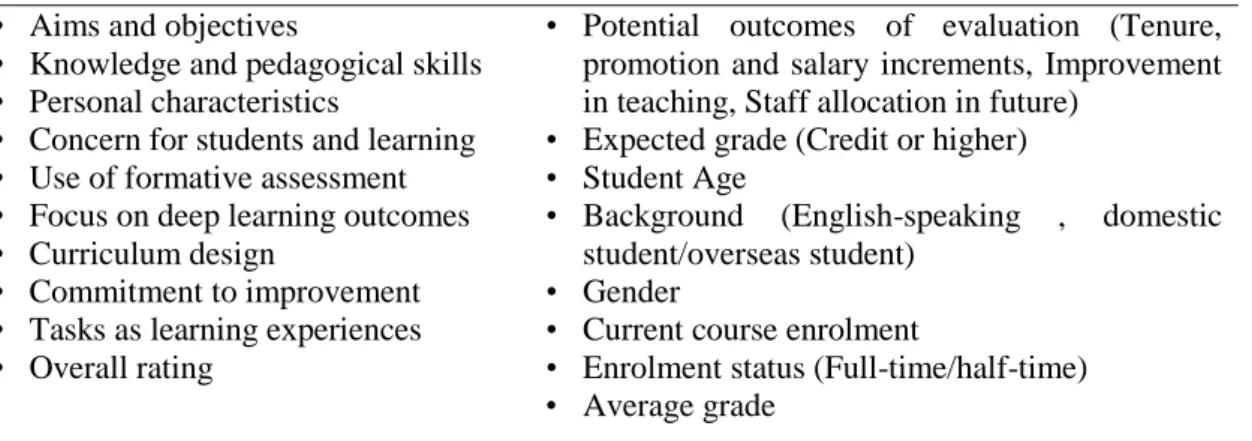
Quantitative data are leveraged in a longitudinal study, although the study’s paradigm is interpretative. The data used in this study are obtained from an anonymous questionnaire administered to 140 students in a first-year Management Master Degree subject at a medium Portuguese university. The subject is compulsory in the graduate MSc programme. Class contact consists of a three-hour lecture per week followed by a one-hour tutorial, and assessment comprises several class tests, a mid-semester examination and a final examination. The same teacher gave all lectures and the survey was pursued at the end of the semester. Student evaluations of teaching were administered each semester for five consecutive years in an identical manner. Responses were obtained always from more than 70% of the enrolled students in any of the five study years. All the questions focus on the formative (quality improvement) function of student evaluations and are common to all SFQs administered in the university. Additional sets of questions concerning the context of the teaching situation (e.g. classrooms, problem or technology-based learning) are available, but were not considered in the present work. The SFQ is therefore viewed as largely invariant to the emphasis of the teacher on a deep learning approach or an ‘information transmission’ view of teaching (Table 2).
Table 2 – Teacher’s evaluation questionnaire.
Issues that might be considered in teachers evaluation questionnaire
• Aims and objectives
• Knowledge and pedagogical skills • Personal characteristics
• Concern for students and learning • Use of formative assessment • Focus on deep learning outcomes • Curriculum design
• Commitment to improvement • Tasks as learning experiences • Overall rating
• Potential outcomes of evaluation (Tenure, promotion and salary increments, Improvement in teaching, Staff allocation in future)
• Expected grade (Credit or higher) • Student Age
• Background (English-speaking , domestic student/overseas student)
• Gender
• Current course enrolment
• Enrolment status (Full-time/half-time) • Average grade
Various aspects of teaching methods and lecturer characteristics are tested, including course content, knowledge, personality and lectures’ attitude, as follows:
(1) Learning Outcome: The extent to which students felt that they had been able to understand the subject matter taught by the teacher.
(2) Interaction: The extent to which the teacher encouraged discussion and student participation in class.
(3) Individual Help: Student’s perception of the availability of help from the teacher when they need assistance.
(4) Organization and Presentation: The teacher´s organization in teaching and clarity in presentation.
(5) Motivation: The extent to which students perceive that the teaching is motivating. (6) Feedback: The frequency and quality of feedback given to students by the teacher. Students were asked to indicate the extent to which they agree with each of the questions on a 5-point Likert-type scale (5= Always or almost always (that is, in almost all classes); 4= Frequently; 3= Sometimes; 2= Rarely; 1= Never or almost never (that is,
7
in none of the classes). They are also asked to refer the global satisfaction level with this teacher by using a scale that varies between 0 (Totally unsatisfied) and 10 (Totally satisfied) and, in a last question, what possible comments and suggestions can be given reporting the teacher and the course. A statistical analysis is applied to the questionnaires obtained through the students’ evaluations over the five years period.
Epistemologically, the accumulated responses are evaluated under the interpretative paradigm, linking socio-psychological traits of business students to dimensions of teaching practice.
Findings
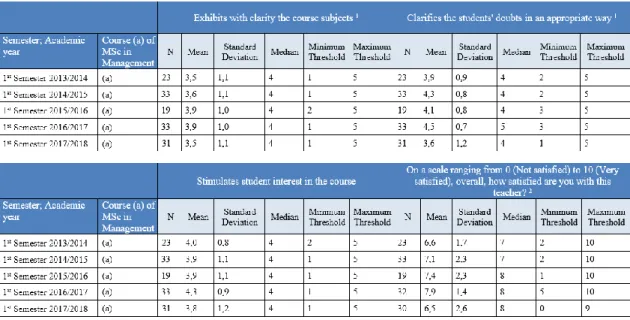
Table 3a gives as an overview of the mean scores of variables of effectiveness of teaching.
Table 3a – Descriptive statistics of the module questions, per year group
1 Answer Scale: 1 | "Never or almost never (that is, in no class)"; 2 | "Rarely"; 3 | "Sometimes"; 4 | "Often"; 5 | "Always or almost always (that is, in
almost every class)".
2 Answer Scale: 0 | "Not at all satisfied"; 5 | "Moderately satisfied"; 10 | "Very satisfied".
The variables that the students’ opinion regarding a lecturer’s relevance of assignments, assessment of insight, relevance of the course and the relevance of the course to a career after the MSc all carry the expected positive sign and are statistically significant. The average mean on the course is 4.41 (Table 3b) on the 5-point Likert-scale and this indicates that respondents agreed that the lecturer uses all the proper methods in lecturing.
Table 3b – The module questions in raking order.
Ranking Variables Average
Mean Std
1 Clarifies students' doubts in an appropriate way 4.1 0.8 2 Stimulates student interest in the course 4.0 1.0 3 Exhibits with clarity the course subjects 3.6 1.1 4 Satisfaction with the teacher 7 (out of 10) 2.0
For each item analysis, most of the respondents revealed that the presentation of the module is just right. The respondents gave a clear indication with each question that they were satisfied that effective learning took place. Table 3b gives an overview of the module
8
questions in ranking order. The item “Clarifies the students' doubts in an appropriate way” has the highest average mean and the question “Exhibits with clarity the course subjects” has the lowest average mean on the 5-point Likert-scale. All the questions carry the expected positive sign and are statistically significant. The comments and suggestions about the lecturer can be divided into three main categories, as follows:
(i) Knowledge. If teacher: is well-prepared for contact sessions; displays a good general expertise of the subject; manages to guide the student towards understanding difficult concepts; applies a variety of educational methods effectively.
(ii) Personality. If teacher: encourages/promote learner participation during learning opportunities; displays enthusiasm for the subject and learning material; displays a sensitivity towards, and a competency in language of instruction; communicates clearly (orally, through writing and electronically).
(iii) Attitude in general. If teacher: provides feedback on tasks, reports, assignments, tests, etc. within reasonable time; is accessible to learners to time and conduct; displays punctuality to appointments/tutorials; organises the learning environment effectively.
In spite of the existence of precise instructions, just less than half of the students presented suggestions and comments in the question. An analysis of the content of both requests, reveals a lack of homogeneous structure and great variations in quality. Half of the comments and suggestions were vague in content or very brief and must therefore be regarded as inadequate. Others have some particularly marked criticisms censuring the teacher utterly mainly due to: (i) focus on concepts that are not relevant, beyond the current course; (ii) assign relatively difficult problems in homework and class, and (iii) do not circumscribe what students should study to prepare for their exams. In opposition, there are appointments with an approach constructive/relevant. Further comments address for the teacher’s high-quality, specialist expertise and also the enthusiasm and willingness demonstrated to convey knowledge about the course in all classes.
Discussion
Under a system of anonymous evaluations, students need take no responsibility for their opinions. With no possibility for follow-up, students need not think through their decision. They do not have to carefully consider all facts, in order to come to a valid and justifiable conclusion, supported by facts. An evaluation could be based solely on latent anger resulting from a recent grade received on an exam, or from a single negative in-class experience with a teacher over the course of an entire semester (Abrami and Mizener, 1983). Because student evaluations of teaching effectiveness are an important and widely used tool used in the evaluation and reward systems for faculty members in higher education, it is necessary to discuss and analyse the ethical problems that may arise as a result of the conflict created by expectations of student’s performance and effective results (Neal and Elliot, 2009). Nevertheless, it should be noted that “ethical behaviour” and “intentional behaviour” constitute two different scopes (Almeida and Silva, 2016): individuals could make both intentional and unintentional ethical and unethical choices (Tenbrunsel and Smith-Crowe, 2008). Studies on ethical fading (Tenbrunsel and Messick, 2004, p. 224) asserts that ‘individuals do not ‘‘see’’ the moral components of an ethical decision, not because they are morally uneducated, but because psychological processes fade the ‘‘ethics’’ from an ethical situation’.
Another potential problem is lack of ability to follow up on the results. No details can be gathered as to why an evaluation was very positive or very negative
(Kornell.and.Hausman, 2016). Do all students with low grades give low evaluations?
While a question may be asked concerning the students expected grades, there is no way to ensure that students' reports are accurate (Marsh, 2007). Do students with poor
9
attendance records give low evaluations to a teacher they may have only rarely had contact with in class? There is absolutely no way to determine the relationship between class attendance and student evaluations of teachers. Opponents of large-scale use of student evaluations claim, that they measure teacher’s popularity (comparable to the TV ratings) (Davidovitch and Soen, 2006), rather than of the quality of instruction. Furthermore, they argue that students lack the ability or judgment to properly evaluate their teachers, or the level and content of their courses (Wilson, 1998). Thus "… the critical question, of course, is whether students are equipped to judge teaching quality. Are college students competent to grade their teachers? Are students who are doing poorly in their courses able to objectively judge their teachers? And are students, who are almost universally considered as lacking in critical thinking skills, able to critically evaluate their teachers? There is substantial evidence that they are not" (Sproule, 2000, 31). These critics do not reject the use of student evaluations per se. They reject indiscriminate use of these evaluations as valid evidence of the quality of instruction or the effectiveness of the teacher. They insist that student evaluations should be used primarily, if not exclusively, to assist college teachers in ongoing programs of self-improvement (Marsh and Roche, 1993; Morgan et al., 2003; Tagomori and Bishop, 1995). This reasoning is consistent with early explanations of concerns that where raised with student evaluations, as described by Feldman (1979) and Blunt (1991). Both report that students tend to give somewhat higher ratings when they identify themselves compared to those when they remain anonymous. Yet, Feldman (1979) states there are other circumstances which may interact with anonymity, such as whether the ratings are given before or after the students know their grades, whether the ratings are done in "special experimental sessions", whether the students are told that the ratings will be used for research purposes only, and whether the students believe that there is a possibility of a 'confrontation' with the teacher (Abrami et al. 1982). Blunt (1991) also expresses concern as to whether or not students feel that they can trust faculty and administration assurances of anonymity and confidentiality. Other authors (Scherer et al, 2013) recommend that student raters remain anonymous.
Student evaluations are a result of survey data. The structure of the collection process, involving emotional arousal and anonymity in a group situation, may induce a state of deindividuation, which allows students to write cruel remarks and morally disengage from the consequences of their actions (Lindahl and Unger, 2010). Such behavior may also reflect more general student attitudes toward their education (Baldwin and Blattner, 2003). While the survey results may give an overview of student feelings concerning a faculty member, they do not provide an in-depth picture of what happened in the classroom. They also do not allow for probing, to determine the factors leading to the evaluation. If it was possible to track evaluations to individual students, in depth interviews could determine reasons for dissatisfaction. This would allow to determine whether the problems were due to weaknesses in the teacher, or in the student, or in both. It would be possible to determine, for example, if there was a correlation between academic preparation of students and evaluation of teachers and to understand if teachers do get lower evaluations from students who are less prepared.
Conclusion
The used inquiring tool suggests that course content, knowledge, personality and attitude of a lecturer play an important role in determining effectiveness of teaching in the MSc course of a Business school (RQ2). However, just an example of a validity check concerning the suitability of the used business student ratings has showed that students with extreme views are more likely to complete a teacher evaluation. In these situations,
10
the “sample” of students surveyed about the professor's performance is skewed, tainting the validity of the findings. The related discussion to explore limitations of current practices provides evidence that some characteristics associated with: (i) the administration of business students’ evaluations, (ii) characteristics of the course itself and, (iii) teacher and students characteristics, may influence student appraisal and teaching ratings, by entailing negative evaluations of teaching, leading to the introduction of bias in the assessment process (RQ3). Moreover, despite feedback from students may help teachers to improve their teaching performance, the use of such ratings for evaluations relating to reward systems in university may be problematic. If students are responding to factors that should be unrelated to teaching quality, such evaluations may be misleading, having negative consequences to teachers careers. Evaluating the teaching performance of faculty members is a critical part of ensuring a high quality education for students. However, given the research showing potential problems with the current method of evaluation, significant changes might need to be made. Student feedback system is a very important tool in assuring quality in higher education. If educational institutions are considered to be service providers then students are the service consumers. Hence their feedback and expectations are very important in total quality management. To make effective use of this tool, the purpose of evaluation should be clearly explained to students before collecting feedback. Transparency should be ensured at all levels. Students must come out of their biased perceptions while evaluating the performance of teachers. However, the feedback collected from only one source should not be the deciding factor in arriving at conclusions. The validity and reliability of feedback tools should be checked from time to time. The authors have concluded that the existing feedback practices need a thorough revision to ensure qualitative education.
Relevance/Contribution and Limitations of the Study
The scope of the study is limited to one class of an MSc in management of the Business School chosen for the study. Sample size is limited to 140 respondents, response of which cannot be a true representative of the universe. Biasness/ignorance of respondents in answering the questionnaire cannot be ignored.
This research has identified a few implications and limitations of student ratings in assessing the teaching performance of business teachers in the domain of operations management. Unlike conventional analysis, some innovative viewpoints are put forward, in order to help the efficacy and fairness of those evaluations. Thus, it is argued for a confidential inquiring instead of anonymous, in order to enable a neutral follow up to investigate and explain the outliers of the assessment process. This will enable the triangulation of purely quantitative evaluation processes with in-depth interviews to improve the research validity. In addition, this procedure would also determine to what, extent rigour and high expectations or, lack of rigour and low expectations, may affect student’s evaluations. Such a system would protect faculty members, who are very demanding in the classroom but skilled teachers. Another suggestion is to revisit former students to know about their opinions after accumulating both work and life experiences. This will enable a longitudinal triangulation of student perceptions and a more reliable assessment.
References